How Much Does Dumpster Rental Cost? A Complete Guide to Small and Roll Off Dumpster Rental Prices So You Can Choose the Right Size for Your Project
Dumpster rentals range from $200 to $ 800 or more, depending on size, location, duration, and type of debris. But here’s what most pricing guides won’t tell you—the sticker price rarely reflects your final bill.
After hauling thousands of loads since 2014, we’ve seen customers get blindsided by overage fees, permit costs, and prohibited item charges that doubled their expected costs. The dumpster sitting in your driveway is only part of the equation.
Here’s what we’ve learned firsthand:
- Most homeowners overestimate the dumpster size they need—and overpay by $150–$300
- “Flat rate” rentals often exclude weight limits, delivery fees, and disposal costs
- A 10-yard dumpster handles more than people expect—typically 3–4 pickup truck loads worth
This guide covers real-world pricing for small residential dumpsters through large roll-off containers, what’s actually included in rental quotes, and how to avoid the hidden costs that catch first-timers off guard. We’ll also break down when full-service junk removal delivers better value than the DIY dumpster route—something we help customers evaluate every day.
Quick Answers
Dumpster Rental Prices
Short answer: Dumpster rentals typically cost $200–$800, depending on size, location, and rental duration.
Average pricing by size:
- 10-yard: $250–$400 (garage cleanouts, small renovations)
- 15-yard: $300–$450 (single-room remodels, estate cleanouts)
- 20-yard: $350–$500 (multi-room projects, roof replacements)
- 30-yard: $400–$650 (major renovations, construction debris)
- 40-yard: $500–$800+ (large demolitions, commercial projects)
What we’ve learned after a decade of hauling: The quoted price rarely tells the full story. Weight overages, prohibited item fees, permit costs, and extended rental charges can push final bills 30–50% higher than expected.
Pro tip: Always ask about weight limits, included tonnage, and restricted materials before booking. Customers who ask detailed questions upfront consistently pay closer to the quoted price.
Top 5 Takeaways
- Base prices range from $200–$800—but that’s rarely the final number. Weight limits, delivery, disposal, and rental duration all affect your total. Ask what’s included before booking.
- Most first-time renters underestimate debris volume. Our recommendation: estimate your needs, then size up one level. The upcharge is almost always cheaper than overages or a second haul.
- Hidden fees add 30–50% to quoted prices. Watch for:
- Weight overages: $40–$100 per ton
- Prohibited items: $25–$100 each
- Extended days: $10–$25 per day
- Permits: $25–$150+
- Sorting materials saves money. Separate clean concrete, metal, and untreated wood from general debris. Lower tipping fees. Less in landfills.
- Cheapest quote ≠ best value. Factor in your time, labor, and likely add-ons. For complex projects, full-service removal often costs less than DIY once you calculate the true total.
Table of contents
- How Much Does Dumpster Rental Cost? A Complete Guide to Small and Roll Off Dumpster Rental Prices So You Can Choose the Right Size for Your Project
- Quick Answers
- Top 5 Takeaways
- Dumpster Rental Costs by Size
- Small Dumpster Rentals (10–15 Yards)
- Roll-Off Dumpster Rentals (20–40 Yards)
- What’s Included in Dumpster Rental Pricing
- Factors That Affect Your Total Cost
- How to Choose the Right Dumpster Size
- Hidden Fees to Watch For
- Dumpster Rental vs. Full-Service Junk Removal
- 7 Essential Resources to Help You Get the Best Value on Your Dumpster Rental
- 1. Protect Yourself from Hazardous Waste Surcharges
- 2. Lower Your Costs by Sorting Construction Materials
- 3. Find Free Drop-Off Options for Restricted Items
- 4. Understand How Regional Landfill Fees Affect Your Price
- 5. Check Permit Requirements Before Scheduling Delivery
- 6. Know What Materials to Keep Out of Your Dumpster
- 7. Estimate Your Debris Volume with Confidence
- Supporting Statistics
- Final Thought & Opinion
- FAQ on “Dumpster Rental Prices”
- Q: How much does it cost to rent a dumpster for a home project?
- Q: Why do dumpster rental prices vary so much between companies?
- Q: What hidden fees should I watch out for with dumpster rentals?
- Q: What size dumpster do I need, and how does size affect price?
- Q: Is it cheaper to rent a dumpster or hire a junk removal service?
- Get the Right Size and Price for Your Project—Without the Guesswork
Dumpster Rental Costs by Size
Dumpster pricing scales with container size, measured in cubic yards. Here’s what you can expect to pay in 2025:
A 10-yard dumpster typically runs $250–$400 and works best for garage cleanouts and small renovations. The 15-yard option costs $300–$450, handling single-room remodels and estate cleanouts comfortably. Mid-range 20-yard containers fall between $350–$500 and suit multi-room projects and roofing jobs well.
For larger projects, 30-yard dumpsters range from $400–$650 and accommodate major renovations and construction debris. The largest standard option—a 40-yard container—runs $500–$800+ and serves large demolitions and commercial projects.
These ranges reflect base rental rates. Your actual cost depends on location, rental duration, debris type, and weight—factors we’ll break down below.
Small Dumpster Rentals (10–15 Yards)
Small dumpsters work well for residential projects where you’re handling the loading yourself. A 10-yard container measures roughly 12 feet long, 8 feet wide, and 4 feet high—equivalent to about 3–4 pickup truck loads.
In our experience, 10-yard dumpsters suit most garage cleanouts, attic purges, and single-room renovations. We’ve found that homeowners often rent larger than necessary because they’re unsure how much space they actually need.
A 10-yard dumpster typically fits the contents of a single-car garage cleanout, flooring and carpet from 1–2 rooms, small bathroom or kitchen demo debris, or furniture from a studio or one-bedroom apartment.
The 15-yard option adds about a foot of height and handles slightly larger projects—think whole-house decluttering or small estate cleanouts.
Roll-Off Dumpster Rentals (20–40 Yards)
Roll-off dumpsters are the workhorses for renovations, construction projects, and large-scale cleanouts. These open-top containers get delivered on specialized trucks and “roll off” onto your driveway or job site.
20-yard roll-offs are the most commonly rented size. They handle multi-room renovations, roof replacements on average-sized homes, and medium-sized construction projects. At roughly 22 feet long and 4.5 feet high, they fit in most residential driveways.
30- and 40-yard containers serve major renovations, new construction debris, and commercial cleanouts. Before ordering these larger sizes, confirm you have adequate space—a 40-yard dumpster stretches over 22 feet long and stands 8 feet high.
One thing we tell customers: bigger isn’t always better. A half-empty 40-yard dumpster costs significantly more than a properly sized 20-yard dumpster that fits your project.
What’s Included in Dumpster Rental Pricing
Standard dumpster rental quotes typically include delivery, pickup, a set rental period (usually 7–10 days), and disposal up to a specified weight limit.
Most rentals include drop-off and pickup within the service area, a 7–10 day rental window, disposal fees up to the weight limit (often 2–4 tons depending on size), and basic customer support.
However, several items often cost extra: extended rental days ($10–$25 per additional day), weight overages ($40–$100 per additional ton), specific debris types like mattresses, appliances, and electronics, permit fees if placed on public streets, and same-day or expedited delivery.
We’ve seen final bills come in 30–50% higher than the quoted price when customers don’t clarify what’s included upfront. Always ask about weight limits and prohibited items before booking.
Factors That Affect Your Total Cost
Several variables influence what you’ll actually pay.
Location matters. Urban areas with higher disposal fees and limited landfill access typically run 15–25% more than suburban or rural regions. Delivery distance from the rental company also factors into pricing.
Debris type changes everything. General household items cost less to dispose of than concrete, roofing shingles, or mixed construction debris. Heavy materials like dirt, brick, and asphalt often carry weight-based surcharges or require special containers.
Timing impacts availability and price. Spring and summer are peak seasons for renovations and cleanouts. Booking during off-peak months (late fall through early spring) sometimes yields better rates.
Rental duration adds up. Most companies include 7–10 days in their base price. If your project runs longer, daily extension fees accumulate quickly.
How to Choose the Right Dumpster Size
Selecting the right size saves money and headaches. Here’s a practical framework we recommend.
Estimate your volume, then add 20%. Projects almost always generate more debris than expected. That buffer prevents overage fees or needing a second haul.
Consider the weight, not just the space. Heavy materials like concrete, tile, and roofing fill weight limits long before filling the container’s volume. A 10-yard dumpster maxed out with concrete will hit weight limits fast.
Match the container to your project scope. Single-room cleanouts typically need a 10-yard container. Whole-house decluttering or small renovations call for 15–20 yards. Major renovations or roof replacements fit well in 20–30 yard dumpsters. New construction or large demolition projects require 30–40 yard containers.
When customers call us unsure about sizing, we ask what they’re removing and where it’s located. Those two details usually point to the right answer.
Hidden Fees to Watch For
Dumpster rentals come with potential add-on costs that aren’t always disclosed upfront.
Overage charges apply when your load exceeds the weight limit. At $40–$100 per extra ton, a heavy load can add $200+ to your bill unexpectedly.
Prohibited item fees get charged when restricted materials end up in the container. Mattresses, appliances with refrigerants, electronics, tires, and hazardous materials typically require separate disposal and separate charges.
Permit costs apply in many municipalities when dumpsters sit on public streets rather than private property. Fees range from $25 to $150+, depending on your location.
Dry run fees get charged if the delivery truck arrives and can’t place the container due to access issues, vehicles blocking the spot, or other obstacles.
Trip charges may apply for deliveries outside the company’s standard service radius.
Ask specifically about each of these before confirming your rental. Reputable companies disclose all potential fees upfront.
Dumpster Rental vs. Full-Service Junk Removal
Renting a dumpster makes sense when you have time to load it yourself, a clear spot for placement, and a straightforward project with predictable debris.
Full-service junk removal often delivers better value when you’re short on time or physical ability to load heavy items, when the project involves stairs, tight spaces, or difficult access, when you’re dealing with mixed materials including items dumpsters won’t accept, when you need same-day or next-day service, or when you’d rather avoid permit hassles for street placement.
With full-service removal, the crew handles all lifting, loading, hauling, and responsible disposal—including sorting donations and recyclables. You point to what goes, and the rest is handled for you.
In our experience, customers clearing estates, managing hoarding situations, or juggling renovation timelines often find full-service more cost-effective than expected once they factor in their time, physical effort, and potential dumpster overages.
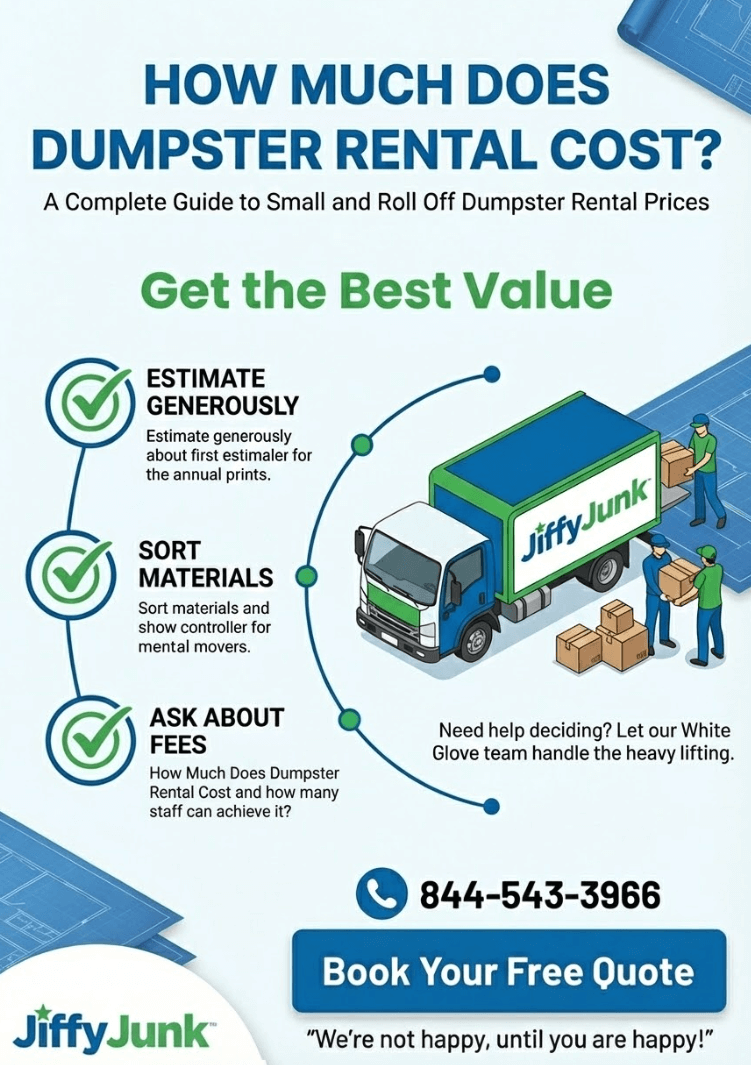
“After handling thousands of cleanout projects since 2014, we’ve found that the rental price on a dumpster quote rarely tells the full story—it’s the weight overages, extended rental days, and prohibited item fees that catch people off guard. The customers who save the most are the ones who ask detailed questions upfront and right-size their container based on what they’re actually removing, not just how much space they think they need.”
— Jiffy Junk Operations Team
7 Essential Resources to Help You Get the Best Value on Your Dumpster Rental
We want every customer to feel confident before booking. These trusted resources help you understand local regulations, sidestep surprise fees, and find eco-friendly disposal options for materials that require special handling.
1. Protect Yourself from Hazardous Waste Surcharges
Certain household items—paints, batteries, cleaners, and some electronics—require special disposal and can add $50 to $500 in unexpected charges if they end up in a standard dumpster. The EPA’s Household Hazardous Waste guide helps you identify these materials and locate proper disposal options near you. We recommend reviewing this before your cleanout so you know exactly what needs separate handling.
Source: U.S. Environmental Protection Agency URL: https://www.epa.gov/hw/household-hazardous-waste-hhw
2. Lower Your Costs by Sorting Construction Materials
Here’s one thing we’ve learned from thousands of renovation projects that we want to share with you: Taking management of recyclable materials – concrete, metal, clean lumber – apart from the general debris will save you a lot of money in the disposal costs. The EPA’s construction and demolition guide takes you through the process of sorting practices and recycling requirements to help you save money and take reusable materials out of the landfill.
Source: U.S. Environmental Protection Agency URL: https://www.epa.gov/smm/sustainable-management-construction-and-demolition-materials
3. Find Free Drop-Off Options for Restricted Items
Electronics, appliances, tires, and hazardous materials can often be disposed of free of charge and/or at low cost by local community programs. Earth911 has one of North America’s most complete recycling databases, 350+ Materials, 100k+ Locations. A little search by zip code, though, can lead you to some convenient ways in which to keep these pieces out of your dumpster and out of your wallet.
Source: Earth911 URL: https://search.earth911.com/
4. Understand How Regional Landfill Fees Affect Your Price
Landfill tipping fees have been found to range from $28 – $70+ per ton, depending on where you live, and these fees directly account for your dumpster rental quote. The EPA’s resource on landfills takes you through some regional disposal regulations and fee structures, so that you know why the disposal charge differs from place to place. This knowledge should help you to evaluate quotes with more confidence and ask the right questions.
Source: U.S. Environmental Protection Agency URL: https://www.epa.gov/landfills
5. Check Permit Requirements Before Scheduling Delivery
Planning to place your dumpster on the street or public right-of-way? Most municipalities require permits, ranging from $25 to $ 150 or more. Arriving without one can mean delivery delays or additional fees. This resource explains permit requirements by placement type and guides you through the application process—so everything runs smoothly on delivery day.
Source: Dumpsters.com URL: https://www.dumpsters.com/resources/dumpster-permits
6. Know What Materials to Keep Out of Your Dumpster
Placing restricted items in your container can result in rejected loads, return charges, or fines reaching $500. We always encourage customers to review prohibited items before loading begins. This comprehensive guide covers hazardous materials, electronics, appliances with refrigerants, and location-specific restrictions—helping you avoid surprises and dispose of everything responsibly.
Source: Dumpsters.com URL: https://www.dumpsters.com/resources/prohibited-items
7. Estimate Your Debris Volume with Confidence
Choosing the wrong dumpster size costs money either way—too large means overpaying by $150 to $300, while too small triggers overage fees. The EPA’s data on construction and demolition debris helps you calculate realistic volume estimates based on your project type. Pair this with a conversation with our team, and you’ll get the right size the first time.
Supporting Statistics
After more than a decade in the hauling industry, we’ve developed a clear picture of how waste flows through American homes and job sites. These EPA statistics confirm what we see every day—and help explain why so many first-time renters get caught off guard.
1. Renovation Projects Generate Far More Debris Than Most People Expect
One of the most common calls we get starts with: “I thought a 10-yard would be enough.”
The EPA reports that 600 million tons of construction and demolition debris were generated in the United States in 2018. That’s more than double all regular household waste combined.
What we’ve learned from experience:
- A 50-square-foot bathroom gut-job can easily fill a 10-yard container
- Flooring, drywall, cabinets, and fixtures add up faster than you’d expect
- Always add 20% to your initial estimate—most customers wish they had
Source: U.S. Environmental Protection Agency URL: https://www.epa.gov/facts-and-figures-about-materials-waste-and-recycling/construction-and-demolition-debris-material
2. Tear-Out Work Creates the Lion’s Share of Project Waste
Building something new? Materials arrive in neat bundles. Tearing something out? That’s where the real volume comes from.
EPA data confirms that demolition accounts for more than 90 percent of all C&D debris. New construction and renovation combined generate less than 10 percent.
Projects that generate more debris than expected:
- Roof replacements (old shingles are heavy and bulky)
- Kitchen and bathroom gut-outs (layered flooring, plaster, tile)
- Flooring removal (carpet, padding, subfloor, adhesive)
- Siding replacement (old materials plus packaging from new)
The takeaway: If you’re ripping out old materials, plan for significantly more volume than the finished project suggests.
Source: U.S. Environmental Protection Agency URL: https://www.epa.gov/smm/sustainable-management-construction-and-demolition-materials
3. Recycling and Sorting Can Significantly Reduce What You Pay
We’re often asked why we emphasize separating materials. The answer: cost and responsibility.
According to the EPA, 50 percent of municipal solid waste still ends up in landfills—down from 94 percent in 1960. Recycling and composting now divert nearly 94 million tons annually.
How sorting saves you money:
- Landfills charge tipping fees based on weight
- Clean concrete and asphalt often go to recyclers at reduced rates—sometimes free
- Mixed loads with hazardous or prohibited items trigger surcharges
- Customers who spend 15 minutes sorting typically save $50–$200
Materials worth separating:
- Clean concrete, brick, and asphalt
- Scrap metal (appliances, fixtures, rebar)
- Untreated lumber and wood
- Cardboard and packaging
Source: U.S. Environmental Protection Agency URL: https://www.epa.gov/facts-and-figures-about-materials-waste-and-recycling/national-overview-facts-and-figures-materials
The Bottom Line
Three things we tell every customer:
- Estimate generously. Debris volume surprises most first-timers.
- Sort when you can. Fifteen minutes of separation saves real money.
- Ask questions before you book. Our team has seen it all and can help you plan.
The difference between a smooth project and an expensive headache often comes down to understanding how much material you’re actually dealing with—and planning accordingly.
Final Thought & Opinion
After handling thousands of cleanouts, renovations, and debris hauls since 2014, we’ve formed some opinions about dumpster rentals that don’t always make it into the typical pricing guide.
Here’s the truth: Dumpster rentals work well for a specific type of customer and project. But the pricing model has more variables than most people anticipate—and those variables tend to work against first-time renters estimating blind.
What we see far too often:
- The 10-yard wasn’t big enough
- Weight overages added $150–$300 to the bill
- A mattress or appliance triggered a prohibited item fee
- A permit nobody mentioned delayed delivery by days
- The rental period expired before the project finished
None of these mean dumpster rentals are bad. They mean the true cost is harder to predict than the quoted price suggests.
Our perspective, based on experience:
- Dumpster rentals favor experienced users. Contractors who rent regularly know what size they need and what to keep out. First-time renters rarely have that context.
- The “cheapest” option often isn’t. A $299 rental that becomes $550 after fees costs more than a full-service removal that includes everything upfront.
- Time has real value. Loading a dumpster yourself takes hours—sometimes an entire weekend. Your labor cost often exceeds what you’d pay a crew.
- Hidden complexity favors the rental company. Weight limits, prohibited items, permits, and extensions aren’t flaws—they’re profit centers.
When a dumpster rental makes sense:
- You’re a contractor managing a predictable job site
- You’re a property manager with routine turnover debris
- Your project involves a single material type (roof tear-off, concrete removal)
- You have the time, ability, and space to load it yourself
When full-service removal often delivers better value:
- Estate cleanouts with mixed items
- Hoarding situations require sensitivity and speed
- Projects involving stairs, tight spaces, or heavy lifting
- Time-sensitive jobs where weekends aren’t available
- Mixed debris, including items that dumpsters won’t accept
The bottom line:
The $200–$800 range you see everywhere is real. So are the overages, fees, and surprises that push final bills 30–50% higher.
Our advice:
- Do the math on your actual project—not the best-case scenario
- Factor in your time and the complexity of loading
- Account for the likelihood of surprises
- Ask detailed questions before booking anything
Sometimes a dumpster is the right call. Sometimes it isn’t. We’re happy to help you figure out which applies to your situation.
That’s what we mean by White Glove Treatment—not just handling the job, but helping you make the right choice in the first place.
FAQ on “Dumpster Rental Prices”
Q: How much does it cost to rent a dumpster for a home project?
A: Most homeowners pay $250–$500 for a standard 7–10 day rental. But that quote is a starting point—not a guarantee.
Typical pricing by size:
- 10-yard: $250–$400
- 20-yard: $350–$500
- 30-yard: $400–$650
- 40-yard: $500–$800+
After thousands of customer conversations, we’ve noticed a clear pattern. Those who paid close to the quoted price asked detailed questions upfront. Those surprised by bills 40% higher assumed everything was included.
The difference isn’t luck—it’s knowing what to ask before you book.
Q: Why do dumpster rental prices vary so much between companies?
A: We get this question constantly. Usually from customers comparing a $279 quote against a $450 one.
The short answer: It’s about what’s included.
- Some companies advertise low base rates, then add delivery, pickup, and disposal separately.
- Others bundle everything into one piece
- Neither approach is wrong—but comparing them without reading the fine print creates confusion
Location matters too. Landfill tipping fees range from $28/ton in rural areas to $70+ in metro markets. That cost passes directly to you.
Three questions that reveal the true price:
- What’s my weight limit?
- What happens if I exceed it?
- What items trigger extra fees?
Q: What hidden fees should I watch out for with dumpster rentals?
A: This is where we hear the most frustration from customers who rented before discovering full-service removal.
Fees that catch people off guard:
- Weight overages: $40–$100 per ton over limit. One customer’s concrete load added $180 unexpectedly.
- Prohibited items: $25–$100 per mattress, appliance, or electronic. Often not disclosed until the invoice.
- Extended rental: $10–$25 per extra day. Projects run long—rental companies know this.
- Permits: $25–$150+ for street placement. Some cities require them even for driveways.
- Dry-run fees: $50–$100 if the truck arrives and can’t deliver.
The reality: These add-ons push final bills 30–50% higher for customers who didn’t ask upfront. Rental companies aren’t hiding anything—but they’re not volunteering information either.
Q: What size dumpster do I need, and how does size affect price?
A: Sizing is where first-time renters make the most expensive mistakes.
We’ve talked to countless homeowners who ordered a 10-yard, filled it halfway through, then paid for a second haul—or crammed everything in and got hit with weight overages.
Size and pricing guide:
- 10-yard ($250–$400): Single-room cleanout, small bathroom reno, garage purge. Holds 3–4 pickup truck loads.
- 20-yard ($350–$500): Multi-room projects, roof tear-offs, medium renovations. Most popular residential size.
- 30-yard ($400–$650): Major renovations, large estate cleanouts, construction projects.
- 40-yard ($500–$800+): Commercial jobs, new construction, full-property cleanouts.
Our rule of thumb: Estimate your debris, then go one size up.
The upcharge for a larger container is almost always less than:
- Overage fees
- A second rental
- An emergency haul mid-project
After a decade of seeing this play out, we’d rather customers have extra room than scramble at the end.
Q: Is it cheaper to rent a dumpster or hire a junk removal service?
A: This is the question behind almost every call we receive. The honest answer: it depends.
On paper, dumpster rentals look cheaper. A $300 rental beats a $500 removal quote. But that math changes once you factor in reality.
What the rental doesn’t include:
- Your labor loading it (often an entire weekend)
- Overage risk if you misjudge weight or size
- Fees for prohibited items you didn’t know about
- Permits for street placement
We’ve met customers whose “cheap” $300 rental became $600 after extras—more than full-service would have cost.
Dumpster rental makes sense when:
- You have the time and ability to load it yourself
- Debris is straightforward (single material, no prohibited items)
- You can estimate volume and weight accurately
- You have a clear, accessible placement space
Full-service removal often delivers better value when:
- Your project involves stairs, tight spaces, or heavy items
- You’re dealing with mixed materials or restricted items
- Time matters more than saving a few dollars
- You want the final price locked in before work begins
The bottom line: Neither option is universally better. Get quotes for both and compare total cost—not just the advertised number.
Get the Right Size and Price for Your Project—Without the Guesswork
Whether you’re comparing dumpster rental costs or considering full-service removal, our team can help you choose the best option for your specific project and budget. Call us at 844-543-3966 or book online for a free, no-obligation quote—and let us handle the heavy lifting from there.