How Much Does Junk Removal and Hauling Cost? Understanding the Average Price Per Hour of Junk Removal Service So You Can Budget for Your Project
Most junk removal jobs run $150–$700, though hourly rates ($100–$200/hour) rarely tell the full story. At Jiffy Junk, we price by volume—not time—because after thousands of jobs since 2014, we’ve found it’s the only way to give customers real cost certainty.
Here’s what we’ve learned hauling junk across the country: the “hourly rate” question is actually the wrong question. Customers who focus on hourly pricing often end up surprised by their final bill. Why? Because a two-person crew working quickly costs the same as a slower crew taking twice as long, but only one leaves you frustrated.
We’ve moved away from hourly pricing entirely because we saw firsthand how it creates misaligned incentives. Volume-based pricing means our crews work efficiently without you watching the clock.
In this guide, we’re sharing the pricing insights we’ve gathered from over a decade in the industry—including what drives costs up, where you can save money, and the red flags that signal hidden fees. Whether you’re clearing a single room or an entire estate, you’ll walk away knowing exactly what to expect and how to budget with confidence.
Quick Answers
Junk Removal Cost
Short answer: Most junk removal jobs cost between $150 and $700, with the national average around $250.
After a decade of hauling, here’s what we consistently see:
Single item removal, like a mattress, couch, or appliance, typically runs $75–$200. Quarter truckload jobs—common for small garage cleanouts—average $200–$300. Half truckload projects covering a garage or basement fall between $300–$450. Full truckload cleanouts for estates or major renovations range from $450–$800 or more.
Key factors that affect your price:
- Volume: How much truck space your items occupy
- Weight: Heavy materials like concrete cost more to dispose of
- Location: Disposal fees range from $45–$85+ per ton by region
- Accessibility: Stairs and long carry distances increase labor costs
What we’ve learned: Most reputable companies price by volume, not by the hour. Volume-based pricing protects you from surprises—the quote you receive upfront is the price you pay.
Top 5 Takeaways
- Most junk removal jobs cost $150–$700.
- Single item: $75–$200
- Quarter truckload: $200–$300
- Full truckload: $450–$800+
- National average: ~$250
- Volume-based pricing beats hourly rates.
- Pay for truck space, not time on the clock
- No watching the meter
- No surprise charges at the end
- Four factors drive your final price.
- Volume: How much space your items take
- Weight: Heavy materials cost more
- Location: Disposal fees range from $45 to $85+ per ton
- Accessibility: Stairs and distance add labor
- The cheapest quote is rarely the best value.
- Watch for hidden stair fees
- Ask if disposal is included
- Confirm no “environmental” surcharges
- Get the full price in writing
- Donating items saves money and does good.
- Usable goods can go to charity
- Less landfill volume can lower your costs
- You may qualify for a tax deduction
Table of contents
- How Much Does Junk Removal and Hauling Cost? Understanding the Average Price Per Hour of Junk Removal Service So You Can Budget for Your Project
- Quick Answers
- Top 5 Takeaways
- How Junk Removal Pricing Actually Works
- Average Junk Removal Costs by Job Size
- Factors That Drive Your Final Price
- Why Hourly Rates Can Be Misleading
- How to Get an Accurate Quote
- Red Flags to Watch For
- Budgeting Tips for Your Project
- Helpful Resources to Make Your Junk Removal Project a Breeze
- 1. Check a Company’s Reputation Before You Book
- 2. Know the Warning Signs of Junk Removal Scams
- 3. Understand What Counts as Hazardous Material
- 4. Find Recycling and Disposal Options Near You
- 5. Donate Furniture and Appliances Instead of Disposing
- 6. Give Building Materials a Second Life
- 7. Maximize Your Tax Deduction for Donated Items
- The Numbers Behind What You Pay for Junk Removal
- Final Thought & Opinion
- FAQ on “Junk Removal Cost”
- Get Your Free, No-Obligation Quote from Jiffy Junk
How Junk Removal Pricing Actually Works
The junk removal industry has largely shifted away from hourly pricing—and for good reason. Most professional companies now charge based on how much space your items occupy in the truck, not how long the job takes.
At Jiffy Junk, we use volume-based pricing because it protects you from unpredictable costs. A quarter truckload costs the same whether it takes 20 minutes or an hour to load. You’re paying for results, not time.
That said, some companies still advertise hourly rates to appear more affordable upfront. The problem? Those rates rarely include the full picture—loading time, drive time, disposal fees, and minimum charges can quickly inflate your final bill.
Average Junk Removal Costs by Job Size
Based on our experience across thousands of jobs nationwide, here’s what most customers can expect to pay:
Single item removal (mattress, couch, appliance): $75–$200. Pricing depends on the item’s size, weight, and disposal requirements. Refrigerators and other appliances containing refrigerants typically cost more due to EPA-mandated handling procedures.
Partial truck load (small garage cleanout, a few rooms of furniture): $200–$450. This covers most residential jobs we complete. You’re looking at roughly 25–50% of truck capacity.
Full truck load (estate cleanouts, major renovations, whole-home clearing): $450–$800+. Larger projects sometimes require multiple trips, which affects the total cost.
Minimum charges typically range from $75–$150 regardless of job size. This covers the operational costs of dispatching a crew and truck to your location.
Factors That Drive Your Final Price
We’ve identified the key variables that move pricing up or down on virtually every job.
Volume and weight matter most. A truck full of cardboard boxes costs less to haul and dispose of than the same volume of concrete or construction debris. Heavy materials increase disposal fees at transfer stations and landfills.
Location and accessibility affect labor time. A ground-floor cleanout goes faster than hauling items down three flights of stairs or across a large property. We don’t charge hourly, but difficult access does require more crew effort.
Item type and disposal requirements can add costs. Electronics, appliances with refrigerants, mattresses, and hazardous materials often carry special handling or recycling fees mandated by local regulations. We factor these into your quote upfront rather than surprising you later.
The geographic market influences baseline pricing. Junk removal in New York City or San Francisco costs more than in smaller markets due to higher labor costs, disposal fees, and operational expenses.
Why Hourly Rates Can Be Misleading
When a company quotes $100/hour, that number often excludes critical cost components. In our experience, hourly quotes frequently leave out disposal and dump fees (often $50–$150+ per load), travel time to and from your location, minimum charge requirements, and additional labor for heavy or difficult items.
A job quoted at “$100/hour” can easily become $300–$400 once these extras are added. Volume-based pricing eliminates this guesswork by rolling everything into one transparent quote.
We’ve also seen how hourly pricing creates awkward dynamics. Customers feel pressured to help load items or rush the crew, which can lead to property damage or injuries. When you’re not watching the clock, everyone can focus on doing the job right.
How to Get an Accurate Quote
The most reliable way to budget for junk removal is to get an on-site estimate or provide detailed photos of everything you need removed. Here’s what helps us give you the most accurate quote:
Show everything that needs to go. Hidden items in closets, attics, or sheds can significantly change the scope. We’d rather see it all upfront than adjust the price mid-job.
Mention accessibility challenges. Stairs, narrow hallways, long carry distances, and parking limitations all affect the work involved. Letting us know ahead of time ensures your quote reflects the actual job.
Ask about included services. Our White Glove Treatment means we handle all the loading, hauling, and cleanup—you don’t lift a finger. Some companies charge extra for services that we include in the standard.
Confirm disposal is included. Your quote should cover hauling your items to the appropriate facility, whether that’s a recycling center, donation partner, or landfill. If disposal fees are “extra,” ask for a realistic estimate.
Red Flags to Watch For
After more than a decade in this industry, we’ve seen the tactics that lead to customer frustration. Be cautious of companies that won’t provide any estimate without an on-site visit for small jobs, quote suspiciously low prices over the phone, then inflate them on arrival, charge hourly but won’t estimate total time, add “environmental fees” or “fuel surcharges” after quoting, or pressure you to decide immediately without a written quote.
Reputable junk removal companies are transparent about pricing because they want your business long-term—not just one surprise-inflated job.
Budgeting Tips for Your Project
If you’re planning a cleanout and want to manage costs effectively, we recommend these approaches based on what’s worked for our customers.
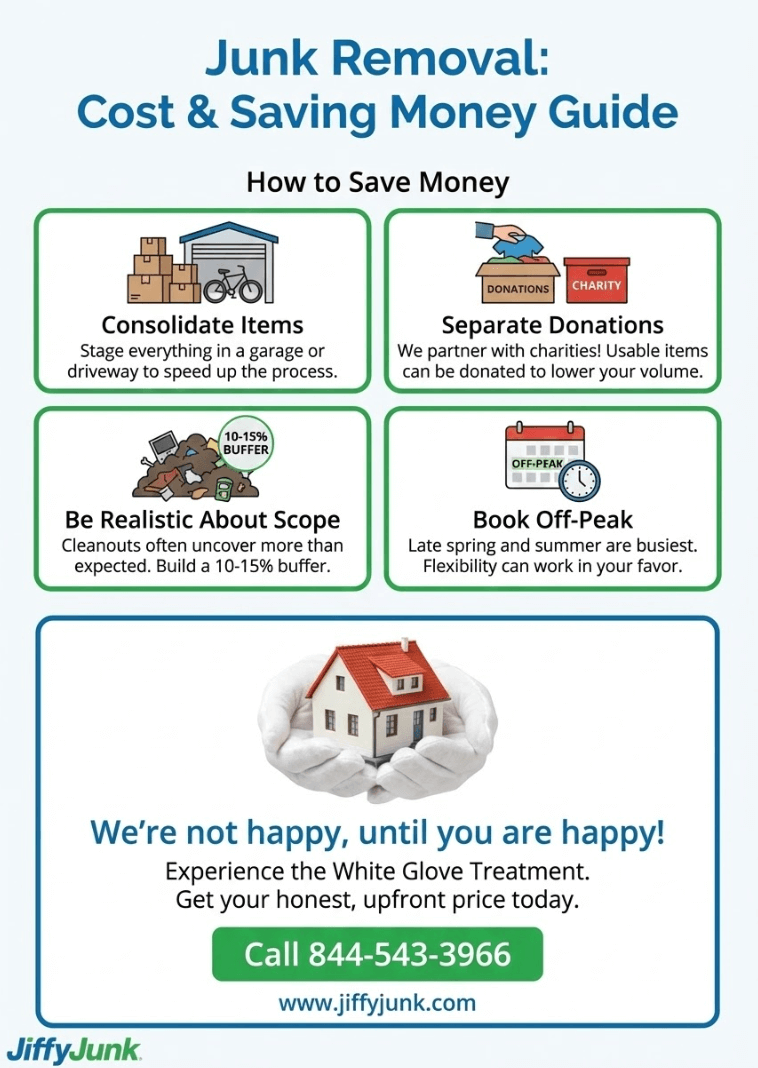
Consolidate items in one accessible area. When everything is staged in a garage or driveway, the job moves faster. While we don’t charge hourly, efficiency benefits everyone and ensures the smoothest possible experience.
Separate donations from disposal items. If you have items in good condition, let us know. We partner with local charities and can often donate items instead of sending them to the landfill. This aligns with our commitment to eco-friendly disposal and sometimes reduces overall volume.
Be realistic about scope. Cleanout projects often uncover more items than expected, especially in basements, attics, and storage areas. Building a small buffer into your budget—around 10–15%—helps you avoid stress if the job grows slightly.
Book during off-peak times when possible. Late spring and summer are our busiest seasons due to moving and renovation projects. Scheduling flexibility can sometimes work in your favor.
“After hauling thousands of loads since 2014, we’ve found that customers don’t actually want the lowest price—they want the honest price. The companies that quote low and charge high give our whole industry a bad name, which is why we show you exactly what you’ll pay before we lift a single item.” – Jiffy Junk Team
Helpful Resources to Make Your Junk Removal Project a Breeze
We believe informed customers are happy customers. Before you book any junk removal service—including ours—these trusted resources help you verify companies, understand your options, and even save money by donating items in good condition.
1. Check a Company’s Reputation Before You Book
Better Business Bureau (BBB) Business Directory
A few minutes of research can save you hours of frustration. The BBB lets you review ratings, read verified customer feedback, and see how companies handle concerns. Look for businesses that respond professionally to customers—it says a lot about how they’ll treat you.
Resource: https://www.bbb.org/search
2. Know the Warning Signs of Junk Removal Scams
FTC Consumer Advice: Hiring a Contractor
Unfortunately, not every company operates with integrity. The FTC’s guide walks you through red flags like pressure tactics, cash-only demands, and quotes that seem too good to be true. We recommend this resource because transparency matters—and you deserve to know what honest service looks like.
Resource: https://www.consumer.ftc.gov/articles/0242-hiring-contractor
3. Understand What Counts as Hazardous Material
EPA Household Hazardous Waste Guide
Items like old paint, batteries, cleaners, and pesticides require special handling, which can affect your final cost. The EPA explains what qualifies and how to dispose of these materials safely. Knowing ahead of time helps you plan your project and avoid surprises.
Resource: https://www.epa.gov/hw/household-hazardous-waste-hhw
4. Find Recycling and Disposal Options Near You
Earth911 Recycling Locator
At Jiffy Junk, we’re committed to recycling and donating items whenever possible. If you’d like to handle some materials yourself, Earth911 helps you locate recycling centers, hazardous waste drop-offs, and specialty disposal sites in your community. It’s a great tool for eco-conscious customers.
Resource: https://search.earth911.com/
5. Donate Furniture and Appliances Instead of Disposing
The Salvation Army Donation Pickup
Many items that feel like clutter to you could transform someone else’s home. The Salvation Army offers free pickup for furniture, working appliances, and household goods in good condition. Donating keeps usable items out of landfills and may qualify you for a tax deduction—a win all around.
Resource: https://satruck.org/
6. Give Building Materials a Second Life
Habitat for Humanity ReStore
Renovating or clearing out a property? ReStore accepts furniture, appliances, cabinets, and leftover building materials. Most locations provide free pickup for larger donations, and every item sold helps fund affordable housing in your community. It’s one of our favorite ways to recommend customers reclaim space while doing good.
Resource: https://www.habitat.org/restores/donate-goods
7. Maximize Your Tax Deduction for Donated Items
IRS Publication 561: Determining the Value of Donated Property
If you’re donating items to charity, you’ll want to document everything properly. This IRS guide explains how to value furniture, appliances, and household goods for tax purposes. Taking a few extra minutes now can pay off when you file your return.
Resource: https://www.irs.gov/publications/p561
The Numbers Behind What You Pay for Junk Removal
After a decade of hauling items across the country, we’ve developed a clear understanding of why junk removal costs what it does. These statistics from authoritative sources confirm what we see every day on the job.
292.4 Million Tons of Household Waste Generated Annually
Americans produce nearly 300 million tons of municipal solid waste each year. That breaks down to 4.9 pounds per person, per day.
Where it goes:
- 50% ends up in landfills
- 32.1% is recycled or composted
- The remainder is combusted for energy recovery
What we see on the ground:
- Transfer stations are busier than ever
- Wait times have increased in many markets
- Disposal fees continue to rise with demand
This is why we’ve invested in relationships with recycling partners and donation centers. Diverting items from landfills benefits the environment—and often keeps your costs more manageable.
Source: U.S. Environmental Protection Agency https://www.epa.gov/facts-and-figures-about-materials-waste-and-recycling/national-overview-facts-and-figures-materials
600 Million Tons of Construction & Demolition Debris Each Year
Renovation and demolition projects generate more than twice the waste of regular household trash. The good news: 76% of this debris gets recycled or reused rather than landfilled.
What we’ve learned on renovation cleanouts:
- Sorted loads cost less. Separating concrete from wood, metal from drywall, often means better pricing because processing is simpler.
- Most homeowners underestimate volume. A single bathroom remodel can fill a quarter truck. A kitchen gut often requires a full load or more.
- Surprises are common. We recommend building a 10–15% buffer into your cleanout budget. Once demolition starts, hidden debris often appears.
That 76% recycling rate doesn’t happen by accident—it requires planning and proper separation.
Source: U.S. Environmental Protection Agency https://www.epa.gov/facts-and-figures-about-materials-waste-and-recycling/construction-and-demolition-debris-material
$62.28 Average Landfill Tipping Fee Per Ton
Landfill disposal costs hit $62.28 per ton in 2024—a 10% jump from the previous year. This marks the largest single-year increase since 2022.
Regional breakdown:
- Northeast: Over $80 per ton (highest in the country)
- Pacific: Approximately $73 per ton
- South Central: Under $45 per ton (lowest rates)
Why does this affect your quote:
Tipping fees are one of our highest operating costs. We’ve watched them climb steadily since we started in 2014.
- Junk removal costs more in New York than in Texas, largely because disposal fees are nearly double
- Every item we donate or recycle is one less item we pay landfill fees to dispose of
- These savings allow us to keep pricing competitive while diverting usable items from the waste stream.
Source: Environmental Research & Education Foundation (EREF) https://erefdn.org/analyzing-municipal-solid-waste-landfill-tipping-fees/
Final Thought & Opinion
Our Take: What Actually Matters When Budgeting for Junk Removal
After hauling thousands of loads since 2014, we’ve formed strong opinions about pricing in this industry.
Here’s the truth: Hourly rates are mostly a distraction.
We stopped quoting by the hour years ago. We saw how it created unnecessary stress—customers rushing to “help,” watching the clock, and still ending up surprised by the final bill.
Volume-based pricing solved that problem. You know what you’re paying before we lift a single item.
The real factors that determine your cost:
- How much space do your items occupy in the truck
- What those items are made of (heavy materials cost more to dispose of)
- Where you’re located (disposal fees vary dramatically by region)
- How accessible the items are (ground floor versus third-floor walkup)
Everything else is noise.
What We Wish More Customers Knew
If there’s one insight from a decade in this business, the cheapest quote is rarely the best value.
We’ve heard countless stories from customers who hired low-ball competitors and faced:
- Surprise fees added on-site
- Damaged property during removal
- Items left behind because they “weren’t included.”
- Unlicensed operators who dumped materials illegally
What a reputable junk removal company will do:
- Provide an upfront quote covering labor, hauling, and disposal
- Show proof of licensing and insurance without hesitation
- Explain exactly what happens to your items after pickup
- Arrive when scheduled and communicate proactively
Companies cutting corners on price are usually cutting corners elsewhere, too.
The Bigger Picture
Junk removal should be simple.
You have items you no longer need. We have trucks, crews, and the know-how to make them disappear responsibly. The transaction shouldn’t require a degree in waste management to understand.
What you’re paying for with Jiffy Junk:
- Professional service with no surprises
- Items handled with care from your home to their final destination
- Commitment to recycling and donating whenever possible
- Our White Glove Treatment on every job
At the end of the day, junk removal is about reclaiming your space. You deserve a partner who respects your time, your property, and your budget.
We’re not happy until you are.
That’s not just a tagline. It’s how we’ve built this company from a local Long Island operation into a nationwide service—and the standard we hold ourselves to on every single job.
FAQ on “Junk Removal Cost”
Q: How much does junk removal cost on average?
A: Most jobs fall between $150 and $700. After thousands of jobs, here’s what we typically see:
- Single item (sofa, hot tub, appliance): $75–$200
- Quarter truckload (garage cleanout): $200–$300
- Half truckload (multiple rooms): $300–$450
- Full truckload (estate cleanout, major renovation): $450–$800+
What factor do customers underestimate most? Location.
We pay nearly double the disposal fees in New York compared to Southern markets. That difference shows up in every quote. When pricing varies by region, tipping fees are usually the reason.
Q: Is it cheaper to rent a dumpster or hire a junk removal service?
A: It depends on your project and what your time is worth. We get this question constantly.
Dumpster rental makes sense when:
- You have a multi-week renovation project
- You can load debris yourself over time
- You’re comfortable with heavy lifting
- Cost: $300–$600 per week
Full-service junk removal makes sense when:
- You need everything gone the same day
- You have heavy or bulky items
- You have physical limitations
- You’re working under time pressure
What we’ve observed: Customers often underestimate how long loading takes. We’ve been called many times to finish jobs that started as DIY dumpster projects.
For one-time cleanouts and time-sensitive moves, professional removal almost always wins when you factor in the true cost of your time.
Q: Why do junk removal prices vary so much between companies?
A: After a decade in this industry, we’ve seen the full spectrum. Price differences come down to three things:
1. Disposal costs vary by region.
- Northeast: Over $80 per ton
- South Central: Under $45 per ton
- A company in Boston has fundamentally different costs from one in Dallas
2. Service levels aren’t equal.
- Licensing and insurance cost money.
- Trained, uniformed crews cost money.
- Well-maintained trucks cost money
- When a quote seems too good to be true, something is being cut
3. Quoting practices differ.
- Some companies quote low, then add fees on-site
- Others include everything upfront
- The lowest quote often becomes the most expensive job
Our advice: Always ask what’s included before comparing numbers.
Q: Are there hidden fees I should watch out for?
A: Unfortunately, yes. Hidden fees are one of the biggest complaints we hear from customers who tried other companies first.
Common surprise charges to watch for:
- Minimum charges not disclosed until the crew arrives ($75–$150 is standard—but should be stated upfront)
- Stair fees or “difficult access” surcharges are quoted on-site after you’ve committed
- Disposal fees are listed separately from labor to make the initial quote look lower
- Fuel surcharges or vague “environmental fees” are added to the final invoice
- Weight overages for heavy items like concrete or refrigerators
How to protect yourself:
- Ask for an all-inclusive quote in writing
- Confirm what happens if the job is larger than expected
- Request proof of licensing and insurance
- Read reviews mentioning pricing accuracy
Our policy: The quote we give before we start is the price you pay when we finish. No exceptions.
Q: How can I reduce my junk removal costs?
A: Over the years, we’ve noticed clear patterns in what helps customers save. These tips come directly from what we’ve seen work:
1. Stage everything in one accessible spot. Consolidate items in a garage or driveway. Easier access means a smoother job for everyone.
2. Separate donations from disposal items.
- Working appliances and good furniture can go to charity
- Less landfill volume can mean better pricing
- You may qualify for a tax deduction
3. Sort renovation debris by material.
- Clean concrete, scrap metal, or wood costs less to process
- Mixed construction waste costs more
- A little separation effort saves money
4. Consider timing if flexible.
- Late spring through early fall is peak season
- Off-peak scheduling may offer more availability
5. Get multiple quotes—but compare correctly.
- Ask exactly what’s included.
- The lowest number means nothing if it doubles on-site
One more thing: Donating items in good condition isn’t just cheaper—it’s the right thing to do. Someone gets the furniture they need. Usable goods stay out of landfills. You reclaim your space, knowing those items found a second home.
Get Your Free, No-Obligation Quote from Jiffy Junk
Now that you understand what drives junk removal costs, take the next step and get an upfront quote for your specific project. Call us at 844-543-3966 or book online to experience the transparent pricing and White Glove Treatment that’s made Jiffy Junk a trusted name in junk removal since 2014.