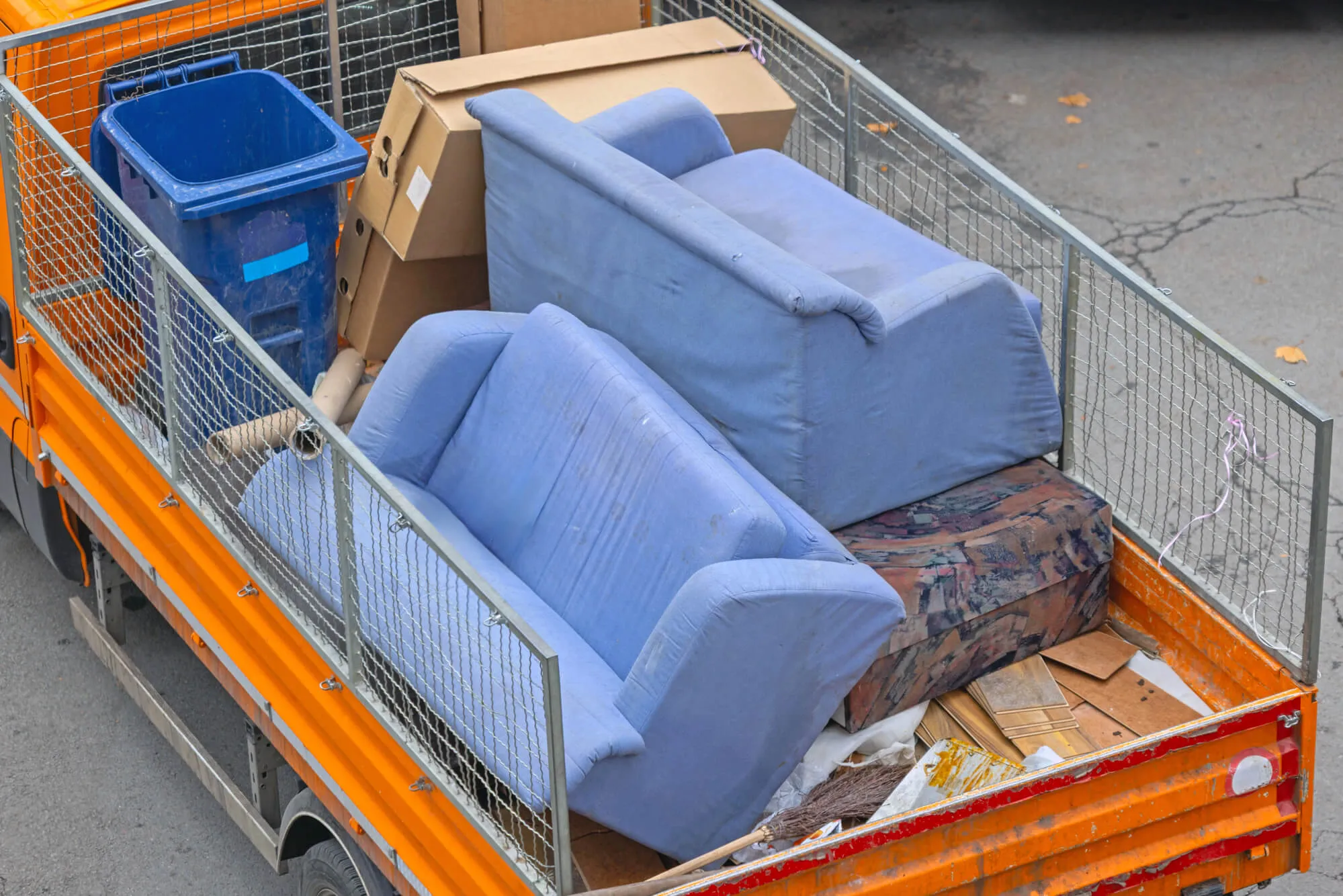
How to Get Rid of and Dispose of Old Furniture: Best Way to Donate, Throw Away, or Remove a Couch Near Me Without the Hassle
That old couch isn’t going to move itself — and after more than a decade of hauling furniture out of homes nationwide, we can tell you that most people underestimate just how tricky disposal can be. City bulk pickup schedules are unreliable, donation centers are increasingly selective about what they’ll accept, and renting a truck for one piece of furniture rarely makes financial sense.
We’ve seen it all at Jiffy Junk — from third-floor sleeper sofas that won’t fit through the stairwell to entire households that need to be cleared in a single day. That hands-on experience has taught us which removal methods actually work, which ones waste your time, and when it’s worth calling in a professional crew. Below, we walk you through every option so you can pick the right one for your situation — and if you’d rather skip the research and let our fully licensed, insured team give you the White Glove Treatment, we’ll do all the heavy lifting while you relax.
TL;DR Quick Answers
How to Get Rid of Old Furniture
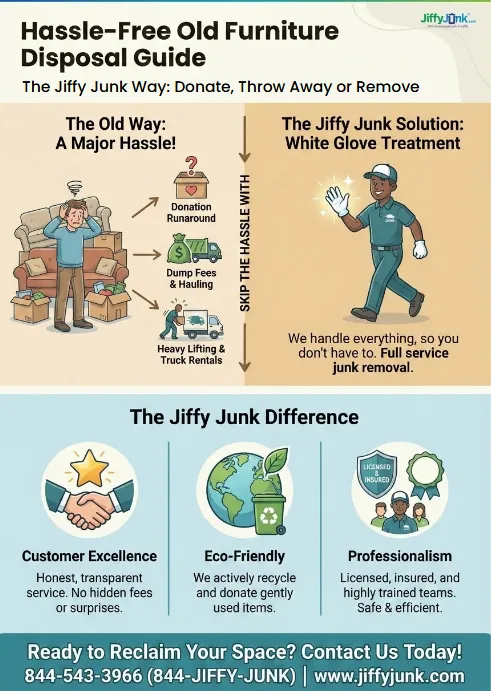
You have five main options for getting rid of old furniture — each with different trade-offs for cost, effort, and environmental impact.
- Donate it — Habitat for Humanity ReStore, and the Salvation Army accept gently used furniture and often offer free pickup. Best for items in good condition.
- Sell or give it away — List on Facebook Marketplace, Craigslist, or Freecycle. Free to post, but requires your time and coordination with a buyer.
- Schedule city bulk pickup — Many municipalities collect large items for free or low cost. Availability and wait times vary widely — confirm your local rules first.
- Haul it yourself — Rent a truck and drive to a dump or transfer station. Expect to spend $75–$150+ for a single item once you factor in rental, fuel, and disposal fees.
- Hire a professional junk removal service — The fastest, most hands-off option. A company like Jiffy Junk handles all lifting, loading, donation, and disposal in a single visit.
From our experience removing thousands of pieces of furniture nationwide, most people underestimate how limited their local options actually are until they start making calls. Donation centers are increasingly selective, city pickup schedules are unreliable, and DIY hauling costs more than expected. If you want the job done right — with items donated or recycled whenever possible — professional removal is the simplest path from cluttered to clear.
Top Takeaways
- You have more options than you think. Donating, selling, curbside pickup, DIY hauling, and professional removal are all on the table. The right choice depends on three things: your furniture’s condition, your timeline, and how much effort you’re willing to invest.
- Most furniture doesn’t have to end up in a landfill. EPA data shows 80.1% of discarded furniture is landfilled — yet much of it is still usable. Donating or recycling keeps it out of the waste stream and may qualify you for a tax deduction.
- Donation sounds simple. It’s not.
- Strict condition requirements (no stains, rips, or pet damage)
- Limited pickup windows that can stretch weeks out
- Items frequently rejected at the door for issues the donor didn’t anticipate
- Bottom line: Call ahead and always have a backup plan
- DIY hauling adds up fast.
- Truck rental: $30–$50+
- Fuel and dump fees: $40–$100+
- Time: 2–4 hours minimum
- Injury risk on staircases and tight doorways
- Typical total for one piece of furniture: $75–$150+
- Professional removal is the fastest path from cluttered to clear. One visit. One crew. All lifting, loading, donation, recycling, and disposal handled for you — no logistics, no labor, no guesswork.
Table of Contents
- How to Get Rid of and Dispose of Old Furniture: Best Way to Donate, Throw Away, or Remove a Couch Near Me Without the Hassle
- TL;DR Quick Answers
- Top Takeaways
- Donate Your Old Furniture
- Sell or Give It Away
- Curbside Bulk Pickup
- Rent a Truck or Haul It Yourself
- Hire a Professional Junk Removal Service
- How to Decide Which Option Is Right for You
- 7 Essential Resources to Help You Get Rid of Old Furniture the Right Way
- 1. Habitat for Humanity ReStore — Find a Free Furniture Donation Pickup Near You
- 2. The Salvation Army — Schedule a Fast, Free Furniture Donation Pickup
- 3. The Salvation Army Donation Valuation Guide — Know What Your Furniture Is Actually Worth
- 4. IRS Publication 561 — Understand Exactly How to Deduct Donated Furniture on Your Taxes
- 5. Earth911 — Learn How to Recycle Furniture and Find Drop-Off Locations Near You
- 6. Freecycle Network — Give Away Furniture for Free to Neighbors Who Actually Want It
- 7. U.S. EPA Durable Goods Data — See Why Responsible Furniture Disposal Matters More Than Ever
- Supporting Statistics: What We See on the Ground — and What the Data Confirms
- Final Thought: What a Decade of Furniture Removal Has Taught Us
- FAQ on “How to Get Rid of Old Furniture”
- Q: What is the easiest way to get rid of old furniture?
- Q: How do I get rid of a couch or large piece of furniture for free?
- Q: Can I donate furniture that’s in less-than-perfect condition?
- Q: Is it worth paying for furniture removal instead of doing it myself?
- Q: Can I get a tax deduction for donating old furniture?
- Ready to Get Rid of Your Old Furniture the Easy Way?
Donate Your Old Furniture
Donating is one of the most rewarding ways to part with furniture that’s still in decent shape. Organizations like Goodwill, Salvation Army, and Habitat for Humanity ReStores accept gently used couches, tables, dressers, and more — and many offer free pickup for larger items. Local shelters and community groups are also worth checking, especially for pieces that still have plenty of life left.
A few things we’ve learned from coordinating with donation partners over the years: call ahead before loading anything up. Most centers won’t take items with stains, rips, pet damage, or missing parts, and policies vary widely by location. If your furniture qualifies, donating keeps usable items out of landfills and may even earn you a tax-deductible receipt.
Sell or Give It Away
If your piece is in good condition, listing it on Facebook Marketplace, Craigslist, or Nextdoor can put a few dollars back in your pocket — or at least get it out of your home for free. The trade-off is time: you’ll need to photograph the item, respond to inquiries, and coordinate pickup with a stranger. For faster results, posting a “free” listing or placing the item curbside with a sign tends to move things quickly in most neighborhoods.
Curbside Bulk Pickup
Many municipalities offer scheduled bulk trash pickup for oversized items like furniture. It’s typically free or low-cost, but availability and wait times vary. Some cities collect monthly, others require you to call and schedule weeks in advance, and most have restrictions on what they’ll take. We’ve worked with homeowners who waited three or four weeks for a city pickup that never came — so it’s worth confirming your local rules and having a backup plan.
Rent a Truck or Haul It Yourself
DIY hauling offers you global control of when you haul, but the prices accumulate more quickly than other people’s approximation. Between truck rental costs, the cost of fuel, your dump or transfer station fees, and the physical effort of removing the heavy furniture safely, a single removal of a couch can easily cost $75 to $150 (and more) – before you consider your time. This route is the best when you’re already moving somewhere big, or have several items you want to drop Jennys off simultaneously.
Hire a Professional Junk Removal Service
When convenience and speed are the most important factors, full-service junk removal is the easiest way to go. A professional crew comes to your location, takes care of all of the lifting and loading, disposal, recycling, or donation in your name – no truck rental, no scheduling headaches, no sore back the next morning.
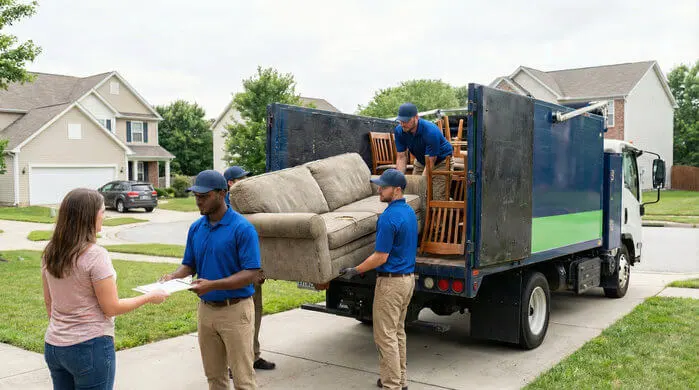
At Jiffy Junk, this is what we do on a daily basis. Our licensed and insured teams will provide upfront and transparent pricing before any work ever starts, and they work hard to recycle and donate items whenever possible. Whether it’s one reclining chair or a whole living room suite, we bring our signature White Glove Treatment to every job we do – which means that when we finish our job, your space is clean, clear, and ready for you to feel inspired.
How to Decide Which Option Is Right for You
The best way depends on three things: the condition of your furniture, how fast you need to get rid of it, and how much effort you have to put in. Donating and selling are great options when you have time and your pieces are in good shape. Curbside pickup and DIY hauling can be cost-effective but take patience and physical effort. And when you want the job done in no time without hassle, the professional removal of them ticks all the boxes off your favorite list in one go.
No matter which route you choose, the goal is the same — reclaiming your space and moving on. If you’d rather let us handle it, book online in about 60 seconds or call us at 844-JIFFY-JUNK for a free, no-obligation quote. We’ll take it from there.
“After removing thousands of couches, mattresses, and living room sets from homes across the country, we’ve found that most people don’t realize how limited their local disposal options actually are until they’re standing in the driveway with a sofa that won’t fit in their car. That’s exactly why we built Jiffy Junk around one idea — show up fast, handle everything, and leave the space cleaner than we found it.” — Jiffy Junk Team
7 Essential Resources to Help You Get Rid of Old Furniture the Right Way
You’ve decided it’s time to clear out the old furniture — great! Now comes the part most people get stuck on: figuring out where it should actually go. We’ve put together the seven most valuable resources to help you donate, recycle, or remove your furniture with confidence. Whether you’re reclaiming a spare room or clearing out an entire home, these links will point you in the right direction.
1. Habitat for Humanity ReStore — Find a Free Furniture Donation Pickup Near You
Looking to recycle old furniture? Habitat ReStores take in new and gently used furniture, appliances, and building materials, and for the most part, the gigantic things are picked up for free. Just search for the zip code to locate your nearest location and book a time that is suitable. Your donation helps build affordable housing in your community – and you won’t have to do a fingerprint of working your finger.
Why you’ll love this: A simple, feel-good way to clear your space while helping families in need.
Source: https://www.habitat.org/restores/donate-goods
2. The Salvation Army — Schedule a Fast, Free Furniture Donation Pickup
Ready to get that couch out of your living room? Scheduling a pickup with The Salvation Army is quick and easy – put in your zip code, select a date, and you’re all set. Your donated furniture is resold at local thrift stores, with the proceeds going directly to rehabilitation programs nationwide.
Why you’ll love this: It’s one of the fastest, most widely available free pickup options out there.
Source: https://satruck.org/donate/choose
3. The Salvation Army Donation Valuation Guide — Know What Your Furniture Is Actually Worth
Before you donate, it’s a good idea to know how much money you’re leaving behind. The Salvation Army’s Donation Value Guide is available to help you understand how much tax-deductible value can be claimed for some common items donated, such as furniture with low and high estimates. That way, you’ll be ready when it is time to file your return – no guesswork, no surprises.
Why you’ll love this: Takes the mystery out of furniture valuation so you can claim the right deduction with confidence.
Source: https://satruck.org/Home/DonationValueGuide
4. IRS Publication 561 — Understand Exactly How to Deduct Donated Furniture on Your Taxes
Donating furniture can save you money at tax time – but it has to be done properly to follow the rules. The IRS states that goods, including furniture, must be in good used condition or better to qualify for the charitable contribution deduction on the donation. This official guide guides you through the process of valuing your items or seizing the value of your Household Items.
Why you’ll love this: Straight from the source — everything you need to make sure your donation deduction holds up.
Source: https://www.irs.gov/publications/p561
5. Earth911 — Learn How to Recycle Furniture and Find Drop-Off Locations Near You
Not every piece of furniture is in good enough shape to donate – and that’s okay. Earth911’s guide to recycling says to consider a practical order of priority – repair if possible, donate if available, and as a last resort recycle. Their built-in locator allows you to look up by zip code to find facilities nearby that accept oversized items such as furniture, so nothing goes to waste unnecessarily.
Why you’ll love this: Helps you find the most eco-friendly option for furniture that’s past its prime.
Source: https://earth911.com/recycling-guide/how-to-recycle-furniture/
6. Freecycle Network — Give Away Furniture for Free to Neighbors Who Actually Want It
Sometimes the quickest way to clear your space is to connect directly with someone who needs what you’ve got. The Freecycle Network is a grassroots, entirely nonprofit movement of people giving and getting stuff for free in their own towns, focused on reuse and keeping good items out of landfills. Post your furniture, and a local community member will often come pick it up the same day.
Why you’ll love this: It’s fast, it’s free, and your furniture goes straight to someone who wants it — no middleman.
Source: https://www.freecycle.org
7. U.S. EPA Durable Goods Data — See Why Responsible Furniture Disposal Matters More Than Ever
Here’s the big picture: EPA data shows that furniture and furnishings entering the municipal waste stream reached 12.1 million tons in 2018, up from 2.2 million tons in 1960. That’s a staggering amount of material heading to landfills every year. This resource puts the scale of furniture waste into perspective — and it’s exactly why we’re so committed to recycling and donating items from every job we do.
Why you’ll love this: A quick reality check that makes it easy to see why choosing the right disposal method really matters.
Supporting Statistics: What We See on the Ground — and What the Data Confirms
After more than a decade in junk removal, we’ve loaded tens of thousands of couches, dressers, and dining sets onto our trucks. Most of what we haul away didn’t need to end up in a landfill — and the national data backs that up.
1. 80.1% of Discarded Furniture Goes Straight to a Landfill
According to EPA data, 80.1 percent of all discarded furniture and furnishings were landfilled in 2018. Only a tiny fraction was recycled or meaningfully diverted.
What we see firsthand:
- Homeowners call us to haul away furniture that’s in perfectly good shape — they just redecorated or moved
- Without a removal service that prioritizes donation, those items go straight to the dump
- On a typical job, our crews assess every item before it leaves your home and route anything with life left in it to a local donation partner.
The takeaway: Most furniture disposal methods skip the donation step entirely. We don’t.
Source: Durable Goods: Product-Specific Data
2. 12.1 Million Tons of Furniture Waste Generated Every Year — and Growing
Furniture and furnishings entering the municipal waste stream hit 12.1 million tons in 2018, up from 2.2 million tons in 1960 — a more than fivefold increase.
What’s driving the growth (from our perspective on the job):
- A decade ago: We hauled mostly solid wood dressers and metal bed frames — heavy, well-built pieces that lasted for years
- Today: A growing share of our pickups involves particleboard shelving, flat-pack furniture, and foam-filled couches never designed to survive a single move
- The core problem: Inexpensive, disposable “fast furniture” cycles through homes faster and is nearly impossible to recycle because it’s made from bonded mixed materials
The takeaway: That 12.1 million ton figure isn’t just a statistic to us — we feel it in every truck we fill.
Source: Furniture and Furnishings
3. Nearly 900 Donation Centers Exist — Most People Just Can’t Find Them
Habitat for Humanity operates nearly 900 ReStores across 49 states, and they accept new and gently used furniture, with many locations offering free pickup for large items. The infrastructure for donation is there. The problem is access.
What we hear from customers all the time:
- “I wanted to donate, but I couldn’t figure out who would take it.”
- “The donation center had a three-week wait for pickup.”
- “They told me they wouldn’t accept it because of a small stain.”
How we bridge that gap:
- Our teams already know which local organizations are currently accepting furniture
- We understand the specific condition requirements each partner enforces
- We handle delivery to donation centers as part of our standard removal process — no extra legwork for you
The takeaway: Good intentions aren’t enough when the logistics are this complicated. We’ve built donation coordination directly into how we operate.
Source: Habitat ReStores
The Bottom Line
Every piece of furniture we remove is a decision point: landfill or donation, waste or reuse. When you work with Jiffy Junk, you’re choosing a team that’s already done the homework on where your items should go — so you can reclaim your space knowing nothing went to waste that didn’t have to.
Final Thought: What a Decade of Furniture Removal Has Taught Us
After hauling away more furniture than we could ever count, one thing is clear: getting rid of old furniture is a bigger decision than most people realize. We wrote this guide because too many perfectly good pieces end up in landfills simply because no one showed the owner a better path.
The resources exist. The donation centers exist. The recycling programs exist. The real problem has never been a lack of options — it’s been a lack of clarity about how to actually use them.
Here’s Our Honest Take on What’s Broken
The furniture disposal system in the U.S. fails people at almost every step:
Donation centers do incredible work, but they’re overwhelmed, underfunded, and increasingly selective about what they’ll accept
- Municipal bulk pickup varies wildly by city — some programs are reliable, others are essentially nonexistent
- DIY hauling sounds simple until you’re adding up truck rentals, dump fees, and the very real risk of injuring yourself on a staircase
- The biggest gap: the distance between wanting to do the right thing and actually being able to do it is wider than it should be
We’ve met thousands of homeowners who fully intended to donate their furniture, only to give up after rejected phone calls and two-month pickup waits. That’s not a failure of good intentions. It’s a failure of infrastructure.
That’s Exactly the Gap Jiffy Junk Was Built to Close
We didn’t get into this business just to move heavy objects. We got into it because we saw an opportunity to make the entire process seamless — removal, donation, recycling, and disposal — for people who don’t have the time, physical ability, or logistics network to handle it themselves.
How it works on every job:
- Our crew arrives on your schedule and assesses every item in your home
- Anything that can be donated or recycled gets routed to a local partner
- Everything else is disposed of responsibly — no shortcuts, no dumping
- You’re left with a clean, clutter-free space and the confidence that it was done right
Not because it’s a nice marketing message. Because after a decade of doing this work, we’ve seen what happens when no one takes that extra step.
One Thing to Take Away from This Guide
You have more options than you think — and the choice you make about your old furniture matters more than you’d expect.
- Donate it yourself through Habitat ReStore or Salvation Army
- List it for free on Freecycle or Facebook Marketplace
- Schedule a city pickup through your local bulk waste program
- Call us and let a team that does this every day handle everything
Any of those paths is better than defaulting to the landfill. And if you’d rather skip the research entirely, that’s exactly what our White Glove Treatment is for — we show up on time, handle every item with care, and make sure your furniture ends up in the best possible place, not just the most convenient one.
FAQ on “How to Get Rid of Old Furniture”
Q: What is the easiest way to get rid of old furniture?
A: After removing furniture from thousands of homes nationwide, we can tell you it depends on your timeline and how much effort you want to put in.
Your options, ranked by ease:
- Full-service junk removal (easiest) — A company like Jiffy Junk shows up on your schedule, does all the heavy lifting, and handles donation or recycling for you. Zero effort on your end.
- Free online listings (moderate effort) — Posting on Freecycle or Facebook Marketplace works well, but from what we’ve seen, finding a taker can take anywhere from a few hours to a few weeks.
- Donation pickup (moderate effort) — Organizations like Habitat ReStore offer free pickup, but scheduling windows are limited,d and condition requirements are strict.
- DIY hauling (most effort) — You control the timing, but you’ll need a truck, a strong back, and a plan for where to take it.
Q: How do I get rid of a couch or large piece of furniture for free?
A: We get this question more than almost any other. Free options exist — but they come with trade-offs most people don’t expect.
Free removal options:
- Municipal bulk pickup — Available in many cities at no charge. The catch: scheduling can take weeks, and some programs are unreliable. We’ve worked with homeowners who waited a month for a city pickup that never showed.
- Donation pickup — Habitat for Humanity ReStore and the Salvation Army both offer free pickup in many areas. The catch: strict condition standards and limited availability.
- Curbside “free” listing — Post on Nextdoor or place a sign on the item. The catch: no guarantee anyone takes it, and some municipalities fine you for curbside items left too long.
Our honest advice: Start with your city’s bulk waste program and a donation center, but have a backup plan. When those options fall through — and they sometimes do — that’s usually when people call us.
Q: Can I donate furniture that’s in less-than-perfect condition?
A: This is where a lot of well-intentioned donation plans fall apart. The bar is higher than most people assume.
What most donation centers require:
- No major stains, rips, or tears
- No structural damage or missing parts
- No pest issues or pet damage
- Functional and safe for immediate use
What we’ve seen happen: Customers load a couch into their car, drive to a donation center, and get turned away at the door because of a stain they didn’t think was a big deal.
How we handle it differently:
- Our crews know exactly which local partners will accept what
- Items that meet donation standards get routed to a charity
- Items that don’t get sent to a recycling facility instead
- Nothing ends up in a landfill that doesn’t have to
Q: Is it worth paying for furniture removal instead of doing it myself?
A: We’re biased on this one — but the math usually speaks for itself.
The true cost of DIY hauling:
- Truck rental: $30–$50+
- Fuel: $15–$30
- Dump or transfer station fees: $25–$75
- Your time: 2–4 hours minimum
- Total for a single couch: $75–$150+ before factoring in injury risk
What we’ve seen go wrong with DIY removal:
- Scratched hardwood floors from dragging heavy pieces
- Damaged doorframes from tight turns
- Pulled muscles and back injuries on staircases
- Dump fees that were higher than expected
What professional removal gives you:
- No physical labor or injury risk
- No truck rental, fuel, or dump fees to calculate
- Donation and recycling are handled on your behalf
- A clean, clear space — usually within an hour
Q: Can I get a tax deduction for donating old furniture?
A: Yes — and it’s one of the most underused benefits we see. Here’s what you need to know.
The basics:
- Donate to a qualified 501(c)(3) organization (Habitat ReStore, Salvation Army, Goodwill, etc.)
- Itemize deductions on your federal tax return using Schedule A
- Deduct the fair market value — what a buyer would pay at a thrift store, not what you originally paid
A common misconception we hear from customers: “I paid $2,000 for this couch, so that’s what I can write off.” Unfortunately, the fair market value for used furniture is significantly lower than the original purchase price.
What you need to document:
- Written receipt from the charity at the time of donation
- Description and estimated value of each item
- IRS Form 8283 if total noncash donations exceed $500
Two resources we recommend to every customer:
- Salvation Army Donation Valuation Guide
- IRS Publication 561
Ready to Get Rid of Your Old Furniture the Easy Way?
Skip the hassle of figuring out donations, dump fees, and truck rentals — let Jiffy Junk handle everything from removal to responsible disposal with our signature White Glove Treatment. Call 844-JIFFY-JUNK or book online at jiffyjunk.com/booking for a free, no-obligation quote and reclaim your space today.