
Decluttering Guide: How to Declutter Your Home Room by Room with Tips, a Checklist, and a Whole House Plan
After removing over 10,000 truckloads of clutter from homes nationwide, we’ve noticed something: most people don’t have a junk problem — they have a “where do I start” problem. That’s the number one thing our crews hear on the job, and it’s exactly why we built this guide.
Drawing from years of hands-on experience inside homes of every size and situation — from overwhelmed families to estate cleanouts to full-scale downsizes — our team has developed a room-by-room decluttering system based on what actually works in the real world, not just theory. Inside, you’ll find the prioritization method our White Glove crews recommend to clients on-site, a whole-house plan you can start today, and a printable checklist to keep you on track. When you’re ready to clear it all out, we’ll handle the heavy lifting so you don’t have to.
TL;DR Quick Answers
Decluttering Guide
A decluttering guide is a step-by-step plan for sorting through every room in your home, deciding what to keep, donate, recycle, or remove, and clearing out the items that no longer serve you. After a decade of helping homeowners across the country complete full cleanouts, here’s the approach we recommend:
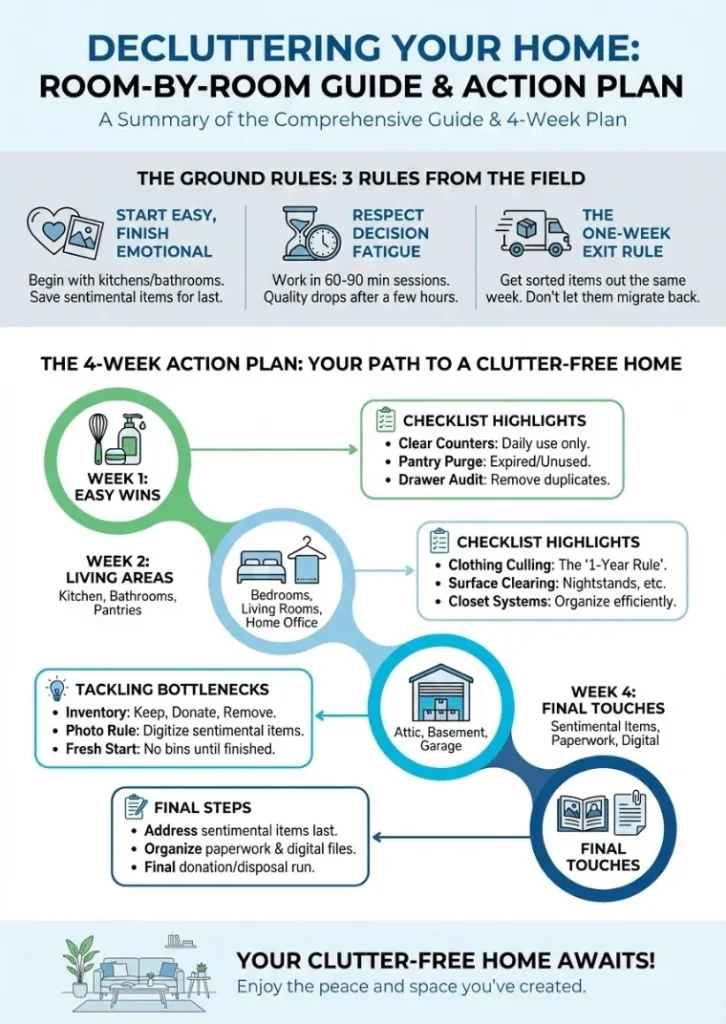
The 4-week whole-house method:
- Week 1 — Start with kitchens and bathrooms (fastest results, easiest decisions)
- Week 2 — Move to living areas and common spaces
- Week 3 — Tackle bedrooms and closets
- Week 4 — Finish with attic, basement, and garage
3 rules from the field that make every declutter easier:
- Start easy, finish emotional. Low-attachment spaces first. Sentimental items last.
- Work in 60- to 90-minute sessions. Decision fatigue is real — short sessions produce better results than marathon days.
- Get items out the same week you sort them. Donation piles that sit in a corner migrate back into the house. We’ve seen it thousands of times.
When the sorting is done, sort items into three groups: donate to organizations like Habitat for Humanity ReStore, recycle through local facilities found at Earth911.com, and remove everything else. For large-volume removal, a professional junk removal service like Jiffy Junk handles the heavy lifting — including donating and recycling as much as possible from every job.
The best decluttering guide isn’t the most complicated one. It’s the one you’ll actually follow.
Top Takeaways
- Start easy, finish emotional. Kitchens and bathrooms first — fast results, simple decisions. Attics, basements, and garages last — that’s where sentimental items slow you down.
- The barrier isn’t the stuff — it’s not having a plan. Over half of Americans feel overwhelmed by their belongings. A room-by-room system with a four-week timeline makes it manageable.
- Get items out the same week you sort them. Donate piles that sit for weeks, get reabsorbed into the house. We’ve seen it thousands of times. Schedule a drop-off or pickup immediately.
- Where your items end up matters. Over 146 million tons of household materials go to U.S. landfills annually. Donate usable items. Recycle what you can. Every item diverted makes a difference.
- You make the decisions — we handle the heavy lifting. This guide gives you the plan. When the sorting is done, Jiffy Junk’s White Glove Treatment takes it from there — donating and recycling as much as possible from every job.
Table of Contents
- Decluttering Guide: How to Declutter Your Home Room by Room with Tips, a Checklist, and a Whole House Plan
- TL;DR Quick Answers
- Top Takeaways
- Why Decluttering Feels So Hard (and Why It Doesn’t Have to Be)
- The Jiffy Junk Room-by-Room Decluttering Method
- Your Whole-House Decluttering Plan
- Decluttering Tips Our Crews Swear By
- Your Printable Decluttering Checklist
- When It’s Time to Call in the Pros
- 7 Essential Resources to Help You Donate, Recycle, and Clear the Clutter for Good
- 1. Habitat for Humanity ReStore — Give Your Furniture and Appliances a Second Life While Building Homes
- 2. Earth911 Recycling Search — Find the Right Drop-Off Location for Just About Anything
- 3. EPA Recycling Guide — Know Exactly What Can and What Should Go to a Recycling Facility
- 4. EPA Household Hazardous Waste Guide — Safely Handle Paints, Cleaners, and Chemicals You’ll Uncover Along the Way
- 5. IRS Publication 561 — Determine the Fair Value of Your Donated Belongings and Maximize Your Deduction
- 6. IRS Publication 526 — Understand the Rules So Your Charitable Donations Are Fully Deductible
- 7. The Salvation Army Donation Value Guide — Get Quick, Easy Estimates for Common Household Items
- The Numbers Behind the Clutter: What a Decade of Junk Removal Has Taught Us
- Final Thought: Decluttering Isn’t Really About the Stuff
- FAQ on “Decluttering Guide”
- Q: Where is the best place to start when decluttering your home?
- Q: How long does it take to declutter an entire house?
- Q: What should I do with items after I declutter them?
- Q: Can I get a tax deduction for items I donate during a declutter?
- Q: When should I hire a professional junk removal service instead of decluttering on my own?
- Ready to Turn Your Decluttering Plan Into a Clutter-Free Home?
Why Decluttering Feels So Hard (and Why It Doesn’t Have to Be)
Most homeowners stall before they even start — not because the work is too difficult, but because looking at an entire house full of stuff feels paralyzing. From our experience working inside thousands of homes, the fix is simple: stop thinking about the whole house and start thinking about one room, one category, and one decision at a time. That shift in approach is the difference between a weekend of progress and another month of putting it off.
The Jiffy Junk Room-by-Room Decluttering Method
Our crews have seen firsthand what makes a cleanout go smoothly versus what creates bottlenecks. The most effective approach is to work through your home in a specific order, starting with the easiest spaces to build momentum before tackling the areas where decisions get harder.
Start with these high-impact, low-attachment spaces first:
Kitchen — Begin with expired pantry items, duplicate utensils, chipped dishware, and small appliances you haven’t touched in over a year. Kitchens produce fast, visible results that fuel motivation for the rest of the house.
Bathrooms — Expired medications, old toiletries, worn towels, and half-used products add up quickly. Most homeowners are surprised by how much they clear from bathrooms alone.
Living Room and Common Areas — Focus on outdated media, broken electronics, excess décor, and furniture that no longer fits your lifestyle. If a piece hasn’t been used or sat in during the past six months, it’s likely time to let it go.
Then move to the spaces where decisions get tougher:
Bedrooms — Sort clothing seasonally and be honest about what you actually wear. Our crews commonly remove bags of clothing that homeowners held onto for years out of guilt rather than use. A good rule from the field: if you wouldn’t buy it again today, it’s ready to go.
Home Office — Old paperwork, outdated electronics, and tangled cables are some of the most common items our teams remove. Digitize what you need and clear the rest.
Attic, Basement, and Garage — These are the spaces where clutter hides longest. Holiday decorations you no longer display, old sports equipment, broken furniture, and boxes that haven’t been opened since your last move are all prime candidates for removal. We recommend sorting everything into three groups: keep, donate, and remove.
Your Whole-House Decluttering Plan
A successful whole-house declutter doesn’t happen in a single afternoon — but it doesn’t need to drag on for months either. Based on what we’ve seen work best for our clients, here’s a realistic timeline to follow.
Week One — Kitchen, bathrooms, and entryways. These quick wins set the tone.
Week Two — Living areas, dining room, and common spaces. Focus on furniture, electronics, and décor.
Week Three — Bedrooms and closets. Take your time with sentimental items, but stay honest.
Week Four — Attic, basement, garage, and storage areas. This is where the bulk of removal happens, and where our teams can save you the most time and physical effort.
By the end of the month, every room in your home will have been touched, sorted, and cleared of what no longer serves you.
Decluttering Tips Our Crews Swear By
After years on the job, our team has picked up practical wisdom that most guides don’t mention.
Work in short, focused sessions of 60 to 90 minutes rather than marathon days. Decision fatigue is real, and quality choices drop sharply after a few hours.
Take a photo of sentimental items before you let them go. You keep the memory without keeping the clutter.
Donate early and often. We see homeowners create “donate” piles that sit in a corner for weeks and slowly migrate back into the house. Schedule a pickup or drop-off the same week you sort.
Don’t buy organizing products until after you’ve decluttered. Storage bins don’t solve clutter — they hide it. Reduce first, then organize what remains.
When in doubt, set it aside for removal. Our experience shows that the items people agonize over during a declutter are rarely the items they miss afterward.
Your Printable Decluttering Checklist
Use this room-by-room checklist to track your progress and stay on course throughout the process.
Kitchen: Expired food, duplicate tools, unused appliances, chipped or mismatched dishware, old takeout containers
Bathrooms: Expired products, old medications, worn linens, samples, and travel-size bottles you’ll never use
Living Room: Broken electronics, outdated media, excess throw pillows and blankets, and décor that no longer fits
Bedrooms: Clothing unworn for 12-plus months, old bedding, shoes past their life, and accessories collecting dust
Home Office: Old paperwork, outdated tech, tangled cords, broken office supplies
Attic/Basement/Garage: Unopened moving boxes, holiday items no longer used, broken furniture, outgrown sports gear, old paint cans
When It’s Time to Call in the Pros
There comes a point in every declutter where the sorting is done, and you’re left staring at a mountain of stuff that needs to go — and that’s where we come in. Our licensed and insured teams handle everything from single-item pickups to full property cleanouts, and we donate and recycle as much as possible from every job. No heavy lifting on your end, no multiple trips to the dump, and no guessing about where things should go. Just point to what needs to be removed, and we’ll take care of the rest with our signature White Glove Treatment.
“After a decade of walking into homes across the country, we’ve learned that the biggest obstacle to decluttering is never the stuff itself — it’s not having a clear plan for where to start and when to let go.” —Jiffy Junk Team
7 Essential Resources to Help You Donate, Recycle, and Clear the Clutter for Good
You’ve done the hard part — sorting through every room and deciding what stays and what goes. Now it’s time to make sure everything leaves your home the right way. We’re committed to recycling and donating whenever possible, and we encourage our customers to do the same. These seven trusted resources make it simple to donate your belongings, recycle responsibly, and even save money on your taxes while you’re at it.
1. Habitat for Humanity ReStore — Give Your Furniture and Appliances a Second Life While Building Homes
Got a couch, refrigerator, or set of cabinets that still has plenty of life left? Habitat ReStores accept new and gently used furniture, appliances, home goods, and building materials, and most locations offer free pickup for large items. Every item sold helps fund affordable housing in your community. It’s one of the easiest and most meaningful ways to rehome your belongings during a declutter.
Source: https://www.habitat.org/restores/donate-goods
2. Earth911 Recycling Search — Find the Right Drop-Off Location for Just About Anything
Not sure where to take old electronics, batteries, or that stack of paint cans in the garage? Earth911 maintains one of North America’s most extensive recycling databases, covering over 350 materials and more than 100,000 listings. Just enter your zip code and the item you need to recycle. You’ll have a local drop-off location in seconds — simple as that.
Source: https://search.earth911.com/
3. EPA Recycling Guide — Know Exactly What Can and What Should Go to a Recycling Facility
Your curbside bin is great for the basics, but a whole-house declutter turns up items that need special handling. The EPA provides item-by-item guidance on recycling common household materials, including clothing, electronics, batteries, and glass, and recommends confirming specific rules with your local solid waste agency. Bookmark this before you start your project so you’re ready when those tricky items come up.
Source: https://www.epa.gov/recycle/how-do-i-recycle-common-recyclables
4. EPA Household Hazardous Waste Guide — Safely Handle Paints, Cleaners, and Chemicals You’ll Uncover Along the Way
Here’s something our crews see on nearly every job: homeowners uncover old paint cans, cleaning chemicals, pesticides, and expired batteries tucked away in basements, garages, and under sinks. The EPA classifies leftover household products that can catch fire, react, explode, or are corrosive or toxic — including paints, cleaners, oils, batteries, and pesticides — as household hazardous waste requiring special care during disposal. This guide walks you through how to handle these items safely and locate collection programs near you.
Source: https://www.epa.gov/hw/household-hazardous-waste-hhw
5. IRS Publication 561 — Determine the Fair Value of Your Donated Belongings and Maximize Your Deduction
Donating your decluttered items feels great — and it can save you money at tax time, too. According to the IRS, the fair market value of used household items is typically much lower than the original purchase price, and donated items must be in good used condition or better to qualify for a charitable tax deduction. This guide helps you assign an accurate, defensible value to every donation so you get the full deduction you deserve.
Source: https://www.irs.gov/publications/p561
6. IRS Publication 526 — Understand the Rules So Your Charitable Donations Are Fully Deductible
Before you drop off that truckload of belongings, you’ll want to know exactly what qualifies for a tax deduction and what records to keep. Publication 526 covers which organizations are qualified to receive deductible contributions, which types of donations are eligible, and the recordkeeping requirements you need to follow. A few minutes with this resource now saves you time and potential headaches when you file.
Source: https://www.irs.gov/publications/p526
7. The Salvation Army Donation Value Guide — Get Quick, Easy Estimates for Common Household Items
Wondering what that old dresser or winter coat is worth as a donation? The Salvation Army provides a reference guide with low and high value estimates for commonly donated items — including appliances, furniture, clothing, and household goods — to help you determine approximate tax-deductible value. We recommend using this alongside the IRS publications above to keep clean, complete records from the very first bag you donate.
Source: https://satruck.org/Home/DonationValueGuide.
We’ll take it from here. Once you’ve sorted, donated, and recycled what you can, our licensed and insured teams handle the rest — fast. We donate and recycle as much as possible from every job, so your belongings are cleared responsibly and you never lift a finger. That’s our White Glove Treatment in action.
The Numbers Behind the Clutter: What a Decade of Junk Removal Has Taught Us
Our crews see what Americans accumulate, what gets forgotten, and where it all ends up. Here’s what the data confirms about what we witness every day.
1. 146+ Million Tons Go to U.S. Landfills Every Year
The EPA reports that Americans generated 292.4 million tons of municipal solid waste in 2018 — 4.9 pounds per person, per day. Half of it — over 146 million tons — went straight to landfills.
What we see on the job:
- A single whole-house cleanout fills multiple truckloads — much of it still usable.
- Without a plan, most of it ends up in a landfill by default
- We sort every job into donate, recycle, and remove — it’s standard, not optional
Source: EPA — National Overview: Facts and Figures on Materials, Wastes and Recycling
2. Recycling Saved 193 Million Metric Tons of CO2 in One Year
EPA data shows recycling and composting saved over 193 million metric tons of carbon dioxide equivalent in 2018.
How we contribute to every job:
- Usable furniture and appliances → local donation centers
- Recyclable materials → appropriate facilities
- Only end-of-life items → disposal
Every item we divert makes a measurable difference.
Source: EPA — Recycling Basics and Benefits
3. Over Half of Americans Feel Overwhelmed by Their Stuff
A national survey by Decluttr and the National Association of Productivity and Organizing Professionals found that more than half of Americans feel overwhelmed by the amount of stuff in their homes.
What a decade of cleanouts has taught us:
- The barrier is never physical — it’s not knowing where to start
- A room-by-room plan turns “impossible” into “manageable.”
- This guide gives you that plan; our White Glove Treatment handles the rest
Source: NAPO — Why We Keep Too Much Stuff

Final Thought: Decluttering Isn’t Really About the Stuff
After a decade of clearing out homes across the country, we’ve come to a conclusion that might surprise you: decluttering was never really about the stuff. It’s about what the stuff is costing you.
The hidden costs we see on every job:
- The weekend spent reorganizing the same closet for the third time
- The spare bedroom that your family can’t use because it has become a storage unit
- The low-grade stress every time you open the garage door
- The move you’ve been putting off because you can’t face packing it all
The pattern is always the same. People hold onto items long past their usefulness — not because they need them, but because letting go feels harder than living with the clutter.
What Most Decluttering Guides Won’t Tell You
The perfect system matters less than the decision to start.
We’ve watched homeowners spend weeks researching methods, buying bins, and debating which room to tackle first — only to feel more overwhelmed than when they began. The clients who make the fastest progress aren’t the most organized. They’re the ones who:
- Pick a room and start
- Make quick decisions without overthinking
- Get items out of the house the same week they sort them
Momentum beats perfection every single time.
The Emotional Weight Is Always Heavier Than the Physical Weight
Our crews can clear a three-bedroom house in a single day. But the decision-making that leads up to that call? That’s the part that takes people months — sometimes years.
If that sounds familiar, here’s our advice from the field:
- Stop overthinking it
- You don’t need to decide the fate of every item in one weekend
- Start with one room, one category, and one honest question:
Does this still serve the life I’m living right now?
If the answer is no, it’s ready to go.
That’s What This Entire Guide Is Built On
The room-by-room method. The checklist. The timeline. The resources. All of it comes from what we’ve seen succeed in real homes — not just in theory. It’s the same approach our teams recommend to clients on-site every day.
And when the sorting is done? That’s where we come in.
- Our licensed and insured teams handle every item with care
- We donate and recycle as much as possible from every job
- The rest is disposed of responsibly — you never lift a finger
Because at the end of the day, we’re not in the junk removal business. We’re in the fresh start business. And we’re not happy until you are.
FAQ on “Decluttering Guide”
Q: Where is the best place to start when decluttering your home?
A: Start where the decisions are easiest, and the results are most visible. After thousands of cleanouts, our answer is always the same: kitchens and bathrooms first.
Why these rooms work best as a starting point:
- Expired food, duplicate utensils, and old toiletries require almost zero emotional deliberation
- You’ll see clear counter and shelf space within an hour
- That quick visual payoff fuels motivation to keep going
The most common mistake we see homeowners make:
- Diving straight into the attic, basement, or garage
- Those spaces are packed with sentimental items that stall progress before it builds
- Our rule from the field: easy rooms first, emotional rooms last
Q: How long does it take to declutter an entire house?
A: For most homeowners, about four weeks at a steady pace. Here’s the phased timeline we recommend to clients:
- Week 1 — Kitchens and bathrooms
- Week 2 — Living areas and common spaces
- Week 3 — Bedrooms and closets
- Week 4 — Attic, basement, and garage
One thing we’ve learned from watching the process up close:
- Marathon sessions almost always backfire
- After two to three hours, people start keeping things they’d otherwise let go of
- Our crews see the evidence constantly — “already decluttered” rooms still packed with unsorted items.
- Best practice: Work in focused 60- to 90-minute sessions instead
Every home is different. We’ve cleared one-bedroom apartments in an afternoon and multi-generational family homes that needed six to eight weeks. The key isn’t speed — it’s consistency.
Q: What should I do with items after I declutter them?
A: Set up three categories before you sort a single item: donate, recycle, and remove.
Where each category goes:
- Donate (good, usable condition) → Habitat for Humanity ReStore, The Salvation Army, local shelters
- Recycle (electronics, batteries, specialty materials) → Local recycling facilities via Earth911.com
- Hazardous (paint, cleaners, pesticides) → Local household hazardous waste program via EPA.gov
The insight most guides leave out:
The biggest threat to a successful declutter isn’t indecision during sorting. It’s the “donate pile” that sits in a corner for three weeks and slowly gets absorbed back into the house. We’ve seen it happen over and over.
Our strongest recommendation: Schedule a donation drop-off or pickup the same week you sort. The moment items leave your home, the declutter becomes real.
Q: Can I get a tax deduction for items I donate during a declutter?
A: Yes. If you donate to a qualified 501(c)(3) organization and itemize deductions, you can deduct the fair market value of donated goods in good used condition or better.
What surprises many of our clients:
- A whole-house declutter can produce multiple truckloads of deductible donations
- Furniture, clothing, appliances, and household goods add up quickly
- The combined fair market value can be significant at tax time
How to document it properly:
- Keep a running log from day one — item descriptions, quantities, condition, estimated values
- Request a dated receipt at every drop-off or scheduled pickup
- Use the Salvation Army Donation Value Guide for common item estimates
- Review IRS Publication 526 and IRS Publication 561 for full rules and limits
A few minutes of recordkeeping throughout your declutter can translate into real savings. Consult a tax professional for advice specific to your situation.
Q: When should I hire a professional junk removal service instead of decluttering on my own?
A: The sorting and decision-making? That’s yours — and this guide is built to help you do it. But after thousands of jobs, we’ve noticed a predictable moment in every declutter: the sorting is done, and you’re surrounded by a mountain of items that all need to leave at once.
That’s the inflection point where a professional crew adds the most value.
Situations where our teams make the biggest difference:
- Large, heavy items — sofas, appliances, mattresses — that are difficult to move safely
- Full property cleanouts with high volume
- Estate or foreclosure situations requiring care and discretion
- Tight timelines,like an upcoming move or listing
What sets our approach apart:
- Removal is only part of what we do
- Our licensed and insured crews donate and recycle as much as possible from every job
- You never make multiple trips to different facilities yourself
- Your items are handled responsibly from pickup to final destination
You’ve already done the hardest work by deciding what stays and what goes. We handle everything from that point forward with our White Glove Treatment.
Ready to Turn Your Decluttering Plan Into a Clutter-Free Home?
You’ve got the room-by-room guide, the checklist, and the whole-house plan — now let us handle the heavy lifting. Book online in 60 seconds or call 844-JIFFY-JUNK for a free, no-obligation quote and experience the White Glove Treatment that’s helped thousands of homeowners reclaim their space.