
How to Prepare for a Junk Removal Appointment: Checklist, Tips, and What to Expect on the Day of Your Pickup So Everything Goes Smoothly
Here’s what actually holds up a Jiffy Junk pickup: a blocked hallway or a last-minute question about what stays and what goes. That’s genuinely it. We’ve handled thousands of jobs nationwide since 2014, and the customers who wrap up fastest are the ones who took a few minutes the day before. This guide covers all of it: what to do before we arrive, what to expect on pickup day, and what happens after the truck pulls away.
TL;DR Quick Answers
How to Prepare for Junk Removal
To prepare for junk removal: confirm your appointment window, walk the property to identify all items for removal, physically separate anything you want to keep, and clear a path to large items before the crew arrives. You don’t need to move anything heavy yourself. Jiffy Junk’s team does all the lifting. For best results:
- Confirm your booking and note the arrival window.
- Separate items from removal items in advance.
- Clear doorways, hallways, and the driveway for fast access.
- Flag any items that require special handling.
- Have a payment method ready. Jiffy Junk provides an upfront quote with no hidden fees.
Top 5 Takeaways
- Clear the path. Unblock doorways, hallways, and driveways before we arrive. It’s the single step that speeds up every pickup.
- Separate what you’re keeping. Move valuables and keepsakes into a clearly separate area before your crew gets there. It protects what matters and removes all guesswork on the day.
- Check for hazardous materials in advance. Paints, chemicals, propane tanks, and certain batteries can’t go on our truck. Arrange for separate disposal through your local household hazardous waste program before your appointment.
- Donate before we arrive — it makes a real difference. Usable furniture, appliances, clothing, and electronics set aside for Habitat ReStore or Goodwill stay out of the waste stream entirely. A little sorting before pickup day changes where your items end up.
- You don’t have to figure any of this out alone. Our licensed, insured team walks the property with you, gives you an upfront quote with no hidden fees, and handles all the heavy lifting. We’re not happy until you are happy.
Table of Contents
- How to Prepare for a Junk Removal Appointment: Checklist, Tips, and What to Expect on the Day of Your Pickup So Everything Goes Smoothly
- TL;DR Quick Answers
- Top 5 Takeaways
- Before Your Appointment: How to Prepare in Advance
- Day of Your Appointment: What to Expect When the Crew Arrives
- After Your Appointment: What Happens Next
- What Items Does Jiffy Junk Remove?
- Essential Resources
- 1. How to Identify and Safely Dispose of Household Hazardous Waste
- 2. Donate Furniture, Appliances, and Building Materials Before Your Pickup
- 3. What Goodwill Accepts: Clothing, Household Goods, and Electronics
- 4. How to Recycle Your Old Mattress the Right Way
- 5. Check What Your City Offers for Bulky Item Pickup
- 6. How Special Item Collection Works for Appliances and Electronics
- 7. Tax Deductions for Donated Items: What You Can Claim
- Supporting Statistics
- Final Thoughts and Opinion
- Frequently Asked Questions
- Q: Do I need to be home when the junk removal crew arrives?
- Q: How do I know what items Jiffy Junk will and won’t take?
- Q: Should I separate my items before the crew arrives?
- Q: How long does a typical junk removal appointment take?
- Q: What happens to my items after pickup?
- Q: How does Jiffy Junk determine pricing?
- Q: Can I schedule same-day or next-day junk removal?
- Ready to Book Your Junk Removal Appointment?
Before Your Appointment: How to Prepare in Advance
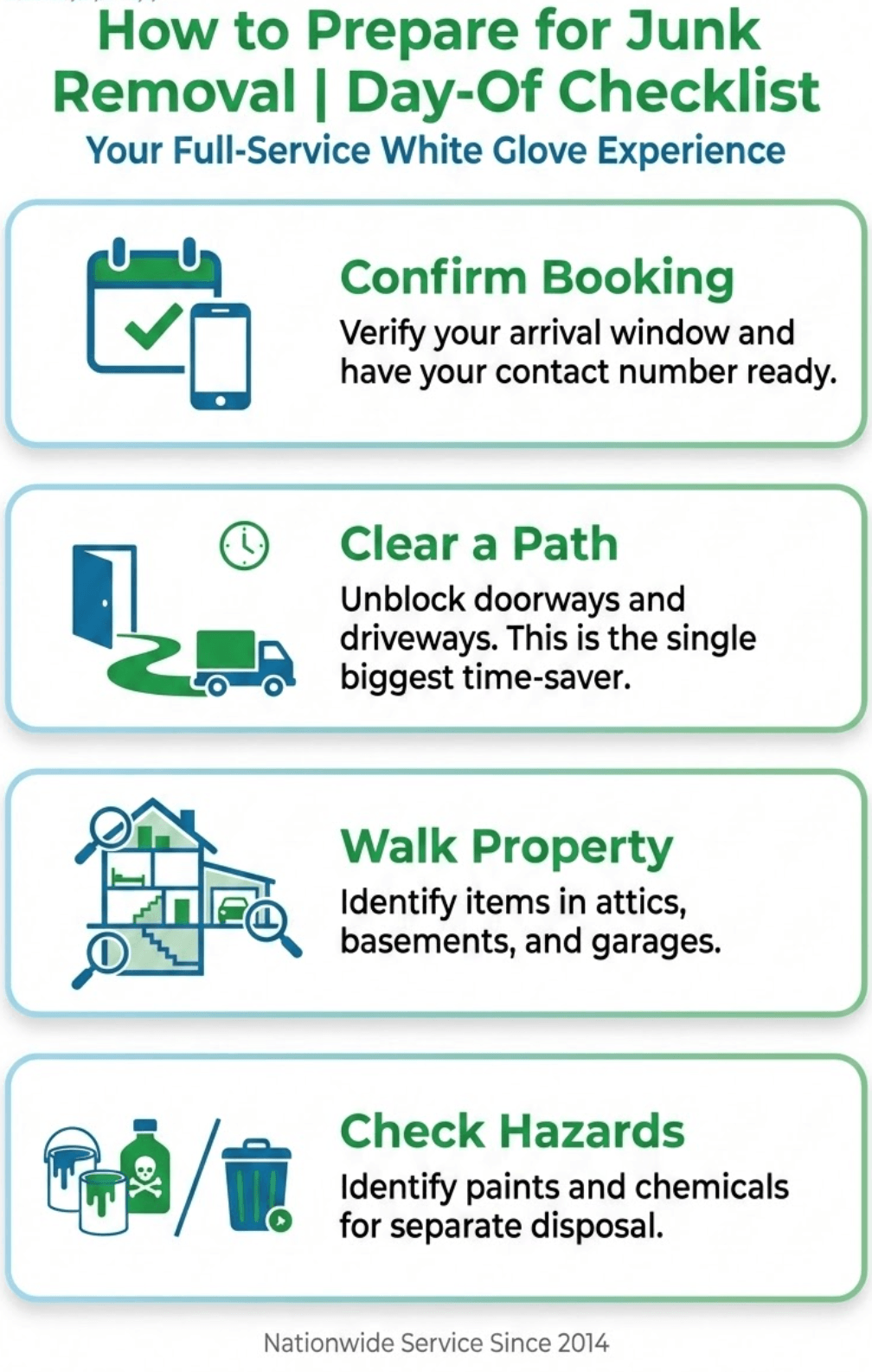
A little preparation the day before makes a real difference. Start by confirming your booking: check your confirmation email, note the two-hour arrival window, and make sure you have the right contact number ready. Then walk every room, attic, basement, and garage to take stock of what you want removed. A rough mental list prevents scrambling on the day.
The step most customers skip is physically moving the items they want to keep before we arrive. Get keepsakes, important documents, and valuables out of the removal area and into a clearly separate space. One clean visual boundary saves everyone time. Then clear a path. Unobstructed doorways, hallways, and driveways let the team work quickly, and that directly affects how fast your appointment wraps up.
It’s also worth checking for hazardous materials in advance. Paints, chemicals, and propane tanks need to go through a separate disposal channel rather than onto our trucks. Your local municipality’s website will point you toward the right resources for those specific items.
Your pre-appointment checklist:
- Confirm your appointment date, time window, and contact number.
- Walk through every room, attic, basement, and garage to identify all removal items.
- Physically separate items to keep from those to remove.
- Clear all pathways: doorways, stairways, hallways, and the driveway.
- Remove fragile or sentimental items from the removal area.
- Note any items that may require special handling or disassembly.
- Confirm your payment method. Jiffy Junk provides an upfront quote with no hidden fees.
- Check for hazardous materials and arrange separate disposal if needed.
Day of Your Appointment: What to Expect When the Crew Arrives
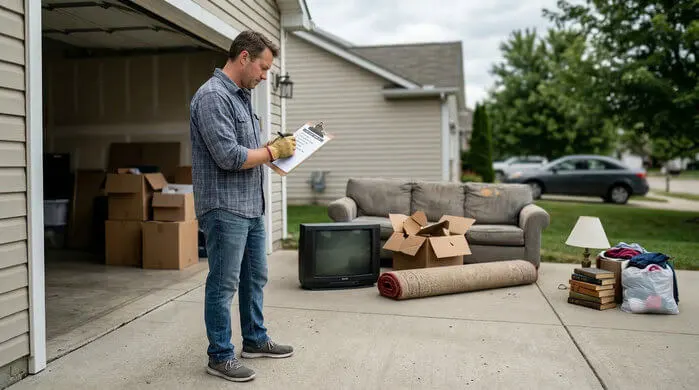
You’ll get a courtesy heads-up call or text when the crew is on the way. Once they arrive, your Jiffy Junk team walks the property with you and gives you an on-site quote before a single item moves. That’s our upfront pricing in practice: what we quote is what you pay, with no surprises.
Approve the quote, and the crew handles the rest. You don’t lift a finger. Just point to what needs to go and step back. That’s the White Glove Treatment in action, and it’s what sets us apart from a standard pickup service.
Wondering whether you need to be home? In most cases, yes, at least for the initial walkthrough and quote approval. If you need to arrange access in advance, reach out before your appointment, and we’ll sort out the details together.
Before leaving, the crew sweeps the area and does a final walkthrough with you to confirm everything is complete to your satisfaction. That last step is our promise in practice: we’re not happy until you are happy.
Your day-of checklist:
- Be available by phone when the crew is en route.
- Meet the team at the property to approve the on-site quote.
- Point out all items for removal. You don’t need to move anything yourself.
- Indicate clearly any items that should NOT be removed.
- Allow the crew full access to the removal area.
- Do a final walkthrough with the crew before they depart.
- Confirm payment and receive your receipt.
After Your Appointment: What Happens Next
Once the truck pulls away, your items don’t end up in a landfill by default. Jiffy Junk sorts everything into three paths: donation, recycling, or responsible disposal, in that order. Usable furniture and household goods go to local charities first. Recyclable materials get recycled. This commitment to responsible solid waste management means your old sofa could find a new home rather than a dumpster.
After your pickup, you’ll receive a follow-up to make sure everything meets your expectations. If it did, a Google review genuinely helps us serve your community better, and we’d be grateful for it. Whenever you need us again, booking takes 60 seconds at jiffyjunk.com/booking.
Planning a move? Our guide on junk removal when moving covers everything worth tackling before the moving truck arrives.
What Items Does Jiffy Junk Remove?
The short answer: most things. Our fully licensed and insured teams handle virtually any residential or commercial removal job. Here’s what we take regularly:
- Old furniture: sofas, mattresses, bed frames, dressers, and dining sets
- Appliances: refrigerators, washers, dryers, dishwashers, and microwaves
- Electronics: TVs, computers, printers, and audio equipment
- Yard and outdoor items: patio furniture, swing sets, and lawn equipment
- Construction debris: drywall, lumber, tile, and flooring materials
- Moving leftovers: boxes, packing materials, and miscellaneous household items
- Office equipment: desks, filing cabinets, and cubicle partitions
Not sure about a specific item? Send us a photo before your appointment, and we’ll confirm right away. For a full breakdown, visit jiffyjunk.com/junk-removal-services.
“In our experience, completing thousands of junk removal jobs nationwide since 2014, the single biggest factor that speeds up a pickup is a clear, unobstructed path to the items. Customers who handle that one thing in advance consistently tell us the whole job feels effortless from start to finish.”
— The Jiffy Junk Operations Team
Essential Resources
1. How to Identify and Safely Dispose of Household Hazardous Waste
Some items in your home need a different disposal channel before our crew arrives. Paints, pesticides, batteries, and certain cleaners can’t go on our truck — not because we don’t want to help, but because federal regulations require special handling for these specific materials. The U.S. EPA’s Household Hazardous Waste guide tells you exactly what qualifies and helps you find a certified local collection program, so nothing holds up your appointment.
Source: epa.gov
2. Donate Furniture, Appliances, and Building Materials Before Your Pickup
Got a sofa, appliance, or pile of building materials that’s still in good shape? Pull those items out before your appointment and send them somewhere they’ll be used. Habitat for Humanity ReStores take furniture, appliances, and surplus materials, and most locations will come pick up large items from your home at no charge. Your donation also helps fund affordable housing in your community.
Source: habitat.org
3. What Goodwill Accepts: Clothing, Household Goods, and Electronics
Before your crew arrives, set aside anything still in working condition — clothing, kitchenware, small appliances, and electronics. Goodwill accepts a wide range of household items and offers thousands of drop-off locations nationwide. Donating those items first means less goes to the landfill and more stays in your community.
Source: goodwill.org
4. How to Recycle Your Old Mattress the Right Way
Mattresses come up on nearly every job we handle, and they deserve a better end than a landfill. The Mattress Recycling Council breaks down why recycling matters — over 75 percent of a mattress can be recovered and repurposed — and helps you find a free drop-off site near you before your appointment day.
Source: mattressrecyclingcouncil.org
5. Check What Your City Offers for Bulky Item Pickup
Your municipality may already offer free or low-cost curbside collection for large furniture and appliances — and it’s worth checking before you book. Kansas City’s bulky item program is a solid example of how these services typically work: what gets accepted, item limits, and how to schedule. Look up your own city’s program using this as a reference.
Source: kcmo.gov
6. How Special Item Collection Works for Appliances and Electronics
TVs, refrigerators, washers, and large furniture often qualify for scheduled collection through your local utility or solid waste service. Seattle Public Utilities lays out a clear, practical example of how these programs work, what items qualify, and how to prepare them for pickup day. Check whether your city runs a similar program before your appointment.
Source: seattle.gov
7. Tax Deductions for Donated Items: What You Can Claim
Here’s something worth knowing before your pickup day: items you donate to qualifying nonprofits may be tax-deductible. The IRS Charitable Contribution Deductions page walks you through the documentation you’ll need, how to determine fair market value, and what counts toward your return. A little paperwork at donation time can pay off when tax season rolls around.
Source: irs.gov
Supporting Statistics
1. Moving is the number 1 Trigger for Junk Removal Appointments — and Millions of Households Do It Every Year
We’ve seen it on thousands of jobs: moving day makes clutter impossible to ignore. The numbers back it up.
- 11.8% of Americans — roughly 38 million people — moved to a new residence in 2024
- That’s tens of millions of households deciding what stays, what goes, and what needs hauling away
- In our experience, the customers who prepare in advance are the ones who tell us afterward that it felt effortless
Source: U.S. Census Bureau — American Community Survey Geographic Mobility Data
2. Most Recyclable Materials in U.S. Homes Never Actually Get Recycled
Since 2014, we’ve learned one consistent truth: what happens to your items after pickup depends on how they’re sorted before we arrive. The Recycling Partnership’s State of Recycling Report puts a hard number on what’s at stake.
- 76% of recyclable materials in U.S. homes end up landfilled or incinerated
- That’s nearly 34 million tons of redirectable material lost every year
- Flagging donatable items and pulling out anything needing special handling before we arrive is the single step that changes where your items end up
3. What Ends Up in the Landfill Is Often Decided Before the Truck Shows Up
We tell customers this regularly: by the time our crew arrives, a lot of the environmental outcome is already set. CalRecycle’s 2021 Disposal Facility-Based Waste Characterization Study makes that point in striking terms.
- California’s annual landfill volume weighs roughly 45 times as much as the Golden Gate Bridge.
- Targeted programs cutting specific waste streams reduced landfill organic waste by 6% in just a few years.
- Items set aside for donation before pickup day stay out of the waste stream entirely — that preparation takes minutes and changes where your items end up.
Source: CalRecycle — 2021 Disposal Facility-Based Waste Characterization Study
Final Thoughts and Opinion
Preparing for a junk removal appointment doesn’t take much. A quick walkthrough, a cleared path, and a confirmed window are really all you need to do. The rest is on us.
At Jiffy Junk, we’ve built our operation around making this as easy as possible for every customer, every time. From the moment you book to the final sweep of the removal area, our White Glove Treatment means you never have to lift a finger.
Our honest recommendation: do three things before your crew arrives. Confirm your window. Separate what you’re keeping from what you’re clearing out. Clear a path to the items. That’s your part done. We handle everything else.
Frequently Asked Questions
Q: Do I need to be home when the junk removal crew arrives?
A: Ideal, yes, at least for the initial walkthrough and on-site quote approval. In many situations, access can be arranged in advance. Reach out to Jiffy Junk before your appointment, and we’ll work out the details together.
Q: How do I know what items Jiffy Junk will and won’t take?
A: We remove most household, office, and yard items: furniture, appliances, electronics, and construction debris are all fair game. Hazardous materials like paints, chemicals, and propane tanks require special disposal through a separate channel. When in doubt, send us a photo before your appointment, and we’ll confirm right away.
Q: Should I separate my items before the crew arrives?
A: It helps, but it’s not required. The crew walks the property with you to confirm exactly what goes. The most important thing is making sure items you want to keep are clearly out of the removal area before we start.
Q: How long does a typical junk removal appointment take?
A: Most residential pickups run 30 minutes to two hours, depending on volume. Larger jobs like full estate cleanouts may take longer. Your crew will give you a straight time estimate on arrival.
Q: What happens to my items after pickup?
A: Jiffy Junk prioritizes donating usable items to local charities and recycling materials responsibly before anything goes to the landfill. That’s our eco-friendly commitment in action. Your old sofa might find a brand-new home.
Q: How does Jiffy Junk determine pricing?
A: Pricing is based on the volume of space your items take up in the truck. You get a transparent, no-obligation on-site quote before any work begins. No hidden fees, ever. That’s our promise.
Q: Can I schedule same-day or next-day junk removal?
A: In many service areas, yes. Book online at jiffyjunk.com/booking or call 844-543-3966 to check availability near you.
Ready to Book Your Junk Removal Appointment?
You’ve got the checklist, and you know what to expect. Book your Jiffy Junk pickup in 60 seconds at jiffyjunk.com/booking, or call us at 844-543-3966, and our licensed, insured team handles everything from there. We’re not happy until you are happy.