Can You Pour Acetone Down the Drain? How to Safely Dispose and Get Rid of Acetone at Home Without Harming Your Plumbing or the Environment
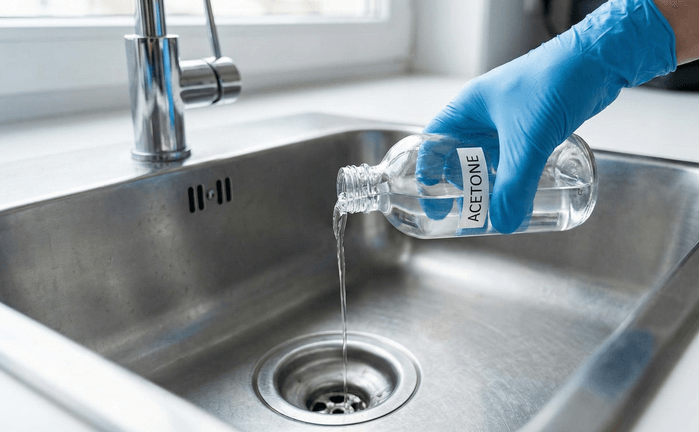
No—never pour acetone down the drain. This common mistake can corrode pipes, create toxic fumes, and land you with an EPA violation.
We’ve hauled away thousands of garage cleanouts and estate projects since 2014, and improperly stored solvents rank among the trickiest items we encounter. Homeowners often don’t realize that a small bottle of nail polish remover follows the same disposal rules as industrial-strength acetone. Both are classified as hazardous waste, and both require more than a trip to your kitchen sink.
Here’s what we’ve learned works: most communities offer free hazardous waste drop-off days, and many auto shops and hardware stores accept solvents year-round. For larger quantities from renovations or property cleanouts, professional removal saves you the headache of transport regulations and liability concerns.
This guide covers your safest disposal options, local resources worth knowing, and the environmental impact most articles skip over. We’ll help you handle acetone the right way—whether it’s a single bottle or a shed full of old chemicals.
Quick Answers
How to Dispose of Acetone
Never pour acetone down the drain. It damages pipes, kills septic bacteria, and contaminates groundwater.
Safe disposal methods:
- Evaporate small amounts — Pour into a metal or glass container outdoors; let dry completely
- Absorb with cat litter — Seal in a metal container; take to a hazardous waste facility
- Use local drop-off sites — Find free locations at search.earth911.com
For larger quantities: Contact your municipal HHW facility or schedule professional removal.
What we’ve learned after thousands of cleanouts: Most homeowners don’t realize nail polish remover follows the same disposal rules as industrial solvents. Both are hazardous waste. Both need proper handling. The good news—free disposal options exist in most communities. Finding them takes minutes.
Top 5 Takeaways
- Never pour acetone down the drain.
- Corrodes PVC pipes and rubber seals
- Kills septic system bacteria
- Contaminates groundwater
- Damage often goes unnoticed for years
- Nail polish remover = industrial solvent.
- The same EPA disposal rules apply
- Both are classified as hazardous waste
- Both require proper facilities
- Free disposal options exist.
- Find locations: search.earth911.com
- Municipal collection events run quarterly
- Some retailers accept solvents
- Small amounts can evaporate safely.
- Use a metal or glass container
- Place outdoors with good airflow
- Keep away from heat sources
- Dispose of the dry container in the regular trash
- Call professionals for larger quantities.
- Multiple containers
- Unknown chemicals
- Estate or renovation cleanouts
- Transport regulations handled for you
Table of contents
- Can You Pour Acetone Down the Drain? How to Safely Dispose and Get Rid of Acetone at Home Without Harming Your Plumbing or the Environment
- Quick Answers
- Top 5 Takeaways
- Why Acetone Can’t Go Down the Drain
- How to Safely Dispose of Small Amounts of Acetone
- Where to Take Acetone for Proper Disposal
- Handling Larger Quantities from Cleanouts and Renovations
- Protecting the Environment Beyond Disposal
- 7 Trusted Resources to Help You Dispose of Acetone the Right Way
- 1. Find a Free Drop-Off Location Near You
- 2. Understand Why Acetone Needs Special Handling
- 3. Know the Health Risks Before You Get Started
- 4. Check the Official Safety Standards
- 5. Be Ready for Spills and Fire Hazards
- 6. Learn Why Acetone Harms Plumbing and the Environment
- 7. Locate Professional Disposal Services for Larger Quantities
- What a Decade of Hauling Taught Us About Acetone Disposal
- Final Thought & Opinion Section
- FAQ on “How to Dispose of Acetone”
- Ready to Dispose of Acetone the Right Way?
Why Acetone Can’t Go Down the Drain
Acetone dissolves more than nail polish—it attacks PVC pipes, rubber seals, and the protective coatings inside your plumbing. Even small amounts can weaken pipe joints over time, leading to leaks you won’t notice until the damage is done.
The environmental impact extends beyond your home. Acetone that reaches municipal water systems disrupts treatment processes and can contaminate groundwater. Septic system owners face an additional risk: acetone kills the beneficial bacteria your tank needs to function, potentially causing system failure that costs thousands to repair.
In our experience clearing out properties, we’ve seen the aftermath of years of improper solvent disposal. Corroded drain lines and contaminated soil are more common—and more expensive to remediate—than most homeowners expect.
How to Safely Dispose of Small Amounts of Acetone
For leftover nail polish remover or small craft project quantities, you have a few practical options.
Let it evaporate. Pour small amounts into a metal or glass container and place it outdoors in a well-ventilated area away from heat sources, children, and pets. Acetone evaporates quickly—usually within a few hours. Once the container is completely dry, you can dispose of it with regular household waste.
Absorb and contain. Soak acetone into cat litter, sawdust, or paper towels. Place the saturated material in a sealed metal container and take it to your local hazardous waste facility. This method works well for slightly larger quantities that would take too long to evaporate safely.
Use it up. Acetone is useful for cleaning paint brushes, removing adhesive residue, and prepping surfaces for painting. If you have projects on the horizon, working through your supply eliminates the disposal question.
Where to Take Acetone for Proper Disposal
Most communities offer free hazardous waste disposal through one of these channels:
Municipal collection events. Many cities and counties host quarterly or annual drop-off days for household hazardous waste. Check your local government website or call your sanitation department for the schedule.
Permanent drop-off facilities. Larger municipalities often operate year-round collection sites. These typically accept acetone, paint thinners, and other common solvents at no charge for residents.
Retail take-back programs. Some auto parts stores, hardware stores, and home improvement centers accept solvents for recycling. Call ahead to confirm—policies vary by location.
We recommend storing acetone in its original container with the label intact. Facilities need to identify what they’re handling, and unmarked containers often get rejected or require additional processing fees.
Handling Larger Quantities from Cleanouts and Renovations
Garage cleanouts, estate projects, and renovation debris often involve more than a bottle or two of acetone. When you’re dealing with multiple containers, expired solvents, or unknown chemicals, the disposal process gets more complicated.
Transport regulations add another layer. In many states, moving more than small household quantities of hazardous materials requires specific containers, labeling, and sometimes permits. Violating these rules—even unintentionally—can result in fines.
This is where professional junk removal makes sense. Our teams are trained to identify, handle, and transport hazardous materials according to EPA and state guidelines. We’ve cleared out workshops, storage units, and inherited properties where decades of accumulated chemicals needed proper disposal. You point to what needs to go, and we handle the logistics.
Protecting the Environment Beyond Disposal
Proper acetone disposal is one piece of a larger picture. Consider these practices to minimize your environmental footprint:
Buy only what you need. Acetone has a long shelf life when stored properly, but purchasing smaller quantities reduces the chance of waste.
Store it correctly. Keep acetone in a cool, dry place away from heat and ignition sources. Proper storage extends usability and prevents container degradation.
Choose alternatives when possible. For some applications, less toxic solvents like isopropyl alcohol or plant-based removers work just as well without the hazardous waste concerns.
At Jiffy Junk, we’re committed to recycling and donating items whenever possible—and ensuring hazardous materials reach the right facilities. When you work with us, you’re choosing disposal that prioritizes environmental responsibility alongside convenience.

“In over a decade of property cleanouts, we’ve learned that the chemicals people worry about least often cause the most damage—acetone tops that list because it seems harmless sitting next to the nail polish, but it follows the same disposal rules as industrial solvents and can silently destroy plumbing for years before anyone notices.” — Jiffy Junk Removal Team
7 Trusted Resources to Help You Dispose of Acetone the Right Way
Figuring out how to get rid of acetone safely doesn’t have to be complicated. We’ve pulled together the most reliable resources so you can handle this task with confidence—whether you’re clearing out a single bottle or tackling a full garage cleanout.
1. Find a Free Drop-Off Location Near You
Earth911 Recycling Search is the quickest way to locate hazardous waste collection centers in your area. Just enter your zip code, and you’ll see your nearest options in seconds. We point our customers here all the time—it’s the easiest first step.
🔗 https://search.earth911.com/
2. Understand Why Acetone Needs Special Handling
EPA Household Hazardous Waste Guide breaks down what makes common solvents like acetone different from regular household items. You’ll learn about collection programs, safe storage tips, and disposal best practices. It’s the same guidance our teams follow on every job.
🔗 https://www.epa.gov/hw/household-hazardous-waste-hhw
3. Know the Health Risks Before You Get Started
ATSDR Toxicological Profile for Acetone is the federal government’s go-to resource on acetone exposure. It covers inhalation hazards, skin contact effects, and safe handling limits. A quick read here helps you protect yourself and your family during any DIY disposal project.
🔗 https://wwwn.cdc.gov/TSP/ToxProfiles/ToxProfiles.aspx?id=5&tid=1
4. Check the Official Safety Standards
OSHA Acetone Chemical Database spells out workplace exposure limits and safety requirements. The permissible exposure limit of 1,000 ppm gives you a practical benchmark for ventilation when working with acetone at home. Good ventilation makes a real difference—we’ve seen it firsthand.
🔗 https://www.osha.gov/chemicaldata/476
5. Be Ready for Spills and Fire Hazards
NOAA CAMEO Chemicals Database provides clear emergency response steps if something goes wrong. You’ll find fire suppression methods, safe distances, and protective gear recommendations. We hope you never need it, but it’s worth bookmarking just in case.
🔗 https://cameochemicals.noaa.gov/chemical/8
6. Learn Why Acetone Harms Plumbing and the Environment
PubChem Compound Summary from the National Institutes of Health explains acetone’s chemical properties and environmental impact. This is where you’ll understand exactly why pouring it down the drain causes real damage to pipes and water systems.
🔗 https://pubchem.ncbi.nlm.nih.gov/compound/Acetone
7. Locate Professional Disposal Services for Larger Quantities
EPA Hazardous Waste Facility Locator helps you find licensed treatment and disposal facilities in your area. When household collection centers can’t handle your volume—like after an estate cleanout or renovation—this tool points you to the right professionals.
🔗 https://www.epa.gov/hwpermitting/how-do-i-find-hazardous-waste-management-facilities-my-area
What a Decade of Hauling Taught Us About Acetone Disposal
We’ve cleared thousands of garages, estates, and renovation sites since 2014. The statistics below match what we see on the ground every day.
652 Hazardous Waste Sites Contain Acetone Contamination
Acetone appears at more than one-third of the EPA’s National Priorities List sites.
What we’ve learned firsthand:
- Acetone is an “invisible” hazard—homeowners overlook it
- Small amounts disposed of improperly add up over decades
- Contamination often goes unnoticed until soil or well water testing reveals problems
We’ve hauled away forgotten solvents from storage units and workshops where the damage wasn’t obvious until someone tested.
Source: ATSDR Toxicological Profile for Acetone
🔗 https://www.atsdr.cdc.gov/toxprofiles/tp21-c5.pdf
85% of Superfund Cleanups Involve Groundwater Contamination
Nearly 9 out of 10 major cleanup sites require groundwater remediation.
Why does this happen? Acetone moves fast through soil
- It doesn’t bind to sediment like heavier chemicals
- It leaches directly into groundwater
- By discovery, cleanup costs far exceed what proper disposal would have cost. We’ve worked on properties where years of improper disposal led to failed well water tests and calls from environmental agencies.
Source: EPA, How Superfund Addresses Groundwater Contamination
🔗 https://www.epa.gov/superfund/how-superfund-addresses-groundwater-contamination
1.5+ Million Tons of Hazardous Waste Recycled Annually
Proper disposal doesn’t mean destruction—it means recovery and reuse.
What reaches licensed facilities gets reclaimed:
- Solvents like acetone can be processed for a second life
- Recycling keeps chemicals out of landfills and water supplies
- EPA documented 1.5M+ tons managed through recycling in one reporting year
We point customers toward proper channels because responsible disposal benefits everyone.
Source: EPA, Hazardous Waste Recycling
🔗 https://www.epa.gov/hw/hazardous-waste-recycling
Final Thought & Opinion Section
Our Take: Why Acetone Disposal Deserves More Attention
After a decade in junk removal, we’ve developed strong opinions about household hazardous waste. Acetone sits near the top of our list of underestimated hazards.
The Real Problem Isn’t the Chemical. It’s the Perception.
Acetone is everywhere—nail polish remover, paint thinner, adhesive cleaner. It’s so common that most people treat it like any other household product.
That’s exactly why it causes so much preventable damage.
What we’ve observed:
- Homeowners pour small amounts down drains without hesitation
- Garages accumulate half-empty containers for years
- Estate cleanouts uncover decades of forgotten solvents
- Consequences don’t surface until pipes corrode or well tests fail
The EPA didn’t find acetone at 652 hazardous waste sites because of industrial accidents. Most contamination traces back to thousands of small disposal decisions by people who didn’t know better.
What We Wish More People Understood
1. “Small amounts” still matter. Acetone doesn’t disappear down the drain. It disrupts septic systems, passes through water treatment, and migrates into groundwater. One bottle won’t cause a crisis—but multiply it across every household, year after year, and the math changes fast.
2. Nail polish remover follows industrial solvent rules. This surprises almost everyone. The bottle in your bathroom requires the same disposal as the can in your workshop. Both are hazardous waste. Both need proper facilities.
3. Proper disposal is easier than expected.
- Free drop-off locations exist in most communities
- Evaporation works for small quantities
- Collection events happen regularly
The barrier isn’t access—it’s awareness.
4. Professional help makes sense for larger quantities. Multiple containers, unknown chemicals, and cleanout projects get complicated fast. Transport regulations, liability concerns, and facility requirements add up. That’s where we come in.
Our Professional Opinion
Acetone disposal isn’t complicated. It’s just overlooked.
We’ve seen what happens when solvents get handled wrong:
- Corroded plumbing
- Contaminated soil
- Environmental violations
- Cleanup costs that dwarf proper disposal expenses
These outcomes are preventable. Prevention starts with treating common solvents like the hazardous materials they actually are.
The homeowner who takes five minutes to find a drop-off location isn’t just protecting their property. They’re keeping their community’s water clean.
That matters to us. It’s why we handle hazardous materials by the book—and why we created this guide.
The Bottom Line
You don’t need to become a hazardous waste expert. Know three things:
- Never pour acetone down the drain. It damages plumbing and contaminates water.
- Use local resources. Free disposal options exist—Earth911 finds them in seconds.
- Call for help when needed. Larger projects benefit from professional handling.
We’ve been doing this work since 2014. We’ve seen the problems and helped thousands of customers avoid them.
FAQ on “How to Dispose of Acetone”
Q: Can I pour acetone down the sink or toilet?
A: No—never pour acetone down any drain.
What acetone does to plumbing:
- Corrodes PVC pipes and joints
- Deteriorates rubber seals and gaskets
- Makes pipes brittle over time
- Causes cracks that lead to leaks
What it does to septic systems:
- Kills beneficial bacteria instantly
- Stops waste breakdown completely
- Leads to system failure
What we’ve seen firsthand: We regularly encounter corroded pipes during property cleanouts. One customer’s garage drain had become brittle from five years of solvent disposal. We’ve worked on estates where septic remediation cost $15,000+—all from pouring “just a little” down the drain over time.
Q: How do I dispose of small amounts of acetone, like nail polish remover?
A: Evaporation works for small quantities. Here’s how to do it safely.
Evaporation method:
- Pour acetone into a metal or glass container—never plastic
- Place outdoors in a well-ventilated area
- Position away from heat sources and direct sunlight
- Keep out of reach of children, pets, and wildlife
- Wait for complete evaporation (usually a few hours)
- Dispose of the dry container in regular trash
Absorption method:
- Saturate plain clay cat litter (not clumping—it absorbs better)
- Seal in a metal container
- Take it to the local hazardous waste facility
Insight from experience: Humidity affects evaporation speed. In humid climates, the process can take days. Move the container to a drier location with better airflow if progress stalls.
Q: Where can I take acetone for proper disposal?
A: More free options exist than most homeowners realize.
Disposal locations:
| Option | Availability | Best For |
|---|---|---|
| Municipal collection events | Quarterly or annually | Planned disposal |
| Permanent HHW facilities | Year-round (larger cities) | Immediate needs |
| Retail take-back programs | Varies by store | Convenience |
Tips from experience:
- Fall typically offers the most collection events
- Weekday mornings have the shortest wait times at permanent facilities
- Call retailers ahead—policies change frequently
Best resource: Earth911 search tool at search.earth911.com. Enter your zip code and “acetone” to find nearby options. We recommend this over municipal websites—it’s updated more often.
Critical tip: Keep acetone in original labeled containers. We’ve seen facilities reject unmarked containers on the spot. If transferred, label clearly with contents and “FLAMMABLE.”
Q: Is acetone considered hazardous waste?
A: Yes. This surprises most homeowners we work with.
Why is acetone classified as hazardous?
- Flash point of 0°F—ignites in cold conditions
- High vapor density—fumes collect in low spaces
- Environmental mobility—moves fast through soil to groundwater
- Persistence—doesn’t biodegrade as people assume
The insight we share regularly: Nail polish remover follows the same disposal rules as industrial degreaser. The EPA doesn’t distinguish between them. Both are hazardous waste. Both require proper facilities.
What the data shows:
- Found at 650+ EPA Superfund sites
- Most contamination came from residential disposal, not industrial accidents
- Remediation costs dwarf what proper disposal would have cost
Consequences of improper disposal:
- Potential fines from environmental violations
- Soil contamination that persists for decades
- Groundwater impact affecting entire neighborhoods
Q: What should I do if I have large quantities of acetone from a cleanout or renovation?
A: Larger quantities require more planning. Here’s what we’ve learned handling these projects.
Complications most people don’t anticipate:
| Challenge | Why It Matters |
|---|---|
| Transport regulations | Rules vary by state; violations carry penalties |
| Chemical mixing | Unknown combinations require specialized handling |
| Facility limits | Many sites cap drop-offs at 5 gallons per year |
| Container condition | Leaking or damaged containers need special prep |
Your options:
- Call your local HHW facility first
- Ask about quantity limits
- Confirm what containers they accept
- Schedule if required
- Check for municipal pickup
- Some areas offer scheduled collection for larger loads
- Usually requires booking
- Consider professional removal
- Best for multiple containers or unknown chemicals
- Handles transport, identification, and disposal logistics
- Licensed and insured for hazardous materials
When professional help makes sense:
- Estate cleanouts with accumulated chemicals
- Renovation debris mixed with solvents
- Garage cleanouts with unlabeled containers
- Time-sensitive projects with compliance requirements
Our teams handle hazardous material removal regularly. We identify unlabeled containers, separate incompatible materials, and transport according to EPA and state guidelines.
Ready to Dispose of Acetone the Right Way?
Skip the hassle of finding drop-off locations and hauling hazardous materials yourself—our licensed teams handle acetone and other household chemicals safely. Get a free quote or call 844-JIFFY-JUNK (844-543-3966) today.