Can You Throw a Microwave in the Trash? How and Where to Dispose of an Old Broken Microwave Safely Without Getting Fined or Harming the Environment
No, you can’t throw a microwave in the trash—and after hauling away thousands of old appliances, our teams have seen firsthand what happens when people try. Fines, rejected curbside pickups, and microwaves sitting at the curb for weeks.
Here’s what most people don’t realize: microwaves are classified as e-waste because of their electronic components and capacitors, which means standard garbage collection won’t touch them. We’ve helped homeowners across the country navigate this exact situation, and the good news is you have several options—many of them free.
This guide shares what we’ve learned from years of appliance removal: which disposal methods actually work, how to avoid common mistakes that lead to fines, and the fastest way to get that old microwave out of your kitchen for good.
Quick Answers
Can a microwave be thrown in the trash?
No. Microwaves are classified as electronic waste (e-waste) and cannot go in regular household trash in most U.S. jurisdictions.
Why not:
- Contains circuit boards, capacitors, and hazardous materials
- Most garbage services will refuse curbside pickup
- Improper disposal can result in fines from $100 to $25,000+
What to do instead:
- Drop off at Best Buy or other retailer recycling programs
- Use municipal e-waste collection facilities
- Attend local e-waste recycling events
- Schedule professional junk removal
From our experience: We regularly get calls from customers whose microwaves sat at the curb for days after garbage trucks passed them by. The few minutes it takes to dispose of a microwave properly beats the hassle of a rejected pickup or a code violation notice.
Top 5 Takeaways
- Microwaves cannot go in regular trash.
- Classified as e-waste
- Contain circuit boards, capacitors, and hazardous materials
- Most garbage services will leave them at the curb
- Improper disposal can cost you.
- Fines range from $100 to $25,000+
- Varies by state e-waste laws
- We’ve seen violation fees exceed the microwave’s value
- Never disassemble a microwave yourself.
- High-voltage capacitor holds lethal charge for days after unplugging
- CPSC reports 2 electrocution deaths per year from DIY repairs
- Not worth the risk for a few dollars in scrap
- Free disposal options exist.
- Best Buy: All U.S. locations accept small appliances
- Municipal facilities: Host periodic e-waste events
- Scrap recyclers: Often take microwaves at no cost
- Always call ahead to confirm
- When convenience matters, we’re here.
- Same-day or next-day removal available
- Certified recycling guaranteed
- No research, no drop-offs, no heavy lifting
Table of contents
- Can You Throw a Microwave in the Trash? How and Where to Dispose of an Old Broken Microwave Safely Without Getting Fined or Harming the Environment
- Quick Answers
- Top 5 Takeaways
- Why Microwaves Can’t Go in Regular Trash
- Your Microwave Disposal Options
- How to Prepare Your Microwave for Disposal
- How to Avoid Fines
- When to Call a Junk Removal Service
- 7 Helpful Resources to Make Microwave Disposal Simple
- 1. Find a Recycling Drop-Off Near You in Seconds
- 2. Drop Off Your Microwave at Best Buy—No Purchase Required
- 3. Know Your State’s Rules Before You Make a Move
- 4. Get the Official Word from the EPA
- 5. Don’t Forget the Batteries—They Need Separate Handling
- 6. Stay Safe—Microwaves Can Be More Dangerous Than They Look
- 7. Give Your Working Microwave a Second Life
- What We’ve Learned About E-Waste: The Numbers Behind Our Work
- Final Thoughts: Why Microwave Disposal Reflects a Bigger Problem
- FAQ on “Can a Microwave Be Thrown in the Trash”
- Skip the Hassle—Let Jiffy Junk Handle Your Microwave Disposal
Why Microwaves Can’t Go in Regular Trash
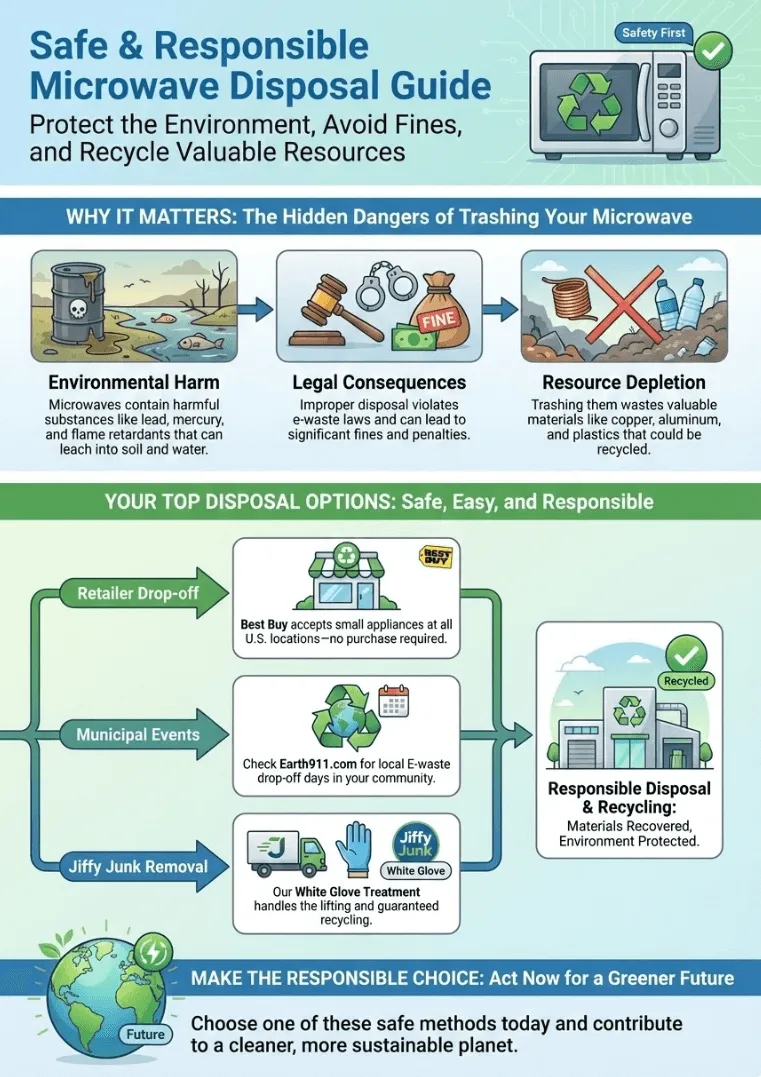
Microwaves contain circuit boards, magnetrons, and high-voltage capacitors that classify them as electronic waste. Most municipalities ban e-waste from standard garbage collection because these components can leach harmful materials into landfills and groundwater.
Beyond environmental concerns, there’s a practical reality: garbage collectors will simply leave your microwave at the curb. We regularly get calls from frustrated homeowners who tried curbside disposal first and ended up with an appliance baking in their driveway for days.
Your Microwave Disposal Options
Retailer Take-Back Programs: Many appliance retailers accept old microwaves when you buy a new one. Best Buy, Home Depot, and Lowe’s all have recycling programs, but the policies depend on location. Call ahead and make sure they’ll take your particular unit.
Local E-Waste Collection Events. Most counties have periodic e-waste drop-off days where you can drop off the microwaves for free. Check your municipal waste management’s website for the dates. The downside? These types of events usually occur only a few times a year.
Scrap Metal Recyclers Microwaves contain valuable metals, which the scrap yard will often take at no cost, and sometimes will even pay you for them. Find out if there are scrap metal recyclers in your area and call to find out if they accept small appliances.
Municipal Hazardous Waste Facilities: Your local hazardous waste or e-waste facility will accept microwaves, usually for free and with proof of residency. Hours and appointment requirements differ, so do your homework before loading up the car.
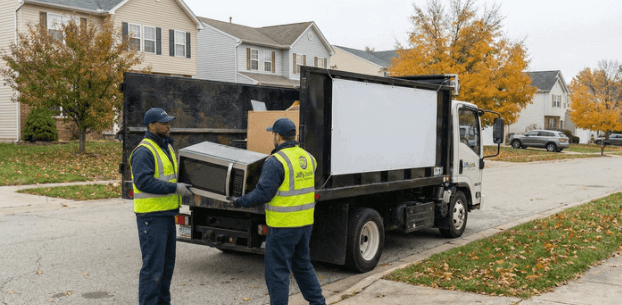
Professional Junk Removal When you need that microwave gone today – not in the future when the e-waste event rolls around – that’s when a junk removal service does the job. And we go out, we do it, and make sure it goes to a proper recycling facility.
How to Prepare Your Microwave for Disposal
Before any disposal method, take these simple steps:
1. Unplug the unit and let it sit for at least 24 hours. The capacitor inside can hold a dangerous charge even when disconnected.
2. Remove the glass turntable and roller ring. These can often be recycled separately or donated if still in good condition.
3. Wipe down the interior to remove food residue, especially if donating or selling a working unit.
4. Keep the door closed during transport to prevent damage and contain any loose parts.
One important safety note: never attempt to disassemble a microwave yourself. The capacitor can deliver a fatal shock even when the unit is unplugged. Leave internal components to professionals with proper equipment.
How to Avoid Fines
Illegal dumping penalties vary widely depending on where you live. In some states, improper e-waste disposal carries fines ranging from $100 to over $25,000 for repeat offenses.
The simplest way to stay compliant? Keep your receipt or documentation. Whether you drop your microwave at a recycling center, hand it to a retailer, or have a licensed junk removal company haul it away, that paper trail proves you disposed of it properly if questions ever arise.
When to Call a Junk Removal Service
DIY disposal works fine if you have the time, transportation, and a facility that’s convenient to your schedule. But from our experience, most people reach out to us because:
- The microwave is a built-in or over-the-range model that requires disconnection and heavy lifting
- They’re clearing out multiple appliances at once during a kitchen renovation or move
- Local recycling facilities have limited hours that conflict with their work schedule
- They simply want the certainty that it’s handled correctly without researching local regulations
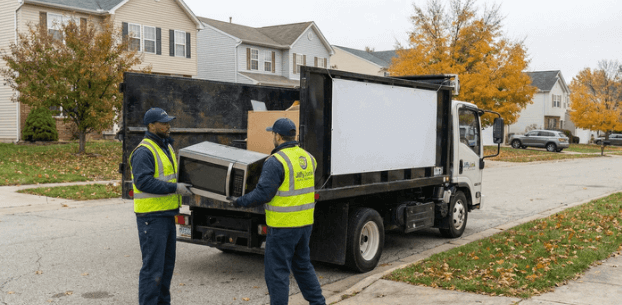
Our crews deal with microwave disposal daily. We know which local facilities accept them, we handle all the lifting, and we ensure your old appliance gets recycled properly—not dumped in a landfill.
The Bottom Line
You have plenty of options for getting rid of an old microwave responsibly. Retailer programs, e-waste events, scrap recyclers, and municipal facilities all work well if you have flexibility in your schedule. When you need it gone now with zero hassle, Jiffy Junk’s appliance removal service takes care of everything from your kitchen to the recycling center.
“After removing thousands of microwaves from homes across the country, the most common thing we hear is ‘I had no idea I couldn’t just put this on the curb’—that’s why we always make sure every appliance we haul gets to a certified recycling facility, not a landfill.” — Jiffy Junk Operations Team
7 Helpful Resources to Make Microwave Disposal Simple
We know that figuring out where to take an old microwave can feel overwhelming—trust us, we hear it from customers every day. That’s why we’ve pulled together the most reliable resources to help you handle this quickly and responsibly, whether you decide to go the DIY route or let our team take care of it for you.
1. Find a Recycling Drop-Off Near You in Seconds
Resource: Earth911 Recycling Search
URL: https://search.earth911.com/
This is the tool our team recommends when customers want to explore their options. Just type in “microwave” with your ZIP code, and you’ll see every drop-off center, collection event, and mail-in program in your area. With over 100,000 listings across North America, chances are there’s a convenient option closer than you think.
2. Drop Off Your Microwave at Best Buy—No Purchase Required
Resource: Best Buy Electronics and Appliances Recycling Program
URL: https://www.bestbuy.com/site/services/recycling/pcmcat149900050025.c
Here’s something many people don’t realize: Best Buy accepts electronics and small appliances for recycling at all U.S. locations, even if you didn’t buy them there. It’s a solid option if you’re already heading out for errands. Just check their state-specific guidelines first—some items may have a small recycling fee.
3. Know Your State’s Rules Before You Make a Move
Resource: State E-Waste Laws Interactive Map
URL: https://www.ecycleclearinghouse.org/contentpage.aspx?pageid=10
This one’s important. Twenty-five states plus Washington, D.C., have specific e-waste disposal laws, and the requirements vary quite a bit. Some states ban microwaves from landfills entirely, while others require manufacturers to offer take-back programs. A quick look at this interactive map helps you stay compliant and avoid any surprises.
4. Get the Official Word from the EPA
Resource: EPA Electronics Donation and Recycling Guide
URL: https://www.epa.gov/recycle/electronics-donation-and-recycling
When you want to be absolutely certain you’re doing things right, the EPA’s guidance is the gold standard. Their resource explains exactly why electronics need special handling and how to verify that a recycler meets federal environmental standards. It’s the same information our crews follow to ensure every appliance we haul gets processed responsibly.
5. Don’t Forget the Batteries—They Need Separate Handling
Resource: Call2Recycle Battery Drop-Off Locator
URL: https://www.call2recycle.org/locator/
If your microwave has a digital display, there’s a good chance it contains a small rechargeable battery that can’t go in the regular recycling stream. Call2Recycle makes this easy with over 30,000 free drop-off locations at retailers you probably already visit, like Home Depot, Lowe’s, and Best Buy.
6. Stay Safe—Microwaves Can Be More Dangerous Than They Look
Resource: Consumer Product Safety Commission Microwave Safety Warning
URL: https://www.cpsc.gov/s3fs-public/micro.pdf
We can’t stress this enough: please don’t try to take apart a microwave yourself. The high-voltage capacitor inside can hold a dangerous charge for even days after you’ve unplugged it. The CPSC has documented serious injuries and fatalities from DIY microwave repairs. When in doubt, leave the internal components to professionals who have the right equipment and training.
7. Give Your Working Microwave a Second Life
Resource: Habitat for Humanity ReStore Donation Locator
URL: https://www.habitat.org/restores/donate-goods
If your microwave still heats up just fine and you’re simply upgrading, donation is a wonderful alternative to disposal. Habitat ReStores accept gently used, working appliances and put the proceeds toward building affordable housing in your community. You’ll get a tax-deductible receipt, and someone else gets a microwave they need—everyone wins.
What We’ve Learned About E-Waste: The Numbers Behind Our Work
After hauling thousands of appliances out of homes across the country, our crews have developed a clear picture of where old microwaves end up—and why shortcuts create bigger problems than most people realize. Federal data confirms what we see every day on the job.
E-Waste Accounts for 70% of Toxic Landfill Waste
Electronic waste makes up only 2% of what goes into American landfills—but it represents 70% of the toxic waste in those same landfills.
What we see in the field:
- Microwaves were sitting in garages for years because homeowners didn’t know what to do with them
- Capacitors and circuit boards containing lead, cadmium, and other hazardous materials
- Appliances that would have been tossed curbside if customers knew garbage services wouldn’t take them
This is exactly why we partner with certified recyclers. Getting the microwave out of your house is only half the job—making sure it doesn’t become someone else’s environmental problem is the other half.
Source: U.S. Environmental Protection Agency https://www.epa.gov/archive/epapages/newsroom_archive/newsreleases/2b721e26484eb12a85257855006acce5.html
Only 38.5% of Electronics Get Recycled.
According to the EPA, only 38.5% of consumer electronics generated in 2018 were collected for recycling. The remaining 61.5%—over 1.6 million tons—went primarily to landfills.
Why we think this happens:
- Recycling options exist,t but aren’t convenient
- Drop-off facilities have limited hours
- People know microwaves can’t go in the trash, but don’t have time to research alternatives
- Appliances sit in basements and garages for months (sometimes years)
That’s a system problem, not a customer problem. It’s why we make appliance removal as simple as a phone call—because when disposal is convenient, more people do it the right way.
Our commitment: Every microwave we pick up goes to a certified facility. We track it, document it, and ensure it doesn’t become part of that 61.5%.
Source: U.S. Environmental Protection Agency https://www.epa.gov/facts-and-figures-about-materials-waste-and-recycling/frequent-questions-regarding-epas-facts-and
DIY Microwave Repairs Cause 2 Deaths Per Year
The Consumer Product Safety Commission documented an average of two electrocution deaths annually from consumers attempting to repair their own microwave ovens.
What most people don’t realize:
- The high-voltage capacitor retains a dangerous charge even when unplugged
- That charge can remain for days after disconnection
- A kitchen appliance that seems harmless can deliver a fatal shock
What our crews do differently:
- Trained to handle appliances safely
- Approach microwaves with caution, even during routine removal
- Never attempt internal disassembly on-site
We’ve had customers tell us they planned to “take it apart for scrap” before calling us. Every time, we’re grateful they reconsidered. A few dollars in recoverable metal isn’t worth the risk.
Source: U.S. Consumer Product Safety Commission https://www.cpsc.gov/s3fs-public/micro.pdf
Final Thoughts: Why Microwave Disposal Reflects a Bigger Problem
Here’s something we don’t often say out loud: the fact that disposing of a microwave is this complicated represents a failure of the system, not a failure of the customer.
The Honest Truth
We’ve been in this business long enough to recognize a pattern. Customers who call us about microwave disposal aren’t careless—they’re busy people who tried to do the right thing and hit a wall.
What we hear regularly:
- “I called the city, and they said they don’t take it.”
- “The recycling center is only open Tuesday and Thursday from 9 to 3.”
- “I’ve had this thing in my garage for eight months.”
- “I didn’t know it was illegal to throw it away.”
These aren’t excuses. They’re symptoms of disposal infrastructure that hasn’t kept pace with the electronics Americans are expected to manage responsibly.
What Should Change
If we could redesign the system:
1. Clearer point-of-sale communication. Know how to dispose of a microwave when you buy it—not years later when it breaks.
2. Accessible drop-off hours. Weekday-only facilities don’t serve people with traditional jobs. Evening and weekend availability should be standard.
3. Real manufacturer accountability. Companies producing millions of microwaves annually should bear more end-of-life responsibility—not just voluntary programs, but systems that make recycling as easy as purchasing.
4. Realistic expectations. When proper disposal requires research, transportation, and schedule flexibility, people default to the path of least resistance. That’s human nature, not moral failure.
Until systemic changes happen, households navigate a patchwork of local regulations, limited facilities, and inconsistent policies. That’s the gap we fill—but we’d rather see it not exist.
Why We Care Beyond the Business
We could show up, take your microwave, collect our fee, and move on. That’s never been how we operate.
What we’ve invested in:
- Relationships with certified recyclers
- Documented chain of custody for every appliance
- Facilities equipped for proper material recovery
What we know from doing this work:
- The 70% toxic waste statistic isn’t abstract to us—we’ve seen improper disposal at scale
- Safety warnings about capacitors aren’t overcautious—we’ve heard near-miss stories from customers
- Frustration about e-waste disposal is legitimate—the system genuinely is harder than it should be
We’re not environmentalists by training. We’re a junk removal company. But you can’t do this job with integrity without caring about where things end up.
Quick Summary
What this guide covered:
- Microwaves are e-waste—they can’t go in regular trash
- Fines range from $100 to $25,000+, depending on location
- High-voltage capacitors hold lethal charges even when unplugged
- Free options exist: retailers, municipal facilities, e-waste events
- Only 38.5% of electronics get recycled
- E-waste is 2% of landfill volume, but 70% of toxic waste
What we hope you take away:
Proper disposal isn’t difficult once you know your options. The challenge is that most people don’t encounter this information until they’re standing in their kitchen with a broken appliance.
If this guide helped you find a solution, we’ve done our job.
One Final Thought
Most people want to do the right thing with old appliances. They just need the process to be clear, convenient, and realistic.
Until the system catches up, we’ll keep showing up—hauling microwaves out of garages and basements, making sure they reach facilities where they’re handled responsibly.
That’s not just our business model. It’s our commitment.
FAQ on “Can a Microwave Be Thrown in the Trash”
Q: Can I throw a microwave in the regular trash?
A: No. Microwaves are classified as e-waste, and most garbage services won’t collect them.
What we see happen:
- The customer puts the microwave at the curb
- The garbage truck passes it by
- The appliance sits in the driveway collecting rain
- Customer calls us out of frustration—or lets it sit for weeks
Your actual options:
- Retailer programs (Best Buy accepts most appliances)
- Municipal e-waste facilities
- Scheduled collection events
- Professional junk removal
Any of these beats the curbside gamble.
Q: What happens if I put a microwave in the dumpster or trash?
A: Nothing good.
Possible outcomes:
- Best case: Collectors leave it behind—you’re back to square one
- Middle case: Warning from your waste management company
- Worst case: Fine ranging from $100 to $25,000+, depending on state laws
What we’ve seen:
- Customers calling after receiving code violation notices
- One customer’s fine costs more than replacing the microwave
- Appliances sitting curbside for weeks after rejection
Environmental reality: Lead and other hazardous materials leach into groundwater when e-waste reaches landfills.
The shortcut isn’t worth it. A few extra minutes of proper disposal saves real headaches.
Q: How do I get rid of a microwave for free?
A: More options exist than most people realize.
Free disposal options:
| Option | Notes |
| Best Buy | All U.S. locations; some state fees may apply |
| Municipal e-waste events | Free, but only a few times per year |
| Scrap metal recyclers | May take it for free or pay you a few dollars |
| Habitat ReStore | Working microwaves only |
The catch: Free options require your time.
- Facilities have limited hours
- Events happen on specific dates
- Scrap yards may be across town
What customers tell us: “I’ve had this microwave in my garage for six months waiting for a convenient drop-off.”
We get it. Free isn’t always free when you factor in time and logistics.
Pro tip: Always call ahead to confirm acceptance before making the trip.
Q: Is it safe to take apart a microwave myself to recycle the parts?
A: No. We strongly advise against it—and this isn’t overcautious.
The danger:
- High-voltage capacitors hold lethal charges for days after unplugging
- Consumer Product Safety Commission documents 2 electrocution deaths per year from DIY microwave repairs
- A kitchen appliance most people consider harmless can stop your heart
What our crews do:
- Trained in safe appliance handling
- Never attempt on-site disassembly
- Transport microwaves intact to certified facilities
What customers have told us: “I was going to crack it open for the copper before I decided to call you.”
Every time, we’re relieved they reconsidered. A few dollars in scrap isn’t worth the risk.
Bottom line: This is one DIY project that genuinely isn’t worth attempting.
Q: Where can I take an old microwave near me?
A: Start here: https://search.earth911.com/
Enter “microwave” + your ZIP code to find local options.
Other places to check:
- Best Buy: All U.S. locations accept small appliances
- Municipal hazardous waste facility: Call to confirm hours and residency requirements
- Local scrap metal recyclers: Many accept small appliances
The real barrier: Finding a location isn’t the problem. Finding one that fits your schedule is.
Most facilities operate weekday business hours only. That doesn’t work for everyone.
If making the trip isn’t realistic, we handle microwave removal daily—typically within a day or two of your call.
What you get:
- No loading it in your car
- No taking time off work
- No, hoping the facility is open when you arrive
- Certified recycling guaranteed
Skip the Hassle—Let Jiffy Junk Handle Your Microwave Disposal
Now that you know a microwave can’t go in the trash, let us take it from here. Book online in 60 seconds at www.jiffyjunk.com/booking or call 844-JIFFY-JUNK—we’ll handle the heavy lifting, ensure proper recycling, and give you back your space without the fines or the worry.