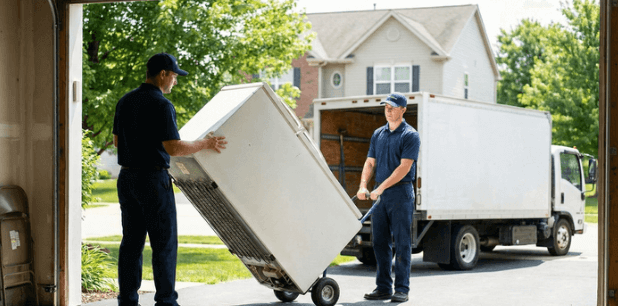
Fridge Pick Up, Removal, Haul Away, and Disposal Made Easy: How to Get Rid of an Old Refrigerator Without the Heavy Lifting, Hassle, or Stress of Doing It Yourself
That old refrigerator weighs 200+ pounds, contains EPA-regulated refrigerants, and isn’t going anywhere on its own. Most people underestimate what proper disposal actually involves—until they’re stuck.
In our experience removing thousands of refrigerators from homes nationwide, we’ve found three things consistently surprise customers: municipal services often won’t accept fridges curbside, recycling centers frequently require advance appointments and refrigerant certification, and retailer take-back programs typically only apply when you’re buying new. What looks like a simple pickup becomes a logistics puzzle fast.
We’ve hauled fridges from third-floor walkups, navigated units through doorways with barely an inch of clearance, and handled models so old the refrigerant requires specialized recovery equipment. After a decade in the junk removal industry, we know that refrigerator disposal sits at the intersection of heavy appliance logistics and environmental compliance—two areas where DIY approaches often fall short.
This guide covers your realistic options: utility rebate programs, retailer haul-away policies, donation routes, and professional removal services. We’ll break down actual costs, timeline expectations, and the environmental regulations that apply to your situation.
When you’re ready to skip the hassle entirely, Jiffy Junk’s White Glove Treatment handles disconnection, removal from any location in your home, and eco-responsible disposal—recycling and donation prioritized.
No heavy lifting. No refrigerant headaches. Just reclaimed space.
Quick Answers
How to Get Rid of an Old Refrigerator
After removing thousands of refrigerators nationwide, here are the most reliable options:
- Utility rebate programs – Get paid $25–$75 for working units
- Retailer haul-away – Available with new appliance purchase ($25–$50)
- Donation – Habitat for Humanity ReStores accepts working fridges under 10 years old
- Municipal bulk pickup – Check local requirements; many require prior refrigerant removal
- Professional junk removal – Fastest option; handles refrigerant compliance for you
Important: Refrigerators contain EPA-regulated refrigerants. Don’t leave them curbside without scheduled pickup—improper disposal can result in fines and environmental harm.
Fastest solution: Call Jiffy Junk at 844-543-3966. We handle disconnection, removal from any location, and eco-responsible disposal—often same-day.
Top Takeaways
- Refrigerators can’t go out with regular trash.
- EPA regulations require certified refrigerant recovery
- Most curbside services won’t accept them without documentation
- You may get paid to recycle a working unit.
- Utility rebates: $25–$75 typical
- Retailer haul-away: Often available with a new purchase
- The numbers are significant.
- 11+ million refrigerators are disposed of annually in the U.S.
- Proper recycling recovers steel, aluminum, copper, and glass
- Old refrigerators cost more than you think.
- 15+ year-old units use 20%+ more energy
- That’s $95+ per year in wasted electricity
- Professional removal is often the simplest solution.
- One call handles disconnection, removal, and disposal
- Jiffy Junk offers same-day service and eco-responsible recycling
Table of contents
- Fridge Pick Up, Removal, Haul Away, and Disposal Made Easy: How to Get Rid of an Old Refrigerator Without the Heavy Lifting, Hassle, or Stress of Doing It Yourself
- Quick Answers
- Top Takeaways
- Why Refrigerator Disposal Requires More Than Curbside Pickup
- Your Refrigerator Disposal Options
- When Professional Removal Makes Sense
- What Jiffy Junk’s White Glove Treatment Includes
- Understanding Removal Costs
- Environmental Responsibility Matters
- Essential Resources for Refrigerator Disposal
- 1. Understand What Federal Law Requires
- 2. Find Out What Your Old Fridge Is Really Costing You
- 3. Discover Rebates and Free Pickup Programs in Your Area
- 4. Give Your Working Fridge a Second Life Through Donation
- 5. Locate Certified Recyclers Right in Your Neighborhood
- 6. Confirm Your Recycler Follows Eco-Friendly Practices
- 7. Search Every Available Incentive in Your State
- Supporting Statistics
- Final Thought & Opinion
- Next Steps
- FAQ on “How to Get Rid of an Old Refrigerator”
- Q: Can I put my old refrigerator on the curb for regular trash pickup?
- Q: How much does it cost to have an old refrigerator removed?
- Q: Will anyone pick up a broken refrigerator for free?
- Q: What happens to my refrigerator after it’s hauled away?
- Q: Can I donate my old refrigerator instead of throwing it away?
- Ready to Get Rid of Your Old Refrigerator the Easy Way?
Why Refrigerator Disposal Requires More Than Curbside Pickup
Refrigerators aren’t like other large items you can leave at the curb. They contain refrigerants—chemicals like Freon, R-134a, or newer blends—that federal law requires to be recovered by certified technicians before disposal. The compressor also holds oils that need proper handling. Toss a fridge improperly, and you’re looking at potential fines and environmental damage.
Beyond the regulatory side, there’s the sheer physical challenge. A standard refrigerator weighs between 150 and 300 pounds, with older models often tipping the heavier end of that scale. Moving one without proper equipment risks damage to your floors, walls, and doorframes—not to mention your back.
Your Refrigerator Disposal Options
Retailer Take-Back Programs: Many appliance retailers offer haul-away when you purchase a new unit. Availability varies, and fees typically range from $25 to $50. The catch: this only works if you’re buying a replacement.
Utility Company Rebates: Some electric companies offer $25 to $75 to pick up working refrigerators as part of energy efficiency programs. The unit usually needs to be operational and meet size requirements—programs aren’t designed for broken appliances.
Municipal Bulk Pickup: Select cities offer appliance collection days, though many require you to schedule in advance, pay a separate fee, and certify that refrigerants have been professionally removed beforehand.
Scrap Metal Recyclers: Local recyclers may accept refrigerators, but most require refrigerant removal documentation. You’ll also need a way to transport a 200-pound appliance yourself.
Donation: Organizations like Habitat for Humanity ReStores accept working refrigerators in good condition. If your fridge still runs reliably, a donation keeps it out of the waste stream and helps someone in need.
When Professional Removal Makes Sense
We’ve found that most customers reach out after hitting a wall with DIY options. The retailer charges extra, the utility program has a six-week waitlist, and municipal pickup requires refrigerant certification that they don’t have. Meanwhile, the old fridge sits in the kitchen or garage, taking up space.
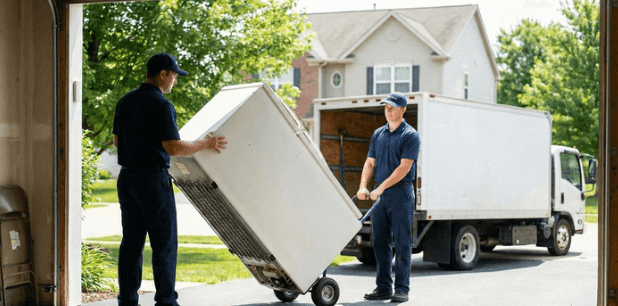
Professional junk removal works by solving the logistics problem totally. Our crews show up with all the right tools, dollies, and experience to get into tight spaces-we’ve taken fridges from basements, workshop spaces, upstairs apartments, and garages full of decades of collectibles. We deal with disconnection, transport, and make sure they are properly disposed of through certified recycling partners.
What Jiffy Junk’s White Glove Treatment Includes
When you book refrigerator removal with Jiffy Junk, our licensed and insured team manages every step:
- Assessment and upfront quote: We evaluate access points and provide transparent pricing before any work begins.
- Careful removal: Protective measures for your floors and walls, with experienced handling through doorways and stairwells.
- Eco-responsible disposal: We prioritize recycling and work with certified facilities for refrigerant recovery. Working units in good condition go to donation partners whenever possible.
- Complete cleanup: We don’t leave debris, packaging, or mess behind. Your space is ready to use immediately.
Understanding Removal Costs
Refrigerator removal costs depend on factors like location within the home, accessibility, and whether additional items need hauling. Single-appliance pickups typically fall within a predictable range, and bundling the fridge with other items you need gone often provides better overall value.
We provide quotes upfront with no hidden fees—the price we give is the price you pay. That transparency is central to how we operate.
Environmental Responsibility Matters
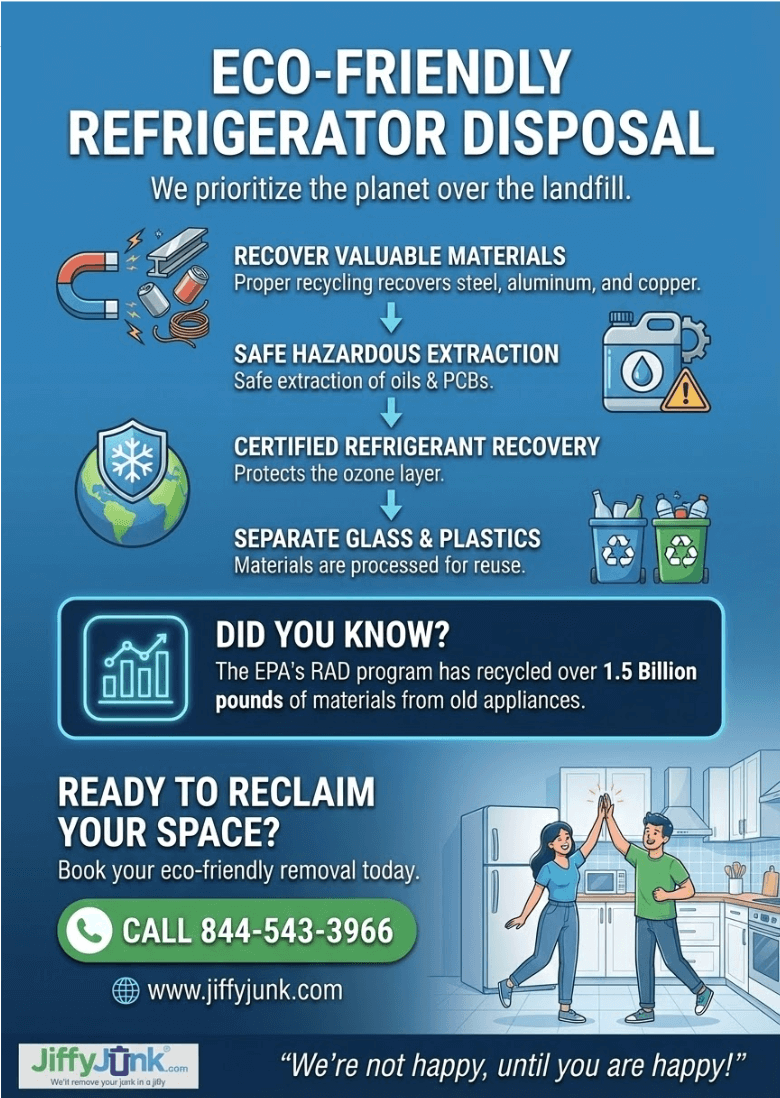
Refrigerators contain materials that shouldn’t end up in landfills: refrigerants that deplete ozone or contribute to greenhouse effects, oils, foam insulation with embedded chemicals, and plastics that take centuries to break down. Proper recycling recovers steel, aluminum, copper, and glass while ensuring hazardous components are handled safely.
In our experience, customers increasingly care about where their old appliances end up. When you choose Jiffy Junk, you’re choosing a company that prioritizes recycling and donation over landfill disposal—because responsible removal shouldn’t be an afterthought.
“After removing thousands of refrigerators from homes across the country, we’ve learned that the biggest challenge isn’t the weight—it’s the combination of tight spaces, EPA compliance requirements, and customers who’ve already spent weeks trying to find a simpler solution that doesn’t exist. Our job is to be that simpler solution.” — Jiffy Junk Operations Team
Essential Resources for Refrigerator Disposal
We know you want to handle your refrigerator removal the right way—and that means having the information you need to make a smart decision. Whether you’re exploring rebates, looking into donation options, or simply trying to understand the regulations, these seven resources will point you in the right direction.
1. Understand What Federal Law Requires
Before scheduling any pickup, it helps to know the rules. The EPA’s Section 608 guidelines explain what’s legally required for refrigerator disposal, including professional refrigerant recovery. A quick read ensures you’re covered—and helps you avoid any surprises.
Source: U.S. Environmental Protection Agency https://www.epa.gov/section608/appliance-disposal
2. Find Out What Your Old Fridge Is Really Costing You
That older refrigerator in your kitchen or garage might be using more electricity than you realize. ENERGY STAR’s Flip Your Fridge Calculator shows you the annual operating costs and potential savings from upgrading. Just enter your model number or appliance age—it only takes a minute.
Source: U.S. Department of Energy / ENERGY STAR https://www.energystar.gov/products/refrigerators/flip-your-fridge
3. Discover Rebates and Free Pickup Programs in Your Area
Here’s some good news: many utility companies actually pay you to recycle your old refrigerator. This ENERGY STAR directory helps you find local programs offering cash rebates (often $25–$75 or more) along with free appliance pickup. It’s worth checking before you make any decisions.
Source: U.S. Department of Energy / ENERGY STAR https://www.energystar.gov/products/recycle/find_fridge_freezer_recycling_program
4. Give Your Working Fridge a Second Life Through Donation
If your refrigerator still runs well, donating it keeps a perfectly good appliance out of the waste stream—and supports families in your community. Habitat for Humanity ReStores accept working refrigerators (typically under 10 years old) and often provide free pickup. It’s a simple way to do some good.
Source: Habitat for Humanity International https://www.habitat.org/restores/donate-goods
5. Locate Certified Recyclers Right in Your Neighborhood
Not sure where to take an old appliance? Earth911’s recycling locator searches over 100,000 locations nationwide to find appliance recyclers and municipal programs near you. Just enter your ZIP code to see your options.
Source: Earth911 https://earth911.com/recycling-guide/how-to-recycle-large-appliances/
6. Confirm Your Recycler Follows Eco-Friendly Practices
When it comes to refrigerator disposal, not all recyclers are created equal. The EPA’s RAD Program identifies utilities, retailers, and manufacturers committed to responsible disposal—recovering refrigerants, recycling materials, and properly handling any hazardous components. Choosing a RAD partner means your appliance won’t end up harming the environment.
Source: U.S. Environmental Protection Agency https://www.epa.gov/section608/appliance-disposal
7. Search Every Available Incentive in Your State
DSIRE is the go-to database for state, local, and utility-based incentive programs across the country. Search by your location for appliance recycling rebates, energy-efficient upgrades discounts, and other programs that might save you money.
Source: N.C. Clean Energy Technology Center / N.C. State University https://www.dsireusa.org/
Of course, when you’re ready to skip the research and have someone handle everything for you, Jiffy Junk’s White Glove Treatment takes care of the entire process—from disconnection to eco-responsible disposal. Just point to the fridge, and we’ll do the rest.
Supporting Statistics
After a decade of removing refrigerators from homes nationwide, we’ve seen how these numbers play out in real-world situations. Here’s what federal data tells us—and what our crews experience every day.
11+ Million Refrigerators Disposed Annually
The EPA estimates 11–13 million refrigerated appliances reach end-of-life each year in the U.S. We see this reflected in our own call logs—refrigerator removal ranks among our most requested services.
What we’ve learned in the field:
- Appliances left curbside without a scheduled pickup often end up mishandled
- Illegal dumping and improper refrigerant venting still occur despite federal regulations
- Working with certified recycling partners ensures EPA guidelines are followed
Source: U.S. Environmental Protection Agency https://www.epa.gov/section608/appliance-disposal
Refrigerators Over 15 Years Old Cost $95+ Annually
ENERGY STAR data shows that older refrigerators drain more money than most people realize.
Key findings:
- 15+ year-old units cost over $95/year just to operate
- Old refrigerators use roughly 20% more energy than current ENERGY STAR models
- Replacing every outdated U.S. refrigerator would save $330 million in annual energy costs
- That same replacement would prevent 5.5 billion pounds of greenhouse gas emissions
In our experience, this information helps customers finally let go of that second garage fridge they’ve kept “just in case.” It’s not just taking up space—it’s quietly costing money every month.
Source: U.S. Department of Energy / ENERGY STAR https://www.energystar.gov/products/refrigerators
Proper Recycling Recovers 1.5 Billion Pounds of Materials
The EPA’s Responsible Appliance Disposal Program proves what responsible handling achieves at scale.
RAD Program results (2006–2025):
- 9+ million refrigerated appliances processed
- 1.5 billion pounds of metals, plastics, and materials recycled
- 543,000+ hazardous components safely managed
- Emissions avoided are equivalent to powering 5 million homes annually
These numbers validate our approach. When we haul away your refrigerator, we ensure:
- Steel and metals get reclaimed
- Refrigerants are recovered properly
- Hazardous materials stay out of landfills
Customers increasingly ask where their appliances go after pickup. We’re always glad to tell them.
Source: U.S. Environmental Protection Agency https://www.epa.gov/section608/appliance-disposal
When you choose Jiffy Junk’s White Glove Treatment, you’re choosing a team that takes these consequences seriously—eco-responsible disposal, recycling prioritized, and complete transparency about where your appliance ends up.
Final Thought & Opinion
Getting rid of an old refrigerator sounds simple—until you’re standing in front of a 200-pound appliance trying to figure out your next move. Between EPA regulations, municipal pickup limitations, utility rebate requirements, and the physical challenge of moving a heavy unit through tight spaces, what seems straightforward becomes a logistics puzzle fast.
Your Options at a Glance
This guide covered several paths forward:
- Utility rebate programs that pay you to recycle working units
- Retailer take-back services tied to new appliance purchases
- Donation routes for refrigerators still in good condition
- Professional removal when you need the simplest path forward
Each option has trade-offs in cost, timeline, and effort required.
Our Honest Take
After removing thousands of refrigerators from homes across the country, here’s what we’ve learned:
Most people underestimate what proper disposal involves. That’s not their fault—the junk removal industry doesn’t always make it clear what happens after appliances leave your home. We’ve seen too many units mishandled: refrigerants vented, recyclable materials sent straight to landfills.
Every refrigerator contains recoverable materials. Steel, aluminum, copper, glass. The EPA’s data showing 1.5 billion pounds recycled through responsible programs proves what’s possible when disposal is done right. Yet most refrigerators disposed of each year never see that level of care.
If You Handle It Yourself
- Use the resources outlined in this guide
- Verify your recycler follows EPA guidelines
- Ask where your appliance actually ends up
- Don’t assume curbside pickup means responsible disposal
If You’d Rather Skip the Hassle
That’s exactly why we’re here.
Jiffy Junk’s White Glove Treatment includes:
- Disconnection handled by our team
- Careful removal from wherever your refrigerator sits
- Eco-responsible disposal with recycling and donation prioritized
- Transparent, upfront pricing—no surprises, no hidden fees
Just reclaimed space where that old unit used to be.
Next Steps
Ready to get that old refrigerator out of your home? Follow this clear path based on your situation.
Step 1: Assess Your Refrigerator
Answer these quick questions first:
- Still running? Working units qualify for rebates and donations
- How old? Units 15+ years old rarely qualify for resale
- Where is it? Basement or upstairs locations affect DIY options
Step 2: Choose Your Path
Working refrigerator under 10 years old:
- Check Habitat for Humanity ReStore for donation pickup
- Contact your electric utility about rebate programs ($25–$75 typical)
- Ask retailers about haul-away with a new purchase
Broken or outdated refrigerator:
- Verify municipal pickup availability and requirements
- Search Earth911 for certified recyclers nearby
- Confirm EPA-compliant refrigerant recovery
Want the simplest solution:
- Call Jiffy Junk or book online
- Point to the refrigerator
- We handle everything else
Step 3: Gather Your Information
Have this ready before scheduling:
- Refrigerator location (floor level, access points)
- Approximate dimensions and age
- Your timeline (same-day, scheduled, flexible)
- Any additional items needing removal
Step 4: Compare Your Options
| Option | Best For | Timeline |
| Utility rebate | Working units, flexible schedule | 2–6 weeks |
| Retailer haul-away | New appliance purchases | Delivery day |
| Donation pickup | Working units under 10 years | 1–2 weeks |
| Municipal pickup | Budget-conscious, flexible | Varies |
| Professional removal | Any condition, fast turnaround | Same day–48 hours |
Step 5: Confirm Responsible Disposal
Ask any service provider these questions:
- Will certified technicians recover refrigerants?
- What percentage of materials get recycled?
- Will working units be donated?
- Can you document proper disposal?
FAQ on “How to Get Rid of an Old Refrigerator”
Q: Can I put my old refrigerator on the curb for regular trash pickup?
A: In most cases, no. This is one of the biggest misconceptions we encounter.
Why standard trash pickup won’t work:
- Refrigerators contain EPA-regulated refrigerants requiring certified recovery
- Most municipal waste services won’t accept refrigerators with regular trash
- Many bulk pickup programs require proof of prior refrigerant removal
What we’ve seen in the field: Customers often don’t discover these requirements until the refrigerator is already at the curb. Save yourself the hassle—check with your local Department of Public Works first, or use a professional service that handles compliance for you.
Q: How much does it cost to have an old refrigerator removed?
A: We get this question daily. The honest answer: it depends on your method.
Typical cost ranges:
- Utility rebate programs: Pay you $25–$75 (working units only)
- Retailer haul-away: $25–$50 with new purchase
- Municipal bulk pickup: Free to $50+ (varies by location)
- Professional junk removal: Based on location, accessibility, and volume
What we’ve learned: Customers who bundle the refrigerator with other items—old furniture, appliances, garage cleanouts—often get better overall value than single-item removal. Jiffy Junk provides upfront quotes with no hidden fees.
Q: Will anyone pick up a broken refrigerator for free?
A: This is where expectations meet reality. Free options for non-working units are limited.
Why free pickup is hard to find:
- Utility rebate programs require working units
- Donation organizations need sellable appliances
- Scrap recyclers often require refrigerant removal documentation first
Our experience: We’ve seen customers spend weeks calling around for free broken-refrigerator pickup—only to end up where they started. If free options aren’t panning out, professional removal gets the job done. Sometimes, the same day you call.
Q: What happens to my refrigerator after it’s hauled away?
A: More customers ask this now, and we’re glad they do. What happens depends entirely on who removes it.
Responsible disposal includes:
- Certified refrigerant recovery by trained technicians
- Extraction of hazardous components (mercury switches, PCB capacitors)
- Separation of materials for recycling (steel, aluminum, copper, plastic, glass)
- Proper documentation of the process
The numbers:
- EPA reports proper recycling diverts up to 85% of refrigerator weight from landfills
- Not all haulers follow these practices
- Illegal dumping and refrigerant venting still occur
Jiffy Junk’s approach:
- We work with certified recycling partners
- Working units go to donation when possible
- We answer questions about where your appliance ends up—transparency matters
Q: Can I donate my old refrigerator instead of throwing it away?
A: Yes—if it meets the criteria. Donation is often the most satisfying option when it works out.
Organizations that accept working refrigerators:
- Habitat for Humanity ReStores (typically under 10 years old)
- The Salvation Army (varies by location)
- Local Goodwill chapters (functioning units only)
Benefits of donation:
- Keeps usable appliances out of the waste stream
- Supports community programs
- May qualify for tax deduction
- Many organizations offer free pickup
What we’ve seen: Donation pickups sometimes fall through—unit too old, cosmetic damage, changed requirements. If the donation doesn’t work out, certified recycling still ensures responsible handling.
Ready to Get Rid of Your Old Refrigerator the Easy Way?
Skip the heavy lifting, the refrigerant headaches, and the stress of figuring it out yourself—Jiffy Junk’s White Glove Treatment handles everything from disconnection to eco-responsible disposal. Call 844-543-3966 or book online at www.jiffyjunk.com/booking for a free, no-obligation quote today.