How Big Is a 20 Cubic Yard Dumpster Really? A Clear Look at Size Dimensions, Capacity, and Rental Cost to Help You Decide If It’s Right for You
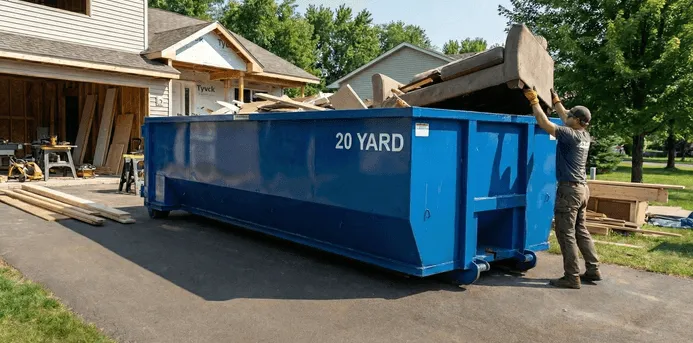
A 20 cubic yard dumpster measures roughly 22 feet long, 8 feet wide, and 4 feet tall—about the footprint of a parking space stacked chest-high. In our experience hauling thousands of loads nationwide, we’ve seen this size handle everything from complete garage cleanouts to mid-sized kitchen renovations with room to spare.
Here’s what most rental companies won’t tell you: cubic yard capacity and usable space aren’t the same thing. Bulky furniture eats up volume fast, while dense materials like concrete hit weight limits long before you fill the container. We’ve watched customers overpay for 30-yarders they didn’t need—and others squeeze a 20-yard job into a 15-yarder, only to pay overage fees.
This guide shares the real-world sizing insights we’ve learned on the job so you can choose confidently. We’ll cover true dimensions, realistic capacity by project type, weight restrictions that impact cost, and how to know when a 20-yarder is the right call for your specific situation.
Quick Answers
20 Yard Dumpster
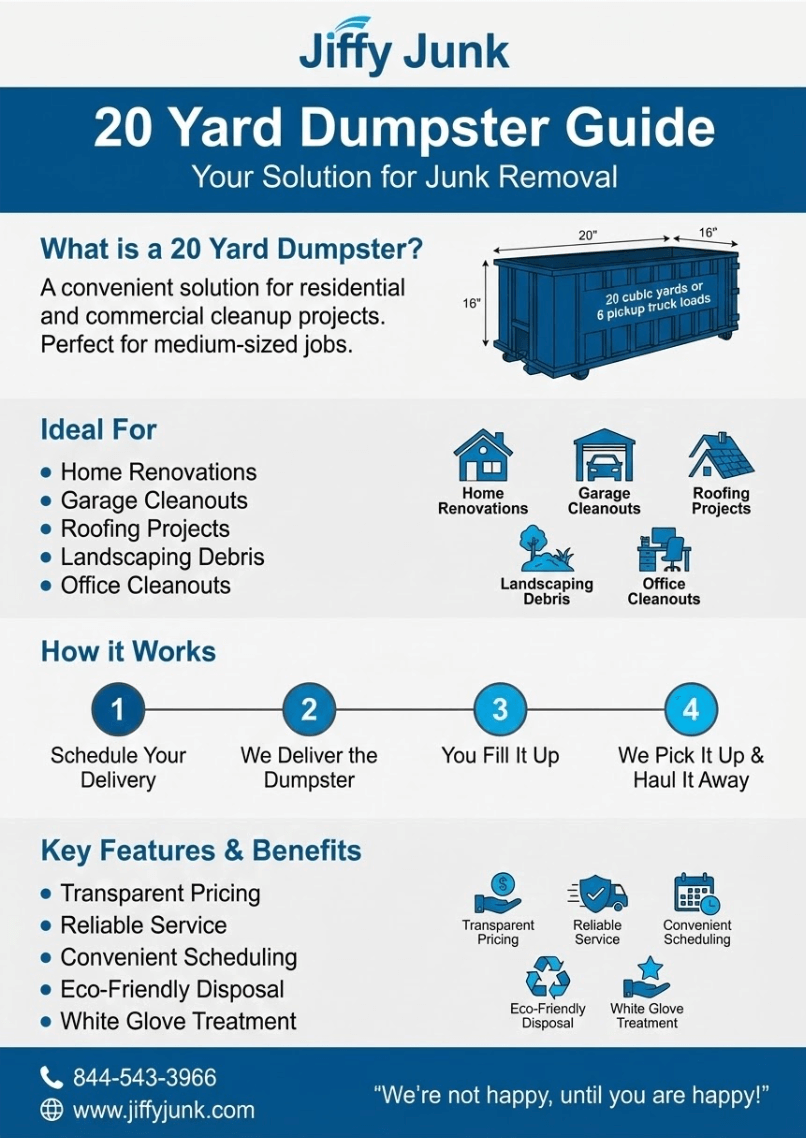
A 20-yard dumpster measures approximately 22 feet long × 8 feet wide × 4 feet tall and holds about 6 pickup truck loads of debris.
Key facts:
- Capacity: 20 cubic yards (~110–130 trash bags)
- Weight limit: 2–4 tons, depending on location
- Rental cost: $350–$600 for 7 days
- Fits: Standard residential driveways
Best for:
- Whole-home cleanouts
- Kitchen and bathroom renovations
- Estate cleanouts (2–3 bedroom homes)
- Garage, attic, and basement purges
- Small roofing projects (under 1,500 sq ft)
What we’ve learned: After thousands of deliveries, the 20-yarder handles roughly 70% of mid-sized residential projects. It’s the sweet spot between capacity and cost for most homeowners.
Watch for weight: Volume fills the container, but weight determines your final cost. Heavy materials like concrete and roofing shingles can max out tonnage limits before the dumpster looks full.
Top Takeaways
- Dimensions: 22′ long × 8′ wide × 4′ tall. Holds ~6 pickup truck loads. Fits most standard driveways.
- Weight matters more than volume. A half-full container of concrete can cost more than one overflowing with furniture. Always ask about tonnage limits before booking.
- Works for 70% of residential projects. The 20-yarder is the practical middle ground—large enough for serious cleanouts, compact enough for most properties.
- Cost runs $350–$600 for 7 days. Final price depends on location, materials, and weight. Demand transparent pricing upfront—no clear quote is a red flag.
- Donate first, dumpster second. A quick call to ReStore can divert hundreds of pounds, lower your costs, and give usable items a second life.
Table of contents
- How Big Is a 20 Cubic Yard Dumpster Really? A Clear Look at Size Dimensions, Capacity, and Rental Cost to Help You Decide If It’s Right for You
- Quick Answers
- Top Takeaways
- Exact Dimensions of a 20-Cubic-Yard Dumpster
- What a 20 Yard Dumpster Actually Holds
- Best Projects for a 20 Yard Dumpster
- Weight Limits: The Hidden Factor in Dumpster Sizing
- 20 Yard Dumpster Rental Costs
- How to Know If a 20 Yard Dumpster Is Right for You
- 7 Helpful Resources We Recommend Before You Rent a Dumpster
- 1. Know What Belongs in Your Dumpster — EPA Household Hazardous Waste Guidelines
- 2. Understand the Rules for Renovation and Construction Materials — EPA Sustainable Materials Management
- 3. Donate Usable Items and Give Them a Second Life — Habitat for Humanity ReStore
- 4. Find Local Recycling Options Near You — Earth911 Recycling Center Search
- 5. Estimate Your Debris Weight Before You Book — Dumpster Weight Calculator Tools
- 6. Check Whether You Need a Permit — Dumpster Permit Requirements Guide
- 7. Calculate Waste for Larger Construction Projects — CalRecycle C&D Waste Stream Tool
- Why We Share These Resources
- Supporting Statistics
- Final Thought & Opinion
- FAQ on “20 Yard Dumpster”
- Ready to Find Out If a 20 Yard Dumpster Is Right for Your Project?
Exact Dimensions of a 20-Cubic-Yard Dumpster
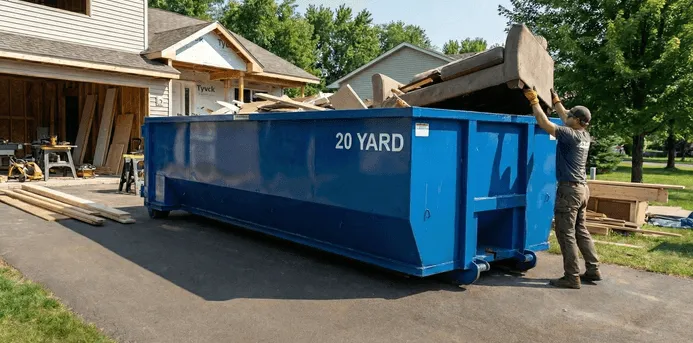
A standard 20 cubic yard dumpster measures approximately 22 feet long, 8 feet wide, and 4 feet tall. These dimensions can vary slightly between providers, but most containers fall within a foot of these measurements.
To visualize the footprint, think of a standard parking space—that’s roughly the ground clearance you’ll need. The 4-foot sidewall height is significant because it sits low enough for most people to toss items over the edge without a ladder, yet tall enough to hold substantial volume. In our experience, this accessible height makes loading faster and safer than taller containers that require climbing or ramps.
What a 20 Yard Dumpster Actually Holds
The 20 cubic yard capacity translates to approximately 6 full pickup truck loads or about 110–130 standard 33-gallon bags. However, real-world capacity depends heavily on what you’re loading.
Loose, bulky items like furniture, mattresses, and cardboard boxes consume space quickly but weigh relatively little. Dense materials such as roofing shingles, concrete, and soil pack tightly but hit weight limits fast. We’ve found that mixed residential cleanouts—a combination of furniture, household items, and general debris—typically use the container’s volume and weight capacity proportionally. Single-material loads require more careful planning to avoid overages on one side or the other.
Best Projects for a 20 Yard Dumpster
After years of matching customers to the right container size, we’ve identified the projects where a 20-yarder consistently performs well.
Whole-home decluttering spanning multiple rooms, attics, basements, and garages fits comfortably in this size. Mid-sized renovations like kitchen or bathroom remodels generate enough debris—cabinetry, flooring, drywall—to justify the capacity without excessive overage. Estate cleanouts involving furniture, clothing, and general household contents from a 2–3 bedroom home typically fill a 20-yard container. Roofing projects on homes up to approximately 1,500 square feet work well, though larger roofs may require a 30-yard or multiple hauls.
Projects that often need sizing up include full home renovations, large construction jobs, and commercial cleanouts. Projects that could size down include single-room cleanouts, small landscaping jobs, and light decluttering—a 10 or 15-yard container may serve those needs more economically.
Weight Limits: The Hidden Factor in Dumpster Sizing
Here’s where many first-time renters get surprised: dumpster pricing isn’t just about volume. Every container comes with a weight allowance, typically ranging from 2 to 4 tons for a 20-yard dumpster, depending on the provider and disposal facility.
Lightweight materials like cardboard, wood furniture, and general household items rarely approach weight limits before filling the container. Heavy materials change the equation entirely. Concrete, brick, roofing shingles, and dirt can max out weight allowances with the dumpster only partially full. We’ve seen 20-yard containers hit their tonnage cap at just one-third capacity when loaded with concrete debris.
Our recommendation: if your project involves heavy materials, ask about weight limits upfront and consider whether a smaller container with a higher weight allowance—or multiple hauls—makes more financial sense than paying overage fees per ton.
20 Yard Dumpster Rental Costs
Rental pricing for a 20 cubic yard dumpster typically ranges from $350 to $600 for a standard 7-day rental period. Several factors influence where your quote falls within that range.
Location affects pricing significantly due to varying disposal fees, landfill tipping rates, and transportation costs. Urban areas with higher operating expenses generally sit at the upper end. Rental duration beyond the standard period incurs daily extension fees, usually $10–$25 per additional day. Material type matters because certain items—like electronics, mattresses, or hazardous materials—require special handling or disposal methods that add cost. Weight overages typically run $40–$75 per additional ton beyond your included allowance.
Transparent pricing without hidden fees remains central to how we operate. When you request a quote, we account for your specific project type, location, and estimated weight so the number we give you is the number you pay.
How to Know If a 20 Yard Dumpster Is Right for You
Choosing the right size comes down to three honest assessments: project scope, material type, and available space.
Project scope: If you’re clearing out more than one room but less than an entire large home, a 20-yarder likely fits. Single-room projects can often downsize; full estate cleanouts of larger properties may need to size up.
Material type: Mixed household contents and light renovation debris work perfectly. Heavy material loads—concrete, soil, roofing from larger homes—may require recalculating based on weight rather than volume.
Available space: Ensure you have a flat surface roughly 22 feet long and 10 feet wide (allowing clearance for delivery). Driveways work well; tight urban spaces may present challenges. We recommend measuring beforehand and confirming placement logistics during booking.
When customers call us uncertain about sizing, we ask about their specific project and make honest recommendations—even when that means suggesting a smaller container. Overpaying for unused capacity benefits no one, and our goal is to match you with exactly what you need.
“After delivering thousands of dumpsters, we’ve learned that the 20-yarder works for about 70% of residential projects—but the customers who run into trouble are almost always surprised by weight limits, not volume. A container half-full of concrete can cost more in overage fees than renting the next size up, so we always ask what’s going on before we talk about how much space you need.” — Jiffy Junk Operations Team
7 Helpful Resources We Recommend Before You Rent a Dumpster
At Jiffy Junk, we believe informed customers make confident decisions. Before you book a 20-yard dumpster, a little research goes a long way toward avoiding surprise fees and ensuring your project runs smoothly. We’ve compiled these trusted resources from government agencies and nonprofit organizations to help you plan—because we’re not happy until you are.
1. Know What Belongs in Your Dumpster — EPA Household Hazardous Waste Guidelines
Certain household items require special handling and cannot go in a standard dumpster. The EPA explains which materials—like paint, batteries, and cleaning chemicals—need alternative disposal. Reviewing this guide helps you sort your items properly and stay compliant.
Source: U.S. Environmental Protection Agency
URL: https://www.epa.gov/hw/household-hazardous-waste-hhw
2. Understand the Rules for Renovation and Construction Materials — EPA Sustainable Materials Management
Planning a remodel or cleanout that involves drywall, lumber, or roofing materials? Federal guidelines outline proper disposal and recycling practices for construction debris. This resource helps you handle C&D materials the right way.
Source: U.S. Environmental Protection Agency
URL: https://www.epa.gov/smm/sustainable-materials-management-basics
3. Donate Usable Items and Give Them a Second Life — Habitat for Humanity ReStore
Before anything goes in the dumpster, consider whether it could help someone else. ReStore locations accept furniture, appliances, and building materials in good condition—and many offer free pickup. Donating first means less to haul and more good in your community.
Source: Habitat for Humanity
URL: https://www.habitat.org/restores/donate-goods
4. Find Local Recycling Options Near You — Earth911 Recycling Center Search
Not sure where to take electronics, tires, or old appliances? Earth911 lets you search over 100,000 recycling locations by zip code. It’s a quick way to find responsible disposal options for items that need special handling.
Source: Earth911
URL: https://search.earth911.com/
5. Estimate Your Debris Weight Before You Book — Dumpster Weight Calculator Tools
Weight limits matter just as much as volume. These interactive calculators help you estimate tonnage for common materials like shingles, concrete, drywall, and carpet. A few minutes with this tool can save you from unexpected overage charges.
Source: Dumpsters.com
URL: https://www.dumpsters.com/resources/dumpster-weight-calculator
6. Check Whether You Need a Permit — Dumpster Permit Requirements Guide
Permit rules vary by city and neighborhood. This guide walks you through when a permit is required, how to apply, and what placement rules may affect your driveway or street. A quick check now prevents delays later.
Source: Dumpsters.com
URL:https://www.dumpsters.com/resources/dumpster-permits
7. Calculate Waste for Larger Construction Projects — CalRecycle C&D Waste Stream Tool
Tackling a bigger renovation or demolition? This state-level calculator helps you estimate construction waste composition by volume and weight—useful for detailed project planning and accurate dumpster sizing.
Source: California Department of Resources Recycling and Recovery
URL: https://www2.calrecycle.ca.gov/WasteCharacterization/General/ConDemoCalculator
Why We Share These Resources
Our commitment to exceptional service extends beyond hauling. We want you to feel confident about every aspect of your project—from understanding disposal regulations to finding eco-friendly alternatives. When you donate usable items and recycle what you can, less ends up in the landfill, and more gets a second chance. That’s good for your community and the environment.
Have questions about what can go in your dumpster or which size is right for your project? Our team is happy to help. That’s the Jiffy Junk difference—full-service support with our signature White Glove Treatment.
Supporting Statistics
What the Numbers Tell Us—And What We’ve Learned on the Job
After a decade in junk removal and dumpster rentals, we’ve developed a ground-level perspective that goes beyond statistics. These federal and nonprofit data points confirm what we see every day on job sites across the country.
600 Million Tons of C&D Debris Generated Annually
The EPA estimates 600 million tons of construction and demolition debris were generated in 2018—more than double all household trash combined.
What we’ve learned:
- Most homeowners underestimate how much material a single renovation produces
- A bathroom remodel that looks manageable on day one often fills a 20-yard container
- Tile, drywall, vanities, and flooring add up faster than expected
- We ask detailed scope questions because debris totals surprise people
Source: U.S. Environmental Protection Agency
Over 75% of C&D Materials Recycled or Reused
EPA data shows 455+ million tons directed to recycling and reuse, while under 145 million tons went to landfills.
How we contribute to these numbers:
- Our teams sort materials whenever possible
- Metals go to scrap recyclers
- Clean wood and concrete get diverted to appropriate facilities
- Items in good condition are set aside for donation
- This approach often reduces disposal costs for customers
Source: U.S. Environmental Protection Agency
URL: https://www.epa.gov/smm/sustainable-management-construction-and-demolition-materials
12.1 Million Tons of Furniture Discarded Annually
The EPA reports 12.1 million tons of furniture entered the waste stream in 2018. Much of it still has useful life remaining.
What we see on the job:
- Sofas that just need cleaning
- Functional desks families simply outgrew
- Dining sets with years of use left
- Dressers in perfectly good condition
Our recommendation: Call local donation centers before scheduling pickup. A ten-minute call can divert hundreds of pounds from your dumpster.
Source: U.S. Environmental Protection Agency
Final Thought & Opinion
Our Take on the 20 Yard Dumpster—After Thousands of Deliveries
A 20 cubic yard dumpster isn’t right for every project. But in our experience, it’s right for most.
Why We Recommend It So Often
The 20-yarder sits in a practical middle ground. Large enough for serious cleanouts. Compact enough for standard driveways. Priced reasonably for weekend warriors and contractors alike.
Projects where it consistently performs:
- Whole-home decluttering across multiple rooms
- Kitchen and bathroom renovations
- Estate cleanouts from 2–3 bedroom homes
- Garage, attic, and basement purges
- Roofing jobs under 1,500 square feet
The Honest Truth About Sizing
Our observation: the 20-yard works for roughly 70% of residential projects we handle.
The other 30% breaks down simply:
| Situation | Better Choice |
| Single-room cleanout, light debris | 10 or 15-yard container |
| Full home renovation, heavy materials | 30-yard or multiple hauls |
When in doubt, size up. Paying for unused capacity costs less than scheduling a second delivery.
The Factor Most People Miss
Volume gets all the attention. Weight catches people off guard.
A dumpster half-full of concrete can cost more than one overflowing with furniture. Dense materials hit tonnage caps long before filling the container.
Heavy materials that surprise customers:
- Concrete and brick
- Roofing shingles
- Soil and dirt
- Tile and stone
Our advice: If heavy materials are involved, ask about weight limits before you book. Five minutes upfront prevents surprise invoices later.
What We Wish More Customers Knew
Four lessons from a decade of hauling:
- Donate first, dumpster second — A quick call to ReStore can divert hundreds of pounds and lower your costs
- Measure your space — A 22-foot container needs clearance; tight driveways create problems
- Check permit requirements — Rules vary by city; street placement almost always requires one
- Demand transparent pricing — Flat-rate quotes with clear weight limits protect you from surprises
Our Perspective
We’ve built our reputation on honest recommendations—not upselling.
Sometimes we suggest a smaller container. Sometimes a larger one. Sometimes, full-service junk removal makes more sense than a dumpster rental altogether.
The 20 cubic yard dumpster is versatile and practical for mid-sized projects. But choosing wisely still requires understanding your scope, your materials, and your weight.
That’s why we wrote this guide. The more you know going in, the smoother your project runs.
We’re not happy until you are.
FAQ on “20 Yard Dumpster”
Q: What are the exact dimensions of a 20-yard dumpster?
A: A standard 20-yard dumpster measures approximately 22 feet long, 8 feet wide, and 4 feet tall.
What we’ve learned from years of deliveries:
- The 22-foot length surprises customers most often
- Driveways that look long enough sometimes aren’t
- Measure before you book—confirm 22+ feet of clearance
Why the 4-foot height matters:
- Low enough for most adults to load without climbing
- No ladder or ramp required
- We’ve watched customers in their 60s and 70s load these comfortably
Pro tip: Grab a tape measure and walk your driveway before scheduling delivery.
Q: How much does a 20-yard dumpster hold?
A: A 20 cubic yard dumpster holds approximately 6 pickup truck loads or 110–130 standard trash bags. Actual capacity depends on what you’re loading.
Best use case: Mixed cleanouts combining furniture, household items, and light renovation debris. This fills volume and weight proportionally.
Our practice: When single-material loads are scheduled, we call to double-check the plan. A container of concrete isn’t the same job as a container of basement clutter.
Q: How much does it cost to rent a 20-yard dumpster?
A: Most 20-yard rentals cost $350–$600 for a standard 7-day period. Base price is only part of the story.
Factors affecting final cost:
- Location — Landfill fees vary; we’ve seen $150+ differences between neighboring counties
- Duration — Extensions run $10–$25/day; most projects finish within the standard window
- Material type — Mattresses, electronics, and certain appliances may carry added fees
- Weight overages — Exceeding tonnage allowance costs $40–$75 per extra ton
Our approach: Customers hate surprises more than higher prices. We quote flat rates with weight limits explained upfront. The number we give is the number you pay.
If your load might run heavy, we tell you before you book—not after.
Q: What is the weight limit for a 20-yard dumpster?
A: Weight limits typically range from 2–4 tons depending on provider, location, and road regulations. This is the most misunderstood aspect of dumpster rentals.
The common mistake: “But I didn’t even fill it up.”
That’s exactly the problem. Volume and weight aren’t the same.
Our advice:
- If your project involves dense materials, lead with weight in planning
- Ask about tonnage allowances before booking
- A 5-minute conversation prevents unexpected charges
We ask what’s going on in the container before discussing size. That one question saves customers from surprise bills.
Q: What can and cannot go in a 20-yard dumpster?
A: Most non-hazardous materials are accepted. Details vary by location.
Typically allowed:
- Furniture, mattresses, box springs
- Most appliances
- Household junk and clutter
- Construction debris (drywall, lumber, flooring, cabinets)
- Yard waste (branches, brush, leaves)
Typically prohibited:
- Hazardous materials (paint, chemicals, solvents, pesticides)
- Flammable liquids (gasoline, oil, propane tanks)
- Batteries, TVs, electronics (restricted in many areas)
- Refrigerators, freezers, AC units (require refrigerant removal)
- Tires (banned from most landfills)
- Medical waste and sharps
Why these rules exist: The prohibited items list protects workers, not profits. We’ve seen landfill employees injured by improperly disposed of chemicals and equipment damaged by propane tanks.
When unsure, ask first. We’d rather answer a quick question than sort through a loaded dumpster at the facility.
Ready to Find Out If a 20 Yard Dumpster Is Right for Your Project?
Now that you know the dimensions, capacity, weight limits, and costs, the next step is simple—give us a call or request a quote online. Our team will help you choose the right size, answer any remaining questions, and schedule delivery at a time that works for you.
Call 844-543-3966 or visit jiffyjunk.com/booking to get started.