How Big Is a 30 Cubic Yard Dumpster? A Look at Size Dimensions, Capacity, and Rental Cost to Help You Decide If It’s Right for You
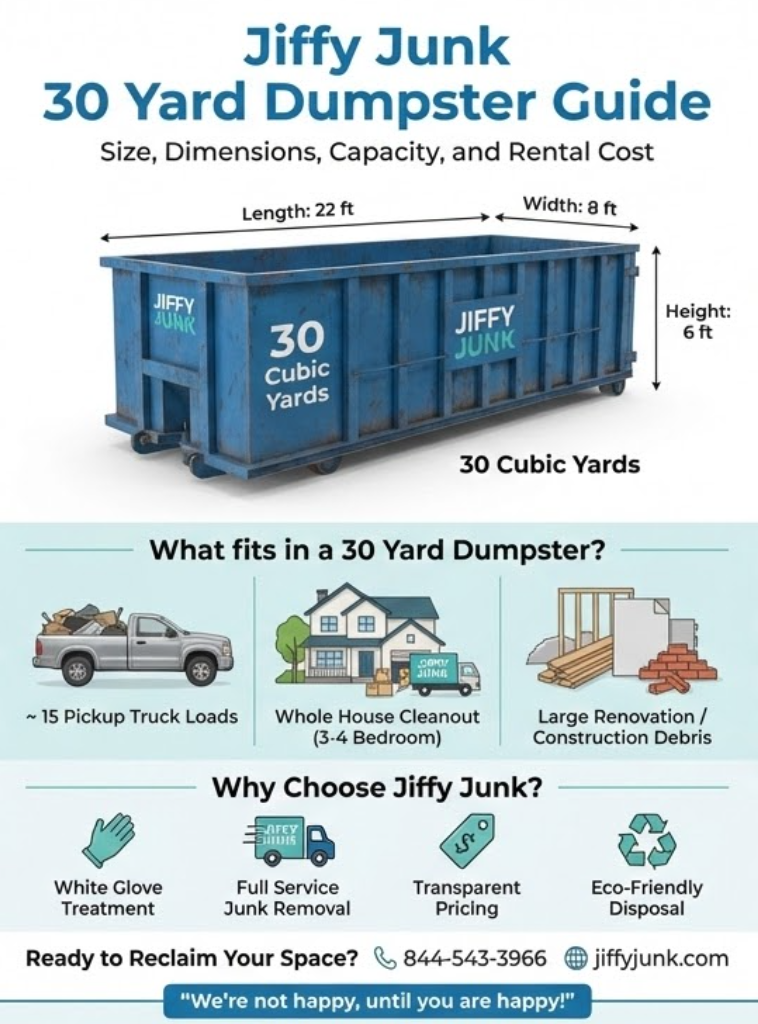
A 30 cubic yard dumpster measures approximately 22 feet long, 8 feet wide, and 6 feet tall—equivalent to about 9 pickup truck loads of material.
In our experience, the 30-yard container hits a sweet spot for large-scale projects. We’ve found it handles whole-house cleanouts, major renovations, and commercial property clearings without the overkill of a 40-yard roll-off. Customers tell us they appreciate having room to work without worrying about running out of space mid-project.
That said, we’ve also seen homeowners rent 30 yards when a 20 yard would have done the job—and others try to squeeze a full estate cleanout into a 20 yard, only to need a second haul.
This guide includes everything from the actual capacity of a 30-yard dumpster in the real world, some common projects you might want to get into, and some common costs for renting these kinds of dumpsters, as well as weight limits in the real world that really determine what you can put inside.
TL;DR Quick Answers
30 Yard Dumpster
A 30-yard dumpster measures 22 feet long x 8 feet wide x 6 feet tall and holds approximately 9 pickup truck loads of material.
Key specifications:
- Capacity: 30 cubic yards (170–190 standard trash bags)
- Weight limit: 4–6 tons (8,000–12,000 lbs)
- Typical rental cost: $450–$700 for 7 days
- Best for: Whole-house cleanouts, major renovations, roofing projects up to 3,500 sq ft
Our experience: After hauling thousands of containers, we’ve found the 30-yard dumpster is the most versatile option for large residential and commercial projects. It handles mixed debris—furniture, construction materials, appliances—without the overkill of a 40-yard roll-off.
Pro tip: Weight limits matter more than volume. Concrete and roofing shingles can max out your allowance before the container looks full. Ask about tonnage before you book.
Top 5 Takeaways
- Know your dimensions.
- 22 feet long × 8 feet wide × 6 feet tall
- Equivalent to 9 pickup truck loads
- Requires 25+ feet of clearance for delivery
- Weight limits matter more than volume.
- Most containers allow 4–6 tons (8,000–12,000 lbs)
- Concrete, shingles, and brick max out allowances fast
- A half-full container can already be overweight
- Ask about tonnage before you book
- When in doubt, size up.
- The price difference between 20 and 30 yards is modest
- Second hauls cost more and delay projects
- Running out of space mid-project creates headaches
- Donate before you dump.
- Many items are still usable
- Contact Habitat ReStore or local donation centers
- Reduces volume, lowers costs, keeps materials out of landfills
- Get the all-in price.
- Base quotes often exclude overages and fees
- The lowest rate doesn’t mean the lowest final bill
- Ask for total cost upfront—no surprises
Table of Contents
- How Big Is a 30 Cubic Yard Dumpster? A Look at Size Dimensions, Capacity, and Rental Cost to Help You Decide If It’s Right for You
- TL;DR Quick Answers
- Top 5 Takeaways
- Exact Dimensions of a 30 Yard Dumpster
- What a 30 Yard Dumpster Can Actually Hold
- Best Projects for a 30 Yard Container
- Typical Rental Costs for a 30 Yard Dumpster
- Understanding Weight Limits
- How to Decide If a 30 Yard Dumpster Is Right for You
- Essential Resources for Your 30 Yard Dumpster Project
- 1. EPA Construction & Demolition Debris Guidelines — Understand What’s Accepted at Disposal Facilities
- 2. EPA Appliance Disposal Requirements — Handle Refrigerators and Freezers the Right Way
- 3. EPA Hazardous Waste Basics — Know Which Items Need Special Handling
- 4. Earth911 Recycling Locator — Find a Recycling Center Near You
- 5. Habitat for Humanity ReStore — Give Usable Items a Second Life
- 6. SWANA Waste Management Resources — Access Professional Industry Guidance
- Supporting Statistics
- Final Thoughts & Opinion
- Frequently Asked Questions
- Ready to Book Your 30 Yard Dumpster?
Exact Dimensions of a 30 Yard Dumpster
A typical 30 cubic yard dumpster will be about 22 feet long by 8 feet wide by 6 feet tall. These dimensions can differ slightly from provider to provider, but most containers are within a foot of these dimensions.
For placement, you’ll need a flat surface at least 25 feet long and 10 feet wide to allow clearance for delivery. We recommend checking overhead clearance, too—tree branches and low-hanging wires are the most common obstacles our drivers encounter.
The height of the sidewall – 6 feet – is worth mentioning. Unlike smaller containers, a 30-yarder, you have to throw things up and over instead of walking things in the back door. Most models feature a swing-open back gate, but after half-full, the container requires a lot of lifting and throwing.
What a 30 Yard Dumpster Can Actually Hold
Thirty cubic yards translates to approximately 9 full-size pickup truck loads or around 170–190 standard 13-gallon trash bags. But cubic capacity only tells part of the story.
In our experience, the amount of practical capacity has a lot to do with what you’re loading. Large pieces of furniture and appliances tend to be bulky and irregular, and this space is quickly consumed by air pockets. Dense materials, such as concrete, roofing shingles, or soil, reach weight limits much before you fill up the container.
Here’s what we typically see a 30-yard dumpster accommodate:
- Contents of a 3,000–5,000 square foot home cleanout
- Debris from a 500–700 square foot roof replacement
- Materials from a large kitchen and bathroom remodel combined
- Full garage, basement, and attic cleanout in one haul
- Commercial office furniture and equipment from a mid-size business
Customers often ask us whether to size up or down. Our rule of thumb: if you’re debating between a 20-yard and a 30-yard dumpster, and the project involves construction debris or multiple rooms, the 30-yard usually proves worth it.
Best Projects for a 30 Yard Container
The 30-yard dumpster works best for projects that generate substantial volume without extreme weight. After handling thousands of rentals, we’ve found it’s the go-to choice for:
Whole-House Cleanouts: Estate cleanouts, move-outs, and downsizing projects fit naturally into this size. You get enough room to clear furniture, appliances, boxes, and accumulated items from every room without scheduling a second pickup.
Major Renovations: Gut renovations for multiple rooms result in mixed debris – drywall, flooring, cabinetry, fixtures. A 30-yarder has no issue with the variety, without the need for real-time attention to weight, barring disposing of live concrete or heavy tile.
Roofing Projects: On average, a 2,500-3500 square foot roof replacement in a 30-yard container. Shingles are heavy, so you’ll probably get to weight limits before volume limits.
Commercial Property Clearing Office cleanouts, retail fixture removal, and warehouse clearing projects benefit from the larger footprint. You can dispose of desks, shelving, inventory, and general debris in a single rental period.
Large Landscaping Overhauls, Fence removal, deck demolition, and yard debris from a large landscaping project fits well – just leave heavy materials like dirt, sod, and stone in the yard, which quickly transform into weight.
Typical Rental Costs for a 30 Yard Dumpster
The cost of rentals will differ depending on the location, disposal fees, and weight allowance included. Nationally, it costs between $450 and $700 for a 7-day rental period for 30-yard dumpster rentals.
Several factors influence your final cost:
Base Rental Fee This covers delivery, pickup, and a standard rental window (usually 7–14 days). Urban areas with higher disposal costs tend to price at the upper end of the range.
Weight Allowance Most rentals include 2–4 tons of disposal weight. Exceeding this allowance triggers overage fees, typically $40–$75 per additional ton. We’ve seen customers surprised by overage charges when loading heavy materials like roofing or concrete, so it’s worth asking about weight limits upfront.
Rental Period Extensions: Need the container longer than the standard window? Daily extension fees usually run $10–$25 per day.
Prohibited Items and Special Disposal: Hazardous materials, electronics, and appliances containing refrigerants often carry additional fees or require separate disposal. Confirming what’s accepted before loading saves unexpected charges.
When comparing quotes, we recommend asking for the all-in price including delivery, pickup, disposal, and weight allowance.
Understanding Weight Limits
Weight limits matter more than most renters realize. A 30 cubic yard dumpster typically allows 4–6 tons (8,000–12,000 pounds) of material, depending on the provider and local landfill restrictions.
Here’s why this matters: dense materials fill weight capacity long before volume capacity. A container loaded with concrete might look half-empty, but already exceeds its limit. Meanwhile, a container stuffed with furniture and household items might appear overflowing while staying well under the weight threshold.
Approximate weights for common materials:
- Household furniture and general items: 150–300 lbs per cubic yard
- Construction debris (mixed): 300–500 lbs per cubic yard
- Roofing shingles: 750–1,000 lbs per cubic yard
- Concrete and masonry: 2,000+ lbs per cubic yard
We’ve hauled plenty of containers where customers mixed heavy and light materials strategically—shingles on the bottom, lighter debris on top—and stayed within limits while maximizing space. Planning your load makes a difference.
How to Decide If a 30 Yard Dumpster Is Right for You
Choosing the right size comes down to three questions:
What’s the scope of your project? A single-room cleanout or small bathroom remodel rarely justifies a 30-yarder. Whole-house projects, major renovations, or commercial cleanouts almost always do.
What materials are you disposing of? Heavy materials like concrete, brick, or roofing shingles may require a smaller container with a higher weight allowance—or a dedicated heavy debris dumpster. Lighter materials like furniture, drywall, and general household items maximize the 30 yard’s volume.
What’s your timeline? If you’re clearing a property over several weekends, the extended rental window of a larger container might prove more economical than multiple smaller rentals.
When customers call unsure about sizing, we often suggest erring toward the larger container if the price difference is modest. Scheduling a second haul typically costs more than the upgrade, and running out of space mid-project creates headaches nobody needs.
“After hauling thousands of 30-yard containers, we’ve found that most customers don’t regret sizing up—but plenty wish they had. The price difference between a 20 and 30 yard rental is usually far less than the cost and hassle of scheduling a second pickup when you run out of room mid-project.” — Jiffy Junk Operations Team
Essential Resources for Your 30 Yard Dumpster Project
We believe in helping you make smart decisions—not just renting you a container. Before your project begins, these trusted resources can help you understand disposal regulations, find recycling options, and handle materials responsibly.
Our teams use these same guidelines every day to ensure eco-friendly disposal and full compliance with local requirements.
1. EPA Construction & Demolition Debris Guidelines — Understand What’s Accepted at Disposal Facilities
Planning a renovation or cleanout? The EPA provides clear guidance on which construction and demolition materials can be disposed of in standard landfills and which require special handling.
We recommend reviewing these guidelines before loading heavy debris like concrete, roofing materials, or treated lumber.
- Helpful for: Renovation projects, demolition debris, construction materials
- Source: U.S. Environmental Protection Agency
- URL: https://www.epa.gov/smm/sustainable-management-construction-and-demolition-materials
2. EPA Appliance Disposal Requirements — Handle Refrigerators and Freezers the Right Way
Refrigerators, freezers, and air conditioning units contain refrigerants that require professional removal before disposal. Federal regulations are clear on this—and so are we.
When customers ask about appliance disposal, we always point them to these guidelines first. Proper handling protects your family, your community, and the environment.
- Helpful for: Refrigerators, freezers, window AC units, dehumidifiers
- Source: U.S. Environmental Protection Agency
- URL: https://www.epa.gov/section608/appliance-disposal
3. EPA Hazardous Waste Basics — Know Which Items Need Special Handling
Certain materials require separate disposal and should never go into a standard dumpster. Paints, solvents, batteries, and chemicals fall into this category.
We’ve found that most customers aren’t aware of these restrictions until pickup day. A quick review of this guide helps you plan and avoid surprises.
- Helpful for: Paints, solvents, chemicals, batteries, fluorescent lighting
- Source: U.S. Environmental Protection Agency
- URL: https://www.epa.gov/hw/learn-basics-hazardous-waste
4. Earth911 Recycling Locator — Find a Recycling Center Near You
Not everything needs to end up in a landfill. This searchable database includes over 100,000 recycling locations across North America—just enter your zip code and material type.
At Jiffy Junk, we’re committed to recycling and donating whenever possible. This tool helps you do the same with items that fall outside our service area.
- Helpful for: Electronics, scrap metal, tires, construction materials, specialty items
- Source: Earth911
- URL: https://search.earth911.com/
5. Habitat for Humanity ReStore — Give Usable Items a Second Life
Before filling your dumpster, consider whether some items could benefit someone else. Habitat ReStores accept furniture, working appliances, cabinets, and building materials in good condition—and most locations offer free pickup.
We love seeing usable items donated rather than disposed of. It’s better for the community and better for the environment.
- Helpful for: Furniture, working appliances, cabinets, doors, fixtures
- Source: Habitat for Humanity
- URL: https://www.habitat.org/restores/donate-goods
6. SWANA Waste Management Resources — Access Professional Industry Guidance
The Solid Waste Association of North America offers technical resources on recycling programs, sustainable disposal practices, and waste reduction strategies.
This resource is especially valuable for commercial property managers, contractors, and businesses handling large-scale cleanout projects.
- Helpful for: Commercial projects, large-scale property clearings, businesses
- Source: Solid Waste Association of North America
- URL: https://swana.org/resources
Supporting Statistics
After more than a decade in junk removal, we’ve seen firsthand how much material flows through projects like yours. These federal statistics confirm what our crews observe every day.
600 Million Tons of C&D Debris Generated Annually
The EPA estimates 600 million tons of construction and demolition debris were generated in the United States in 2018—more than twice the amount of regular household waste.
What we see on job sites:
- 76% of C&D materials get recovered or recycled rather than landfilled
- Demolition accounts for over 90% of debris; new construction generates less than 10%
- Concrete, asphalt, wood, drywall, and roofing materials make up the bulk—exactly what fills our 30-yard containers
Our takeaway: Gut renovations and major teardowns generate more volume than most customers expect. It’s one reason we recommend the 30-yard size for these projects.
- Source: U.S. Environmental Protection Agency
- URL: https://www.epa.gov/smm/sustainable-management-construction-and-demolition-materials
12.1 Million Tons of Furniture Discarded Each Year
Americans generated 12.1 million tons of furniture and furnishings waste in 2018, representing 4.1% of total municipal solid waste.
What this looks like in practice:
- A single estate cleanout can fill a 30-yard container with sofas, dressers, dining sets, and mattresses
- Wood is the largest material component, followed by ferrous metals
- Many items remain in usable condition
What we’ve found: Customers feel better knowing that gently used furniture goes to someone who needs it rather than a landfill. We always recommend checking with donation centers like Habitat ReStore before scheduling a cleanout.
- Source: U.S. Environmental Protection Agency
- URL: https://www.epa.gov/facts-and-figures-about-materials-waste-and-recycling/durable-goods-product-specific-data
3.1 Million Tons of Appliances Recycled Annually
The EPA reports 5.3 million tons of major appliances reached end-of-life in 2018. Approximately 3.1 million tons were recycled—a 58% recycling rate.
Why this matters:
- Refrigerators, freezers, and AC units contain refrigerants requiring professional removal
- Federal law mandates proper handling before disposal
- Improper dumping can result in fines for property owners
What’s inside these units:
- Steel, copper, and aluminum with real recycling value
- Hazardous materials that don’t belong in landfills
Our approach: Our crews are trained to handle appliance removal correctly. Responsible disposal protects the environment and keeps our customers compliant.
- Source: U.S. Environmental Protection Agency
- URL: https://www.epa.gov/facts-and-figures-about-materials-waste-and-recycling/durable-goods-product-specific-data
Final Thoughts & Opinion
Our Take on the 30 Yard Dumpster
After hauling thousands of containers, we’ve developed a clear perspective on when a 30-yard dumpster makes sense—and when it doesn’t.
The bottom line: For large-scale cleanouts, major renovations, and commercial property clearings, the 30-yard container delivers the best balance of capacity, cost, and convenience.
What We’ve Learned Over the Years
1. Most customers underestimate volume. We can’t count the number of times someone has called mid-project asking to swap a 20-yard for something larger. Whole-house cleanouts and gut renovations almost always generate more debris than expected.
2. Weight limits matter more than size. Heavy materials like concrete, roofing, and tile can max out your weight allowance long before you fill the space. Ask about tonnage limits upfront.
3. The price difference between sizes is smaller than you’d think. Upgrading from a 20-yard to 30 yard typically costs far less than scheduling a second haul. When in doubt, size up.
Our Honest Opinion
The 30-yard dumpster is the workhorse of large projects. Here’s why:
- Handles volume without the overkill of a 40-yard roll-off
- Accommodates mixed debris—furniture, construction materials, appliances, household items
- Gives customers room to work without stress
But disposal is only half the job. The statistics tell the story:
- 600 million tons of C&D debris are generated annually
- 12 million tons of furniture are discarded each year
- Millions of appliances reaching end-of-life
At Jiffy Junk, we believe how you remove items matters as much as what you remove. We’re committed to recycling and donating whenever possible—not because it’s trendy, but because we’ve seen the difference it makes.
Our Recommendation
Before filling any dumpster, take 30 minutes to:
- Separate what can be donated from what truly needs disposal
- Check with local restrooms and recycling centers
- Contact appliance recyclers for refrigerators, freezers, and AC units
The payoff:
- Reduced disposal volume
- Potentially lower costs
- Usable items stay out of landfills
In our experience, customers who take this step feel better about the entire process.
Frequently Asked Questions
Q: What are the exact dimensions of a 30-yard dumpster?
A: A standard 30-yard dumpster measures approximately 22 feet long, 8 feet wide, and 6 feet tall. Dimensions vary slightly between providers but typically fall within a foot of these measurements.
What our drivers check before delivery:
- Flat surface at least 25 feet long and 10 feet wide
- Overhead clearance for tree branches and power lines
- Ground conditions to support the container weight
Good to know: The 6-foot sidewall means you’ll toss items up and over once the container fills past halfway. Most models include a swing-open back gate for walk-in loading early in your project.
Q: How much does it cost to rent a 30-yard dumpster?
A: Rental costs typically range from $450 to $700 for 7 days. After years in this business, we’ve learned the advertised price rarely tells the whole story.
What determines your final cost:
- Base rental fee: Delivery, pickup, and standard rental window
- Weight allowance: Usually 2–4 tons included; overages run $40–$75 per ton
- Location: Urban areas are priced higher due to disposal costs
- Extensions: $10–$25 per day for additional time
Our advice: Ask for the all-in price. The cheapest quote on paper isn’t always the cheapest bill in your hand.
Q: What can I put in a 30-yard dumpster?
A: Most cleanout and renovation materials go in without issue—furniture, appliances, construction debris, roofing materials, and yard waste.
What to keep out:
- Hazardous waste (paints, solvents, chemicals)
- Flammable liquids
- Batteries
- Tires
- Refrigerators and AC units with refrigerants
- Electronics (restrictions vary by area)
What we’ve noticed: Most customers aren’t aware of these restrictions until pickup day. A quick conversation before loading saves headaches later.
Q: How much weight can a 30-yard dumpster hold?
A: Most 30-yard dumpsters allow 4–6 tons (8,000–12,000 pounds). Weight limits matter more than most renters realize.
What catches people off guard: We’ve hauled containers that looked half-empty but exceeded their allowance due to heavy materials.
Approximate weights per cubic yard:
- Household furniture and general items: 150–300 lbs
- Mixed construction debris: 300–500 lbs
- Roofing shingles: 750–1,000 lbs
- Concrete and masonry: 2,000+ lbs
Our tip: Load heavy materials first, lighter items on top. Ask about weight allowances before you book—not after.
Q: What projects are best suited for a 30-yard dumpster?
A: After handling thousands of rentals, we’ve found the 30-yard container hits a sweet spot for large projects without extreme weight.
Where it works best:
- Whole-house cleanouts and estate turnovers
- Major kitchen and bathroom renovations combined
- Roof replacements up to 3,500 square feet
- Full garage, basement, and attic cleanouts
- Commercial office furniture removal
- Large landscaping projects (fence removal, deck demolition)
Capacity reference: One 30-yard container typically holds the contents of a 3,000–5,000 square foot home cleanout.
Our honest take: Debating between 20 and 30 yards? If your project involves construction debris or multiple rooms, go with the 30. The price difference is modest. A second haul costs significantly more.
Ready to Book Your 30 Yard Dumpster?
Now that you know the dimensions, capacity, and costs involved, let our team help you determine if the 30-yard container is the right fit for your project. Call us at 844-543-3966 or visit www.jiffyjunk.com/booking to get a free quote and schedule your delivery.