How Big Is a 8 Cubic Yard Dumpster Compared to Other Sizes? Exact Dimensions, Rental Cost, and What This Size Can Handle for Your Project
An 8 cubic yard dumpster holds roughly 40-48 standard trash bags—but in our experience, that number rarely tells the full story. After a decade of hauling, we’ve learned that how you load matters just as much as total capacity.
Picture a container about the size of two large hot tubs side by side. It’s compact enough for most driveways yet handles a full bathroom renovation, a garage cleanout, or several rooms of furniture without breaking a sweat.
Here’s what we’ve seen firsthand: customers often underestimate the 8-yard and rent larger than they need, or they overestimate and end up paying for a second haul. This guide gives you exact dimensions, real-world comparisons to other sizes, typical rental costs, and the project types where our teams consistently see this container deliver the best value.
TL;DR Quick Answers
8 Yard Dumpster
An 8 yard dumpster is a mid-size waste container ideal for residential cleanouts and small renovation projects.
Key specs:
- Dimensions: 12′ long x 6′ wide x 3′ tall
- Capacity: 40-48 trash bags or 2-3 pickup truck loads
- Weight limit: 1-2 tons (2,000-4,000 lbs)
- Typical rental cost: $275-$450
Best for:
- Bathroom or kitchen renovations
- Single-car garage cleanouts
- Attic or basement decluttering
- Small landscaping projects
From our experience: The 8-yard is one of the most versatile dumpster sizes we deliver. The low 3-foot walls make loading easy without climbing. Most driveway placements don’t require permits. If your project involves heavy materials like concrete or tile, factor weight limits into your decision—not just volume.
Top Takeaways
- Dimensions: 12′ long x 6′ wide x 3′ tall. Holds 40-48 trash bags. Low walls make loading easy for customers of all ages.
- Best for mid-range projects: Bathroom renovations, one-car garage cleanouts, attic decluttering, small landscaping. Two-car garages or whole-home cleanouts need a larger size.
- Weight matters more than volume. Most 8-yard containers allow 1-2 tons. Concrete, tile, and roofing shingles hit weight limits fast—even when the bin looks half-empty.
- When in doubt, size up. The $50-$75 difference between an 8-yard and larger container costs less than a second rental or stalled project.
- Donate before you load. Usable furniture and appliances reduce your load, support your community, and often qualify for tax deductions.
Table of Contents
- How Big Is a 8 Cubic Yard Dumpster Compared to Other Sizes? Exact Dimensions, Rental Cost, and What This Size Can Handle for Your Project
- TL;DR Quick Answers
- Top Takeaways
- Exact Dimensions of an 8 Cubic Yard Dumpster
- How the 8 Cubic Yard Compares to Other Dumpster Sizes
- What Projects Fit an 8-Cubic-Yard Dumpster Best
- Typical Rental Costs for an 8-Cubic-Yard Dumpster
- Weight Limits and Loading Tips
- Is an 8 Cubic Yard Dumpster Right for Your Project?
- Essential Resources for Your Dumpster Rental Decision
- Supporting Statistics
- Final Thought: Is an 8 Cubic Yard Dumpster Right for You?
- Next Steps: Ready to Book Your Dumpster?
- FAQ on “8 Yard Dumpster”
- Get the Right Dumpster Size for Your Project
Exact Dimensions of an 8 Cubic Yard Dumpster
Standard 8 cubic yard dumpsters measure approximately 12 feet long, 6 feet wide, and 3 feet tall. These dimensions can vary slightly between providers, but most containers we deliver fall within a few inches of these measurements.
At just 3 feet high, this is one of the lowest-profile dumpsters available. We’ve found this height makes loading significantly easier—most people can lift items over the side without straining or needing a step. It’s also why property managers and HOAs tend to prefer this size for community cleanups.
How the 8 Cubic Yard Compares to Other Dumpster Sizes
Understanding where the 8-yard sits in the lineup helps you avoid overpaying for unused space or scrambling for a second container mid-project.
| Size | Approximate Dimensions | Trash Bag Equivalent | Best For |
| 6 Cubic Yard | 10′ x 6′ x 3′ | 30-36 bags | Small cleanouts, single-room projects |
| 8 Cubic Yard | 12′ x 6′ x 3′ | 40-48 bags | Mid-size renovations, garage cleanouts |
| 10 Cubic Yard | 14′ x 7.5′ x 3.5′ | 50-60 bags | Larger renovations, roofing debris |
| 15 Cubic Yard | 16′ x 7.5′ x 4.5′ | 75-90 bags | Whole-home cleanouts, construction |
| 20 Cubic Yard | 22′ x 7.5′ x 4.5′ | 100-120 bags | Major remodels, commercial projects |
In our experience, the 8-yard handles about 25% more than the 6-yard while maintaining the same low-profile design. Customers tackling medium-sized residential projects consistently find this the most practical balance between capacity and footprint.
What Projects Fit an 8-Cubic-Yard Dumpster Best
Over the years, we’ve delivered 8 cubic yard dumpsters to thousands of job sites. These projects consistently get the best results from this size:
Ideal fits:
- Single bathroom or kitchen renovations (cabinets, flooring, fixtures)
- Garage or basement cleanouts
- Attic decluttering projects
- Small landscaping jobs with light debris
- Downsizing before a move
- Estate cleanouts for smaller properties
When you might need to size up:
- Whole-home renovations typically require a 15 or 20-yard container
- Heavy materials like concrete, brick, or roofing shingles add weight fast—even if you have space remaining, you may hit weight limits
- Multi-room furniture disposal often fills an 8-yard dumpster quicker than expected
Typical Rental Costs for an 8-Cubic-Yard Dumpster
Rental pricing for 8 cubic yard dumpsters generally ranges from $275 to $450, depending on your location, rental duration, and included weight allowance. Urban areas and regions with higher disposal fees typically land at the upper end of this range.
Most rental periods run 7 to 14 days. We’ve found that residential cleanout projects rarely need more than a week, while renovation work—where debris accumulates in stages—benefits from the longer window.
Factors that affect your final cost:
- Location: Disposal fees vary significantly by municipality
- Weight: Exceeding the included tonnage triggers overage charges
- Rental duration: Extensions are usually available for a daily fee
- Debris type: Certain materials, like mattresses or appliances, may carry additional fees
Our advice: always confirm what’s included before booking. Transparent pricing with no hidden fees saves headaches on pickup day.
Weight Limits and Loading Tips
An 8 cubic yard dumpster typically carries a weight limit between 1 and 2 tons (2,000–4,000 pounds), depending on the provider and your local disposal facility. This is plenty for household items, furniture, and general renovation debris—but heavy materials change the equation fast.
Weight estimates for common items:
- Standard household furniture and boxes: 8-yard fills comfortably under limit
- Drywall and lumber: moderate weight, usually fine
- Concrete, brick, dirt, or asphalt: fills weight limit long before capacity
After thousands of jobs, here’s the loading advice we give every customer: place flat items like plywood and drywall along the bottom and sides first. Break down boxes. Fill gaps with smaller items. This approach maximizes usable space and prevents the “looks full but isn’t” problem we see all the time.
Is an 8 Cubic Yard Dumpster Right for Your Project?
The 8 cubic yard dumpster works best when your project falls into the mid-range—more than a few trips to the local dump would handle, but not enough debris to justify a large roll-off container.
Choose the 8-yard if:
- Your project involves one to two rooms or a single-car garage
- You’re disposing primarily of furniture, household items, or light construction debris
- Driveway space is limited, or you want to avoid permit requirements
- You prefer easy side-loading without climbing into the container
Consider a different size if:
- You’re tackling a whole-home cleanout or major renovation
- Heavy materials make up the bulk of your debris
- You’d rather overestimate than risk needing a second rental
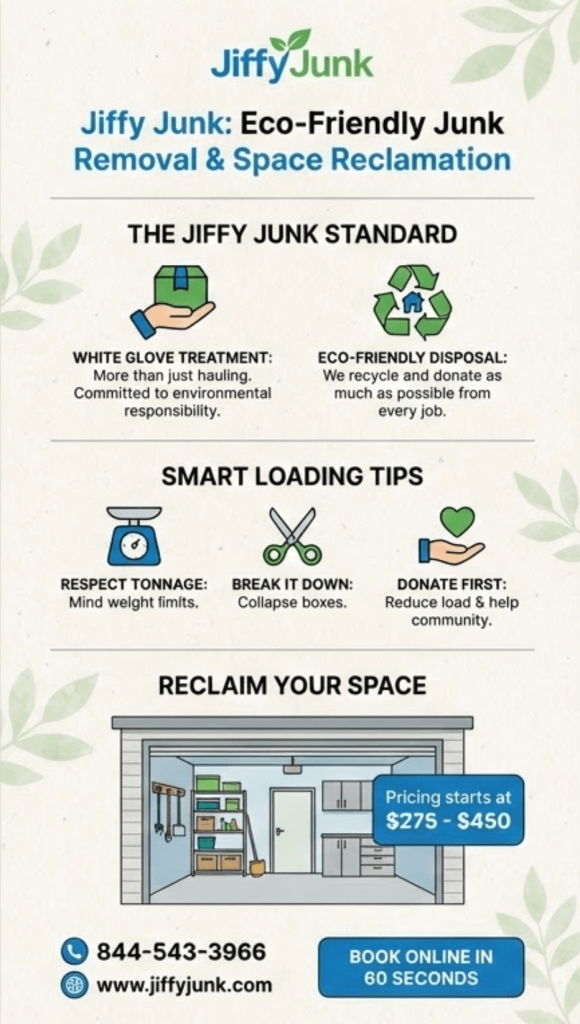
“After delivering tens of thousands of dumpsters, we’ve noticed the 8 cubic yard is where most customers find their ‘Goldilocks zone’—it handles the average garage cleanout or bathroom remodel without paying for empty space, and that low 3-foot wall means you’re tossing items in, not climbing up to load them.” — Jiffy Junk Operations Team
Essential Resources for Your Dumpster Rental Decision
We want every customer to feel confident before booking. These seven trusted resources help you choose the right dumpster size, understand what materials need special handling, and explore eco-friendly alternatives—so your project runs smoothly from start to finish.
1. Know What Can’t Go in Your Dumpster
Resource: EPA Household Hazardous Waste Guide
Certain household items—paints, batteries, cleaners, and chemicals—require special disposal and can’t go in a standard dumpster. We always recommend checking this EPA guide before your cleanout so there are no surprises on pickup day.
Source: U.S. Environmental Protection Agency (.gov)
URL: https://www.epa.gov/hw/household-hazardous-waste-hhw
2. Understand Renovation and Demolition Debris Rules
Resource: EPA Sustainable Management of Construction and Demolition Materials
Tackling a bathroom remodel or garage renovation? Drywall, lumber, concrete, and roofing materials fall under specific guidelines. This resource explains what can be recycled—and our teams are always happy to answer questions about your specific project.
Source: U.S. Environmental Protection Agency (.gov)
URL: https://www.epa.gov/smm/sustainable-management-construction-and-demolition-materials
3. Donate Usable Items Before You Load
Resource: Habitat for Humanity ReStore Donation Locator
Here’s something we tell customers all the time: if furniture, appliances, or building materials are still in good shape, donation is a great first step. ReStore locations often offer free pickup, and you’ll keep perfectly usable items out of the landfill while supporting families in your community.
Source: Habitat for Humanity (.org)
URL: https://www.habitat.org/restores/donate-goods
4. Find Local Recycling Options for Specialty Items
Resource: Earth911 Recycling Center Search
Some materials—electronics, certain appliances, and specialty items—need to go somewhere other than your dumpster. This searchable database covers over 100,000 locations and 350+ material types, making it simple to find the right drop-off spot near you.
Source: Earth911 (.com)
URL: https://search.earth911.com/
5. Review National Waste Statistics for Project Planning
Resource: EPA Facts and Figures on Materials, Waste, and Recycling
Americans generate nearly 5 pounds of waste per person every day. Understanding where materials end up—and how much gets recycled—can help you make informed choices. We’re proud to recycle and donate whenever possible, and this EPA data shows why it matters.
Source: U.S. Environmental Protection Agency (.gov)
6. Protect Yourself with Safe Lifting Techniques
Resource: OSHA Ergonomics and Heavy Lifting Guidelines
Planning to load the dumpster yourself? Safety comes first. Ergonomic guidelines recommend a 50-pound maximum for solo lifts. This OSHA resource walks you through proper technique—or you can skip the heavy lifting entirely and let our White Glove team handle it for you.
Source: U.S. Occupational Safety and Health Administration (.gov)
URL: https://www.osha.gov/etools/electrical-contractors/materials-handling/heavy
Supporting Statistics
After more than a decade in the junk removal and dumpster rental industry, we’ve seen these national trends play out on job sites across the country. Here’s what the data confirms—and what it means for your project.
600 Million Tons of Construction and Demolition Debris Generated Annually
When customers ask why we emphasize recycling partnerships, this number tells the story. The EPA estimates that Americans generated 600 million tons of construction and demolition debris in 2018—more than double the amount of all household trash combined.
Here’s what we find encouraging: over 76% of that material was recovered for recycling or reuse rather than landfilled. In our experience, renovation projects—especially bathroom and kitchen remodels—generate far more recyclable material than most homeowners expect. Concrete, metal fixtures, wood framing, and even old cabinets often have a second life when handled properly. We’ve built relationships with local recycling facilities specifically because we see this volume firsthand, and we know how much of it doesn’t need to end up in a landfill.
Source: U.S. Environmental Protection Agency, Sustainable Management of Construction and Demolition Materials
URL: https://www.epa.gov/smm/sustainable-management-construction-and-demolition-materials
12.1 Million Tons of Furniture Discarded Each Year—80% Landfilled
This statistic hits close to home for our teams. The EPA reports that Americans discard 12.1 million tons of furniture annually, and more than 80% of it ends up in landfills.
We see this play out constantly during estate cleanouts, downsizing projects, and move-out jobs. Perfectly good sofas, dressers, and dining sets get tossed because homeowners don’t know where to donate or assume nobody wants older furniture. The truth? Local charities, Habitat for Humanity ReStores, and community organizations are often eager to take gently used pieces. When our crews arrive for a cleanout, one of the first things we do is identify items that can be donated instead of hauled to disposal. It’s better for the environment, and many customers appreciate the tax deduction opportunity.
Source: U.S. Environmental Protection Agency, Durable Goods: Product-Specific Data
292.4 Million Tons of Household Waste Generated in 2018
The EPA reports that Americans generated 292.4 million tons of municipal solid waste in 2018—roughly 4.9 pounds per person, per day. Only about 32% was recycled or composted.
That per-person number helps explain something we’ve observed over thousands of jobs: people consistently underestimate how much material accumulates in garages, basements, and attics. A single-car garage that’s been collecting items for a decade can easily fill an 8 cubic yard dumpster. When customers tell us “it’s not that much stuff,” we’ve learned to ask follow-up questions—how long has it been accumulating? Are there boxes you haven’t opened in years? Those answers usually reveal whether an 8-yard container is the right fit or whether sizing up makes more sense.
Source: U.S. Environmental Protection Agency, National Overview: Facts and Figures on Materials, Wastes and Recycling
Final Thought: Is an 8 Cubic Yard Dumpster Right for You?
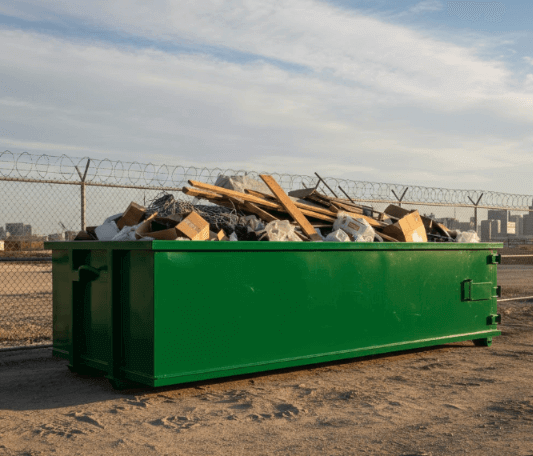
At roughly 12 feet long, 6 feet wide, and 3 feet tall, the 8-yard container handles mid-size residential projects with room to spare. The low walls make loading easy, the compact footprint fits most driveways without a permit, and the price point works for homeowners tackling manageable jobs.
But here’s what we’ve learned after delivering tens of thousands of dumpsters: the “right” size isn’t always the one that technically fits your debris—it’s the one that fits your project’s rhythm.
When the 8-Yard Works Best
This container shines when debris accumulates steadily over a few days:
- Weekend garage cleanouts
- Single bathroom or kitchen renovations
- Attic or basement decluttering
- Small landscaping projects with light debris
- Downsizing before a move
In these scenarios, the 8-yard stays accessible, loading remains manageable, and you’re not paying for empty space.
When to Size Up
We see problems when customers choose the 8-yard to save $50-$75, then run out of room mid-project. The money saved disappears—and so does a weekend.
Our rule of thumb: If you’re on the fence and your project involves any unknowns, size up. The peace of mind is worth the price difference.
Size up if:
- You haven’t fully assessed what’s in those boxes, closets, or storage areas
- Renovation work might reveal surprises behind walls
- You’re clearing a two-car garage or multiple rooms
- Heavy materials like concrete, tile, or roofing shingles are involved
What Sets a Good Dumpster Decision Apart
Customers who have the best experience share a few habits:
- They think about weight, not just volume. Heavy materials hit weight limits long before the bin looks full. Factor tonnage into your decision—not just cubic yards.
- They load strategically. Flat items along the bottom, broken-down boxes, gaps filled with smaller pieces. Smart packing adds 20-30% more usable capacity.
- They consider donation before disposal. That dresser, those chairs, the working appliances—donating first reduces your load, supports your community, and often qualifies for a tax deduction.
The Bottom Line
An 8 cubic yard dumpster is a versatile, right-sized solution for thousands of projects every year. But no container is universally “best.” The right choice depends on your project, your timeline, and how much uncertainty you’re working with.
When in doubt, we’d rather help you pick a container with breathing room than watch you struggle with one that’s technically sufficient but practically frustrating.
That’s the Jiffy Junk approach: we’re not here to rent you a dumpster—we’re here to help you finish your project. Still unsure? Reach out. Our team has seen every scenario, and we’re happy to talk through the details before you book.
We’re not happy until you are happy.
Next Steps: Ready to Book Your Dumpster?
You’ve got the dimensions, comparisons, and project guidance. Here’s how to move forward.
1. Assess Your Project Scope
Take 10 minutes to walk through your space:
- What areas are you clearing? Count rooms or measure the garage.
- What materials are involved? Heavy items like concrete and tile require weight planning.
- How long has debris accumulated? Spaces untouched for 5+ years typically hold more than expected.
Still uncertain about sizing? We’re happy to help you estimate.
2. Check Permit Requirements
- Driveway placement: Usually permit-free
- Street or sidewalk placement: Permit likely required ($20-$150)
- HOA communities: Check association rules first
A quick call to your local public works department confirms requirements.
3. Identify Donation Opportunities
Before your dumpster arrives, separate items that could benefit someone else:
- Furniture in good condition
- Working appliances
- Building materials (cabinets, fixtures, hardware)
- Clothing, housewares, electronics
Many charities offer free pickup. Donating first reduces your load and often qualifies for a tax deduction.
4. Get Your Quote
Every project is different. Our team can confirm sizing, check availability, and provide an upfront quote with no surprises.
5. Prepare for Delivery Day
- Clear the placement area. Move vehicles and obstacles from the driveway.
- Confirm access. Ensure the truck can reach your location without obstructions.
- Plan your loading approach. Flat items first, heavy materials distributed evenly.
- Know your timeline. Most rentals run 7-14 days. Extensions available if needed.
FAQ on “8 Yard Dumpster”
Q: What are the exact dimensions of an 8 yard dumpster?
A: A standard 8 cubic yard dumpster measures approximately:
- Length: 12 feet
- Width: 6 feet
- Height: 3 feet
That 3-foot wall height is the feature customers mention most. Unlike taller containers requiring climbing or ramps, the 8-yard lets most people lift items directly over the side. We’ve seen homeowners in their 70s load these containers comfortably.
Q: How much does it cost to rent an 8 yard dumpster?
A: Rental prices typically range from $275 to $450. Final cost depends on:
- Location and local disposal fees
- Rental duration (usually 7-14 days)
- Included weight allowance
Q: What can I fit in an 8 yard dumpster?
A: An 8 yard dumpster holds roughly:
- 40-48 standard trash bags
- 2-3 pickup truck loads of debris
Projects that fit well:
- Single bathroom or kitchen renovations
- One-car garage cleanouts
- Attic or basement decluttering
- Small landscaping jobs
Pro tip from the field: How you load matters. Customers who place flat items on the bottom, break down boxes, and fill gaps strategically get 20-30% more capacity from the same container.
Q: What is the weight limit for an 8 yard dumpster?
A: Most 8 yard dumpsters carry a weight limit of 1-2 tons (2,000-4,000 pounds).
What stays under the limit easily:
- Household items and furniture
- General renovation debris
- Wood, drywall, and light fixtures
What hits weight limits fast:
- Concrete and brick
- Ceramic tile
- Roofing shingles
- Dirt and gravel
Q: Do I need a permit to put an 8-yard dumpster in my driveway?
A: Usually no. Driveway placement rarely requires a permit.
When permits are typically required:
- Street placement
- Sidewalk or right-of-way placement
- Some HOA communities
Typical permit costs: $20-$150
Get the Right Dumpster Size for Your Project
Now that you know exactly how an 8 cubic yard dumpster compares to other sizes—and what it can handle—let us help you choose the best fit for your specific project. Call 844-543-3966 or click or tap here to book online and experience the Jiffy Junk White Glove Treatment.