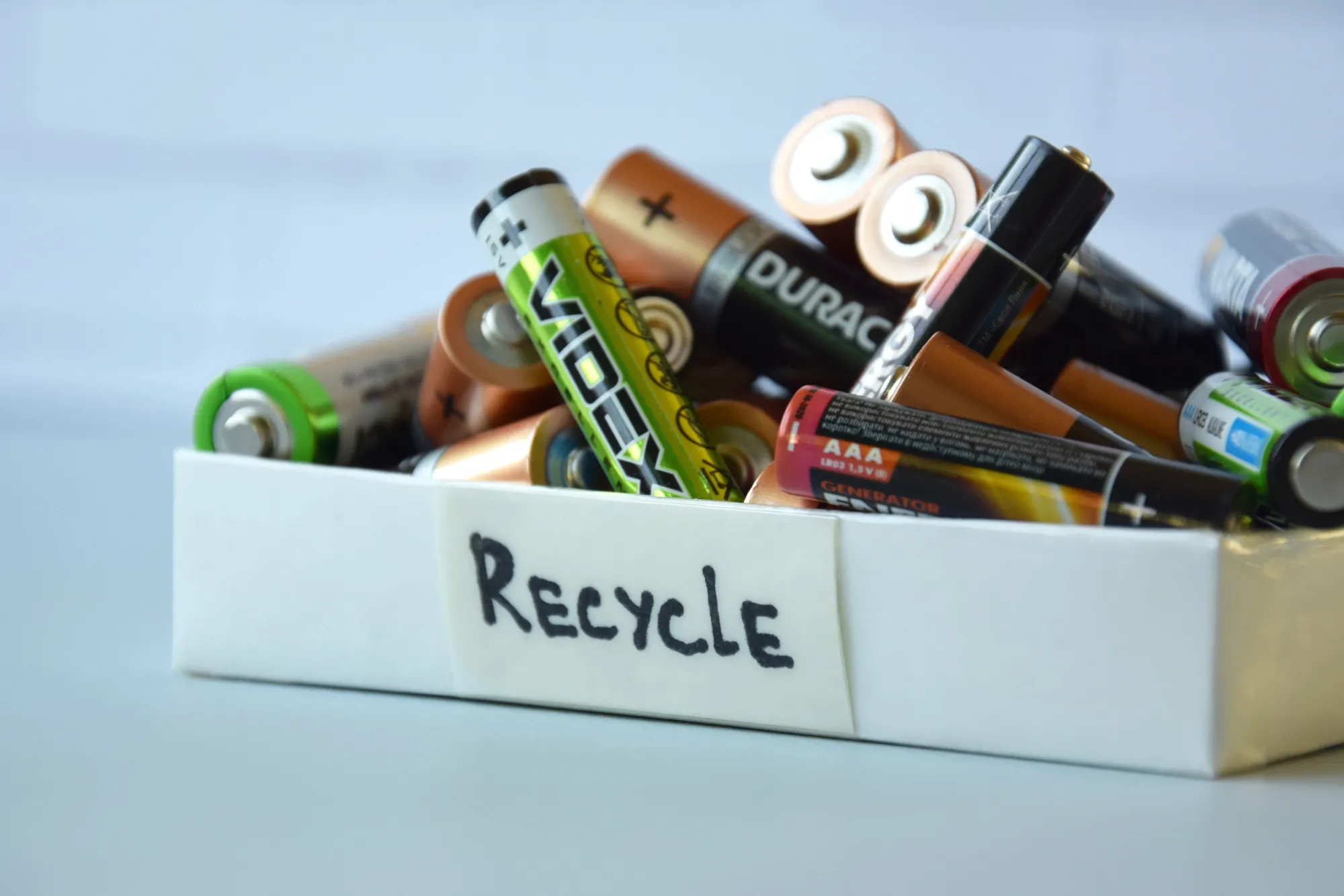
How to Dispose of and Recycle Old Batteries Near Me: Safe Battery Disposal Methods and Where to Drop Off So They Don’t End Up in a Landfill
When our crews show up to a garage cleanout, batteries are almost always in the mix. Old remotes. Dead drill packs. Laptops that last powered on sometime around 2019. Most homeowners have no idea that those batteries are about to cause real damage at a landfill.
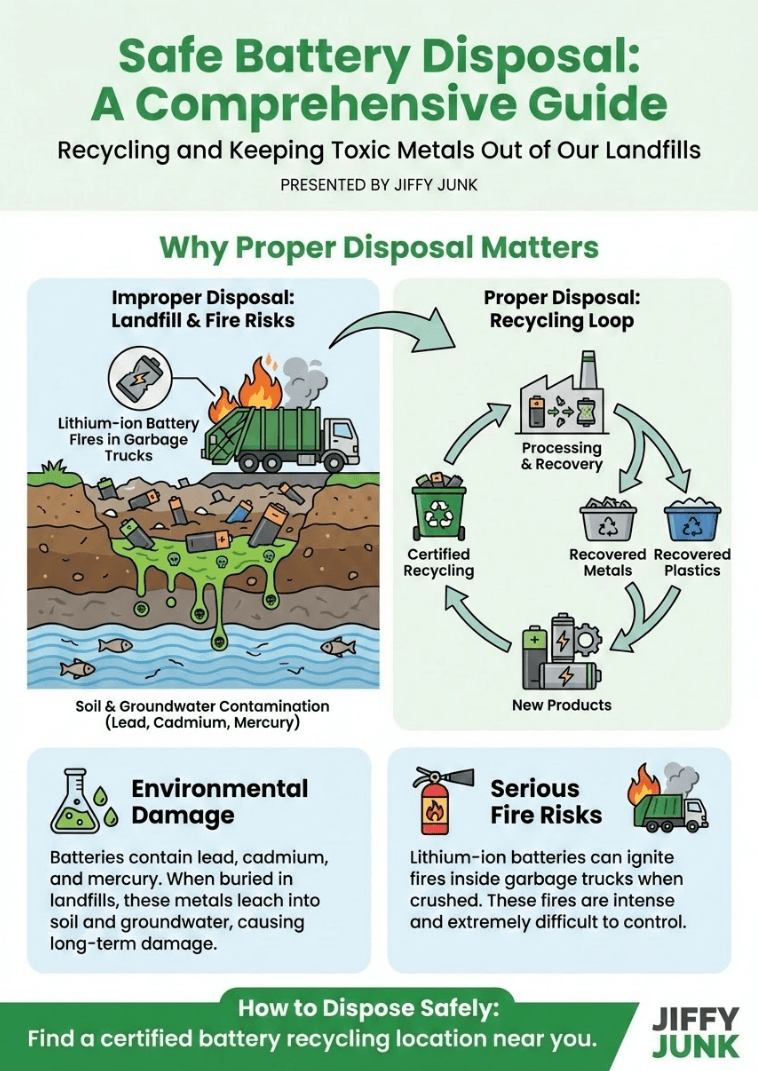
That’s the part that doesn’t make the news. Batteries contain lead, cadmium, and mercury. When they end up buried in a landfill, those metals leach into the surrounding soil and groundwater. Lithium-ion packs can ignite fires inside garbage trucks when they’re crushed. Several U.S. states, California included, have made it illegal to put any battery in your regular waste bin.
We’ve been on the job since 2014, and we’re not here to lecture you. The right way to handle old batteries is genuinely simple once you know it, and in most cases, it costs nothing.
TL;DR Quick Answers
How to Dispose of Batteries Safely
Start by identifying the battery type. Alkaline batteries (AA, AAA, C, D, 9V) can go in household waste in most states, but recycling is always the better choice — drop them at Call2Recycle, Home Depot, or Lowe’s. Lithium-ion batteries from phones, laptops, and power tools must never go in a waste bin or recycling container: take them to Best Buy, Staples, or any Call2Recycle location. Return lead-acid car batteries to an auto parts store like AutoZone or O’Reilly. Rechargeable and button cell batteries belong at a dedicated recycling kiosk. Before any drop-off, tape the terminal ends to prevent shorts. Find your nearest location at Earth911.com or Call2Recycle.org.
Top 5 Takeaways
- Battery type determines disposal method.
- Alkaline batteries: legal in household waste in most states
- Lithium-ion, lead-acid, and rechargeable batteries require a dedicated drop-off
- Several states prohibit all battery disposal in regular trash, including California
- Lithium-ion batteries never go in the trash or recycling bin.
- Documented fire hazard in garbage trucks, recycling facilities, and landfills
- Free drop-off available at Best Buy, Staples, Home Depot, Lowe’s, and Call2Recycle locations
- Free drop-off is available nationwide.
- Call2Recycle.org and Earth911.com both find the nearest collection point by zip code.
- Takes under a minute to locate a drop-off near you
- The stakes are higher than most people think.
- 39 deaths and 181 injuries from lithium-ion battery fires between 2019 and 2023
- Most incidents happened in homes and residential storage areas — not facilities.
- Source: U.S. Consumer Product Safety Commission
- When it’s more than a drop box can handle, call Jiffy Junk.
- Licensed and insured teams handle electronics, appliances, and full property cleanout.
- We coordinate responsible disposal from start to finish
- White Glove Treatment on every job — we’re not happy until you are
- Book online at jiffyjunk.com/booking or call 844-543-3966
Table of Contents
- How to Dispose of and Recycle Old Batteries Near Me: Safe Battery Disposal Methods and Where to Drop Off So They Don’t End Up in a Landfill
- TL;DR Quick Answers
- Top 5 Takeaways
- Why You Can’t Just Throw Batteries in the Trash (And What Happens When You Do)
- Types of Batteries and How to Dispose of Each One Safely
- Where to Recycle or Dispose of Batteries Near Me: Drop-Off Locations and Programs
- Safety Tips: How to Store Old Batteries Before You Drop Them Off
- Other Household Hazardous Items You Should Never Toss in the Trash
- Essential Resources for Safe Battery Disposal Near You
- 1. The Official Federal Guide to Disposing of Every Battery Type Safely
- 2. A Plain-English Battery Recycling Guide From the U.S. Department of Energy
- 3. Find a Free Drop-Off Location Near You in Seconds
- 4. The Locator to Use When Your Battery Type Isn’t Accepted Elsewhere
- 5. A Straightforward Breakdown of Which Batteries Can and Can’t Go in the Bin
- 6. What the Regulations Actually Say About Battery Disposal Done Wrong
- 7. Why Your City’s Rules May Be Tighter Than You’d Expect
- Supporting Statistics on Battery Disposal in the U.S.
- Final Thoughts and Opinion
- Frequently Asked Questions
- Ready to Reclaim Your Space? Jiffy Junk Makes Battery and Junk Disposal Simple.
Why You Can’t Just Throw Batteries in the Trash (And What Happens When You Do)
The chemistry inside a battery determines where it goes when you’re done with it. Electric batteries range from simple alkaline cells to complex lithium-ion packs, and disposal rules vary by both type and state.
Put them in the wrong bin, and the consequences play out on three fronts:
- Environmental damage: Batteries contain lead, cadmium, and mercury. In a landfill, those metals leach into the surrounding soil and groundwater. The process is slow and largely invisible, but the long-term damage is significant.
- Fire risk: Lithium-ion batteries can cause thermal runaway when crushed, triggering intense fires that are hard to control. This is why most states prohibit them from household waste bins and recycling trucks.
- Legal exposure: California classifies every battery as hazardous waste and prohibits landfill disposal statewide. New York, Florida, and several other states have similar laws. In those places, the wrong disposal choice is a violation, not just a habit.
Fortunately, the alternatives are easy, convenient, and in most cases free.
Types of Batteries and How to Dispose of Each One Safely
Disposal rules aren’t universal. They vary by battery type, by state, and sometimes by where you live. Here’s what you need to know about the most common kinds.
Alkaline Batteries (AA, AAA, C, D, 9V)
In most U.S. states, alkaline batteries can go in your regular waste bin legally. California is the exception — every battery counts as hazardous waste there, and landfill disposal is prohibited. Even where disposal is technically legal, recycling is the better call. Call2Recycle accepts alkaline batteries at thousands of free drop-off locations nationwide, and most Home Depot and Lowe’s stores keep collection kiosks near the entrance.
Lithium-Ion Batteries (Phones, Laptops, EVs, Power Tools)
Lithium-ion batteries don’t belong in any household waste bin or curbside recycling container. They’re a documented fire hazard in waste facilities, and the risk is well established. Start with the manufacturer’s take-back program if one exists. Best Buy and Staples both run in-store recycling kiosks, and Call2Recycle accepts lithium-ion batteries at thousands of locations across the country.
If you’re clearing out old laptops, tablets, or power tools, Jiffy Junk’s team handles items like these safely as part of a full cleanout. You won’t need to figure out the recycling logistics on your own.
Lead-Acid Batteries (Car Batteries, Marine Batteries)
Car batteries are among the most recycled products in the country, but they still require proper handling. AutoZone, O’Reilly Auto Parts, and Advance Auto Parts all accept old lead-acid batteries at the counter, and many offer a core charge credit when you drop one off. Municipal hazardous waste programs accept them, too. If a car battery is part of a bigger garage or property cleanout, Jiffy Junk’s team can coordinate the removal.
Rechargeable Batteries (NiMH, NiCd)
Rechargeable batteries in cordless phones, power tools, and older electronics contain nickel-metal hydride or nickel-cadmium, and both materials need dedicated recycling. Call2Recycle is the main take-back program for rechargeable batteries in North America, with collection points at Home Depot, Lowe’s, and Best Buy. Before you drop them off, tape the terminal ends with non-conductive tape. That one step prevents accidental short circuits during transport.
Button and Coin Cell Batteries
Button and coin cell batteries are small, but they carry concentrated energy and often contain silver oxide or lithium. Most battery recycling programs accept them. Pharmacies and electronics stores commonly keep dedicated collection bins near the register. One important note: these batteries are a serious swallowing hazard for young children. Always store used button cells out of reach and tape the terminals before disposal.
Where to Recycle or Dispose of Batteries Near Me: Drop-Off Locations and Programs
Most battery recycling programs are free, and the drop-off points are closer than you’d expect. Here are the main options:
- Call2Recycle: The leading national battery recycling program in North America. Search by zip code at Call2Recycle.org to find the nearest location. Thousands of retail and municipal points participate, and the service is free for consumers.
- Earth911: Use the search tool at Earth911.com to find recycling options for any material, batteries included, by entering your zip code.
- Home Depot and Lowe’s: Both keep in-store collection kiosks, typically near the entrance or customer service area. They accept rechargeable batteries and standard cells.
- Best Buy and Staples: Both run established take-back programs. Best Buy accepts a wide range of rechargeable and lithium batteries, including those from laptops and phones.
- AutoZone, O’Reilly, and Advance Auto Parts: Your best stops for lead-acid car battery recycling. Drop-off typically happens at the counter during regular store hours, and a core charge credit often comes with it.
- Municipal Household Hazardous Waste (HHW) Events: Many communities run periodic drop-off events for batteries, paint, chemicals, and similar materials. Check your local government’s website for upcoming dates and accepted items.
When you’re clearing out an estate, emptying an office, or dealing with a garage packed with old electronics, a single retailer drop-off won’t cover everything you’ve got. Jiffy Junk’s licensed and insured teams are set up for exactly these jobs. We handle the heavy lifting and coordinate responsible disposal, so you’re not making multiple trips or figuring out the logistics alone. Just point us in the right direction, and we’ll take care of the rest.
Safety Tips: How to Store Old Batteries Before You Drop Them Off
Before you head to a drop-off location, how you store old batteries matters. Here’s what our team recommends:
- Tape the terminal ends. Use electrical tape or masking tape to cover the positive and negative terminals on each battery, especially lithium-ion packs, button cells, and 9V batteries. Taped terminals prevent a short if batteries touch each other or make contact with metal.
- Use the original packaging if you still have it. If not, a small plastic bag or a dedicated container works well.
- Keep batteries somewhere cool and dry. Heat speeds up chemical breakdown and raises the risk of swelling or leaks. Keep them away from direct sunlight, heat sources, and out of your car during warm months.
- Don’t store loose batteries together. Batteries rattling around in a drawer can make contact and create sparks. Keep them separated or contained.
- Don’t try to open or puncture a swollen battery. If a battery looks cracked, swollen, or is leaking, seal it in a bag, label it, and take it to a hazardous waste drop-off right away.
- Wear gloves if a battery has already leaked. Avoid skin contact with any residue, and dispose of it as hazardous waste rather than through regular recycling.
Other Household Hazardous Items You Should Never Toss in the Trash
Batteries are one category of household material that needs more care than people typically give them. Paint is another. Both latex and oil-based paints have specific disposal requirements, and most local waste programs won’t take them curbside. If leftover cans are piling up in your garage, our guide on how to dispose of paint safely has the full breakdown.
When you’re doing a whole-house cleanout, whether that’s a basement, garage, or full property, you’ll often run into several types of materials like these at once. Jiffy Junk’s full-service teams are set up for exactly that. We coordinate proper disposal of electronics, appliances, and other items that don’t belong in regular waste collection, so you end up with a clutter-free space and zero guesswork.
“In our years of junk removal work across the country, we’ve seen firsthand how often batteries end up mixed in with general junk. Old remotes, smoke detectors, and laptops — they’re all part of the mix, and most of the time, the homeowner had no idea. The intention is rarely to cause harm. But the impact on landfills and recycling facilities is real, and taking five extra minutes to sort batteries before a cleanout is one of the simplest responsible choices a homeowner can make.” — The Jiffy Junk Team
Essential Resources for Safe Battery Disposal Near You
1. The Official Federal Guide to Disposing of Every Battery Type Safely
The EPA breaks down disposal rules by battery type, flags which materials are prohibited from landfills, and connects you to recycling programs nationwide. If you’re only going to check one source, make it this one.
Source: EPA Used Household Batteries Guide
2. A Plain-English Battery Recycling Guide From the U.S. Department of Energy
Single-use, rechargeable, automotive — the DOE covers all three in one straightforward consumer fact sheet, with safe handling tips and a clear explanation of when recycling is legally required, not just recommended.
Source: DOE Consumer Guide to Battery Recycling
3. Find a Free Drop-Off Location Near You in Seconds
Type in your zip code, and Call2Recycle pulls up the nearest participating drop-off points from thousands of retail and municipal locations across the country. It’s free for consumers and accepts rechargeable batteries, lithium-ion packs, and cell phones.
Source: Call2Recycle Battery Drop-Off Locator
4. The Locator to Use When Your Battery Type Isn’t Accepted Elsewhere
The Battery Network covers the types that standard programs often turn away — e-bike batteries, high-energy packs, and specialty single-use cells. Search by zip code and confirm accepted types before you head out, so you’re not making a wasted trip.
Source: Battery Network Drop-Off Location Finder
5. A Straightforward Breakdown of Which Batteries Can and Can’t Go in the Bin
Florida DEP’s best management practices guide tells you clearly which battery types are landfill-acceptable and which need to go to a certified recycling or hazardous waste facility. It’s a helpful reference if you’re in a state where the rules are stricter than the federal baseline.
Source: Florida DEP Battery Recycling and Disposal Guide
6. What the Regulations Actually Say About Battery Disposal Done Wrong
Washington State’s Department of Ecology lays out universal waste standards, lead-acid exclusions, and safe storage requirements in terms most people can actually follow. Worth a read if you’re handling batteries in volume or want to understand the rules behind responsible disposal.
Source: Washington State DOE Battery Disposal Regulations
7. Why Your City’s Rules May Be Tighter Than You’d Expect
NYC’s Department of Sanitation guide shows how local disposal laws can go further than state or federal requirements — including specific battery types banned from curbside collection and what retailers are required by law to accept. If you live in a major metro area, your city likely has similar rules worth knowing.
Source: NYC Department of Sanitation Battery Disposal Guide
Supporting Statistics on Battery Disposal in the U.S.
1. Lead-Acid Batteries Are the Most Successfully Recycled Consumer Product in America — at 99%
We pull old car batteries out of garages every week. Most homeowners don’t realize they’re sitting on one of the most recyclable objects in their home.
What the numbers show:
- 99% recycling rate — higher than aluminum cans, cardboard, or any other consumer product
- 160+ million lead-acid batteries are kept out of landfills every year
- Drop-off happens at the same place you buy the replacement
That convenience model is exactly what the rest of battery recycling is working toward.
Source: Battery Council International — National Recycling Rate Study
2. Improperly Disposed Lithium-Ion Batteries Caused 39 Deaths and 181 Injuries in Five Years
Our teams clear out e-bikes, scooters, and old power tool packs from garages and storage spaces constantly. Most have been sitting there for years. Most homeowners assume they’re harmless.
What the CPSC documented between 2019 and 2023:
- 227 fire incidents tied to e-bike and micro-mobility lithium-ion batteries
- 39 deaths and 181 injuries
- The CPSC confirmed the real number is likely much higher
These weren’t warehouse accidents. They happened in homes, apartment buildings, and storage areas — the same spaces we walk into every day on the job.
Source: CPSC — Statement on E-Bike Lithium-Ion Battery Fires
3. The Materials in Your Old Batteries Are Classified as Critical to U.S. National Security
On a cleanout, a junk drawer full of dead batteries looks like a disposal problem. It’s actually a resource problem in reverse.
Here’s why it matters:
- Lithium and cobalt — the core materials in rechargeable batteries — are officially classified as critical minerals by the U.S. Geological Survey
- The U.S. depends heavily on foreign sources for both
- Every lithium-ion battery that goes into a landfill takes those materials permanently off the table
- Recycling puts them back into the domestic supply chain
We’re not in the minerals business. But after years of seeing what gets thrown away on jobs across the country, the waste is real — and so is the cost of it.
Source: U.S. Geological Survey — Lithium Statistics and Information

Final Thoughts and Opinion
Battery disposal doesn’t require a lot of effort. It requires knowing what type you have and where to take it. For most alkaline batteries, that’s as simple as a drop box at your local Home Depot. For lithium-ion packs and car batteries, the rules are tighter, and the stakes for getting it wrong are higher.
Call2Recycle, Earth911, and in-store programs at Home Depot, Best Buy, and Staples have made responsible disposal genuinely accessible. The programs are free, the locations are everywhere, and the whole process takes about as long as it takes to read this paragraph.
If you’ve got more to deal with than a bag of old batteries, whether it’s a garage, an estate, or a full property cleanout, Jiffy Junk’s licensed and insured teams are ready. We handle the whole job with our signature White Glove Treatment. We’re not happy until you are, and that means leaving you with a clutter-free space and the confidence that everything was handled the right way.
Frequently Asked Questions
Q: Can you put batteries in the recycling bin?
A: No. Curbside recycling programs don’t accept batteries. Rechargeable and lithium-ion types in particular need to go to a designated drop-off location or take-back program like Call2Recycle. Batteries in a curbside bin create fire risks at sorting facilities and contaminate the recycling stream.
Q: Can you throw AA batteries in the trash?
A: In most U.S. states, alkaline AA batteries can go in household waste legally. California is the exception: every battery is classified as hazardous waste there, and landfill disposal is prohibited. Several other states have similar laws. Even where it’s technically permitted, recycling is always the better choice, and Call2Recycle makes it simple.
Q: Where can I drop off old batteries near me?
A: Home Depot, Lowe’s, Best Buy, and Staples all run free in-store battery drop-off kiosks. Use Earth911.com or Call2Recycle.org to search for the nearest location by zip code. Municipal household hazardous waste events are another option, and most communities run them at least once or twice a year.
Q: Are lithium batteries a fire hazard in the trash?
A: Yes. Lithium-ion batteries are a documented fire hazard in waste compactor trucks and at landfill sites. When crushed or punctured, they can experience thermal runaway, causing intense fires that are hard to control. Keep them out of household waste bins and curbside recycling entirely, and always use a certified electronics or battery recycler.
Q: How do I dispose of car batteries?
A: AutoZone, O’Reilly Auto Parts, and Advance Auto Parts all accept used lead-acid batteries at no charge, and most offer a core charge credit toward your next purchase. Don’t put a car battery in regular waste or leave it at the curb. Municipal hazardous waste programs are a solid backup option in most areas.
Q: Can Jiffy Junk pick up items that contain batteries?
A: Absolutely. Jiffy Junk’s licensed and insured teams handle electronics, appliances, and other items with batteries as part of a full-service cleanout. We coordinate responsible disposal and recycling, so you’re not figuring out the logistics on your own. Book online at jiffyjunk.com or call 844-543-3966 to get started.
Ready to Reclaim Your Space? Jiffy Junk Makes Battery and Junk Disposal Simple.
Our licensed and insured team is ready to handle it all, whether you’ve got a bag of old electronics or an entire property to clear out. We bring our signature White Glove Treatment to every job. Call 844-543-3966 or book online at jiffyjunk.com/booking, and we’ll take care of the rest so you don’t have to lift a finger.