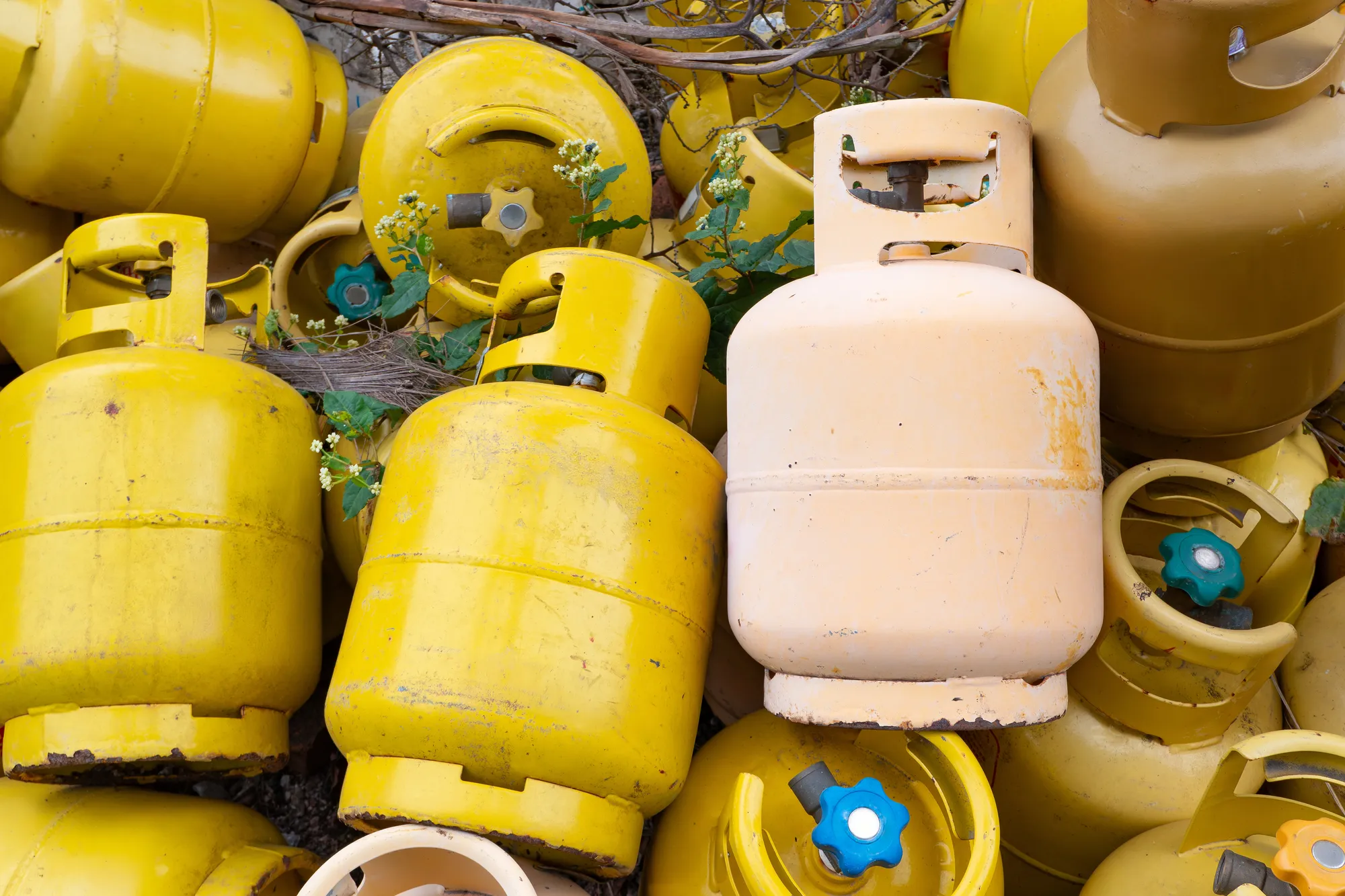
How to Dispose of and Get Rid of Old Empty Propane Tanks Near Me Safely and Legally Without Risking Fines or Safety Hazards
Putting a propane tank at the curb for regular trash pickup is illegal in most places. It’s also, in the wrong conditions, genuinely dangerous.
Most homeowners don’t find this out until the tank is already at the curb. Propane is a compressed, flammable gas — the U.S. Department of Transportation classifies it as a hazardous material, which means the rules around disposal are real and enforceable. They apply whether you’re dealing with a standard 20 lb grill tank or a small 1 lb camping cylinder.
Your options are solid, and most of them are free or low-cost. This guide covers every safe, legal path for getting rid of a propane tank near you, including the fastest route if you’d rather hand it off entirely.
TL;DR Quick Answers
How to Dispose of Propane Tanks
Propane tanks can’t go in regular trash. They’re classified as hazardous materials and require specific disposal channels. Here’s what to do:
- Burn off remaining gas by running the tank on your grill until the flame goes out.
- Open the valve outdoors, away from ignition sources, to release any residual pressure.
- Take the depressurized tank to a Blue Rhino or AmeriGas exchange kiosk at Home Depot, Walmart, or Lowe’s.
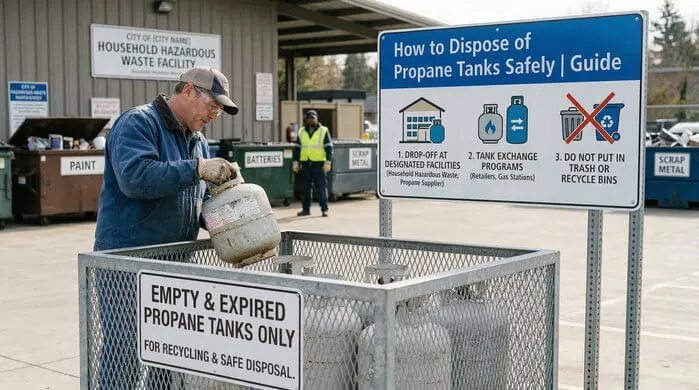
- Drop it off at your county’s household hazardous waste (HHW) facility — typically free for residents.
- Bring it to a local scrap metal yard. Steel tanks are fully recyclable once depressurized.
- Contact a local propane retailer or supplier. Many accept old tanks for proper disposal.
- Schedule a professional pickup with Jiffy Junk — book online at jiffyjunk.com/booking or call 844-JIFFY-JUNK.
Never: puncture, crush, incinerate, or place a propane tank in regular trash or curbside recycling.
Top Takeaways
- Propane tanks cannot go in regular trash. The DOT classifies propane as a hazardous material. Curbside collection is legally prohibited from taking them. Improper disposal can mean fines, property damage, and real safety risks.
- “Empty” doesn’t mean safe. Residual gas and pressure stay inside after use. Every tank needs proper depressurization before transport or drop-off — no exceptions.
- You have more options than you think. Your best routes:
- County HHW facility drop-off — typically free
- Exchange kiosk at Home Depot, Walmart, or Lowe’s
- Local scrap metal yard
- Propane retailer or supplier
- Full-service junk removal pickup
- Tank type determines your best route. A 20 lb grill tank and a 1 lb camping cylinder don’t have the same options. Know your tank before you go anywhere.
- Your tank is recyclable — not landfill material. Depressurize it, remove the valve, and the steel goes straight back into the supply chain. Jiffy Junk builds eco-responsible disposal into every pickup. No extra steps required on your end.
Table of Contents
- How to Dispose of and Get Rid of Old Empty Propane Tanks Near Me Safely and Legally Without Risking Fines or Safety Hazards
- TL;DR Quick Answers
- Top Takeaways
- Why You Can’t Just Throw Away a Propane Tank
- Types of Propane Tanks and Why It Matters for Disposal
- How to Safely Prepare Your Propane Tank for Disposal
- Where to Dispose of Propane Tanks Near You
- How to Recycle a Propane Tank
- Propane Tank Disposal Laws and Regulations
- How Jiffy Junk Can Help With Propane Tank Removal
- 7 Resources That Help You Dispose of Propane Tanks Safely and Legally
- 1. Find a Free Propane Tank Drop-Off Near You
- 2. Check If Your Tank Is Still Safe and Legal to Use
- 3. Know When Federal Law Requires Your Tank to Be Replaced
- 4. Understand the National Safety Standard Behind Propane Tank Handling
- 5. Find Out If Your Older Tank Qualifies for Exchange or Refill
- 6. Get the Full Federal Picture on LP-Gas Storage and Handling
- 7. Check Your State’s Rules on Small Disposable Cylinders
- Supporting Statistics on Propane Tank Disposal, Safety, and Recycling
- Final Thoughts and Opinion
- Frequently Asked Questions
- Q: Can you throw a propane tank in the trash?
- Q: How do I dispose of a 20 lb propane tank?
- Q: Are empty propane tanks safe to throw away?
- Q: Where can I drop off an old propane tank near me?
- Q: How much does propane tank disposal cost?
- Q: Can propane tanks be recycled?
- Q: What do I do with a 1 lb disposable propane tank?
- Q: Does Jiffy Junk pick up propane tanks?
- Ready to Get Rid of Your Old Propane Tanks the Easy Way?
Why You Can’t Just Throw Away a Propane Tank
The DOT designation isn’t bureaucratic paperwork. It carries real consequences for how tanks must be handled from the moment they’re no longer in use. Here’s what drives the restriction:
- Propane is a compressed, flammable gas classified as a hazardous material by the U.S. Department of Transportation. That designation comes with strict requirements for handling and disposal.
- “Empty” tanks aren’t actually empty. Residual gas and internal pressure stay inside after use. A tank that looks spent can still cause a fire or explosion if it’s crushed, punctured, or exposed to heat in a waste truck.
- Municipal solid waste programs aren’t equipped to take propane tanks. Your curbside crew is legally prohibited from handling them in most jurisdictions.
- Fines for improper disposal vary by state and municipality. In some areas, the penalties are steep, particularly if the tank causes damage or injury after being discarded.
Once you know your options, proper disposal is genuinely straightforward.
Types of Propane Tanks and Why It Matters for Disposal
The type of tank you have determines which disposal routes are open to you. Check which category yours falls into before you head anywhere:
- 1 lb disposable cylinders: used for camping stoves and tailgate grills. These aren’t refillable, and most exchange kiosks won’t take them. Your best route is a household hazardous waste (HHW) collection event.
- 20 lb standard BBQ tanks: the most common residential tank. Refillable and widely accepted at exchange kiosks, HHW facilities, and scrap metal yards. Most people asking this question have one of these.
- 30–100 lb residential tanks: used for generators, outdoor heating, and larger appliances. Plan — contact your local HHW facility or a junk removal service to arrange a pickup.
- 500+ gallon bulk tanks: handled directly by your propane supplier. Call them for decommissioning and removal. Don’t try to manage this category on your own.
Knowing your tank type saves you a wasted trip to a facility that can’t take what you’ve got.
How to Safely Prepare Your Propane Tank for Disposal
A few simple steps before drop-off protect both you and the facility workers handling your tank:
- Burn off the remaining gas. Connect the tank to your grill or a compatible appliance and run it until the flame goes out. This brings internal pressure to the lowest practical level before disposal.
- Open the valve in a well-ventilated outdoor area, away from any ignition sources. Let any residual pressure release slowly and completely.
- Leave the valve open. Drop-off facilities check for this. A closed valve signals an unverified tank and may get you turned away.
- Don’t puncture, crush, or cut the tank. Even after depressurization, physical damage to the shell is dangerous. This isn’t a shortcut worth taking.
- Transport it upright in a ventilated vehicle. Never put a propane tank in a sealed car trunk. Use a truck bed, or keep windows fully open if transporting inside a vehicle.
Safety note: Incinerating a propane tank — even one you believe is empty — can cause an explosion. Don’t attempt it under any circumstances.
Where to Dispose of Propane Tanks Near You
Several reliable options exist for propane tank disposal near you. The right one depends on your tank type, your schedule, and how much you want to handle yourself.
Propane Tank Exchange Programs
Blue Rhino and AmeriGas run exchange kiosks at major retailers, including Home Depot, Walmart, and Lowe’s. You drop off your old 20 lb tank and swap it for a filled one. A fee applies, but the process is fast and gets the old tank off your hands immediately.
A couple of things to know before you go:
- Most kiosks accept standard 20 lb tanks only.
- Small 1 lb disposable cylinders are not accepted at exchange kiosks.
- Heavily rusted or damaged tanks may be refused.
Hazardous Waste Facilities
Your county almost certainly runs a household hazardous waste (HHW) program. It takes one of two forms: a scheduled collection event (typically seasonal) or a permanent year-round drop-off site. Both accept propane tanks. Both are generally free for residents.
To find what’s near you, search your county name with “hazardous waste disposal” or check your county’s public works website directly.
Scrap Metal Yards
Propane tanks are steel, which means they carry real scrap value. Most yards accept fully depressurized tanks with the valve removed. Call ahead before making the trip since acceptance policies vary. Some yards pay you a small amount based on current steel scrap rates.
Jiffy Junk also offers a Scrap Metal Pick Up service if you’re dealing with multiple metal items at the same time.
Propane Retailers and Suppliers
Local propane retailers like Ferrellgas and Suburban Propane often accept old tanks, particularly if you’ve bought fuel from them before. Call ahead to confirm their current policy and whether any fees apply.
Junk Removal Services — The Easiest Option
Sometimes the simplest path is the right one. If you don’t have a truck, you’d rather not drive to multiple locations, or you’ve got a full garage to clear alongside the tank, a junk removal service handles everything in one visit. This option makes the most sense when:
- You have other items to remove along with the propane tank.
- You can’t safely transport the tank yourself.
- You want a licensed, insured team to manage the logistics from start to finish.
With Jiffy Junk’s White Glove Treatment, you point us to the tank, and we take care of the rest. Book propane tank removal online at jiffyjunk.com/booking.
How to Recycle a Propane Tank
Steel propane tanks are fully recyclable. Once the tank is depressurized and the valve is removed, your local scrap metal facility can take it. The steel gets recovered and reused rather than going to a landfill.
At Jiffy Junk, recycling is part of how we do the job, not an add-on. We donate and recycle whatever we can on every removal. When you schedule a pickup with us, eco-responsible disposal is already built into the service.
- Steel propane tanks are completely recyclable once depressurized, and the valve is removed.
- Scrap metal recovery keeps usable material out of landfills and puts it back into productive use.
- Jiffy Junk builds eco-friendly disposal into every job at no extra cost or effort to you.
Propane Tank Disposal Laws and Regulations
The rules around propane disposal exist because the risks are real. Here’s what applies at the federal level, and what to check locally:
- The U.S. Department of Transportation classifies propane cylinders as hazardous materials. That designation governs how tanks are transported and disposed of at both the federal and state levels.
- The U.S. Environmental Protection Agency provides household hazardous waste disposal guidance that covers compressed gas cylinders. HHW programs across the country align with these guidelines.
- State and municipal rules vary. What one county permits, another may fine. Check with your local waste management authority before you proceed.
If you’re clearing out other hazardous household items at the same time, our how to dispose of batteries guide covers another item most people get wrong.
When you’re not sure about the rules in your area, contact your county waste authority directly. They’ll give you the specific guidance you need.
How Jiffy Junk Can Help With Propane Tank Removal
You don’t need to figure out drop-off logistics, transportation requirements, or local regulations on your own. Jiffy Junk takes care of all of it.
Since 2014, we’ve served communities across the country with our signature White Glove Treatment. Our licensed and insured teams handle jobs of every size — from a single propane tank to a complete property cleanout — with upfront pricing and zero surprises.
- Transparent quotes, always. The price we give you is the price you pay, full stop.
- Nationwide service backed by locally knowledgeable crews.
- Eco-responsible disposal is built into every job. We recycle and donate wherever we can.
- We’re not happy until you are happy. That’s our promise on every single job.
Ready to get it done? Book your appointment online in 60 seconds at jiffyjunk.com/booking, or call 844-JIFFY-JUNK (844-543-3966).

“In our years of junk removal experience across the country, propane tanks are among the most frequently mishandled items we encounter at residential properties. People assume ‘empty’ means safe — but residual pressure and gas remain, which is exactly why proper preparation and disposal channels aren’t optional. Getting it right protects your home, your community, and your wallet.”
— The Jiffy Junk Expert Team
7 Resources That Help You Dispose of Propane Tanks Safely and Legally
Getting rid of a propane tank the right way takes about five minutes of research. These seven government and industry resources give you everything you need — from finding a free local drop-off to understanding the federal rules that apply to your specific tank.
1. Find a Free Propane Tank Drop-Off Near You
The EPA’s Household Hazardous Waste guide is your first stop. It explains why propane tanks require special handling and walks you through how to find a free HHW collection program in your county.
Source: EPA Household Hazardous Waste Guide
2. Check If Your Tank Is Still Safe and Legal to Use
Before you make any decisions, confirm your cylinder is still within its service life. The DOT’s consumer cylinder safety page shows you exactly how to read the markings on your tank and whether it qualifies for a refill or needs to be replaced.
Source: DOT Propane Cylinder Safety Consumer Guide
3. Know When Federal Law Requires Your Tank to Be Replaced
Every DOT-spec propane cylinder has a requalification schedule — either 5 or 10 years, depending on the type. This PHMSA resource spells out those intervals clearly, so you know whether your tank is still good or has already hit its legal end-of-life.
Source: DOT Propane Cylinder Requalification Requirements
4. Understand the National Safety Standard Behind Propane Tank Handling
NFPA 58 is the LP-Gas Code that most states have adopted as law. The NFPA fact sheet gives you a plain-language summary of the storage, placement, and handling rules that apply to your tank while you’re arranging disposal.
Source: NFPA LP-Gas Safety Fact Sheet
5. Find Out If Your Older Tank Qualifies for Exchange or Refill
If your 20 lb tank predates April 2002, it may not meet the Overfill Prevention Device requirement — which means exchange kiosks can legally turn it away. The CPSC’s guidance explains the rule and tells you what your options are.
Source: CPSC Propane Tank OPD Safety Guidance
6. Get the Full Federal Picture on LP-Gas Storage and Handling
OSHA’s 29 CFR 1910.110 is the federal standard that covers propane container requirements from storage through end-of-life. It’s the regulatory backbone behind the disposal rules that apply to every residential and commercial propane tank in the country.
Source: OSHA LP-Gas Storage and Handling Standard 29 CFR 1910.110
7. Check Your State’s Rules on Small Disposable Cylinders
If you’re dealing with 1 lb camping cylinders, state-level laws may affect how you dispose of them. The NPGA’s coverage of single-use cylinder legislation tracks which states — including California — have passed specific restrictions you’ll want to know about before you act.
Source: NPGA State Single-Use Propane Cylinder Regulations
Supporting Statistics on Propane Tank Disposal, Safety, and Recycling
These numbers reflect what our teams see on the job every day. Propane tanks are among the most common — and most frequently mishandled — items we encounter at residential properties.
1. 42 Million U.S. Households Use Propane for Outdoor Grilling
We see this scale across every market we serve. According to the 2020 Residential Energy Consumption Survey:
- 42 million U.S. households use propane for outdoor grilling
- 11 million more rely on it as a primary home fuel
- That’s tens of millions of tanks that will eventually need safe, legal disposal
In our experience, most homeowners don’t think about disposal until the tank is already rusting in the back of a garage. By then, the question is overdue.
Source: U.S. Energy Information Administration — Propane End Uses in U.S. Households
2. Propane Powers 69% of All Residential Grill Fires
The federal data backs up what our teams see in the field. According to the U.S. Fire Administration, residential grill fires cause:
- 10 deaths
- 100 injuries
- $37 million in property loss
Propane is the fuel source in 69% of those fires. A mishandled, improperly stored, or casually discarded tank isn’t just a disposal headache. It’s a live safety risk for your household and your neighbors. Proper disposal closes that hazard — for good.
Source: U.S. Fire Administration — Residential Grill Fire Statistics
3. The U.S. Recycles 60–80 Million Tons of Steel Scrap Every Year
We tell every customer the same thing: a steel propane tank isn’t waste. It’s a recyclable material that needs the right channel. The American Iron and Steel Institute reports:
- U.S. furnaces process 60–80 million tons of domestic steel scrap annually
- The overall U.S. steel recycling rate sits at approximately 69%
- A fully depressurized propane tank qualifies as recyclable scrap — not landfill material
We see this in every job. The tank gets removed, taken to a scrap facility, the steel gets recovered, and it re-enters the supply chain. No landfill required. Just the right logistics — which is exactly what we’re here to handle.
Source: American Iron and Steel Institute — Steel Recycling
Final Thoughts and Opinion
Propane tank disposal is simpler than most people expect, but it doesn’t happen on its own. The right route matters for your safety, your wallet, and your community. Whether you use an exchange program, drop the tank at your county’s HHW facility, bring it to a scrap yard, or have a team pick it up, the key is that you don’t put it in the trash.
Your options are real, accessible, and most of them cost nothing. If you’d rather skip the legwork entirely, Jiffy Junk has been handling this since 2014. We’ve built our reputation one White Glove job at a time. Point us to the tank. We’ll handle everything else.
Frequently Asked Questions
Q: Can you throw a propane tank in the trash?
A: No. The DOT classifies propane tanks as hazardous materials, and municipal solid waste programs aren’t permitted to accept them. Improper disposal can result in fines. Use an HHW facility, an exchange program, or a professional pickup service like Jiffy Junk instead.
Q: How do I dispose of a 20 lb propane tank?
A: Connect the tank to your grill and burn off any remaining gas. Once it’s depressurized, take it to a Blue Rhino or AmeriGas exchange kiosk, your local HHW facility, or a scrap metal yard. If you’d rather not deal with drop-offs, Jiffy Junk can handle pickup at jiffyjunk.com/booking.
Q: Are empty propane tanks safe to throw away?
A: No. An “empty” tank still holds residual gas and internal pressure. It needs to be properly depressurized and taken to an approved disposal site, not left at the curb or tossed in a dumpster.
Q: Where can I drop off an old propane tank near me?
A: Start with your county’s HHW program — it’s usually free. Other options include Blue Rhino and AmeriGas exchange kiosks at major retailers, local propane suppliers and retailers, scrap metal yards, and full-service junk removal companies like Jiffy Junk. Search your county name and “hazardous waste disposal” to find nearby locations.
Q: How much does propane tank disposal cost?
A: HHW facility drop-offs are typically free for residents. Exchange programs charge a fee but give you a full tank in return. Jiffy Junk provides upfront quotes with no hidden fees, so you know exactly what you’ll pay before the crew arrives.
Q: Can propane tanks be recycled?
A: Yes. Steel propane tanks are fully recyclable once depressurized, and the valve is removed. Scrap metal yards and eco-focused junk removal services both handle this. At Jiffy Junk, recycling and donating items are built into every job.
Q: What do I do with a 1 lb disposable propane tank?
A: Skip the exchange kiosk — they won’t take it. Bring it to a local HHW collection event or permanent HHW facility instead. Search your county’s website for upcoming events or drop-off locations near you.
Q: Does Jiffy Junk pick up propane tanks?
A: Yes. Jiffy Junk provides full-service junk removal that includes propane tank pickup. Our licensed and insured teams handle the logistics from start to finish. Book in 60 seconds at jiffyjunk.com/booking or call 844-JIFFY-JUNK.
Ready to Get Rid of Your Old Propane Tanks the Easy Way?
Jiffy Junk’s White Glove Treatment makes propane tank removal simple — whether you’ve got one old grill tank or a full garage to clear. Book at jiffyjunk.com/booking or call 844-JIFFY-JUNK (844-543-3966), and let our team handle the rest.