Mattress Disposal Made Easy: What to Do With and How to Get Rid of an Old Mattress Without the Heavy Lifting, Hassle, or Stress of Hauling It Yourself
That old mattress won’t fit in your trash bin—and most people don’t realize it until they’re standing at the curb.
Here’s what we’ve learned after hauling thousands of mattresses since 2014: the average person spends 2-3 hours researching disposal options, only to hit dead ends. Municipal pickup has restrictions. Donation centers reject anything with stains. And recycling facilities—if your area even has one—often charge fees that surprise people at drop-off.
We’ve navigated every mattress removal scenario imaginable—from memory foam kings wedged in finished basements to bedbug-compromised units requiring special handling. This guide shares what actually works, what wastes your time, and when professional removal makes more sense than the DIY route.
No heavy lifting. No runaround. Just answers.
Quick Answers
How to Dispose of a Mattress
The short answer: You have five main options—municipal bulk pickup, retailer take-back, recycling drop-off, donation, or professional removal. The best choice depends on your mattress condition, location, and timeline.
Fastest ways to dispose of a mattress:
- Schedule bulk pickup through your city’s waste management (often free, requires 48-72 hours’ notice)
- Request the retailer take back when a new mattress is delivered (free to $100)
- Drop off at a recycling facility (free in CA, CT, RI, OR; $20-$40 elsewhere)
- Donate to a local charity if clean, stain-free, and under 10 years old
- Book professional junk removal for same-day service with no heavy lifting
What we’ve learned after a decade of mattress removal: Most people spend 2-3 hours researching options only to hit dead ends. The quickest path is often the simplest—call your municipality first, check ByeByeMattress.com for free recycling if you’re in a program state, or schedule a professional pickup if time matters more than cost.
Bottom line: Don’t let an old mattress sit in your garage for months. Pick an option, make a call, and reclaim your space.
Top 5 Takeaways
- Mattress disposal is harder than expected. Curbside trash won’t take it. Donation centers reject most. Recycling isn’t available everywhere. Know your options before the new mattress arrives.
- Free disposal exists—with trade-offs. Municipal bulk pickup, retailer take-back, and recycling drop-off cost nothing in some areas. But expect scheduling delays, transportation hassles, and possible rejection.
- 75%+ of a mattress can be recycled. Steel, foam, wood, and fiber all have second lives. Responsible disposal keeps usable materials out of landfills.
- DIY works in the right situation. Ground floor, clean mattress, truck access, and nearby drop-off? Do it yourself. Stairs, tight spaces, contamination, or no time? Professional removal pays for itself.
- The best method depends on your circumstances. Consider condition, location, timeline, and physical ability. There’s no single right answer—just the right one for you.
Table of contents
- Mattress Disposal Made Easy: What to Do With and How to Get Rid of an Old Mattress Without the Heavy Lifting, Hassle, or Stress of Hauling It Yourself
- Quick Answers
- Top 5 Takeaways
- Why Mattress Disposal Isn’t as Simple as It Sounds
- Mattress Disposal Options: What Actually Works
- The DIY Route: When It Makes Sense (and When It Doesn’t)
- What Professional Mattress Removal Looks Like
- Mattresses That Require Special Handling
- Making the Right Choice for Your Situation
- Essential Resources for Mattress Disposal
- 1. Find Free Recycling Drop-Off Locations in Your State
- Bye Bye Mattress – Mattress Recycling Council
- 2. Search 100,000+ Recycling Locations Nationwide
- 3. Dispose of Bed Bug-Exposed Mattresses Safely
- 4. Determine If Your Mattress Qualifies for Donation
- 5. Schedule a Charitable Donation Pickup
- 6. Understand State Recycling Programs and Fees
- 7. Check Your Local Bulk Pickup Schedule
- Supporting Statistics
- Final Thoughts & Opinion
- FAQ on “How to Dispose of a Mattress”
- Ready to Make Mattress Disposal Easy?
Why Mattress Disposal Isn’t as Simple as It Sounds
Mattresses fall into an awkward category. They’re too large for regular waste collection, too bulky for most vehicles, and too cumbersome for one person to handle safely.
In our experience, most people discover these realities after they’ve already bought the new mattress. Now they’re stuck with two—and a problem they didn’t anticipate.
The challenges compound quickly:
- Size and weight: A queen mattress averages 60-80 pounds and doesn’t bend or fold
- Municipal restrictions: Many cities limit curbside pickup to specific days or require advance scheduling
- Transportation hurdles: Mattresses don’t fit in standard vehicles without roof racks, straps, and risk of damage
- Disposal regulations: Some areas prohibit mattress landfill disposal entirely
Understanding your options upfront saves time, frustration, and unexpected costs.
Mattress Disposal Options: What Actually Works
Donation
Donating seems like the obvious first choice. The reality is more complicated.
Most charitable organizations—including Salvation Army and Goodwill—have strict mattress acceptance policies. They typically reject units with stains, tears, odors, or any sign of pest exposure. Some locations have stopped accepting mattresses altogether due to liability concerns.
What we’ve seen work: Local shelters and smaller nonprofits sometimes have more flexible standards. Call ahead with an honest description before loading anything into your vehicle.
Recycling
Mattresses are up to 90% recyclable. Steel springs become scrap metal. Foam gets repurposed into carpet padding. Wood frames go to biomass facilities.
The catch? Dedicated mattress recycling facilities aren’t everywhere. Where they do exist, fees typically range from $20-$40 per unit. Some require you to schedule drop-off appointments weeks in advance.
Pro tip: Search “[your state] mattress recycling” to find the closest facility. California, Connecticut, and Rhode Island have statewide programs that make this easier.
Retailer Take-Back Programs
Many mattress retailers offer the removal of your old mattress when delivering a new one. This convenience comes with caveats.
Fees usually run $50-$100 per mattress. Some retailers restrict the service to mattresses in “sanitary condition.” Others won’t navigate stairs or tight spaces.
From our experience: Retailer programs work well for straightforward swaps—ground floor, easy access, clean mattress. Anything more complicated often gets declined at delivery.
Municipal Bulk Pickup
Your city or county may offer scheduled bulk item collection. Availability, cost, and restrictions vary widely by location.
Common limitations include:
- Pickup windows are once a month or quarter
- Requirements to schedule days or weeks ahead
- Restrictions on mattress condition or quantity
- Fees ranging from free to $50+
Check your local waste management website for specific guidelines. What applies in one ZIP code may differ completely in the next.
Junk Removal Services
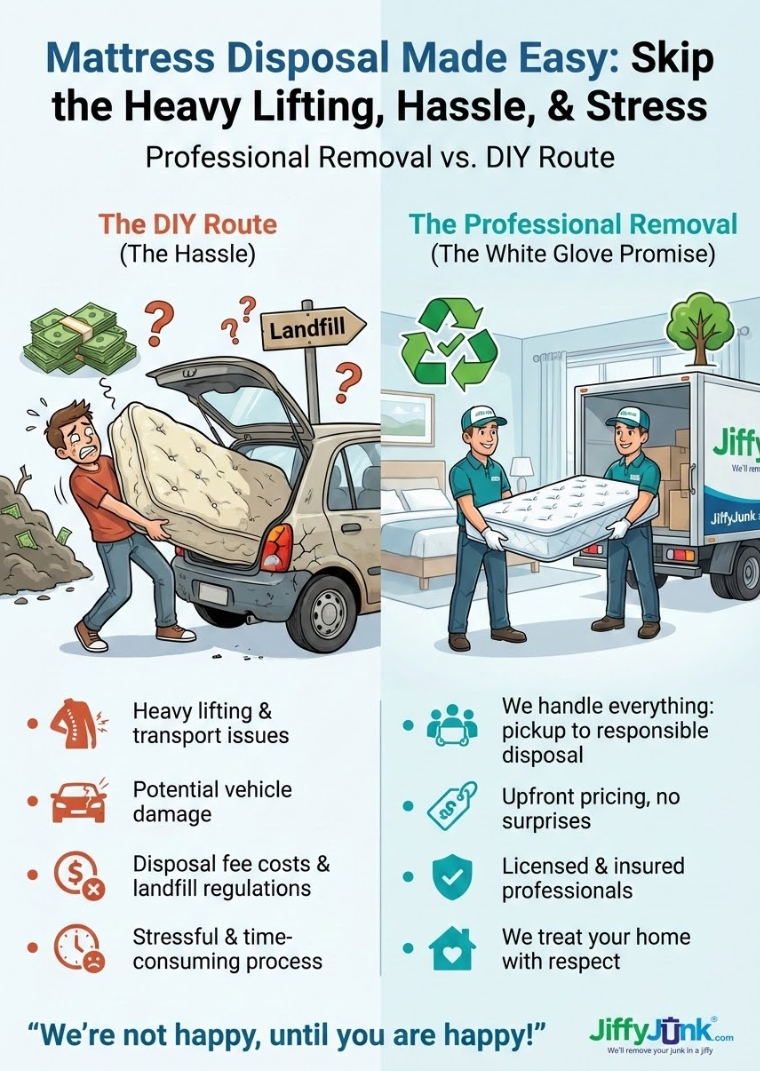
Professional removal eliminates the variables. A crew arrives, handles the heavy lifting, and takes the mattress away—regardless of size, condition, location in your home, or stairs involved.
This option makes the most sense when:
- Your mattress is in a difficult-to-access location
- You have multiple mattresses to remove
- Time constraints make DIY impractical
- Physical limitations prevent safe handling
- The mattress has contamination issues requiring proper disposal
The DIY Route: When It Makes Sense (and When It Doesn’t)
Hauling your own mattress can work under the right circumstances.
DIY might be reasonable if:
- You own a truck or have access to one
- The mattress is on ground level with clear pathways
- You have a helper available
- A disposal site is nearby with convenient hours
- The mattress is in acceptable condition for your chosen destination
DIY becomes problematic when:
- Stairs, narrow hallways, or tight corners are involved
- You’re working alone
- The mattress shows signs of bedbugs or significant contamination
- Your vehicle requires elaborate securing methods
- The nearest disposal option is far away or has limited availability
We’ve responded to countless calls from people who started the DIY approach and got stuck—mattress wedged in a stairwell, strapped precariously to a car roof, or rejected at a donation center after a 30-minute drive.
There’s no shame in recognizing when a job exceeds practical limits.
What Professional Mattress Removal Looks Like
When you schedule mattress removal with a full-service junk removal company, the process is straightforward.
Here’s how it typically works:
- Schedule a pickup window that fits your availability
- Point to the mattress when the crew arrives—any room, any floor
- Receive upfront pricing before any work begins
- Relax while the team handles removal, including navigating stairs and doorways
- Enjoy your cleared space once the mattress is gone
Professional crews come equipped to handle size, weight, and access challenges. Box springs, bed frames, and bedding can usually go at the same time.
Responsible companies prioritize donation and recycling over landfill disposal. Items in good condition get routed to local charities. Recyclable materials go to appropriate facilities. Only what can’t be salvaged ends up in the waste stream.
Mattresses That Require Special Handling
Certain situations call for extra care during disposal.
Bedbug exposure: Mattresses with confirmed or suspected bedbug activity need containment during transport. Many donation centers and recyclers won’t accept them at all. Professional removal ensures proper handling and disposal that won’t spread the problem.
Excessive moisture or mold: Water-damaged mattresses pose health concerns and typically can’t be donated or recycled. These require direct disposal with appropriate precautions.
Biohazard contamination: Mattresses from certain estate cleanouts or hoarding situations may have contamination requiring specialized handling. Reputable junk removal companies know how to manage these sensitively and safely.
If your mattress falls into any of these categories, be upfront when scheduling removal. The right company will handle it professionally without judgment.
Making the Right Choice for Your Situation
The best mattress disposal method depends on your specific circumstances.
Consider these factors:
- Condition of the mattress: Clean and gently used opens more options than stained or damaged
- Your physical capability: Mattress removal is genuinely strenuous work
- Time availability: DIY options often require research, scheduling, and transportation time
- Location challenges: Upper floors and tight spaces complicate self-removal significantly
- Number of mattresses: Multiple units multiply every challenge
- Budget: Free options exist, but often come with trade-offs in time and effort
For many people, the math favors professional removal once they factor in time, physical effort, vehicle logistics, and potential disposal fees. For others, a straightforward donation or recycling drop-off does the job.
Either way, that mattress doesn’t have to occupy your space—or your mental energy—any longer than necessary.
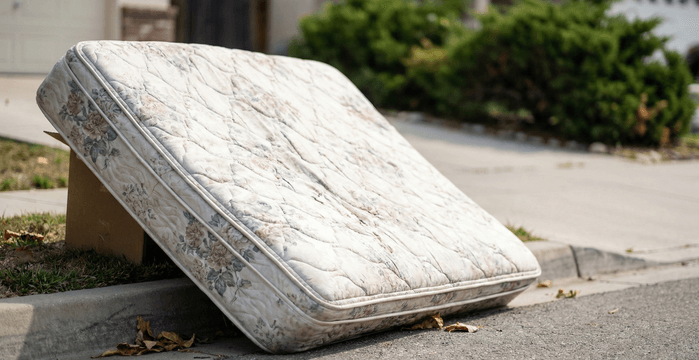
“Most people don’t realize that a mattress sitting curbside for more than a day or two can actually get you fined in many municipalities. We’ve helped countless customers who started with a DIY plan and called us after discovering their city’s bulk pickup was three weeks out—with their old mattress already blocking the driveway.” – JiffyJunk Team, serving customers nationwide since 2014
Essential Resources for Mattress Disposal
Getting rid of an old mattress shouldn’t mean hours of research and dead ends. We’ve pulled together the most helpful resources to point you in the right direction—whether you’re looking to recycle, donate, or schedule a pickup.
These seven trusted sources give you the information you need to make the right choice for your situation.
1. Find Free Recycling Drop-Off Locations in Your State
Bye Bye Mattress – Mattress Recycling Council
This is good news if you live in California, Connecticut, Oregon, or Rhode Island – your state has a free mattress recycling program. This official locator helps you to locate no-cost drop-off sites, collection events, and participating retailers right in your neighborhood.
- Great for: Residents in CA, CT, OR, or RI looking for eco-friendly disposal
- Worth knowing: 99% of California residents live within 15 miles of a recycling location
- URL: https://byebyemattress.com/find-a-facility/
2. Search 100,000+ Recycling Locations Nationwide
Earth911 Recycling Search
Not in a state that has a dedicated program? No problem. Earth911 has the largest recycling database in North America, linking you to mattress recyclers, donation centers, and disposal services of any type anywhere in the country. You just need to type in your zip code to find out what is available around you.
- Great for: Finding options outside of mandatory recycling states
- Worth knowing: Results include both free and fee-based services, so you can compare
- URL: https://search.earth911.com/
3. Dispose of Bed Bug-Exposed Mattresses Safely
EPA Bed Bug Control Guidelines
Dealing with a bed bug-exposed mattress? The EPA has some great, step-by-step instructions for you on how to contain, transport, and dispose of it responsibly – without spreading the problem to somebody else’s home.
- Great for: Anyone handling a mattress with confirmed or suspected pest exposure
- Worth knowing: The EPA recommends slashing or defacing infested mattresses before placing them curbside
- URL: https://www.epa.gov/bedbugs/do-it-yourself-bed-bug-control
4. Determine If Your Mattress Qualifies for Donation
Sleep Foundation – When to Replace Your Mattress
Wondering whether your mattress has any life left in it? The Sleep Foundation breaks down the length of time different types of mattresses last, as well as what signs it’s time to change. This helps you determine if donation is the realistic answer – or if recycling is the better choice.
- Great for: Deciding between donation, recycling, or professional removal
- Worth knowing: Most mattresses last 7-10 years; condition is the deciding factor for donation eligibility
- URL: https://www.sleepfoundation.org/mattress-information/when-should-you-replace-your-mattress
5. Schedule a Charitable Donation Pickup
Salvation Army Donation Services
If your mattress is clean, with no stains, and is still in great shape, it means that your mattress is going to help someone else get a good night’s sleep, and you get the satisfaction of helping out. The Salvation Army does free pick-up in many areas, although there are variations from area to area. A quick phone call would let you know if or not your local center accepts mattresses.
- Great for: Gently used mattresses that meet donation standards
- Worth knowing: Always call ahead—some locations accept mattresses while others don’t
- URL: https://satruck.org/
6. Understand State Recycling Programs and Fees
CalRecycle – California Mattress Stewardship Program
Curious how mattress recycling programs actually work? California’s official program page explains the recycling fee system and what it funds. It’s a helpful reference if you want to understand your options—or if you’re wondering where that fee on your new mattress purchase goes.
- Great for: California residents and anyone researching how state recycling programs operate
- Worth knowing: The $10.50 fee collected at purchase funds free recycling access statewide
- URL: https://calrecycle.ca.gov/mattresses/
7. Check Your Local Bulk Pickup Schedule
Your City or County Waste Management Website
Many municipalities include bulk item pickup as part of their regular services—you just need to know when and how to schedule it. Your local waste management website has the details on pickup days, fees, advance notice requirements, and whether mattresses need to be wrapped in plastic.
- Great for: Taking advantage of services you may already be paying for
- Worth knowing: Most cities require 48-72 hours advance scheduling; some have monthly limits
- How to find it: Search “[your city] bulk waste pickup” or “[your county] mattress disposal”
Supporting Statistics
We’ve hauled thousands of mattresses since 2014. These numbers from government agencies and industry organizations confirm what we see every day on the job.
1. Over 50,000 Mattresses Are Discarded in the U.S. Every Day
Americans throw away 15 to 20 million mattresses annually. Most end up in landfills.
What we’ve learned in the field:
- The average person has no idea where to take a mattress
- Options aren’t obvious—and they vary by location
- Many mattresses sit in garages for months because owners don’t know what to do
What most people don’t realize:
- More than 75% of a mattress can be recycled
- Steel springs get melted down for scrap
- Foam becomes carpet padding
- Wood gets chipped into mulch
We route every mattress to donation or recycling when the condition allows. Burying recoverable materials doesn’t sit right with us.
Source: Mattress Recycling Council
URL: https://mattressrecyclingcouncil.org/why-recycle/
2. Recycling Programs Have Diverted 575 Million Pounds from Landfills
Since 2015, the Bye Bye Mattress program has recycled over 15 million mattresses across four states: California, Connecticut, Rhode Island, and Oregon.
The impact:
- 575 million pounds of materials were kept out of landfills
- Steel, foam, fiber, and wood reclaimed for new products
- Nearly 2 million mattresses are recycled annually
What’s changed since we started:
- A decade ago, finding a mattress recycler was difficult—even for us
- Today, California has 240+ permanent drop-off locations
- 99% of California residents live within 15 miles of a recycling site
Access has never been easier. The industry is moving in the right direction.
Source: Mattress Recycling Council – 10 Year Impact Report
URL: https://mattressrecyclingcouncil.org/impact-report/
3. Connecticut’s Program Saves Municipalities $3.25 Million Per Year
Connecticut passed the nation’s first mattress stewardship law in 2013. The results over ten years speak for themselves.
By the numbers:
- 1.7 million mattresses recycled
- 30,000+ tons of material diverted from landfills
- $3.25 million saved annually in municipal disposal costs
- Enough mattresses to fill Hartford’s XL Center three times
What happens without these programs:
- Mattresses pile up at transfer stations
- Illegal dumping spikes
- Cities spend hundreds of thousands cleaning up curbsides and vacant lots
Connecticut’s success is a model we hope more states will follow.
Source: Connecticut DEEP
URL: https://portal.ct.gov/deep/reduce-reuse-recycle/recycling/mattress-recycling
Final Thoughts & Opinion
After a decade of hauling mattresses out of homes across the country, we’ve come to a simple conclusion: mattress disposal is harder than it needs to be.
The Reality Most People Face
Getting rid of a mattress shouldn’t require hours of research, multiple phone calls, and a borrowed truck. But that’s exactly what it takes for most people.
- Curbside services won’t take it.
- Donation centers reject anything less than pristine
- Recycling facilities aren’t available everywhere
- DIY removal risks injury and wasted time
The system isn’t broken. It’s just incomplete.
What 10+ Years in the Field Has Taught Us
We’ve removed mattresses from third-floor walk-ups, finished basements with 90-degree turns, and homes where the owner physically couldn’t move them themselves.
Four things we’ve observed:
- People want to do the right thing. Given a clear path, most choose recycling over landfill.
- The “easy” option often isn’t. DIY sounds simple until you’re stuck halfway down a staircase.
- One-size-fits-all advice doesn’t work. Every situation is different.
- Professional removal isn’t always a luxury. For seniors, people with disabilities, or tight timelines—it’s often the only practical choice.
Our Honest Take
Not every mattress removal requires a professional crew.
Handle it yourself if:
- Your mattress is clean
- You have access to a truck
- There’s a free drop-off site nearby
We’d rather you recycle it for free than pay for something you don’t need.
Call us if:
- The logistics don’t line up
- Stairs or tight spaces are involved
- You’d simply rather not deal with it
That’s exactly why we exist.
What We Bring to the Table
- Show up when we say we will
- Handle the heavy lifting—stairs included
- Provide upfront pricing with no surprises
- Prioritize recycling and donation over landfill
- Treat your home and your time with respect
That’s the White Glove Treatment. It’s what we’ve built our reputation on since 2014.
The Bottom Line
Mattress disposal isn’t glamorous. But it deserves a real solution—not a runaround.
Whether you handle it yourself or let us take care of it, the goal is the same:
Get that mattress out of your space and into the right hands. Responsibly.
We’re here when you’re ready.
FAQ on “How to Dispose of a Mattress”
Q: Can I put a mattress out with my regular trash for curbside pickup?
A: Rarely. Standard trash collection won’t take mattresses—they’re too bulky and jam compactor equipment.
Most municipalities offer bulk item pickup as a separate service. We’ve coordinated with waste services across the country, and rules vary dramatically by location.
Before dragging your mattress to the curb:
- Check your local waste management website for bulk pickup options
- Call ahead—most require 48-72 hours’ notice
- Ask if mattresses must be wrapped in plastic
- Confirm quantity limits and fees
What we’ve seen: Customers get fined for leaving mattresses curbside without scheduling. A five-minute phone call prevents headaches.
Q: How much does it cost to get rid of a mattress?
A: Anywhere from free to $150, depending on the method—and how you value your time.
Cost breakdown by disposal method:
- Municipal bulk pickup: Free to $50 (limited availability, may take weeks to schedule)
- Retailer take-back: Free to $100 (often won’t haul from upper floors)
- Recycling drop-off in CA, CT, RI, OR: Free at designated locations
- Recycling drop-off elsewhere: $20–$40 per unit
- Professional junk removal: $75–$150 (includes scheduling flexibility, stair carry, proper disposal)
Our honest take: “Free” options aren’t always free when you factor in your time. We’ve picked up countless mattresses from customers who spent half a Saturday on DIY—borrowed a truck, got rejected at the facility, and called us anyway.
Sometimes paying for convenience is the smarter move.
Q: Where can I take a mattress to be recycled?
A: It depends entirely on where you live. This is one of the biggest gaps in the disposal system.
If you’re in California, Connecticut, Rhode Island, or Oregon:
- Visit ByeByeMattress.com for free drop-off locations
- These states have mandatory recycling programs funded by purchase fees
- 99% of California residents live within 15 miles of a site
- We’ve watched this infrastructure expand significantly over the past decade
If you’re anywhere else:
- Search Earth911.com for facilities in your area
- Contact your local waste management office
- Expect fees of $20–$40 per mattress
- Some facilities require appointments scheduled days ahead of time
Our approach: We route mattresses to recycling whenever conditions and location allow. Burying recoverable materials—steel, foam, wood, fiber—in a landfill doesn’t sit right with us.
Q: Will Goodwill or Salvation Army take my old mattress?
A: They might. But in our experience, probably not.
This is one of the most common assumptions we encounter. Most Goodwill and Salvation Army locations have stopped accepting mattresses due to health regulations, liability concerns, and bed bug risks.
Locations that still accept mattresses require:
- No stains, rips, tears, or odors
- No sagging or structural damage
- No signs of pest exposure
- Often under 7–10 years old
- Original law tag still attached
Our advice: Call before you load. We’ve heard from too many customers who drove 30 minutes only to get turned away.
Alternative options:
- Local homeless shelters
- Transitional housing programs
- Furniture banks
- Smaller nonprofits with flexible standards
Always confirm acceptance first. Showing up with a rejected mattress wastes everyone’s time.
Q: How do I dispose of a mattress that has bed bugs?
A: Very carefully—and with more steps than most people expect.
We handle bed bug-exposed mattresses regularly. The rules differ from standard disposal:
- Most donation centers won’t touch them
- Many recyclers refuse them outright
- Containment becomes the priority
Steps for safe disposal:
- Seal completely in a plastic mattress bag or heavy-duty sheeting
- Label clearly as infested, so no one mistakes it for usable
- Slash or deface so it can’t be picked up and reused
- Schedule pickup through your municipality or a professional service
- Never leave uncovered on the curb—you risk spreading the problem
What we’ve seen: Well-meaning people set infested mattresses outside. Within hours, someone takes it—and now there’s a new infestation elsewhere. Destroying the mattress before disposal isn’t cruel. It’s responsible.
Important: Be upfront when calling for removal. We don’t judge. But we need to know so we can handle it properly.
Ready to Make Mattress Disposal Easy?
Skip the heavy lifting, hassle, and stress of hauling it yourself. Book your Jiffy Junk mattress removal today and let our White Glove crew handle the rest.