How to Get Rid of and Remove Bed Bugs in a Mattress: Signs, Treatment, Disposal, and When to Replace Your Mattress
Waking up with unexplained bites? Your mattress may be harboring bed bugs — and from what our teams see on hundreds of removal jobs each year, most people wait too long to act. Here’s what we’ve learned firsthand: by the time you spot visible signs, the infestation is usually weeks ahead of you.
This guide shares what our crews encounter in the field every day — how to confirm you’re dealing with bed bugs, which treatments actually work, and the telltale signs that no amount of cleaning will save your mattress. We’ve hauled away thousands of infested mattresses nationwide, and we can tell you exactly when it’s time to stop treating and start replacing.
When that moment comes, don’t risk spreading the problem by dragging an infested mattress through your home. Our licensed and insured teams handle safe, contained mattress removal so you can reclaim your space — and your sleep — without the hassle.
TL;DR: Quick Answers
How to Get Rid of Bed Bugs in a Mattress
The most effective approach depends on how far the infestation has progressed. Based on what our teams see across thousands of removal jobs nationwide, here’s what actually works:
If caught early (within a few weeks):
- Hire a licensed pest control professional for heat treatment — bed bugs die at sustained temperatures above 120°F
- Seal the mattress in a bed-bug-proof encasement to trap remaining bugs and prevent re-infestation
- Skip the DIY sprays — store-bought products only reach the surface, not the eggs and colonies hidden inside mattress layers
If the infestation keeps coming back after treatment:
- Two or more failed professional treatments typically mean bugs have penetrated too deeply into the mattress interior
- At that point, replacing the mattress is faster, more reliable, and often cheaper than continued treatment cycles
- Wrap the infested mattress in a sealed plastic bag before moving it — dragging it uncovered through your home spreads bugs to other rooms
When you’re ready to remove the mattress:
- Don’t DIY the disposal. From our experience, most whole-home infestations started as a single-bedroom problem that spread during an uncontained removal attempt.
- Jiffy Junk’s licensed and insured teams remove infested mattresses with containment protocols — we handle the lifting, hauling, and responsible disposal so nothing spreads. Most jobs are done the same day.
Top Takeaways
- Sort first, organize later. Separate everything into keep, donate, recycle, and remove before touching a single shelf. From thousands of cleanouts, we’ve learned this is the fastest path to a garage that stays clean.
- Don’t trash what someone else can use. Donate usable furniture, tools, and appliances to Habitat for Humanity ReStore. Find recycling drop-offs for everything else on Earth911.
- Handle hazardous items separately. Old paint, motor oil, pesticides, and automotive fluids require special disposal. Find your local collection program through the EPA’s guide before you start.
- The hardest part is starting. Over half of Americans feel overwhelmed by clutter and don’t know where to begin. Pick a date, block the time, and commit — or skip the stress and call a pro.
- You don’t have to do it alone. Jiffy Junk clears entire garages in a single visit — same-day service, transparent pricing, responsible disposal, zero heavy lifting. Just point to what needs to go.
Table of Contents
- How to Get Rid of and Remove Bed Bugs in a Mattress: Signs, Treatment, Disposal, and When to Replace Your Mattress
- TL;DR: Quick Answers
- Top Takeaways
- How to Spot Bed Bugs in Your Mattress
- Bed Bug Treatment Options That Actually Work
- When to Stop Treating and Replace Your Mattress
- How to Safely Dispose of a Bed Bug–Infested Mattress
- Why Jiffy Junk for Mattress Removal
- FAQ on How to Get Rid of Bed Bugs in a Mattress
- Q: Can I get rid of bed bugs in my mattress without throwing it away?
- Q: What are the first signs of bed bugs in a mattress?
- Q: How do I safely get rid of a mattress that has bed bugs?
- Q: Do DIY bed bug sprays actually work on mattresses?
- Q: How much does it cost to have a bed bug–infested mattress removed?
- Ready to Get Rid of Your Bed Bug–Infested Mattress? Let Jiffy Junk Handle the Removal
How to Spot Bed Bugs in Your Mattress
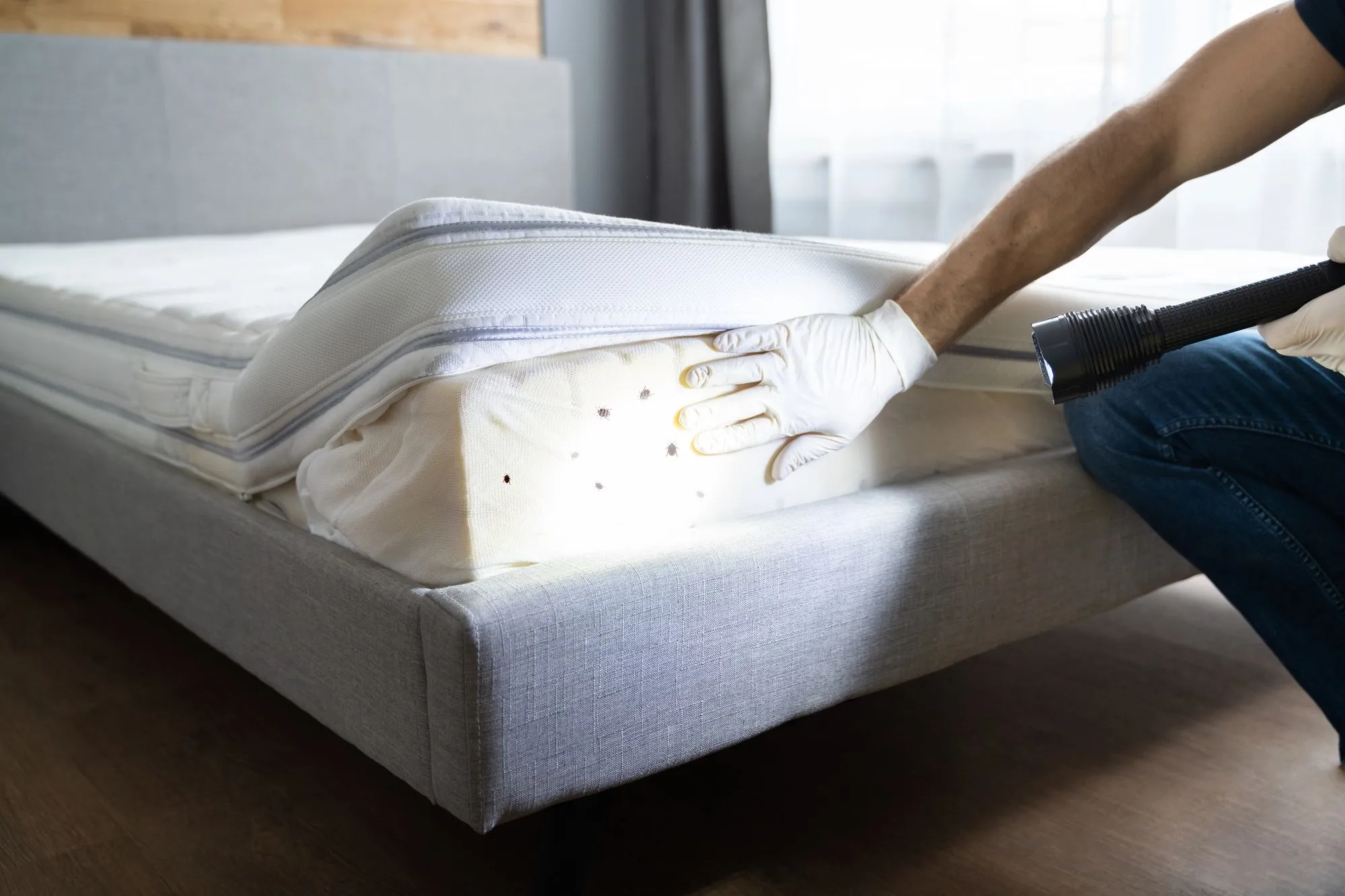
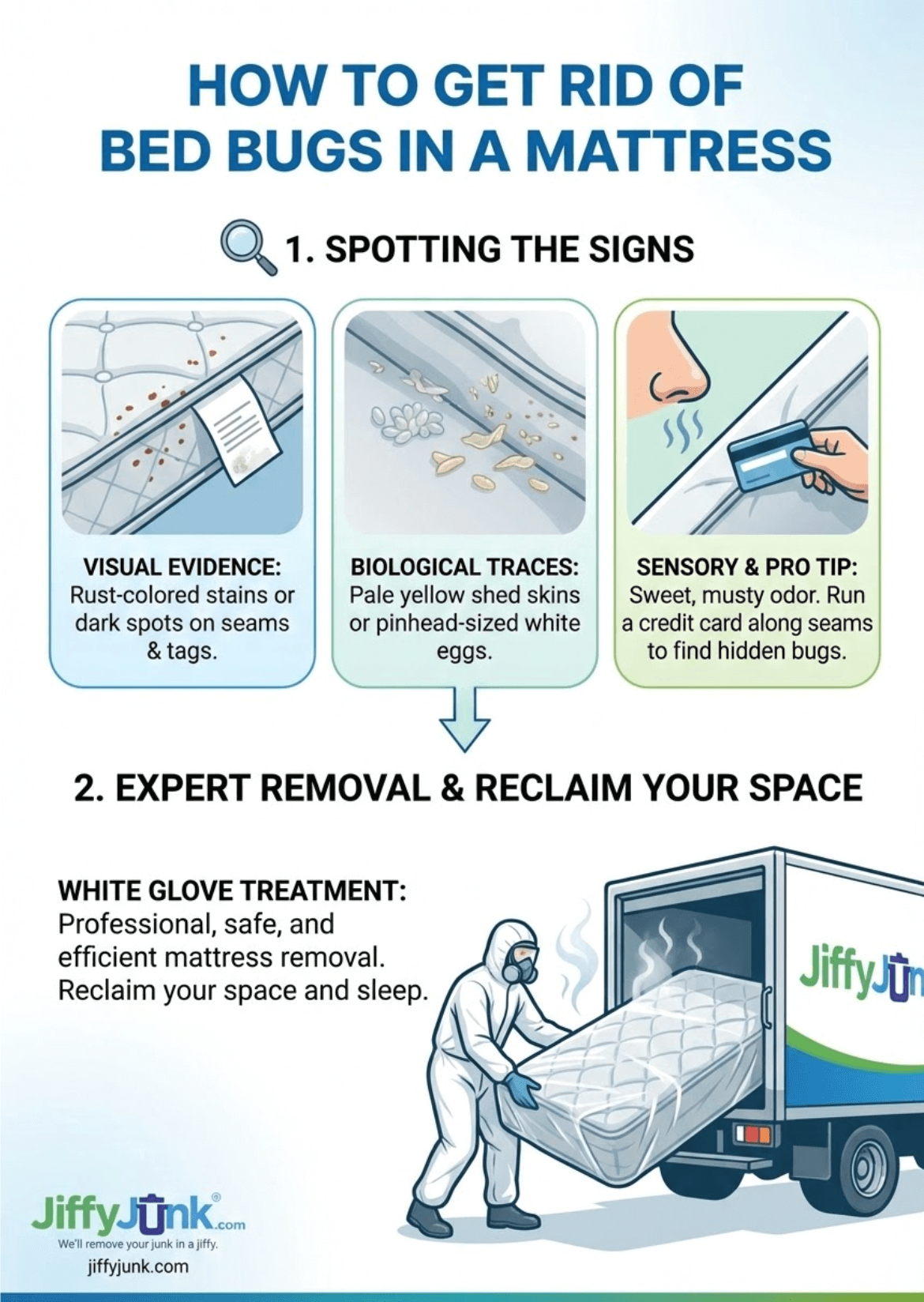
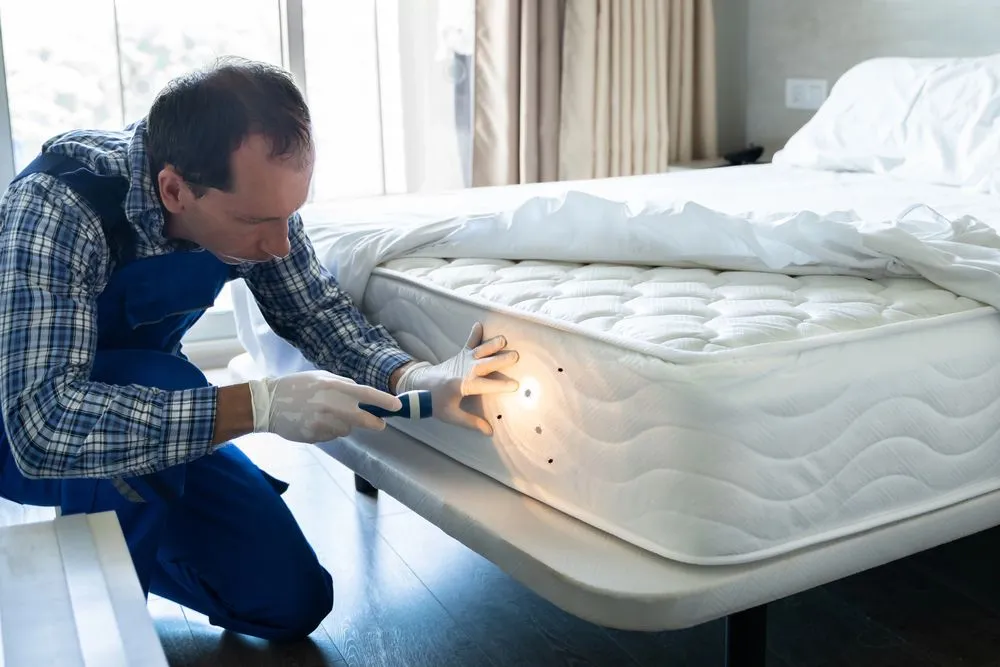
You don’t always see the bugs themselves — but they leave plenty of evidence behind. Check your mattress seams, piping, and tags for small rust-colored stains, which are digested blood left after feeding. You may also notice tiny dark spots (bed bug excrement), pale yellow shed skins, or pinhead-sized white eggs clustered in crevices.
Our crews often find that infestations are heaviest along the seams and corners of mattresses, as well as inside box springs. If you notice a sweet, musty odor coming from your bed, that’s another red flag — it’s a scent produced by the bugs’ glands, and by the time it’s noticeable, the colony is usually well established.
Quick check: Strip your bedding and run a credit card along the mattress seams. This pushes hidden bugs and debris out where you can see them.
Bed Bug Treatment Options That Actually Work
Not every infestation requires throwing out your mattress. Here’s what works — and what we’ve seen fall short.
Heat treatment is one of the most effective professional solutions. Bed bugs die when exposed to sustained temperatures above 120°F. Professional exterminators use industrial heaters to raise the temperature of an entire room, reaching bugs hidden deep inside your mattress and furniture.
Mattress encasements are a smart first step. A sealed, bed-bug-proof cover traps existing bugs inside and prevents new ones from getting in. However, encasements alone won’t solve an active infestation — trapped bugs can survive for months without feeding.
Chemical treatments applied by a licensed pest control professional can target bugs that heat alone may miss. Over-the-counter sprays, on the other hand, rarely penetrate deep enough to reach eggs and nesting sites. Based on what our teams see, DIY chemical treatments are one of the most common reasons infestations drag on for months.
Steam cleaning your mattress at home can kill bugs on contact, but only where the steam directly reaches. It’s a useful supplement — not a standalone solution.
When to Stop Treating and Replace Your Mattress
Here’s the truth from thousands of jobs: sometimes the mattress simply isn’t worth saving. Consider replacing it if you’re dealing with any of the following situations.
- Repeated treatment failures. If you’ve had two or more professional treatments and bugs keep returning to the mattress, the infestation may be too deeply embedded in the interior materials for surface-level treatments to reach.
- Visible structural damage. Sagging, tears, or worn seams give bed bugs more places to hide and make thorough treatment nearly impossible. An aging mattress with existing wear becomes a permanent harbor for re-infestation.
- Health and hygiene concerns. Heavy infestations leave behind significant biological residue — fecal staining, shed skins, and allergens — that saturate the mattress over time. Even after the bugs are eliminated, these contaminants remain and can trigger allergic reactions and respiratory issues.
- Peace of mind. We hear this from customers more than anything else: even after successful treatment, they can’t sleep comfortably on a mattress they know was infested. That psychological factor is completely valid, and it’s one of the most common reasons people call us for removal.
How to Safely Dispose of a Bed Bug–Infested Mattress
This is where most people make a costly mistake. Dragging an infested mattress through your hallway, down the stairs, and out to the curb creates a trail of opportunity for bugs to spread into other rooms — turning a bedroom problem into a whole-home problem.
If you’re handling it yourself, wrap the mattress completely in a sealed plastic mattress bag before moving it. Tape every seam shut. Label it clearly as infested so that no one unknowingly picks it up. Check your local municipality’s bulk disposal rules, as many areas require advance scheduling for curbside mattress pickup.
The easier option? Skip the risk entirely. Jiffy Junk’s teams remove infested mattresses with care and containment so nothing spreads during the process. We handle the heavy lifting, the transport, and the responsible disposal — and we do it fast. Most jobs are completed the same day you book.
Why Jiffy Junk for Mattress Removal
We’ve handled thousands of mattress removals nationwide, including jobs involving bed bug infestations, estate cleanouts, and property turnovers. Here’s what you can expect from our White Glove Treatment.
- Safe, contained removal — we take precautions to ensure nothing spreads during the process.
- Responsible disposal — we follow local regulations and prioritize eco-friendly options whenever possible.
- No heavy lifting on your part — just point to what needs to go, and we take care of the rest.
- Transparent pricing — the quote we give you is the price you pay, with no hidden fees.
“After removing thousands of infested mattresses, the one thing we tell every customer is the same: don’t wait and don’t drag it through your home without containment. Most of the whole-home infestations we see started as a single bedroom problem that spread during a DIY removal attempt.” — Jiffy Junk Removal Team
Essential Resources on How to Get Rid of Bed Bugs in a Mattress
Before you spend a dollar on treatment or toss your mattress in a panic, start here. These seven resources come from government agencies, university research labs, and industry authorities, and they cover every stage of the process — from “Is this actually bed bugs?” all the way through to “How do I get this mattress out of here safely?”
Based on what our teams see from hundreds of bed bug mattress removals each year, the homeowners who get the best outcomes are the ones who take 15 minutes to get informed before they take action. These are the resources we’d point you to first.
1. Make Sure It’s Actually Bed Bugs Before You Spend a Dime
Best for: Positive identification before you invest in treatment
Here’s something most people don’t realize: 76% of suspected bed bug samples submitted to the University of Minnesota turned out to be something else entirely. That’s three out of four people treating for the wrong pest. This entomologist-written guide helps you identify adults, nymphs, eggs, and fecal staining with confidence — and shows you exactly where to look beyond the mattress. You’ll also learn how to tell bed bugs apart from common lookalikes like carpet beetles and bat bugs.
Our crews run into this all the time. A customer is convinced they’ve got bed bugs, and it turns out to be carpet beetle larvae. Start here so you know exactly what you’re dealing with.
University of Minnesota Extension — Bed Bugs Identification & Control Guide
URL: https://extension.umn.edu/biting-insects/bed-bugs
2. Understand the Real Health Risks — and When to Call Your Doctor
Best for: Getting clear, medical-grade answers on what bed bug bites can and can’t do
There’s a lot of misinformation online about bed bugs and disease. Here’s what the CDC says: bed bugs aren’t known to spread diseases, but bites can cause itching, sleep loss, and in rare cases allergic reactions that need medical attention. This resource walks you through bite identification, how long symptoms take to appear, when scratching leads to secondary infection, and the signs that mean it’s time to see a healthcare provider.
We know the anxiety that comes with finding bed bugs in your mattress. This guide helps you separate what’s genuinely urgent from what can wait — so you can make a clear-headed decision about next steps.
CDC — About Bed Bugs: Health Information & Bite Identification
URL: https://www.cdc.gov/bed-bugs/about/index.html
3. Try a Safe, Step-by-Step DIY Approach First
Best for: A structured, government-backed treatment plan you can follow at home
If you’ve caught the infestation early, you may be able to handle it yourself — but only if you do it the right way. This is the most comprehensive federal guide available for homeowners. It covers preparation, non-chemical methods (heat, cold, steam, mattress encasements), proper vacuuming techniques, and which pesticides are safe to use indoors. Just as importantly, it tells you what doesn’t work and what’s outright dangerous.
Here’s what we’ve learned from thousands of removal jobs: homeowners who follow a structured guide like this one get far better results than those who grab the first spray can they find at the hardware store. Take the time to do it right.
EPA — Do-It-Yourself Bed Bug Control
URL: https://www.epa.gov/bedbugs/do-it-yourself-bed-bug-control
4. Use Products That Are EPA-Approved and Actually Safe for Your Home
Best for: Finding the right product for your specific situation — without the guesswork
Over 300 products are registered by the EPA for bed bug control, but using the wrong one can make things worse and put your family’s health at risk. The CDC has documented cases where misapplied pesticides — including products never intended for indoor use — caused serious illness in residents. This searchable tool lets you filter by product type, active ingredient, and where you plan to apply it, so you’re only using what’s been tested and approved for your exact situation.
We always tell customers: the label matters more than the brand name. This tool helps you make sure you’re choosing wisely.
EPA — Bed Bug Product Search Tool
URL: https://cfpub.epa.gov/oppref/bedbug/
5. Know What a Qualified Exterminator Should Actually Deliver
Best for: Understanding what to expect from a professional — and making sure you get it
When DIY treatment isn’t getting the job done, it’s time to bring in a licensed professional. But how do you know if your exterminator is doing everything they should? This resource from the National Pest Management Association lays it all out: service agreements, treatment preparation steps, every available method (heat, steam, freezing, encasements, fumigation, insecticides), and what post-treatment follow-up should look like.
One thing that surprises most customers: the NPMA actually discourages throwing out infested items in most cases. Sometimes the mattress can be saved. A qualified professional will tell you honestly whether yours can — and we respect that approach.
NPMA / PestWorld — Bed Bug Best Management Practices
URL: https://www.pestworld.org/all-things-bed-bugs/best-practices/
6. Combine Multiple Treatment Methods for the Best Shot at Success
Best for: Building a coordinated strategy instead of relying on a single fix
Here’s a pattern our teams see over and over: a homeowner tries one treatment, it doesn’t fully work, so they try another single method, and the cycle continues for months. The EPA’s Integrated Pest Management guide explains why layering heat treatment, encasements, monitoring devices, desiccants, and targeted pesticide application together produces significantly better results than any one method alone. It also covers pesticide resistance — the main reason most store-bought sprays stop working after the first application.
The takeaway? A multi-method plan with consistent follow-through gives you the best chance of clearing the infestation for good.
EPA — Controlling Bed Bugs Using Integrated Pest Management (IPM)
URL: https://www.epa.gov/bedbugs/controlling-bed-bugs-using-integrated-pest-management-ipm
Supporting Statistics on How to Get Rid of Bed Bugs in a Mattress
The advice in this article isn’t guesswork. It’s grounded in federal agency research, national industry surveys, and what our crews see on removal jobs every day.
Only 29% of Americans Can Correctly Identify a Bed Bug
On the professional side, it’s even more telling: 90% of “bed bug” service calls turn out to be a completely different pest — usually carpet beetles, flies, or cockroaches.
- 29% — the share of U.S. adults who can accurately identify bed bugs (Harris Poll / NPMA, 2025; 2,099 respondents)
- 90% — the share of pest professionals who are called out for suspected bed bugs that aren’t bed bugs at all (NPMA Bugs Without Borders, 2025; 375 professionals surveyed)
What our teams see: A significant number of the bed bug removal calls we respond to involve mattresses that either don’t have bed bugs or have a different pest entirely. Confirm what you’re dealing with before you spend money on treatment — or replace a mattress that might not need to be replaced.
Source: National Pest Management Association — Harris Poll Survey & Bugs Without Borders 2025
URL: https://www.pestworld.org/news-hub/pest-articles/bed-bug-survey-results-facts/
169 Pesticide Incidents Tied to Bed Bug Treatment in Just Five Years — 129 Caused Health Effects, Including One Death
The CDC and ATSDR flagged this as an emerging national concern. The root causes are consistent and preventable:
- Misapplied products — wrong concentration, wrong location, wrong method
- Outdoor pesticides used indoors — products never tested or approved for interior spaces
- Legally banned chemicals — substances no longer permitted for residential use
What our teams see: We hear some version of this story on almost every job. A homeowner finds bed bugs, panics, and sprays the mattress with whatever they can find — sometimes outdoor pesticides, rubbing alcohol, or multiple products at once, without reading a label. By the time they call us, the room smells like chemicals, the family has been sleeping in the living room for weeks, and the bugs are still there. Safe treatment isn’t just about effectiveness — it’s about protecting your family’s health while you solve the problem.
Source: CDC / Agency for Toxic Substances and Disease Registry (ATSDR) — Health Alert Network Advisory, November 2012
URL: https://archive.cdc.gov/emergency_cdc_gov/han/han00336.asp
24% of Pest Professionals Rank Bed Bugs as the Single Hardest Pest to Control
That’s nearly twice the difficulty rating given to German cockroaches or rodents — and the problem isn’t shrinking:
- 82%+ of pest control professionals treated bed bugs in the past year
- 94% of infestations are centered in the primary bedroom
- 24% rank bed bugs as the #1 most difficult pest to eliminate
What our teams see: By the time we show up to remove a mattress, most homeowners have already tried at least one DIY treatment and one professional treatment. That’s not a failure — it’s a reflection of how resilient these pests are. The homeowners who reach the replacement decision fastest are usually dealing with a heavy infestation where the mattress was structurally compromised, and retreatment was never going to be enough.
Source: National Pest Management Association — Bugs Without Borders Survey, 2025 (conducted with University of Florida; 375 pest management professionals surveyed)
URL: https://www.pestworld.org/bugs-without-borders/
Final Thoughts & Opinion on How to Get Rid of Bed Bugs in a Mattress
What the Research Tells You
The data is consistent across every source cited on this page — EPA, CDC, and the NPMA’s national surveys of pest control professionals:
- 29% of Americans can correctly identify bed bugs. 90% of professional service calls for “bed bugs” turn out to be a different pest.
- DIY chemical treatments fail more often than they succeed. The CDC documented 129 cases of health effects from misapplied pesticides in a single five-year window — including one death.
- Bed bugs are the hardest pest to eliminate. 24% of pest professionals rank them #1 in difficulty — harder than cockroaches, harder than rodents.
- Multi-method plans work best. The EPA’s Integrated Pest Management approach — heat, encasements, monitoring, and targeted chemicals together — consistently outperforms any single fix.
None of that is opinion. That’s what the research says, and it lines up with everything we see in the field.
What We Believe — Based on Thousands of Removal Jobs
Here’s where our perspective differs from most of the advice you’ll find online.
The mattress replacement decision gets made too late — not too early.
Most bed bug content tells you to exhaust every treatment option before considering replacement. Sometimes that’s the right call. But after removing thousands of infested mattresses from homes across the country, we believe the threshold for replacement should be lower than most experts suggest — specifically in three situations:
- The infestation has been active for 8–12+ weeks. Bed bugs have penetrated deep into interior mattress layers that surface treatments and encasements can contain but can’t reach. At that point, you’re managing — not treating.
- Someone in the household is losing sleep, experiencing anxiety, or reacting to bites. The psychological toll of sleeping on an infested mattress — even encased — is real. We’ve watched customers break down in relief the moment the mattress leaves the house. The mental health cost of “waiting it out” rarely gets factored into the math, but it should be.
- Total retreatment costs are approaching the cost of a new mattress plus professional removal. Most people don’t add it up until they’re three or four treatments in. Two professional heat treatments, plus encasements, plus monitoring devices, plus lost time — that number climbs fast. Replacing and treating the room is often both faster and more cost-effective.
We’re not saying treatment doesn’t work. It does — especially when caught early and done correctly. What we’re saying is that replacement isn’t a failure. It’s often the most practical, cost-effective, and emotionally healthy path forward. Homeowners shouldn’t feel guilty about making that call sooner rather than later.
The One Mistake We See More Than Any Other
If we could give every homeowner reading this page a single piece of advice, it’s this:
Do not move an infested mattress through your home without containment.
We’ve seen single-bedroom problems become whole-home infestations because a homeowner dragged an unwrapped mattress down a hallway, through a living room, and out the front door. Every surface it touches becomes a potential new harborage site.
If you’re moving it yourself:
- Wrap it in sealed plastic before it leaves the bedroom
- Tape every seam airtight
- Move it directly out of the closest exit
- Label it as infested, so no one picks it up off the curb
Or call us. Containment is what we do.
The Bottom Line
Getting rid of bed bugs in a mattress is harder than most people expect, more expensive than most people budget for, and more emotionally draining than most people are prepared for. The best outcomes go to homeowners who take 15 minutes to get informed before taking action.
- Start with identification
- Follow a structured treatment plan using safe, EPA-approved methods
- Bring in a licensed professional when DIY isn’t working
- Remove the mattress when the time comes — and don’t let it sit a day longer than it has to
FAQ on How to Get Rid of Bed Bugs in a Mattress
Q: Can I get rid of bed bugs in my mattress without throwing it away?
A: Sometimes — but timing is everything. Here’s what we’ve learned from thousands of removal jobs:
- Caught early (within a few weeks): Professional heat treatment + a sealed mattress encasement can eliminate the infestation without replacing the mattress
- Caught late (two to three months in): Bugs have typically worked deep into the mattress interior, where surface treatments can’t reach
- After two professional treatments with no improvement: The mattress is telling you something — it’s time to replace, not retreat
Our rule of thumb from the field: if you’re still waking up with bites after two rounds of professional treatment, replacement is the faster and more reliable path forward.
Q: What are the first signs of bed bugs in a mattress?
A: Most people expect to see the bugs themselves — but that’s actually one of the later signs. What shows up first is the evidence they leave behind:
- Rust-colored stains along mattress seams (digested blood from feeding)
- Tiny dark spots on the fabric (fecal matter)
- Pale yellow shed skins in crevices and folds
- Pinhead-sized white eggs clustered in seams and piping
- Sweet, musty odor — by the time this is noticeable, the colony has been established for weeks
Pro tip from our crews: Run a credit card along the mattress seams and piping. It pushes hidden bugs and debris out of the crevices where they nest, making them visible instantly. Don’t wait for the smell. Check the seams first.
Q: How do I safely get rid of a mattress that has bed bugs?
A: This is the question we wish more people asked before they start moving the mattress. What we see far too often is the aftermath of a DIY removal gone wrong — bugs and eggs dropped along the entire path from bedroom to curb, turning a one-room problem into a whole-home infestation.
If you’re handling it yourself:
- Wrap the mattress in a sealed plastic bag before it leaves the bedroom — tape every seam airtight
- Move it directly out the closest exit — no detours through other rooms
- Label it clearly as infested, so no one unknowingly takes it home
If you want it done the first time safely:
Call us before you move it at all. Our teams use containment protocols specifically designed for infested items. Nothing gets dragged through your home uncovered. We handle removal, transport, and disposal — and most of our customers tell us they wish they’d called before attempting it themselves.
Q: Do DIY bed bug sprays actually work on mattresses?
A: We’ll be honest — DIY spray treatments are the single most common reason we see infestations that have dragged on for three to six months by the time homeowners call us. Here’s why they fail:
- Surface-only reach — store-bought sprays kill bugs on direct contact, but can’t penetrate mattress layers where eggs and colonies are hiding
- False sense of resolution — homeowners spray, assume the problem is solved, then the bites return two to three weeks later when eggs hatch
- Repeated cycle — spray, wait, bites return, spray again. Months pass. The infestation grows.
What works instead:
- A licensed pest control professional using heat treatment (sustained temps above 120°F) or professional-grade products
- These methods reach what store-bought sprays simply can’t
If you’ve already sprayed and the bugs came back — stop spraying and call a professional exterminator. You’ll save time, money, and a lot of sleepless nights.
Q: How much does it cost to have a bed bug–infested mattress removed?
A: We get this question on almost every call — and after spending money on treatments that may not have worked, the last thing you want is another bill with surprises. That’s why we do pricing differently.
How it works with Jiffy Junk:
- We arrive and assess the job on the spot — no estimates over the phone based on guesswork
- You get a transparent quote before we touch a single item — the price we give you is the price you pay
- No hidden fees. No, “it’s actually going to be more.” That’s our promise on every job.
What affects the cost:
- Location — service area and travel distance
- Number of items — mattress only, or mattress + box spring + bed frame + headboard
- Accessibility — ground-floor with a clear path vs. third-floor walkup
Most single-mattress removals are completed the same day, often within a couple of hours. Bundling multiple items into one visit typically saves you money compared to separate pickups.
Ready to Get Rid of Your Bed Bug–Infested Mattress? Let Jiffy Junk Handle the Removal
Whether you’ve treated your mattress and it’s time to replace it, or you’re done dealing with bed bugs and ready to start fresh, our licensed and insured teams will remove it safely, responsibly, and fast — most jobs are completed the same day. Book your mattress removal now or call 844-JIFFY-JUNK (844-543-3966) for a free, no-obligation quote.