
Is Styrofoam Biodegradable or Recyclable? Find Out If You Can Put It in the Recycle Bin, Garbage, or Trash—And How Jiffy Junk Can Help
That Styrofoam packaging piled in your garage?
You might want to think twice about it. It’s not your usual junk. When mishandled, it could end up in waterways and eventually in the ocean, where it’s very harmful for marine life.
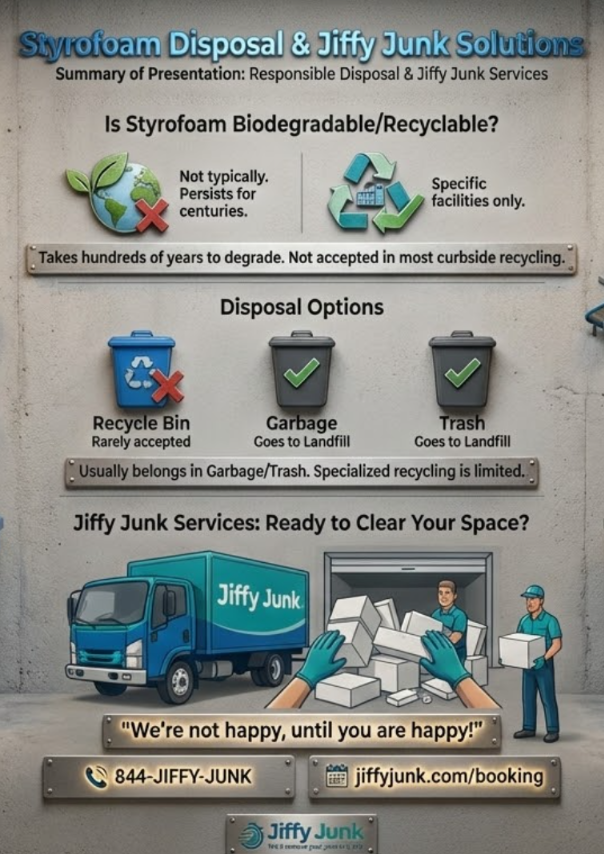
Expanded polystyrene (EPS) isn’t biodegradable, and fewer than 5% of recycling programs accept it.
After a decade of hauling, we’ve seen the confusion firsthand. Customers stack them by their bins, assuming pickup day will solve the problem. It doesn’t. Most curbside programs reject it outright, and what does get tossed will sit in a landfill for 500+ years.
Here’s what actually works: we’ll walk you through which Styrofoam types can be recycled locally, what belongs in regular disposal, and when calling Jiffy Junk makes sense for bulky foam waste. No guesswork—just clear answers from a team that handles this material every day.
TL;DR Quick Answers
Is Styrofoam recyclable?
Short answer: Technically yes, but not through curbside recycling.
Expanded polystyrene carries the #6 recycling symbol, yet fewer than 6.25% of polystyrene containers get recycled nationally. Most municipal programs reject it because the material is 95% air, making transport costs exceed its value.
Your actual options:
- Specialty drop-off locations: Find one legitimate drop off points
- Retailer take-back: Some shipping stores accept clean packing peanuts for reuse
- Professional removal: For large quantities, services like Jiffy Junk ensure responsible handling
What we’ve learned after a decade of hauling: Most customers assume that the recycling symbol means curbside acceptance. It doesn’t. The gap between intention and infrastructure is why foam sits in garages for months—and why people eventually call us to handle it properly.
Top Takeaways: What You Need to Know About Styrofoam Disposal
1. Curbside recycling won’t take it—despite the symbol.
- That #6 recycling symbol doesn’t mean your trash can accepts foam
- Less than 6.25% of polystyrene containers get recycled nationally
- Placing foam in curbside trash containers contaminates other materials and ends up in landfills anyway
2. It’s not biodegradable—and it’s not going anywhere.
- It persists in landfills for 500+ years
- We’ve pulled decades-old foam from cleanouts that looks brand new
- Broken-down foam becomes microplastics, harming wildlife for generations
3. Recycling options exist—but require effort.
- Drop-off locations available
- Works well for small quantities
- Most people don’t know these options exist, or can’t access them conveniently
4. State bans are accelerating.
- 12 U.S. states now have active bans on it
- More legislation is pending nationwide
- Business owners and food service operators: staying ahead of local regulations matters
5. Large quantities? Professional removal is often the smartest choice.
- Drop-off trips become impractical at scale
- We know which facilities accept them in each region
- Recycling is prioritized whenever possible
- We handle the burden so you don’t have to
Table of Contents
- Is Styrofoam Biodegradable or Recyclable? Find Out If You Can Put It in the Recycle Bin, Garbage, or Trash—And How Jiffy Junk Can Help
- TL;DR Quick Answers
- Top Takeaways: What You Need to Know About Styrofoam Disposal
- What Is Styrofoam, Exactly?
- Is Styrofoam Biodegradable?
- Is Styrofoam Recyclable?
- Can You Put Styrofoam in Your Recycling Bin?
- Can You Put Styrofoam in Regular Disposal?
- Styrofoam Disposal Options at a Glance
- How Jiffy Junk Can Help with Styrofoam Removal
- Essential Resources: Where to Recycle Styrofoam and Understand Your Options
- 1. Find Local Foam Recycling Drop-Off Locations Instantly
- 2. Locate Free Foam Drop-Off Centers Nationwide
- 3. Recycle Foam Cups, Egg Cartons, and Packaging for Free
- 4. Check Official EPA Polystyrene Recycling Statistics
- 5. Verify If Your State Has Banned Styrofoam Food Containers
- 6. Understand Styrene Health Risks from Government Sources
- 7. Find City-Specific Foam Disposal Guidelines
- Supporting Statistics: What the Data Confirms About Styrofoam Disposal
- Final Thought: The Real Problem Isn’t Styrofoam—It’s the Gap Between Intention and Infrastructure
- Next Steps: What to Do With Your Styrofoam Now
- Frequently Asked Questions About Styrofoam Disposal
- Is Styrofoam actually recyclable?
- Can I put Styrofoam in my recycling bin?
- Is Styrofoam biodegradable?
- What’s the best way to dispose of small amounts of Styrofoam?
- What should I do with large amounts of Styrofoam?
- Why are so many states banning Styrofoam?
- How much does professional Styrofoam removal cost?
- Does Jiffy Junk recycle the Styrofoam you pick up?
- How do I prepare Styrofoam for pickup?
- Now You Know Styrofoam Isn’t Recyclable Curbside—Let Jiffy Junk Handle the Rest
What Is Styrofoam, Exactly?
Styrofoam is a brand name that’s become shorthand for expanded polystyrene —the lightweight white foam used in takeout containers, coffee cups, packing peanuts, and appliance packaging. It’s made from petroleum-based plastic expanded with air, which gives it that familiar lightweight, cushiony feel.
The material is popular for a reason: it’s cheap, insulates well, and protects fragile items during shipping. But those same properties make it an environmental headache when it’s time to dispose of it.
Is Styrofoam Biodegradable?
No. Styrofoam does not biodegrade in any meaningful timeframe. According to the Environmental Protection Agency, these can persist in landfills for 500 years or longer. It doesn’t break down naturally because microorganisms can’t digest the synthetic polymer structure.
What does happen over time is photodegradation—sunlight breaks it into smaller and smaller pieces. But those fragments don’t disappear. They become microplastics that contaminate soil and waterways. We’ve pulled old Styrofoam from estate cleanouts that looks nearly identical to the day it was manufactured decades ago.
Is Styrofoam Recyclable?
Technically, yes. Practically, it’s complicated.
In reality, most municipal recycling programs reject it because:
- It’s 95% air, making transport costs high relative to material value
- It contaminates other recyclables when it breaks into small pieces
- Specialized equipment is required to compress and process it
- Food residue on containers makes recycling impossible
Some communities do accept them at designated drop-off locations. Packaging retailers like UPS Store locations sometimes take packing peanuts for reuse. But these options require effort that most people don’t realize is necessary.
Can You Put Styrofoam in Your Recycling Bin?
In most cases, no. Placing Styrofoam in your curbside recycling containers often does more harm than good. It typically gets sorted out at the facility and sent to the landfill anyway—after contaminating other materials in the process.
Before tossing them in with your recyclables, check your local municipality’s guidelines. A quick search for your city’s recycling rules will confirm whether your program accepts it. In our experience, about 90% of the areas we serve do not include Styrofoam in curbside pickup.
Can You Put Styrofoam in Regular Disposal?
Yes, but it’s not ideal. When no recycling option exists, Styrofoam can go in your regular waste cans for landfill disposal. Break down large pieces to save space and prevent them from blowing away before collection.
For small quantities—a few takeout containers or some packing material—this is the practical solution. The environmental impact of driving across town to a specialty drop-off location often outweighs the benefit of recycling a handful of foam pieces.
However, large volumes create a different challenge. Styrofoam from appliance packaging, moving supplies, or renovation projects can quickly overwhelm your regular pickup capacity. That’s when professional removal becomes the efficient choice.
Styrofoam Disposal Options at a Glance
Drop-off recycling: Some retailers, shipping stores, and municipal facilities accept them. Call ahead to confirm.
Mail-back programs: Companies like Dart Container offer mail-in recycling for specific products.
Retailer take-back: When purchasing new appliances, ask if the delivery team will haul away the packaging.
Regular waste disposal: Acceptable for small amounts when no recycling option exists.
Professional junk removal: The practical solution for bulk Styrofoam from moves, renovations, or cleanouts.
How Jiffy Junk Can Help with Styrofoam Removal
When you’re dealing with more Styrofoam than your bins can handle, we make it disappear—properly.
Our teams regularly haul them from appliance deliveries, office equipment upgrades, warehouse cleanouts, and residential moves. We’ve cleared entire garages filled with nothing but packing materials. Customers tell us they had no idea how to get rid of it all until they called.
Here’s what sets our approach apart:
We handle the volume. Whether it’s one oversized appliance box or a storage unit packed with foam, we have the truck space and manpower to clear it in one visit.
We sort for responsible disposal. When they can be diverted from the landfill, we work with facilities that accept them. Our commitment to recycling and donating whenever possible extends to every material we haul—including Styrofoam.
We do all the lifting. You point, we load. No dragging bulky foam to the curb or breaking it into pieces yourself.
We quote upfront. Transparent pricing with no hidden fees means you know the cost before we start. That’s our White Glove Treatment promise.
Dealing with a Styrofoam situation that’s gotten out of hand? Book online in 60 seconds or call us at 844-JIFFY-JUNK. We’ll take care of the rest.
“In over a decade of junk removal, we’ve learned that Styrofoam is the one material that surprises people most—they assume it’s recyclable, but when we show up, it’s often been sitting in their garage for months because no one would take it. That’s exactly why we built our process around handling the items other services won’t touch.” — Jiffy Junk Team
Essential Resources: Where to Recycle Styrofoam and Understand Your Options
We’ve compiled the most helpful resources to guide your foam disposal decisions. These trusted sources will point you toward recycling options, local drop-off sites, and current regulations—so you can clear out your space responsibly.
1. Find Local Foam Recycling Drop-Off Locations Instantly
Earth911 Recycling Search is the tool we recommend most to customers asking where to dispose of foam in their area. With 100,000+ listings across North America, you’ll find nearby recycling centers in seconds. Just enter your zip code and search “#6 Plastic – Expanded.”
2. Locate Free Foam Drop-Off Centers Nationwide
The EPS Industry Alliance Recycling Map makes finding a public drop-off site simple. You’ll get an interactive directory covering the U.S. and Canada—plus a helpful hotline (800-828-2214) if you prefer talking to a real person about your options.
3. Recycle Foam Cups, Egg Cartons, and Packaging for Free
Dart Container Foam Recycling Centers operates nearly 100 free drop-off locations nationwide. They accept clean foam cups, meat trays, ice chests, and appliance packaging—then transform them into picture frames and molding. We’ve directed many customers here when they want an eco-friendly solution.
4. Check Official EPA Polystyrene Recycling Statistics
EPA Facts and Figures Database confirms what we see every day: less than 6.25% of polystyrene containers get repurposed nationally. This government resource explains why most curbside programs reject foam—and why specialty recycling or professional removal often makes the most sense.
5. Verify If Your State Has Banned Styrofoam Food Containers
Wikipedia: Phase-out of Polystyrene Foam tracks all 12 U.S. states with active EPS bans. If you’re in California, New York, Maryland, Colorado, Oregon, or Washington, you’ll find current effective dates and exemptions here. Regulations change quickly, so we recommend checking before disposal.
6. Understand Styrene Health Risks from Government Sources
The National Toxicology Program classifies styrene as “reasonably anticipated to be a human carcinogen.” This federal health resource helps you understand why regulators are restricting polystyrene in food packaging—and why proper disposal matters for your family and community.
7. Find City-Specific Foam Disposal Guidelines
RecycleByCity Local Guides breaks down recycling rules for your specific municipality. You’ll quickly learn whether your city accepts foam curbside and where to find local alternatives. Customers tell us this resource saves them time when standard recycling won’t work.
Still have more foam than you can handle? When drop-off trips and curbside limitations don’t fit your situation, our team is ready to help. We’ll haul away bulky Styrofoam from appliance packaging, moving supplies, or cleanout projects—and handle disposal the right way. That’s our White Glove Treatment promise.
Supporting Statistics: What the Data Confirms About Styrofoam Disposal
After years of hauling foam from homes and businesses nationwide, we’ve seen why it creates so much confusion. These federal statistics mirror what our teams encounter daily.
Why Your Recycling Bin Keeps Rejecting Foam
Customers often ask why their recycling program won’t take Styrofoam. The EPA data explains it.
The numbers:
- 80,000 tons of polystyrene containers were generated in 2018
- Less than 5,000 tons recycled—a rate under 6.25%
- Other polystyrene packaging: just 3.6% recycled
What we see firsthand:
- Homeowners stacking foam by bins week after week, watching it get left behind
- Business owners are accumulating mountains of appliance packaging with nowhere to send it
- The same question every time: “Why won’t anyone take this?”
The infrastructure simply doesn’t exist in most communities. That’s why people call us.
Source: U.S. EPA, Facts and Figures About Materials, Waste and Recycling
The Health Concern Driving State-Level Bans
When customers ask why states are banning Styrofoam food containers, we point to federal health findings.
The classification:
- Styrene is listed as “reasonably anticipated to be a human carcinogen.”
- Based on increased cancer risks and DNA damage in exposed workers
- Independently confirmed by the National Academy of Sciences in 2014
Who’s calling us now:
- Restaurant owners are clearing old foam inventory before local bans take effect
- School administrators are transitioning cafeteria supplies
- Event coordinators are replacing foam serviceware for compliance
What used to be routine disposal has become a compliance issue. We help clients transition quickly.
Source: National Toxicology Program, 15th Report on Carcinogens, NIH
https://www.ncbi.nlm.nih.gov/books/NBK590797/
Where Improperly Disposed Foam Actually Ends Up
We tell every customer: Styrofoam that escapes the waste stream doesn’t disappear.
NOAA findings:
- 800+ wildlife species harmed by marine debris worldwide
- Foam floats, fragments into microplastics, and travels far from its origin
- 36,000 metric tons of debris removed from U.S. coastlines since 2006
What we’ve observed:
- Decades-old foam from estate cleanouts looks nearly identical to new
- Material durability that’s great for shipping protection—terrible for the environment
- Improper disposal turns a convenience product into a long-term problem
Our commitment to recycling and donating whenever possible means ensuring foam reaches appropriate facilities.
Source: NOAA Office for Coastal Management, Marine Debris Fast Facts
https://coast.noaa.gov/states/fast-facts/marine-debris.html
Bottom line: These aren’t abstract numbers. They represent the real challenges our crews navigate on every job—and why we built our process around handling materials others can’t or won’t touch.

Final Thought: The Real Problem Isn’t Styrofoam—It’s the Gap Between Intention and Infrastructure
After more than a decade in junk removal, here’s what we’ve learned: Styrofoam isn’t the villain. The real issue is the massive disconnect between what people want to do with it and what they’re actually able to do.
Every week, our teams meet customers who’ve done everything right:
- Rinsed their foam containers
- Separated packing materials from recyclables
- Searched online for drop-off locations
And yet, the Styrofoam is still sitting in their garage three months later. The system never caught up to the product.
Our Honest Take
Styrofoam delivers on its promises: convenience and protection. The problem? No one planned for what happens after.
The reality today:
- Recycling infrastructure remains sparse
- Curbside programs reject foam
- Drop-off centers are few and inconvenient
- The material lasts for centuries in landfills
- Microplastics harm wildlife for generations
We’re not here to tell you to never use Styrofoam again. That’s not realistic. Here’s what we will say:
When You Can Avoid It, Do
- Choose cardboard packaging when ordering appliances
- Bring reusable containers for takeout
- Ask retailers if they’ll take back foam packaging
When You Can’t Avoid It, Dispose Properly
- Check Earth911 or the EPS Industry Alliance map for drop-off options
- Never place foam in curbside recycling unless your municipality explicitly accepts it
- For large quantities, call professionals who ensure responsible handling
When It Piles Up Faster Than You Can Manage—Call Us
We’ve seen it all:
- Garage cleanouts where homeowners saved every piece of packing material for years, hoping recycling would catch up
- Warehouses where businesses accumulated pallets of foam with no disposal solution
- Estate cleanouts, removing decades of carefully stored packaging, loved ones couldn’t bear to throw away
The story is always the same: good intentions stalled by limited options.
Our View
Until recycling infrastructure expands to meet foam volume, professional removal isn’t just convenient—it’s often the most responsible path forward.
What we bring to every job:
- Knowledge of which facilities accept them in each region we serve
- Commitment to diverting materials from landfills whenever possible
- Relief for customers who’ve spent too much time on a problem the system created
Styrofoam isn’t going away tomorrow. But with the right approach—reducing where you can, recycling where it’s available, and calling in help when you need it—you can clear your space without adding to the problem.
That’s our commitment: We’re not happy until you are happy—and until your foam is handled the right way.
Next Steps: What to Do With Your Styrofoam Now
You’ve got the information. Here’s how to act on it.
Step 1: Assess What You Have
Small quantities (fits in a kitchen trash bag):
- Takeout containers, coffee cups, egg cartons
- A few pieces of packing material
Medium quantities (a few boxes worth):
- Packaging from appliance deliveries
- Accumulated packing peanuts from online orders
Large quantities (fills a garage corner or more):
- Multiple appliance boxes from a remodel
- Estate cleanout materials
- Business or warehouse accumulation
Step 2: Choose Your Disposal Path
Small quantities:
- Verify if your municipality accepts foam curbside (most don’t)
- Find a local drop-off
- No recycling option? Place in regular waste, bagged to prevent escape
Medium quantities:
- Locate a Container drop-off
- Call shipping stores about packing peanut reuse
- Contact your waste hauler about bulk pickup
- Combine drop-off trips with other errands
Large quantities:
- Evaluate if multiple drop-off trips are practical
- Ask appliance retailers about packaging take-back
- Get a quote from Jiffy Junk
- Schedule removal before foam accumulates further
Step 3: Prepare Your Foam
Proper preparation ensures correct handling:
- Remove all tape, labels, and non-foam materials
- Separate food-contaminated foam from clean packaging
- Break down large pieces when transporting yourself
- Bag loose peanuts to prevent spillage
- Keep foam dry—wet foam is often rejected
Step 4: Prevent Future Buildup
When shopping:
- Request cardboard packaging for fragile items
- Ask about foam take-back policies before purchasing
- Choose products with minimal packaging
When receiving deliveries:
- Have delivery teams take the packaging with them
- Designate a bin for reusable packing materials
- Set monthly reminders to dispose of accumulated foam
When ordering takeout:
- Bring your own containers for pickup
- Support restaurants using compostable alternatives
- Request no foam packaging when ordering
Step 5: Know When to Call for Help
DIY works for small amounts. Professional removal makes sense when:
- Drop-off locations are too far or inconvenient
- You have more foam than your vehicle can handle
- Time constraints make multiple trips impractical
- You’re clearing an estate, garage, or warehouse
- You want assurance that materials are handled responsibly
What to expect from Jiffy Junk:
- Upfront pricing, no hidden fees
- We handle all lifting and loading
- Recycling is prioritized whenever possible
- Same-day or next-day availability in most areas
Frequently Asked Questions About Styrofoam Disposal
Is Styrofoam actually recyclable?
Technically yes. Practically, it’s complicated.
The reality:
- EPS carries the #6 recycling symbol—but most programs reject it
- Less than 6.25% of polystyrene containers get recycled nationally
- The material is 95% air, making transport costs exceed material value
What we tell customers:
- Specialty drop-off locations exist through Earth911 and Dart Container
- Most people don’t know these options exist
- The nearest location is often inconveniently far
Can I put Styrofoam in my recycling bin?
In most cases, no. Doing so causes problems.
What actually happens:
- Foam gets sorted out at the facility
- It ends up in the landfill anyway
- Other recyclables get contaminated in the process
Our recommendation:
- Check your municipality’s guidelines first
- About 90% of the areas we serve don’t accept foam curbside
- When in doubt, keep it out of the bin
Is Styrofoam biodegradable?
No. Not in any meaningful timeframe.
Key facts:
- Persists in landfills for 500+ years
- Microorganisms can’t digest the synthetic polymer structure
- Sunlight breaks it into microplastics—but those never disappear
What we’ve seen:
- Decades-old foam from estate cleanouts looks brand new
- Broken-down fragments contaminate soil and waterways for generations
What’s the best way to dispose of small amounts of Styrofoam?
For a few containers or packing materials:
- Check for drop-off locations
- Call local shipping stores—some accept clean packing peanuts for reuse
- If no recycling option exists, place in regular waste in a sealed bag
Our honest advice:
- Don’t drive 30 miles to recycle one foam container
- The environmental cost of the trip can outweigh the benefit
- Do what’s practical. Focus on reducing foam use going forward.
What should I do with large amounts of Styrofoam?
This is where professional removal makes sense.
Common scenarios we handle:
- Appliance packaging from remodels or new home setups
- Moving supplies from household relocations
- Estate cleanout materials
- Business and warehouse accumulation
Why customers call us:
- Multiple drop-off trips become impractical
- Regular waste pickup can’t accommodate the volume
- We make it disappear in one visit
Why are so many states banning Styrofoam?
Two reasons: environmental impact and health concerns.
Environmental factors:
- Persists for centuries in landfills
- Escapes waste streams and becomes litter easily
- Breaks into microplastics harming wildlife
Health factors:
- Styrene is classified as “reasonably anticipated to be a human carcinogen.”
- Classification by the National Toxicology Program
- Confirmed by the National Academy of Sciences in 2014
Current status:
- 12 U.S. states have enacted EPS bans as of 2025
- More legislation is pending nationwide
- We’re seeing increased calls from businesses clearing inventory before bans take effect
How much does professional Styrofoam removal cost?
Upfront quotes based on volume. No hidden fees.
Pricing depends on:
- How much foam do you have
- Your location
- Accessibility of the materials
How to get an estimate:
- Book online at jiffyjunk.com/booking
- Request a free quote—no obligation
What customers tell us:
- Cost is worth it versus multiple drop-off trips
- Beats the frustration of foam sitting in their space for months
Does Jiffy Junk recycle the Styrofoam you pick up?
Whenever possible, yes.
Our commitment:
- Work with facilities that accept them
- Prioritize diverting materials from landfills
- Ensure responsible disposal when recycling isn’t available
Our promise:
- Recycling and donating extend to every material we haul
- Customers who care about where foam ends up can trust our process
- Part of our White Glove Treatment guarantee
How do I prepare Styrofoam for pickup?
Minimal prep required. Here’s what helps:
- Remove tape, labels, and non-foam materials
- Separate food-contaminated foam from clean packaging
- Bag loose packing peanuts to prevent spillage
- Keep foam dry—wet foam is often rejected by recyclers
What you don’t need to do:
- Break down large pieces—we handle that
- Sort by type—we’ll take care of it
- Carry anything—just point, we lift
Now You Know Styrofoam Isn’t Recyclable Curbside—Let Jiffy Junk Handle the Rest
Skip the drop-off searches and bin rejections. Call 844-JIFFY-JUNK or book online at jiffyjunk.com/booking to clear your foam the right way—we’re not happy until you are.