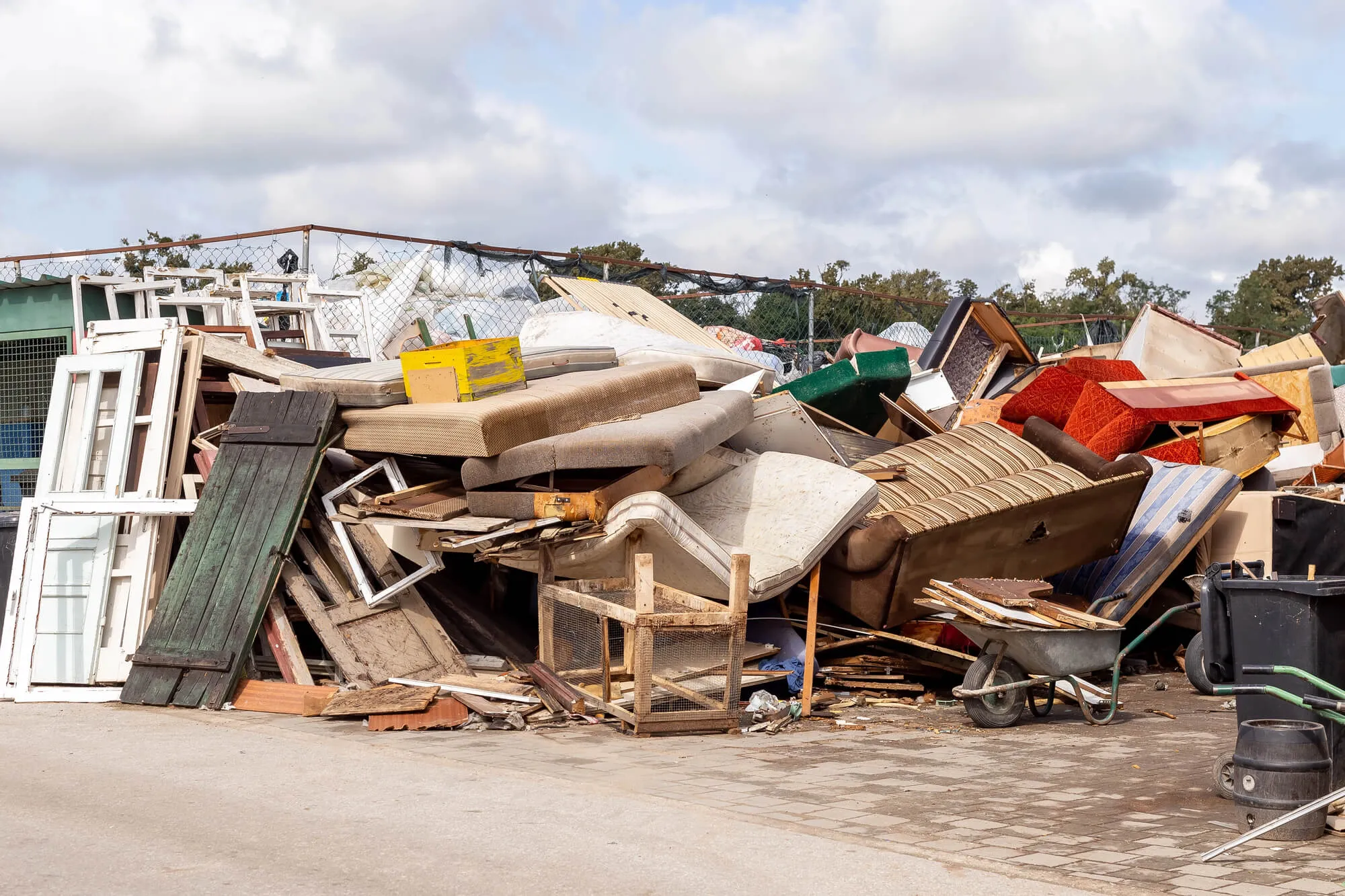
What Happens to Junk After Removal? Where Does It Go? Recycling, Donation, Disposal Methods, and Sustainability Explained
After more than a decade of hauling everything from single mattresses to full estate cleanouts, one question comes up more than almost any other: “So… where does it all go?”
It’s a fair question — and the answer matters more than most people realize. Since 2014, we’ve seen firsthand how the junk removal industry handles disposal, and the reality is that not every company takes the extra steps to sort, donate, and recycle. At Jiffy Junk, we do. Every job goes through our recovery process, where our teams separate reusable furniture, recyclable materials, and donatable goods before anything heads to a landfill. We’ve furnished community centers with items that would have otherwise been buried in a dump, and we’ve diverted tons of recyclable material from overflowing disposal sites — because we believe what leaves your home still has a story to tell.
Here’s a behind-the-scenes look at exactly what happens after our White Glove Treatment team drives away — and why it should factor into the junk removal company you choose.
TL;DR Quick Answers
What Happens to Junk After Removal?
After a junk removal team picks up your items, the load is sorted to determine what can be donated, recycled, or disposed of. At Jiffy Junk, we’ve handled tens of thousands of jobs since 2014, and here’s how we route every load:
- Donated — Usable furniture, working appliances, and household goods go to local charities and nonprofit partners like Habitat for Humanity ReStore and The Salvation Army
- Recycled — Metals, plastics, glass, cardboard, wood, and electronics are sent to certified recycling facilities for proper processing
- Responsibly disposed — Only items that truly can’t be reused or recovered are sent to licensed landfill facilities as a last resort.
The short answer: your junk doesn’t just disappear — and the company you choose determines whether it gets a second life or goes straight into the ground. A responsible junk removal provider will sort every load, maintain recycling and donation partnerships, and treat the landfill as the final option, never the default.
Top Takeaways
- Where your junk ends up depends on who removes it. Not all companies sort, donate, and recycle — many default straight to the landfill. Ask what happens after pickup before you book.
- Most “junk” isn’t junk at all. After tens of thousands of jobs, we’ve found that a significant portion of every load can be donated or recycled — furniture, appliances, building materials, and household goods that still have life left.
- Responsible removal creates measurable community impact. According to the EPA, every 1,000 tons of materials recycled supports:
- 1.17 jobs
- $65,230 in wages
- $9,420 in tax revenue
- Electronics and hazardous items need certified processing. Standard recycling can’t handle e-waste, refrigerants, or batteries safely. Look for a provider that uses R2 or e-Stewards certified facilities — the two EPA-recognized programs for responsible electronics recycling.
- Donated items may qualify for a tax deduction. When your items go to a qualified 501(c)(3) charity, the IRS allows you to deduct their fair market value. Ask your removal company to coordinate donation receipts so you don’t miss the benefit.
The Sorting Process: Where Every Job Begins
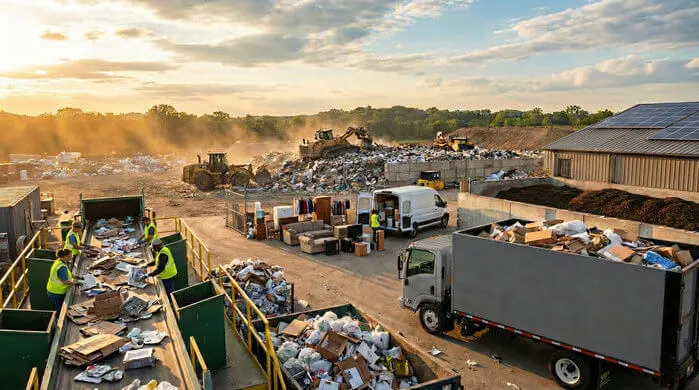
Once our team loads your items, the work is far from over. Before anything reaches a final destination, every load goes through a sorting process where we separate materials into three main categories: items that can be donated, materials that can be recycled, and waste that requires proper disposal.
This isn’t a token effort. Our crews are trained to identify reusable goods, salvageable materials, and recyclable components — even in items most people would assume are destined for the dump. A worn dresser might need a new drawer pull, not a landfill. An old appliance often contains metals and parts that recycling facilities can recover and repurpose. That sorting step is what separates a responsible junk removal company from one that simply hauls everything to the nearest disposal site.
Donation: Giving Your Items a Second Life
A significant portion of the items we pick up every day still have plenty of use left in them. Furniture, clothing, working electronics, household goods, and appliances in decent condition are routed to local charities, shelters, and donation centers in the communities we serve.
Over the years, we’ve built relationships with nonprofit organizations nationwide to make this process as seamless as possible. When you choose a junk removal service that prioritizes donation, your unwanted couch could end up in a family’s first apartment, or your old kitchen table could find its way to a community dining hall. It’s one of the most rewarding parts of what we do — and our customers consistently tell us they appreciate knowing it.
Recycling: Keeping Reusable Materials Out of Landfills
Not everything can be donated, but that doesn’t mean it belongs in a landfill. Metals, plastics, glass, cardboard, wood, and certain textiles can all be broken down and reprocessed through recycling facilities. Construction debris, yard waste, and e-waste each follow their own specialized recycling streams as well.
At Jiffy Junk, we work with certified recycling partners to make sure recoverable materials are handled correctly. Electronics, for example, contain components that require careful processing to avoid environmental contamination — so we route them to e-waste facilities equipped to manage that safely. The same goes for large appliances that contain refrigerants or other regulated substances. Our experience has taught us that proper recycling takes a little more effort on the front end, but the environmental payoff is well worth it.
Responsible Disposal: When Landfill Is the Last Resort
Some items simply can’t be reused or recycled — and we’re transparent about that. Certain materials, heavily damaged goods, and non-recyclable waste do end up at licensed disposal facilities. The difference is that with Jiffy Junk, the landfill is always the last stop, never the first.
We follow all local and federal disposal regulations, and we work exclusively with permitted facilities to ensure that waste is managed safely and legally. Our goal on every job is to minimize what reaches a landfill by maximizing what we can recover through donation and recycling first.
Why Sustainable Junk Removal Matters
The environmental impact of junk removal is something most people don’t think about until they start asking the question this page answers. Landfills across the country are reaching capacity, and materials that could have been recycled or reused take up space and generate greenhouse gases as they decompose.
Choosing a junk removal company that invests in sustainable practices isn’t just a feel-good decision — it directly reduces the volume of waste that ends up in the ground. When we donate a truckload of usable furniture or divert a ton of recyclable metal, that’s a measurable difference. It’s also why we believe transparency about what happens after pickup should be a standard part of the conversation, not an afterthought.
How Jiffy Junk’s White Glove Treatment Makes the Difference
Our approach to post-removal sorting, donation, and recycling is built into the same White Glove Treatment our customers know us for. It’s not a separate program or an add-on — it’s how we operate on every job, from a single-item pickup to a full property cleanout.
When you book with Jiffy Junk, you’re choosing a team that’s fully licensed and insured, committed to upfront pricing with no hidden fees, and dedicated to handling your items responsibly from the moment we arrive to the moment they reach their final destination. We take the heavy lifting off your hands and the guesswork out of where it all ends up.
“After removing thousands of loads over the past decade, we’ve learned that what happens after the truck pulls away matters just as much as the pickup itself — and that’s why we sort every single job for donation and recycling before anything gets near a landfill.” — The Jiffy Junk Team
7 Essential Resources to Help You See Where Your Items Go After Removal
We believe you deserve to know exactly what happens after our team drives away. That’s part of delivering the White Glove Treatment — full transparency, not just a clean space. Whether you’re curious about how recycling works, where to donate, or what tax benefits you might qualify for, these resources will give you the complete picture. We’ve handpicked each one so you can feel confident that your items are being handled responsibly.
1. Understand How Recycling Works Across the Country
Ever wonder what actually happens to materials once they reach a recycling facility? The EPA’s recycling overview walks you through the full process — from collection to reprocessing — and explains why keeping reusable materials out of landfills makes a real difference for communities and the environment. It’s the best starting point if you want to see the bigger picture behind eco-friendly junk removal.
Source: https://www.epa.gov/recycle/recycling-basics-and-benefits
2. Find a Local Recycling Drop-Off in Seconds
Confused as to where to take a particular item? Earth911 makes it simple. Just type in the material and your zip code, and you’ll be given a list of recycling and reuse locations near you – including everything from metals and plastics to specialty items such as paint and batteries. With more than 100,000 listings across North America, it’s the fastest way to get to where you need to go, or anywhere you need to go, for just about anything.
Source: https://search.earth911.com/
3. Give Your Furniture and Appliances a Second Life Through Habitat ReStore
Your old couch or kitchen set doesn’t need to go to the landfill. Habitat for Humanity ReStores take gently used furniture, working appliances, and building materials – and many locations will even take them up for free of charge. The best part? All of the items we sell go directly to constructing affordable homes in your community. It’s one of the easiest ways of making a cleanout something meaningful.
Source: https://www.habitat.org/restores/donate-goods
4. Schedule a Free Pickup for Household Items You No Longer Need
The Salvation Army makes an effort to donate. Their free online scheduling tool makes it easy to schedule a time for a pickup of furniture, clothing, electronics, and household goods in just a few clicks. Your donated items support rehabilitation and community assistance programs nationwide – so, at the same time, you clear your space for some real good.
Source: https://satruck.org/donate/choose
5. Make Sure Your Old Electronics Are Recycled Safely
Computers, televisions, and appliances with hazardous components need specialized handling — they can’t just go in a standard recycling bin. The EPA’s certified recycler directory connects you with facilities that meet the R2 and e-Stewards standards, the two nationally recognized programs for responsible electronics processing. If you’ve got e-waste to deal with, this is the resource to bookmark.
Source: https://www.epa.gov/electronics-batteries-management/certified-electronics-recyclers
6. Check Exactly What Can and Can’t Be Recycled — Item by Item
Recycling isn’t always as straightforward as it seems. Batteries, motor oil, yard trimmings, and food waste all follow different rules. The EPA’s common recyclables guide breaks it down material by material, so you’ll know exactly which items from your removal need a dedicated recycling stream and which ones are simpler to handle.
Source: https://www.epa.gov/recycle/how-do-i-recycle-common-recyclables
7. See If You Qualify for a Tax Deduction on Donated Items
Here’s something many people don’t realize: if items from your cleanout are donated to a qualified charity, you may be able to claim a tax deduction based on their fair market value. IRS Publication 526 covers everything you need to know — from which household goods and furniture qualify to what documentation you’ll want to keep. It’s worth a quick read before your next removal.
Source: https://www.irs.gov/publications/p526
Supporting Statistics — What We’ve Learned About Waste — And Why the Numbers Should Matter to You
After more than a decade in junk removal, we’ve seen what happens when items aren’t sorted, recycled, or donated. The national data backs up what we witness on the ground every day.
1. Half of All U.S. Waste Still Ends Up in Landfills
On our jobs, we regularly pull furniture, metals, and electronics that have plenty of life left. The EPA confirms what we see firsthand:
- 292.4 million tons of municipal solid waste were generated in 2018
- 50% landfilled — over 146 million tons buried
- Only 32% recycled or composted
We’ve learned that the difference between a landfill-bound load and a responsibly handled one often comes down to whether someone takes the time to sort through it. That’s why we do it on every job.
Source: EPA — National Overview: Facts and Figures on Materials, Wastes and Recycling
2. Recycling and Composting Prevented Over 193 Million Metric Tons of CO₂ in a Single Year
A single cleanout may seem small. After thousands of jobs, we can tell you — it adds up fast.
- 193+ million metric tons of carbon dioxide equivalent saved through recycling and composting in 2018
- That’s comparable to taking tens of millions of cars off the road for a full year.
We think about that number every time we route a load to a recycling partner instead of straight to disposal. Across every community we serve, those individual decisions compound into measurable impact. It’s one of the things our team takes the most pride in.
Source: EPA — Reducing and Reusing Basics
3. Responsible Removal Creates Jobs and Strengthens Local Economies
Most customers don’t see the network behind responsible junk removal — the recycling facilities, donation centers, and processing partners we work with on every job. The EPA’s 2020 Recycling Economic Information Report shows what that network produces for every 1,000 tons of materials recycled:
- 1.17 jobs supported
- $65,230 in wages generated
- $9,420 in tax revenue contributed
Those aren’t abstract numbers to us. They represent the workers at the facilities we deliver to, the staff at the donation centers we partner with, and the communities that benefit when materials are recovered instead of buried.
Source: EPA — Recycling Economic Information (REI) Report
We didn’t build our sorting and recycling process because the numbers told us to — we built it because, after years of doing this work, we saw what happens when nobody takes that extra step. The data just confirmed what we already knew from experience.
Final Thoughts & Opinion
After more than ten years and tens of thousands of completed jobs, here’s something we believe doesn’t get talked about enough: most customers have no idea where their items end up after the truck pulls away. And for a long time, a lot of companies have been fine with that.
We weren’t.
What We Noticed Early On
When we started Jiffy Junk in 2014, the industry standard was simple — show up, load the truck, drive away. What happened next was rarely discussed. We saw a problem with that, because when there’s no accountability for what happens after pickup, the easiest path is always the landfill.
What We Built Instead
That’s why we designed our operation around responsible handling from day one:
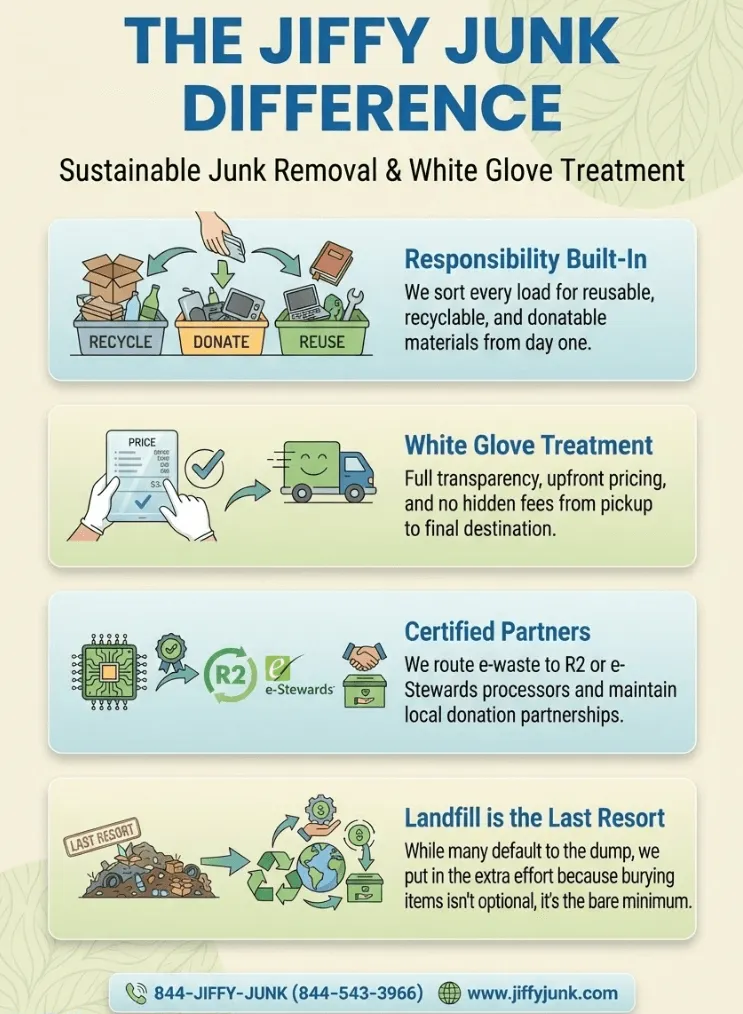
- We sort every load for reusable, recyclable, and donatable materials
- We maintain partnerships with local donation centers and certified recycling facilities in every market we serve
- We route electronics to e-waste processors equipped for hazardous components
- We treat the landfill as a last resort — never a default
Is it more work? Absolutely. It takes longer to sort a load than to dump one. But after seeing firsthand how much usable material gets buried every day — with the EPA reporting that 50% of all U.S. waste still goes straight to landfills — we believe the extra effort isn’t optional. It’s the bare minimum.
What We’d Encourage You to Do
If you’re researching junk removal companies, ask these questions before you book:
- What happens to my items after pickup?
- Do you sort donations and recycling?
- Do you work with certified recycling facilities?
If they can’t give you a clear answer, that tells you something. If they can, that tells you even more.
Why We Wrote This Page
We believe transparency builds trust — and trust is what our entire business is built on. We’re not happy until you are, and that includes making sure you feel good about where your items end up after we leave.
FAQ on “What Happens to Junk After Removal”
Q: Does all junk end up in a landfill after it’s removed?
A: It shouldn’t — but it depends on who you hire. We’ve been in this industry since 2014, and we know the fastest way to handle a load is to drive it straight to a landfill. Some companies do exactly that. We’ve never operated that way.
At Jiffy Junk, every load is sorted into three categories before anything reaches a disposal facility:
- Donatable goods — furniture, appliances, and household items that still have use left
- Recyclable materials — metals, plastics, glass, cardboard, wood, and electronics
- Disposal-only waste — items that genuinely can’t be recovered
Here’s what tens of thousands of jobs have taught us: the majority of what people call “junk” isn’t junk at all. We regularly pull working appliances, solid furniture, and perfectly good building materials out of loads customers assumed were all headed for the dump. Sorting is the single biggest factor in whether your items get a second life or end up underground.
Q: What types of items get donated after junk removal?
A: More than most people expect. One thing that struck us early on was how much usable material comes out of an average cleanout — couches that just needed a steam clean, refrigerators with years left, household goods in better shape than what you’d find on a shelf.
Items we commonly route to donation partners include:
- Furniture — tables, dressers, couches, bed frames, shelving
- Working appliances — refrigerators, washers, dryers, microwaves
- Household goods — kitchenware, clothing, toys, books, small electronics
Over the years, we’ve built partnerships with organizations like Habitat for Humanity ReStore and The Salvation Army, so we always have a reliable destination for these items. Customers often tell us they’re relieved to hear their grandmother’s dining table is going to a family that needs it — not a landfill. That connection matters to people, and it matters to us.
If you’d like a donation receipt for tax purposes, just let us know when you book.
Q: How are electronics and hazardous items handled after removal?
A: This is where we’ve seen the widest gap between what companies say and what they actually do. Electronics, batteries, and appliances with refrigerants can’t go through standard recycling. They require certified specialized processing.
Here’s how we handle it:
- E-waste is routed to facilities operating under R2 or e-Stewards certification — the two programs the EPA recognizes for responsible electronics recycling
- Appliances with refrigerants go to processors equipped to safely extract and manage regulated substances
- Batteries and hazardous components are directed to dedicated hazardous waste facilities
These partnerships weren’t built overnight. It took years of vetting processors, visiting facilities, and establishing relationships we trust. From what we’ve seen across the industry, hazardous item handling is where many companies cut corners — either because they lack the right partnerships or because proper processing costs more than dumping. If your provider can’t tell you specifically where your old TV or refrigerator is going, that’s a red flag.
Q: How do I know if my junk removal company is actually recycling and not just dumping everything?
A: We get this question more than you’d think — and we’re glad when people ask. After over a decade in this industry, the difference between companies that genuinely recycle and those that just market it comes down to three things:
- They explain their process clearly. Ask what happens after pickup. A company that sorts, donates, and recycles will walk you through each step. Vague answers like “we handle it responsibly” without specifics usually mean the landfill is the primary destination.
- They show documentation. Donation receipts, recycling records, and named facility partnerships are tangible proof. We track where materials go on every job because accountability is the only way to back up the commitment.
- They name their partners. Companies invested in responsible disposal will tell you who they work with. We share that information openly because we’ve spent years building those relationships.
The truth: recycling and donation take more time and effort than dumping a load. If a company’s pricing seems too good to be true and they can’t answer these questions, there’s a reason. At Jiffy Junk, transparency isn’t a selling point — it’s built into our White Glove Treatment.
Q: Can I get a tax deduction for items donated through junk removal?
A: In many cases, yes — and we think more customers should know this before they book. When items are donated to a qualified 501(c)(3) charity, you may be eligible for a tax deduction based on fair market value.
Items that commonly qualify include:
- Furniture in good used condition
- Working appliances
- Clothing, household goods, and electronics
Over the years, countless customers have told us they wish they’d known about the deduction ahead of time. A dining set, a working washer and dryer, a bedroom full of furniture — those items add up to meaningful value when documented properly.
To capture the benefit, we recommend:
- Keep a detailed list of donated items with descriptions and estimated values
- Request a receipt from the receiving charity or donation center
- Review IRS Publication 526 for documentation requirements and deduction limits
Let our team know when you book if you’d like us to coordinate donation receipts. We’ve been through this process thousands of times, and we’re happy to help.
Ready to Clear Your Space With a Team That Handles Every Item the Right Way?
Now that you know what happens to junk after removal — and why it matters — let us put our sorting, donation, and recycling process to work for you. Call 844-JIFFY-JUNK (844-543-3966) or book online today for a free, no-obligation quote and experience the White Glove Treatment from pickup to final destination.