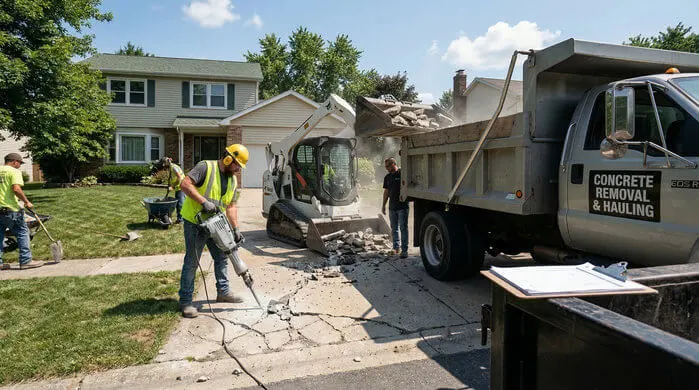
Here’s what most people don’t figure out until they’re standing in the driveway holding a sledgehammer: a standard 10×10 concrete patio weighs over 2,500 lbs, and a rented pickup truck won’t cut it. If you’re replacing a driveway, clearing space for a new patio, or finally getting rid of that cracked slab that’s been a trip hazard for years, Jiffy Junk’s concrete removal service covers the whole job. Our fully licensed and insured crews break it up on-site, load every piece, and haul it away. You don’t lift a finger.
We’ve been handling jobs like this since 2014, starting in Suffolk and Nassau County on Long Island and growing into a nationwide operation. The standard hasn’t changed: show up on time, price the job honestly before we start, and leave your property cleaner than we found it.
When you’re ready to get started, book your free quote at jiffyjunk.com/booking. It takes 60 seconds.
TL;DR Quick Answers
Concrete Removal Service
A concrete removal service breaks up, loads, and hauls away old or unwanted concrete from your property. This includes driveways, patios, slabs, sidewalks, pool decks, and garage floors. The process uses on-site demolition equipment like jackhammers, followed by full hauling to a licensed disposal or recycling facility. At Jiffy Junk, our concrete removal service comes with upfront pricing, licensed and insured crews, availability nationwide, and our White Glove Treatment standard, so your property is left clean, clear, and ready for whatever you’re planning next.
Top 5 Takeaways
- Concrete removal is not a DIY job.
- A standard 10×10 patio weighs over 2,500 lbs.
- Safe removal requires professional equipment, trained crews, and licensed disposal.
- Rental tools and a strong back won’t get the job done safely
- Upfront pricing means no surprises.
- Every Jiffy Junk quote is locked in before work begins
- The price you see is the price you pay
- No hidden fees, no charges added after the job is done
- Where your concrete goes after hauling matters.
- Responsible crews route material to licensed recycling facilities
- Crushed concrete gets repurposed as road base and aggregate fill
- Always ask your contractor where the material goes — the answer tells you a lot
- Calling 811 before any ground work is non-negotiable.
- Gas lines, water pipes, and electrical cables can run just inches below a slab.
- Every Jiffy Junk crew contacts 811 before any project that touches the ground.
- Skipping this step puts your property, utilities, and crew at risk
- We’re not happy until you are.
- White Glove Treatment is the standard on every job we take
- That means a transparent quote, careful work, and a clean site when we leave
- Every driveway, patio, slab, and garage floor gets the same level of care
Table of Contents
- TL;DR Quick Answers
- Top 5 Takeaways
- What Makes Concrete So Difficult to Remove?
- Our Concrete Removal Services Cover It All
- How Much Does Concrete Removal Cost?
- Before You Book a Concrete Removal Service: 7 Resources That Help You Hire Right and Dispose Responsibly
- 1. Understand What Makes Concrete So Difficult — and Costly — to Remove
- 2. Know Where Your Old Concrete Is Required to Go After Hauling
- 3. See the Safety Standards Every Licensed Demolition Crew Must Follow
- 4. Learn Why Concrete Dust Is a Serious Health Risk — and What Controls Prevent It
- 5. Confirm Your Old Concrete Gets Recycled, Not Landfilled
- 6. Protect Yourself Before You Sign Any Contractor Agreement
- 7. Call 811 Before Any Concrete Removal That Involves Digging or Excavation
- The Numbers Behind Concrete Removal: What the Data Says
- 1. American Homeowners Complete 140 Million Home Improvement Projects Every Year — and 64% Hire Professionals to Do It
- 2. Building Demolition Generates an Estimated 123 Million Tons of Construction Waste Every Year in the United States
- 3. Failure to Notify Before Digging Is One of the Leading Root Causes of Underground Utility Damage in the U.S. Every Year
- Final Thoughts and Opinion
- Frequently Asked Questions
- Ready to Remove Your Old Concrete? Let’s Get Started
What Makes Concrete So Difficult to Remove?
Concrete is one of the most durable construction materials ever made. It’s also one of the heaviest. A standard 4-inch slab weighs about 50 lbs per square foot. That 10×10 patio you’ve been stepping around? It weighs more than 2,500 lbs before a single piece moves.
That’s not a job for a weekend and a rented jackhammer.
Breaking concrete safely means working around utilities, rebar, and adjacent structures. It takes real demolition equipment and crews trained to use it. And once it’s down, concrete has to go to a licensed disposal or recycling facility. You can’t bag it and leave it at the curb.
Here’s what actually drives time and cost on a typical project:
- Slab thickness: Thicker pours need more breaking time and heavier equipment
- Rebar and wire mesh: reinforced concrete requires cutting and separation before hauling
- Accessibility: tight side yards, hillside patios, and basement slabs all add complexity
- Proximity to structures: demolition near fencing, foundations, or landscaping calls for careful work
- Disposal routing: licensed facility fees vary by region and are factored into your quote
That’s exactly why homeowners and property managers across the country call Jiffy Junk. We arrive with the right equipment and the right crew, and we’ve been doing this long enough to handle whatever the job throws at us.
Our Concrete Removal Services Cover It All
Whether it’s a driveway that’s seen better days or concrete debris left over from a renovation, our teams are ready for it. Here’s what we take:
- Concrete Driveway Removal
- Concrete Patio Removal
- Concrete Slab Removal
- Concrete Sidewalk and Walkway Removal
- Concrete Steps and Stair Removal
- Pool Deck Concrete Removal
- Garage Floor Removal
- Concrete Retaining Wall Removal
- Post-Construction Concrete Debris Hauling
Not sure if your project makes the list? Send us a photo. We’ll give you a straight answer fast. That’s the Jiffy Junk way.
Got more than just concrete to deal with? Our professional cleanout services tackle entire spaces, inside and out, so you can take care of everything in one job.
How Much Does Concrete Removal Cost?
The honest answer: it depends on your project. Size, slab thickness, rebar, how accessible the area is, and local disposal rates all factor into the number. What stays the same is how we handle pricing. We give you a transparent, upfront quote before any work starts, with no hidden fees and no surprises built in at the end. The price you see is the price you pay.
Here’s what shapes your estimate:
- Project Size: More square footage means more labor and haul time
- Slab Thickness: Thicker concrete takes longer to break and requires more loads to haul
- Rebar and Wire Mesh: reinforced slabs add cutting and separation time
- Accessibility: tight locations and below-grade work add complexity
- Local Disposal Rates: these vary by region and are included in your quote
- Same-Day or Rush Scheduling: A premium may apply based on availability
General price ranges for reference (confirm with Jiffy Junk for your specific project):
- Small patio or walkway (up to 100 sq ft): ~$300–$700
- Driveway removal (200–400 sq ft): ~$800–$1,800
- Large slab or garage floor (400+ sq ft): ~$1,500–$3,500+
- Reinforced concrete with rebar: Add 20–30% to the base estimate
Call 844-543-3966 or book online to get your free, no-obligation estimate. We’ll walk you through every line.
“Concrete removal isn’t just heavy work — it’s precision work. A crew that rushes the demolition risks cracking a foundation, damaging underground lines, or creating debris that’s harder to haul. At Jiffy Junk, we’ve seen every type of slab situation since 2014, and what we’ve learned is this: the right equipment and experienced hands make the difference between a clean job and a costly one.”
— The Jiffy Junk Operations Team
Before You Book a Concrete Removal Service: 7 Resources That Help You Hire Right and Dispose Responsibly
1. Understand What Makes Concrete So Difficult — and Costly — to Remove
A 10×10 patio can weigh over 2,500 lbs before a single piece moves. The American Cement Association’s FAQ explains what gives concrete that kind of strength, why it keeps hardening over time, and why moving it safely takes professional equipment — not a rental and a free Saturday.
Source: Cement & Concrete FAQ — American Cement Association
2. Know Where Your Old Concrete Is Required to Go After Hauling
Your concrete doesn’t just disappear when the truck pulls away — it has to go somewhere compliant. The EPA’s construction and demolition materials page outlines federal standards for how concrete gets recycled or disposed of after removal, so you can ask your crew the right questions and know what a responsible answer sounds like.
Source: Sustainable Management of Construction and Demolition Materials — U.S. EPA
3. See the Safety Standards Every Licensed Demolition Crew Must Follow
OSHA sets the binding federal requirements for all demolition work: pre-job engineering surveys, utility assessments, structural hazard checks, and protective equipment standards. This is the baseline any fully licensed and insured concrete removal team is legally required to meet before they touch your property — and it’s worth knowing what that looks like.
Source: Demolition Safety Overview — Occupational Safety and Health Administration
4. Learn Why Concrete Dust Is a Serious Health Risk — and What Controls Prevent It
When concrete gets cut or broken up, it releases crystalline silica dust — a lung hazard that builds up with repeated exposure. The CDC’s NIOSH resource explains the exposure limits and the engineering controls, like wet cutting methods and proper ventilation, that professional crews use to keep your job site safe from the first swing to the last load.
Source: Safe Work Practices for Silica Exposure — CDC / NIOSH
5. Confirm Your Old Concrete Gets Recycled, Not Landfilled
Crushed concrete gets a second life as aggregate fill and road base material — one of the cleaner outcomes in demolition work. CalRecycle’s C&D recycling guide explains how the recycling process works and how to locate permitted facilities near you, so you can verify your crew is handling disposal the eco-friendly way, not just the easy way.
Source: Construction and Demolition Debris Recycling — CalRecycle
6. Protect Yourself Before You Sign Any Contractor Agreement
A verified license, a written contract, and a clear payment schedule aren’t extras — they’re the minimum you should have before any crew starts work on your property. Massachusetts OCABR’s homeowner guide walks you through exactly what to check, what to put in writing, and what your options are if the job doesn’t go as promised.
Source: Homeowner’s Guide to Hiring a Home Improvement Contractor — Mass.gov
7. Call 811 Before Any Concrete Removal That Involves Digging or Excavation
Gas lines, water pipes, and electrical cables can run just inches below a concrete slab. Striking one during removal can cause outages, injuries, and repair bills that dwarf the cost of the original project. Calling 811 before work begins is free, takes minutes, and is legally required in most states — a quick step that protects you, your crew, and your neighbors.
Source: Call Before You Dig — Utility Notification Center
The Numbers Behind Concrete Removal: What the Data Says
1. American Homeowners Complete 140 Million Home Improvement Projects Every Year — and 64% Hire Professionals to Do It
We’ve seen it firsthand: homeowners who attempt concrete removal themselves almost always call us anyway — usually after a rental machine sits unused all weekend.
The 2023 American Housing Survey confirms what our crews see every day:
- U.S. homeowners completed roughly 140 million home improvement projects in 2023
- Nearly 2 out of 3 hired professionals to get the work done
- Driveways, walkways, patios, and outdoor hardscape ranked among the top spending categories nationwide
There’s a reason for that. Concrete is heavy, requires real equipment, and getting rid of it legally takes more than a strong back and a borrowed truck.
Source: 2023 American Housing Survey — U.S. Census Bureau
2. Building Demolition Generates an Estimated 123 Million Tons of Construction Waste Every Year in the United States
One question we hear constantly: “Where does the concrete actually go?” It’s exactly the right thing to ask.
Here’s what the data shows:
- The Federal Highway Administration estimates demolition activity generates approximately 123 million tons of construction waste annually in the U.S.
- Concrete makes up the largest single share of that total
- Crushed concrete gets a real second life — repurposed as road base and aggregate fill when routed to a licensed recycling facility
In our experience, the difference between a responsible crew and a cut-rate one comes down to this: where your material goes after it leaves your property. We route it right.
Source: Transportation Applications of Recycled Concrete Aggregate — Federal Highway Administration
3. Failure to Notify Before Digging Is One of the Leading Root Causes of Underground Utility Damage in the U.S. Every Year
In over a decade of concrete removal work, we’ve seen what happens when a crew skips the utility check. It’s never worth the time it saves.
What the Common Ground Alliance’s annual DIRT Report — the only comprehensive accounting of underground utility damage in the U.S. and Canada — consistently finds:
- Excavation-related damage incidents number in the hundreds of thousands each year
- Failure to contact a one-call center before digging ranks as one of the top root causes
- Gas lines, water pipes, and electrical cables can run just inches below a slab
Every Jiffy Junk crew contacts 811 before any project that touches the ground. Protecting your property, your utilities, and everyone on the job site is not a step we skip.
Source: DIRT Report — Common Ground Alliance
Final Thoughts and Opinion
Old concrete sitting on your property costs you something even when you’re ignoring it. It takes up space you could be using. It’s a safety risk. It’s in the way of every project you’ve been putting off because of it.
Our honest take, after more than a decade doing this: DIY concrete removal rarely saves money when you add up equipment rental, disposal fees, and the time it actually takes to do it safely. Without the right setup, it’s also easy to damage surrounding structures or cut into utilities. The faster, safer path is a professional crew with the tools and experience to handle it right the first time.
We’ll show up on schedule, price the job upfront, work carefully around your property, and clean up before we leave. That’s the White Glove Treatment, and it’s the standard we hold every job to.
We’re not happy until you are.
Frequently Asked Questions
Q: How much does concrete removal cost?
A: Concrete removal typically runs between $300 and $3,500 or more, depending on project size, slab thickness, reinforcement, and your location. At Jiffy Junk, we give you a transparent, upfront quote before any work begins, with no hidden fees and no surprises. The price we quote is the price you pay.
Q: Can you break up and remove concrete near me?
A: Yes. Jiffy Junk offers concrete demolition and removal across the country. Our licensed and insured crews handle everything from driveway slabs to patio concrete. Book online or call 844-543-3966 to check availability in your area.
Q: What types of concrete can you remove?
A: We remove driveways, patios, walkways, pool decks, garage floors, retaining walls, concrete steps, and post-construction debris. Reinforced concrete with rebar or wire mesh is no challenge for our crews. We have the equipment for it. Not sure what you’ve got? Just ask.
Q: How do you dispose of old concrete?
A: We haul it to a licensed disposal or recycling facility. Recycling facilities can crush concrete and repurpose it as aggregate fill or road base material, which makes it one of the more eco-friendly demolition materials to dispose of. We route your old concrete to recycling wherever possible.
Q: Is concrete removal a DIY project?
A: For most residential slabs, no. The weight makes it a job that genuinely needs professional equipment, and disposal requires a licensed facility. Rental costs for a jackhammer and a dumpster add up fast, too. In most cases, hiring a professional concrete removal service is safer, faster, and more cost-effective once you factor in everything.
Q: How long does concrete removal take?
A: Most residential projects wrap up in a single day. A standard driveway or patio typically takes 3 to 6 hours, depending on thickness, reinforcement, and crew size. Larger or commercial projects may need more time. We’ll include a clear time estimate with your quote.
Q: Do I need a permit to remove concrete?
A: It depends on your municipality. For most residential projects like driveways, patios, and basic slabs, no permit is required. If the work involves excavation near a public right-of-way, a permit may be needed. Check with your local building department, and our team is happy to advise based on your specific project.
Ready to Remove Your Old Concrete? Let’s Get Started
Don’t let that cracked driveway, old patio, or unwanted slab take up another inch of your space. Jiffy Junk’s licensed, insured crews will break it up, haul it away, and leave your property spotless with the White Glove Treatment you deserve. Get your free upfront quote today at jiffyjunk.com/booking or call 844-543-3966. We’re not happy until you are.