Based on thousands of boat removals we’ve completed across the country, most vessel disposals fall between $500 and $5,000. However, we’ve seen jobs outside of this range, depending on the boat’s size, condition, and accessibility.
Here’s what we’ve learned firsthand: The biggest cost drivers are not always what you’d expect. A 20-foot boat in a packed backyard with no access to a puller often costs more to take down than a larger boat that is sitting in an open marina. Fiberglass hulls must be disposed of in special areas, and boats carrying fuel, oil, or batteries still on board require environmental handling that adds a measure of complexity.
Most boat owners we work with have already discovered the hard part—getting straight answers. Marinas won’t take it. Donation programs reject anything that isn’t seaworthy. And finding a hauler who actually shows up? That’s a project in itself.
Jiffy Junk gets rid of the runaround. Our teams arrive equipped, we give you upfront pricing with no surprise costs, and we do everything from disconnecting your appliances to eco-responsible disposal.
Quick Answers
What is a boat removal service?
A boat removal service is a professional hauling company that removes unwanted vessels from your property and disposes of them responsibly.
What’s included:
- On-site assessment and upfront quote
- All labor, equipment, and heavy lifting
- Loading, transport, and disposal
- Hazardous material handling (fuel, oil, batteries)
- Complete cleanup after removal
Who uses boat removal services:
- Homeowners with old boats in driveways or backyards
- Property buyers who inherited unwanted vessels
- Families managing estates with boats to dispose of
- Marina owners clearing abandoned watercraft
Why it matters: With approximately 200,000 boats reaching the end of life annually in the U.S., professional removal ensures vessels are disposed of properly—not abandoned in waterways or dumped illegally.
What to look for in a service:
- Upfront, transparent pricing
- Licensed and insured crews
- Eco-responsible disposal practices
- Reliable scheduling and follow-through
Top 5 Takeaways
- Boat removal costs $500 to $5,000+
- Price depends on size, accessibility, condition, and hazardous materials
- Accessibility often impacts cost more than vessel size
- 200,000 boats reach the end of life annually in the U.S.
- Limited disposal infrastructure leaves owners struggling
- Professional removal services fill a critical gap
- Waiting increases costs and complications
- Hulls deteriorate
- Fluids leak
- Trailers rust into the ground
- Simple removals become expensive multi-day projects
- Responsible disposal protects our waterways
- Metals get recycled
- Usable components get salvaged
- Hazardous materials are handled properly
- The right service makes it easy
- Upfront pricing with no surprises
- Reliable scheduling
- Full-service removal—you don’t lift a finger
Table of contents
- Quick Answers
- Top 5 Takeaways
- What Factors Determine Your Boat Removal Cost?
- Types of Vessels We Remove
- What’s Included in Professional Boat Removal?
- How to Choose the Right Boat Disposal Company
- Why Customers Choose Jiffy Junk for Boat Removal
- Get Your Boat Removed—The Simple Way
- 7 Helpful Resources to Guide Your Boat Disposal Journey
- 1. Discover What Programs Are Available in Your State
- 2. Learn What Environmental Steps Are Required Before Disposal
- 3. Understand How Boat Donation Tax Deductions Actually Work
- 4. See If Your Boat Qualifies for a Charitable Donation
- 5. Get Clear on Hazardous Material Disposal Requirements
- 6. Explore Free Vessel Turn-In Programs in Select States
- 7. Know What to Expect with Fiberglass Boat Disposal
- Supporting Statistics
- Final Thoughts & Opinion
- Next Steps Section
- FAQ on “Boat Removal Service”
- Get Your Free Boat Removal Quote Today
What Factors Determine Your Boat Removal Cost?
Every boat removal job is its own, and having worked on boats of all types and conditions, we’ve found the factors that count the most when it comes to your ultimate price:
Size and weight matter most. A 14-foot aluminum fishing boat needs much less equipment and labor than a 30-foot cabin cruiser. Larger craft may require special trailers, cranes, or even on-site dismantling.
Location and accessibility can have a tremendous influence on cost. A boat on a trailer located in an open driveway is simple. A vessel wedged behind a fence, stuck in a muddy backyard, or sitting in a slip requiring marina coordination is an added time and logistical consideration.
The condition of the vessel is involved as well. Boats with clamped hulls that are drained of fluids and batteries are simpler to haul. Deteriorated fiberglass, environmental risks such as fuel or oil, or vessels that have been standing for years, need a form of extra handling, as well as responsible waste disposal.
The location that you are in also influences pricing. Urban areas with nearby disposal facilities are typically cheaper than remote properties with the associated longer distances required to transport the material.
Types of Vessels We Remove
Jiffy Junk removes watercraft of virtually every type, size, and condition:
- Sailboats and motorboats
- Fishing boats and bass boats
- Cabin cruisers and pontoon boats
- Jet skis and personal watercraft
- Canoes, kayaks, and rowboats
- Houseboats and commercial vessels
- Boat trailers and marine equipment
Whether your vessel is seaworthy, salvageable, or completely beyond repair, we have the equipment and expertise to remove it properly. We’ve hauled boats from driveways, backyards, storage facilities, dry docks, and marina slips across the country.
What’s Included in Professional Boat Removal?
When you hire Jiffy Junk, you’re not just getting a hauler—you’re getting full-service boat disposal with our White Glove Treatment. Here’s what that means:
On-site assessment and upfront quote. We evaluate your specific situation and provide transparent pricing before any work begins. The quote we give is the price you pay—no surprises, no hidden fees.
All labor and heavy lifting. Our licensed, insured crews handle disconnection, loading, and transport. You don’t touch a thing.
Eco-responsible disposal. We’re committed to recycling and salvaging materials whenever possible. Aluminum, steel, and usable components get diverted from landfills. Hazardous materials like fuel, oil, and batteries are disposed of according to environmental regulations.
Complete cleanup. Once your boat is gone, we leave the area clean and clear—ready for whatever comes next.
How to Choose the Right Boat Disposal Company
Not all junk removal companies handle boats, and not all boat removal services deliver the same experience. Here’s what to look for:
Proper licensing and insurance. Boat removal involves heavy equipment, transport logistics, and sometimes hazardous materials. Verify that any company you hire carries comprehensive liability coverage and meets local licensing requirements.
Transparent, upfront pricing. Reputable companies provide clear quotes before work begins. Be wary of vague estimates, per-hour billing that can spiral, or surprise fees tacked on after the job.
Experience with vessels. Removing a boat isn’t the same as hauling furniture. Look for a company with proven experience handling watercraft of various sizes and conditions.
Environmental responsibility. Ask how the company disposes of boats. Responsible haulers prioritize recycling, salvage, and proper hazardous waste handling over simply dumping everything in a landfill.
Reviews and reputation. Check online reviews and testimonials. Consistent feedback about professionalism, punctuality, and fair pricing indicates a company you can trust.
Why Customers Choose Jiffy Junk for Boat Removal
Since 2014, we’ve built our reputation on doing junk removal differently. Our White Glove Treatment means we handle every detail with professionalism and care—and boat removal is no exception.
We show up when we say we will. Reliability isn’t optional for us; it’s foundational.
We give you a straight answer on price. No games, no bait-and-switch, no mystery fees after the fact.
We do the work so you don’t have to. From the moment we arrive until the moment we leave, you’re free to focus on anything else.
We dispose of boats responsibly. Materials that can be recycled or salvaged are handled accordingly. Hazardous components are managed properly. We take environmental responsibility seriously on every job.
We’re nationwide. Whether you’re on Long Island, where we started, or anywhere else across the country, Jiffy Junk teams are ready to help.
Get Your Boat Removed—The Simple Way
Ready to reclaim your space and stop staring at that old vessel? Getting started takes less than a minute.
Call us at 844-JIFFY-JUNK to speak with our team and get a quote over the phone.
Or book online at jiffyjunk.com/booking to schedule your appointment instantly.
We’ll confirm your time, arrive within your scheduled window, provide your upfront price, and handle everything from there. No stress, no guesswork—just results.
We’re not happy until you are. That’s the Jiffy Junk promise.
7 Helpful Resources to Guide Your Boat Disposal Journey
We know that figuring out what to do with an unwanted boat can feel overwhelming. That’s why we’ve gathered seven trusted resources to help you understand your options—whether you’re exploring donation, researching regulations, or simply trying to figure out where to start. Consider this your go-to reference as you decide the best path forward for your vessel.
1. Discover What Programs Are Available in Your State
NOAA Marine Debris Program: Abandoned and Derelict Vessels Info Hub
Every state has a slightly different approach to disposal of vessels. This easy-to-navigate federal database tells you where there are the programs and funding options and agency contacts that can be found where you live – so you’re able to explore all avenues before making a decision.
Resource URL: https://marinedebris.noaa.gov/resources/abandoned-and-derelict-vessels-info-hub
Source Type: Federal Government Agency
2. Learn What Environmental Steps Are Required Before Disposal
EPA: Disposal of Vessels at Sea
Boats tend to have fuel, oil, batteries, and other properties that require proper handling. The EPA lays out exactly what should be removed and the process by which this can be done – all in an effort to keep you (and everyone else) compliant and keep the waterways we all enjoy free of pollution.
Resource URL: https://www.epa.gov/ocean-dumping/disposal-vessels-sea
Source Type: Federal Government Agency
3. Understand How Boat Donation Tax Deductions Actually Work
IRS Publication 526: Charitable Contributions
Thinking about donating your boat? This official IRS guide explains the real rules around tax deductions for vessels valued over $500—including Form 1098-C requirements and what determines your eligible deduction amount. Worth reading before you commit to any donation program.
Resource URL: https://www.irs.gov/publications/p526
Source Type: Federal Government Agency
4. See If Your Boat Qualifies for a Charitable Donation
BoatUS Foundation: Boat Donation Program
If your vessel is still in decent shape, it may be a great way to go if you decide on donation. The BoatUS Foundation accepts boats for boating safety and clean water efforts. Their free evaluation helps you quickly determine if your boat qualifies – and what tax benefits you might receive.
Resource URL:https://www.boatus.org/donate/boat-donation
Source Type: Nonprofit Organization (501c3)
5. Get Clear on Hazardous Material Disposal Requirements
BoatUS Foundation: Environmental Laws & Regulations
From used oil to old batteries, this easy-to-use guide breaks down federal requirements in easy-to-understand language. So whether building your project, specifically donating, recycling, or jobs for a legitimate removal apartment like Jiffy Junk that require special handling, it helps you prepare.
Resource URL: https://www.boatus.org/study-guide/environment/laws
Source Type: Nonprofit Educational Resource
6. Explore Free Vessel Turn-In Programs in Select States
Florida Fish and Wildlife Conservation Commission: Vessel Turn-In Program (VTIP)
Some states offer free removal for qualifying vessels. Florida’s VTIP is one of the best examples—removing at-risk boats at no cost to owners. Even if you’re not in Florida, this resource shows how these programs work and what other states are developing similar options.
Resource URL: https://myfwc.com/boating/waterway/derelict-vessels/
Source Type: State Government Agency
7. Know What to Expect with Fiberglass Boat Disposal
Earth911: How to Recycle Fiberglass Boats
Most recreational boats built in the last 50 years have fiberglass hulls—and fiberglass presents unique disposal challenges. This helpful guide covers salvage options, emerging recycling programs, and what realistically happens when a fiberglass vessel reaches the end of its life.
Resource URL: https://earth911.com/eco-tech/recycle-boats/
Source Type: Environmental Education Publication
Ready to Skip the Research and Get Your Boat Removed?
We understand that not everyone has time to navigate regulations, chase down state programs, or coordinate multiple vendors. That’s exactly why Jiffy Junk offers full-service boat removal with our signature White Glove Treatment.
Supporting Statistics
What We’ve Learned About Boat Disposal in America
After years of removing vessels across the country, we’ve developed a clear picture of the boat disposal landscape. These statistics from federal agencies confirm what we see every day on the job.
200,000 Boats Reach End of Life Every Year
The data: According to NOAA, 2-3% of all U.S. recreational boats reach end of life annually—approximately 200,000 vessels per year.
What we see firsthand:
- Many boats sit for years because owners don’t know what to do
- Donation programs reject vessels that aren’t seaworthy
- Selling isn’t realistic for most aging boats
- DIY fiberglass disposal isn’t a weekend project
The reality: Disposal infrastructure hasn’t kept pace with aging vessels.
Source: NOAA Marine Debris Program
https://marinedebris.noaa.gov/prevention/building-fiberglass-boat-recycling-program
11.5+ Million Registered Boats in the U.S.
The data: The U.S. Coast Guard reports approximately 11.55 million registered recreational vessels as of 2023.
What we’ve noticed:
- Steady increase in calls from owners of 1970s–1990s boats
- These vessels are now 30-50 years old
- Many have outlived their usefulness
Common callers:
- Retirees who can no longer maintain boats
- Families who inherited unwanted vessels
- Property buyers who discovered boats came with their purchase
The math: Millions of boats + decades of aging = growing removal demand.
Source: U.S. Coast Guard, Recreational Boating Statistics 2023
https://www.uscgboating.org/library/accident-statistics/Recreational-Boating-Statistics-2024.pdf
1,205+ Vessels Removed in Washington State Alone
The data: Washington’s DNR Derelict Vessel Removal Program has removed over 1,205 abandoned vessels since 2002.
What this tells us:
- Boat abandonment is a nationwide problem
- State programs validate what we tell customers daily
- Acting now is always easier and cheaper than waiting
The pattern we see repeatedly:
- Owner faces unexpected repair bill
- Can’t afford marina fees
- No affordable disposal option exists
- Owner walks away
- Boat deteriorates
- Becomes someone else’s problem
Source: Washington State Department of Natural Resources
https://www.dnr.wa.gov/derelict-vessels
Why This Matters for Your Boat Removal Decision
These statistics reinforce what we’ve observed through thousands of boat removals: the problem is bigger than most people realize, the infrastructure for disposal is limited, and waiting only makes things harder. The good news is that responsible boat removal doesn’t have to be complicated—not when you have the right team handling it.

Final Thoughts & Opinion
Our Take: Why Boat Removal Shouldn’t Be This Hard
After removing countless vessels from properties across the country, we’ve developed strong opinions about boat disposal in America—and what owners deserve when they’re ready to let go.
Here’s the honest truth: getting rid of a boat is harder than it should be.
The boating industry makes buying easy—dealerships, financing, boat shows, and marina memberships. But the path out of ownership? That’s where things fall apart.
There’s no trade-in program for aging hulls. No national recycling infrastructure. No simple process telling owners what to do when a boat reaches the end of its life.
Instead, we see boat owners left to figure it out alone:
- Spending weeks researching options that lead nowhere
- Getting rejected by donation programs because the vessel isn’t seaworthy
- Receiving quotes from haulers who never show up—or who triple the price on arrival
- Considering abandonment because it feels easier than navigating a broken system
This isn’t a failure of boat owners. It’s a failure of the industry to take end-of-life responsibility seriously.
What Boat Owners Actually Need
Based on everything we’ve learned, owners dealing with disposal need three things that are surprisingly hard to find:
1. Straight Answers Most people calling us have already spent hours searching and making calls. They need someone to assess their situation, provide an honest cost, and explain exactly what happens next. No runaround.
2. Reliable Execution The number of customers who tell us “the last company never showed up” is frustrating. If you commit to a job, you show up and do it right. Basic professionalism—but in this industry, it’s become a differentiator.
3. Environmental Accountability Every boat contains materials requiring proper handling—fuel, oil, batteries, fiberglass, metals. Responsible disposal costs more than landfill dumping, but it’s the right thing to do. We’d rather be part of the solution.
The Real Cost of Waiting
If there’s one piece of advice we’d offer: don’t wait.
The boats that become expensive, complicated problems are almost always the ones that sat too long.
What happens when you delay:
- Hulls deteriorate beyond simple removal
- Hazardous materials leak into the surrounding soil
- Trailers rust into the ground
- A few-hour job becomes a multi-day project requiring specialized equipment
- Removal costs can triple simply from a few years of inaction
More importantly, waiting doesn’t make the problem disappear—it transfers the burden:
- To neighbors who have to look at it
- To the local waterways if it gets abandoned
- To the next property owner who inherits your problem
- To taxpayers funding state derelict vessel programs
The 200,000 boats reaching the end of life every year won’t dispose of themselves. Each one represents a decision: handle it responsibly now, or let it become someone else’s problem later.
Where We Stand
We got into junk removal because people deserve better than struggling alone with problems they didn’t ask for.
Boat removal is a perfect example. Nobody buys a boat planning for disposal day. But that day comes, and when it does, owners deserve:
- A service that treats them with respect
- A company that delivers on its promises
- A team that handles its vessel the right way
That’s what we’ve built at Jiffy Junk. We apply the same White Glove Treatment to every job—whether it’s a basement cleanout, estate clearing, or a 25-foot cabin cruiser sitting in a backyard for a decade.
We’re not happy until you are. That’s not just a tagline. It’s the standard we hold ourselves to, job after job, boat after boat.
Next Steps Section
Ready to Remove Your Boat? Here’s How to Get Started
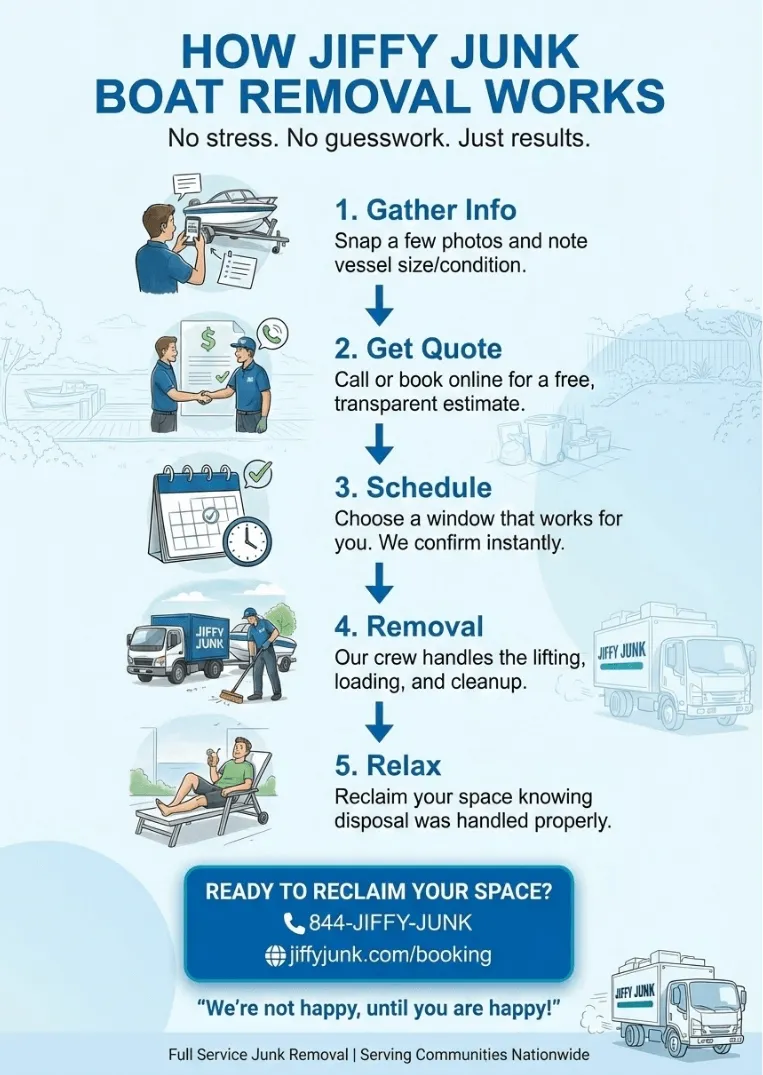
You’ve done the research. Now it’s time to take action. Follow these five simple steps to get your boat removed quickly and professionally.
Step 1: Gather Basic Information
Before reaching out, collect these details for a faster, more accurate quote:
- Vessel type and approximate length (in feet)
- Location (driveway, backyard, marina, storage facility)
- Accessibility (trailer access, gates, tight spaces)
- Condition (running or not, on a trailer, visible damage)
- Hazardous materials (fuel, oil, batteries still onboard)
Tip: Snap a few photos on your phone. Text or email them to speed up the process.
Step 2: Get Your Free Quote
Choose the option that works best for you:
| Method | How It Works |
| 📞 Call | 844-JIFFY-JUNK — Get a quote in minutes |
| 💻 Online | jiffyjunk.com/booking — Submit details, we follow up |
| 📍 On-Site | Request a free in-person estimate for complex jobs |
No obligation. No pressure. Just straight answers.
Step 3: Review and Schedule
Once you receive your quote:
- Transparent pricing — The quote is the price. No hidden fees.
- Flexible scheduling — We work with your timeline.
- Confirmation sent — You’ll know exactly when to expect us.
Questions? Just ask. We’ll explain everything included.
Step 4: Prepare for Removal Day
What you need to do:
- Ensure clear access to the vessel
- Remove personal belongings you want to keep
- Be available to confirm the scope of work
What we handle:
- Draining fluids
- Disconnecting batteries
- All disassembly
- Every bit of heavy lifting
You don’t touch a thing. That’s White Glove Treatment.
Step 5: Relax While We Work
Here’s what happens on removal day:
1. Our crew arrives within your scheduled window
2. We confirm the scope and final price before starting
3. We handle all lifting, loading, and transport
4. Your vessel is disposed of responsibly
5. We leave your space clean and clear
Done. No stress. No guesswork. No lingering to-do items.
Quick-Reference Checklist
- Gather vessel details (size, location, condition)
- Take photos of the boat and access points
- Contact Jiffy Junk for a free quote
- Review the quote and schedule an appointment
- Clear access and remove personal items
- Relax and let us handle the rest
FAQ on “Boat Removal Service”
Q: How much does a boat removal service cost?
A: Based on the thousands of boats we’ve removed, most jobs fall between $500 and $5,000—though costs vary based on your specific situation.
Key cost factors we’ve identified:
- Size and weight — Larger vessels require more equipment and labor
- Accessibility — Tight backyards cost more than open driveways
- Condition — Boats with fuel, oil, or batteries need hazardous material handling
- Location — Distance to disposal facilities affects pricing
What we’ve learned: Accessibility often matters more than size. We’ve removed 25-foot boats in two hours and spent all day on 16-foot vessels wedged into difficult spaces.
Our pricing promise: The quote we give is the price you pay. No surprises. No bait-and-switch.
Q: What types of boats can a removal service take?
A: If it floats—or used to float—we can probably remove it.
Vessels we regularly remove:
- Sailboats and motorboats
- Fishing boats and bass boats
- Pontoon boats and cabin cruisers
- Jet skis and personal watercraft
- Canoes, kayaks, and rowboats
- Houseboats and commercial vessels
- Boat trailers and marine equipment
Condition doesn’t matter. We’ve removed:
- Fiberglass hulls sitting for 20+ years
- Aluminum boats with trees growing through them
- Vessels that no longer resemble boats at all
Your boat doesn’t need to:
- Run
- Be seaworthy
- Look presentable
- Be intact
Not sure if yours qualifies? Call us. Nine times out of ten, the answer is yes.
Q: What happens to my boat after the removal service takes it?
A: Every boat we remove gets processed with environmental responsibility in mind.
How we handle disposal:
| Material | Disposal Method |
| Aluminum and steel | Recycled at certified facilities |
| Engines and electronics | Salvaged when possible |
| Usable hardware | Recovered for reuse |
| Fuel, oil, coolant, batteries | Disposed of per environmental regulations |
| Fiberglass hulls | Processed through approved disposal channels |
Why this matters to us: We’ve seen what happens when boats are abandoned or dumped irresponsibly. The NOAA statistics on derelict vessels aren’t just numbers to us—they represent real environmental damage.
Our commitment: We’d rather do the job right than contribute to a problem affecting waterways nationwide.
Q: Do I need to prepare my boat before the removal service arrives?
A: Minimal preparation required. Here’s the breakdown:
What you should do:
- Clear a path to the vessel
- Remove personal belongings you want to keep
- Mention any unusual access situations when scheduling
What we handle:
- Draining all fluids
- Disconnecting batteries
- Disassembly as needed
- All heavy lifting
- Loading and transport
- Complete cleanup
What doesn’t faze us:
- Years of accumulated debris inside
- Wasp nests in the cabin
- Trailers rusted into the ground
- Boats in any condition
Bottom line: Your only job is to point. We do the rest. That’s White Glove Treatment.
Q: How quickly can a boat removal service schedule a pickup?
A: Most removals get scheduled within a few days to one week, depending on location and availability.
What to expect from our process:
1. Contact us — Call or book online with your boat details
2. Get your quote — We provide upfront pricing quickly
3. Schedule service — Choose a time that works for you
4. Receive confirmation — We give you a specific arrival window
5. Removal day — We arrive on time, fully equipped
How long does removal take?
- Many boats: 2-4 hours
- Larger vessels: Half day or more
- Complex access situations: We’ll tell you upfront
What customers tell us: The relief isn’t just that the boat is gone—it’s that the process was far simpler than they expected.
Get Your Free Boat Removal Quote Today
Now that you know what boat removal costs and what to look for in a disposal company, take the next step and get a straightforward quote from Jiffy Junk. Call 844-JIFFY-JUNK or book online at jiffyjunk.com/booking—we’ll handle everything so you can finally reclaim your space without the stress or guesswork.