After hauling thousands of carpets from homes and businesses nationwide, we’ve learned one thing: most people overpay for carpet removal because they don’t know what actually drives the cost.
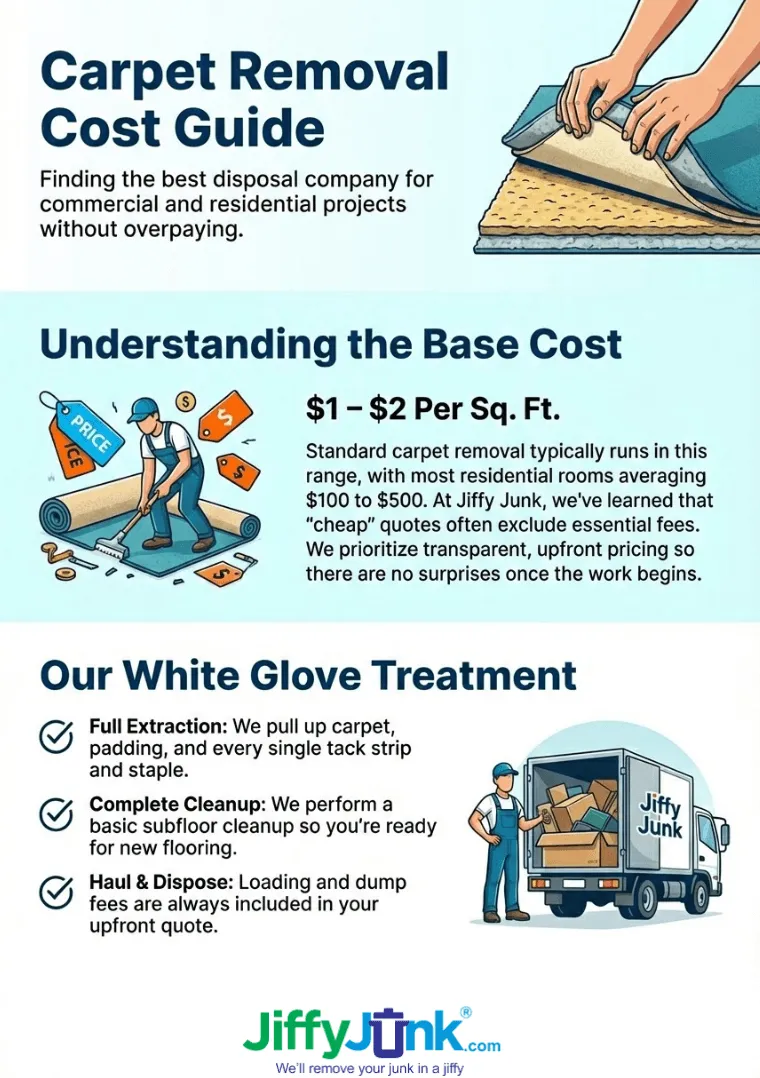
Standard carpet removal runs $1 to $2 per square foot—but that number means nothing without context. Based on our experience at Jiffy Junk, the real price drivers are carpet type, subfloor condition, and whether your old flooring contains glue-down adhesive or hidden layers of padding that double the labor time.
Here’s what most removal companies won’t tell you: a “cheap” quote often excludes disposal fees, stair surcharges, or furniture moving costs that mysteriously appear after the work begins. We’ve built our reputation on transparent, upfront pricing because we’ve seen too many customers get burned by bait-and-switch estimates.
This guide shares what we’ve learned from years of residential cleanouts and commercial renovation projects. You’ll get an insider perspective on fair pricing, red flags to watch for, and how to ensure your carpet disposal is handled responsibly—not just dumped in a landfill.
Ready to skip the guesswork? Let’s break down exactly what your project should cost.
Quick Answers
What is a carpet removal service?
A carpet removal service handles the complete process of extracting old carpet from your home or business—so you don’t have to.
What’s typically included:
- Pulling up carpet and padding
- Removing tack strips and staples
- Basic subfloor cleanup
- Hauling away all materials
- Proper disposal or recycling
What we’ve learned from thousands of jobs:
Most homeowners underestimate the labor involved. Carpet is heavy, padding is often glued or stapled, and disposal requires access to appropriate facilities.
Who uses carpet removal services:
- Homeowners replacing flooring
- Landlords turning over rental units
- Property managers and realtors
- Businesses renovating commercial spaces
- Anyone avoiding DIY heavy lifting
A professional carpet removal service saves time, eliminates physical strain, and ensures responsible disposal. At Jiffy Junk, we call it the White Glove Treatment—full-service removal with transparent pricing and no surprises.
Top Takeaways
- Cost: $1–$2 per square foot. Most rooms: $100–$500. Price varies by carpet type, adhesive method, and whether hauling/disposal is included.
- Ask what’s included. Full-service means:
- Carpet and padding removal
- Tack strip and staple extraction
- Cleanup and haul-away
- Proper disposal
Many companies quote removal only, then charge extra for everything else.
- 73% of carpet goes to landfills. It doesn’t have to. Choose a service that prioritizes recycling. Old carpet becomes automotive parts, insulation, and new padding.
- DIY works for small projects. Hire a pro for:
- Multiple rooms
- Glue-down carpet
- Stairs
- Tight timelines
We’ve seen many DIY projects turn into rescue calls midway through.
- Cheapest quote ≠ , best value. Low estimates often hide fees or cut corners on disposal. Get written quotes. Verify licensing and insurance. Choose transparency over price alone.
Table of contents
- Quick Answers
- Top Takeaways
- What Affects Carpet Removal Pricing?
- Residential vs. Commercial Carpet Removal: Key Differences
- What Should Professional Carpet Removal Include?
- How to Avoid Overpaying for Carpet Disposal
- Get Your Carpet Removed the Right Way
- Essential Resources on Carpet Removal Services
- 1. Get Accurate Cost Estimates for Your Specific Project
- 2. Learn DIY Removal Techniques from Industry Experts
- 3. Find Carpet Recycling Locations Near You
- 4. Understand Environmental Impact and Disposal Guidelines
- 5. Calculate Location-Specific Project Costs
- 6. Vet Contractors Before You Hire
- 7. Plan Your New Flooring Installation
- Supporting Statistics: What We’ve Learned About Carpet Waste
- Final Thought: Why Carpet Removal Is About More Than Just Hauling
- FAQ on “Carpet Removal Service”
- Get Transparent Carpet Removal Pricing Without the Guesswork
What Affects Carpet Removal Pricing?
Several factors determine your final cost, and understanding them puts you in control of your budget.
Square footage is the baseline—larger spaces require more labor and disposal capacity. However, carpet type matters just as much. Thick commercial-grade carpet or multiple layers of vintage flooring take significantly longer to remove than standard residential carpet over plywood subflooring.
Adhesive and installation methods often catch homeowners off guard. Glue-down carpet requires scraping and solvent work that can triple removal time compared to carpet secured with tack strips. Our crews frequently encounter older homes where previous owners installed new carpet directly over old layers, turning a straightforward job into an archaeological dig.
Accessibility and obstacles also factor in. Second-floor bedrooms, tight hallways, and rooms full of furniture all add time. We recommend clearing the space before your appointment when possible—it keeps your cost down and speeds up the process.
Residential vs. Commercial Carpet Removal: Key Differences
Residential projects typically involve one to several rooms, with costs ranging from $100 to $500 for most homes. The work is usually straightforward: remove carpet and padding, pull tack strips, and haul everything away.
Commercial carpet removal operates at a different scale. Office buildings, retail spaces, and multi-unit properties involve thousands of square feet, tighter timelines, and coordination around business hours. We’ve handled overnight retail renovations and weekend office cleanouts where timing was just as critical as pricing. Commercial clients should expect volume-based pricing and may benefit from project quotes rather than per-square-foot rates.
Both project types require proper disposal. Carpet contains synthetic materials that many standard waste facilities won’t accept, which is why working with a removal service that handles responsible disposal matters.
What Should Professional Carpet Removal Include?
A reputable carpet removal company handles the complete process—not just the parts that are convenient.
Full-service removal means your crew pulls up carpet, padding, and tack strips. They address adhesive residue when possible and leave your subfloor ready for whatever comes next. At Jiffy Junk, our White Glove Treatment means we don’t leave debris, staples, or mess behind for you to clean up.
Hauling and disposal should be included in your quote. Be wary of companies that quote removal only, then charge separately for loading and dump fees. We’ve heard from so many customers who learned this lesson the hard way before they called us.
Transparent pricing involves exactly what you expect to pay for the quote you are given. There are no fuel surcharges, there are no surprise charges added for stairs, and there are no add-ons for “heavy” carpet. If a company isn’t willing to tell you an up-front number, that’s a red flag and one you should take seriously.
How to Avoid Overpaying for Carpet Disposal
The lowest quote is not always the perfect value. Here’s what the experienced customers are looking for:
Get specifics in writing. Your estimate should spell-out exactly what’s included – removal, hauling, disposal, the list goes on, including prep work. Vague quotes result in vague billing.
Ask about disposal methods. Responsible companies recycle carpet materials whenever possible – and otherwise dispose of it properly. If your company cannot explain to you where your carpet ends up, they could be taking a corner-cut by giving you liability.
Check for licensing and insurance. Carpet removal consists of heavy lifting and possible contact with the property. Working with a licensed, insured crew has the benefit of protecting your home, and it gives you recourse should something go wrong. Jiffy Junk teams are fully licensed and insured with no exceptions on every job.
Read the reviews for consistency. Gather patterns in customer feedback. Praise for on-time work, clean work, and proper pricing speaks volumes about a company that does what they say they will do.
Get Your Carpet Removed the Right Way
Carpet removal doesn’t have to be complicated or expensive. The key is working with a company that respects your time, communicates clearly, and stands behind their pricing.
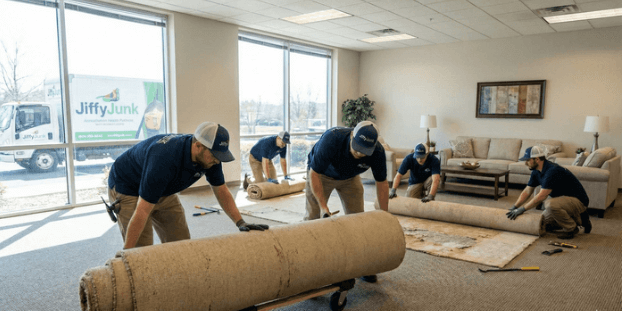
At Jiffy Junk, we’ve built our reputation on doing exactly that. Our teams arrive on time, provide upfront quotes with no hidden fees, and handle every step from removal to responsible disposal. Whether you’re refreshing a single room or clearing an entire commercial property, we make the process simple.
Ready to reclaim your space? Book online in 60 seconds or call us at 844-JIFFY-JUNK for a free, no-obligation quote. We’re not happy until you are.
Expert’s Quote
“After removing carpet from thousands of properties, we’ve found that the biggest cost surprises come from what’s hidden underneath—glue-down adhesive, multiple flooring layers, or deteriorated padding that previous owners covered up rather than replaced. A company willing to assess these conditions upfront won’t surprise you with add-on charges later.”— Jiffy Junk Team
Essential Resources on Carpet Removal Services
We know you want to make smart decisions about your carpet removal project—and that starts with having the right information at your fingertips. We’ve pulled together seven trusted resources that cover everything from fair pricing to eco-friendly disposal options. Whether you’re exploring DIY or looking for a full-service solution, these guides will help you move forward with confidence.
1. Get Accurate Cost Estimates for Your Specific Project
Resource: HomeGuide — Carpet Removal Cost Guide
URL: https://homeguide.com/costs/carpet-removal-cost
Nobody likes pricing surprises. This comprehensive guide breaks down carpet removal costs by room type, installation method, and location—so you’ll know what’s fair before you request a single quote. It also includes helpful questions to ask any contractor you’re considering. Knowledge is power, and this resource puts you in the driver’s seat.
2. Learn DIY Removal Techniques from Industry Experts
Resource: This Old House — How to Remove Carpet
URL: https://www.thisoldhouse.com/flooring/21097110/how-to-remove-carpet
Thinking about tackling carpet removal yourself? This step-by-step guide walks you through the entire process—from gathering the right tools to prepping your subfloor for new flooring. It’s straightforward, easy to follow, and packed with tips that can save you time and headaches. And if you decide midway that you’d rather have professionals handle the heavy lifting, we’re just a call away.
3. Find Carpet Recycling Locations Near You
Resource: Carpet America Recovery Effort (CARE)
URL: https://carpetrecovery.org/
At Jiffy Junk, we’re committed to recycling and donating whenever possible—and we love seeing others make eco-friendly choices too. CARE’s searchable database helps you locate carpet recycling drop-off sites across the country. You’ll also learn how old carpet gets transformed into new products like automotive parts and composite lumber. It’s a simple way to keep materials out of landfills and give them a second life.
4. Understand Environmental Impact and Disposal Guidelines
Resource: U.S. Environmental Protection Agency — Greener Carpet Guide
URL: https://www.epa.gov/greenerproducts/identifying-greener-carpet
Over four billion pounds of carpet end up in landfills every year—that’s a lot of material that could be recycled or repurposed. The EPA’s guide explains carpet’s environmental footprint, health considerations during removal, and responsible disposal options. If sustainability matters to you (and it matters to us), this resource is worth a few minutes of your time.
5. Calculate Location-Specific Project Costs
Resource: Homewyse — Carpet Removal Cost Calculator
URL: https://www.homewyse.com/services/cost_to_remove_carpet.html
Every project is different, and costs vary by location. Homewyse’s calculator lets you plug in your ZIP code and project details to generate a customized estimate based on current labor rates in your area. It’s a quick, easy way to set realistic expectations before you start comparing quotes. No guesswork required.
6. Vet Contractors Before You Hire
Resource: HomeGuide — Carpet Removal Companies Guide
URL: https://homeguide.com/carpet-removal-companies
Choosing the right removal service makes all the difference. This guide covers everything you should verify before hiring—licensing, insurance, disposal methods, and the questions that separate reliable professionals from fly-by-night operators. We believe in transparent pricing with no hidden fees, and this resource helps you find other companies that share that commitment to honesty.
7. Plan Your New Flooring Installation
Resource: Hunker — How to Replace Carpet with Laminate Flooring
URL: https://www.hunker.com/13402326/how-to-replace-carpet-with-laminate-flooring/
Carpet removal is just the first step—what comes next matters too. This guide covers subfloor assessment, preparation requirements, and installation tips for laminate, hardwood, and vinyl flooring. Planning ahead ensures your subfloor is ready for whatever beautiful new flooring you choose. A little prep work now means better results later.
Supporting Statistics: What We’ve Learned About Carpet Waste
After hauling carpet from homes and businesses nationwide, we’ve developed a clear picture of where all that material ends up. These statistics confirm what our crews see every day: carpet waste is a significant challenge—but one with real solutions.
The Scale of the Problem
Over 4 billion pounds of carpet enter the U.S. waste stream annually.
What that looks like in practice:
- A single 1,500-square-foot home generates 400–600 pounds of carpet waste
- Carpet accounts for 1% of all municipal solid waste by weight
- The bulky material takes up roughly 2% of landfill volume
- Mixed materials make processing and recycling more complex
We’ve watched landfills struggle with the sheer bulk. Carpet doesn’t compress well, and most facilities aren’t equipped to separate the fibers from the backing materials.
Source: U.S. Environmental Protection Agency — Identifying Greener Carpet
https://www.epa.gov/greenerproducts/identifying-greener-carpet
Recycling Progress Is Real
4.6 billion pounds of carpet diverted from U.S. landfills since 2002.
What the carpet recycling industry has achieved:
- 23 million cubic yards of landfill space saved (equivalent to 6 entire landfills)
- 1.3 billion pounds collected in California alone since the state program began
- 90.5% recycling rate for collected materials in California (2024)
- 390 collection points now operating statewide
- 680+ jobs supporting California’s carpet recycling industry
We stay connected to these developments because knowing where recycling facilities exist helps us route materials responsibly.
Source: Carpet America Recovery Effort (CARE)
The Problem Is Growing
Textile waste increased 50%+ between 2000 and 2018.
Key factors driving the increase:
1. Shorter replacement cycles (5–7 years vs. the traditional 10–15)
2. Changing consumer preferences and design trends
3. Limited collection infrastructure in many regions
4. Emerging recycling technologies are still scaling up
We’ve noticed more customers replacing carpet that’s barely a decade old. This trend makes responsible disposal more critical than ever.
Source: U.S. Government Accountability Office (GAO-25-107165)
https://www.gao.gov/products/gao-25-107165
Final Thought: Why Carpet Removal Is About More Than Just Hauling
After removing carpet from thousands of properties, we’ve reached a simple conclusion: the actual removal is the easy part.
What separates a forgettable experience from a great one comes down to three things:
1. Honest communication
2. Responsible disposal
3. Genuine respect for your space
What We’ve Learned on the Job
Most customers aren’t just getting rid of flooring. They’re starting something new—a renovation, a fresh chapter, or finally tackling a long-postponed project. That context shapes how we approach every job.
We’ve also learned that pricing confusion causes more frustration than the work itself. Customers don’t mind paying fair rates. They mind being surprised.
Common surprises we’ve heard about from other services:
- Disposal fees added after the quote
- Stair surcharges are not mentioned upfront
- “Removal” that didn’t include hauling or cleanup
- Vague estimates that ballooned on completion
That’s why we built our process around transparency. The quote we give is the price you pay. Period.
Our Honest Take on the Industry
Here’s something that doesn’t get discussed enough: carpet removal is an environmental decision, not just a convenience one.
The numbers tell the story:
| Reality | Impact |
| 4+ billion lbs of carpet are discarded annually | Massive strain on waste systems |
| 73% ends up in landfills | Most companies take the easy route |
| Only 9.2% gets recycled | Huge opportunity for improvement |
Every removal project presents a choice. You can work with a company that dumps everything and moves, or choose a service that explores recycling and donation options first.
Our approach:
- We pursue recycling when the material type and condition allow
- We coordinate donations when items have remaining life
- We prioritize responsible disposal over speed alone
We’re not perfect. Not every carpet can be recycled. But the effort matters.
The Bottom Line
Typical carpet removal costs:
- $1–$2 per square foot
- $100–$500 for most residential projects
- Commercial jobs scale based on footage, timeline, and complexity
These numbers are useful starting points—but they don’t reveal service quality, pricing honesty, or disposal practices.
Before you book, ask:
1. What’s included in this quote?
2. Where do my materials go after removal?
3. Is your crew licensed and insured?
4. Are there any additional fees I should know about?
The answers tell you far more than price alone.
Why We Do This Work
We got into this business because we saw an opportunity to do something simple—really well.
Carpet removal isn’t glamorous. But done right, it:
- Transforms spaces
- Eliminates stress
- Saves customers from backbreaking DIY work
- Keeps materials out of landfills when possible
Every carpet we remove represents a customer trusting us with their home or business. We don’t take that lightly.
What that means in practice:
- We show up on time
- We communicate clearly
- We leave spaces cleaner than we found them
- We stand behind our pricing
It’s not complicated. It just requires caring about the details.
The Jiffy Junk Difference
- Full-service removal — carpet, padding, tack strips, and debris
- White Glove Treatment — professional crews, respectful service
- Transparent pricing — no hidden fees, no surprises
- Responsible disposal — recycling and donation prioritized
FAQ on “Carpet Removal Service”
Q: How much does a carpet removal service cost?
A: Based on thousands of jobs we’ve completed, expect these ranges:
- Per square foot: $1–$2
- Per room (typical): $100–$500
- Stairs: $7–$10 per step
What actually drives your price:
- Carpet type (glue-down costs more than tack strip)
- Total square footage
- Accessibility and room layout
- Hidden layers or deteriorated padding
Our advice:
1. Get at least three estimates
2. Ask specifically what’s included
3. Request written quotes—not verbal ballparks
4. Watch for vague answers about fees
At Jiffy Junk, the price we quote is the price you pay. No surprises.
Q: What does a carpet removal service include?
A: We’ve seen this trip up customers repeatedly. Many companies quote “removal” but define it differently than you’d expect.
Full-service removal should include:
- Pulling up all the carpet
- Extracting padding underneath
- Removing tack strips
- Pulling staples from the subfloor
- Basic cleanup
- Hauling away all materials
- Responsible disposal
What some companies leave out:
- Hauling (quoted separately)
- Disposal fees (added after)
- Tack strip removal
- Staple extraction
- Cleanup
Our White Glove Treatment covers everything. When we leave, you see a clean subfloor ready for new flooring. No debris. No leftover tack strips. No “that wasn’t included” conversations.
Q: Should I remove the carpet myself or hire a professional?
A: We’re honest—DIY works for some projects.
DIY makes sense if you have:
- One small room (under 200 sq. ft.)
- Basic tools available
- Physical ability for heavy lifting
- Vehicle for hauling materials
- Disposal access (landfill or recycling)
- Flexible timeline
Hire a pro if you’re facing:
- Multiple rooms
- Glue-down carpet
- Stairs
- Tight deadlines
- No disposal plan
- Physical limitations
What we’ve observed:
Many customers call us midway through DIY projects. Common issues:
1. Carpet came up fine, but the padding was glued down
2. Hundreds of staples embedded in the subfloor
3. Rolled carpet piled in the garage with no hauling plan
4. The project took three times longer than expected
There’s no shame in starting DIY and calling for backup. We see it all the time.
Q: How long does professional carpet removal take?
A: Speed surprises most customers. Our typical timelines:
| Project Type | Estimated Time |
| Single bedroom (tack strip) | 30–45 minutes |
| Standard living room | 45–60 minutes |
| Whole house (3–4 rooms) | 2–3 hours |
| Glue-down carpet | Add 30–50% more time |
| Stairs (per flight) | 20–30 minutes |
Factors that add time:
- Glue-down adhesive requiring scraping
- Multiple carpet layers
- Excessive staples or a damaged subfloor
- Furniture needing relocation
- Limited access or tight spaces
Commercial projects vary widely. We’ve completed:
- Overnight retail renovations (finished before store opening)
- Weekend office cleanouts
- Multi-day warehouse projects
We provide realistic time estimates based on your specific situation. No vague “sometime between 8 and 5” windows.
Q: What happens to my carpet after removal?
A: This question matters more than most people realize. Few customers think to ask it.
The industry reality:
- 73% of discarded carpet ends up in landfills
- Landfill disposal is the easiest option for most companies
- Recycling requires extra effort and facility knowledge
Our approach is different.
We prioritize responsible disposal:
1. Recycling — Carpet processed into automotive parts, building insulation, and new padding
2. Donation — Materials in good condition go to local centers
3. Landfill — Last resort when other options aren’t viable
Limitations we’re honest about:
- Not every carpet can be recycled
- Fiber type affects recyclability
- Material condition matters
- Regional infrastructure varies
How to vet any removal service:
Ask directly: “Where does my carpet actually go?”
- Specific answer = company prioritizes sustainability.
- Vague response = likely landfill default
We make the effort. It’s part of doing the job right.
Get Transparent Carpet Removal Pricing Without the Guesswork
Stop wondering what your carpet removal should cost—get a free, no-obligation quote from Jiffy Junk and see exactly what full-service removal looks like for your residential or commercial project. Call 844-JIFFY-JUNK or book online in 60 seconds at jiffyjunk.com/booking.