After hauling away debris from thousands of renovation, demolition, and new construction projects across the country, we’ve learned one thing: No two job sites are the same – but if every contractor and homeowner has one thing in common: they all want the same thing. A clean site, handled fast and with zero hassle.
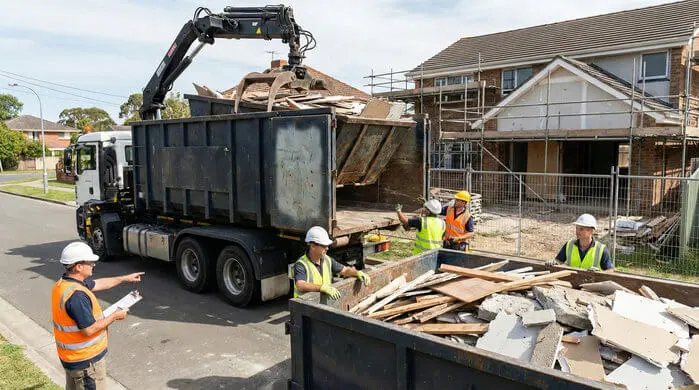
That’s exactly why we built Jiffy Junk’s construction debris removal service the way that we did. Our crews have been responsible for everything from one-bathroom-gut-jobs to large commercial in multi-story tear-downs, and that kind of hands-on experience means that we show up knowing what to expect – whether it be a one-step driveway with tons of broken concrete, or an attic chocked full of old framing lumber, drywall, and roofing materials. We bring the right equipment, the right team size, and a plan to get your space cleared in the most efficient way and ensure your project stays on course.
What sets us apart? We combine that field-tested expertise with our signature White Glove Treatment: licensed, insured folks who respect your property, provide an upfront quote before they lift a single board, and want to recycle or donate materials whenever possible. Based on our experience, responsible disposal isn’t always the sole way to save the environment; it’s often cost-effective in the long run for our clients in terms of overall lower waste costs on a project basis.
TL;DR Quick Answers
What Is Construction Debris Removal and Why Does It Matter?
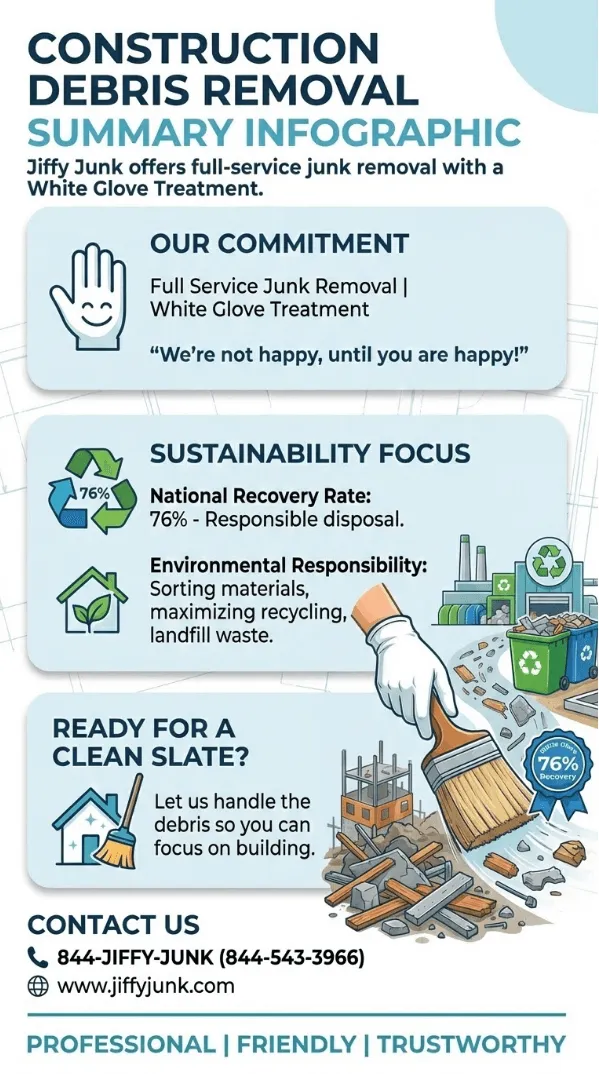
Construction debris removal is the professional hauling, sorting, and responsible disposal of waste materials generated during construction, renovation, and demolition projects. It matters because construction and demolition activities produce over 600 million tons of waste annually in the United States—and how that debris is handled directly impacts your project timeline, your budget, and the environment.
What it includes:
- Removal of drywall, lumber, concrete, roofing, metal, flooring, fixtures, and mixed demolition debris
- On-site sorting to separate recyclable and donatable materials from true waste
- Responsible disposal through recycling facilities, donation centers, and approved landfills
Why professional removal makes a difference:
- Keeps your project on schedule by clearing debris efficiently as work progresses
- Eliminates the risk of underestimating volume, which leads to costly delays and extra hauls
- Diverts usable materials from landfills—something we prioritize on every single job
The Jiffy Junk approach: Our licensed and insured crews handle construction debris of any size with our signature White Glove Treatment—upfront pricing, on-site sorting, eco-friendly disposal, and a clean site guaranteed. We’ve cleared thousands of job sites nationwide, and we’ve built our service around one simple standard: do it right every time.
Top 5 Takeaways
- Debris adds up faster than you think. Over 600 million tons of C&D waste are generated annually in the U.S. Demolition alone accounts for more than 90% of that total. Having a professional removal plan before work begins saves time, money, and headaches.
- How your debris is handled matters. About 76% of construction waste nationally is recovered for recycling or next use—but only when crews sort on-site. The right removal partner keeps usable materials out of landfills and can lower your overall project waste costs.
- Not all removal services are equal. There’s a real difference between a crew that loads and dumps and a team that:
- Assess your site before quoting
- Matches the right crew size and equipment to the job
- Sorts materials for recycling and donation
- Leaves your space truly clean
- Regulations are part of the process. OSHA safety standards, local demolition permits, and disposal requirements all apply. Working with a licensed and insured team that understands these obligations protects your property and your liability.
- The right partner treats cleanup as a responsibility—not a transaction. At Jiffy Junk, that means our signature White Glove Treatment on every job: upfront pricing, eco-friendly disposal, and a clean site guaranteed.
Table of Contents
- TL;DR Quick Answers
- Top 5 Takeaways
- What We Haul: Construction Debris We Remove Every Day
- How Our Construction Debris Removal Process Works
- Renovation Waste Cleanup for Homeowners and Contractors
- Demolition Debris Removal: From Tear-Down to Clean Slate
- Building Material Disposal Done Responsibly
- Why Customers Trust Jiffy Junk for Construction Cleanup
- 7 Essential Resources to Help You Tackle Construction Debris Removal with Confidence
- 1. Learn What Counts as Construction Debris—and How to Handle It the Right Way
- 2. Cut Waste, Save Money, and Recover More from Your Project
- 3. Understand the True Scale of Construction Waste Across the Country
- 4. Stay Safe and Stay Compliant with Federal Demolition Standards
- 5. Plan Smarter Waste Management for Large-Scale or Green-Certified Builds
- 6. Give Reusable Materials a Second Life Instead of Sending Them to a Landfill
- 7. Get Your Demolition Permits Sorted Before the First Swing
- Supporting Statistics: What the Numbers Tell Us—and What We’ve Learned on the Ground
- Final Thoughts and Opinion
- Frequently Asked Questions
- Get Reliable Construction Debris Removal from a Team That Does It Right
What We Haul: Construction Debris We Remove Every Day
From small weekend projects to mountains of commercial-sized building waste, Jiffy Junk’s crews handle the entire home construction waste range. That includes drywall and sheetrock, lumber and framing material, concrete, brick and stone, roofing shingles and underlay material, metal scraps and rebar, flooring and tile, cabinetry and countertops, windows, doors and fixtures, and mixed demolition material. If it came out of a building, chances are we’ve removed it before. Not certain of the qualifications of your materials? Send us a photo, and we’ll agree immediately – no guesswork involved.
How Our Construction Debris Removal Process Works
We’ve simplified our process as needed from years of experience on the job site, so as not to make things too complicated for you. It all begins with your asking for your free quote online, or you can call 844-JIFFY-JUNK. We’ll have a pickup window that struck for yours. project timeline. Our licensed and insured crew is on time, looks at the debris,s and confirms your up-front price before work even begins. From there, all the loading, hauling, and sorting is done by us – separating the recyclable and donatable materials from the real waste. Once the site is clear, we then go on a final walk-through to ensure the space is meeting our White Glove Treatment standard. You are left with another project site, nice and clean, with zero clean-up headaches.
Renovation Waste Cleanup for Homeowners and Contractors
Whether you’re a homeowner, working on a Kitchen remodel, or if you’re a general contractor, handling multiple active sites, renovation projects have a lot of waste, fast. Torn-out cabinetry, old plumbing fixtures, stripped flooring, and piles of drywall add up rather quickly – and they’re not something most curbside haulers are willing to handle. Jiffy Junk fills that gap. We work around your renovation schedule, and clear up debris in stages if necessary, and thus it is possible to ensure that your work area is kept clear for the next phase of your project to commence without delay. Many of our repeat clients are contractors who tell us that having a decent debris removal partner is just as important as any subcontractor working on the job.
Demolition Debris Removal: From Tear-Down to Clean Slate
Demolition work is messy by nature, and what’s left behind can stall your entire timeline if it’s not addressed quickly. Our teams are experienced with both interior and exterior demolition cleanup—partial tear-downs, structural guts, shed and deck removals, and full building demolitions. We’ve found that the key to efficient demo cleanup is matching the right crew size and equipment to the scope of the job, and that’s something we assess before we ever provide a quote. The result is faster turnaround, fewer trips, and a site that’s ready for whatever comes next.
Building Material Disposal Done Responsibly
Not all construction waste belongs in a landfill, and at Jiffy Junk, we take that seriously. Usable lumber, fixtures, appliances, and surplus materials are donated to local organizations whenever possible. Metals, concrete, and other recyclables are sorted and sent to the appropriate facilities. Our commitment to eco-friendly disposal means your project’s environmental footprint stays as small as possible—something we’ve seen matter more and more to both homeowners and commercial clients who want to build responsibly.
Why Customers Trust Jiffy Junk for Construction Cleanup
Choosing a construction debris removal service comes down to reliability, and that’s where our track record speaks for itself. Every Jiffy Junk crew is fully licensed and insured, our pricing is transparent with no hidden fees, and we show up when we say we will. We’ve built our reputation one clean jobsite at a time—earning the trust of homeowners, contractors, property managers, and real estate professionals nationwide. When your project depends on a clean site and a tight timeline, you need a partner who delivers every time.
“After clearing debris from thousands of construction sites nationwide, we’ve found that the difference between a good cleanup and a great one comes down to preparation—knowing exactly what materials we’re dealing with, matching the right crew and equipment to the job, and treating every site like our reputation depends on it, because it does.” — The Jiffy Junk Team
7 Essential Resources to Help You Tackle Construction Debris Removal with Confidence
We get it—between managing timelines, coordinating contractors, and keeping your project on budget, figuring out what to do with all that construction debris can feel overwhelming. That’s why we’ve pulled together seven trusted resources to help you understand your options, stay compliant, and make the most of every material on your site. Think of this as your go-to reference guide before the first piece of drywall hits the floor.
1. Learn What Counts as Construction Debris—and How to Handle It the Right Way
Not sure whether your project waste qualifies as construction debris? You’re not alone. The EPA promotes a Sustainable Materials Management approach that treats certain C&D materials as reusable commodities rather than waste headed straight to a landfill. This is the best place to start when you want a clear picture of how your materials should be classified and managed from day one.
Resource: EPA — Sustainable Management of Construction and Demolition Materials
Source: epa.gov — Sustainable Management of C&D Materials
At Jiffy Junk, our crews are trained to sort and manage every type of construction material responsibly—so you don’t have to become a waste classification expert.
2. Cut Waste, Save Money, and Recover More from Your Project
Here’s something we’ve seen firsthand on thousands of job sites: the less material that ends up in a landfill, the more you save. This EPA guide walks builders, construction teams, and design practitioners through practical ways to divert C&D materials from disposal—including source reduction, salvaging, recycling, and purchasing used or recycled products. It’s a smart read for anyone looking to keep project costs down while doing right by the environment.
Resource: EPA — Best Practices for Reducing, Reusing, and Recycling C&D Materials
Source: epa.gov — Best Practices for Reducing, Reusing, and Recycling C&D Materials
Eco-friendly disposal is built into every Jiffy Junk job. We recycle and donate materials whenever possible—because the right thing to do and the smart thing to do are usually the same thing.
3. Understand the True Scale of Construction Waste Across the Country
You might be surprised by just how much construction debris the U.S. produces each year. The EPA estimated that 600 million tons of C&D debris were generated in the United States in 2018—more than double the amount of municipal solid waste produced that same year. These numbers put your own project into perspective and highlight why responsible removal matters at every scale, from a single-room renovation to a full commercial tear-down.
Resource: EPA — Construction and Demolition Debris Material-Specific Data
Source: epa.gov — C&D Debris Material-Specific Data
Every job we complete is a chance to keep usable materials out of landfills. That commitment to responsible disposal is part of our White Glove Treatment—and it’s something our customers tell us sets us apart.
4. Stay Safe and Stay Compliant with Federal Demolition Standards
Safety isn’t optional on a demolition site—it’s the law. OSHA requires that before any demolition operations begin, a competent person must conduct an engineering survey to assess the condition of the structure’s framing, floors, and walls, and evaluate the risk of unplanned collapse. Whether you’re hiring a removal team or managing your own crew, knowing these federal standards helps protect everyone on your property.
Resource: OSHA — Demolition Safety Standards (29 CFR 1926, Subpart T)
Source: osha.gov — 1926.850 Preparatory Operations
Our fully licensed and insured teams arrive prepared for every job. We follow strict safety protocols because your property—and everyone on it—deserves nothing less.
5. Plan Smarter Waste Management for Large-Scale or Green-Certified Builds
If you’re managing a commercial project or pursuing green building certification, you need a waste management plan that goes beyond the basics. This comprehensive guide frames responsible waste management as an essential part of sustainable building—eliminating waste where possible, minimizing it where feasible, and reusing materials that might otherwise end up in a landfill. Published by the National Institute of Building Sciences, it’s a trusted playbook for contractors and project managers tackling complex builds.
Resource: Whole Building Design Guide — Construction Waste Management
Source: wbdg.org — Construction Waste Management
Working on a large-scale project? Jiffy Junk partners with contractors nationwide to keep job sites clear and projects moving. We handle the debris so your team can focus on building.
6. Give Reusable Materials a Second Life Instead of Sending Them to a Landfill
One of the easiest ways to make your renovation or cleanout more meaningful? Donate what’s still usable. Habitat ReStores accept new and gently used furniture, appliances, and surplus building materials, and many locations offer free pickup service for large items. Your donations are tax-deductible, they support affordable housing in your community, and they keep perfectly good materials in circulation. That’s a win for your project, your neighborhood, and the environment.
Resource: Habitat for Humanity ReStore — Donate Building Materials
Source: habitat.org — Donate Goods to Habitat ReStore
At Jiffy Junk, donating reusable items is part of how we do business. When we clear your site, we sort materials for recycling and donation—because we believe every item deserves a chance at a second life.
7. Get Your Demolition Permits Sorted Before the First Swing
Before any major debris removal can begin, you’ll likely need a permit—and the requirements vary depending on where you live. Complete or partial demolition typically requires prior approval from local regulating bodies, and the specific requirements depend on your location, project type, and the size of the structure being removed. This practical guide breaks down when permits are needed, what paperwork to prepare, and how to avoid common delays that can throw off your timeline.
Resource: PermitFlow — Demolition Permits: What Builders Need to Know
Source: permitflow.com — Demolition Permits
Supporting Statistics: What the Numbers Tell Us—and What We’ve Learned on the Ground
We’ve cleared construction debris from thousands of job sites across the country. While every project is different, the patterns we see line up with what the national data confirms. Here are three statistics that reflect the scale of the construction waste challenge—and what we’ve experienced firsthand working in the field every day.
1. 600 Million Tons of Construction Debris Generated Every Year
The EPA estimates that 600 million tons of C&D debris were generated in the United States in 2018—more than twice the amount of municipal solid waste produced that same year.
What we’ve seen on the ground:
- Most homeowners don’t realize how fast construction materials add up—even from a single kitchen renovation
- A surprising amount of what people assume is “trash” is actually recoverable and recyclable
- That gap between perception and reality is one of the biggest opportunities we find in every job
That’s why our crews are trained to sort before they haul, not after.
Source: U.S. EPA — C&D Debris: Material-Specific Data
2. Demolition Produces Over 90% of All C&D Waste
EPA data shows that demolition represents more than 90 percent of total C&D debris generation, while new construction accounts for less than 10 percent.
What we’ve learned from experience:
- A new build generates manageable cutoffs and packaging waste
- A demolition project—even a partial one—can produce ten times that volume in a single day
- The number one mistake we see? Underestimating debris volume, which leads to delays, extra trips, and cost overruns
That’s why we assess every demolition job before we quote it—walking the site, evaluating materials, and matching the right crew size and equipment to the actual scope of work.
Source: U.S EPA — Sustainable Materials Management
3. Over 455 Million Tons of C&D Materials Recovered for Next Use
Of the 600 million tons of C&D debris generated in 2018, just over 455 million tons were directed to next use—including recycling, manufacturing, and aggregate production—while just under 145 million tons were sent to landfills.
Where we see the opportunity:
- A 76% national recovery rate is real progress—but there’s still significant room to improve
- On our job sites, we regularly find usable lumber, intact fixtures, working appliances, and surplus materials that would have gone straight to a landfill.
- We’ve found that the difference between 76% and something closer to 90% often comes down to one thing: whether the removal crew sorts on-site rather than dumping everything into a single load.
That on-site sorting is a standard our teams hold themselves to on every project—because we’ve seen what happens when reusable materials get a second chance.
Source: U.S. EPA — Sustainable Management of C&D Materials
Final Thoughts and Opinion
After hauling away debris from thousands of construction, renovation, and demolition projects nationwide, we’ve come to a conclusion that might surprise you: the debris removal phase is the most underestimated part of any project.
Homeowners budget carefully for materials, labor, and permits. Contractors plan timelines down to the day. But when it comes to what happens with all the waste those projects produce, the plan is often little more than “we’ll figure it out when we get there.”
We’ve seen firsthand where that approach leads:
- Stalled timelines and unexpected costs
- Overflowing dumpsters that sit on-site for weeks
- Perfectly reusable materials are buried in landfills because no one took the time to sort them
What Years of Hands-On Experience Have Taught Us
1. Debris removal isn’t the last step—it’s a running part of your project. The most successful jobs we’ve worked on are the ones where removal is planned from the start, not treated as an afterthought once the dust settles.
2. What you throw away matters just as much as what you build. With 600 million tons of C&D waste generated annually in the U.S., every sorting decision has a real environmental impact. We’ve seen a single job site yield hundreds of pounds of donatable fixtures and recyclable lumber that would have gone to a landfill without proper handling.
3. Not all removal services are created equal. A truck and a strong back can move debris from point A to point B. But responsible removal—the kind that protects your property, respects your timeline, and sorts for recycling and donation—requires training, experience, and a team that genuinely cares about doing the job right.
Our Honest Take on Where the Industry Stands
The construction industry has made impressive strides. A 76% national waste diversion rate is real progress. But we know from experience that the gap between where we are and where we could be comes down to choices made at the job site level:
- Does the crew see a pile of “junk”—or a mix of materials that each deserve the right destination?
- Does the removal partner treat your project as a one-time transaction—or a responsibility?
At Jiffy Junk, we’ve always chosen to see it as a responsibility. That perspective shapes everything we do:
- How do we quote your job
- How we train our crews
- How we handle every piece of drywall, lumber, and concrete that comes off your site
It’s the reason we built our service around the White Glove Treatment—and the reason thousands of homeowners, contractors, and property managers trust us to get it right.
Frequently Asked Questions
Q: What types of construction debris does Jiffy Junk remove?
A: We handle just about everything a construction, renovation, or demolition project can produce, including:
- Drywall and sheetrock
- Lumber and framing materials
- Concrete, brick, and stone
- Roofing shingles and underlayment
- Metal scraps and rebar
- Flooring, tile, and carpet
- Cabinetry and countertops
- Windows, doors, and fixtures
- General mixed demolition debris
If it came out of a building, chances are we’ve hauled it before. Not sure if your materials qualify? Send us a photo or call 844-JIFFY-JUNK—we’ll confirm right away.
Q: How much does construction debris removal cost?
A: Every project is different. Here’s how our pricing works:
- We provide upfront, transparent quotes based on the volume and type of materials involved
- There are no hidden fees, no surprise charges, and no last-minute add-ons
- The price we quote is the price you pay—period
Based on our experience, most customers are surprised by how affordable professional removal is compared to the time, labor, and disposal fees involved in doing it themselves.
Get your free, no-obligation quote online or call us directly.
Q: What happens to the construction debris after Jiffy Junk picks it up?
A: Responsible disposal is built into every job. Here’s our process:
- Sort on-site — Our crews separate recyclable materials from true waste before anything leaves your property
- Recycle — Metals, concrete, lumber, and other recoverable materials are sent to appropriate recycling facilities
- Donate — Usable fixtures, appliances, and surplus building materials go to local organizations whenever possible
- Dispose responsibly — Only materials that can’t be recycled or repurposed are sent to approved disposal facilities
We’ve found that this approach keeps significant amounts of usable material out of landfills that would have been lost without proper sorting.
Q: How quickly can Jiffy Junk schedule a construction debris removal?
A: Debris on a job site doesn’t wait—and neither should you. Here’s what to expect:
- Flexible scheduling designed to work around your project timeline
- One-time pickups after a completed renovation or recurring removal throughout an active demolition
- Same-day or next-day service available in many areas
Book online or call 844-JIFFY-JUNK, and we’ll lock in a window that keeps your project moving.
Q: Do I need a permit before scheduling construction debris removal?
A: It depends on the scope of your project:
- Standard debris removal from a renovation or cleanout typically does not require a separate permit—you’re clearing waste from work already authorized.
- Full or partial demolition of a structure does require a demolition permit in most jurisdictions before work begins.
- Requirements vary by location, project type, and structure size
We always recommend checking with your local building department early in the planning process. Not sure where to start? Give us a call—our team has navigated these situations thousands of times, and we’re happy to point you in the right direction.
Get Reliable Construction Debris Removal from a Team That Does It Right
Whether you’re wrapping up a demolition, clearing out a renovation, or hauling away building materials from any project, Jiffy Junk’s licensed and insured crews are ready to handle it all with our signature White Glove Treatment. Book your free quote online or call 844-JIFFY-JUNK today—because the sooner the debris is gone, the sooner your space is yours again.