Most garage cleanouts cost between $200 and $800, with the average landing around $400 to $600 for a standard two-car garage.
Here’s what we’ve learned after hauling out thousands of garages since 2014: nearly everyone underestimates their load. That “half-full” garage? It’s usually a full truckload once we pull everything into the daylight.
We’ve also found that the biggest cost factor isn’t square footage—it’s density. A garage packed floor-to-ceiling with boxes costs more than one with a boat and some lawn equipment, even if they look similar at first glance.
This guide breaks down real-world pricing based on jobs we’ve completed across the country, what professional hauling actually includes, and the questions to ask before you book. We’ll also share the mistakes we see homeowners make that end up costing them more on service day.
Quick Answers
Garage Clean Out
A garage cleanout involves removing accumulated items—furniture, appliances, boxes, equipment, and debris—from a residential garage. Professional services typically cost $200 to $800, depending on volume and item type.
What’s included:
- All lifting, loading, and hauling
- Sorting for donation and recycling
- Sweep-clean finish
- Same-day or scheduled service
Average timeline: 1-3 hours for most two-car garages
Key insight from experience: The biggest pricing factor isn’t garage size—it’s density. A tightly packed single-car garage often costs more than a two-car garage with sparse, bulky items.
Best for homeowners who:
- Lack of time for multiple dump runs
- Have heavy or awkward items
- Want usable items donated rather than landfilled
- Need hazardous materials flagged for proper disposal
Top 5 Takeaways
- Cost: $400-$600 average. Full range: $200-$800. Density matters more than garage size.
- Time: 1-3 hours for most jobs. Standard two-car garage: ~2 hours including sweep-clean finish.
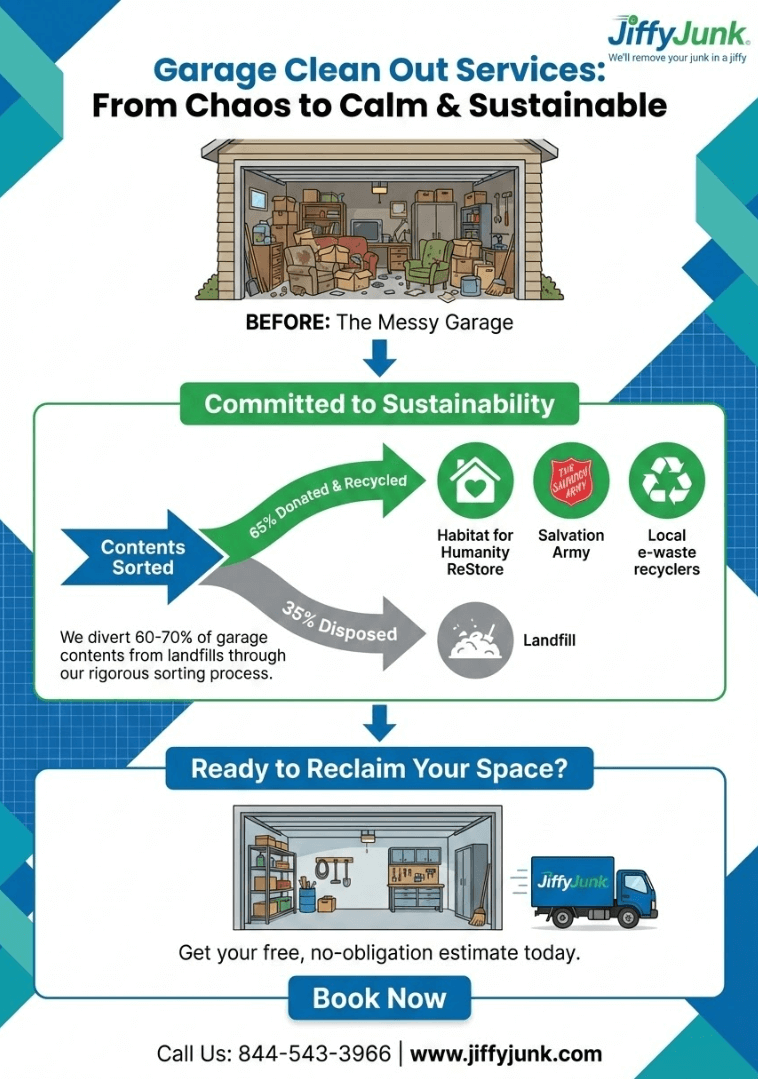
- Landfill diversion: 60-70% of contents can be donated or recycled with proper sorting.
- DIY math: Professional help often costs less after factoring in truck rental, dump fees, and multiple trips.
- Biggest barrier: Decision-making—not physical labor. Knowing where items go stalls most projects.
Table of contents
- Quick Answers
- Top 5 Takeaways
- What Determines Garage Cleanout Pricing
- Average Cost Breakdown by Garage Size
- What Professional Garage Cleanout Services Include
- How to Know If You’re Getting a Fair Price
- DIY vs. Professional Cleanout: The Real Cost Comparison
- What to Expect on Service Day
- Essential Resources for Your Garage Cleanout
- 1. Find Local Recycling Centers for Any Material
- 2. Safely Dispose of Paints, Chemicals, and Solvents
- 3. Schedule Free Pickup for Furniture and Appliances
- 4. Donate Building Materials, Tools, and Fixtures
- 5. Recycle Old Electronics and Small Appliances
- 6. Properly Handle Old Tires
- 7. Document Donations for Tax Deductions
- Supporting Statistics
- Final Thought: Why Most Garage Cleanouts Take Longer Than They Should
- FAQ on “Garage Clean Out”
- Get Your Free Garage Cleanout Estimate Today
What Determines Garage Cleanout Pricing
Garage cleanout costs come down to three main factors: volume, item type, and labor intensity.
Volume is measured by how much truck space your items occupy. Most companies price by partial load, half load, or full load rather than by the hour. A single-car garage with moderate clutter might fill a quarter truck. A packed two-car garage often requires a full load or more.
Item type matters because some materials cost more to dispose of properly. Standard household items, furniture, and boxes fall into base pricing. Appliances, electronics, tires, and paint require special handling and may carry additional fees.
Labor intensity accounts for how difficult the job is. A garage where we can back the truck right up costs less than one requiring us to haul items through a side yard or up a driveway. Heavy items like safes, piano parts, or concrete also increase labor time.
In our experience, the homeowners who get the most accurate quotes send photos beforehand. A quick snapshot of your garage from multiple angles helps us estimate volume without surprises on service day.
Average Cost Breakdown by Garage Size
| Garage Type | Typical Volume | Average Cost Range |
|---|---|---|
| Single-car (light clutter) | 1/4 truck | $150–$300 |
| Single-car (full) | 1/2 truck | $300–$450 |
| Two-car (moderate) | 1/2 to 3/4 truck | $400–$600 |
| Two-car (packed) | Full truck+ | $600–$800+ |
These ranges reflect what we see on typical residential jobs. Your actual cost depends on the specific factors above. Some cleanouts come in under $200. Others—especially garages that haven’t been touched in decades—can exceed $1,000 when multiple truckloads are needed.
We always recommend an upfront quote before work begins. Reputable companies won’t surprise you with hidden fees after the fact.
What Professional Garage Cleanout Services Include
A full-service garage cleanout handles everything, so you don’t lift a finger. Here’s what that typically covers:
Sorting and removal — We pull everything out, separate what’s going and what’s staying, and load it onto the truck. You point, we haul.
Heavy lifting — Bulky items like old furniture, appliances, exercise equipment, and workbenches are our responsibility, not yours.
Sweep-clean finish — Most professional services leave your garage broom-swept and ready to use. This is where “White Glove Treatment” makes a real difference.
Responsible disposal — Items get sorted for proper disposal. Anything donatable goes to local charities. Recyclable materials head to appropriate facilities. We’ve diverted thousands of tons from landfills through these practices.
What’s typically not included: hazardous materials like chemicals, paint, propane tanks, and certain automotive fluids require specialized disposal and may incur extra fees or need to be handled separately.
How to Know If You’re Getting a Fair Price
After completing jobs in markets across the country, we’ve identified the signs of transparent pricing versus companies that pad the bill:
Green flags:
- Free, no-obligation quotes provided before any work starts
- Pricing based on volume, clearly explained
- All fees disclosed upfront, including disposal costs
- Licensed and insured with proof available on request
Red flags:
- Hourly pricing without a cap (jobs mysteriously take longer)
- Vague estimates that balloon after loading begins
- No written quote or receipt
- Unwillingness to answer questions about where items go
One question we recommend asking: “Is the price you quote the price I’ll pay?” A trustworthy company answers yes without hesitation.
DIY vs. Professional Cleanout: The Real Cost Comparison
Handling a garage cleanout yourself seems cheaper on paper. In practice, the hidden costs add up quickly.
DIY costs to consider:
- Truck or trailer rental: $50–$150 per day
- Dump fees: $30–$80 per load (multiple trips common)
- Fuel and mileage
- Your time: a full weekend for most two-car garages
- Physical strain and potential injury risk
We regularly hear from homeowners who started the job themselves, made one dump run, and realized they had three more loads to go. By Sunday afternoon, the cost savings had evaporated, and their backs were aching.
Professional services make the most sense when your time has value, the load is substantial, or heavy and awkward items are involved. For a single carload of light items, DIY might work. For everything else, the math usually favors calling in help.
What to Expect on Service Day
Knowing the process reduces stress and helps the job go smoothly:
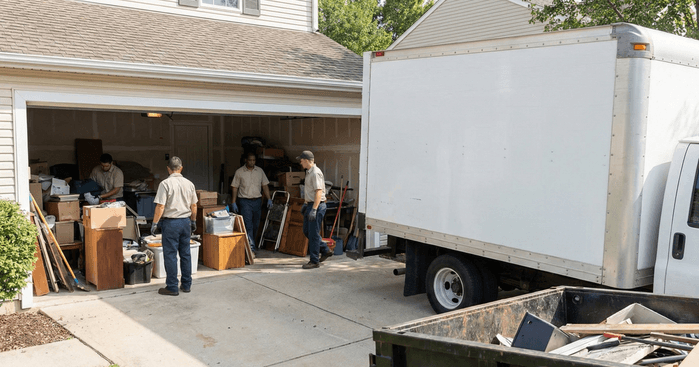
- Arrival and walkthrough — The crew arrives within your scheduled window and does a quick walkthrough to confirm the scope and finalize pricing.
- Removal — We work efficiently, typically completing most garage cleanouts in one to three hours, depending on volume.
- Final sweep — Once items are loaded, we sweep the space clean and do a final check with you.
- Payment — You pay only after the work is complete and you’re satisfied with the results.
One tip from years on the job: be present for the walkthrough, but you don’t need to hover. Feel free to go about your day while we work. We’ll find you when we’re finished.
“After clearing out thousands of garages since 2014, we’ve found that the real value of professional cleanout isn’t just the hauling—it’s giving people back a space they’d written off years ago, usually in less time than it would take them to make a single dump run themselves.”
— Jiffy Junk Operations Team
Essential Resources for Your Garage Cleanout
Clearing out your garage means dealing with all kinds of items—some you can donate, some need recycling, and others require special handling. We’ve put together these trusted resources to help you make responsible choices for everything we can’t haul away, or for those DIY moments when you want to tackle part of the project yourself.
At Jiffy Junk, we’re committed to recycling and donating whenever possible. These are the same types of resources our teams use to keep usable items out of landfills and give your belongings a second life.
1. Find Local Recycling Centers for Any Material
Earth911 Recycling Locator
Not sure where to take that stack of old batteries or scrap metal? Earth911 makes it simple. Just enter your zip code and the item you need to recycle, and you’ll get directions to the nearest drop-off location. Their database covers over 350 materials and 100,000+ locations nationwide.
Resource: https://search.earth911.com/
2. Safely Dispose of Paints, Chemicals, and Solvents
EPA Household Hazardous Waste Guide
Garages tend to collect items that need special care—old paint cans, motor oil, pesticides, and cleaning solvents. The EPA’s guide helps you identify what qualifies as hazardous and points you to collection programs in your community. It’s the right way to handle materials that shouldn’t end up in landfills or storm drains.
Resource: https://www.epa.gov/hw/household-hazardous-waste-hhw
3. Schedule Free Pickup for Furniture and Appliances
Salvation Army Donation Services
That old dresser or working refrigerator sitting in your garage? Someone else can use it. The Salvation Army offers complimentary pickup for gently used furniture, appliances, and household goods. You’ll receive a tax-deductible receipt, and your donation supports community programs that help people rebuild their lives.
Resource: https://satruck.org/
4. Donate Building Materials, Tools, and Fixtures
Habitat for Humanity ReStore
Leftover lumber, cabinets, light fixtures, or hand tools from past projects can find a new home at your local ReStore. Habitat for Humanity accepts building materials and home improvement supplies in good condition, and proceeds go directly toward constructing affordable housing in your community. Many locations even offer free pickup for larger donations.
Resource: https://www.habitat.org/restores
5. Recycle Old Electronics and Small Appliances
Best Buy Electronics Recycling Program
Old computers, televisions, cables, and small appliances don’t belong in the trash. Best Buy accepts up to three items per household per day at any store location—regardless of where you originally purchased them. As America’s largest retail collector of e-waste, they’ve responsibly recycled over 2.7 billion pounds of electronics since 2009.
Resource: https://www.bestbuy.com/site/services/recycling/pcmcat149900050025.c
6. Properly Handle Old Tires
EPA Scrap Tire Resources
Tires are one of those items that most landfills won’t accept, which is why they tend to pile up in garages. The EPA’s scrap tire guide helps you locate retailers, recycling centers, and community collection events that take used tires. Many tire shops also accept old tires when you purchase new ones—just ask.
Resource: https://archive.epa.gov/epawaste/conserve/materials/tires/web/html/faq.html
7. Document Donations for Tax Deductions
IRS Publication 561: Determining the Value of Donated Property
When you donate furniture, appliances, or household goods during your cleanout, you may qualify for a tax deduction. This official IRS guide explains how to determine fair market value and what records you’ll need to keep. It’s worth a few minutes of preparation to maximize your contribution benefits.
Resource: https://www.irs.gov/publications/p561
Supporting Statistics
After clearing out thousands of garages since 2014, we’ve seen firsthand how much usable material ends up at the curb. These federal statistics confirm what our crews encounter daily.
12.1 Million Tons of Furniture Discarded Annually
The EPA reports Americans discard 12.1 million tons of furniture and furnishings each year—4.1 percent of total municipal solid waste.
What we see on the job:
- Old patio sets were pushed to the back corner
- Dining chairs were replaced years ago and never donated
- Couches that migrated from the living room to the garage, to “we’ll deal with it later.”
In our experience, roughly half the furniture we haul still has life left. That’s why we partner with local donation centers—a table collecting dust for three years can still serve a family that needs one.
Source: U.S. EPA, Durable Goods: Product-Specific Data https://www.epa.gov/facts-and-figures-about-materials-waste-and-recycling/durable-goods-product-specific-data
Only 5.6% of Small Appliances Get Recycled
The EPA found that of 2.2 million tons of small appliances discarded in 2018:
- 5.6% were recycled
- 18.5% were combusted for energy recovery
- 75.9% went straight to landfills
We’ve pulled countless box fans, vacuums, coffee makers, and power tools from garage shelves. These items contain recoverable metals and components. The problem isn’t that people don’t care—it’s that most don’t know where to take them.
Our approach: we sort every load and route recyclable appliances to proper facilities rather than defaulting to the landfill.
Source: U.S. EPA, Durable Goods: Product-Specific Data https://www.epa.gov/facts-and-figures-about-materials-waste-and-recycling/durable-goods-product-specific-data
124,000+ Tons Diverted by Habitat ReStores
Habitat for Humanity reports its ReStore locations have diverted more than 124,000 tons of reusable goods from landfills since 1991. We’ve contributed directly—routing cabinets, building materials, and working appliances to ReStores in communities we serve.
What we’ve learned after a decade of cleanouts:
- The line between “junk” and “donation” often comes down to condition and timing
- Cabinets pulled during renovation look like debris to the homeowner—but they’re affordable materials to a family shopping at ReStore.
- Our job is recognizing that difference and making sure items end up where they do the most good
Source: Habitat for Humanity International, “25 Years of Facts and Finds” https://www.habitat.org/stories/25-years-facts-and-finds
What This Means for Your Cleanout
Every garage tells a similar story: years of accumulated items that homeowners didn’t know how to handle. When you work with Jiffy Junk, your cleanout becomes part of the solution.
We’ve built relationships with:
- Recyclers for metals, electronics, and appliances
- Donation centers for furniture and household goods
- Specialty facilities for items requiring proper disposal
The result: your items don’t automatically become part of the 12.1 million tons of discarded furniture or the 75.9 percent of appliances headed for landfills.
That’s what homeowners actually want—knowing their stuff went somewhere useful, not just hauled off and buried.
Final Thought: Why Most Garage Cleanouts Take Longer Than They Should
After a decade of hauling, we’ve formed a clear opinion: the project itself isn’t what overwhelms people. It’s the decision-making.
Homeowners don’t struggle with physical labor. They struggle with figuring out what goes where. That uncertainty leads to delay, and delay leads to garages that sit untouched for years.
Patterns We See in Every Cleanout
The garages we clear fall into predictable categories:
- The “someday” pile: Items kept because they might be useful, but never touched
- The guilt items: Inherited furniture too sentimental to toss, too bulky to store inside
- The mystery boxes: Containers unopened since the last move
- The project graveyard: Half-finished renovations and materials for repairs that never happened
Most homeowners know exactly what needs to go. What they lack is a clear path forward—and the time to sort, load, haul, and dispose of everything properly.
DIY vs. Professional Help: Our Honest Take
Not every garage cleanout requires a professional service.
DIY makes sense when:
- You have a single carload of light items
- Nothing requires special disposal
- You have a free weekend and truck access
- You know exactly where everything is going
Professional help makes sense when:
- Multiple truckloads are involved
- Heavy or awkward items need removal
- Hazardous materials are present
- Your time is worth more than the service cost
- You want items sorted for donation and recycling
No wrong answer—just the one that fits your situation.
Why We Prioritize Responsible Disposal Over Speed
Here’s where we differ from some haulers: we don’t measure success by how fast we clear a garage. We measure it by how little ends up in a landfill.
The statistics aren’t abstract to us:
- We see 12.1 million tons of discarded furniture in every dining set pushed to the back corner
- We see that 5.6% appliance recycling rate in every fan and vacuum we pull off the shelves
- We see 124,000 tons diverted by Habitat ReStores in the cabinets we route there instead of the dump
Sorting takes more time. Building relationships with donation centers takes effort. But it’s the right way to do this work—and it’s what homeowners actually want.
The Bottom Line
A garage cleanout isn’t just about removing items. It’s about making responsible choices for materials that still have value.
FAQ on “Garage Clean Out”
Q: How much does a professional garage cleanout cost?
A: Most garage cleanouts cost $200 to $800. Average price: $400 to $600 for a standard two-car garage.
Pricing factors:
- Volume: Truck space your items occupy
- Item type: Appliances and electronics may carry disposal fees
- Labor intensity: Access difficulty and item weight
What we’ve learned: The biggest cost factor isn’t square footage—it’s density. A packed garage costs more than one with bulky but sparse items.
Pro tip: Send photos beforehand for a tighter estimate.
Q: What items can be removed during a garage cleanout?
A: Professional services handle most garage items.
Commonly removed:
- Furniture and mattresses
- Appliances (refrigerators, freezers, washers, dryers)
- Electronics and televisions
- Exercise and sporting equipment
- Lawn and garden equipment
- Construction debris
- Boxes and general clutter
Not accepted (requires special disposal):
- Paint and solvents
- Propane tanks
- Automotive fluids
- Pool chemicals
From experience: Most homeowners underestimate what qualifies as hazardous. We flag these items during the walkthrough.
Q: How long does a garage cleanout take?
A: One to three hours for most residential garages. Average two-car garage: approximately two hours.
Factors affecting time:
- Volume: More items mean more truck trips
- Weight: Heavy items like safes or concrete slow the process
- Access: Direct truck access speeds things up
- Decisions: Reviewing each item adds time
Pattern we’ve observed: Cleanouts tied to major decisions (moving, downsizing, estate settlement) go faster. The emotional processing is already done.
Q: What happens to items after they’re hauled away?
A: We sort every load for maximum landfill diversion.
Three-channel approach:
- Donation: Usable furniture and working appliances go to local charities and Habitat ReStore
- Recycling: Metals, electronics, and recyclables go to processing facilities
- Disposal: Only non-reusable items go to licensed facilities
Our tracking shows: 60-70% of typical garage contents can be diverted from landfills through proper sorting.
What we’ve found: Homeowners want to know their items went somewhere useful. That’s why we sort—even though it takes longer.
Q: How should I prepare for a garage cleanout service?
A: Minimal preparation needed.
Helpful steps:
- Mark items you want to keep with tape or sticky notes
- Ensure truck access to the garage area
- Gather hazardous materials in one spot for discussion
- Be present for the five-minute walkthrough and estimate
Not necessary:
- Pre-sorting or organizing
- Bagging loose items
- Moving heavy things yourself
- Cleaning before arrival
What we tell customers: Don’t throw out your back preparing for people whose job is heavy lifting. Point to what goes. We handle the rest.
Get Your Free Garage Cleanout Estimate Today
Now that you know what to expect from professional garage cleanout services—and what fair pricing looks like—take the next step and see exactly what your project will cost. Call us at 844-543-3966 or book online at jiffyjunk.com/booking for a free, no-obligation quote and let our team handle the heavy lifting with our signature White Glove Treatment.