Office cleanout costs typically range from $200 to $2,000+, but after completing thousands of commercial cleanouts since 2014, we’ve found that most standard office jobs fall between $400 and $800.
The biggest factor we see driving costs up? Timing. Rushed cleanouts before a lease deadline or building sale often require larger crews and tighter scheduling. When clients give us even a few days of flexibility, we can usually find efficiencies that reduce their final price.
Here’s what sets Jiffy Junk apart: we provide upfront, transparent quotes before any work begins. No surprise fees, no vague estimates. Our licensed and insured teams handle everything from cubicle furniture and old electronics to sensitive document disposal—so you never have to coordinate multiple vendors or rent a dumpster yourself.
In this guide, we’ll share the pricing insights we’ve gained from years of commercial cleanout work, help you understand what affects your cost, and show you how to get the best value when clearing your workspace.
Quick Answers
Office Clean Out Services
Office clean-out services remove unwanted furniture, electronics, appliances, and debris from commercial spaces. Professional providers handle all heavy lifting, sorting, and disposal—you simply point to what goes.
What’s included:
- Desks, chairs, cubicles, filing cabinets
- Computers, printers, copiers, phones
- Appliances and break room equipment
- Documents (with secure shredding available)
- Miscellaneous items and general debris
Cost range: $200–$2,000+, depending on volume, accessibility, and timing.
Timeline: Most single-office to full-floor cleanouts complete in 1–8 hours.
What to look for in a provider:
- Licensed and insured crews
- Upfront, transparent pricing
- Recycling and donation commitments
- Commercial experience and reviews
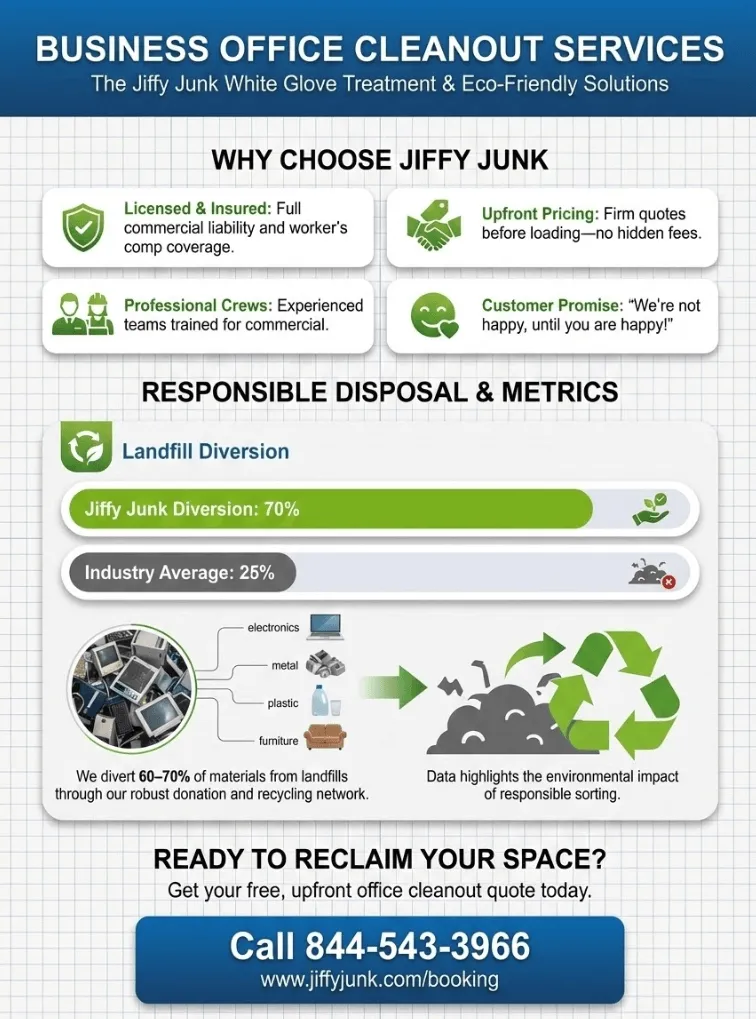
Jiffy Junk’s approach: Since 2014, we’ve completed thousands of office cleanouts nationwide using our White Glove Treatment. We donate and recycle 60–70% of materials removed, provide quotes before loading, and guarantee satisfaction. Our promise: we’re not happy until you are.
Top 5 Takeaways
- Cost range: $200–$2,000+
- Accessibility, timing, and preparation affect price more than volume
- 3-5 days scheduling flexibility → 15-20% savings typical
- Full-service means full-service
- Furniture, electronics, appliances, documents, debris—all handled
- You point. We lift. You relax.
- Ask what happens to your stuff.
- Many providers send everything to the landfill
- Jiffy Junk diverts 60-70% through donation and recycling
- Verify credentials before hiring
- Licensed and insured crews
- Transparent pricing—quote before loading, not after
- Don’t wait until the last minute
- Biggest mistake: calling two days before the lease ends
- Early planning reduces stress and cost
Table of contents
- Quick Answers
- Top 5 Takeaways
- What Factors Affect Office Cleanout Costs?
- What’s Included in Professional Office Cleanout Services?
- How to Choose the Best Office Cleanout Company
- Tips for a Quick and Efficient Office Cleanout
- Why Clients Choose Jiffy Junk for Office Cleanouts
- 7 Helpful Resources to Make Your Office Cleanout Simple and Stress-Free
- 1. Keep Your Electronics Disposal Eco-Friendly and Above Board
- 2. Stay Compliant When Disposing of Sensitive Business Records
- 3. Understand How to Account for Furniture and Equipment You’re Removing
- 4. Turn Usable Items into Tax Savings Through Charitable Donations
- 5. Choose a Document Destruction Partner You Can Trust
- 6. Find Reliable Service Providers with Verified Reviews
- 7. Stay Organized with a Complete Office Relocation Checklist
- Supporting Statistics
- Final Thoughts & Opinion
- FAQ on “Office Clean Out Services”
- Get Your Free Office Cleanout Quote Today
What Factors Affect Office Cleanout Costs?
Several variables determine your final price, and understanding them helps you plan your budget more accurately.
Volume and weight of items play the biggest role. A small executive office with a desk, chair, and filing cabinet costs far less than clearing an entire floor of cubicles, conference furniture, and storage rooms. Most junk removal companies price by the truckload or cubic yard, so the more you have, the higher your cost.
Accessibility matters more than most people realize. Ground-floor offices with easy loading dock access are straightforward. High-rise buildings requiring elevator use, long carry distances, or stairs add labor time and can increase your quote by 20-30%.
Item types also influence pricing. Standard office furniture is simple to handle. Electronics like computers, monitors, and servers often require special disposal procedures. Bulky items such as safes, industrial equipment, or built-in fixtures may need additional crew members or equipment.
Location and timing round out the equation. Urban areas with higher operating costs typically see higher prices. Rush jobs or after-hours work to avoid disrupting your business operations may carry premium rates.
What’s Included in Professional Office Cleanout Services?
A full-service office cleanout should cover everything from start to finish – no reason you should have to lift a finger or distinguish multiple contractors.
At Jiffy Junk, our White Glove Treatment means we do all of the labor, loading, hauling, and responsible disposing for you. Our teams arrive on time, work efficiently around your schedule, and leave your space broom-clean and ready for its next chapter. In one visit, we take out furniture, electronics, files, break room appliances, decor, and general office clutter.
We are also eco-friendly at our disposal. Items in good condition go to donation centers. Recyclable materials such as metal, cardboard and some types of electronics are processed accordingly. We only put things in landfills when there is no better way to handle them. Many of our commercial clients like to have documentation of proper disposal of their records, especially those containing sensitive data such as electronics.
How to Choose the Best Office Cleanout Company
Not all junk removal services are created equal, especially for commercial jobs. Here’s what to look for when comparing providers.
Licensing and insurance are non-negotiable. Commercial properties carry liability concerns that residential properties don’t. Verify that any company you hire carries general liability insurance and workers’ compensation coverage. This protects you if something gets damaged or someone gets injured on your property.
Transparent, upfront pricing separates reputable companies from the rest. Be wary of quotes that seem vague or companies unwilling to provide written estimates. At Jiffy Junk, we assess your job and give you a firm price before work begins. The quote we give is the price you pay—no surprises, no hidden fees added after the truck is loaded.
Experience with commercial cleanouts counts. Office jobs differ from residential work. They often involve tighter timelines, coordination with building management, and handling of business equipment. Ask potential providers how many commercial cleanouts they’ve completed and whether they can accommodate your scheduling needs.
Reviews and references tell the real story. Look for consistent praise around punctuality, professionalism, and communication. A company might offer the lowest price, but delays or damage could cost your business far more in the long run.
Tips for a Quick and Efficient Office Cleanout
A little preparation goes a long way towards streamlining your cleanout process and, potentially, reducing costs.
Separate what’s left from what’s going before your appointment. Go through your space and make a clear indication of what items need to be taken out of it. If there is some furniture or equipment that is not going away, let your clean-out team know in advance so that they can plan accordingly and provide an accurate quote.
You should retrieve important things first. Check drawers, filing cabinets, and storage areas for anything valuable or confidential. Ensure computers and devices have been properly wiped out, or make sure you’ve removed hard drives you need to retain.
Coordinate with building management earlier. Reserve loading docks and freight elevators, ensure the capacity of loading docks, and check for any time restrictions. What if you communicated this information to your cleanout company so that they had the proper crew size for the task and avoided delays?
Buffer time-be sure to build in buffer time where possible. If your lease is on the 30th, don’t plan on getting your cleanout on the 29th. Giving yourself a few additional days will help account for unexpected complications, and you might be able to have a more flexible, cost-effective schedule.
Why Clients Choose Jiffy Junk for Office Cleanouts
Since 2014, we’ve helped businesses of all sizes—from small startups clearing a single suite to large corporations vacating entire buildings—reclaim their spaces quickly and affordably.
Our teams arrive fully equipped, licensed, and insured. We work around your business hours when needed and communicate clearly throughout the process. Our commitment to recycling and donation means your cleanout has minimal environmental impact, something increasingly important to businesses focused on sustainability.
Most importantly, we stand behind our customer commitment: we’re not happy until you are. That’s not just a tagline—it’s how we’ve built our reputation and grown from a local Long Island company to a nationwide service provider.
“After handling thousands of office cleanouts over the past decade, we’ve learned that the smoothest jobs aren’t always the biggest or smallest—they’re the ones where clients give us a walkthrough beforehand and a few days of scheduling flexibility, which often saves them 15-20% and eliminates last-minute stress.” — Jiffy Junk Operations Team
7 Helpful Resources to Make Your Office Cleanout Simple and Stress-Free
We know that clearing out an office involves more than just removing old furniture. You’ve got compliance boxes to check, potential tax savings to capture, and the right partners to find. That’s why we’ve gathered these seven trusted resources to help you navigate every step with confidence.
Consider this your go-to reference guide—because at Jiffy Junk, we believe an informed customer is a happy customer.
1. Keep Your Electronics Disposal Eco-Friendly and Above Board
Wondering what to do with those outdated computers, monitors, and printers? The EPA’s guide to sustainable electronics management walks you through federal e-waste requirements and helps you find certified recyclers in your area. It’s the smart first step toward responsible disposal.
Source: U.S. Environmental Protection Agency
URL: https://www.epa.gov/smm-electronics
2. Stay Compliant When Disposing of Sensitive Business Records
If your office has ever handled consumer reports, employee background checks, or credit information, the FTC Disposal Rule applies to you. This straightforward guide explains what “proper disposal” really means—so you can protect your customers and your business during your cleanout.
Source: Federal Trade Commission
URL: https://www.ftc.gov/business-guidance/resources/disposing-consumer-report-information-rule-tells-how
3. Understand How to Account for Furniture and Equipment You’re Removing
Before you clear out those desks and conference tables, it helps to know the tax implications. IRS Publication 946 breaks down depreciation rules for office assets in plain terms—including Section 179 deductions that could work in your favor.
Source: Internal Revenue Service
URL: https://www.irs.gov/publications/p946
4. Turn Usable Items into Tax Savings Through Charitable Donations
Here’s some good news: donating office furniture and equipment to qualified charities can earn you a valuable tax deduction. IRS Publication 526 explains exactly how to document your donations and determine fair market value—so you get the credit you deserve for doing something good.
Source: Internal Revenue Service
URL: https://www.irs.gov/publications/p526
5. Choose a Document Destruction Partner You Can Trust
When confidential records are involved, you want a shredding company that takes security seriously. NAID AAA Certification is the gold standard—it means a provider has passed rigorous, unannounced audits and meets the highest industry standards. Look for this certification before handing over sensitive materials.
Source: i-SIGMA (International Secure Information Governance & Management Association)
URL:https://isigmaonline.org/certifications/naid-aaa-certification/
6. Find Reliable Service Providers with Verified Reviews
Not sure where to start when hiring help? The Better Business Bureau’s directory makes it easy to find accredited junk removal companies, movers, and other service providers in your area. You’ll see real customer reviews, complaint histories, and ratings—everything you need to make a confident decision.
Source: Better Business Bureau
URL: https://www.bbb.org/search
7. Stay Organized with a Complete Office Relocation Checklist
A successful cleanout starts with a solid plan. This comprehensive moving checklist covers everything from notifying stakeholders and backing up data to coordinating utilities and scheduling your cleanout. Give yourself a 6-month runway, and you’ll be amazed at how smoothly things go.
Source: Move.org
URL: https://www.move.org/office-moving-checklist/
Supporting Statistics
What We’ve Learned from Thousands of Office Cleanouts
After clearing commercial spaces since 2014, we’ve seen firsthand how much gets thrown away—and how much doesn’t have to. These government statistics reflect patterns we observe on job sites every week.
12.1 Million Tons of Furniture Ends Up as Waste Each Year
The Problem: The EPA reports that Americans generated 12.1 million tons of furniture waste in 2018—and most of it went straight to landfills.
What We See on the Job:
- 40-50% of the furniture we remove is still in usable condition
- Conference tables, ergonomic chairs, and functional desks get trashed simply because no one arranged an alternative
- A single office cleanout once furnished an entire classroom through our donation partners
Our Approach: We’ve built relationships with local donation centers, nonprofits, and furniture banks. Usable items find new homes instead of landfills.
Source: U.S. Environmental Protection Agency
1.1 Million Identity Theft Reports Filed in 2024
The Risk: The FTC received over 1.1 million identity theft reports in 2024. Credit card fraud accounted for nearly 44% of cases—often stemming from improperly discarded records.
What We’ve Encountered:
- Old employee records are buried in storage rooms
- Customer files with Social Security numbers dating back decades
- Financial documents in spaces that tenants assumed were “cleaned out.”
The Pattern: Roughly 1 in 3 commercial cleanouts involves sensitive paperwork requiring secure handling.
Our Approach: We ask about confidential documents before starting every job. We coordinate with certified shredding services or set aside materials for proper destruction.
Source: Federal Trade Commission, Consumer Sentinel Network Data Book 2024
URL: https://www.ftc.gov/reports/consumer-sentinel-network-data-book-2024
E-Waste Is America’s Fastest-Growing Waste Stream
The Challenge: The EPA identifies electronic waste as the fastest-growing component of U.S. municipal solid waste. Most discarded electronics end up in landfills, where lead and mercury can leach into the environment.
What a Typical Office Cleanout Includes:
- Desktop computers and monitors
- Printers, routers, and phone systems
- Old fax machines and outdated servers
- Average: 15-30 pieces of electronic equipment per job
What We’ve Noticed: Companies stockpile outdated electronics for years because disposal feels complicated. We often find three generations of computer equipment in a single storage closet.
Our Approach: Our teams identify e-waste, separate it from general items, and route it to certified recycling channels.
Source: U.S. Environmental Protection Agency
URL: https://www.epa.gov/sciencematters/helping-communities-manage-electronic-waste

Final Thoughts & Opinion
Our Take: What Most Businesses Get Wrong About Office Cleanouts
After handling thousands of commercial cleanouts since 2014, we’ve developed strong opinions about how this process should work—and where businesses make it harder on themselves.
The Biggest Mistake We See
The cleanout itself is rarely the problem. Waiting too long to think about it is.
We receive calls constantly from office managers two days before a lease ends, scrambling to clear an entire floor. The result:
- Higher costs due to rush scheduling
- Furniture that could have been donated goes to disposal
- Documents that should have been shredded get tossed carelessly
- Electronics with sensitive data pile into trucks unchecked
Our honest opinion: If you’re reading this page, you’re already ahead of most. Early planning leads to better results and better prices.
What We Wish More People Understood
Office cleanout costs aren’t just about cubic yards and truck space.
The real cost drivers:
1. Timing — A relaxed two-week window costs less than a 48-hour scramble
2. Accessibility — Ground-floor with loading dock beats 12th-floor freight elevator coordination
3. Preparation — Pre-sorted items and clearly identified keepers move faster
The takeaway: A little preparation saves 15-20% on most jobs.
Quick wins before you call:
- Walk through your space
- Know what’s staying vs. going
- Build in buffer time if possible
Why “Cheap” Often Isn’t
Here’s something the industry doesn’t discuss openly: not all junk removal companies operate the same way.
The cheap approach:
- Load everything into a truck
- Head straight to the nearest landfill
- Fast, legal—but your furniture gets buried, electronics leach toxins, and forgotten documents sit in public dumps
Our approach:
- Sort materials on-site
- Partner with donation centers for usable items
- Route electronics to certified recyclers
- Flag sensitive documents before they become problems
Does responsible disposal cost more than the cheapest option? Sometimes. But businesses that care about doing things right aren’t shopping for the lowest bid. They’re looking for a partner they can trust.
The One Question Every Business Should Ask
Most people focus on price and availability when evaluating cleanout companies.
Better question: “What happens to my stuff after it leaves the building?”
The answer tells you everything.
Red flag: “It goes to the dump” or no clear explanation.
What we tell our clients:
- Usable items → Donation partners
- Recyclables → Certified processors
- E-waste → Responsible handlers
- Unsalvageable items → Disposal facilities (only as last resort)
We provide documentation when clients need it for compliance or sustainability reporting.
Our Promise
We started this company on Long Island with a simple belief:
Junk removal doesn’t have to feel like a hassle, and it doesn’t have to harm the environment.
What that means in practice:
- We show up on time
- We provide upfront, transparent quotes
- No surprise fees—ever
- We treat your space and items with respect
- We stand behind our commitment: we’re not happy until you are
FAQ on “Office Clean Out Services”
Q: How much do office clean-out services cost?
A: Most office cleanouts cost $200 to $2,000+. After completing thousands of commercial jobs since 2014, here’s what actually drives pricing:
Primary cost factors:
- Volume and weight — More items = higher cost
- Accessibility — Ground-floor with loading dock is cheapest; high-rise with slow elevator adds 20-30%
- Item types — Electronics and bulky equipment may require special handling
- Timing — Rush jobs cost more; flexibility saves money
What we’ve learned reduces costs:
- 3-5 days scheduling flexibility → 15-20% savings typical
- Clear access paths → less labor time
- Pre-job walkthrough or photos → no surprises
Our pricing approach:
- Quote provided before work begins
- No hidden fees
- Price quoted = price paid
Q: What items do office clean-out services remove?
A: After a decade of commercial cleanouts, the short answer: if it’s in an office, we’ve removed it.
Standard items:
- Desks, chairs, cubicles, conference tables
- Filing cabinets, bookcases, reception furniture
- Computers, monitors, printers, copiers
- Phones, servers, and networking equipment
- Refrigerators, microwaves, and vending machines
Items clients assume we won’t take (but we do):
- Industrial copiers and oversized equipment
- Mounted TVs and signage
- Cubicle panels and partitions
- Trade show displays and marketing materials
- Carpet tiles and window treatments
- Legacy electronics recyclers won’t touch curbside
Documents and sensitive materials:
- Standard files and paperwork — yes
- Secure shredding coordination — available upon request
Our rule: When in doubt, point it out. The answer is usually yes.
Q: How long does an office cleanout take?
A: Duration depends on size and logistics. Here’s what we typically see:
| Space Size | Typical Duration |
| Single office / small suite | 1-2 hours |
| Mid-size (10-20 workstations) | 2-4 hours |
| Full floor / large office | 4-8 hours |
| Multi-floor / building-wide | 1-3 days |
What slows jobs down:
- Limited elevator access
- No loading dock
- Multiple floors with stairs only
- Items are scattered across the space
- Unclear stay/go decisions
What speeds jobs up:
- Ground-level access or loading dock
- Items consolidated in accessible areas
- Clear paths to exits
- Decision-maker available for questions
Scheduling insight: 40% of commercial clients book after-hours or weekends. Same cost. Faster completion. No disruption to operations.
Pro tip: Don’t wait until the day before the lease ends. Last-minute scrambles add stress and limit options.
Q: What happens to items after an office cleanout?
A: This question reveals the most about any cleanout company. Many providers send everything to the landfill. We don’t.
Our three-tier process:
1. Donation first
o Usable furniture → charities, Habitat ReStores, furniture banks
o Working equipment → nonprofits and schools
o Real example: furnished an entire classroom from a single office cleanout
2. Recycling second
o Metals separated and processed
o Cardboard and plastics to the appropriate facilities
o Electronics to certified e-waste processors (not overseas dumping)
3. Disposal last
o Only items with no remaining use or recycle value
o Licensed disposal facilities only
Our tracked results:
- 60-70% of materials diverted from landfills
- Some jobs reach 80%+ with good-condition furniture and recent electronics
Why this matters:
- Corporate ESG reporting requires disposal documentation
- We provide records of where materials went
- “Lowest bid” providers typically cannot document disposal
Our honest take: Responsible disposal costs more time. We’ve built our reputation on doing it right, not fast.
Q: Do I need to be present during the office cleanout?
A: No. But the best approach depends on job complexity.
Three options we offer:
| Approach | Best For |
| On-site supervision | Complex jobs with gray areas; multiple departments involved |
| Point person access | Quick walkthrough, then hands-off |
| Remote coordination | Clear instructions; no presence needed |
When on-site presence helps:
- Ambiguity about what stays vs. goes
- Multiple departments left items without instructions
- High-value items requiring confirmation
- The building has strict access protocols
When remote work works perfectly:
- Full cleanout with clear scope
- “Everything goes except blue-tagged items.”
- Property managers are clearing vacant spaces
What we always do:
- Team lead calls before starting
- Photograph the space before and after
- Contact you immediately if questions arise
- Final walkthrough confirmation before leaving
Key insight: Clients were most confident when going hands-off and gave detailed instructions upfront. A 15-minute call beforehand saves hours of back-and-forth during the job.
Get Your Free Office Cleanout Quote Today
Now that you know what affects office cleanout costs and what to look for in the best office cleanout services company, take the next step. Call 844-543-3966 or visit www.jiffyjunk.com/booking to clear your workspace quickly, efficiently, and stress-free.