Most people don’t realize their old TV can’t legally go to the curb — and that’s usually when they call us. After handling thousands of electronics removal jobs nationwide, we’ve seen it all: garages stacked with CRT monitors no one will take, offices full of outdated computers with no clear disposal path, and homeowners hit with fines for e-waste left at the curb.
We built our electronics disposal service around what we learned firsthand — that people don’t just need a hauler, they need someone who knows how to handle hazardous materials like lead and mercury properly and can prove it. Every Jiffy Junk team is fully licensed and insured, and we track our recycling and donation efforts, so you know your old electronics are being handled responsibly, not just dumped somewhere else.
Here’s what makes us different: you don’t sort, disconnect, or carry a thing. Our White Glove Treatment means we come to you, provide a transparent quote with no hidden fees, and remove everything from wherever it sits — upstairs bedroom, basement, or loading dock. We’ve helped homeowners clear out a single flat-screen and businesses decommissioning entire server rooms, and we treat every job the same way.
TL;DR Quick Answers
What Is a TV & Electronics Disposal Service and Why Do You Need One?
Short answer: A TV and electronics disposal service removes old televisions, computers, monitors, and other e-waste from your home or business and ensures every item is recycled or disposed of in compliance with local and federal environmental regulations — so you don’t have to figure it out yourself.
Why it matters:
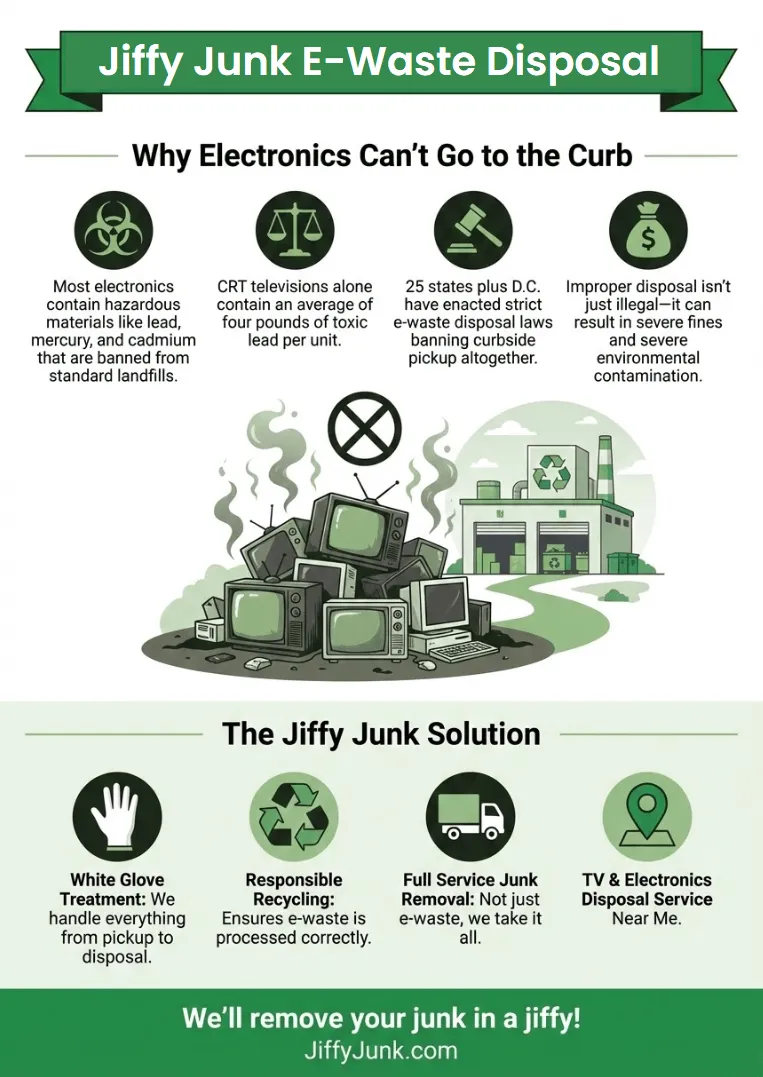
- Most electronics contain hazardous materials like lead, mercury, and cadmium that are banned from standard curbside pickup and landfills in many states
- CRT televisions alone contain an average of four pounds of lead per unit
- Improper disposal can result in fines, environmental contamination, and personal health risks
What Jiffy Junk handles for you:
- Pickup: We come to you and remove items from wherever they sit — no carrying, sorting, or disconnecting on your end
- Compliance: We navigate the regulations so you don’t have to research what’s legal in your state
- Recycling: We route every item through proper recycling and donation channels and track our disposal efforts
- Pricing: We quote on-site with no hidden fees — the price we give you is the price you pay
Based on our experience removing thousands of old TVs and electronics nationwide, the biggest reason people put off disposal isn’t a lack of awareness — it’s a lack of convenient options. That’s exactly the gap our White Glove Treatment is designed to fill.
Top 5 Takeaways
1. Most old electronics can’t legally go to the curb.
- 25 states plus D.C. have e-waste disposal laws
- Most municipal haulers won’t accept TVs, computers, or monitors
- Putting electronics out with regular trash can result in fines
2. CRT televisions require specialized handling.
- Every CRT contains an average of four pounds of lead
- Classified as hazardous waste in most jurisdictions
- Donation centers won’t take them, and standard haulers turn them down
- A cracked tube releases lead dust into your home
- Professional removal isn’t just convenient — it’s the safest option
3. The e-waste problem is growing faster than most people realize.
- 24 electronic devices per average American household
- E-waste is now the fastest-growing component of the municipal waste stream
- What starts as one old TV often turns into a full cleanout once customers start checking closets, drawers, and storage bins
4. Responsible disposal is only as good as the accountability behind it.
- Not all haulers recycle what they collect
- The EPA recommends using R2 or e-Stewards certified recyclers
- Jiffy Junk routes electronics through proper recycling and donation channels
- We track our eco-friendly disposal efforts on every job because our customers deserve to know what actually happens to their items
5. The biggest barrier to doing the right thing is convenience.
- Most people already know their old devices shouldn’t go in the trash
- They just need someone to show up, give an honest price, and handle everything
- That’s the gap our White Glove Treatment fills — from pickup to responsible recycling, on every job, every time
Table of Contents
- TL;DR Quick Answers
- Top 5 Takeaways
- What Counts as E-Waste — and Why It Can’t Go in the Trash
- Electronics and Items We Remove
- How Our Electronics Disposal Process Works
- Why CRT TVs and Monitors Need Special Handling
- Responsible Recycling and Donation: Where Your Electronics Actually Go
- Residential and Commercial Electronics Removal
- 7 Essential Resources for Responsible TV & Electronics Disposal
- 1. Understand Why Electronics Need Special Handling
- 2. Find a Certified Electronics Recycler You Can Trust
- 3. Check the E-Waste Disposal Laws in Your State
- 4. Look Up Your State’s Specific E-Waste Rules in Seconds
- 5. Verify That a Recycler Meets the Highest Industry Standards
- 6. Locate a Recycling Drop-Off or Collection Event Near You
- 7. Protect Your Personal Data Before Any Device Leaves Your Home
- The Numbers Behind the E-Waste Problem
- Final Thoughts and Opinion
- FAQ on TV & Electronics Disposal
- Q: Can I put my old TV or computer out with regular trash or curbside pickup?
- Q: What makes CRT TVs and monitors different from other electronics when it comes to disposal?
- Q: How do I know my old electronics are actually being recycled and not just dumped somewhere?
- Q: Should I wipe my data before having old computers or phones removed?
- Q: What types of electronics does Jiffy Junk remove, and is there anything you can’t take ?
- Ready to Get Rid of Your Old TV, Computer, or E-Waste the Right Way?
What Counts as E-Waste — and Why It Can’t Go in the Trash
Electronics contain materials that make them hazardous waste in most states. CRT televisions and monitors hold anywhere from four to eight pounds of lead. Circuit boards contain mercury, cadmium, and flame retardants. LCD screens use mercury-filled backlights. When these items end up in landfills, those toxins leach into soil and groundwater — which is exactly why most municipalities have banned curbside electronics disposal altogether.
The challenge for homeowners and businesses is that knowing the rules and actually getting rid of the items are two very different problems. That’s the gap Jiffy Junk fills every day.
Electronics and Items We Remove
Our teams handle the full spectrum of consumer and commercial electronics, including:
- Televisions — flat-screen, LED, LCD, plasma, projection, and CRT models of any size
- Computers and peripherals — desktops, laptops, monitors, keyboards, mice, and hard drives
- Printers and office equipment — copiers, scanners, fax machines, and shredders
- Home entertainment systems — stereo receivers, speakers, DVD and Blu-ray players, gaming consoles
- Small electronics — routers, modems, cables, phone chargers, and old cell phones
- Appliances with electronic components — microwaves, window AC units, and similar items
If you’re not sure whether we can take something, send us a photo and we’ll let you know right away. In our experience, the answer is almost always yes.
How Our Electronics Disposal Process Works
We designed our process around the number one complaint people have about e-waste removal: nobody makes it easy. Here’s how we’ve changed that.
You book — we show up. Schedule online in 60 seconds or call 844-JIFFY-JUNK. We’ll confirm your appointment and send a reminder so your day stays on track.
We quote on-site — no surprises. Our team assesses the job in person and gives you a transparent, all-inclusive price before we touch a thing. No hidden fees, no last-minute add-ons. The quote we give you is the price you pay — period.
We do all the heavy lifting. You don’t carry, disconnect, or sort anything. Whether your old CRT is in a second-floor bedroom or your decommissioned servers are in a basement, we handle the removal from wherever items sit.
We dispose of everything responsibly. Every item we remove is processed through proper recycling and donation channels. We track our eco-friendly disposal efforts because we believe accountability matters — not just promises.
Why CRT TVs and Monitors Need Special Handling
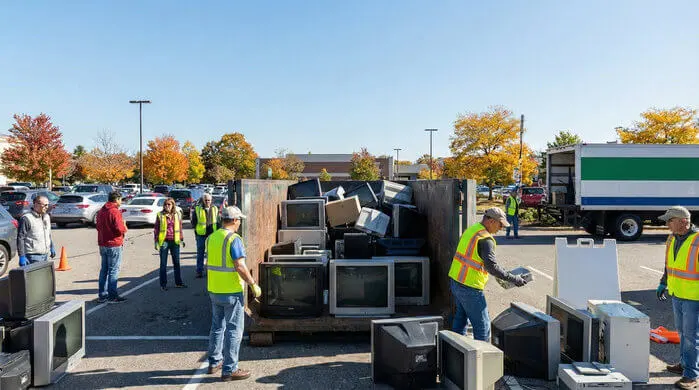
CRT disposal is one of the most common requests we get, and for good reason. These older tube-style televisions and monitors are heavy, fragile, and classified as hazardous waste in many states because of their high lead content. Most donation centers no longer accept them, and standard waste haulers won’t pick them up.
We’ve removed thousands of CRTs from homes and businesses across the country. Our teams know how to transport them safely without cracking the glass — which would release lead dust — and route them to certified recycling facilities equipped to process the materials properly.
Responsible Recycling and Donation: Where Your Electronics Actually Go
We think you deserve to know what happens after we drive away. Jiffy Junk is committed to recycling and donating items whenever possible, and electronics are no exception.
Items in working condition are evaluated for donation to local organizations and reuse programs. Non-working electronics are delivered to certified e-waste recyclers who dismantle them and recover valuable materials like copper, aluminum, and glass while safely containing hazardous components. Our goal on every job is to divert as much as possible from landfills — because responsible disposal isn’t just a service line for us, it’s part of who we are.
Residential and Commercial Electronics Removal
Whether you’re a homeowner clearing out a garage or a property manager decommissioning an office floor, our service scales to fit.
For homes, we commonly handle post-upgrade cleanouts — you bought a new TV or computer, and now the old one has nowhere to go. We also help families manage estate cleanouts or downsizing, where electronics have accumulated over years or even decades. We approach every one of these situations with care and respect for what our customers are going through.
For businesses, we handle bulk electronics removal, including IT equipment, office furniture with electronic components, and full-site decommissions. Our teams work efficiently to minimize disruption to your operations, and we can provide documentation of proper disposal for your compliance records.
“After removing thousands of old TVs and electronics from homes and businesses nationwide, we’ve learned that what people really need isn’t just a hauler — they need someone who shows up on time, gives them an honest price, and can prove every item was disposed of the right way.” — Jiffy Junk Team
7 Essential Resources for Responsible TV & Electronics Disposal
We know that figuring out how to get rid of old TVs, computers, and e-waste can feel overwhelming. The rules vary by state, not every recycler operates the same way, and your personal data needs protection before any device leaves your home. That’s why we’ve put together the seven most valuable resources to help you feel confident about your next step — whether you tackle it yourself or let our team handle everything for you.
1. Understand Why Electronics Need Special Handling
Your old TV or computer contains materials like lead, mercury, and cadmium that can harm the environment if they end up in a landfill. The EPA breaks down exactly what’s inside common electronics, why standard disposal methods fall short, and what responsible alternatives look like. If you’re wondering why your items can’t simply go to the curb, this is the place to start.
Source: U.S. Environmental Protection Agency — Cleaning Up Electronic Waste
URL: https://www.epa.gov/international-cooperation/cleaning-electronic-waste-e-waste
2. Find a Certified Electronics Recycler You Can Trust
Not all recyclers are created equal. The EPA recommends using certified electronics recyclers and currently recognizes two accredited certification standards — R2 and e-Stewards — both of which advance best management practices for environmental safety, worker health, and data security. This page helps you locate certified recyclers near you so you know your electronics are in good hands.
Source: U.S. Environmental Protection Agency — Certified Electronics Recyclers
URL: https://www.epa.gov/electronics-batteries-management/certified-electronics-recyclers
3. Check the E-Waste Disposal Laws in Your State
Here’s something many people don’t realize until it’s too late: twenty-five U.S. states plus the District of Columbia currently have electronics recycling laws, and CRT glass is often regulated as hazardous waste due to its high lead content. This resource walks you through federal CRT rules and links to a state-by-state breakdown — so you’ll know exactly what applies where you live before you make a move.
Source: U.S. Environmental Protection Agency — Regulations for Electronics Stewardship
URL: https://www.epa.gov/smm-electronics/regulations-electronics-stewardship
4. Look Up Your State’s Specific E-Waste Rules in Seconds
Want a faster way to find your state’s requirements? The ERCC’s interactive map highlights all 25 states with e-waste laws and lets you click each state for detailed information, including summaries and direct links to the legislation. It’s the quickest way to find out whether your state bans electronics from landfills or requires a specific recycling process. Simple as that.
Source: Electronics Recycling Coordination Clearinghouse (ERCC) — State Laws Map
URL: https://www.ecycleclearinghouse.org/contentpage.aspx?pageid=10
5. Verify That a Recycler Meets the Highest Industry Standards
We believe in accountability — and we think you should expect it from anyone handling your old electronics. SERI maintains a consolidated directory of all R2 Certified facilities, collected from every authorized certification body. Search this directory to confirm that a recycler has been independently audited for responsible processing, data security, and environmental compliance before you hand over a single device.
Source: Sustainable Electronics Recycling International (SERI) — R2 Certified Facility Directory
URL: https://sustainableelectronics.org/find-an-r2-certified-facility/
6. Locate a Recycling Drop-Off or Collection Event Near You
If you’ve got a smaller item you’d like to drop off yourself, this tool makes it easy. Earth911 maintains one of North America’s most extensive recycling databases, with over 350 materials and 100,000+ listings. Just enter the type of electronics you need to recycle along with your zip code, and you’ll see nearby drop-off locations, scheduled collection events, and mail-in options right away.
Source: Earth911 — Recycling Center Search
URL: https://search.earth911.com/
7. Protect Your Personal Data Before Any Device Leaves Your Home
This one’s important — and it’s the step we see people skip most often. The FTC walks you through backing up your files, erasing your hard drive, resetting your device to factory settings, and understanding that most computers contain hazardous materials that don’t belong in a landfill. Whether you’re recycling on your own, donating, or scheduling a professional removal, take a few minutes to wipe your data first. You’ll be glad you did.
Source: Federal Trade Commission — How to Remove Personal Information Before Disposing of Your Computer
URL: https://consumer.ftc.gov/articles/how-remove-your-personal-information-you-get-rid-your-computer
The Numbers Behind the E-Waste Problem
After years of hauling old TVs, monitors, and computers out of homes and businesses nationwide, we’ve seen firsthand how big the electronics disposal problem really is. Most people are surprised when they learn the numbers. For our teams, these statistics reflect what we walk into every day.
1. Only 38.5% of Discarded Electronics Ever Reach a Recycler
The EPA reports that 2.7 million tons of consumer electronics were generated as waste in 2018 — but only 1.04 million tons were collected for recycling.
What we see on the ground:
- Homeowners hold onto old electronics for years because they don’t know where to take them
- Many assume curbside pickup will handle it — in most areas, it won’t
- By the time they call us, they’ve often accumulated a garage or basement full of devices no one else would touch
- Every item we remove gets routed to a certified recycler instead of a landfill — and over thousands of jobs, that adds up.
Source: U.S. EPA — Facts and Figures about Materials, Waste, and Recycling
2. The Average American Household Has 24 Electronic Devices
According to the EPA, Americans own more than 3 billion electronic products, and e-waste is now the fastest-growing component of the municipal waste stream in the United States.
What we see on the ground:
- A request to remove one old TV often turns into a full cleanout once customers start checking closets, drawers, and storage bins
- Old laptops, tangled cables, forgotten printers — it all comes out
- We built our service around this reality: our teams arrive prepared to handle whatever you’ve got, no matter how much has piled .up
- We quote on-site, so there are never any surprises
Source: U.S. EPA — Helping Communities Manage Electronic Waste
3. Every CRT TV Contains an Average of 4 Pounds of Lead
The EPA confirms that CRT televisions and color monitors contain an average of four pounds of lead — a toxic metal linked to neurological damage in children and serious health effects in adults.
What most people don’t know:
- Donation centers no longer accept CRTs
- Standard haulers typically turn them down
- A cracked tube can release lead dust into your home
- CRTs are classified as hazardous waste in most jurisdictions
What we bring to every CRT removal:
- Thousands of safe CRT removals completed nationwide
- Trained crews who know how to handle the weight, fragility, and hazardous classification
- Proper transport from wherever the item sits — second-floor bedrooms, basements, commercial storage
- Responsible routing to certified recycling facilities
Source: U.S. EPA — Final Rule: Recycling of Used Cathode Ray Tubes
Final Thoughts and Opinion
After removing thousands of old TVs, CRT monitors, computers, and miscellaneous electronics from homes and businesses across the country, we’ve concluded that the data supports, but rarely says outright: America’s e-waste problem isn’t primarily a recycling problem. It’s a service problem.
The infrastructure is there. Certified recyclers exist. Twenty-five states have laws on the books. The EPA has published clear guidelines. And yet, only 38.5 percent of discarded consumer electronics were collected for recycling in 2018. The majority still ends up exactly where it shouldn’t.
The Real Barrier Isn’t Awareness — It’s Access
Most customers who call us already know their old TV shouldn’t go in the trash. They’ve known for months, sometimes years. The reason it’s still in their garage isn’t a lack of caring. It’s a lack of options that actually work.
Here’s what we hear from customers over and over:
- They searched for local drop-off locations and found limited hours, long drives, or item restrictions
- They called their regular hauler and were told electronics aren’t accepted
- They looked into recycling programs and got buried in regulations they didn’t have time to sort through
- They gave up, and the items stayed right where they were
The barrier was never information. It was convenient.
How We Built Our Service Around This Insight
We designed Jiffy Junk’s electronics disposal process to eliminate every point of friction we’ve watched customers struggle with:
- No sorting required. We don’t ask you to figure out what’s hazardous and what isn’t.
- No heavy lifting. We remove everything from wherever it sits — upstairs, basement, or loading dock.
- No research needed. We handle state regulations, CRT classifications, and recycling routing for you.
- No surprises. We quote on-site with transparent pricing before we touch a thing.
Our position is simple: if responsible disposal were as easy as irresponsible disposal, most people would choose the right option every time. That’s exactly what we’ve seen play out across thousands of jobs. Remove the friction, and people are more than happy to do the right thing.
The Need Is Only Growing
With 24 electronic devices per American household and e-waste now the fastest-growing component of the municipal waste stream, accessible full-service electronics removal isn’t a luxury. It’s a necessity.
We believe the companies that will make the biggest dent in this problem aren’t the ones publishing more guidelines. They’re the ones picking up the phone, showing up on time, and making responsible disposal the path of least resistance.
That’s what we set out to do every day. And we’re not planning to stop.
FAQ on TV & Electronics Disposal
Q: Can I put my old TV or computer out with regular trash or curbside pickup?
A: In almost every case we’ve encountered, the answer is no. Twenty-five U.S. states plus the District of Columbia currently have electronics recycling laws by the US EPA, and many explicitly ban TVs, monitors, and computers from curbside collection and landfills.
What we see happen regularly:
- Homeowners set an old TV at the curb, expecting their hauler to take it
- It sits there for days — sometimes with a violation notice attached
- They call us after realizing standard pickup doesn’t cover electronics
Why the confusion exists: Electronics look like any other bulky item, but the hazardous materials inside them put them in a completely different disposal category. We handle all the regulatory details so our customers never have to second-guess whether they’re doing it right.
Q: What makes CRT TVs and monitors different from other electronics when it comes to disposal?
A: CRTs are the single most challenging item we remove regularly — and we say that after handling thousands of them. The EPA confirms that CRT televisions and color monitors contain an average of four pounds of lead — a toxic metal that can cause delayed neurological development in children and other adverse health effects in adults. US EPA
Why CRTs are in a category of their own:
- Donation centers stopped accepting them years ago
- Standard haulers won’t touch them
- A cracked tube releases lead dust into your living space
- They’re classified as hazardous waste in most jurisdictions
What our trained crews bring to every CRT job:
- Experience navigating tight stairwells with sets weighing 100 pounds or more
- Safe transport techniques that prevent the glass from cracking
- Routing to certified facilities equipped to process lead safely
It’s one of the jobs we take the most seriously because the margin for error is the smallest.
Q: How do I know my old electronics are actually being recycled and not just dumped somewhere?
A: We hear this question more than almost any other — and it’s the right one to ask. We’ve talked to enough customers who used a different hauler and later found out their items ended up in a landfill or were shipped overseas with no accountability.
The EPA recommends using certified electronics recyclers and recognizes two accredited certification standards — R2 and e-Stewards — both requiring independent audits to verify environmental safety, worker health, and data security practices. US EPA
How Jiffy Junk handles accountability differently:
- We route all electronics through proper recycling and donation channels
- We track our eco-friendly disposal efforts on every job
- We believe our customers deserve to know what actually happens to their items — not just hear a vague promise
Accountability is a core part of how we’ve built trust with the communities we serve. It’s a standard we hold ourselves to on every job.
Q: Should I wipe my data before having old computers or phones removed?
A: Absolutely. Based on what we’ve seen, this is the step that gets skipped most often.
What many customers don’t realize:
- Old hard drives — even ones that won’t boot up — can still contain passwords, tax documents, and banking information
- A broken screen doesn’t mean the data inside is gone
- Years of personal photos and saved logins may still be recoverable
The FTC advises consumers to erase their hard drives and reset devices to factory settings before disposing of them. FTC Consumer Advice: Most operating systems make this fairly straightforward in just a few minutes.
Our recommendation:
- Wipe all devices before our team arrives
- If a device won’t power on or you’re unsure how to reset it, let us know when you book
- We’re happy to walk you through your options — a quick conversation upfront saves a lot of worry after the fact
Q: What types of electronics does Jiffy Junk remove, and is there anything you can’t take?
A: After years of handling electronics removal jobs of every size and complexity, the list of what we take is a lot longer than the list of what we don’t.
Residential electronics we remove:
- Televisions — flat-screen, LED, LCD, plasma, projection, and CRT models of any size
- Computers — desktops, laptops, and monitors
- Peripherals — printers, copiers, scanners, keyboards, and mice
- Entertainment systems — stereos, speakers, gaming consoles, DVD and Blu-ray players
- Small electronics — routers, modems, cables, chargers, and old cell phones
- Appliances with electronic components — microwaves, window AC units, and similar items
Commercial electronics we remove:
- Bulk IT equipment and server hardware
- Full office decommissions
- Complete site cleanouts with disposal documentation
What surprises people most: They call about a single item, and we end up clearing a decade’s worth of accumulated electronics in one visit. If you’ve got something unusual, send us a photo — in our experience, the answer is almost always yes.
Ready to Get Rid of Your Old TV, Computer, or E-Waste the Right Way?
Book your TV and electronics disposal service online in 60 seconds at jiffyjunk.com/booking or call 844-JIFFY-JUNK for a free, no-obligation quote. Our fully licensed and insured team will handle the pickup, the heavy lifting, and the responsible recycling — all you have to do is point to what needs to go.