We’ve been hauling away old TVs since 2014 — thousands of them at this point — and the stories could fill a book. CRTs that weigh more than a grown adult, jammed into basement corners with no clear path out. Cracked flat screens piled three high in the back of a garage. A projection TV from 1998 that nobody wanted to admit was still there.
Here’s what all those jobs taught us: getting rid of a television is one of those chores people put off for years, and for good reason. Curbside pickup won’t take them. Recycling centers keep odd hours, and the drop-off lines move at a crawl. And TVs aren’t just bulky — they contain lead, mercury, and other hazardous materials that make landfill disposal illegal in a growing number of states.
So we stopped expecting people to sort through all of that on their own.
Jiffy Junk picks up any television you’ve got — CRT, plasma, LCD, LED, projection, doesn’t matter — right from wherever it’s sitting in your home. Mounted on a wall in the living room? Buried behind boxes in the attic? We’ll get to it. Our crew disconnects it, carries it out, and makes sure it goes to the right place — whether that’s a certified recycler or a donation center that can put it back to use.
No researching disposal rules. No renting a truck for one trip. No herniated discs from trying to wrestle a 36-inch Trinitron up a staircase. That’s White Glove Treatment, the way our customers have come to know it — applied to one of the most common headaches homeowners keep putting off.
TL;DR: Quick Answers
TV Disposal Near Me
The fastest way to dispose of an old TV is to book a professional junk removal pickup. Most curbside trash services won’t accept televisions because they contain hazardous materials like lead and mercury, and improper disposal can result in fines.
Your three main options:
- Professional full-service pickup — a licensed, insured team comes to your home, removes the TV from any room, and handles all recycling and disposal. Jiffy Junk offers this nationwide with upfront pricing and eco-friendly handling.
- Municipal e-waste drop-off — free or low-cost, but requires you to transport the TV yourself during limited hours. Check search.earth911.com for locations near you.
- Retailer take-back programs — some stores accept old TVs when you purchase a new one, but policies vary by location, brand, and screen size.
What we recommend based on a decade of doing this work: If your TV is heavy, hard to access, or you have multiple electronics to get rid of, professional pickup saves you time, effort, and the risk of injury or fines. One appointment handles everything.
Top Takeaways
1. TV disposal is more complicated than most people realize. Old televisions contain hazardous materials, lead, mercury, and cadmium, that require special handling.
- Most curbside services won’t accept them
- Drop-off sites have limited hours and TV-type restrictions
- Fines for improper disposal can range from $50 to over $1,000
- Professional removal eliminates every one of those barriers
2. The biggest obstacle to responsible recycling isn’t apathy — it’s access. Fewer than 40 percent of consumer electronics ever reach a recycler. After a decade on the job, we’ve seen the real reason: people hold onto old TVs for years because there’s no convenient, trustworthy way to get rid of them.
- The infrastructure exists
- The willingness exists
- What’s missing is an easy path from your home to a certified facility
Making disposal easy is the single most effective way to keep electronics out of landfills.
3. Not all junk removal companies handle disposal the same way. Some haul everything straight to the nearest landfill. Jiffy Junk takes a different approach:
- We partner with certified e-waste recycling facilities for material recovery
- We work with local donation organizations to give functional items a second life
- Every TV, monitor, and device we pick up is routed to the most responsible destination
4. You can clear every outdated device in your home in a single appointment. The average American household has 24 electronic devices — and most people accumulate multiple generations over the years.
- TVs, monitors, computers, cables, and peripherals — all in one pickup
- Volume-based pricing means no per-item charges add up
- One appointment. Everything goes. Nothing gets left behind.
5. Choosing a licensed, insured, eco-friendly service protects you and your community. Before you book with any company:
- Verify licensing and insurance
- Ask about disposal and recycling practices
- Look for transparent, upfront pricing with no hidden fees
Jiffy Junk has delivered our White Glove Treatment nationwide since 2014, fully licensed, fully insured, and committed to recycling and donating whenever possible. We’re not happy until you are.
Table of Contents
- TL;DR: Quick Answers
- Top Takeaways
- Why TV Disposal Requires Professional Removal
- Types of TVs We Pick Up and Recycle
- How Our TV Removal Service Works
- Where Do Old TVs Go After Pickup?
- TV Disposal Options Compared: DIY vs. Professional Pickup
- Serving Communities Nationwide
- 7 Essential Resources to Help You Book Junk Removal Online With Confidence
- 1. Book Your Junk Removal Pickup in 60 Seconds — The Easy Way
- 2. Find Out What Junk Removal Should Cost — So You’re Never Caught Off Guard
- 3. Compare Full-Service Pickup vs. Dumpster Rental — And Pick What’s Right for You
- 4. Check Any Junk Removal Company’s Track Record Before You Book
- 5. Understand the Rules Around E-Waste and Electronics Disposal
- 6. Locate Recycling Centers and Drop-Off Sites in Your Area
- 7. Protect Yourself From Scams When Hiring a Service Online
- Supporting Statistics: What We See on the Ground — and What the Data Confirms
- Final Thought: What a Decade of Hauling Away Old TVs Has Taught Us
- FAQ on “TV Disposal Near Me”
- Q: Can I put an old TV in the trash or leave it at the curb for regular pickup?
- Q: How much does it cost to have an old TV picked up and disposed of?
- Q: What types of TVs do you accept for removal and recycling?
- Q: What happens to my old TV after Jiffy Junk picks it up?
- Q: Do I need to disconnect or move the TV before your team arrives?
- Ready to Get That Old TV Out of Your Life? Book Your Pickup Today
Why TV Disposal Requires Professional Removal
Televisions aren’t like ordinary household items. CRTs contain up to eight pounds of lead, and even modern flat screens house components with mercury, cadmium, and flame retardants that make them classified as electronic waste in most states. That means tossing an old TV in the trash isn’t just inconvenient — in many areas, it’s actually illegal. Fines can range from $50 to over $1,000, depending on your local regulations.
We’ve helped customers who tried the DIY route first — wrestling a heavy CRT down a flight of stairs or driving across town only to find out the recycling center doesn’t accept their TV type. Our team handles the logistics so you don’t have to deal with any of that.
Types of TVs We Pick Up and Recycle
No matter what’s sitting in your living room, basement, or garage, Jiffy Junk removes it. Our teams regularly pick up:
CRT Televisions — Those old tube-style sets are heavy, bulky, and among the hardest to dispose of properly. We have the equipment and trained crews to safely remove them from any room in your home, including tight spaces like attics and basements.
Flat Screen TVs — LCD, LED, OLED, and plasma screens may be lighter than CRTs, but they still require specialized recycling to recover valuable materials and keep hazardous components out of landfills.
Projection and Big Screen TVs — Oversized rear-projection units are awkward to move and nearly impossible to fit in a standard vehicle. Our teams come prepared with the right equipment to haul them out without damaging your home.
Commercial and Multiple-Unit Pickups — Upgrading an office, hotel, or rental property? We handle bulk TV removal efficiently, minimizing downtime for your business.
How Our TV Removal Service Works
We built our process to be as easy as possible, because we know that if getting rid of an old TV were simple, you would have done it already.
Step 1: Book Your Pickup — Schedule online in about 60 seconds or call us at 844-JIFFY-JUNK. Choose a time window that works for your schedule.
Step 2: We Arrive and Quote — Our licensed, insured team arrives during your scheduled window and provides a transparent, upfront quote before any work begins. No hidden fees, no surprises.
Step 3: We Do All the Work — We disconnect, carry, load, and haul away your old TVs. You don’t lift a finger. That’s our White Glove Treatment in action.
Step 4: Responsible Disposal — We recycle and donate materials whenever possible, partnering with certified e-waste facilities to make sure your old television is handled the right way.
Where Do Old TVs Go After Pickup?
This is a question our customers ask often, and we think it’s an important one. When we remove a television from your home, it doesn’t just disappear into a landfill. Our commitment to eco-friendly disposal means we work with certified electronics recyclers who break down TVs into their component materials — glass, copper, plastics, and circuit boards — so they can be repurposed rather than wasted.
Functional TVs in good condition may be donated to local organizations and families in need. Over the years, we’ve seen firsthand how a working television that’s just taking up space in one home can make a real difference in another.
TV Disposal Options Compared: DIY vs. Professional Pickup
Municipal Drop-Off Sites — Many cities offer free or low-cost e-waste collection events, but they typically run on limited schedules, require you to transport the TV yourself, and often involve long wait times. If you have a heavy CRT or no way to transport it, this option can be more hassle than it’s worth.
Retailer Take-Back Programs — Some electronics retailers accept old TVs when you purchase a new one, but policies vary by store and often come with size or brand restrictions.
Jiffy Junk Full-Service Pickup — We come to you, on your schedule, and handle everything from removal to recycling. No transporting, no restrictions on TV type or size, and no guessing whether your set qualifies. For most homeowners, the convenience and peace of mind make professional pickup the clear choice.
Serving Communities Nationwide
What started in 2014 on Long Island has grown into a nationwide junk removal service, but our approach hasn’t changed. Every TV removal job gets the same level of care, professionalism, and eco-conscious disposal that built our reputation from day one. Whether you’re in a suburban home or a downtown high-rise, our local teams know your area and are ready to help.

“After removing thousands of old televisions over the past decade, we’ve found that most people don’t realize how difficult proper TV disposal actually is until they try it themselves — that’s why we made it our job to handle every step, from the heavy lifting to the responsible recycling, so our customers never have to.” — The Jiffy Junk Team
7 Essential Resources to Help You Book Junk Removal Online With Confidence
We know you want to feel good about the junk removal company you hire — not just on price, but on trust, professionalism, and how your items are handled after they leave your home. That’s why we’ve pulled together seven resources we genuinely think you’ll find helpful. Whether you’re comparing costs, checking credentials, or figuring out the rules around electronics recycling, these will give you everything you need to make a smart, informed decision.
1. Book Your Junk Removal Pickup in 60 Seconds — The Easy Way
Ready to reclaim your space? Our online booking system lets you schedule full-service junk removal on your timeline with transparent, upfront pricing from the start. Pick your preferred time window, confirm your appointment, and we’ll handle everything else — that’s our White Glove Treatment in action.
2. Find Out What Junk Removal Should Cost — So You’re Never Caught Off Guard
Not sure what’s fair? HomeGuide breaks down national junk removal pricing by load size, item type, and service level. It’s one of the most reliable cost references out there, and we’d recommend checking it before you request quotes — because the more you know upfront, the more confident you’ll feel about the price you’re paying.
Source: HomeGuide — Home Service Cost Data and Professional Matching
URL: homeguide.com/costs/junk-removal-prices
3. Compare Full-Service Pickup vs. Dumpster Rental — And Pick What’s Right for You
Should you hire a full-service team or rent a dumpster and load it yourself? Angi’s cost guide lays out real project data across both options — from single-item pickups to complete truckloads — so you can weigh convenience, effort, and budget side by side. We find that most homeowners prefer leaving the heavy lifting to the pros, but it’s always good to see the numbers for yourself.
Source: Angi — Trusted Home Service Reviews and Cost Estimates
URL: www.angi.com/articles/how-much-does-junk-removal-cost.htm
4. Check Any Junk Removal Company’s Track Record Before You Book
Here’s something we always encourage: look up any company you’re considering on the Better Business Bureau before you commit. You’ll be able to check accreditation status, read customer complaints, and see how the company responds to feedback. A reputable junk removal service — like ours — will have nothing to hide. Transparency is something we take seriously, and we think every company in this industry should.
Source: Better Business Bureau (BBB) — Consumer Trust and Business Accountability
URL: www.bbb.org/near-me/junk-removal
5. Understand the Rules Around E-Waste and Electronics Disposal
Getting rid of old TVs, computers, or appliances? There are federal regulations you’ll want to know about. The EPA outlines disposal rules for electronics — including CRT televisions that contain lead — and explains certified recycler standards like R2 and e-Stewards. At Jiffy Junk, we work with certified e-waste facilities to make sure your electronics are handled safely and legally, but it’s always helpful to understand the guidelines yourself.
Source: U.S. Environmental Protection Agency (EPA) — Electronics Stewardship
URL: www.epa.gov/smm-electronics/regulations-electronics-stewardship
6. Locate Recycling Centers and Drop-Off Sites in Your Area
If you’d prefer to drop off smaller items on your own, Earth911 is the best place to start. Their recycling database covers over 100,000 locations across North America and lets you search by zip code and material type. It’s a fantastic resource for finding nearby e-waste collection events, donation sites, and mail-in recycling programs. For larger or heavier items, though, that’s where we come in — just point to what needs to go, and we’ll take care of the rest.
Source: Earth911 — Recycling Center Search and Sustainability Resource
URL: search.earth911.com
7. Protect Yourself From Scams When Hiring a Service Online
We want you to feel confident about whoever you hire — even if it’s not us. The FTC’s consumer guide walks you through how to verify that a company is licensed and insured, how to spot warning signs like high-pressure sales tactics or demands for full payment upfront, and what to do if something goes wrong. These are the same standards we hold ourselves to every day: honest pricing, proper licensing, and complete accountability to our customers.
Source: Federal Trade Commission (FTC) — Consumer Protection and Fraud Prevention
URL: consumer.ftc.gov/articles/how-avoid-home-improvement-scam
Supporting Statistics: What We See on the Ground — and What the Data Confirms
After more than a decade of removing old TVs and clearing out electronics from homes across the country, we’ve developed a clear picture of the e-waste problem in America. The data from federal agencies and national industry organizations backs up everything we’ve experienced firsthand.
Most Electronics Never Make It to a Recycler
The EPA reports that Americans generated 2.7 million tons of consumer electronics in 2018. Only 1.04 million tons were collected for recycling — a recovery rate of just 38.5 percent. The rest largely ended up in landfills, where lead, mercury, and cadmium can leach into soil and groundwater.
What we see on the job:
- Old CRT televisions were stored for a decade or more because customers didn’t know how to dispose of them safely
- Basements, garages, and storage units are functioning as unofficial electronics graveyards
- A backlog of devices in nearly every home we service during cleanout jobs
What this taught us: We partnered with certified e-waste facilities early on because we saw first-hand that without a convenient removal option, most of this material would never get recycled at all.
Source: U.S. Environmental Protection Agency — Frequent Questions Regarding EPA’s Facts and Figures
The Average Household Has 24 Electronic Devices — That Number Feels Low to Us
According to the EPA, Americans own more than 3 billion electronic products — an average of 24 devices per household — and e-waste is the fastest-growing component of the municipal waste stream.
What we actually find during a typical home cleanout:
- 5–6 screens per property (old TVs, broken monitors, forgotten tablets)
- Drawers and boxes full of cables, chargers, and peripherals
- Every generation of device a homeowner has ever owned — kept because there was never a convenient way to get rid of them
The insight that shaped our service: Rather than charging per item and creating an incentive to leave things behind, we built our pricing around volume. One appointment. Everything goes. More material stays out of landfills.
Source: U.S. Environmental Protection Agency — Helping Communities Manage Electronic Waste
URL: www.epa.gov/sciencematters/helping-communities-manage-electronic-waste
This Industry Supports 450,000 Jobs — We Take Our Role Seriously
The National Waste & Recycling Association reports that the private sector waste and recycling industry employs approximately 450,000 workers with a payroll exceeding $28 billion, generating nearly a quarter of a trillion dollars in U.S. economic activity.
What those numbers look like from inside Jiffy Junk:
- We started as a small team on Long Island in 2014 and grew into a nationwide operation
- Every crew member is trained, licensed, and insured — no exceptions
- We learned early that professionalism on the job site is what turns a one-time customer into a lifelong one
The ripple effect of responsible junk removal:
- Our crews pick up and haul away your old electronics
- Certified recycling partners sort, process, and recover valuable materials like copper, glass, and circuit boards
- Local donation centers redistribute functional items to families and organizations in need
- Your community benefits from jobs, cleaner disposal, and less material in landfills
When you hire a professional service that prioritizes recycling and donation over landfilling, you’re supporting that entire chain.
Source: National Waste & Recycling Association (NWRA) — About the Private Sector Waste and Recycling Industry
URL: wasterecycling.org/about-the-private-sector-waste-and-recycling-industry
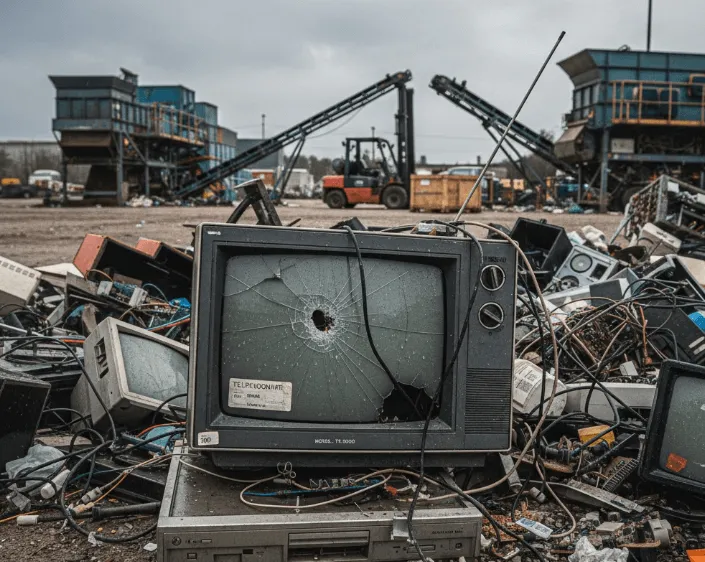
Final Thought: What a Decade of Hauling Away Old TVs Has Taught Us
After removing thousands of televisions from homes across the country since 2014 — CRTs wedged behind water heaters, flat screens leaning against garage walls for years, projection units so heavy they hadn’t moved since installation — we’ve reached a conclusion the data supports but doesn’t fully capture:
The biggest barrier to responsible TV disposal isn’t willingness. It’s friction.
Most people want to do the right thing. They know TVs don’t belong in landfills. They’ve heard about lead in CRTs and mercury in flat screens. But when the process involves all of this:
- Researching local e-waste regulations
- Finding a certified drop-off site with limited hours
- Loading a 150-pound television into your car
- Hoping the facility actually accepts your specific TV type
Most people do what’s easiest. They store it. They push it to the back of a closet, a basement corner, or a garage shelf. And it stays there — sometimes for years.
Who We Actually Meet on the Job
The homes we service aren’t filled with careless people. They’re filled with:
- Busy families running out of space
- Aging parents downsizing after decades in the same home
- Professionals managing estate cleanouts on tight timelines
- First-time homeowners who inherited someone else’s problem
The old TV in the basement isn’t lazy. It’s a symptom of a disposal system that was never designed with the average homeowner in mind. That’s the gap we set out to fill when we started Jiffy Junk.
Our Opinion — Informed by Over a Decade of Direct Experience
Any company can load a truck. What matters is what happens after the truck leaves your driveway:
- Where do the materials go? Are they recycled through certified channels?
- Are functional items donated to people and organizations that can use them?
- Or does everything end up in the nearest landfill because it’s cheaper and faster?
We chose the harder path early on, and we’ve never regretted it:
- We invested in partnerships with certified e-waste recyclers in every market we serve
- We built donation relationships with local organizations nationwide
- We trained our teams to handle hazardous materials properly — not because regulations forced us to, but because we saw the alternative up close
What We Believe
If you make responsible disposal as easy as irresponsible disposal, people will choose the right option every time. That’s the principle behind our White Glove Treatment.
You shouldn’t have to:
- Become an expert in e-waste regulations
- Spend your Saturday driving to a recycling center
- Wonder whether your old TV is being handled responsibly
You should be able to:
- Book a pickup in 60 seconds
- Point to what needs to go
- Trust that a trained, licensed, insured team handles the rest — from the heavy lifting to the final destination of every component
What This Page Comes Down To
The statistics we’ve shared paint a clear picture:
- Millions of tons of electronics are still being landfilled every year
- The average home is overflowing with outdated devices
- The recycling infrastructure exists, but remains underutilized because the path from consumer to recycler is too complicated for most people
Our job — the one we chose and the one we show up for every day — is to be the bridge between those two realities.
If you’ve been staring at an old TV wondering what to do with it, you’re not alone. And you don’t have to figure it out yourself. That’s what we’re here for.
FAQ on “TV Disposal Near Me”
Q: Can I put an old TV in the trash or leave it at the curb for regular pickup?
A: In most areas, no. Old televisions contain hazardous materials like lead and mercury that are banned from standard curbside collection in many states.
What we’ve seen happen when customers try the curb route:
- TVs left sitting for a week or more with no pickup
- Violation notices taped to the screen
- Fines ranging from $50 to over $1,000, depending on local regulations
- Customers who’ve been fined multiple times before finally call us
Q: How much does it cost to have an old TV picked up and disposed of?
A: Costs vary based on TV type, quantity, and location. But after running thousands of these jobs, here’s what we know for certain: the number-one pricing frustration customers share with us is hidden fees.
Common surprise charges from other companies that we’ve heard about:
- Stairway surcharges
- Weight-based add-ons
- Distance-to-truck fees
- Disposal surcharges are added on the day of service
How we built our pricing to eliminate that experience:
- Transparent, upfront quote before any work begins
- What we quote is what you pay — period
- Volume-based pricing, so you can bundle your TV with other items in one appointment
- No per-item charges are adding up unexpectedly
What we’ve observed: Customers who bundle a full electronics cleanout consistently feel they got better value than those who schedule single-item pickups.
Q: What types of TVs do you accept for removal and recycling?
A: Every type. No restrictions on brand, size, age, condition, or technology. After more than a decade, we’ve removed just about every make and model ever manufactured.
What our teams handle regularly:
- CRT televisions — heavy tube-style sets that are the most difficult to dispose of. We’ve carried them out of finished basements, up narrow staircases, and through doorways that seemed physically impossible.
- Flat screen TVs — LCD, LED, OLED, and plasma. Lighter than CRTs but still require certified e-waste recycling for internal components.
- Projection and big screen TVs — oversized rear-projection units that won’t fit in a standard vehicle. We’ve removed hundreds of these.
- Broken or non-functional TVs — cracked screens, dead power supplies, water damage. If you want it gone, we’ll take it.
A pattern we’ve noticed over the years: Customers rarely have just one TV to get rid of. By the time they call, there are usually two or three — plus old cables, a monitor, and a box of forgotten devices. We’re ready for all of it.
Q: What happens to my old TV after Jiffy Junk picks it up?
A: Your old TV doesn’t end up in a landfill. Every television we collect goes to one of two destinations:
- Certified e-waste recycling facilities — where TVs are broken down into recoverable materials like glass, copper, plastics, and circuit boards for repurposing
- Local donation organizations — where functional TVs in good condition are redistributed to families, schools, and community centers
Why this matters to us personally: We built these partnerships into our process back when we were still a small operation on Long Island. On some of our earliest jobs, we visited transfer stations and saw first-hand how much perfectly recoverable material was being crushed and buried because no one had separated it. That stuck with us.
How we operate today:
- Every market we serve has certified recycling and donation partners in place before we take our first job there
- Responsible disposal isn’t an afterthought — it’s the foundation of how we work
- We track material routing so we can stand behind our eco-friendly commitment
Q: Do I need to disconnect or move the TV before your team arrives?
A: No — and we’d actually prefer you didn’t try. This is something we feel strongly about based on years of experience. Old TVs — especially CRTs — are heavy, awkward, and dangerous if you’re not trained to handle them.
Why we recommend leaving it to us:
- CRT glass contains lead and can expose sharp edges if cracked
- A standard CRT can weigh 150–200 pounds
- We’ve seen customers injure their backs trying to move a set of stairs before we arrived
What our White Glove Treatment covers:
- Disconnect — we detach the TV from cables, mounts, or entertainment systems
- Carry out — from wherever it sits (basement, attic, upstairs bedroom, wall mount)
- Load — safely onto our truck using proper equipment and lifting techniques
- Clean up — the area is left free of dust, debris, and cable clutter
Jobs we’ve handled that prove no situation is too difficult:
- CRTs down spiral staircases
- Flat screens out of third-floor walkup apartments
- Wall-mounted TVs untouched since original installation
- Projection units in rooms with no clear path to an exit
No matter where it is or how heavy it is, we’ve almost certainly done this exact job before.
Ready to Get That Old TV Out of Your Life? Book Your Pickup Today
Whether it’s a heavy CRT in the basement, a broken flat screen in the garage, or a full electronics cleanout, Jiffy Junk makes TV disposal and recycling effortless with our White Glove Treatment — no heavy lifting, no drop-off lines, no guesswork Book online in 60 seconds or call 844-JIFFY-JUNK (844-543-3966) for a free, no-obligation quote and let us handle the rest.