Spring Cleaning Checklist, Tips, and Guide: How to Deep Clean and Declutter Your House Room by Room
After a decade of hauling away thousands of homes’ worth of clutter, our Jiffy Junk teams have seen firsthand what works — and what doesn’t — when it comes to a successful spring cleanout. The number one mistake we see? Homeowners trying to clean and declutter at the same time, burning out before they ever reach the garage.
This room-by-room guide is built from what we’ve learned on the job. You’ll get a practical deep-cleaning checklist, decluttering strategies our crews recommend to customers every day, and a clear system to keep the project from becoming overwhelming. And when you uncover the bulky, heavy, or just plain unwanted items that every home seems to be hiding, our fully licensed and insured teams are ready to handle the rest with our signature White Glove Treatment — including donating and recycling your items whenever possible.
TL;DR: Quick Answers
Spring Cleaning Checklist
A spring cleaning checklist is a room-by-room guide for deep cleaning and decluttering your entire home. After thousands of residential cleanouts, our Jiffy Junk teams recommend this streamlined approach:
Before you start:
- Gather all supplies — bags, cleaners, labels, boxes
- Set up donation and disposal options in advance
- Assign one room per session to prevent burnout
The process (per room):
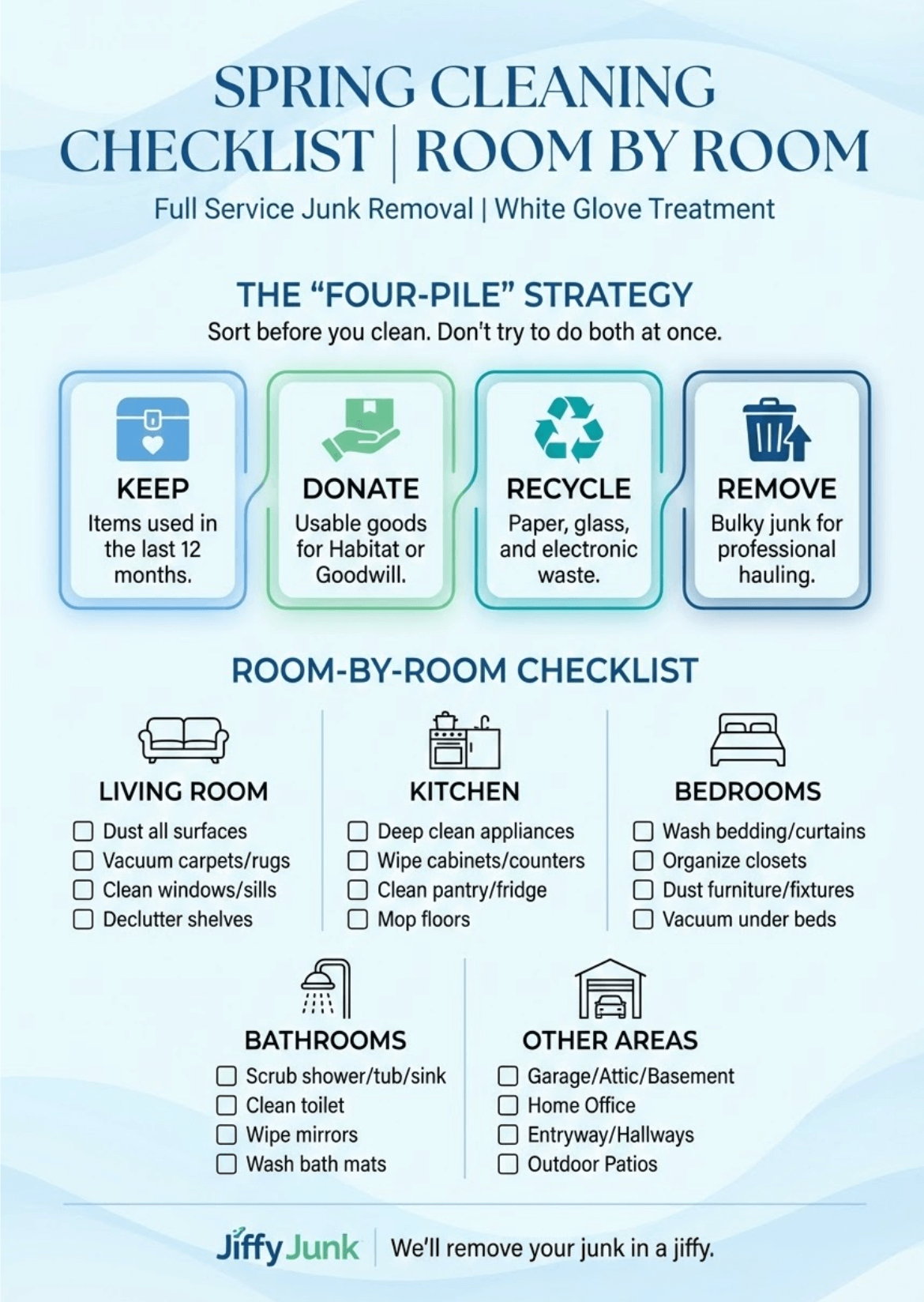
- Declutter first — sort everything into four piles: Keep, Donate, Recycle, Remove
- Work top to bottom — dust high surfaces before cleaning floors
- Deep clean the space — scrub, sanitize, and organize what stays
Room order that works best:
- Bathrooms and bedrooms (quick wins)
- Kitchen (highest hidden clutter)
- Living and family rooms
- Garage, attic, and basement (heaviest volume — save for last)
Items that need special handling:
- Expired medications →EPA drug take-back locator
- Paint, batteries, chemicals →EPA hazardous waste guide
- Bulky furniture, appliances, mattresses → professional junk removal
The insight most checklists miss: The biggest obstacle to a successful spring cleanout isn’t the cleaning — it’s not having a plan for what to do with everything you uncover. Solve the disposal question first, and the rest falls into place.
Need help with the heavy stuff? Jiffy Junk’s licensed and insured teams provide full-service removal with our signature White Glove Treatment — including donation and recycling of usable items.
Top Takeaways
Everything you need to know from this guide — at a glance.
The Core Insight
Declutter first. Deep clean second. After thousands of residential cleanouts, this is the single biggest difference-maker we see between projects that succeed and projects that stall.
5 Things to Remember
- Work room by room — tackling the whole house at once leads to burnout
- Sort before you scrub — use the four-pile system: Keep, Donate, Recycle, Remove
- Plan your disposal — know where donations, hazardous waste, and bulky items will go before you start
- Don’t underestimate the volume — a thorough cleanout produces far more material than regular curbside pickup can handle
- Schedule junk removal for the heavy stuff — furniture, appliances, mattresses, and renovation debris require professional hauling
By the Numbers
- 4.9 lbs — average waste generated per person, per day in the U.S.
- 600M tons — construction and demolition debris generated annually, more than double household waste
- 124,000+ tons — goods diverted from landfills by Habitat for Humanity ReStores
Table of Contents
- Spring Cleaning Checklist, Tips, and Guide: How to Deep Clean and Declutter Your House Room by Room
- TL;DR: Quick Answers
- Top Takeaways
- Why a Room-by-Room Approach Works Best
- Living Room and Family Room
- Garage, Attic, and Basement
- Your Spring Cleaning Checklist at a Glance
- When It’s Time to Call in the Pros
- 7 Resources We Recommend to Make Your Spring Cleanout Easier, Greener, and Stress-Free
- Supporting Statistics: What the Numbers Tell Us (And What We See on the Ground)
- Final Thought: The Real Secret to a Successful Spring Cleanout
- FAQ on “Spring Cleaning Checklist”
- Your Spring Cleaning Checklist Is Ready — Let Jiffy Junk Handle the Heavy Lifting
Why a Room-by-Room Approach Works Best
From our experience clearing out homes of every size, the fastest way to lose momentum during a spring clean is trying to tackle everything at once. A room-by-room approach keeps the project focused and gives you visible wins early — which is what keeps most homeowners going through the tougher spaces like basements and garages.
Work through each room in order, and sort as you go: keep, donate, recycle, or remove. If an item hasn’t been used in over a year, our crews find that most customers never miss it once it’s gone.
Kitchen
The kitchen collects more hidden clutter than almost any other room. Start by pulling everything out of cabinets and drawers — expired pantry items, duplicate gadgets, chipped dishware, and old storage containers missing their lids are the usual culprits.
Deep-clean priorities:
- Degrease the range hood, stovetop, and oven interior
- Clean behind and beneath the refrigerator
- Wipe down cabinet interiors and replace shelf liners
- Sanitize the dishwasher and garbage disposal
- Scrub tile grout and backsplash
Pro tip from our teams: Broken or outdated small appliances are some of the most common items we haul out of kitchens. If it doesn’t work or hasn’t been plugged in within the past year, it’s time to let it go.
Living Room and Family Room
Living areas tend to accumulate oversized items — worn-out furniture, outdated electronics, stacks of old magazines — that are easy to ignore because they’ve blended into the background.
Deep-clean priorities:
- Vacuum and shampoo upholstery and carpets
- Dust ceiling fans, light fixtures, and window treatments
- Clean windows inside and out
- Wipe down baseboards and door frames
- Move furniture to clean underneath
Decluttering focus: Be honest about furniture that’s seen better days. A sagging couch or scratched coffee table you’ve been meaning to replace is the kind of bulky item that stalls a cleanout — and exactly what our White Glove Treatment is designed to handle.
Bedrooms
Bedrooms are where clothing clutter thrives. The closet is the place to start, and the simplest rule still holds: if you haven’t worn it in a year, donate it.
Deep-clean priorities:
- Wash all bedding, including mattress protectors and pillow covers
- Rotate or flip your mattress
- Dust and wipe down all furniture surfaces
- Vacuum under the bed and inside closets
- Clean mirrors, light switches, and door handles
Pro tip from our teams: Mattresses are one of the trickiest items for homeowners to get rid of on their own. We remove old mattresses every day — no need to wrestle one down the stairs yourself.
Bathrooms
Bathrooms are small but demand serious scrubbing. They’re also magnets for expired products that quietly take over every drawer and shelf.
Deep-clean priorities:
- Scrub and disinfect the toilet, tub, and shower tile
- Remove and treat mildew or mold in grout and caulk
- Clean exhaust fan and light fixtures
- Descale faucets and showerheads
- Organize cabinets and discard expired medications, cosmetics, and products
Keep in mind: Many expired medications and certain personal care products require special disposal. Check your local guidelines or set them aside — our teams can advise you on responsible removal options.
Garage, Attic, and Basement
These are the spaces homeowners dread most, and for good reason. After years of “just put it out there” decisions, garages, attics, and basements become storage graveyards for broken furniture, old paint cans, outgrown sports equipment, and boxes that haven’t been opened since the last move.
Deep-clean priorities:
- Sweep and mop concrete floors; check for moisture or cracks
- Dust shelving, rafters, and exposed surfaces
- Inspect for pest activity or water damage
- Test and organize tools, holiday décor, and seasonal gear
- Clear pathways and reclaim usable space
This is where professional junk removal pays for itself. In our experience, garages and basements account for the largest volume of items we remove in a single visit. Rather than making dozens of trips to the dump yourself, our crews can clear the space in one appointment — and we’ll sort items for donation and recycling so usable goods get a second life.
Your Spring Cleaning Checklist at a Glance
Use this quick-reference checklist to stay on track:
- Set your schedule — assign one room per session to avoid burnout
- Gather supplies first — cleaners, bags, boxes, and labels
- Sort before you scrub — declutter each room, then deep clean
- Work top to bottom — dust and clean high surfaces before floors
- Tackle one drawer, shelf, or closet at a time — small wins build momentum
- Create a donation pile as you go — bag it and box it immediately
- Schedule junk removal for the heavy stuff — don’t let bulky items stall your progress
When It’s Time to Call in the Pros
A spring cleanout almost always uncovers more than you expected — old furniture, broken appliances, construction leftovers, electronics, and piles of miscellaneous items that won’t fit in your weekly curbside pickup.
That’s exactly what Jiffy Junk is here for. Our fully licensed and insured teams handle items of every size, and we’re committed to recycling and donating whenever possible. No heavy lifting, no multiple dump runs, no guessing what goes where. Just point to what needs to go, and we take care of everything.
“After removing over a million items from homes across the country, we’ve learned that the biggest obstacle to a successful spring cleanout isn’t the cleaning itself — it’s the stuff standing in your way. Clear the clutter first, and the deep clean practically takes care of itself.” — Jiffy Junk Team
7 Resources We Recommend to Make Your Spring Cleanout Easier, Greener, and Stress-Free
Here’s what we’ve learned after a decade of full-service junk removal: the cleanout itself isn’t what slows people down. It’s the moment you’re standing in your garage holding a can of old paint or staring at a couch you can’t lift alone, wondering, “Now what?”
We’ve put together the resources our teams point customers to most often. Bookmark these before you start — they’ll save you time and help make sure your unwanted items end up in the right place.
1. Find a Recycling Center for Any Material Near You
Earth911 Recycling Search
Not sure where to take old batteries, electronics, or leftover construction materials? Earth911 lets you enter the material and your zip code to find local recycling options. Their database covers over 350 materials and 100,000+ listings across North America — so you can recycle responsibly without spending your afternoon searching.
We’re committed to eco-friendly disposal on every job, and this is one of the tools that helps us — and you — get it right.
Resource: Earth911 Recycling Search
2. Safely Dispose of Hazardous Household Products
EPA Household Hazardous Waste Guide
Old paint, solvents, pesticides, and harsh cleaners can’t go in your regular pickup — and our crews see them tucked away in garages and basements on nearly every job. The EPA’s guide walks you through how to safely manage these items and find local disposal and recycling options, including natural alternatives.
When in doubt, set these items aside. Our team can help you figure out the best way to handle them.
Resource: EPA Household Hazardous Waste Guide
3. Get Rid of Expired Medications the Right Way
EPA Medication Disposal Guide
Bathroom cleanouts almost always uncover expired prescriptions and old over-the-counter products. Please don’t flush them or toss them in the bin. The EPA recommends drug take-back programs as the safest and most environmentally protective way to dispose of unwanted household medicines. Their page connects you to year-round collection sites and the DEA’s twice-yearly National Take-back Days in April and October.
This is one of those small steps that makes a real difference — for your home and your community.
Resource: EPA Household Medication Disposal
4. Donate Clothing, Housewares, and Electronics Locally
Goodwill Donation Center Locator
If it’s still in good shape, someone else can use it. That’s the philosophy we bring to every Jiffy Junk job — we donate and recycle items whenever possible. Goodwill makes it simple to do the same on your own. They accept clothing, household goods, electronics, and furniture, with donations directly supporting job training and employment placement programs in your community.
Drop off your items and pick up a tax-deductible receipt on the spot. Easy.
Resource: Goodwill Donation Center Locator
5. Donate Furniture, Appliances, and Building Materials to Build Homes
Habitat for Humanity ReStore
That old dresser or stack of leftover tiles from your renovation? They could help a family build a home. Habitat ReStores divert hundreds of tons from landfills each year, accepting furniture, appliances, and surplus building materials — and many locations offer free pickup for large items.
Our teams love knowing that the items we help clear out of your space can end up making a difference somewhere else. This is one of the best ways to make that happen.
Resource: Habitat for Humanity ReStore Donations
6. Schedule a Free Donation Pickup for Large Items
The Salvation Army Pickup & Drop-Off Locator
Got more to donate than your car can handle? We know the feeling — it’s what we do every day. For the items you’d like to donate yourself, The Salvation Army makes it simple. Enter your zip code to find pickup services and drop-off locations nearest you. They accept furniture, working appliances, clothing, and household goods, and they’ll come right to your door.
And if your donation pile turns into something bigger than expected? That’s exactly when our White Glove Treatment comes in handy. Just point to what needs to go, and we’ll handle everything — including sorting items for donation and recycling.
Resource: The Salvation Army Pickup & Drop-Off Locator
7. Get Expert Room-by-Room Cleaning Techniques
HGTV Spring Cleaning Checklist
We’re junk removal experts — but we know a great cleaning resource when we see one. Once you’ve cleared the clutter (with or without our help), you’ll want a solid plan for the deep clean. HGTV’s expert-backed checklist covers every room inside and out, with tips and product recommendations designed to cut down on dust and allergens ahead of allergy season.
Pair it with our decluttering guide above for a complete clean-and-clear system.
Resource: HGTV Spring Cleaning Checklist
Supporting Statistics: What the Numbers Tell Us (And What We See on the Ground)
After a decade of full-service junk removal, we’ve developed a clear picture of what comes out of American homes every spring. The data from federal agencies and national nonprofits confirms what our crews experience on the job every day.
Here are three statistics that shaped how we approach every cleanout — and why they should shape yours too.
1. Nearly 5 Pounds of Waste Per Person, Per Day
The EPA reports that U.S. municipal solid waste generation reached 292.4 million tons in 2018 — roughly 4.9 pounds per person per day.
Spring cleaning multiplies that number overnight. On a typical Jiffy Junk job, we remove more from a single home in one visit than that household would produce in weeks of regular trash pickup.
What we see on the ground:
- Garages collecting “I’ll deal with it later” items since 2019
- Basements full of boxes from a move three houses ago
- Attics nobody’s opened in a decade
Most homeowners significantly underestimate how much material a thorough cleanout produces. Our advice: have a disposal plan before you start pulling items off shelves — not after you’re surrounded by things that won’t fit in your curbside bin.
Source: EPA — National Overview: Facts and Figures on Materials, Waste and Recycling
2. Renovation Debris Generates Over Twice the Waste of Regular Household Trash
The EPA estimated that 600 million tons of construction and demolition debris were generated in the U.S. in 2018 — more than double the amount of municipal solid waste.
Most people don’t associate spring cleaning with construction debris. Our teams know better. A surprising number of cleanouts involve leftover renovation materials that never got properly removed:
- Stacked drywall scraps in the garage
- Old cabinet doors leaning against the basement wall
- Tile and grout from a bathroom remodel that finished two years ago
Why this matters for your cleanout:
- Renovation leftovers are heavier, bulkier, and harder to dispose of than typical household items
- You can’t put old drywall or broken tile in your recycling bin
- However, many of these materials — concrete, metal, wood — are highly recyclable when sorted correctly
Our crews are trained to identify and separate construction materials on every job. It’s a behind-the-scenes detail that makes a real difference in how much of your cleanout ends up in a landfill versus being put back to use.
Source: EPA — Construction and Demolition Debris: Material-Specific Data
3. One Nonprofit Network Has Diverted 124,000+ Tons from Landfills
Habitat for Humanity’s ReStore locations have diverted more than 124,000 tons of goods from landfills — turning donated furniture, appliances, and building materials into funding for affordable housing.
That number resonates with us because we see the donation side of this equation on almost every job. Items we commonly route to donation rather than disposal include:
- Functional dining tables and furniture that no longer fit the space
- Working appliances being replaced by upgrades
- Kitchen cabinets and fixtures pulled during remodels
These aren’t junk — they’re resources. We built donation and recycling into our process from day one, not as a marketing claim, but as a core part of how we operate.
The takeaway: When the systems are in place to redirect usable goods, the impact compounds fast. Habitat’s 124,000-ton figure proves what we’ve always believed — most of what people throw away doesn’t need to be thrown away at all.
Source: Habitat for Humanity — 25 Years of Facts and Finds

Final Thought: The Real Secret to a Successful Spring Cleanout
After more than ten years and thousands of residential cleanouts, we’ve come to a conclusion that might surprise you: spring cleaning isn’t really about cleaning at all. It’s about making decisions.
Every cluttered garage, overflowing closet, and neglected basement we walk into tells the same story. The homeowner didn’t run out of cleaning supplies or motivation. They ran out of answers for what to do with everything they uncovered:
- The broken treadmill no one knows how to dispose of
- The kids’ outgrown furniture that’s too bulky to move alone
- The five half-empty paint cans from a renovation three years ago
These items don’t have an obvious next step — so they sit, they accumulate, and they turn a weekend project into something that feels impossible. That’s the real obstacle, and it’s the one most spring cleaning guides completely ignore.
What We’ve Learned on the Job
The single most impactful thing you can do before touching a sponge or a mop is make a plan for your stuff. Not a cleaning plan — a decision plan.
Before you start, answer three questions:
- Where will donations go? Identify your drop-off location or schedule a pickup in advance.
- Who handles the bulky and heavy items? Know your options before you’re stuck with a couch in the hallway.
- What qualifies as hazardous waste? Old paint, expired medications, and harsh chemicals all require special disposal.
Answer those questions first, and the rest of the cleanout falls into place faster than most people expect.
Why We Built This Guide the Way We Did
Every section of this page maps to that principle:
- The room-by-room checklist gives you a system to work through your home without getting overwhelmed
- The resources section gives you the tools to dispose of items responsibly — recycling, donation, and safe disposal
- The statistics show why it matters — not just for your home, but for your community and the environment
And when the job gets bigger than one person or one family can handle alone, that’s exactly what our White Glove Treatment was designed for.
The Pattern We See in Every Market We Serve
Homeowners who separate the decluttering decision from the cleaning process consistently:
- Finish faster
- Feel less overwhelmed
- End up with results that last longer
The homes that stay clutter-free aren’t the ones that got the deepest scrub. They’re the ones where the homeowner finally dealt with the stuff that had been quietly piling up for years.
Spring Is Your Permission to Let Go
Not because the calendar says so — but because a fresh season gives you the push to release things that are no longer serving you. Thoughtfully. Responsibly. And maybe even a little bit satisfyingly.
We’d love to help you get there. And if you hit the point where you’re standing in your garage thinking, “this is more than I can handle” — that’s not failure. That’s the exact moment we exist for.
FAQ on “Spring Cleaning Checklist”
Q: What is the best order to spring-clean your house?
A: After cleaning out thousands of homes, we’ve found that room order matters more than most people realize.
The sequence that works best:
- Start small — a bathroom or single bedroom creates quick, visible momentum
- Move to high-traffic rooms — kitchen and living areas next
- Finish with storage spaces — garage, attic, and basement last
Why this order works: Storage-heavy spaces consistently produce the largest volume of items — often more than the rest of the house combined. Tackling them last lets you accumulate your “Remove” pile from every room and have everything hauled in a single pickup.
The number one mistake we see: Trying to clean and declutter at the same time. Sort and clear the room first. Deep clean the space second. That one change in sequence is the difference between a project that stalls and one that gets finished.
Q: How long does a full spring cleaning take?
A: Most households need two to three weekends for a thorough room-by-room cleanout. That’s realistic — not slow.
What works:
- Assign one room per session
- Give your hardest spaces — garage, basement, attic — their own dedicated day
- Build in one extra day specifically for disposal logistics
What doesn’t work: Marathon single-day attempts. We’ve watched too many customers burn out by noon on Saturday and leave the project half-finished for weeks.
What we’ve observed: Customers who schedule a disposal day from the start — donation drop-offs, recycling runs, or a Jiffy Junk appointment — finish the entire project roughly a week faster than those who figure it out as they go.
Q: What should I throw away during spring cleaning?
A: Less than you think. One of the most consistent patterns we see is homeowners defaulting to “throw it all away” when overwhelmed. But a significant portion of what comes out of most homes belongs somewhere other than a landfill.
The sorting framework our teams use on every job:
- Donate — functional furniture, lightly worn clothing, working appliances, housewares in good condition
- Recycle — cardboard, glass, plastics, metals, electronics (Earth911 finds local options by zip code)
- Special disposal — expired medications, old paint, batteries, chemicals, fluorescent bulbs
- Professional removal — bulky furniture, mattresses, broken appliances, renovation debris
The bottom line from our experience: A little upfront sorting makes the difference between a cleanout that fills a landfill and one that gives usable items a second life.
Q: What cleaning supplies do I need for spring cleaning?
A: After walking through thousands of homes mid-cleanout, we’ve noticed one clear pattern. The homeowners who finish fastest always have their supplies staged and ready before the first drawer gets opened.
The essentials:
- All-purpose cleaner, glass cleaner, disinfectant spray
- Microfiber cloths, sponges, scrub brushes
- Vacuum with attachments, mop, bucket
- Heavy-duty trash bags and recycling bags
- Boxes, labels, permanent marker (Keep, Donate, Recycle, Remove)
- Rubber gloves and a step stool
Two additions most guides won’t mention:
- Tape measure — you’ll want to measure cleared spaces for new furniture or storage
- Phone charger — you’ll drain your battery faster than expected, looking up recycling locations, photographing appliance serial numbers, and scheduling pickups
The pattern we see: Homeowners who keep supplies within arm’s reach and their phone charged move through rooms faster with less frustration. Mid-project supply runs are one of the biggest momentum killers.
Q: When should I hire a junk removal service instead of doing it myself?
A: This guide is designed to help you do as much as possible on your own. But after ten years in this business, we know exactly where the DIY approach hits its limit.
Call Jiffy Junk when:
- Items are too heavy or awkward to move safely — couches, mattresses, refrigerators, and exercise equipment cause more DIY injuries during cleanout season than most people realize
- Renovation debris is involved — drywall, tile, old cabinets, and construction leftovers require specialized disposal
- Volume exceeds expectations — what looks like “a few things in the garage” often turns out to be multiple truckloads once everything is pulled out
- Items need proper sorting — electronics, refrigerant-containing appliances, and large mixed loads all need correct handling
- You’re on a deadline — selling, moving, or preparing for an event with a hard date
The truth from our experience: Calling for help isn’t a sign the project got away from you. It’s a recognition that some items require a trained, equipped crew. That’s exactly why our White Glove Treatment exists.
Your Spring Cleaning Checklist Is Ready — Let Jiffy Junk Handle the Heavy Lifting
You’ve got the room-by-room plan to deep clean and declutter your entire house — now let our White Glove Treatment take care of the bulky items, heavy furniture, and everything in between. Book your free quote today or call 844-JIFFY-JUNK and enjoy the clutter-free space you deserve.