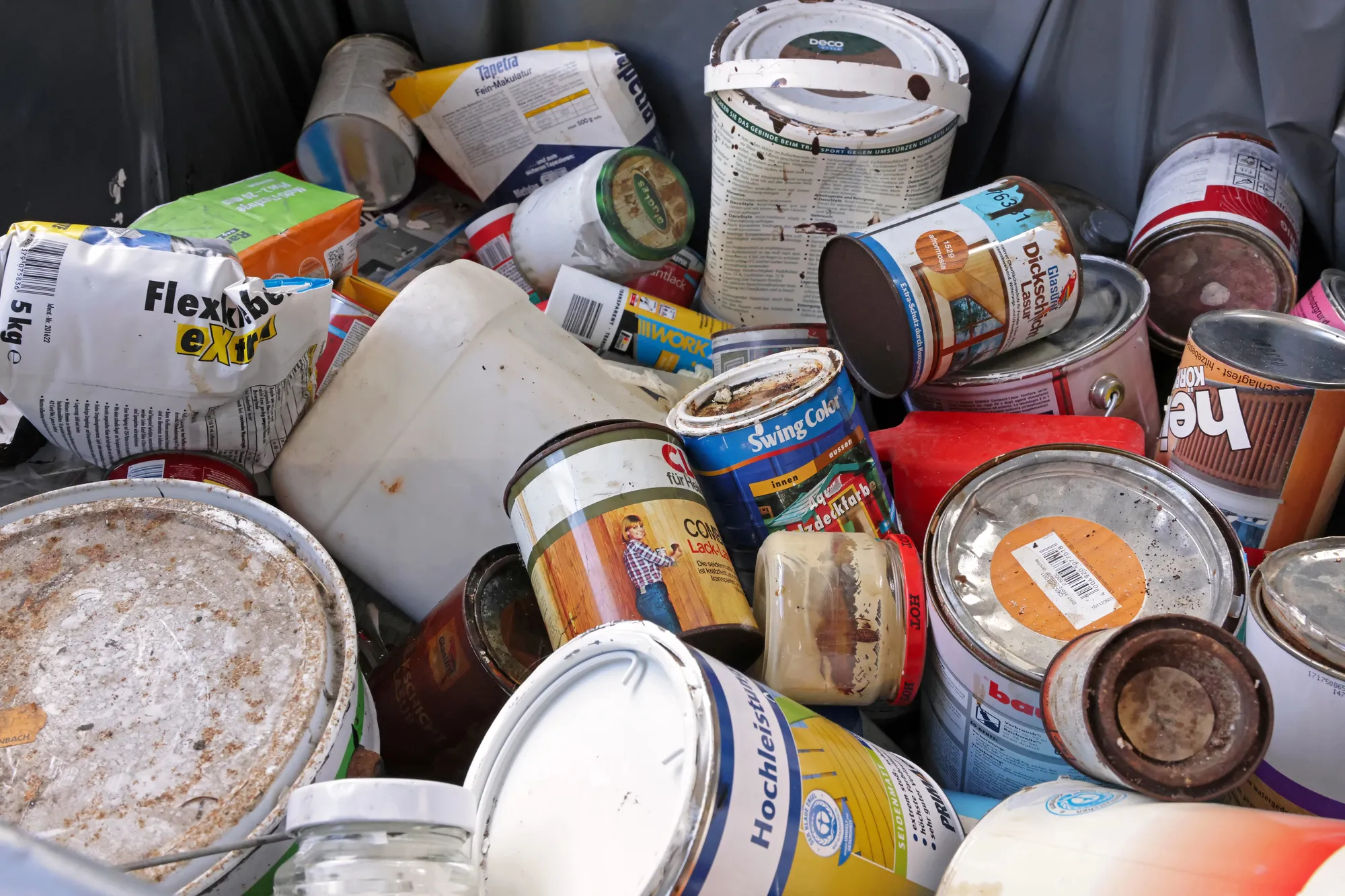
How to Dispose of Old Latex and Oil Paint at Home Safely: Where to Get Rid of Leftover Paint Cans Without Breaking Any Rules or Harming the Environment
Throwing liquid paint in the trash is illegal in most U.S. states, and plenty of homeowners find that out the hard way. Whether you’re dealing with leftover latex from a weekend refresh or oil-based cans you’ve been meaning to clear out for years, knowing how to dispose of paint properly keeps you on the right side of local laws, protects your surrounding environment, and gets those cans out of your space for good.
Since 2014, Jiffy Junk has helped homeowners and businesses nationwide reclaim their spaces with our signature White Glove Treatment. We’ve cleared stuffed garages, packed basements, and storage rooms stacked floor to ceiling with old paint cans. Here’s what this guide covers:
- The key difference between latex and oil-based paint, and why it changes everything about disposal
- Step-by-step options for safely disposing of latex paint at home
- How to legally get rid of hazardous oil-based paint
- Common mistakes that could get you into trouble
- Where to find free local disposal resources near you
TL;DR Quick Answers
How to Dispose of Paint
Start here: identify your paint type.
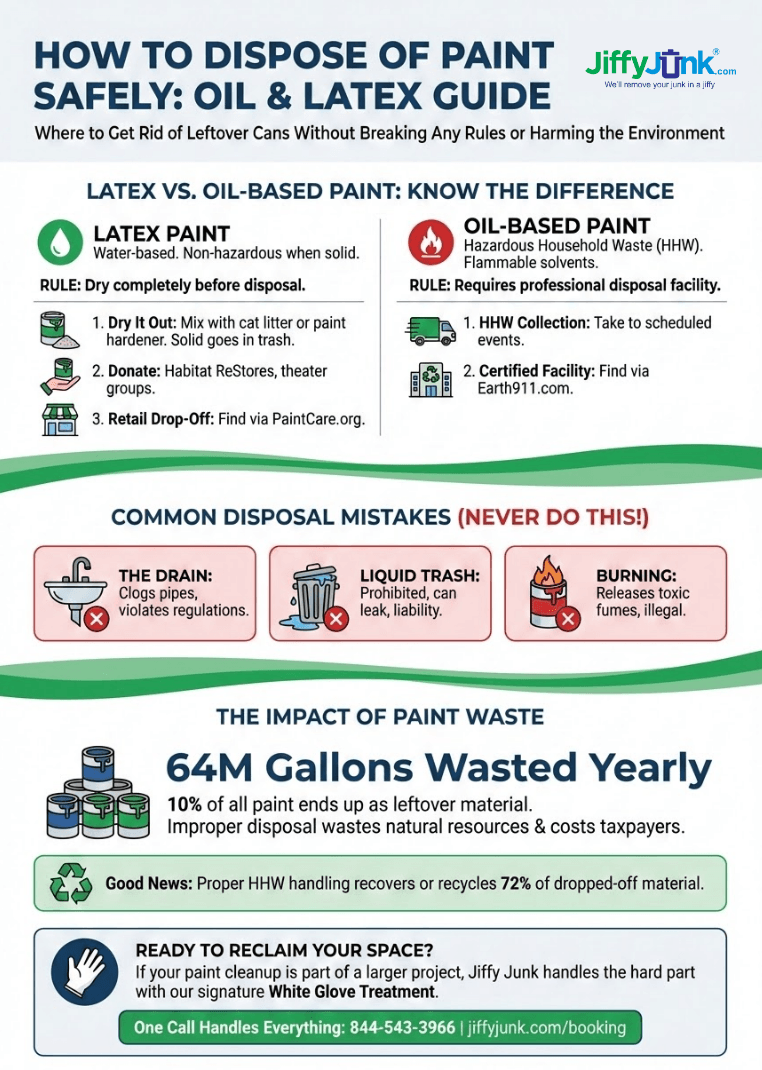
- Latex (water-based) paint: Dry it out completely with cat litter or paint hardener, then dispose of the solid material in the regular trash. You can also donate usable paint or drop it off at a PaintCare location or a hardware store recycling program.
- Oil-based paint: This is Hazardous Household Waste (HHW). Take it to a scheduled HHW collection event, a certified disposal facility, or use Earth911.com to find a free drop-off near you. Never pour oil-based paint down a drain or into the trash.
- For large quantities: Contact a licensed junk removal service like Jiffy Junk for safe, efficient removal as part of a full cleanout.
- Key rule: Never pour any paint, latex, or oil-based products down the drain or on the ground.
Top Takeaways
- Identify your paint type first. Latex and oil-based paint have completely different disposal rules. Get that one step right — everything else follows.
- Throwing liquid paint in the trash is illegal in most U.S. states. It’s not a gray area. Free, legal disposal options exist in virtually every community.
- Usable paint deserves a second life. Before you dispose, consider:
- Habitat for Humanity ReStores
- Community organizations and theater groups
- Freecycle, Facebook Marketplace, and Nextdoor
- Free drop-off is closer than you think. Three places to start:
- PaintCare.org — thousands of locations at local hardware stores
- Earth911.com — zip code search for nearby HHW facilities
- EPA.gov — directory of free state and local collection events
- One call handles everything. When paint is part of a bigger cleanout, Jiffy Junk’s licensed, insured teams manage mixed loads with our signature White Glove Treatment — no multiple trips, no coordination hassle. Call 844-543-3966 or book at jiffyjunk.com/booking. We’re not happy until you are.
Table of Contents
- How to Dispose of Old Latex and Oil Paint at Home Safely: Where to Get Rid of Leftover Paint Cans Without Breaking Any Rules or Harming the Environment
- TL;DR Quick Answers
- Top Takeaways
- Latex Paint vs. Oil-Based Paint: Why It Matters for Disposal
- How to Dispose of Latex Paint Safely at Home
- How to Dispose of Oil-Based Paint: The Safe and Legal Method
- Paint Disposal Mistakes That Could Get You in Trouble
- Where to Dispose of Old Paint: Resources by Paint Type
- When It’s Easier to Call a Junk Removal Service
- Your Complete Paint Disposal Toolkit: 7 Trusted Resources That Do the Research for You
- 1. Start Here: Find Out If Your Paint Is Actually Hazardous
- 2. Find a Free Drop-Off Location and Clear Those Cans Out Today
- 3. Know Your State’s Rules So You Stay on the Right Side of the Law
- 4. Give Usable Paint a New Home Instead of a Disposal Facility
- 5. Get the Step-by-Step Breakdown With No Confusion
- 6. Search 100,000+ Local Recycling and Disposal Locations in One Spot
- 7. See How Local Governments Spell Out the Rules Simply and Clearly
- By the Numbers: What the Data Says About Paint Disposal in America
- Final Thoughts and Opinion
- Frequently Asked Questions
- Q: Can you put paint in the trash?
- Q: How do you dispose of latex paint?
- Q: How do I get rid of oil-based paint?
- Q: Where can I dispose of old paint for free?
- Q: Is dried latex paint safe to throw away?
- Q: Can Jiffy Junk remove old paint cans?
- Q: How long can you store paint before it goes bad?
- Q: What happens if you pour paint down the drain?
- Ready to Reclaim Your Space? Let Jiffy Junk Handle the Hard Part
Latex Paint vs. Oil-Based Paint: Why It Matters for Disposal
The type of paint you have determines everything about how you dispose of it. Get that part right first, and the rest of the process is straightforward.
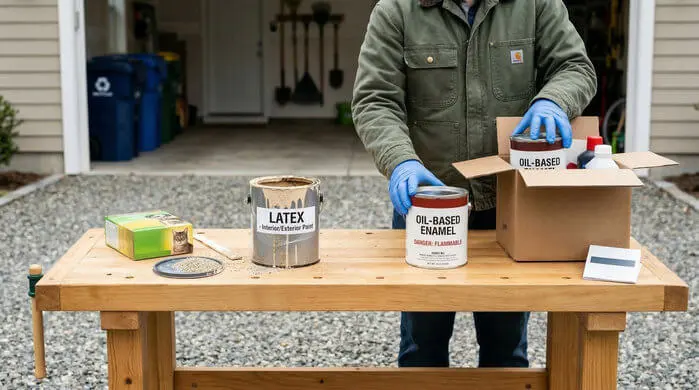
Latex paint, also called water-based paint, is the most common type in homes today. It cleans up with water, dries quickly, and once it’s fully hardened, it’s generally not classified as hazardous household waste. That opens up more disposal options for you, including the regular trash once it’s completely solid.
Oil-based paint works differently. It contains chemical solvents that make it flammable and chemically reactive, which is why most jurisdictions classify it as Hazardous Household Waste (HHW). You can’t pour it down the drain, place it in the trash, or leave it to evaporate outside. It has to go to a designated disposal facility or a scheduled collection event.
Not sure which type you have? Check the label. “Clean up with water” or “water-based” means latex. “Mineral spirits,” “turpentine,” or “clean up with solvents” means oil-based.
How to Dispose of Latex Paint Safely at Home
Latex paint gives you more flexibility than most people expect. Here are your options:
Option 1 — Let It Dry Out and Throw It Away
Once latex paint is fully dried and hardened, it can typically go in the regular trash, though rules vary by jurisdiction, so check with your local municipality before you do. To speed up the process, try one of these methods:
- Leave the lid off the can and let it air-dry completely
- Stir in cat litter or a commercial paint hardener until the mixture is solid
- Spread thin layers onto cardboard, letting each layer dry before adding the next
Once the paint is rock solid all the way through, it’s ready to go out with the regular waste. If there’s only a small amount left at the bottom, the air-dry method is usually fastest.
Option 2 — Donate or Give Away Usable Paint
If your paint is still in good condition, not separated, rancid-smelling, or frozen, there’s a better path than disposal: passing it along. At Jiffy Junk, we’d always rather see usable items find a new home than end up in a landfill.
- Habitat for Humanity ReStores accept usable latex paint donations
- Local community theater groups often welcome leftover paint for set design
- Platforms like Freecycle, Facebook Marketplace, and Nextdoor connect you with neighbors who can put it to use
- PaintCare’s paint exchange program lets you list or claim free paint near you
Option 3 — Drop It Off at a Recycling Center
Recycling drop-off is often the easiest path for leftover latex paint. PaintCare (paintcare.org) runs drop-off locations at thousands of hardware stores and retailers nationwide, many at no cost to you. Their website has a locator to find the closest spot.
- Home Depot and Lowe’s participate in paint recycling programs at many locations.
- Sherwin-Williams stores often accept paint for recycling as well
- Search PaintCare.org to find a drop-off point near you
How to Dispose of Oil-Based Paint: The Safe and Legal Method
Why Oil Paint Is Different
Oil-based paint contains solvents that are flammable, toxic to aquatic life, and capable of contaminating soil and groundwater. Pouring it down the drain can damage your plumbing and violate water treatment regulations. In most U.S. states, placing it in the regular trash is illegal. There’s no workaround: this type of paint has to go through a designated disposal program.
Hazardous Household Waste (HHW) Drop-Off Events
Your best starting point for oil paint disposal is your local municipality. Many counties and cities hold free HHW collection events several times a year where residents can drop off oil-based paint, solvents, and other regulated materials at no charge.
- Visit Earth911.com and enter your zip code to find local HHW facilities and scheduled collection events.
- The EPA’s website (epa.gov) maintains a directory of state and local HHW programs.
- Search “hazardous waste disposal paint near me” for the most current options in your area.
Certified Disposal Companies
For large quantities left behind after estate cleanouts, foreclosure properties, or commercial renovations, hauling everything to a drop-off location usually isn’t practical. That’s where professional junk removal makes the most sense. Jiffy Junk’s fully licensed and insured teams provide commercial junk removal services, handling large-scale cleanouts, including the responsible removal of unwanted materials, safely and efficiently. Just point us to what needs to go, and we take care of the rest.
Paint Disposal Mistakes That Could Get You in Trouble
Plenty of people mean well and still get this wrong. Here’s what to avoid:
- Pouring paint down the drain. Even latex paint can clog pipes over time. Oil-based paint can cause serious plumbing damage and violates water treatment regulations.
- Placing liquid paint in the trash. Most states prohibit it. Cans can tip and leak, creating a real liability for sanitation workers.
- Burning paint or paint cans. This releases toxic fumes and is illegal in virtually all residential areas.
- Storing paint indefinitely without a plan. Cans rust, seals fail, and you eventually end up with a hardened mess that’s harder to dispose of legally than liquid paint ever was.
- Treating all paint the same. Handling oil-based paint like latex can put you in violation of local regulations. Identify your type before you act.
Where to Dispose of Old Paint: Resources by Paint Type
Here are the best resources for each paint type:
For latex paint:
- PaintCare.org — drop-off locator for both latex and oil-based paint
- Home Depot, Lowe’s, and Sherwin-Williams — in-store paint recycling at participating locations
- Local municipal recycling centers — call ahead to confirm they accept latex paint
For oil-based paint:
- Earth911.com — search tool for hazardous waste facilities near you
- EPA.gov — directory of state and local HHW programs
- Your county’s environmental services department — free collection events are often listed on their website
If you’re dealing with a larger cleanout that combines old paint cans with unwanted appliances, furniture, or construction materials, a single junk removal visit is far more practical than multiple trips to multiple facilities. Jiffy Junk serves communities nationwide and handles mixed loads with one visit, one team, and zero coordination on your end.
When It’s Easier to Call a Junk Removal Service
Drop-off recycling works well for a few cans. For anything larger, here’s when it makes more sense to call Jiffy Junk directly:
- You’re clearing an estate, and there are dozens of old cans mixed in with furniture, appliances, and other belongings
- You’re managing a foreclosure property with bulk materials left behind
- Your paint is part of a larger cleanout, a garage, basement, or full home, and you need one team to handle everything
- You’re a commercial property manager dealing with leftover materials from a renovation project
- You simply don’t have time to research local drop-off locations and coordinate multiple pickups
Our licensed, insured teams bring the same White Glove Treatment to every job, whether it’s a single load or a full property cleanout. We handle the heavy lifting and make sure everything is managed responsibly, so you can get back to your clutter-free space.
“The single most common mistake we see homeowners make is assuming all paint can go in the trash the same way. Identifying your paint type first — latex versus oil-based — is the step that determines everything else, including whether disposal is a five-minute task or requires a trip to a certified facility. When in doubt, call a professional: a small amount of upfront guidance saves a lot of costly cleanup later.”
— ThJiffy Junk Operations Team
Your Complete Paint Disposal Toolkit: 7 Trusted Resources That Do the Research for You
1. Start Here: Find Out If Your Paint Is Actually Hazardous
The EPA’s Household Hazardous Waste Guide takes the guesswork out of paint classification — it tells you exactly what qualifies as HHW, what the consequences of improper disposal are, and how to find a free local collection program with your zip code.
Source: EPA Household Hazardous Waste Guide
2. Find a Free Drop-Off Location and Clear Those Cans Out Today
PaintCare’s nationwide locator makes it easy to find the closest drop-off site for your leftover latex or oil-based paint — no calls, no coordination, just enter your zip code and go.
Source: PaintCare Drop-Off Site Locator
3. Know Your State’s Rules So You Stay on the Right Side of the Law
CalRecycle’s Paint Management Program lays out exactly what California permits for latex and oil-based paint disposal — a helpful benchmark for understanding how regulations work at the state level, wherever you live.
Source: CalRecycle Paint Management Program
4. Give Usable Paint a New Home Instead of a Disposal Facility
Habitat for Humanity ReStores accept leftover paint donations at locations nationwide, keeping perfectly good materials out of landfills and putting them to work in your community — the kind of eco-friendly outcome we always look for first.
Source: Habitat for Humanity ReStore Donation Center
5. Get the Step-by-Step Breakdown With No Confusion
The Green Project’s Paint Disposal Guide walks you through identifying your paint type and covers every disposal method clearly — including what to do, and what to avoid, with latex, oil-based, and aerosol paints.
Source: The Green Project Paint Disposal Guide
6. Search 100,000+ Local Recycling and Disposal Locations in One Spot
Earth911’s paint recycling guide explains your options for both paint types and connects you to a zip code-based search tool covering more than 100,000 drop-off and recycling locations across North America — so you can find a solution near you fast.
Source: Earth911 How to Recycle Paint
7. See How Local Governments Spell Out the Rules Simply and Clearly
Durham County’s official Paint Disposal Fact Sheet is a straightforward, government-issued reference that breaks down oil-based versus latex disposal requirements — a good example of the local guidance your own municipality likely publishes, too.
Source: Durham County Paint Disposal Fact Sheet
By the Numbers: What the Data Says About Paint Disposal in America
1. An Estimated 64 Million Gallons of Leftover Paint Goes to Waste Every Year in the U.S.
After more than a decade of clearing garages, basements, and storage rooms nationwide, we see it on every job: leftover paint is one of the things people don’t know what to do with. The EPA’s numbers confirm it:
- 10% of all paint purchased in the U.S. ends up as leftover
- That adds up to approximately 64 million gallons every year
- The result: wasted natural resources, environmental risk, and thousands in municipal disposal costs passed back to taxpayers.
Source: Connecticut DEEP Paint Recycling Program
2. Paint Solvents Rank Among the Most Commonly Detected Groundwater Contaminants Across the U.S.
When customers ask us why pouring oil-based paint down the drain is such a serious concern, this is the data we point to. A U.S. Geological Survey analysis of approximately 3,500 water samples from nearly 100 aquifer studies found:
- Solvents — the same class of chemicals in oil-based paint — are among the most frequently detected groundwater contaminants in the country
- Once present, they don’t leave easily
- They migrate toward drinking-water supply wells and persist long after the source is gone
Source: U.S. Geological Survey — Volatile Organic Compounds in Groundwater
3. Proper HHW Handling Recovers or Recycles 72% of What Gets Dropped Off
On estate cleanouts and foreclosure jobs, our teams regularly find paint that sat in a garage for years because the owner didn’t know a better option existed. Data from Metro’s regional hazardous waste facilities in Oregon shows what happens when paint reaches the right facility:
- 72% of all household hazardous waste received — including paint, solvents, and coatings — is recycled, reused, or converted to fuel
- That material goes to industrial boilers and cement kilns rather than a landfill
- The overwhelming majority of what people assume is waste can be recovered — when it’s handled correctly from the start
Source: Oregon Metro — Where Hazardous Waste Goes
Final Thoughts and Opinion
Knowing your paint type is the starting point for everything else. Latex gives you real options: dry it out, donate it, or drop it off at a local recycling program. Oil-based paint takes more planning, but the process is straightforward once you know where your nearest HHW facility is. Either way, disposing of it correctly keeps you legal, protects your local environment, and clears out the space.
Jiffy Junk has been helping customers reclaim their spaces since 2014, from single-item pickups to full property cleanouts. We’re not happy until you are — that’s always been the mission. If your paint cleanup is part of a bigger project, our team can handle the whole thing in one visit.
Frequently Asked Questions
Q: Can you put paint in the trash?
A: Liquid paint generally can’t go in the trash. It can leak, and in most states it’s regulated as hazardous waste. Dried latex paint that is fully solid is typically accepted in regular household waste, but always check with your local sanitation department first. Oil-based paint must go to a designated HHW facility regardless of whether it’s dry.
Q: How do you dispose of latex paint?
A: Several options work here. Dry it out completely using cat litter, a commercial paint hardener, or by leaving the lid off until it hardens, then place it in the regular trash once fully solid. You can also donate usable paint to organizations like Habitat for Humanity ReStores, or drop it off at a PaintCare location or a participating hardware store recycling program.
Q: How do I get rid of oil-based paint?
A: Oil-based paint is classified as hazardous household waste and has to go to a designated HHW drop-off event or a certified disposal facility. Never pour it down the drain or place it in the trash. It’s flammable and can contaminate soil and water. Use Earth911.com or your county’s environmental services website to find a free local option near you.
Q: Where can I dispose of old paint for free?
A: Many municipalities hold free HHW collection events throughout the year where you can drop off both latex and oil-based paint at no charge. Hardware stores like Home Depot and Lowe’s participate in free paint recycling programs at many locations. PaintCare.org has a drop-off locator to help you find free options quickly.
Q: Is dried latex paint safe to throw away?
A: In most jurisdictions, yes. Once latex paint is completely dried and hardened, it’s typically no longer classified as hazardous waste and can go in the regular trash. It’s still worth checking with your local waste management authority, since rules vary by region.
Q: Can Jiffy Junk remove old paint cans?
A: Jiffy Junk specializes in full-service junk removal, including large-scale cleanouts that may involve old paint cans, solvents, and a wide range of other unwanted items. Contact our team directly for guidance on what we can accept in your area. We’re here to make the process as easy as possible.
Q: How long can you store paint before it goes bad?
A: Latex paint stored properly, tightly sealed in a climate-controlled space away from extreme heat or freezing temperatures, can remain usable for two to ten years. Oil-based paint may last up to 15 years under the same conditions. If the paint smells rancid, has developed a thick skin, or has separated beyond re-mixing, it’s time to dispose of it.
Q: What happens if you pour paint down the drain?
A: Pouring paint down the drain, especially oil-based paint, can cause serious problems. It can damage your plumbing over time, clog municipal sewer systems, and violate local environmental regulations. Oil-based paint is particularly harmful because its solvents can contaminate local water supplies. Always use designated disposal methods to protect your home and your community.
Ready to Reclaim Your Space? Let Jiffy Junk Handle the Hard Part
Got more to clear out beyond the paint cans? Our fully licensed and insured teams are ready to tackle the whole job with our signature White Glove Treatment. Call us at 844-543-3966, book online at jiffyjunk.com/booking, or get a free quote. We’re not happy until you are!