Dumpster Rental vs Junk Removal: Which Is Better? A Cost Comparison and Guide to When to Choose Each Option for Your Project
On most weekdays, the first calls to our dispatchers sound the same. Someone has a garage that their car no longer fits in, a kitchen mid-remodel, or a home they need empty by Friday. The items need to go. The question is whether a dumpster or a junk removal crew gets them there faster and cheaper.
The answer shifts with the project, and reaching it takes about thirty seconds. Because we run both services nationwide, the honest path to that answer doesn’t favor one over the other.
TL;DR Quick Answers
Dumpster Rental Vs. Junk Removal: Which Should I Choose?
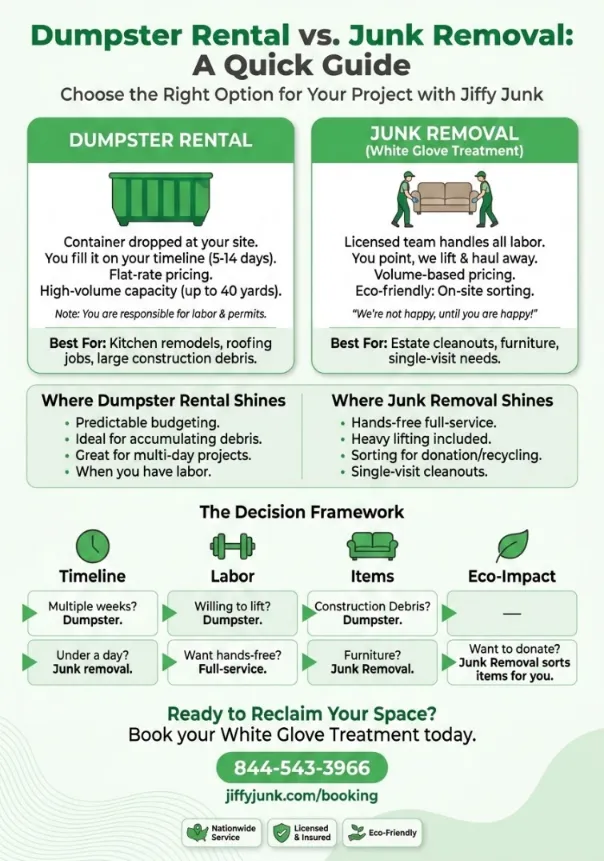
Rent a dumpster when your project runs multiple days, produces construction debris, and you’ve got the help to load it yourself. Book full-service junk removal when you want a single-visit cleanout, need a crew for heavy lifting, or want your items sorted for donation and recycling instead of trucked to the landfill.
The short version:
- Dumpster rental wins on flat-rate pricing for big, multi-day jobs.
- Junk removal wins on speed, convenience, and eco-friendly disposal.
- The average junk removal job runs about $75 to $800, depending on volume. Dumpster rentals typically run $250 to $750 per container.
- Junk removal is the better fit for single items, furniture, appliances, and estate cleanouts. Dumpsters are a stronger fit for kitchen remodels, roofing jobs, and large construction projects.
- With Jiffy Junk, you can book either service. Our White Glove Treatment comes standard on every full-service job.
Top 5 Takeaways
- The right answer depends on your project. Each service has a clear best use case. Match the method to the situation.
- Labor is the biggest difference. With a dumpster, you do the loading. With junk removal, our crew does it all.
- Cost tracks project size. Small cleanouts: junk removal usually wins on total cost. Large multi-day renovations: dumpsters win per cubic yard.
- Junk removal includes donation and recycling. Dumpsters usually skip both steps. Our crews sort and route items to donation and recycling partners before anything heads to the landfill.
- Both services can pair. For renovations with construction debris alongside household items, a dumpster plus a junk removal visit often makes the most sense.
Table of Contents
- Dumpster Rental vs Junk Removal: Which Is Better? A Cost Comparison and Guide to When to Choose Each Option for Your Project
- TL;DR Quick Answers
- Top 5 Takeaways
- What Is A Dumpster Rental?
- What Is Full-Service Junk Removal?
- The Real Cost Comparison: Dumpster Rental Vs. Junk Removal
- Real-World Pricing From Our Markets
- When To Choose Each: A Simple Decision Framework
- Why Many Projects Use Both
- Essential Resources On Dumpster Rental Vs. Junk Removal
- 1. Schedule A Free Furniture Donation Pickup Through Habitat ReStore
- 2. Check Goodwill’s Donation Guide Before Booking Any Hauler
- 3. Find An ENERGY STAR Recycling Program For Your Old Appliances
- 4. Run Your Items Through The CPSC Recall Database Before You Donate
- 5. Learn How The Waste Industry Actually Works With SWANA
- 6. Use Keep America Beautiful To Find Local Recycling Drop-Offs
- 7. Read NRDC On What Your Cleanout Really Costs The Planet
- Supporting Statistics: What The Data Actually Shows
- Final Thoughts And Opinion
- Frequently Asked Questions
- Ready to Reclaim Your Space? Let’s Help You Choose the Right Option.
What Is A Dumpster Rental?
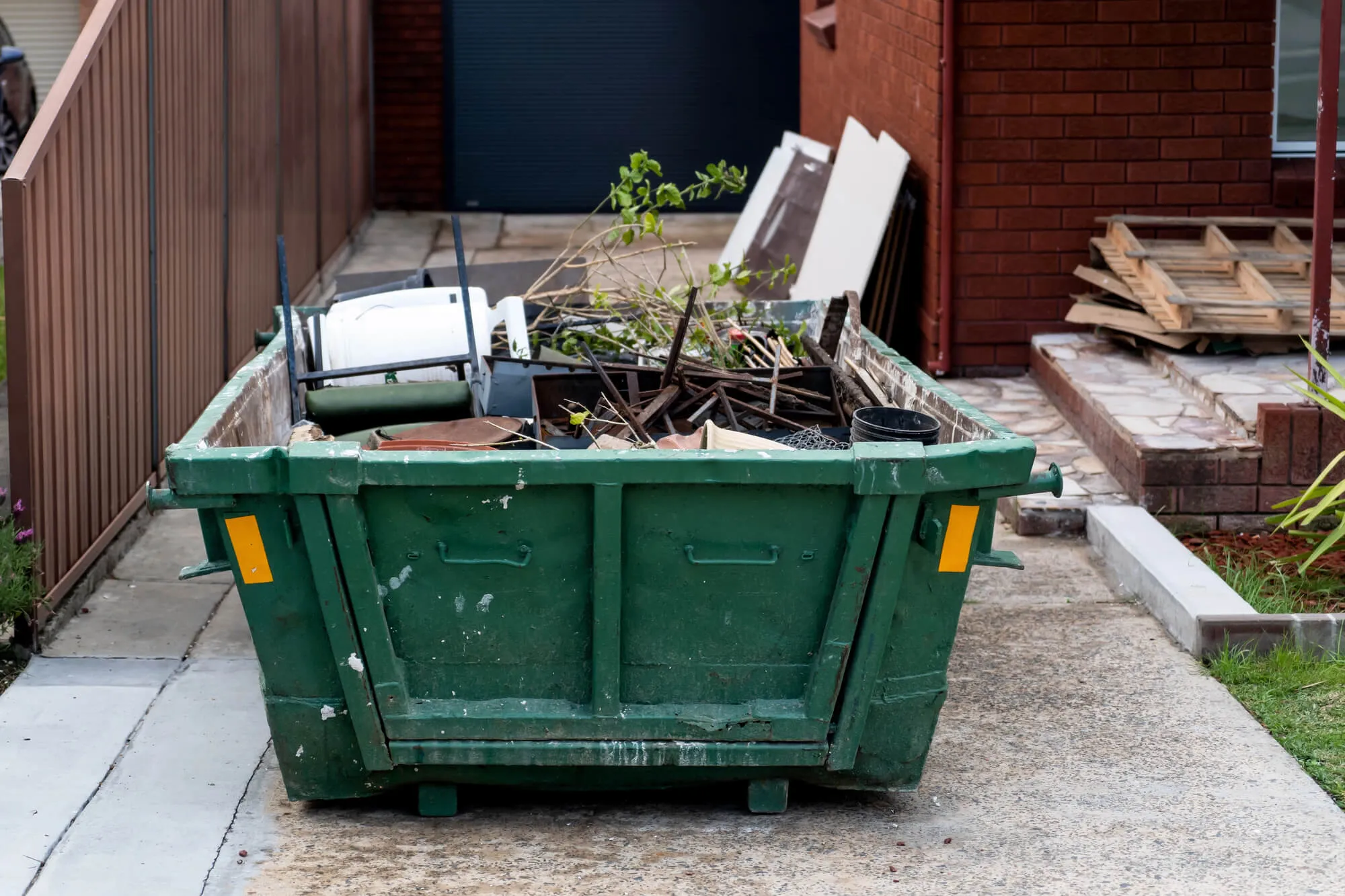
A dumpster rental means a company drops a large container at your driveway or jobsite. Most providers use a roll-off waste container. You fill it on your own timeline, and the company hauls it away when you’re done.
Standard sizes run from 10 cubic yards (small driveway cleanouts) up to 40 cubic yards (major construction and demolition work). Rental periods last 5 to 14 days, though terms vary by provider and market.
Where dumpsters shine:
- Multi-day renovations where debris accumulates gradually.
- High-volume jobs like roofing tear-offs, flooring projects, and full-home demolitions.
- Situations where you’ve got a crew or family to help load the container.
- Flat-rate pricing so you see the total before work starts.
Where dumpsters fall short:
- Every pound of lifting is on you.
- Containers occupy driveway or street space, and many cities require a permit for street placement.
- Weight overage fees apply if you underestimate heavy materials like concrete, roofing shingles, or wet yard debris.
- Most dumpster loads head straight to the landfill. Few dumpster providers include donation or recycling as standard.
- The prohibited items list can be long. Tires, household hazardous waste, and some appliances often stay off-limits.
What Is Full-Service Junk Removal?
Full-service junk removal is the hands-free option. A licensed, insured team arrives at your scheduled window, walks the job with you, gives you an upfront quote, and handles every piece of labor. You point. They lift, carry, load, and haul.
Pricing is volume-based. Most companies charge by the fraction of a truckload your items take up: 1/8, 1/4, 1/2, or full. You pay for the space you use, not for container space that sits empty. At Jiffy Junk, our Free One-Click Virtual Estimate gives you a firm quote before our team arrives.
Where junk removal shines:
- Single-visit cleanouts, often same-day or next-day.
- Heavy, awkward items like hot tubs, pianos, treadmills, appliances, and sectional sofas.
- Estate, foreclosure, and hoarding cleanouts where discretion and care matter.
- Jobs where donation and recycling are a priority. Our team sorts items on-site and diverts as much as possible from the landfill.
- Properties with no space for a dumpster, or where a container in the driveway isn’t welcome.
Where junk removal fits less well:
- Very large construction projects where dumpsters cost less per cubic yard.
- Renovations where debris accumulates over weeks. A dumpster sitting onsite makes more sense.
- Jobs where you want maximum flexibility on your own timeline rather than a scheduled window.
The Real Cost Comparison: Dumpster Rental Vs. Junk Removal
In our experience, fielding thousands of customer calls, the cost conversation almost always comes down to three variables: project size, item type, and local disposal fees. Here’s what each service typically runs.
Dumpster rental costs:
- 10-yard dumpster: about $250 to $400. Good for a small garage or single-room cleanout.
- 20-yard dumpster: about $400 to $600. Good for a kitchen remodel or a full basement.
- 30-yard dumpster: about $500 to $800. Good for whole-home cleanouts or additions.
- 40-yard dumpster: about $600 to $1,500+. Built for major construction and demolition work.
For a closer look at what drives dumpster pricing, including the hidden fees that surprise most first-time renters, see our full dumpster rental cost guide.
Junk removal costs:
- Single item pickup (couch, fridge, treadmill): about $75 to $200.
- Quarter truck: about $200 to $350. Ideal for small cleanouts.
- Half truck: about $400 to $600. Ideal for a garage or basement.
- Full truck: about $700 to $900. Ideal for a full-room or full-apartment cleanout.
Local disposal fees shift these numbers meaningfully from one market to another. For more on what drives junk removal pricing in your specific area, see our guide to local junk removal prices.
Prices vary by market and the specifics of your job. The simplest way to answer “which costs less?” is to get quotes from both. For a small to medium project, junk removal often wins once you factor in your time and labor. For a large, multi-day project, a dumpster typically comes out ahead per cubic yard. Local disposal fees and permit costs can swing the math either way.
One factor rarely shown up in other comparison articles: safety. DIY loading is a leading source of home injuries tracked by the CDC, including strained backs, pulled muscles, and slip-and-falls from awkward lifts. If you’re handling the job alone, add that risk to your math.
Real-World Pricing From Our Markets
Three example side-by-side comparisons from Jiffy Junk service areas. Use these to check where your project actually lands.
- Long Island, NY: a 20-yard dumpster rental typically runs $475–$650. A half-truck of junk removal for the same job averages $250–$400.
- Atlanta, GA: a 20-yard dumpster rental typically runs $455–$595. A half-truck of junk removal for the same job averages $389–$488.
- Phoenix, AZ: a 20-yard dumpster rental typically runs $400–$525. A half-truck of junk removal for the same job averages $235–$310.
The pattern our dispatchers see: in dense urban markets with higher landfill fees, junk removal pencils out closer to dumpster rental than people expect. In lower-cost markets, dumpsters keep their per-cubic-yard advantage on big jobs.
When To Choose Each: A Simple Decision Framework
When a customer calls us unsure which service to book, we ask four simple questions. Walk through these, and the answer usually becomes clear.
1. How Long Will Your Project Take?
- Under a day: junk removal wins. A single crew visit handles the load.
- A few days to a few weeks: a dumpster rental wins. You can fill it gradually.
2. How Much Labor Are You Willing To Do?
- None: book junk removal. Our team does every lift.
- Most of it, with help available: a dumpster fits well.
3. What Kind Of Items Are You Clearing?
- Furniture, appliances, estate items, household goods: junk removal shines. These are the items we handle every day.
- Construction debris, roofing materials, concrete, demolition: a dumpster is the better fit.
4. Do You Care About Donation And Recycling?
- Yes, strongly: book junk removal. We sort and divert items from the landfill on every job.
- Not a priority: either service works.
Why Many Projects Use Both
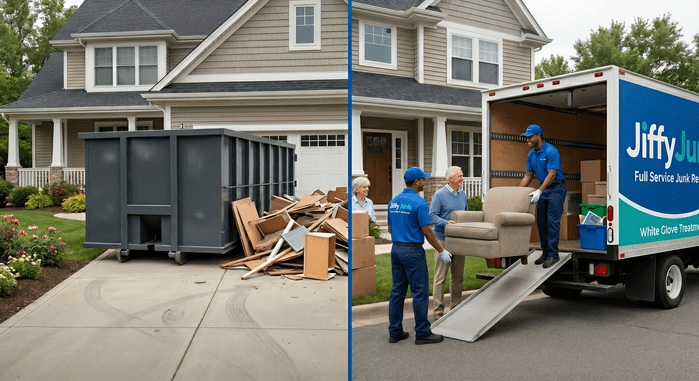
Some of our favorite jobs are the ones that use both services: full home renovations, estate cleanouts tied to a remodel, and post-construction cleanups. A dumpster handles the construction debris on your schedule. A junk removal visit clears the furniture, appliances, and sentimental items that deserve careful handling.
If you’re not sure which option fits your project, call us. We’ll tell you honestly which route saves you the most time and money, even when that means recommending a dumpster over our own full-service crew.
“After more than a decade of running both dumpster rentals and full-service junk removal, one pattern shows up on every call: customers don’t want a container or a crew. They want their space back. The right service is whichever one gets you there with the least stress, the lowest total cost, and the fewest items in the landfill.”
-The Jiffy Junk Team
Essential Resources On Dumpster Rental Vs. Junk Removal
We field the dumpster-or-junk-removal question every day. When customers ask what else to read, these are the seven sources we point them to. Each one helps you plan smarter, donate more, or avoid a surprise no hauler wants to flag first.
1. Schedule A Free Furniture Donation Pickup Through Habitat ReStore
Habitat for Humanity ReStore picks up furniture, appliances, and building materials at no cost in most U.S. markets. Your items fund affordable housing work in your community instead of heading straight to a landfill.
Source: Habitat for Humanity ReStore furniture donation pickup
2. Check Goodwill’s Donation Guide Before Booking Any Hauler
Goodwill publishes a clear list of what it accepts, how to value your donation for tax purposes, and where to drop off. Running your items through this list first can cut what you pay any hauler.
Source: Goodwill donation guidelines and accepted items
3. Find An ENERGY STAR Recycling Program For Your Old Appliances
Most rented dumpsters restrict or ban refrigerators, freezers, and washers because of refrigerants and compressor oils. ENERGY STAR lists certified programs that handle those parts the right way.
Source: ENERGY STAR certified appliance recycling programs
4. Run Your Items Through The CPSC Recall Database Before You Donate
The Consumer Product Safety Commission keeps a searchable list of every recalled household product, from cribs and space heaters to furniture and appliances. Two minutes here prevents someone else from inheriting a dangerous item.
Source: CPSC product recall database
5. Learn How The Waste Industry Actually Works With SWANA
The Solid Waste Association of North America is the trade body that sets standards for landfills, recycling centers, and transfer stations across the country. Read it when you want an honest picture of where your items end up.
Source: Solid Waste Association of North America (SWANA)
6. Use Keep America Beautiful To Find Local Recycling Drop-Offs
Keep America Beautiful runs affiliate programs in cities and towns across the country that divert usable household items from landfills. Local chapters often know about drop-offs that municipal haulers rarely advertise.
Source: Keep America Beautiful community recycling programs
7. Read NRDC On What Your Cleanout Really Costs The Planet
The Natural Resources Defense Council publishes plain-language guides on household waste, plastics, and recycling realities. It’s the fastest way to turn a routine cleanout into a more deliberate one.
Source: Natural Resources Defense Council household waste guides
Supporting Statistics: What The Data Actually Shows
Three numbers that frame every dumpster-vs-junk-removal conversation we have with customers.
1. Construction Debris Dwarfs Everyday Household Waste
- The EPA reports that the United States generated 600 million tons of construction and demolition debris in 2018.
- That’s more than twice the amount of municipal solid waste Americans threw out the same year.
- The practical takeaway for our customers: if you’re in the middle of a renovation, the sheer volume of debris is the single biggest reason our team often recommends a dumpster over full-service hauling.
Source: EPA construction and demolition debris data
2. Overexertion Is The Top Category Of Workplace Injury
- The U.S. Bureau of Labor Statistics tracks overexertion and bodily reaction as the single largest category of nonfatal workplace injuries each year.
- The bulk of those injuries comes from lifting and carrying. Those are the exact tasks a DIY dumpster load requires.
- This is the stat we point to most often when customers ask whether hiring a professional crew is worth it. For heavy items, it almost always is.
Source: U.S. Bureau of Labor Statistics workplace injury data
3. Four Out Of Five Materials-Handling Injuries Hit The Lower Back
- OSHA’s Technical Manual documents that manual materials handling is the principal source of compensable workplace injuries in the United States.
- Four out of five of those injuries affect the lower back.
- OSHA also recommends that two or more people lift any load over 50 pounds. That threshold covers most couches, mattresses, and major appliances in a typical cleanout.
Source: OSHA Technical Manual on back disorders and manual materials handling
Final Thoughts And Opinion
After more than a decade running both services, here’s what we’ve come to believe: the dumpster-vs-junk-removal debate is mostly a false choice. The question that actually matters sits one layer deeper. Which service fits the specific job in front of you this week?
Our honest take:
- For most homeowners with a one-day cleanout, junk removal wins. You save time, you save your back, and more of your items find a second life through donation and recycling.
- For contractors and serious renovators, a dumpster usually wins. The volume, the timeline, and the per-cubic-yard math all point in the same direction.
- For a big, mixed project, the combination wins. A dumpster for construction debris, a junk removal visit for the furniture and appliances. That pairing routinely saves customers hundreds of dollars and a weekend of labor.
Most comparison articles try to pretend there’s a universal answer. There isn’t. The honest answer takes thirty seconds of questions about your project.
Here’s what we’d add that no pure-dumpster company or pure-hauler will tell you: most people underestimate the donation value of what they’re about to throw out. We see it on nearly every job. A dining set someone planned to dumpster ends up funding a Habitat build. A working refrigerator, someone assumed was scrap, gets placed with a family through ReStore. The best service moves your items out quickly while making sure the right ones find a second chance before the landfill does.
That’s the Jiffy Junk philosophy in one line: pick the service that matches your project, and pick the team that cares what happens to your items after they leave your driveway.
Frequently Asked Questions
Q: Which costs less: a dumpster rental or junk removal?
A: For small to medium jobs, junk removal usually wins once you factor in dumpster minimums, disposal fees, and your own time spent loading. Think single items, a garage cleanout, or a room’s worth of furniture. For large, multi-day projects with high volumes of construction debris, dumpster rental typically comes out ahead on price per cubic yard. The fastest way to confirm is to get quotes from both services for the same job. A Jiffy Junk Free One-Click Virtual Estimate takes about a minute.
Q: Should I rent a dumpster or hire junk removal for a garage cleanout?
A: For most garage cleanouts, junk removal is the faster and easier choice. A single crew visit clears everything in a few hours: old bikes, broken appliances, stacks of lumber, forgotten furniture. No lifting required on your end. If your garage cleanout is tied to a longer renovation, or you’re also tearing out drywall and shelving, a small 10- or 15-yard dumpster may pencil out better. The volume of debris usually decides for you.
Q: Does junk removal include recycling and donation?
A: With Jiffy Junk, yes. It’s standard on every job, not a premium add-on. Our crews sort items on-site and route usable furniture, appliances, and electronics to donation partners and certified recycling facilities before anything heads to a landfill. Appliances with refrigerants get directed to programs that follow EPA guidance on responsible appliance disposal, which captures refrigerants and foam instead of venting them. Most dumpster rentals skip this sorting step, so whatever lands in the container typically ships straight to the dump. If donation and recycling matter to you, that single difference often tilts the decision toward junk removal.
Q: What’s not allowed in a rented dumpster?
A: Prohibited items vary by provider, but most dumpster companies restrict tires, hazardous chemicals, paint, batteries, refrigerators and freezers with refrigerant, and in some cases, concrete beyond a weight limit. Wet materials like yard waste after heavy rain can push the load over the weight limit and trigger overage fees. Always ask for the full prohibited list before you start loading. Items that a dumpster rejects are usually fine for a junk removal crew to haul.
Q: Is dumpster rental or junk removal better for an estate cleanout?
A: Junk removal is almost always the better choice for an estate cleanout. These jobs involve sentimental items, donations to coordinate with family, and timelines that rarely stretch into the weeks a dumpster would sit in the driveway. Our crews work discreetly and carefully, usually in a single visit, and leave the space broom-clean and ready for sale. We also slow down when something matters, flagging items with likely donation value before they get bagged for disposal. For a detailed look at what full-property estate cleanouts typically run, see our estate cleanout cost guide.
Ready to Reclaim Your Space? Let’s Help You Choose the Right Option.
Whether you’re leaning toward a dumpster, a full-service junk removal crew, or a combination of both, Jiffy Junk can get the job done. Request a Free One-Click Virtual Estimate today. We’ll walk through your project with you and recommend the option that saves you the most time, money, and stress.
Call 844-543-3966 or book online at jiffyjunk.com/booking. We’re not happy until you are happy!