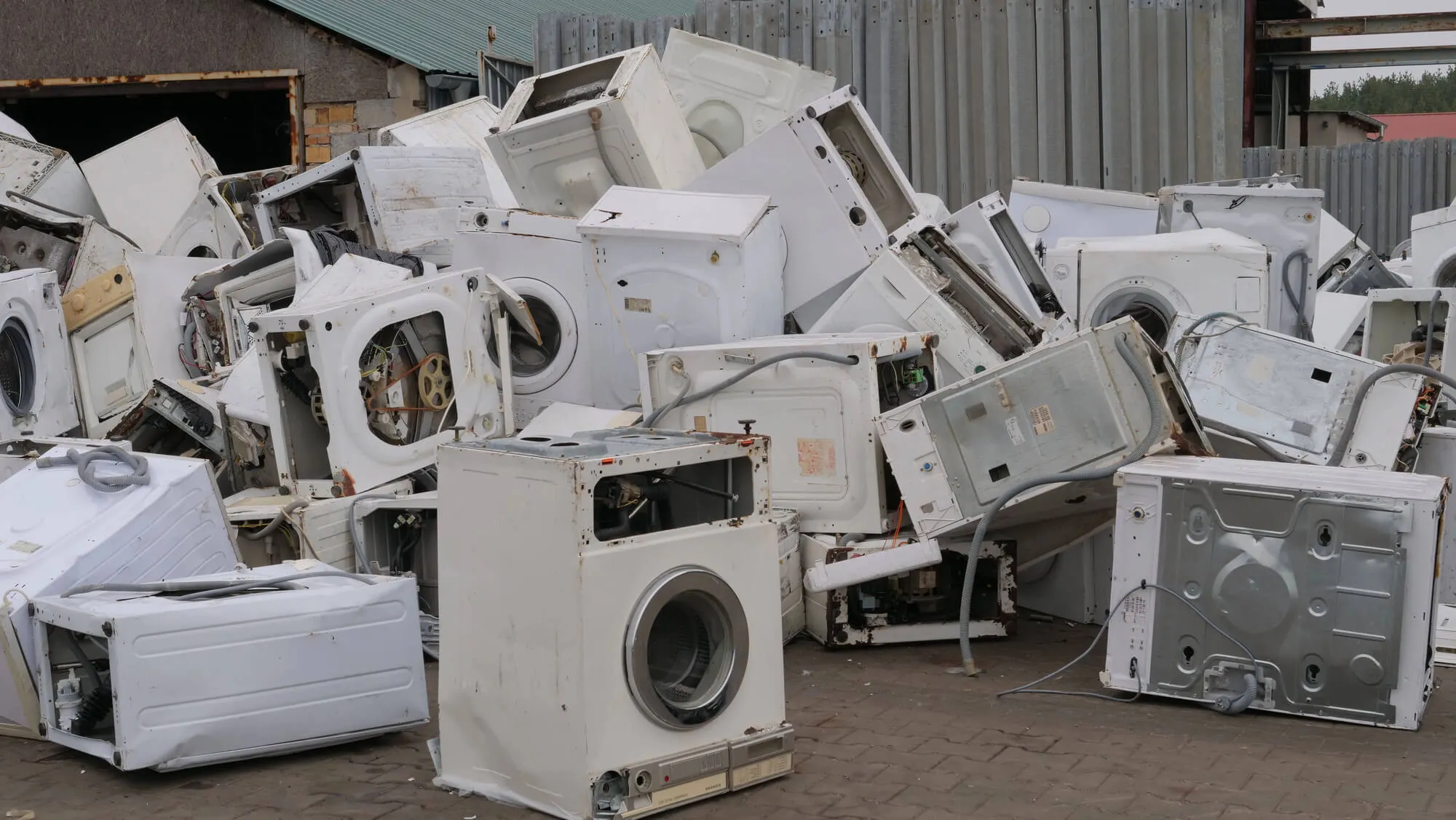
How to Get Rid of and Dispose of an Old Washer and Dryer: Best Options for Removal, Recycling, Donation, and Haul Away Near Me So You Can Upgrade Stress-Free
You pick out the new set. You book a delivery. You plan the whole upgrade. Then the day comes, and two 200-pound appliances are still sitting in your laundry room with nowhere to go.
Nine times out of ten, that’s what holds up a washer and dryer upgrade. Not the shopping. Not the install. The old units. Since 2014, our crews have handled thousands of these removals, and the pattern hardly ever changes.
Seven options are actually on the table for getting rid of an old washer and dryer. Some cost money. Some pay you back a little. Some happen today, and a couple make you wait weeks. The right one comes down to your timeline, your budget, whether the unit still runs, and how much lifting you want to do yourself.
Honesty up front: we run a paid removal service. Every option below still gets a fair write-up. Take the free route if it fits your situation. We’re here if it doesn’t.
TL;DR Quick Answers
How To Get Rid Of Old Washer And Dryer
The fastest route is to book a full-service junk removal crew that handles the disconnection, lifting, and eco-friendly disposal in one visit. If you’re already buying a new set, Home Depot, Lowe’s, and Best Buy will haul the old one away for $25 to $50 per item at delivery. Habitat for Humanity ReStore, Goodwill, and the Salvation Army accept working units under about ten years old, and many locations offer free pickup. If the unit no longer runs, a certified scrap metal yard will take it for recycling. Most U.S. cities fine homeowners $100 to $1,000 for leaving a washer or dryer at the curb with regular pickup.
Top 5 Takeaways
- Seven disposal options cover almost every situation: professional removal, retailer haul-away, donation, online resale, scrap metal recycling, municipal bulk pickup, and dumpster rental. The right one comes down to your timeline and whether the unit still runs.
- Most U.S. cities don’t allow washers and dryers at the curb with regular pickup. Fines run $100 to $1,000 or more, so check your local rules before setting anything out.
- Most of a washer or dryer, by weight, is recyclable metal: roughly 60 to 70 percent steel, plus copper windings and aluminum. Handled right, all of that stays in circulation and out of landfill.
- Donation is only an option for units under about ten years old in clean working condition. Broken or heavily worn appliances get turned away at most Habitat ReStores and major charity drop-offs.
- Professional junk removal is the fastest route, with same-day to 48-hour turnaround in most markets. It’s also the only option where you never have to touch the unit yourself.
Table of Contents
- How to Get Rid of and Dispose of an Old Washer and Dryer: Best Options for Removal, Recycling, Donation, and Haul Away Near Me So You Can Upgrade Stress-Free
- TL;DR Quick Answers
- Top 5 Takeaways
- Best Options For Removal, Recycling, Donation, And Haul Away
- The 7 Ways To Get Rid Of An Old Washer And Dryer
- When Professional Removal Is Worth It
- Essential Resources On How To Get Rid Of An Old Washer And Dryer
- 1. ENERGY STAR Clothes Washer Recycling Program Finder
- 2. Habitat For Humanity ReStore Donation Pickup
- 3. Goodwill Donation Locator
- 4. Salvation Army Donation Pickup Scheduler
- 5. Consumer Reports Washing Machine Buying Guide
- 6. U.S. Department Of Energy — Laundry Energy Savings Guide
- 7. IRS Charitable Contribution Tax Deduction Rules
- Supporting Statistics
- Final Thoughts & Opinion
- Frequently Asked Questions
- Q: Can I put my old washer or dryer at the curb with regular pickup?
- Q: Do Home Depot, Lowe’s, and Best Buy take old washers and dryers?
- Q: How much is an old washing machine worth at a scrap yard?
- Q: Do I need a plumber to disconnect a gas dryer before removal?
- Q: Can I donate a broken washer or dryer?
- Q: How fast can Jiffy Junk remove my old washer and dryer?
- Q: Will my old washer and dryer actually be recycled?
- Q: What’s the most eco-friendly way to get rid of an old washer and dryer?
- Ready To Upgrade Stress-Free? Book Washer And Dryer Removal Today
Best Options For Removal, Recycling, Donation, And Haul Away
Replacing a washer and dryer should feel good: a fresh set, lower energy bills, maybe a bigger drum. What we see at Jiffy Junk instead are upgrades that stall because no one planned the last step. The delivery truck shows up, the new units arrive, and two 200-pound appliances are suddenly blocking the laundry room.
Let’s fix that.
Prep Before You Pick A Disposal Method
Whichever option you choose, your old washer and dryer need to be safely disconnected before they move an inch. Water lines, gas lines, and electrical hookups don’t mix well with hurried removal, so prep is non-negotiable.
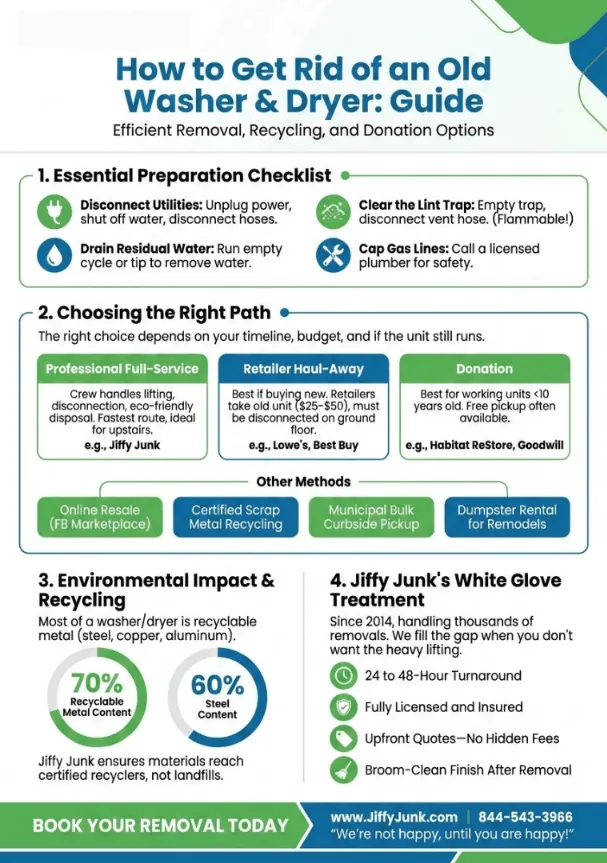
The 4 Prep Steps, In Order
- Unplug everything and shut off the water valves behind the washer. Disconnect the hot and cold supply lines, then the drain hose. A small amount of water will spill from the hoses, so have a towel ready.
- Drain the residual water from the washer tub. Most washers hold about a half-gallon of water even after the cycle ends. Run a short empty cycle or tip the unit gently to pour it out. Skip this step, and you’ll leave a trail across your floor during removal.
- Clean the lint trap and disconnect the dryer vent hose from the wall. Lint is highly flammable, and a full trap is a fire hazard the moment the dryer moves. Take 30 seconds to clear it.
- If you have a gas dryer, call a licensed plumber or gas technician to cap the gas line. This is one thing most junk removal crews won’t do, ours included. Gas work has to go through someone licensed for it.
Dryers look simple on the outside, but there’s genuine engineering inside. The drum is usually stainless steel, the heating element is aluminum, and the motor is copper-wound. For a deeper look at how a clothes dryer works, Wikipedia has a solid overview of the components. The short version: most of a washer or dryer, by weight, is recyclable metal. That’s why scrap yards take them, and why responsible disposal matters.
The 7 Ways To Get Rid Of An Old Washer And Dryer
Here are the seven realistic options, roughly ranked from easiest to most hands-on. Every one of them works for someone. The trick is matching the option to your situation.
1. Professional Junk Removal
Best for: fast turnarounds, difficult-access locations, or anyone who’d rather not touch the unit. A licensed crew shows up, disconnects everything except the gas line, hauls the unit from wherever it’s sitting, and handles recycling or donation. Typical cost runs $75 to $250 for a single appliance or $150 to $400 for a pair, depending on your area and access.
2. Retailer Haul-Away With A New Purchase
Best for: anyone already buying a replacement set. Home Depot, Lowe’s, Best Buy, and Costco will take the old unit when they deliver the new one, usually for $25 to $50 per item. The catch: the unit has to be fully disconnected and sitting in a ground-floor spot the delivery team can reach.
3. Donate To A Charity
Best for: working units under about ten years old. Habitat for Humanity ReStore, Goodwill, and the Salvation Army accept washers and dryers in clean working condition, and many locations offer free pickup. The bonus: you get a receipt for a tax deduction.
4. Sell Online
Best for: matched sets in working condition when you have a few weeks to sell. Facebook Marketplace, Craigslist, and OfferUp move used appliances the fastest. A decent pair typically recovers $50 to $300. The trade-off is your time: photos, messages, buyer no-shows, and lifting help on pickup day.
5. Scrap Metal Recycling
Best for: non-working units when you have a truck and half a Saturday. Local scrap yards pay by weight for the steel, copper, and aluminum inside. A typical washer or dryer nets $10 to $25 at current scrap rates. You handle the transport, and the yard recycles the metals into new products. Our home appliance recycling guide covers what gets recovered during the process and why it matters.
6. Municipal Bulk Pickup Or Drop-Off
Best for: tight budgets and flexible timelines. Most cities run a scheduled bulk pickup program, which is usually free or low-cost but comes with a one-to-four-week wait. You’ll typically move the unit curbside yourself on pickup day. Hold off on setting it out before then, because most cities fine homeowners $100 to $1,000 for abandoning large appliances at the curb outside a scheduled window.
7. Rent A Dumpster
Best for: laundry room remodels and larger cleanouts. A 10-yard dumpster rental runs about $300 to $600 for a week. That’s overkill for a single appliance. It makes sense when you’re clearing the cabinets, flooring, and old stuff in one sweep. You load it yourself.
When Professional Removal Is Worth It
After more than ten years of doing this work, we see the same four situations repeat. These are the moments when every other option stops being practical, and professional removal becomes the obvious call:
- The unit is not on the ground floor. Stairs, narrow doorways, and tight landings turn a routine haul into a two-person wrestling match.
- Your new appliance is already on the delivery truck. If the old unit is still in place when the new one arrives, you’re going to pay a re-delivery fee or scramble for an emergency solution.
- The unit no longer works, which means donation is off the table. Most retailers also decline non-working units. That leaves two routes: scrap metal, which you handle yourself, or professional removal.
- Time is the constraint. Every free option asks for transport, a wait, or your own labor. Once your weekend is worth more than $150, the math tips toward hiring it out.
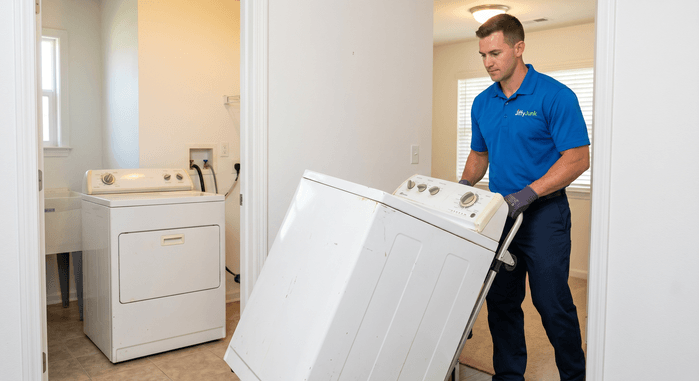
That’s exactly the gap our washer and dryer removal service fills. Our licensed and insured crew handles every step except the gas line: the disconnection, the heavy lifting from any floor, the hauling, and the eco-friendly disposal. You get an upfront quote before we touch anything. There are no hidden fees at the end. We book most markets within 24 to 48 hours, and most pickups wrap up in under an hour once the crew is on site. If you’re also looking at a refrigerator, stove, or dishwasher in the same visit, our old appliance removal and haul-away guide covers how those categories differ.
The White Glove Treatment is our signature. We leave your laundry room broom-clean, not the mess most people expect after a removal. We’re not happy until you are happy. That’s been the promise since 2014, and it’s still how we run every job.
If a free option fits your situation, take it. We’re still here if it doesn’t.
“After thousands of washer and dryer removals since 2014, the pattern is always the same: the upgrade itself isn’t the holdup. The old unit is. Homeowners pick out the new set weeks in advance, but nobody plans the removal until the delivery truck is on its way. A five-minute booking ahead of time prevents the single biggest source of stress in the whole process.”
— The Jiffy Junk Appliance Removal Team
Essential Resources On How To Get Rid Of An Old Washer And Dryer
When you’re working through what to do with an old washer and dryer, a handful of authoritative sources are worth bookmarking. We’ve vetted these ourselves. They’re the pages our customers ask about most often, and the ones that give straight answers instead of sales pitches.
1. ENERGY STAR Clothes Washer Recycling Program Finder
The federal clearinghouse for washer recycling programs. ENERGY STAR walks you through retailer pickup, utility rebate programs, municipal options, and scrap recyclers in one place. Start here to confirm what’s available in your area before you call anyone.
Source: ENERGY STAR Clothes Washer Recycling Program Finder
2. Habitat For Humanity ReStore Donation Pickup
Habitat ReStores take working washers and dryers, typically under ten years old, and resell them to fund home-building in your community. Many locations offer free pickup for large items, which solves the heavy-lifting part at no cost.
Source: Habitat for Humanity ReStore donation page
3. Goodwill Donation Locator
Goodwill’s ZIP-code donation finder points you to the nearest drop-off or scheduled pickup. Goodwill accepts working appliances at many locations, though not all, so call ahead to confirm. Donations support the organization’s job training programs and come with a tax-deductible receipt.
Source: Goodwill donation locator
4. Salvation Army Donation Pickup Scheduler
The Salvation Army’s nationwide scheduling tool at satruck.org lets you book a free pickup for large donations, washers and dryers included. Proceeds fund the organization’s adult rehabilitation centers, and you receive a tax receipt.
Source: Salvation Army free donation pickup scheduler
5. Consumer Reports Washing Machine Buying Guide
Before you replace the old set, Consumer Reports is the most credible independent source on what to buy next. Their washing machine guide compares reliability, efficiency, and owner-reported repair rates across every major brand.
Source: Consumer Reports washing machine buying guide
6. U.S. Department Of Energy — Laundry Energy Savings Guide
The DOE’s Energy Saver guide breaks down how much energy and water your laundry setup actually uses, what to look for in a replacement, and how much a newer ENERGY STAR model saves over time. Useful context when you’re weighing whether to replace, repair, or keep using the old unit.
Source: U.S. Department of Energy laundry savings guide
7. IRS Charitable Contribution Tax Deduction Rules
If you donate a washer or dryer to a qualified charity, the fair-market value is potentially deductible, but only if the unit is in good used condition or better and you itemize. IRS Topic 506 spells out what records you need and how the deduction works.
Source: IRS Topic 506 charitable contribution rules
Supporting Statistics
The numbers on appliance recycling and disposal are encouraging, but only if the old unit actually reaches a recycler. Here’s the data we lean on when customers ask whether their old washer or dryer gets recycled or just lands in a landfill.
1. 59.8% Of Material In Major Appliances Is Recycled
According to EPA’s most recent Facts and Figures on Materials, Waste and Recycling, the recycling rate for all materials in major appliances, ferrous metals included, was 59.8% in 2018. The Agency estimates that shredded appliances yielded 3.1 million tons of ferrous metal that year. That’s the baseline reason donating or recycling a washer or dryer matters: properly handled, most of it goes back into circulation.
Source: EPA Durable Goods Product-Specific Data
2. U.S. Steel Scrap Recycling Rate Averages 80–90%
The U.S. Geological Survey’s Mineral Commodity Summaries report that the overall U.S. scrap recycling rate has averaged between 80% and 90% over the past decade. A washer or dryer is roughly 60 to 70 percent steel by weight. That means the metal in your old unit stands a strong chance of being reused, provided it reaches a scrap yard or recycler instead of a landfill.
Source: USGS Iron and Steel Scrap Statistics and Information
3. Overall U.S. Steel Recycling Rate Reached 69% In 2019
The American Iron and Steel Institute commissioned research that put the overall U.S. steel recycling rate at 69% in 2019, calculated on a three-year rolling average. Sector-level rates have held between 65% and 80% since 2012. In practical terms: your old washer or dryer, routed correctly, becomes part of next year’s steel supply chain.
Source: AISI Steel Recycling Rates Report
Final Thoughts & Opinion
After more than ten years of removing old washers and dryers, here’s the honest summary:
- Easy isn’t always cheap, and cheap isn’t always easy. Free options work fine. Every one of them asks for effort on your end.
- Donation wins on environmental impact when the unit is still running. When it doesn’t, scrap recycling takes that spot.
- Most homeowners overestimate what curbside pickup will accept and underestimate the fines for getting it wrong. When in doubt, call your city.
Our opinion, after thousands of jobs: professional removal earns its cost when the unit is upstairs, in a basement, no longer running, or tied to a delivery window. In every other scenario, cheaper routes exist, and we’ll tell you that out loud. The difference between a great junk removal company and a pushy one comes down to a single thing: whether they treat your old washer and dryer as a task you’re solving, not a sale they’re closing.
If you’re working on a bigger decluttering or remodeling project that goes beyond the laundry room, our broader guide on getting rid of old appliances covers the full range of disposal options in one place.
Match the option to your situation, prep the unit properly, and the upgrade gets a whole lot less stressful.
Frequently Asked Questions
Q: Can I put my old washer or dryer at the curb with regular pickup?
A: No. Most U.S. cities and counties don’t allow large appliances at the curb with regular collection. Fines typically run from $100 to over $1,000, depending on the municipality. Schedule a bulk pickup, book professional removal, or use a retailer haul-away instead.
Q: Do Home Depot, Lowe’s, and Best Buy take old washers and dryers?
A: Yes, but only when they deliver a new replacement. The fee is usually $25 to $50 per item. Your old unit has to be fully disconnected and sitting in a spot the delivery team can access before the truck arrives.
Q: How much is an old washing machine worth at a scrap yard?
A: Typically $10 to $25 per appliance, based on the roughly 150 to 200 pounds of recoverable steel, copper, and aluminum at current scrap rates. You handle the transport, and payouts vary by region and current commodity prices.
Q: Do I need a plumber to disconnect a gas dryer before removal?
A: Yes. A licensed plumber or gas technician has to cap the gas line, not a junk removal crew. Most professional removal companies, Jiffy Junk included, will take the dryer once the gas line is capped. We draw the line at gas work itself for safety reasons.
Q: Can I donate a broken washer or dryer?
A: Generally, no. Goodwill, the Salvation Army, and Habitat for Humanity ReStore only accept working appliances, and most require the unit to be under about ten years old. Send non-working units to scrap metal recycling or a professional removal service instead.
Q: How fast can Jiffy Junk remove my old washer and dryer?
A: In most markets, within 24 to 48 hours of booking, and often the next business day. Our crews wrap up most pickups in under an hour once they’re on site. Booking takes about 60 seconds online or by phone at 844-543-3966.
Q: Will my old washer and dryer actually be recycled?
A: Yes, whenever possible. We evaluate every unit for donation first. If a unit can’t find a second home, it goes to certified scrap and e-waste recyclers who recover the steel, copper, and aluminum. Landfill is a last resort for us, not a default.
Q: What’s the most eco-friendly way to get rid of an old washer and dryer?
A: Donation wins when the unit still runs, because another household extends its useful life. When the unit no longer works, certified scrap metal recycling is the best environmental route. Most of a washer or dryer, by weight, is recyclable metal.
Ready To Upgrade Stress-Free? Book Washer And Dryer Removal Today
Skip the curbside scheduling, the rental truck, and the heavy lifting. Our licensed crew handles your old washer and dryer from start to finish with the White Glove Treatment, and we’re not happy until you are happy. Book online at jiffyjunk.com/booking in 60 seconds or call 844-543-3966 for an upfront quote today.