Most homeowners don’t find out that curbside pickup won’t take their refrigerator until the old one is already unplugged and sitting in the driveway.
Here’s why that happens: refrigerators contain EPA-regulated refrigerants, commonly called Freon, and federal law requires certified recovery before any fridge can be dismantled or sent to a landfill. Most municipal programs won’t schedule the pickup. Most households don’t own a truck rated for a 300-pound appliance. Booking a certified recycling facility on short notice is a project of its own.
Since 2014, Jiffy Junk has removed refrigerators from homes across the country, kitchens, garages, basements, third-floor walkups, with no heavy lifting required from you, no hidden fees, and no compliance paperwork to sort out. Our licensed, insured crews handle everything from disconnection through eco-friendly disposal. Add our White Glove Treatment, and we leave your space broom-clean when we’re done.
TL;DR Quick Answers
Refrigerator Removal Service: What You Need to Know Right Now
A refrigerator removal service is a professional pickup that safely disconnects, hauls away, and disposes of your old fridge — covering the heavy lifting, EPA refrigerant compliance, and eco-friendly recycling so you don’t have to.
- What it is: Full-service pickup for old refrigerators, including disconnection, transport, and responsible disposal or recycling.
- Who needs it: Anyone replacing, clearing out, or downsizing who’d rather not wrestle a 200–400 lb appliance out the door themselves.
- Why can’t you DIY the disposal? Federal law under the Clean Air Act requires certified refrigerant recovery before a fridge can be dismantled or landfilled.
- What it typically costs: Pricing depends on size, location in the home, and accessibility. Jiffy Junk provides upfront quotes with no hidden fees before any work begins.
- How fast we can get there: In most Jiffy Junk markets, pickup is available within days — and in many areas, as soon as the next business day.
- Where your old fridge goes: Working units may be donated. Non-functional units are recycled. Refrigerants are recovered by certified technicians. Landfill is always our last resort.
Top 5 Takeaways
What matters most about old refrigerator pickup and disposal:
- You can’t legally dispose of a fridge yourself — and most people don’t know that until it’s too late. Refrigerators contain EPA-regulated refrigerants like Freon that require certified recovery under the Clean Air Act before disposal. Venting them is illegal. Most curbside programs won’t accept a refrigerator without proof of refrigerant recovery.
- Most curbside pickup programs won’t take your fridge. Even cities with bulk item collection typically exclude refrigerators or require advance scheduling and refrigerant certification. Don’t assume your program covers it.
- Moving a 200–400 lb appliance downstairs or through a tight hallway is a genuine injury risk. Our crew handles it from wherever the fridge sits. You don’t touch a thing.
- The price we give is the price you pay. Jiffy Junk provides a transparent, on-site quote before work begins. No disposal surcharges, fuel fees, or post-job add-ons.
- Eco-friendly disposal is built into every appointment. Our crews evaluate every fridge for donation, recycling, and responsible refrigerant recovery. Keeping your old unit out of the landfill doesn’t cost you anything extra.
Why Getting Rid of a Refrigerator Is Harder Than It Looks
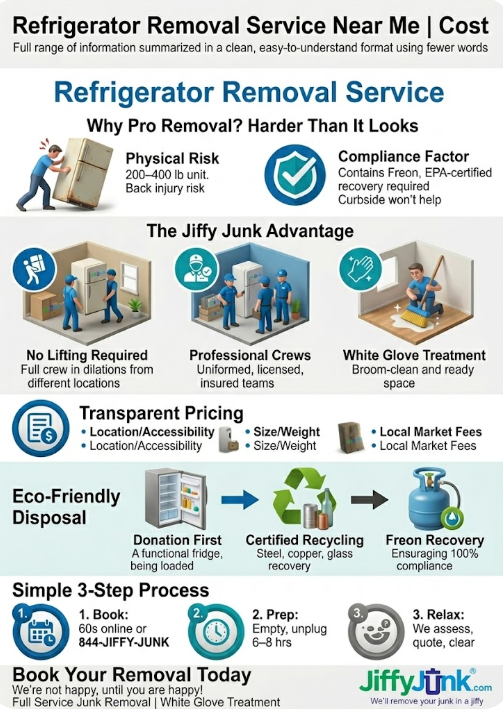
Two things make refrigerator disposal harder than most appliance removals: federal compliance requirements and the sheer physical weight of the unit. Both show up on the same job.
Start with compliance. Every refrigerator contains refrigerants — the gases that keep food cold. Older models used CFCs or HCFCs, commonly called Freon. Newer models use HFCs. All of them fall under Section 608 of the Clean Air Act, which requires a certified technician to recover those refrigerants before the fridge can be dismantled or sent to a landfill. Federal law is not optional.
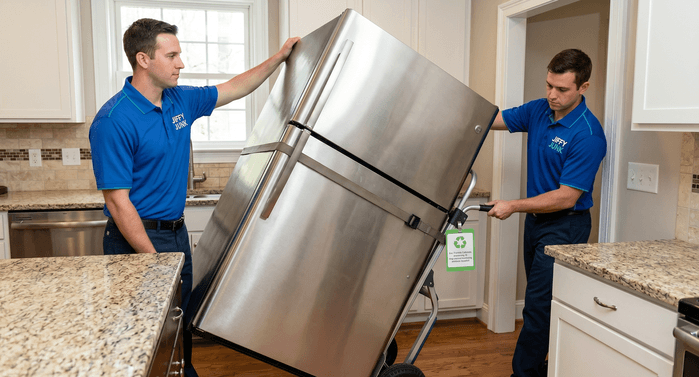
Then there’s the physical side. A standard French door refrigerator weighs 200 to 350 pounds. Getting it through a kitchen, around a corner, down a flight of stairs, and out the front door without damaging your walls, floors, or your back takes training, equipment, and experience. We’ve pulled fridges from third-floor walkups with barely an inch of clearance on either side. We’ve moved ancient units out of finished basements where the staircase was built as an afterthought. Thousands of jobs later, those situations are routine for our crews. They’re rarely routine for the homeowner.
Handling the compliance piece and the physical piece correctly in one appointment is what a professional refrigerator removal service provides.
How Much Does Refrigerator Removal Cost?
This is our most common question. The honest answer: pricing varies by job, and here’s what actually drives the number.
What affects your quote:
- Location in the home. The ground-floor kitchen is straightforward. Third-floor walkup means more time and crew. A finished basement means accounting for the stairs.
- Accessibility. Tight hallways, narrow doorways, and exterior steps all add time.
- Size and weight of the unit. A compact apartment fridge and a commercial double-wide are different jobs.
- Additional items on the same appointment. Bundling your fridge pickup with other items — an old washer, a garage clearout — often brings down the per-item cost compared to separate trips.
- Your market. Local disposal fees and logistics vary by region.
What never appears in your Jiffy Junk quote:
Hidden fees, disposal surcharges, fuel add-ons, or post-job surprises. We give you a clear number before we lift a thing. That’s the price you pay. We’ve worked this way since 2014.
To get an accurate estimate for your situation, call 844-JIFFY-JUNK or book online at jiffyjunk.com/booking. We confirm your appointment instantly.
How Our Refrigerator Pickup Service Works, Step by Step
From the moment you call to the moment we pull away, here’s exactly how a Jiffy Junk fridge removal appointment goes.
- Book in 60 seconds. Schedule at jiffyjunk.com/booking or call 844-JIFFY-JUNK. We confirm your appointment instantly. Same-day or next-day pickup is available in most markets.
- Prep the fridge — it takes about ten minutes. Empty all contents. Unplug the unit 6–8 hours before we arrive and leave the door open to air out. Clear the path to the nearest exit. That’s it. You don’t need to move it to the curb or disconnect any lines yourself.
- We arrive on time, in uniform. Our crew shows up within your scheduled window, ready to work. We walk through what’s going on with you before touching a thing.
- You get an upfront quote. We assess the job and give you a clear, transparent price. Nothing moves until you approve it.
- We handle all the heavy lifting. Our team disconnects, removes, and loads your refrigerator from wherever it’s sitting in your home. Floors and walls are protected throughout.
- Responsible disposal follows every pickup. Working units may be donated. Components are recycled. Regulated refrigerants are recovered by certified technicians per federal law, every time.
- Optional White Glove finish. Add our White Glove Treatment, and we leave the space broom-clean. Open, cleared, and ready to use.
For the full list of appliances we remove — washers, dryers, dishwashers, and more — visit our Appliance Pickup Service page.
Where Your Old Fridge Goes After We Pick It Up
Customers ask this one often. Here’s exactly what happens to every refrigerator we haul away.
Our disposal order on every job:
- Donation first. If your fridge is functional or fixable, we look for a donation placement. A working appliance in another family’s home is the best outcome — for them, and for the environment.
- Certified recycling. Non-functional units go to certified recycling facilities where steel, aluminum, copper, glass, and plastics are recovered and reprocessed. The average refrigerator holds over 120 pounds of recyclable steel.
- Refrigerant recovery on every single pickup. EPA-regulated refrigerants — including Freon — must be extracted by certified technicians before any other processing takes place. We handle this as part of your standard appointment, without exception.
- Landfill as a last resort. Only what can’t be donated, recycled, or otherwise recovered goes to a licensed landfill facility. Our crews work to keep that list short on every job.
We’ve handled disposal this way since 2014. The commitment to doing it right hasn’t changed.
“In our experience, removing thousands of refrigerators from homes nationwide since 2014, municipal programs rarely accept fridges curbside. Freon recovery is a federal legal requirement and not optional, and moving a 300-pound appliance through a narrow hallway without damaging your home takes professional equipment and a trained crew. Homeowners who’ve tried to sort it out on their own say the same thing every time: they wish they’d just called first.”
— Jiffy Junk Experts
7 Essential Resources on Refrigerator Removal Service
Researching your options before you schedule? These seven resources — all from government and nonprofit sources — give you the full picture on compliance, recycling programs, donation options, and environmental impact.
1. EPA Appliance Disposal: Federal Rules You Need to Know
The U.S. Environmental Protection Agency spells out exactly what the law requires when disposing of refrigerators — which hazardous components must be recovered and where the legal responsibility falls. Read this before you put your old fridge at the curb.
Source: EPA Appliance Disposal
2. ENERGY STAR: Find a Fridge or Freezer Recycling Program Near You
ENERGY STAR’s recycling locator connects you to EPA Responsible Appliance Disposal program partners and utility rebate programs in your area — some of which pay cash incentives for turning in an old fridge.
Source: ENERGY STAR Fridge Recycling Finder
3. Habitat for Humanity ReStore: Donate a Working Refrigerator
If your old fridge still runs, Habitat for Humanity ReStores accepts working appliances and puts them back into use, directly supporting affordable housing in your community. Many locations offer free pickup for large items.
Source: Habitat for Humanity ReStore — Donate Goods
4. Green America: How Refrigerator Refrigerants Impact the Climate
Green America breaks down why refrigerant gases in your old fridge carry real climate consequences — HFCs can be thousands of times more potent than CO2 as greenhouse gases — and what responsible disposal looks like in practice.
Source: Green America — Should You Replace Your Fridge?
5. NRDC: Why Proper Refrigerant Recovery Is a Climate Priority
The Natural Resources Defense Council walks through the science behind HFC refrigerants, why recovering them from old equipment reduces climate harm, and what federal and state regulations require of the industry.
Source: NRDC — Recover, Reclaim, Reuse: The Coolest Way to Manage Refrigerants
6. U.S. Energy Information Administration: Refrigerator Energy Use in U.S. Homes
EIA data shows 99% of U.S. homes have at least one refrigerator and 34% have two or more — which puts the scale of responsible disposal in sharp focus for anyone thinking seriously about where all those units end up.
Source: EIA — Electricity Use in Homes
7. Sustainable Recycling Industries: Refrigerator Recycling Fact Sheet
This technical fact sheet explains what happens to a refrigerator at a certified recycling facility — refrigerant extraction, metal recovery, and the environmental risks of informal or improper dismantling.
Source: Sustainable Recycling Industries — Refrigerator Recycling Fact Sheet
Refrigerator Removal by the Numbers
Three verified statistics from federal sources that put responsible fridge disposal in context.
1. The DOE Calculates an Average Residential Refrigerator Lifespan of 16.2 Years. Millions of U.S. Households Are Already Past That Mark.
The U.S. Department of Energy uses an assumed product life of 16.2 years for residential refrigerators in its efficiency calculations. In practice, that means a significant share of U.S. households are running refrigerators well past their efficient operating years — consuming more electricity, failing more often, and taking up floor space as secondary units running 24/7.
In our experience, many of the fridges we remove have been sitting unused in basements or garages for years after the household already replaced them. Homeowners often don’t realize how straightforward the removal process is until they’ve finally made the call.
Source: U.S. Department of Energy — Purchasing Energy-Efficient Residential Refrigerators
2. Replacing an Old Refrigerator with a New ENERGY STAR Model — and Recycling the Old One — Can Cut Your Carbon Footprint by About 9,000 Pounds of Greenhouse Gas Emissions Over the Product’s Lifetime.
That figure reflects the combined effect of switching to a more efficient appliance and ensuring the refrigerants in the old unit are recovered rather than released. Each job our crews complete with certified refrigerant recovery contributes directly to that outcome. Not as a compliance checkbox — as a measurable environmental result we track on every appointment.
Source: ENERGY STAR — Flip Your Fridge Fact Sheet
3. New Refrigerators Use About 65% Less Electricity Than Models Made in 1980.
EIA data shows average electricity consumption for new refrigerators in 2009 was approximately 450 kWh per year — roughly 35% of what a comparable unit consumed in 1980. Every old refrigerator still running in a basement or garage is consuming significantly more electricity than its owner probably realizes. Removing it doesn’t just clear space. It cuts your energy bill.
Customers upgrading from refrigerators that are 15 or more years old consistently say the same thing: the old fridge didn’t seem bad until it was gone.
Final Thoughts and Opinion
Refrigerator removal looks like a simple task from the outside: an old appliance, a truck, a recycling center. The compliance layer is what catches people off guard — usually after the fridge is already disconnected and sitting in the driveway.
Here’s our honest assessment after more than a decade and thousands of refrigerator removals:
- Free options work under the right conditions. Municipal pickup programs are a solid choice if your city accepts refrigerators, you have weeks of lead time, and you can get the unit curbside yourself. Many programs require proof of refrigerant recovery in advance, which adds another step. Utility rebate programs are valuable where they exist, but aren’t available everywhere, and typically exclude non-working units.
- DIY disposal runs into real compliance walls. We’ve seen homeowners bring refrigerators to scrap yards without refrigerant recovery documentation and get turned away. We’ve seen appliances sit on curbs for weeks because the curbside program won’t accept them. Every one of those situations costs more time and effort than a straightforward service call.
- Professional removal costs less than most people expect when you run the comparison honestly. Factor in truck rental, the second person you need to move 300 pounds safely, the time spent coordinating separate appointments, and the genuine injury risk, and a Jiffy Junk appointment is priced competitively against the real-world alternatives.
- Our crews take the environmental side seriously because we’ve watched what happens when people don’t. Donation, recycling, and certified refrigerant recovery aren’t policies we publish for marketing purposes. They’re what we do on every job. If your old fridge still cools food reliably, we’d rather find it a home than send it to a shredder.
If you’re replacing a refrigerator, book the removal before your new appliance arrives. It takes 60 seconds online, eliminates the scheduling conflict, and gets the job handled correctly. That’s been our experience, job after job, since 2014.
Frequently Asked Questions
Q: How much does refrigerator removal service cost?
A: Refrigerator removal cost varies by job. Here’s what drives the number:
- Location of the fridge in your home (ground floor, basement, upstairs)
- Size and weight of the unit
- Accessibility — tight hallways, stairs, or exterior obstacles
- Whether you’re combining multiple items in one appointment
Jiffy Junk provides a transparent, upfront quote on-site before any work begins. The number we give is the number you pay. No hidden fees, no post-job add-ons. Call 844-JIFFY-JUNK or book at jiffyjunk.com/booking for a free estimate.
Q: Can you remove a refrigerator that’s broken or not working?
A: Yes. We remove refrigerators in any condition:
- Fully functional
- Non-working or broken
- Old or damaged units no longer suitable for donation
The unit’s condition doesn’t affect our ability to remove it. Working units may be donated; non-functional units are recycled or responsibly disposed of with proper refrigerant recovery, regardless of condition.
Q: Do I have to move the refrigerator to the curb before pickup?
A: No. Our crew picks up refrigerators from any location inside your home:
- Kitchen
- Garage
- Basement
- Upstairs rooms or apartments
You don’t need to drag it anywhere. We bring the equipment and the crew to handle it safely from wherever it sits.
Q: Why can’t I just leave my old refrigerator on the curb?
A: Most municipal curbside programs won’t accept them. Refrigerators contain EPA-regulated refrigerants — including older Freon compounds and modern HFCs — that must be professionally recovered before disposal. Venting them is illegal under Section 608 of the Clean Air Act. Many cities also require:
- Advance scheduling, sometimes weeks out
- A signed statement confirming refrigerant recovery
- A separate fee for appliance collection
Jiffy Junk handles all of this compliance as part of every removal. You don’t coordinate it separately.
Q: How does Jiffy Junk handle Freon and other refrigerants?
A: Our licensed crews follow all local, state, and federal requirements for refrigerant management. On every fridge removal:
- Refrigerant is recovered by technicians certified under EPA Section 608 requirements.
- Recovery equipment meets federal performance standards.
- Documentation is maintained per regulatory requirements
This is handled as part of your standard appointment. You don’t arrange anything separately.
Q: How quickly can you schedule a refrigerator pickup?
A: In most Jiffy Junk service areas:
- Same-day pickup is available in select markets
- Next-business-day service is standard in most areas
- Appointments are confirmed the moment you book
Schedule at jiffyjunk.com/booking or call 844-JIFFY-JUNK to check availability. If you’re coordinating around a new appliance delivery, book your removal 1–2 days ahead to avoid any scheduling overlap.
Q: Is fridge disposal eco-friendly with Jiffy Junk?
A: Yes. Eco-friendly disposal is how we operate on every single job:
- Working units are evaluated for donation first
- Non-functional units go to certified recycling facilities — steel, aluminum, copper, and glass are all recovered.
- Regulated refrigerants are extracted per federal law before any other processing. A landfill is only used when no other option exists.
Our crews actively work to divert as much as possible from the waste stream.
Q: Do you remove other large appliances besides refrigerators?
A: Yes. Jiffy Junk removes:
- Washers and dryers
- Dishwashers
- Stoves and ovens
- Air conditioners
- Microwaves and freezers
- And most other large appliances that need to go
Q: How do I prepare for my refrigerator removal appointment?
A: Three steps, and they take about ten minutes total:
- Empty the refrigerator. Remove all food, shelving, and drawers.
- Unplug the unit 6–8 hours before pickup and leave the door open to air out. This helps if the fridge can be donated.
- Clear the path from the fridge to the nearest exit. Move rugs, chairs, anything in the way. You don’t move the fridge.
Our crew handles everything from there.
Book Your Refrigerator Removal Service Today — We’ll Handle Everything Else
Your old fridge shouldn’t hold up your kitchen renovation, your garage clearout, or your new delivery day. Jiffy Junk’s licensed, insured team is ready to schedule your pickup with upfront pricing, eco-friendly disposal, and our White Glove Treatment. Book online in 60 seconds at jiffyjunk.com/booking or call 844-JIFFY-JUNK — we’ll confirm your appointment instantly, give you a transparent quote before we lift a thing, and leave your space clutter-free. We’re not happy until you are happy!