How To Dispose Of A Car Battery: Free Recycling Options, Auto-Store Take-Back Programs, And Core Charge Refunds Explained
Your dead car battery is worth anywhere from five to twenty-two dollars to the right person. Every major auto-parts chain in America wants it back; the exchange takes about three minutes at the counter, and you walk out with cash or merchandise credit.
After more than a decade of full-service cleanouts at Jiffy Junk, our crews have hauled thousands of car, truck, marine, and motorcycle batteries out of garages, basements, estates, and small fleets nationwide. We’ve seen every type of battery in every condition. We know where each one belongs.
What follows is the practical version of how to dispose of a car battery the right way. You’ll see which auto-parts stores take old batteries for free, what a core charge refund actually pays, how scrap yards price them, the safest way to remove and transport a battery yourself, and when booking a single full-service pickup makes more sense than making the drive.
TL;DR Quick Answers
How To Dispose Of A Car Battery
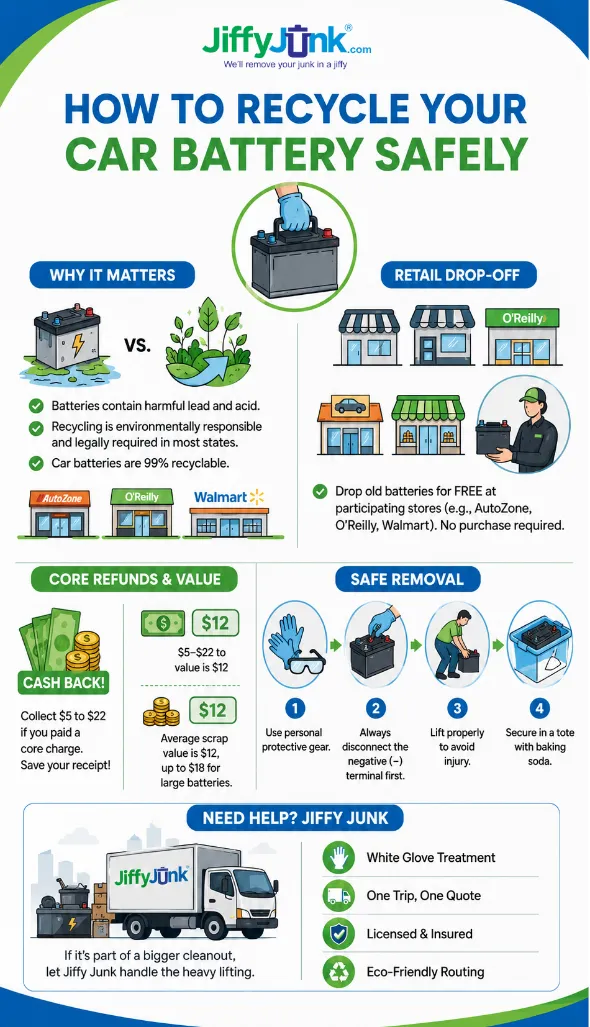
- Drop your old car battery at any AutoZone, O’Reilly Auto Parts, Advance Auto Parts, NAPA, or Walmart Auto Care Center. It’s free, and you do not need to buy a replacement.
- Collect a $5 to $22 core charge refund if you paid one when you bought the replacement. Save the receipt.
- Walk into AutoZone with no purchase at all, and you’ll typically receive about $10 in merchandise credit per qualifying lead-acid battery.
- Sell to a local scrap yard if you’ve got several batteries. Yards pay roughly $5 to $12 each in cash, based on weight.
- Book a Jiffy Junk pickup if you’re clearing a garage, basement, or estate. We’ll haul the batteries with everything else in one trip.
- Skip the curbside bin. Car batteries are classified as hazardous waste under federal law and banned from landfills in 45 states.
Top 5 Takeaways
- Car batteries are 99% recyclable, the most-recycled consumer product in America, ahead of aluminum cans.
- Every major auto-parts retailer accepts old lead-acid batteries for free, even ones you bought somewhere else.
- A core charge is a refundable deposit, not a hidden fee. You collect every dollar when you return the old battery.
- Scrap yards pay roughly $0.15 to $0.24 per pound for clean, intact lead-acid batteries, which works out to about $5 to $12 per car battery in 2026.
- For garage cleanouts, estate properties, or three or more batteries at once, a full-service pickup beats a dozen trips to the store.
Table of Contents
- How To Dispose Of A Car Battery: Free Recycling Options, Auto-Store Take-Back Programs, And Core Charge Refunds Explained
- TL;DR Quick Answers
- Top 5 Takeaways
- What’s Inside A Car Battery (And Why You Can’t Just Toss It)
- Free Drop-Off At Auto-Parts Stores
- Understanding The Core Charge Refund
- What About Cash? Scrap Metal Yards
- How To Safely Remove And Transport An Old Car Battery
- Essential Resources On How To Dispose Of A Car Battery
- 1. Look Up The Battery Disposal Law In Your Own State
- 2. See How California Manages Lead-Acid Battery Disposal
- 3. Handle Lead Safely Before You Pull The Battery
- 4. Protect Your Family From Lead Brought Home From The Garage
- 5. Get The Federal Consumer Guide To Battery Recycling
- 6. Pick A Quality Replacement Battery After You Recycle The Old One
- 7. Read NRDC’s Roadmap For Better Battery Recycling Policy
- Supporting Statistics
- Final Thoughts And Opinion
- Frequently Asked Questions
- Q: Where Is The Closest Place To Dispose Of A Car Battery For Free?
- Q: How Much Will AutoZone Pay For My Old Car Battery?
- Q: What Exactly Is A Core Charge?
- Q: Is It Illegal To Throw A Car Battery Out With Household Waste?
- Q: How Much Is A Used Car Battery Worth In Scrap?
- Q: Can I Recycle A Leaking Or Damaged Car Battery?
- Q: Does Walmart Take Old Car Batteries?
- Q: What About Motorcycle, Marine, Or Truck Batteries?
- Q: How Do I Get Rid Of Multiple Car Batteries From A Garage Or Estate Cleanout?
- Ready To Dispose Of A Car Battery The Easy Way?
What’s Inside A Car Battery (And Why You Can’t Just Toss It)
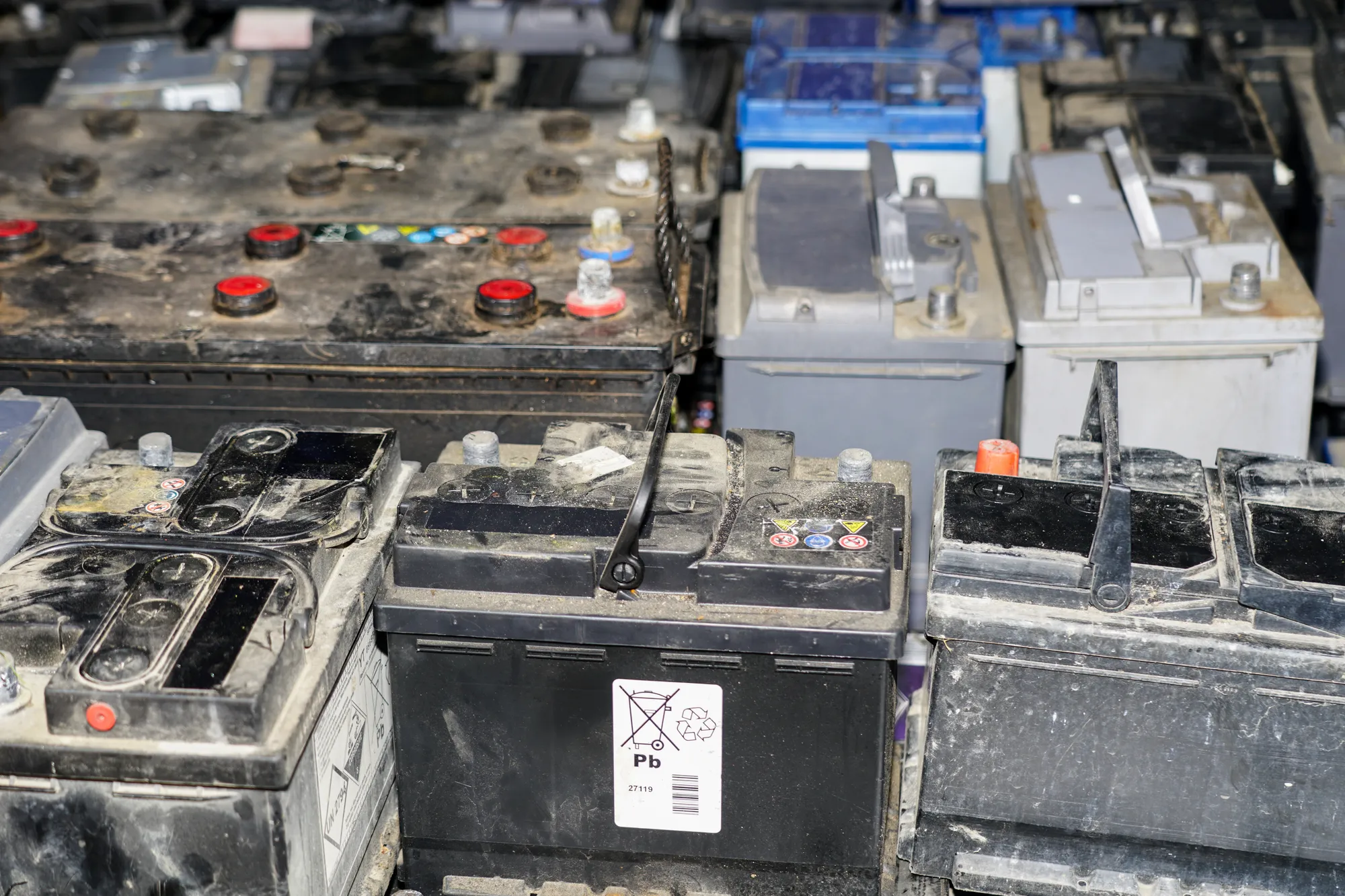
A standard car battery is a lead-acid battery. Inside that 30-to-50-pound case sits roughly 18 to 20 pounds of lead, about 1.5 gallons of sulfuric acid, and a polypropylene shell rugged enough to take ten years under your hood.
The Wikipedia entry on automotive batteries offers a deeper technical breakdown of how a battery holds and delivers a charge.
So why all the rules around throwing them out? Lead is a neurotoxin. Sulfuric acid is corrosive. A car battery that cracks open in a landfill leaches both into the soil and the groundwater. Federal law treats end-of-life lead-acid batteries as hazardous waste under the Resource Conservation and Recovery Act (RCRA).
State law goes further. Forty-five states have adopted laws based on the Battery Council International Model Battery Recycling Legislation. Those laws ban lead-acid batteries from landfills, require retailers to accept used batteries from customers, and back the system with stiff penalties. California, for example, can fine illegal disposal up to $25,000 per occurrence.
That hazardous-waste classification puts car batteries on a short list of items standard junk haulers route through specialized channels rather than the curb. Our guide to materials that need specialized disposal walks through the full list, from sharps to paints to lithium-ion packs.
A car battery has exactly one legal destination. It’s called a recycler.
Free Drop-Off At Auto-Parts Stores
Every major auto-parts chain in the United States accepts used lead-acid car batteries at no charge. You can drop one off without a receipt, without buying a replacement, and without ever having shopped there before. The take-back programs run because most state laws require retailers to accept old batteries, and because each spent core sells back to the lead-smelter network at a profit.
AutoZone
AutoZone gives a $10 in-store merchandise credit per qualifying lead-acid battery, with a limit of ten per customer per day. If you’re buying a new battery, AutoZone refunds your core charge (usually $10 to $22) automatically when you turn in the old one. The $10 walk-in credit promotion excludes motorcycle, lawn-and-garden, and personal-watercraft batteries.
O’Reilly Auto Parts
O’Reilly accepts used lead-acid batteries for free at every store. If you bought a new battery there and paid a core charge, the store refunds it when you bring the old one back within the receipt window. A handful of locations run periodic gift-card promotions for walk-in returns. Call ahead if it matters.
Advance Auto Parts And NAPA
Both chains accept used lead-acid batteries for free. Advance and NAPA refund core charges with your receipt at the time of return. NAPA also runs an annual Earth Day promotion offering an in-store rewards credit for old battery turn-ins.
Walmart Auto Care Center
Walmart’s Auto Care Centers (not standalone Walmart stores) accept old car batteries for free and refund the core charge of typically $5 to $15 when you buy an EverStart or other Walmart battery. Walmart locations without an Auto Care Center generally pass on car batteries. Call before you drive over.
Understanding The Core Charge Refund
A core charge is a refundable deposit that retailers add to the price of a new car battery. When you return the old one for recycling, you get every dollar back. The deposit ranges from $5 to $22 in 2026, and it exists to keep used batteries flowing into the recycling stream instead of into landfills.
A few practical notes on claiming yours:
- Hand in the old battery at the time of purchase, and the core charge gets skipped entirely.
- If you take the new battery home first, bring the old one back within the receipt window. Most retailers allow 30 to 45 days. You’ll receive the refund as cash, card credit, or store credit, depending on the chain’s policy.
- Lost the receipt? Most retailers will still accept the battery, though they’ll issue store credit rather than cash. From our crews’ own experience clearing out old garages, AutoZone’s walk-in $10 merchandise credit (no receipt or purchase required) is usually the best deal for stray batteries with no paper trail.
What About Cash? Scrap Metal Yards
If you have three or more batteries, or you just want cash in hand, a local scrap metal yard is an option. Scrap prices for clean, intact lead-acid batteries run roughly $0.15 to $0.24 per pound as of early 2026. A typical 30-to-50-pound car battery brings about $5 to $12. A truck or marine battery, which can weigh 50 to 75 pounds, brings $8 to $18 each.
A few practical notes before you load up the trunk:
- Yards turn away cracked, leaking, or non-lead-acid batteries on safety grounds. Damaged batteries should go to your county’s household hazardous waste depot instead.
- Transport batteries upright, secured, and in a leak-proof container. Loose or tipped-over batteries are a fast way to get refused at the gate.
- Call ahead. Smaller yards keep limited hours and may not run a scale on weekends.
If you’re sitting on more than just batteries, our scrap metal pickup service will roll up to your door, lift it all out, and route everything to the right recycling streams. One trip, one quote, and you do none of the heavy lifting.
How To Safely Remove And Transport An Old Car Battery
Pulling the battery yourself is straightforward if you follow the order. Skip a step, and you risk acid on your hands or a short across the terminals.
- Gear up. Wear thick rubber or nitrile gloves and safety glasses. A long-sleeved shirt is smart.
- Turn the vehicle off and let the engine cool for 10 to 15 minutes.
- Disconnect the negative terminal first. It’s the black one marked with a minus sign. Use a 10mm or 13mm wrench.
- Disconnect the positive terminal next. Red, marked with a plus sign.
- Remove the hold-down clamp or bracket securing the battery in the tray.
- Lift straight up. Car batteries are heavy. Bend at the knees, not at the back.
- Stand the battery upright in a leak-proof tote lined with cat litter, baking soda, or a folded towel. Any of those will absorb a spill.
- Drive straight to the drop-off. Keep the battery upright and secured so it stays in place through the ride.
“After ten-plus years of cleanouts, the single biggest mistake we see is folks leaving an old battery on a basement shelf for years, where it slowly weeps acid into the concrete. Every car battery in America has a free path to a recycler within ten miles. There’s never a reason to keep one sitting around.” – JiffyJunk Team
Essential Resources On How To Dispose Of A Car Battery
Seven outside sources are worth your time on this topic. They cover state-by-state laws, garage safety, the federal consumer guidance, replacement-battery shopping, and the long view on where battery recycling policy is going.
1. Look Up The Battery Disposal Law In Your Own State
Call2Recycle’s state-by-state map shows you which battery types are banned from regular waste where you live, which retailers are legally required to take them back, and which states impose civil penalties for improper disposal. It’s the fastest way to confirm what’s legal at your address.
Source: Call2Recycle State-By-State Battery Recycling Laws Map
2. See How California Manages Lead-Acid Battery Disposal
California’s Department of Toxic Substances Control runs one of the strictest battery management programs in the country, with fines up to $25,000 per occurrence for illegal disposal. Even if you live elsewhere, this page previews where regulations are heading.
Source: California DTSC: Management Of Spent Lead-Acid Batteries
3. Handle Lead Safely Before You Pull The Battery
OSHA built its Lead overview for industrial workers, but the safety advice translates directly to the home garage. You’ll see how lead enters the body, what protective equipment actually works, and why ordinary hand-washing falls short. Read it before you wrench.
Source: OSHA: Lead Overview For Worker Safety
4. Protect Your Family From Lead Brought Home From The Garage
The CDC’s NIOSH page on lead at work explains how lead dust hitchhikes home on clothing, skin, and tools. If you’ve got young children or pregnant family members in the house, this page will change how you handle the battery and clean up afterward.
Source: CDC NIOSH: About Lead In The Workplace
5. Get The Federal Consumer Guide To Battery Recycling
The U.S. Department of Energy’s Energy Saver fact sheet covers automotive, rechargeable, and single-use batteries in one short, plain-language download. It’s the cleanest single reference for households juggling several battery types.
Source: U.S. Department Of Energy: Consumer Guide To Battery Recycling Fact Sheet
6. Pick A Quality Replacement Battery After You Recycle The Old One
Consumer Reports walks you through why recycling matters and how to choose a quality replacement that lasts another five to seven years. Your $10 merchandise credit stretches a lot further when you spend it on something built to last.
Source: Consumer Reports: Yes, You Need To Recycle Your Old Batteries
7. Read NRDC’s Roadmap For Better Battery Recycling Policy
NRDC’s “Building Batteries Better” report lays out where U.S. battery recycling policy is heading, including reuse and second-life programs across both lead-acid and EV batteries. The long view on where the network is going lives here.
Source: NRDC: Building Batteries Better Report
Supporting Statistics
Federal data and industry research have measured this network for decades. A few of the numbers worth keeping in mind:
1. Lead-Acid Batteries Hit A 99% U.S. Recycling Rate
The United States recycles lead-acid batteries at a 99% rate. That makes them the most-recycled consumer product in the country, ahead of aluminum cans, glass, and paper. From our crews’ day-to-day, that’s why every drop-off counter in America already knows the routine.
Source: U.S. EPA: Lead-Acid Battery Collection Network Case Study
2. 1 Million Tons Of Recycled Lead Produced In 2024
About 1 million tons of secondary lead were produced in the United States in 2024, roughly 70% of total domestic consumption. Nearly all of it came from recycled scrap, mostly lead-acid batteries. In practice, the next battery you buy is almost certainly built from someone else’s old one.
Source: USGS 2025 Mineral Commodity Summaries: Lead
3. 160 Million Batteries Diverted From U.S. Landfills Every Year
The system keeps more than 160 million lead-acid batteries out of U.S. landfills annually, and lead-battery manufacturers typically build a new battery from at least 80% recycled material. That closed-loop “manufacture-use-reuse” model is exactly why your free drop-off pays for itself behind the scenes.
Source: Battery Council International: Lead Battery Recycling Facts
Final Thoughts And Opinion
Car battery disposal is one of the rare household chores where the right answer is also the easiest one. Hand the old battery across an auto-parts counter, walk out with cash or credit, and you’re done.
After a decade of cleanouts, here’s what we’d actually do in each common scenario:
- One battery with a receipt: drive it back to the same store. Collect the core charge refund. Five minutes, five to twenty dollars back in your pocket.
- One battery without a receipt: head to AutoZone. The $10 walk-in merchandise credit is the best no-questions-asked deal in the auto-parts world.
- Three or more batteries: weigh the scrap-yard payout against your time. At $5 to $12 per battery, it adds up. But only if a yard is conveniently on your route.
- Batteries buried in a bigger cleanout: stop driving back and forth. Book a single full-service pickup. Whether the load is in a garage, basement, estate, or small fleet, our licensed and insured crews will route the batteries to certified recyclers along with everything else. Our overview of where items go after pickup walks through the full chain of custody, from donation to recycling to certified disposal.
The one mistake to avoid: leaving an old battery on a basement shelf. Lead-acid batteries weep over time. We’ve pulled them off shelves where they’d eaten through paint, concrete, and occasionally the drywall. Every day that battery stays in your home is a slow, completely avoidable risk.
Frequently Asked Questions
Q: Where Is The Closest Place To Dispose Of A Car Battery For Free?
A: Any AutoZone, O’Reilly Auto Parts, Advance Auto Parts, NAPA, or Walmart Auto Care Center near you. Between the five chains, there are tens of thousands of drop-off locations across the country, which puts most Americans within a short drive of at least one. Call ahead if the closest option is a smaller Walmart without an Auto Care Center.
Q: How Much Will AutoZone Pay For My Old Car Battery?
A: AutoZone offers $10 in-store merchandise credit per qualifying lead-acid car or truck battery, with a limit of ten per customer per day. If you’re buying a new battery, AutoZone refunds your core charge (typically $10 to $22) the moment you turn in the old one.
Q: What Exactly Is A Core Charge?
A: A core charge is a $5 to $22 refundable deposit that retailers add to the price of a new car battery. You get every dollar back when you bring the old battery in for recycling. The deposit keeps used batteries moving back into the recycling stream rather than out to a landfill.
Q: Is It Illegal To Throw A Car Battery Out With Household Waste?
A: Yes, in 45 of the 50 states. Car batteries are federally classified as hazardous waste under RCRA and explicitly banned from landfills in most jurisdictions. Penalties vary by state and can climb as high as $25,000 per occurrence in California.
Q: How Much Is A Used Car Battery Worth In Scrap?
A: Scrap yards pay roughly $0.15 to $0.24 per pound for clean, intact lead-acid batteries as of early 2026. A typical 30-to-50-pound car battery brings $5 to $12 cash. Truck or marine batteries, which can weigh 50 to 75 pounds, bring $8 to $18 each.
Q: Can I Recycle A Leaking Or Damaged Car Battery?
A: Yes, but scrap yards generally pass on leaking units. Take damaged batteries to your county’s household hazardous waste depot. Seal the battery in a heavy-duty plastic bag with cat litter or baking soda first, keep it upright, and transport it in a leak-proof bin.
Q: Does Walmart Take Old Car Batteries?
A: Yes, at Walmart Auto Care Center locations. They accept used lead-acid car batteries for free and refund the core charge (typically $5 to $15) when you buy a new EverStart or other Walmart battery. Standalone Walmart stores without an Auto Care Center generally do not carry car batteries.
Q: What About Motorcycle, Marine, Or Truck Batteries?
A: All three are lead-acid batteries and follow the same disposal path as a car battery. Marine and truck batteries are heavier and bring higher scrap and core values. Most O’Reilly stores and household hazardous waste depots accept motorcycle batteries, but AutoZone’s walk-in $10 credit promo sometimes excludes them. Call ahead for motorcycle batteries specifically. If you’ve also got alkaline, lithium-ion, or rechargeable batteries to clear out from around the house, our full battery disposal and recycling guide walks through each type and where to drop them off.
Q: How Do I Get Rid Of Multiple Car Batteries From A Garage Or Estate Cleanout?
A: Book a full-service junk-removal pickup. Three or more batteries plus the typical odds and ends of a cleanout (old appliances, scrap metal, lawn equipment) is the point where a one-trip haul beats repeated runs to a parts store on both speed and safety.
Ready To Dispose Of A Car Battery The Easy Way?
If your old car battery is part of a bigger cleanout (a garage, basement, estate, or full property), Jiffy Junk’s licensed and insured crews will handle the whole load with our White Glove Treatment and route every battery to a certified recycler for you. Get a free, no-obligation quote in about 60 seconds at JiffyJunk.com or call 844-543-3966. We’re not happy until you are happy.