
Curbside Furniture and Couch Disposal: Can You Leave Furniture on the Curb for Pickup or Do You Need a Professional Haul Away Service to Remove It Properly?
That old couch won’t move itself—and after a decade of hauling furniture from homes nationwide, we can tell you that leaving it on the curb is rarely as simple as it sounds.
Here’s what we’ve learned from thousands of furniture removal jobs: most homeowners don’t realize their city has strict rules about curbside disposal until they’re staring at a fine or watching their sofa sit untouched for days. Some municipalities offer scheduled bulk pickup, others ban curbside furniture entirely, and many have wait times stretching weeks—not ideal when you need that space back now.
This guide shares what actually works when you need to dispose of furniture, based on situations our teams encounter daily. We’ll learn when it makes sense to embrace curbside pickup, when it’s likely to cause more problems than it solves, and how to get a professional haul-away service like our White Glove Treatment to get bulky items out of your home and delivered to someone that can get them disposed of properly – and often, the same day you give us a call.
Whether you’re in the middle of moving in, in the process of a home renovation, or just finally getting around to dumping that worn-out sectional, you’ll find simple-to-understand answers here to help get it right the first time around.
Quick Answers
Can you leave furniture on the curb?
Short answer: It depends on where you live and your local regulations.
What we’ve learned from thousands of removal jobs:
- Some cities allow it — Scheduled bulk pickup programs exist in many municipalities
- Some cities prohibit it — Fines can range from $100 to $10,000
- Most have restrictions — Timing, item types, and quantity limits vary widely
Before placing furniture curbside:
1. Check your city’s bulk pickup schedule and rules
2. Verify item restrictions (mattresses and upholstered furniture often excluded)
3. Review HOA policies if applicable
4. Place items out only during permitted windows
When curbside isn’t an option:
- Donate through Habitat ReStore or Salvation Army (free pickup, 3-7 days notice)
- Sell on Facebook Marketplace or Craigslist
- Hire a professional removalist for same-day service
Curbside disposal can work—but only if you know the rules. When in doubt, or when you need furniture gone fast, professional removal eliminates the guesswork and gets the job done right.
Top 5 Takeaways
- Curbside rules vary dramatically.
- Some cities allow bulk pickup
- Others prohibit it entirely
- Many have confusing restrictions
- Fines can reach thousands of dollars
- Always verify local regulations before placing furniture outside
- 80% of furniture ends up in landfills.
- 12.1 million tons are discarded annually in the U.S.
- Your disposal choice has a real environmental impact
- Donation and recycling keep usable items out of landfills
- Functional furniture deserves a second life.
- Habitat ReStore and Salvation Army offer free pickup
- Items must be in good, sellable condition
- Flexible timeline? Donation is one of the best choices you can make
- “Free” curbside isn’t always free.
- Potential fines for improper placement
- Weather damage to donatable items
- HOA violations
- Failed pickups and wasted time
- True cost adds up quickly
- Professional removal gets it done right.
- Same-day or next-day service available
- We handle heavy lifting
- Donation and recycling are coordinated for you
- Best option when the timeline is tight, or other methods fall short
Table of contents
- Curbside Furniture and Couch Disposal: Can You Leave Furniture on the Curb for Pickup or Do You Need a Professional Haul Away Service to Remove It Properly?
- Quick Answers
- Top 5 Takeaways
- Understanding Your Curbside Furniture Pickup Options
- When Curbside Disposal Works—And When It Doesn’t
- What Professional Furniture Removal Actually Involves
- Making the Right Choice for Your Situation
- Environmental Considerations Worth Knowing
- 7 Helpful Resources for Getting Rid of Furniture the Right Way
- 1. Check If Curbside Bulk Pickup Is Available in Your Area — WM (Waste Management)
- 2. Give Your Furniture a Second Life with Free Donation Pickup — Habitat for Humanity ReStore
- 3. Schedule a Donation Pickup Quickly and Easily — The Salvation Army
- 4. Understand the Rules Before You Put Furniture on the Curb — FindLaw
- 5. Turn Your Unwanted Furniture into Cash — Facebook Marketplace Selling Guide
- 6. Look Up Your City’s Bulk Pickup Schedule by Address — NYC 311 Collection Schedule
- 7. See Why Responsible Disposal Matters — EPA Furniture Waste Data
- The Numbers Behind Furniture Disposal: What We See Every Day
- Final Thought: The Real Question Isn’t “Can I Leave It on the Curb?”
- FAQ on “Can You Leave Furniture on the Curb”
- Q: Is it legal to leave furniture on the curb for pickup?
- Q: How long can I leave furniture on the curb before pickup?
- Q: What happens if the city doesn’t pick up my furniture?
- Q: What types of furniture can’t be left on the curb?
- Q: What are my options if curbside pickup isn’t available or doesn’t work for my situation?
- Skip the Curb—Let Jiffy Junk Handle Your Furniture Removal the Right Way
Understanding Your Curbside Furniture Pickup Options
Before throwing that couch to the curb, you’ll want to know exactly what your municipality does allow.
Curbside bulk pickup programs vary depending on location, and assumptions can be expensive. Many cities and counties have scheduled bulk item collection at least once a month, when citizens can place large items such as furniture at the curb on scheduled days. Some programs require advance scheduling with your waste management provider,while others immediately have a set calendar. A few municipalities will collect by the bulk, therefore including bulk pickup as part of normal trash service, but this is becoming rarer due to the costs of disposal.
The catch? These programs almost always have their restrictions. Weight grocers typically have weight limits, quantity limits on certain items, and restrictions on certain materials. Upholstered furniture,such as couches and mattresses are in a gray area – some programs do accept them, and some reject them for the presence of bedbugs, moisture damage, or landfill regulations. We regularly encounter homeowners who think their sofa qualifies for pickup, and it is then rejected and left sitting days later on the curb.
When Curbside Disposal Works—And When It Doesn’t
Curbside pickup can work well under the right circumstances. If your city offers a reliable program, your furniture meets all requirements, and you can wait for the next scheduled collection date, it’s a reasonable option for a single piece or two.
However, curbside disposal is often not enough in situations our teams see very frequently. Tight timelines are the most common problem – if you’re moving out, selling your house, or need space cleared out so you can do a renovation, waiting two to four weeks for a municipal pickup day isn’t going to work. Large-scale cleanouts that include multiple pieces of furniture will almost always be too large to be done in a single pickup, meaning multiple cycle pickups will be needed to complete the cleanup. And if you are in an HOA community or apartment complex, you may not be able to put out your recycling on the curb because that will be against community rules, no matter what the city policy is.
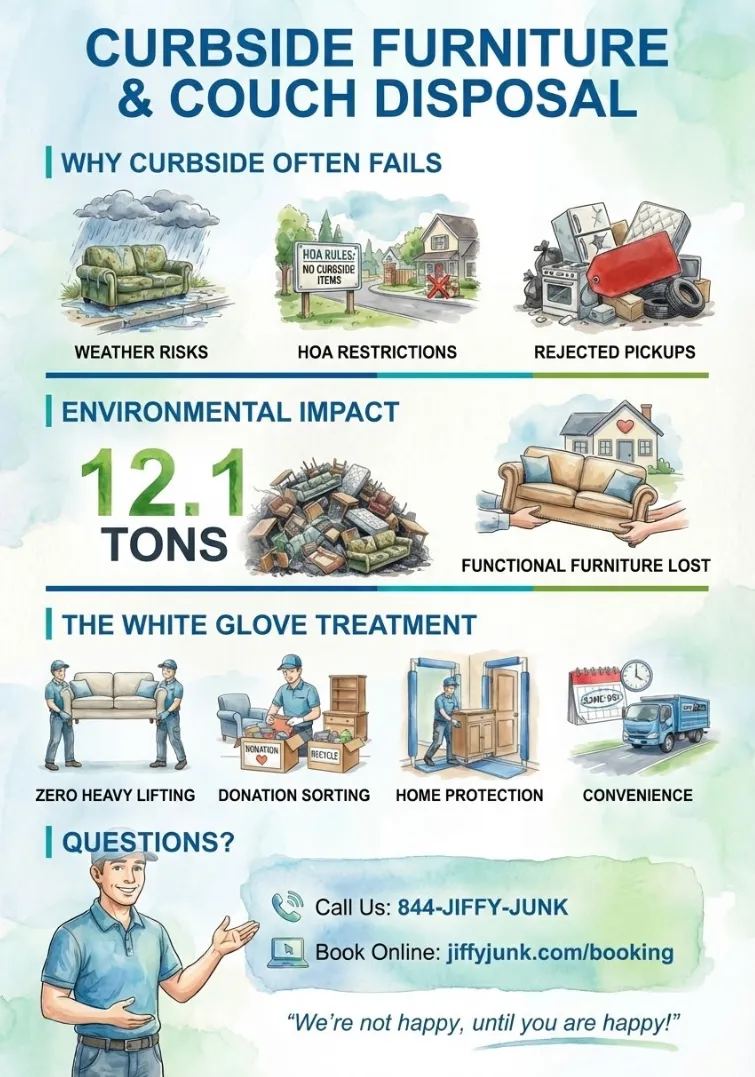
Weather creates additional complications. Upholstered furniture left outside absorbs rain and humidity quickly, creating mold issues and making items impossible to donate. What started as a usable couch becomes landfill-only waste within a day or two of exposure.
What Professional Furniture Removal Actually Involves
Professional haul-away services handle what curbside pickup can’t—and the process is more straightforward than most people expect.
When you book with a full-service removal company, a team comes directly to your home at a scheduled time, typically within a window you choose. You point to what needs to go, and they handle everything from there: lifting, carrying, loading, and transporting. There’s no need to move heavy items yourself, drag anything outside, or worry about disposal logistics.
With our White Glove Treatment approach, we go a step further. Our crews take care to protect your floors, walls, and doorways during removal. We sort items on-site—furniture that’s still in good condition gets routed for donation when possible, keeping usable pieces out of landfills. You get your space back the same day, often within a few hours of our arrival.
Making the Right Choice for Your Situation
The decision between curbside disposal and professional removal typically comes down to three factors: timeline, volume, and physical capability.
If you have a single small piece, your city offers convenient bulk pickup, and you can wait for the scheduled date, or curbside pickup may serve you fine. Check your local waste management website or call ahead to confirm your item qualifies and understand any preparation requirements.
Professional removal makes more sense when you’re working against a deadline, have multiple pieces to clear, or simply don’t want the physical strain of moving heavy furniture. It’s also the better choice for items in good condition you’d prefer to see donated rather than landfilled, or when you’re dealing with especially bulky pieces like sectional sofas, sleeper couches, or solid wood furniture that require multiple people to move safely.
Environmental Considerations Worth Knowing
How your furniture gets disposed of matters—and this is where curbside and professional services often differ significantly.
Municipal bulk pickup typically sends everything directly to the landfill, regardless of condition. That perfectly functional dresser or gently-used couch ends up buried alongside genuinely unsalvageable junk.
Responsible removal companies prioritize diversion from landfills. At Jiffy Junk, we’ve built relationships with local donation centers and recycling facilities specifically so we can route items appropriately. Wood frames, metal components, and certain fabrics can often be recycled. Furniture in decent shape goes to organizations that redistribute it to families in need. Only items that truly can’t be repurposed end up at disposal facilities.
If environmental impact matters to you, ask any removal company about their donation and recycling practices before booking. A company committed to responsible disposal should be able to explain exactly how they handle different materials.
Expert’s Quote
“After removing furniture from thousands of homes, we’ve found that most people don’t call us first—they call us after the couch has been sitting on the curb for a week, the city never came, and now it’s rained twice. A little planning upfront almost always saves time, money, and frustration in the end.” — Jiffy Junk Team
7 Helpful Resources for Getting Rid of Furniture the Right Way
We get it—figuring out how to dispose of that old couch or bulky dresser can feel overwhelming. Should you leave it at the curb? Schedule a pickup? Donate it? Before you make a move, these trusted resources will help you understand your options, avoid unnecessary fines, and make a choice that works for your timeline and your conscience. We’ve done the legwork, so you don’t have to.
1. Check If Curbside Bulk Pickup Is Available in Your Area — WM (Waste Management)
What you’ll find: A simple address lookup tool that shows whether bulk furniture pickup is offered where you live, what it costs, when you can schedule, and which items qualify.
Why this helps: Every municipality handles bulk pickup differently. This quick search saves you time and helps you avoid the frustration of putting furniture out only to watch it sit there untouched.
Resource: https://www.wm.com/us/en/home/bulk-trash-pickup
2. Give Your Furniture a Second Life with Free Donation Pickup — Habitat for Humanity ReStore
What you’ll find: Information on scheduling free furniture donation pickup from Habitat ReStore locations across the country, plus details on what items they accept and how the process works.
Why this helps: When your furniture still has life left in it, donation keeps it out of landfills and supports families building affordable homes in your community. Plus, you’ll receive a tax-deductible receipt—a win all around.
Resource: https://www.habitat.org/stories/does-habitat-offer-furniture-donation-pickup
3. Schedule a Donation Pickup Quickly and Easily — The Salvation Army
What you’ll find: An online scheduling tool and phone line (1-800-SA-TRUCK) for arranging free furniture donation pickup, along with a handy donation value guide for your tax records.
Why this helps: The Salvation Army operates one of the largest donation pickup networks nationwide, which often means faster availability when you need furniture removed sooner rather than later.
Resource: https://satruck.org/
4. Understand the Rules Before You Put Furniture on the Curb — FindLaw
What you’ll find: A clear breakdown of illegal dumping laws by state, potential fines (which can range from a few hundred dollars to $10,000 or more), and what distinguishes a simple mistake from a costly violation.
Why this helps: Leaving furniture curbside without proper authorization isn’t just inconvenient if it doesn’t get picked up—it can result in real fines. Knowing the rules upfront protects your wallet and keeps your neighborhood looking great.
Resource: https://www.findlaw.com/legalblogs/criminal-defense/whats-the-penalty-for-illegal-dumping/
5. Turn Your Unwanted Furniture into Cash — Facebook Marketplace Selling Guide
What you’ll find: Practical tips from experienced sellers on pricing furniture fairly, taking photos that attract buyers, writing descriptions that get responses, and closing the sale smoothly.
Why this helps: Furniture in good condition often has value to someone else. Selling lets you recoup some of your original investment while ensuring a quality piece finds a new home instead of a landfill.
Resource: https://www.apartmenttherapy.com/how-to-use-facebook-marketplace-37394670
6. Look Up Your City’s Bulk Pickup Schedule by Address — NYC 311 Collection Schedule
What you’ll find: An address-based lookup showing exactly when bulk items are collected in your area, how to prepare furniture for pickup, and where to place it curbside.
Why this helps: Most cities offer a similar tool on their municipal website. A quick search for “[your city] bulk trash pickup schedule” gives you accurate, address-specific information so you’re not left guessing.
Resource: https://portal.311.nyc.gov/article/?kanumber=KA-01801
7. See Why Responsible Disposal Matters — EPA Furniture Waste Data
What you’ll find: Federal statistics showing that Americans generate over 12 million tons of furniture waste annually, with only a small fraction recycled or diverted from landfills.
Why this helps: Understanding the bigger picture can make the extra effort of donating or choosing eco-friendly removal feel worthwhile. Small choices add up—and responsible disposal makes a real difference.
The Numbers Behind Furniture Disposal: What We See Every Day
After years of hauling furniture from homes nationwide, we’ve witnessed firsthand how much usable material ends up in landfills. The federal data confirms what our crews experience daily: America has a furniture waste problem—and your choices can help change that.
12.1 Million Tons Discarded Annually
The EPA reports Americans generated 12.1 million tons of furniture waste in 2018—a 450% increase since 1960.
What we’re seeing on the ground:
- More furniture that’s barely a few years old
- Particle board pieces that couldn’t survive a single move
- Flat-pack items are cycling through homes faster than ever
- What used to be a once-a-decade purchase is becoming a regular replacement
Our crews don’t just read these numbers—we’re lifting them onto our trucks every day.
Source: EPA Durable Goods Data
80% Goes Straight to Landfills
The EPA found that 80.1% of discarded furniture—roughly 9.7 million tons—ends up buried in landfills every year. Recycling remains rare because modern furniture mixes too many materials to separate cost-effectively.
Here’s what frustrates us: Much of the furniture we remove is still functional.
We’ve pulled from homes:
- Solid wood dining sets
- Quality leather sofas
- Antique dressers with decades of life left
Most owners assumed the landfill was the only option. They didn’t realize donation was possible—or didn’t have time to coordinate it themselves.
That’s why we built donation partnerships into our process. When we see a piece with life left, we make sure it reaches someone who can use it.
Source: EPA Durable Goods Data
Donation Programs Make a Real Difference
Habitat for Humanity ReStores divert millions of pounds of furniture from landfills annually.
Local impact examples:
- Greater Omaha ReStore: 2,400 tons diverted per year
- Nashville-area ReStores: 1,500+ tons diverted annually
What we’ve seen working alongside these organizations:
- A dining table from one home becomes a young family’s first furniture
- Office chairs from corporate cleanouts end up in nonprofit community centers
- Quality pieces find second lives instead of landfill graves
The challenge? Donation centers have condition standards and can’t always accommodate tight timelines. That’s where professional removal fills the gap—we have the relationships, logistics, and flexibility most homeowners can’t manage alone.
Source: Habitat for Humanity ReStore
Why We Take This Personally
We could have built a business that simply hauled furniture to the nearest disposal facility. Faster. Cheaper. Easier.
Instead, we chose to:
1. Invest in donation partnerships with local organizations
2. Build recycling relationships for materials that can be repurposed
3. Train crews to identify items worth saving
4. Sort on-site and coordinate responsible destinations
5. Track where materials actually end up
It’s more work—but it’s the right work.
When you hire Jiffy Junk, you’re not just clearing space. You’re making sure your furniture goes somewhere responsible. That matters to us. Based on what we hear from customers, it matters to you, too.

Final Thought: The Real Question Isn’t “Can I Leave It on the Curb?”
After exploring municipal programs, donation options, legal considerations, and environmental realities, here’s what it comes down to: the question isn’t whether you can leave furniture on the curb—it’s whether you should.
What This Article Covered
The short answer: It depends on where you live, what your city allows, how long you can wait, and what you’re disposing of.
Key takeaways:
- Municipal pickup varies wildly. Some cities offer convenient service. Others prohibit curbside furniture entirely. Many have confusing rules and multi-week wait times.
- Curbside has real limitations. Weather damage, HOA restrictions, item exclusions, and quantity caps often create more problems than they solve.
- Donation is underutilized. Habitat ReStore and The Salvation Army offer free pickup—yet most people don’t know this exists.
- The environmental stakes matter. 12.1 million tons are discarded annually. Over 80% landfilled. Your single couch actually counts.
- Professional removal fills the gaps. Tight timeline? Heavy items? Want it done right? Full-service hauling delivers convenience and responsible disposal together.
Our Perspective: After Thousands of Jobs
Here’s an opinion we’ve earned through experience: most furniture disposal problems are information problems.
People leave couches curbside not because they don’t care, but because they:
- Don’t know the rules
- Don’t have time to research alternatives
- Don’t realize better options exist
Then the couch sits for a week. It rains. The HOA sends a letter. The city issues a fine. A simple task becomes an expensive headache.
We’ve seen this hundreds of times. Almost every homeowner says the same thing: “I wish I’d known about this sooner.”
What We Believe About Furniture Disposal
Four principles guide how we approach every job:
1. Convenience shouldn’t require compromise. Getting furniture out quickly AND disposing of it responsibly should both be possible. With the right service, they are.
2. Functional furniture deserves a second life. Quality pieces have value. Someone in your community could use them. Landfill burial should be the last resort—not the default.
3. “Free” isn’t always free. Factor in potential fines, research time, weather damage to donatable items, and environmental cost—and paying for professional removal often makes more sense.
4. This industry can do better. Too many companies treat every load the same: pick up, dump, move on. Sorting takes time. Donation relationships take effort. But it’s the right way to operate.
The Bottom Line
You have more options than you realized:
- Curbside pickup might work—or might not
- Donation could be perfect—if timing aligns
- Selling online is worth considering—if you have patience
- Professional removal handles it all—when other options fall short
Our job isn’t just removing furniture. It’s removing the burden entirely.
- You point to what needs to go
- We handle lifting, loading, sorting, donations, recycling, and disposal
- You get your space back
- The furniture goes where it should
That’s not a sales pitch. It’s simply how this service should work.
FAQ on “Can You Leave Furniture on the Curb”
Q: Is it legal to leave furniture on the curb for pickup?
A: It depends entirely on where you live—and we’ve seen the full spectrum.
What we’ve learned working in communities nationwide:
- Some cities offer convenient bulk pickup programs
- Others prohibit curbside furniture completely
- Many have confusing rules about timing, items, and quantities
- Fines range from $100 to $10,000, depending on location
Before placing anything curbside:
1. Check your local waste management website
2. Call your city’s public works department
3. Review HOA rules separately if applicable
Our experience: We’ve picked up plenty of furniture from homeowners who followed city rules perfectly but violated their HOA policy. Never assume—always verify.
Q: How long can I leave furniture on the curb before pickup?
A: Most programs allow 24-48 hours before collection. Some only permit placement the night before.
What the official guidelines don’t tell you: Timing matters more than most people realize.
We’ve seen this scenario repeatedly:
- Homeowner puts furniture out early
- It rains
- Perfectly donatable sofa absorbs moisture
- Mildew develops within 48 hours
- What could have helped a family reduce landfill waste
Additional risks of early placement:
- Citations for illegal dumping
- HOA violation notices
- Neighbor complaints
Our advice: Wait until the last acceptable moment. If rain is forecast, consider whether curbside is really your best option.
Q: What happens if the city doesn’t pick up my furniture?
A: You’re stuck with it. We get these calls more often than you’d think.
Common reasons for failed pickup:
- The item didn’t meet the unknown program requirements
- Placed out on the wrong day or the wrong location
- Exceeded size, weight, or quantity limits
- Contained materials the program doesn’t accept
What happens next:
- The city usually leaves a tag explaining rejection
- Furniture sits outside—possibly rained on
- Neighbors start noticing
- You’re back to square one
Your options at this point:
1. Wait for next pickup cycle (often weeks away)
2. Haul it to a disposal facility yourself
3. Call a professional removal service
Reality check: We’ve made countless “rescue runs” for furniture sitting curbside a week after the city passed it by. By the time people call us, they just want it gone.
Q: What types of furniture can’t be left on the curb?
A: Restrictions vary by location. After years of removal work, here’s what typically gets rejected.
Commonly excluded items:
| Item Type | Common Restriction |
| Mattresses & box springs | Require plastic wrapping or be banned entirely |
| Upholstered furniture | Excluded due to bedbug/pest concerns |
| Heavy items | Weight caps of 50-100 lbs per piece |
| Hazardous materials | Older items with lead paint, treated woods |
| Commercial furniture | Residential programs won’t accept |
| Built-ins & cabinetry | Classified as construction debris |
What surprises homeowners: Even technically accepted items get rejected based on condition.
We’ve seen cities skip:
- Furniture with visible mold
- Waterlogged upholstery
- Pest-infested pieces
- Heavily damaged items
Pro tip: A two-minute phone call to your waste provider can save days of frustration.
Q: What are my options if curbside pickup isn’t available or doesn’t work for my situation?
A: Based on thousands of furniture removal jobs, here are alternatives that actually work.
Option 1: Donation Pickup
- Best for: Flexible timeline, furniture in good condition
- Organizations: Habitat ReStore, Salvation Army
- Lead time: 3-7 days is typically required
- Cost: Free
- Bonus: Tax-deductible receipt
Option 2: Sell It Yourself
- Best for: Quality pieces with resale value
- Platforms: Facebook Marketplace, Craigslist, OfferUp, Nextdoor
- Cost: Free to list
- Trade-off: Requires patience and schedule flexibility
Option 3: Self-Haul to Drop-Off Facility
- Best for: DIYers with truck access
- Requirements: Vehicle, physical ability, time
- Cost: Disposal fee varies by location
Option 4: Professional Junk Removal
- Best for: Tight timelines, heavy items, multiple pieces
- Timeline: Often same-day or next-day
- What’s included: Pickup from inside home, donation routing, recycling, disposal
- Cost: Upfront quote with no hidden fees
What we’ve observed: Most people who call us already tried another option and hit a wall.
Common scenarios we hear:
- The donation center couldn’t come for two weeks
- Facebook buyer flaked three times
- City pickup got skipped
- The item was too heavy to move alone
By the time they reach out, they’re done with the runaround. That’s exactly what we’re here for—no judgment, just a solution that works.
Skip the Curb—Let Jiffy Junk Handle Your Furniture Removal the Right Way
Whether curbside pickup works for your situation or not, there’s an easier path: point to what needs to go, and we’ll take care of everything else. Book your White Glove Treatment online in 60 seconds at jiffyjunk.com/booking or call 844-JIFFY-JUNK (844-543-3966) for a free, no-obligation quote today.