
How To Declutter And Clean Out Your Home Before Selling It: Staging Tips And A Junk Removal Checklist To Help You Get The Best Offer Fast
Your listing photos do most of the selling. A crowded living room makes a buyer scroll past. An empty counter makes them click. Decluttering your home before the real estate photographer arrives is the one move that matters most for your final sale price, and we built this guide from thousands of pre-sale cleanouts to show you exactly how to do it in six weeks.
A clutter-free home photographs better, shows better, and gives buyers the one thing they need to make an offer, which is the room to picture themselves living there. You don’t need a stager or a contractor to get there. You need a plan, a room-by-room checklist, and one clean way to haul everything out when you’re done.
That’s what follows.
TL;DR Quick Answers
How To Declutter Before Selling Your Home
Five moves, in order, get your home show-ready in roughly six weeks:
- Start six to eight weeks before your list date, so you have time to sort rather than rush.
- Walk the house once and sort everything into four piles: keep, sell, donate, and remove.
- Work one room at a time. Kitchen and living room first, then bedrooms and bathrooms, then storage spaces like the basement, attic, garage, and closets.
- Clear visible surfaces down to no more than three items each. Pack away family photos, collections, and any decor with a strong personal stamp.
- Book one professional cleanout at the end to haul everything you’re not keeping in a single visit. That replaces weeks of your own dump runs, back strain, and leftover piles on closing day.
Top 5 Takeaways
- Decluttering directly affects your final sale price. Staged, clutter-free homes sell faster and for more money, often enough to cover the whole pre-sale process several times over.
- Storage spaces do more for your sale price than the “nice” rooms. Buyers open every basement, attic, closet, and garage, and they read empty storage as room to grow.
- Give yourself six to eight weeks. That window is enough to sort, donate, sell, and haul out without the last-minute scramble that costs sellers money.
- Depersonalize before you stage. Family photos, collections, and bold decor keep buyers from picturing themselves living there, which is the whole point of a showing.
- Leave the final haul to a pro. One professional pre-listing cleanout handles in hours what would take you weekends, and it gets your home showing-ready in a single pass.
Table of Contents
- How To Declutter And Clean Out Your Home Before Selling It: Staging Tips And A Junk Removal Checklist To Help You Get The Best Offer Fast
- TL;DR Quick Answers
- Top 5 Takeaways
- Why Decluttering Before You List Matters More Than You Think
- Your Room-By-Room Pre-Sale Declutter Checklist
- From Declutter To Staging: Sorting What Stays And What Goes
- When A Pre-Listing Cleanout Is Worth The Investment
- Essential Resources On How To Declutter Before Selling Your Home
- 1. The Consumer Financial Protection Bureau’s Homeowner Hub
- 2. The EPA’s Playbook For Donating And Reusing Your Stuff
- 3. Habitat For Humanity ReStore: Free Furniture Pickup Nationwide
- 4. Goodwill’s Nationwide Guide For Housewares, Clothing, And Electronics
- 5. AARP’s Working Guide To Home Decluttering (39 Proven Strategies)
- 6. The Official Change-Of-Address Checklist Most Sellers Forget
- 7. The FTC’s Consumer Advice Hub For Home Sellers And Movers
- Supporting Statistics On How To Declutter Before Selling Your Home
- Final Thoughts & Opinion
- Frequently Asked Questions
- Q: How long before listing should I start decluttering?
- Q: Does decluttering actually add to the sale price?
- Q: What’s the one room I should declutter first?
- Q: Should I donate, sell, or just toss everything?
- Q: How much does a pre-listing junk removal service cost?
- Q: Can I schedule a cleanout quickly if my listing date is close?
- Q: What items shouldn’t I declutter right before selling?
- Ready To Declutter Your Home And Get The Best Offer Fast?
Why Decluttering Before You List Matters More Than You Think
Decluttering pays. Every piece of clutter in a listing photo gives a buyer a reason to scroll past. Every overcrowded room at a showing swallows square footage the buyer won’t see. Most buyers now shop on their phones first, and on a phone screen, the photos do the whole opening pitch for you.
From the moment your home hits the MLS, it’s being compared against every other listing in the same price range. The real estate market rewards the homes that look more move-in-ready than their competition at the same price, and decluttering is the fastest way to win that comparison.
What decluttering actually does for your sale:
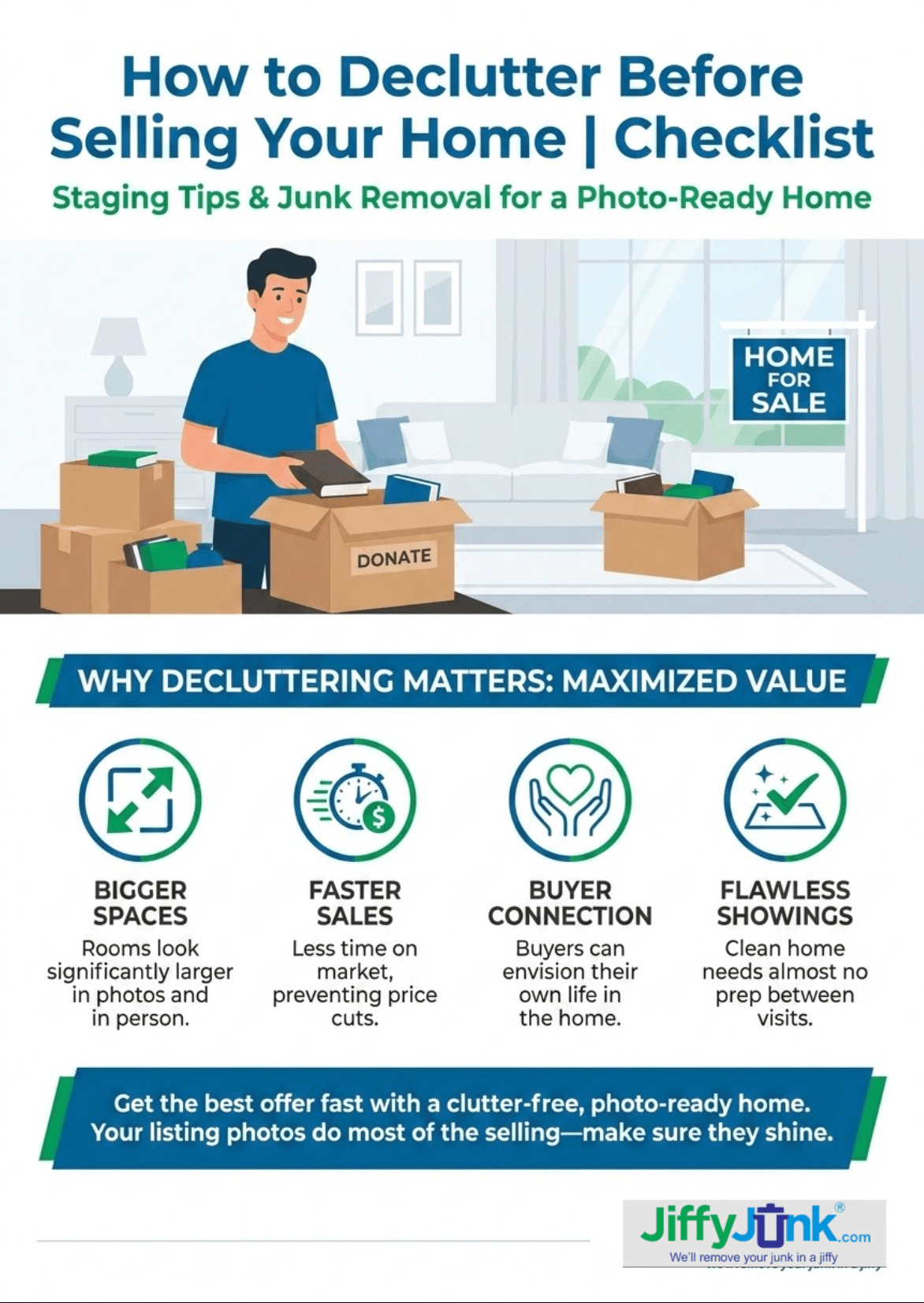
- Rooms look bigger in photos and in person.
- Your home spends less time on the market, which keeps you from cutting the price.
- Buyers can picture themselves living there, which drives full-price offers more than anything else.
- Buyers raise fewer concerns during showings, since clutter often hides the repairs that make them nervous.
- Showings get easier on you because a clean home needs almost no prep between visits.
Your Room-By-Room Pre-Sale Declutter Checklist
Work through the house in the order below. Each room takes an afternoon at most. A single weekend can cover three or four rooms, so spread the work across a few weekends rather than burning out in one marathon. For the same room-by-room system outside a pre-listing window, see our general decluttering guide.
Living Room
- Take out any furniture that crowds walkways or makes the room feel tight.
- Clear coffee tables, mantels, and open shelving down to no more than three items per surface.
- Pack away family photos, diplomas, and personal collections.
- Tuck away visible cords, remote controls, and charging stations.
Kitchen
- Clear countertops down to one or two small appliances, maximum.
- Empty at least a third of your cabinets and pantry, because buyers will open them.
- Strip everything off the refrigerator door, including magnets, photos, and kids’ art.
- Keep only your daily-use cookware out, and box the rest.
Bedrooms
- Trim bedroom furniture down to the essentials: a bed, two nightstands, and one dresser.
- Leave closets no more than 70% full, so they show as spacious.
- Pack away personal photos, religious or political items, and any decor unique to your taste.
- Make the bed look hotel-neutral with simple, clean bedding.
Bathrooms
- Clear counters of personal toiletries.
- Swap worn towels, bath mats, and shower curtains for fresh neutral ones.
- Organize medicine cabinets and under-sink storage. Buyers will check.
Home Office
- File or shred the paperwork that’s been piling up.
- Clear the desk surface and bookshelves.
- Box up any books you won’t need during the selling window.
Basement, Attic, And Garage
- These spaces signal storage capacity. The emptier they look, the bigger the home feels to a buyer.
- Haul out old appliances, broken furniture, and half-finished project materials.
- Sweep up, organize what stays on the shelving, and keep the floor space visible.
- Plan a professional cleanout here. This is where the volume lives.
Outdoor Spaces And Curb Appeal
- Clear out broken patio furniture, dead planters, and yard debris.
- Clean off the porch and entryway, because this is the first thing buyers see.
- Book yard-waste removal if you need it, so nothing distracts from the listing photos.
From Declutter To Staging: Sorting What Stays And What Goes
Once you finish decluttering each room, everything that’s left lands in one of four buckets. Most sellers get stuck at this step, and it’s usually the volume that stalls them, not the sorting itself. Move through the four buckets in this order:
- Keep: anything you use weekly and plan to bring to the next home. Pack it neatly, label every box, and store what you can off-site to keep rooms showing-ready.
- Sell: high-value pieces like quality furniture, appliances in working order, and antiques. Consignment shops, Facebook Marketplace, and estate sales all work well here.
- Donate: usable clothing, housewares, and smaller furniture. A lot goes here, and it should. Donations are often tax-deductible, and they keep usable items out of the landfill.
- Remove: anything broken, heavily worn, or not worth the time to sell. This is where a pre-listing cleanout earns its keep.
Instead of six trips to the dump and four more to the donation center, you can schedule a full-service home cleanout and hand the entire removal pile and the donation pile to one team, in one visit. Our crews load, haul, sweep up, and donate or recycle as much as possible on every job. That’s our White Glove Treatment. We’re not happy, until you are happy!
When A Pre-Listing Cleanout Is Worth The Investment
Some sellers handle decluttering and disposal themselves. Plenty of them find partway through that there’s more volume than they can move on their own, and they end up stressed or still staring at a half-full basement the week before closing. A professional cleanout makes sense if any of the following applies to you:
- You’re on a tight timeline and listing in four weeks or less.
- You’re clearing a high volume, like an estate cleanout, an inherited property, or a downsizing move.
- You’re selling from out of state, and no one local is handling the haul-out for you.
- You have heavy, bulky items like old appliances, pianos, hot tubs, treadmills, or pre-owned furniture.
- You’ve already decluttered, and the donate or remove pile is bigger than your vehicle can handle.
- Lifting, loading, and carrying aren’t an option for you physically, and the DIY route would eat up the weekends you need for the move itself.
A full-service cleanout from a licensed and insured team typically wraps in a few hours on a single day. Compare that against weeks of your own dump runs, and the math almost always lands in favor of the professional job. Add the cost of missing your listing date, and the decision gets even simpler. Once the haul is done, the next step is the deep clean. Our full spring cleaning checklist breaks that down room-by-room so the house is photo-ready before your agent’s showings begin.
“After more than a decade of pre-listing cleanouts, we’ve learned the offer price moves with the clutter out the door. The sellers who start six weeks out are the ones who close fast, at or above asking, with no last-minute surprises on closing day.”
— Jiffy Junk Operations Team
Essential Resources On How To Declutter Before Selling Your Home
Before you list, these are the seven outside resources we hand to any homeowner who asks. They cover the pieces of the pre-sale process that trip up most sellers: the tax rules, the donation routes, the recycling guidance, and the change-of-address paperwork everyone forgets until week one of the move.
1. The Consumer Financial Protection Bureau’s Homeowner Hub
The Consumer Financial Protection Bureau’s housing hub for homeowners. It covers the money side of buying, selling, and managing a mortgage, with plain-language guides on closings, escrow, and the paperwork that comes with the move. A useful first stop for the financial mechanics your real estate agent won’t always spell out for you.
Source: CFPB Housing Tools and Resources
2. The EPA’s Playbook For Donating And Reusing Your Stuff
The Environmental Protection Agency’s plain-language guide to keeping usable items out of the landfill. You get a practical framework for deciding what to donate, what to reuse, and where to take what’s left. Especially useful if your declutter pile includes electronics, appliances, or building materials.
Source: EPA Reducing and Reusing Basics
3. Habitat For Humanity ReStore: Free Furniture Pickup Nationwide
Habitat ReStores accept new and gently used furniture, appliances, housewares, and building materials, and many locations offer free pickup of large items. Donations are tax-deductible, and the proceeds fund affordable housing in your community, which makes this one of the easier wins in the donate pile.
Source: Habitat for Humanity Donate Goods
4. Goodwill’s Nationwide Guide For Housewares, Clothing, And Electronics
Goodwill accepts household items, clothing, small appliances, and electronics at thousands of donation centers across the U.S. and Canada. Your donations fund local job-training programs, which give the items you no longer need a second life that actually helps someone.
Source: Goodwill Donate Goods
5. AARP’s Working Guide To Home Decluttering (39 Proven Strategies)
AARP’s working guide to decluttering, pulled from the advice of professional organizers. Especially strong for sellers who are also downsizing, or who find the emotional side of letting go of long-held items the hardest part of the move.
Source: AARP Smart Guide to Decluttering
6. The Official Change-Of-Address Checklist Most Sellers Forget
The federal government’s short, official guide to updating your address with USPS, the IRS, Social Security, and your state agencies. It’s the one logistical task that slips through the cracks at closing. Bookmark it now.
Source: USA.gov Change Your Address
7. The FTC’s Consumer Advice Hub For Home Sellers And Movers
The Federal Trade Commission’s consumer-protection resource for the home. You’ll find guidance on mover and contractor selection, home-related scams, and the smart-home handoff that’s now part of most sales. Worth a read before you sign anything during listing and closing.
Source: FTC Consumer Advice For the Home
Supporting Statistics On How To Declutter Before Selling Your Home
The numbers below are pulled from U.S. government and American Psychological Association sources. They line up with what our crews see on the ground every week. Decluttered homes sell faster, reduce seller stress during the process, and, when the math is done right, carry meaningful tax protection on the way out.
Stat 1: The Median New U.S. Home Sold In January 2026 For $400,500
The U.S. Census Bureau and HUD’s joint New Residential Sales report puts the median sales price of new single-family homes sold in January 2026 at $400,500. On a home at that price, even a modest 2-5% lift from a well-staged, decluttered listing adds $8,000 to $20,000 in seller proceeds. That kind of return makes a pre-sale cleanout one of the highest-ROI moves you can make as a seller.
Source: U.S. Census Bureau New Residential Sales
Stat 2: Clutter Is A Documented Driver Of Stress And Anxiety
The American Psychological Association’s research into the psychology of clutter finds that living in cluttered spaces drives stress and anxiety, and that it can hurt both mental health and productivity over time. For sellers already juggling inspections, showings, and a moving timeline, clearing the clutter protects your own mental energy during a stretch of life when you need it most.
Source: American Psychological Association
Stat 3: Qualifying Home Sellers Can Exclude Up To $500,000 In Gains From Taxes
The IRS allows qualifying homeowners to exclude up to $250,000 of capital gains on the sale of a main home, or up to $500,000 for married couples filing jointly, as long as they meet the ownership and use tests. Combine that tax protection with the price lift that comes from a decluttered, staged home, and the case for doing the pre-sale work right becomes hard to argue with.
Source: IRS Topic No. 701 Sale of Your Home
Final Thoughts & Opinion
A decade of pre-sale cleanouts surfaces one pattern over and over. Sellers who decluttered early closed faster and walked away with more money. They also tended to feel calmer on closing day, because nothing was stacked up against them in the final week. The sellers who waited paid for the delay, in rushed disposal fees and in price reductions they didn’t have to take.
Our honest take:
- Decluttering isn’t optional if you want top dollar. Most sellers will see a bigger return on this one move than on any other piece of pre-sale work.
- Six to eight weeks is the sweet spot. Any shorter and you’re cutting corners, you’ll feel at closing, and any longer means losing the momentum that got you started.
- Storage spaces (basement, attic, garage, closets) do more for your offer price than the “nice” rooms, because buyers read empty storage as “this home has room to grow.”
- A hybrid approach works best for most sellers. Sort the items yourself, then hand the final haul-out to a team that’s done it a thousand times before.
You’re not aiming for a perfectly empty house. You’re aiming for a house that feels like the buyer’s future home rather than a record of your past one. Clear the surfaces, empty the storage, and let the property tell its own story.
Once the sale closes and you’re prepping for the move, our guide to decluttering before a move picks up where this one leaves off.
Frequently Asked Questions
Q: How long before listing should I start decluttering?
A: Start six to eight weeks before your planned list date. Spend the first two weeks on a whole-home audit and sort. Give yourself the next three weeks for room-by-room work, and the last week or two for the professional cleanout and staging. Starting that early means you’re never rushing decisions, which is where most sellers end up keeping what they meant to donate and tossing what they meant to keep.
Q: Does decluttering actually add to the sale price?
A: Consistently, yes. The National Association of Realtors’ 2025 Profile of Home Staging reports that staging boosts sale prices by 1% to 10% for roughly three in ten agents, and that nearly half of sellers’ agents see shorter time-on-market for staged listings. On a median-priced home, that range adds up to thousands or tens of thousands in seller proceeds, for a process that costs next to nothing.
Q: What’s the one room I should declutter first?
A: Start with whichever room has the most storage, usually the basement or the garage. These spaces tell the buyer more about the home’s real capacity than any formal room will. A half-full basement reads as room to grow, while a packed basement reads as not enough space. Work where the volume actually lives, and the rest of the house gets easier from there.
Q: Should I donate, sell, or just toss everything?
A: Sort in this order. Sell the high-value pieces first, like antiques, quality furniture, and working appliances. Donate anything still in usable condition. Only remove what’s broken, worn out, or too specific to your household to pass on. Most full-service cleanout companies, Jiffy Junk included, will sort and donate on your behalf, which saves you a separate donation run.
Q: How much does a pre-listing junk removal service cost?
A: Pre-listing cleanouts vary by volume, item type, and region, but most whole-home jobs fall in the $400 to $1,500 range. Jiffy Junk gives you a free, no-obligation quote up front. The number we quote is the number you pay. No hidden fees and no closing-day surprises.
Q: Can I schedule a cleanout quickly if my listing date is close?
A: Most of the time, yes. Jiffy Junk routinely books pre-listing cleanouts within 24 to 48 hours. If your listing date is next week and the basement is still packed, call us anyway. We’ve handled tighter turnarounds than that and come through on the deadline.
Q: What items shouldn’t I declutter right before selling?
A: Leave any functional fixtures and built-ins that buyers will expect to stay with the home, like ceiling fans, light fixtures, and built-in shelving. Keep at least minimal staging in each room, too. A totally empty home often sells for less than a thoughtfully staged one, because buyers struggle to gauge scale without some furniture in place.
Ready To Declutter Your Home And Get The Best Offer Fast?
Book your Jiffy Junk pre-listing cleanout today, and we’ll haul every item you’re not taking to closing with the White Glove Treatment and a licensed, insured team on every job. We’re not happy, until you are happy! Call 844-543-3966 or request your free online quote, and list your home with nothing left behind.