Most junk removal companies promise eco-friendly service — we actually built our entire operation around it. When we founded Jiffy Junk in 2014, we saw an industry that treated “green disposal” as an afterthought. We took a different approach. Every job our White Glove teams complete follows a sort-first process: we separate recyclables, identify items with donation potential, and work directly with local charities and recycling facilities in your area to keep as much as possible out of landfills.
Based on our experience handling thousands of cleanouts nationwide — from single-item pickups to full estate clearouts — we’ve learned that most households have far more reusable material than they realize. That old dresser, those working appliances, even partial sets of dishware can find new homes when they’re handled by a team that knows where to route them. Our licensed and insured crews are trained not just to haul, but to assess every item for its highest-value next destination.
You shouldn’t have to research recycling centers, coordinate donation pickups, and rent a truck just to do the responsible thing. Point us to what needs to go, and we take care of the rest — with transparent pricing, no hidden fees, and the peace of mind that your items are getting a genuine second life. Book your free quote today and experience the Jiffy Junk difference.
TL;DR Quick Answers
What Is an Eco-Friendly Junk Removal Service and Why Does It Matter?
Eco-friendly junk removal is a full-service approach that prioritizes recycling and donation over landfill disposal. Instead of hauling everything to the dump, a responsible provider sorts your items on-site and routes usable goods to local charities and certified recycling facilities.
Why it matters:
- Over 146 million tons of municipal solid waste are landfilled annually in the U.S. — much of it still usable
- Furniture, appliances, electronics, textiles, and construction materials almost always have a recycling or donation path when sorted properly
- Choosing eco-friendly junk removal keeps your belongings in circulation, supports local communities, and reduces landfill impact
What to look for in a provider:
- A defined sorting process built into every job — not offered as an optional upgrade
- Active partnerships with local donation centers and certified recycling facilities
- Transparent, upfront pricing that includes responsible disposal at no extra charge
- Licensed and insured crews trained to assess items for their highest-value next destination
Top 5 Takeaways
- Most junk doesn’t belong in a landfill. Furniture, appliances, electronics, textiles, and construction materials almost always have a second life. The problem isn’t the items — it’s that most haulers don’t take the time to sort them.
- Eco-friendly junk removal should be the standard, not a premium upgrade. It takes three things: trained crews, local partnerships, and a commitment to evaluate every item. At Jiffy Junk, all three are built into every job at no extra cost.
- The recycling and donation infrastructure already exists in your community. Habitat ReStores, Salvation Army centers, e-waste recyclers, and construction material processors are already operating nationwide. Our Sort-First Method connects your items to these partners on every cleanout.
- Your donated items can benefit you at tax time. Eligible household goods, furniture, and clothing may qualify for a charitable tax deduction. Document your items, request receipts, and review IRS Publication 526 to maximize the benefit.
- Where your items end up is your choice. Choosing a responsible provider means your belongings support local families, conserve resources, and stay out of landfills. With Jiffy Junk’s White Glove Treatment, you get full-service convenience and real peace of mind.
Table of Contents
- TL;DR Quick Answers
- Top 5 Takeaways
- How Our Eco-Friendly Junk Removal Process Works
- What We Recycle and Donate on Your Behalf
- Why Sustainable Junk Removal Matters More Than You Think
- Full-Service Convenience With a Green Commitment
- 7 Go-To Resources That Help You Feel Great About Where Your Items End Up
- 1. Learn Where Your Donated Items Can Make the Biggest Impact
- 2. See the Real Numbers Behind Why Recycling and Donation Matter
- 3. Find Recycling and Donation Centers Right in Your Neighborhood
- 4. Give Your Furniture and Appliances a Second Home While Supporting Affordable Housing
- 5. Find Out What Your Donated Items Are Actually Worth at Tax Time
- 6. Understand the Rules for Claiming Charitable Donation Deductions
- 7. Recycle Your Old Electronics the Right Way — and Recover Valuable Materials
- What a Decade of Cleanouts Has Taught Us About Where Your Items Really End Up
- Final Thoughts and Opinion
- Frequently Asked Questions
- Q: What exactly is eco-friendly junk removal, and how is it different from regular junk removal?
- Q: What types of items can Jiffy Junk recycle or donate on my behalf ?
- Q: How do I know my items are actually being recycled or donated and not just sent to a landfill?
- Q: Does eco-friendly junk removal cost more than regular junk removal?
- Q: Can I receive a tax deduction for items that Jiffy Junk donates on my behalf?
- Give Your Items a Second Life With Eco-Friendly Junk Removal From Jiffy Junk
How Our Eco-Friendly Junk Removal Process Works
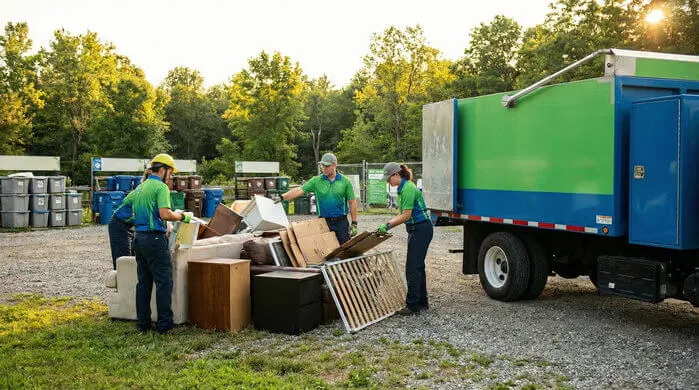
Every Jiffy Junk cleanout follows what we call our Sort-First Method — a process we developed after years of seeing perfectly good items end up in dumpsters. When our White Glove team arrives, we don’t just load everything onto the truck. We assess each item on-site, separating materials into three streams: items for donation, materials for recycling, and only what truly can’t be salvaged goes to disposal. This approach means the majority of what we pick up gets redirected away from landfills and back into your community.
What We Recycle and Donate on Your Behalf
Our crews handle the sorting so you never have to. We routinely route furniture, working appliances, clothing, electronics, books, housewares, and building materials to the right local partners. Usable goods go to charity organizations and thrift centers near you, while metals, plastics, wood, cardboard, and e-waste are delivered to certified recycling facilities. If an item has value left in it, we find the right home for it — that’s a commitment we take seriously on every single job.
Why Sustainable Junk Removal Matters More Than You Think
The EPA estimates that millions of tons of reusable household items end up in landfills each year — furniture, electronics, and textiles that still have functional life. When you choose a junk removal service that prioritizes recycling and donation, you’re not just clearing space. You’re keeping usable goods in circulation, reducing the demand for new raw materials, and supporting local charitable organizations that depend on donated items. We founded Jiffy Junk with the belief that fast, convenient removal and environmental responsibility aren’t competing priorities — they’re the same priority.
Full-Service Convenience With a Green Commitment
Coordinating donations, hauling items to recycling drop-offs, and figuring out what goes where takes hours that most people don’t have. That’s the problem we solve. Our licensed and insured teams handle everything from the heavy lifting to the responsible routing of your items — all included in one transparent, upfront quote with no hidden fees. Whether you’re clearing out a single room or managing a complete estate cleanout, our White Glove Treatment means you relax while we do the work and ensure your items are disposed of the right way.
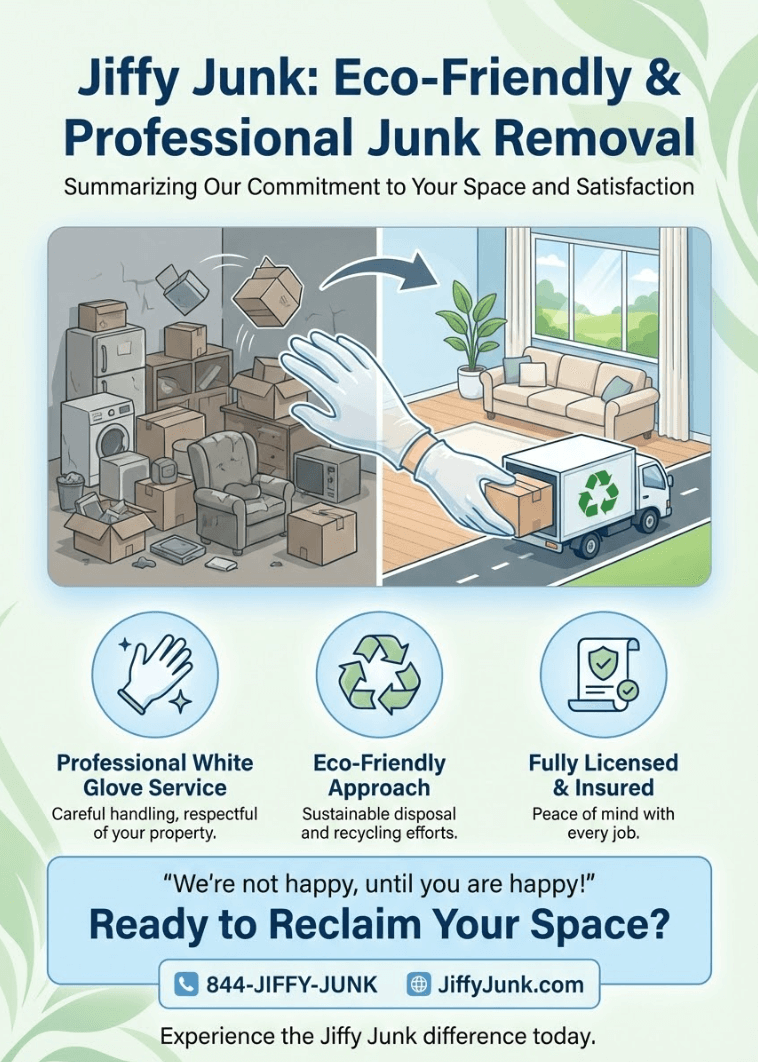
“After a decade of handling thousands of cleanouts across the country, we’ve proven that responsible disposal doesn’t have to slow down the job — in fact, our Sort-First Method has become the reason customers choose us, because they know every item we pick up is assessed for its highest-value next destination before anything ever reaches a landfill.” — Jiffy Junk Leadership Team
7 Go-To Resources That Help You Feel Great About Where Your Items End Up
We know you care about more than just clearing the clutter — you want to know your belongings are going somewhere good. That’s exactly why we do what we do. To help you make the most informed, confident decision about eco-friendly junk removal, we’ve pulled together seven trusted resources. Each one gives you real value — from finding donation centers near you to uncovering tax savings you might not know about.
1. Learn Where Your Donated Items Can Make the Biggest Impact
EPA — Reducing and Reusing Basics
You’d be surprised how many of your household items still have plenty of life left. The EPA points out that local churches, community centers, thrift stores, schools, and nonprofit organizations accept a wide variety of donated items, including used books, working electronics, and unneeded furniture. This is a great starting point if you’re curious about what qualifies for donation — and why reuse is one of the most effective ways to keep your community and the environment thriving.
Where to find it: https://www.epa.gov/recycle/reducing-and-reusing-basics
2. See the Real Numbers Behind Why Recycling and Donation Matter
EPA — Facts and Figures on Materials, Wastes, and Recycling
Here’s a number that might surprise you: the EPA reports that approximately 292.4 million tons of municipal solid waste were generated in 2018, with more than 146 million tons — roughly 50 percent — ending up in landfills. When you see the full picture, it’s easy to understand why choosing a junk removal service that prioritizes recycling and donation makes a real difference. We built our Sort-First Method around exactly this kind of data — because we believe every item deserves a chance at a second life before it ever reaches a landfill.
Where to find it: https://www.epa.gov/facts-and-figures-about-materials-waste-and-recycling/national-overview-facts-and-figures-materials
3. Find Recycling and Donation Centers Right in Your Neighborhood
Earth911 — Recycling Center Search
Wondering where specific items can be recycled near you? Earth911 maintains one of North America’s most extensive recycling databases, covering over 350 materials and 100,000+ listings. Just type in what you need to recycle and your zip code — it’s that simple. This tool is especially handy for specialty items like electronics, paint, or construction materials that can’t go in a standard curbside bin. Of course, when you book with Jiffy Junk, our team handles all of this routing for you — but it’s a fantastic resource if you want to see exactly what’s available in your area.
Where to find it: https://search.earth911.com
4. Give Your Furniture and Appliances a Second Home While Supporting Affordable Housing
Habitat for Humanity — ReStore Donation Program
This one’s close to our hearts. Habitat ReStores divert hundreds of tons from landfills each year by accepting hard-to-dispose-of items, including new and used furniture, appliances, and surplus building materials, with pickup service provided in many cases for large items. The best part? Every item sold at a ReStore helps fund the construction of affordable homes in your community. That means the couch you no longer need could directly help a family build a better future. We partner with organizations like Habitat ReStore in communities nationwide to make sure your items go where they’ll do the most good.
Where to find it: https://www.habitat.org/restores/donate-goods
5. Find Out What Your Donated Items Are Actually Worth at Tax Time
The Salvation Army — Donation Valuation Guide
Here’s something a lot of folks don’t realize — your donated items can save you money on your taxes. The Salvation Army offers a Donation Value Guide with approximate tax-deductible values for commonly donated items, including appliances, furniture, household goods, and clothing, with low and high estimates based on condition. Before your next cleanout, take a quick look at this guide. It’ll help you estimate the financial benefit of donating rather than tossing — and you’ll have the information you need when tax season rolls around.
Where to find it: https://satruck.org/Home/DonationValueGuide
6. Understand the Rules for Claiming Charitable Donation Deductions
IRS — Publication 526: Charitable Contributions
Want to make sure you’re getting every tax benefit you’re entitled to? This is the official IRS guide to charitable deductions, and it’s worth a quick read. The IRS requires that donated household items — including furniture, electronics, appliances, and linens — be in good used condition or better to qualify for an income tax charitable contribution deduction. Knowing these rules upfront helps you plan your cleanout smarter and keep more money in your pocket. When our White Glove team sorts your items on-site, we identify donation-eligible goods so nothing with value gets overlooked.
Where to find it: https://www.irs.gov/publications/p526
7. Recycle Your Old Electronics the Right Way — and Recover Valuable Materials
EPA — Electronics Donation and Recycling Guide
Old computers, phones, and TVs aren’t just clutter — they contain materials that are far too valuable to bury in a landfill. The EPA notes that recycling one million laptops saves energy equivalent to the electricity used by more than 3,500 U.S. homes in a year, and recovering materials from one million cell phones yields 35,000 pounds of copper, 772 pounds of silver, and 75 pounds of gold. Electronics also require careful handling to protect your personal data and the environment. This guide walks you through your options — and when you work with Jiffy Junk, our crew ensures your e-waste gets routed to certified recycling facilities.
Where to find it: https://www.epa.gov/recycle/electronics-donation-and-recycling
What a Decade of Cleanouts Has Taught Us About Where Your Items Really End Up
After handling thousands of cleanouts since 2014, our crews see the same thing on nearly every job — perfectly usable items headed for the landfill simply because no one took the time to sort them. The government data confirms what we witness daily, and it’s exactly why we built our Sort-First Method.
1. 80% of Discarded Furniture Gets Landfilled — We’re Working to Change That
The EPA reports that 12.1 million tons of furniture and furnishings entered the waste stream in 2018, with 80.1 percent landfilled rather than recycled or recovered.
What we see on the job:
- Solid wood bookcases, dining sets, and dressers with years of life left — sitting curbside for disposal
- Families who want to donate but don’t have the time, the truck, or the connections before their deadline
- Usable furniture that simply needs someone to move it to the right place
What we do differently:
- Every piece of furniture is evaluated on-site by our White Glove crew
- Donation-eligible items are connected with local charities and resale organizations
- We’ve built these partnerships in communities nationwide so your furniture gets a second home — not a landfill
Source: U.S. EPA — Durable Goods: Product-Specific Data
2. 600 Million Tons of Construction Debris Generated Annually — Much of It Recyclable
The EPA estimated that 600 million tons of construction and demolition debris were generated in the United States in 2018 — more than twice the total municipal solid waste produced that year.
What we’ve learned from years on job sites:
- Wood, metal, concrete, and drywall make up a large share of construction debris — and most of it has a clear recycling path
- The problem isn’t the material. It’s that most haulers load everything into one truck and send it straight to disposal
- Proper separation at the point of removal is the single biggest factor in keeping C&D materials out of landfills
How our crews handle it:
- Construction materials are sorted on-site during removal
- Recyclable debris is routed to certified processing facilities in your area
- We take the extra time because we’ve seen firsthand how much of this material never needs to reach a landfill
Source: U.S. EPA — Construction and Demolition Debris: Material-Specific Data
3. Two-Thirds of Textile Waste Is Landfilled — We Rescue What Most Haulers Overlook
The U.S. Government Accountability Office reports that 66 percent of textile waste was landfilled in 2018, while only 15 percent was recycled.
What our estate cleanout and downsizing experience has shown us:
- Clothing, bedding, towels, curtains, and upholstery are present in large quantities on nearly every job
- Most junk removal services don’t separate soft goods from everything else — that’s why the landfill rate is so high
- Even items that aren’t in pristine condition can often be accepted by textile recycling programs
Our Sort-First approach to textiles:
- Dedicated sorting step for identifying all textile and soft goods
- Usable items are routed to local charities and thrift organizations
- Worn or damaged textiles are directed to textile recyclers instead of disposal
Source: U.S. Government Accountability Office — GAO-25-107165
URL: https://files.gao.gov/reports/GAO-25-107165/index.html
Final Thoughts and Opinion
After more than a decade of serving communities across the country, we’ve arrived at one clear conclusion: the way most junk gets removed in this country is fundamentally broken — and it doesn’t have to be.
The standard industry model looks like this:
- A truck shows up
- A crew loads everything on
- It all goes to the same place — the landfill
It’s fast. It’s easy. And it’s exactly what’s driving the statistics we cited above — 80% of furniture landfilled, two-thirds of textiles buried, and 600 million tons of construction debris generated in a single year. These aren’t just numbers on a government report. They’re the direct result of an industry built around speed and volume rather than responsibility and care.
We think that’s the wrong approach. And our experience proves there’s a better one.
What a Decade of Doing This Work Has Taught Us
When we founded Jiffy Junk in 2014, we built our Sort-First Method for one reason: we kept seeing items with real value and real remaining life being treated as waste simply because nobody in the process was willing to slow down and sort them properly.
Here’s what we’ve learned since:
- Most households dramatically underestimate how much of their stuff is still usable. We routinely pull working appliances, quality furniture, clean clothing, and functional electronics out of cleanouts where the customer assumed everything was headed for the dump. A single job can yield multiple truckloads of donation-eligible items that any other hauler would have landfilled.
- The recycling and donation infrastructure already exists — the missing link is someone willing to use it. Habitat ReStores, Salvation Army centers, textile recyclers, certified e-waste facilities, and construction material processors are operating in communities across the country. The resources are there. What’s been missing is a junk removal service that builds these partnerships into its daily operations.
- Customers don’t just want convenience — they want to feel good about where their items end up. We hear this more than almost anything else. People want to know that their grandmother’s dining table went to a family who needed it, that old office chairs went to a nonprofit, and that scrap metal was recycled instead of buried. That peace of mind is part of the service.
Our Honest Opinion
Eco-friendly junk removal shouldn’t be a premium add-on or a marketing buzzword. It should be the baseline standard for how this entire industry operates.
Sorting, recycling, and donating don’t require revolutionary technology. They require three things:
- A team trained to do it — crews who know how to assess every item on-site
- Partnerships with the right local organizations — charities, recyclers, and processing facilities already in your community
- A company culture that treats every item as worth evaluating — before it’s ever sent to disposal
That’s the standard we hold ourselves to on every job — from a one-item pickup to a complete estate cleanout. It’s why we created the White Glove Treatment. It’s why we invest in training our licensed and insured crews to find each item’s highest-value next destination.
We think the rest of the industry should be doing the same. And we’re not waiting around for them to catch up.
Frequently Asked Questions
Q: What exactly is eco-friendly junk removal, and how is it different from regular junk removal?
A: Most junk removal companies operate on a single-destination model — everything goes on the truck, and the truck goes to the landfill. After spending over a decade watching that approach waste thousands of tons of usable items, we built something better.
Our Sort-First Method separates every job into three streams:
- Items for donation — usable goods routed to local charities and resale organizations
- Materials for recycling — metals, electronics, textiles, and construction debris sent to certified facilities
- True disposal — only what genuinely can’t be salvaged goes to the landfill
The difference comes down to one thing: whether someone is willing to take the time to sort. After handling thousands of cleanouts since 2014, we can tell you with confidence that the majority of what people throw away still has life left in it.
Q: What types of items can Jiffy Junk recycle or donate on my behalf?
A: Far more than most people expect. Customers frequently tell us they assumed their items were “too old” or “not nice enough” to donate. In our experience, that’s rarely the case.
What our crews routinely route to donation partners and recycling facilities:
- Furniture — dining sets, bookshelves, dressers, couches, bed frames. If it’s structurally sound, there’s almost always an organization that wants it.
- Appliances — working refrigerators, washers, dryers, and microwaves are among the most in-demand items at the donation centers
- Electronics — computers, monitors, phones, and TVs- are routed to certified e-waste recyclers for safe material recovery
- Textiles — clothing, bedding, towels, and curtains. One of the most overlooked categories — even worn items can go to textile recycling programs
- Construction materials — wood, metal, concrete, and drywall. From years of renovation jobs, we’ve learned these almost always have a recycling path when sorted at the point of removal.
- Household goods — kitchenware, books, toys, sporting equipment, and décor. A single estate cleanout can yield dozens of boxes that local charities are grateful to receive
When in doubt, just ask. After ten-plus years, there’s very little we haven’t encountered.
Q: How do I know my items are actually being recycled or donated and not just sent to a landfill?
A: This is one of the smartest questions a customer can ask. Here’s the reality we’ve observed: many companies use “eco-friendly” in their marketing without any real process behind it. We built ours differently.
How we ensure accountability:
- Direct local partnerships — since 2014, we’ve built active relationships with charities, thrift organizations, textile recyclers, e-waste facilities, and construction material processors in the communities we serve
- Built-in process — our Sort-First Method is embedded in every job automatically. It’s not an optional upgrade or something you need to request
- No extra cost — responsible disposal is included in every quote because we believe it should be the default, not the exception
These aren’t logos on a website. They’re partners our crews work with on a regular basis.
Q: Does eco-friendly junk removal cost more than regular junk removal?
A: Not with Jiffy Junk. We made a decision early on that doing the right thing with your belongings shouldn’t be treated as a luxury service.
What’s included in every quote:
- Full White Glove Treatment — all heavy lifting handled by our licensed and insured crew
- On-site sorting — every item assessed for donation or recycling potential
- Responsible routing — usable goods directed to local charities and certified recycling facilities
- Transparent pricing — one upfront quote with no hidden fees and no eco-friendly upcharge
Our experience has shown us that sorting and donating don’t require significantly more resources when they’re built into the workflow from the start. It’s about training, partnerships, and commitment — not extra cost passed along to you.
Q: Can I receive a tax deduction for items that Jiffy Junk donates on my behalf?
A: In many cases, yes. This is something we think more customers should know about before their cleanout, because a little planning can make a meaningful difference at tax time.
Four steps we’ve seen help our customers over the years:
- Document your items before the cleanout — take photos and create a simple list before we arrive. It takes a few minutes and can save you real money when filing.
- Request donation receipts — many of the charitable organizations we work with provide tax receipts. Let our crew know upfront, and we’ll keep the process smooth.h
- Use a valuation guide — the Salvation Army’s Donation Value Guide helps you assign fair market value to common items like furniture, clothing, and household goods.
- Review IRS Publication 526 — this is the official government guide to charitable contribution deductions, including condition requirements for donated household items.
We always recommend consulting a qualified tax professional for guidance specific to your situation. Our team handles the donation logistics — your advisor handles the deduction details.
Give Your Items a Second Life With Eco-Friendly Junk Removal From Jiffy Junk
Your belongings deserve better than a landfill — and with our White Glove Treatment, recycling and donation are built into every job at no extra cost. Book your free quote today at JiffyJunk.com or call 844-JIFFY-JUNK (844-543-3966) and let our team handle the heavy lifting while your items find a new home.