How to Get Rid of and Donate Old Clothes: Where to Take Unwanted Clothing, Donation Pickup Options, and Recycling Programs Near Me
Your closet is stuffed, and you know it. Clothes you haven’t worn since 2021 are still hanging there, the pile on the chair keeps growing, and the guilt about throwing any of it away keeps you from starting.
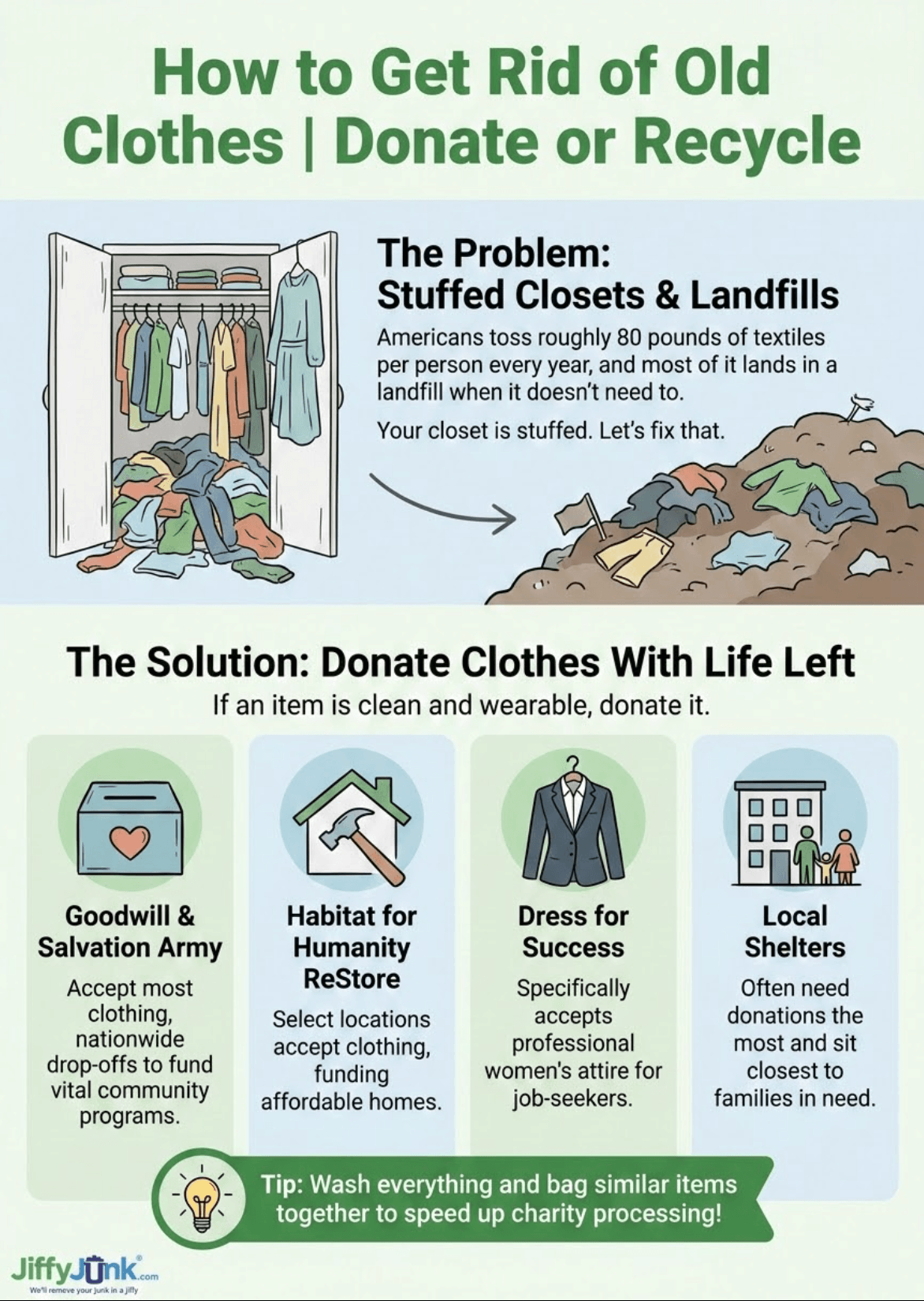
Here’s the thing: getting unwanted clothes out of your house and into the right hands is a lot easier than that pile makes it look. Americans toss roughly 80 pounds of textiles per person every year, and most of it lands in a landfill when it doesn’t need to.
This page covers every real option: where to donate clothes near you, how to recycle clothing that’s past wearing, how to purge a whole wardrobe fast, and how a donation pickup service can clear the closet in one visit. We’ve done this job for families across the country since 2014, so here’s what actually works.
TL;DR Quick Answers
How To Get Rid Of Old Clothes
Match your method to the condition of the clothes. If they’re clean and wearable, donate them to charities like Goodwill, the Salvation Army, a Habitat for Humanity ReStore, or a local women’s shelter. If they’re stained, torn, or truly worn out, recycle them through retailer take-back programs (H&M, Madewell, Levi’s, and Nike all accept used clothing) or municipal textile bins. Designer and high-value pieces are often better off on consignment or a resale app. And if you’re clearing a whole closet in one go, book a donation pickup service that sorts, hauls, and delivers to charities for you. You’ll get a clutter-free closet and an itemized tax-deductible receipt.
Top Takeaways
- Donate wearable clothes first. Goodwill, the Salvation Army, and Habitat for Humanity ReStore all accept most items in good condition.
- Keep damaged clothes out of the garbage. Textile recycling programs and retailer take-back bins accept items that are stained, torn, or worn out.
- Use the 12-month rule: if you haven’t worn it in a year, it isn’t coming back. Sort it, bag it, and schedule the same day.
- Hold onto your tax receipt. Donations to a qualified 501(c)(3) are deductible when you itemize on Schedule A, and anything over $500 requires IRS Form 8283.
- Skip driving when the volume is high. A clothing donation pickup service handles the sorting, hauling, and delivery, so you never have to make the trip.
Table of Contents
- How to Get Rid of and Donate Old Clothes: Where to Take Unwanted Clothing, Donation Pickup Options, and Recycling Programs Near Me
- TL;DR Quick Answers
- Top Takeaways
- Why Old Clothes Are A Bigger Problem Than People Realize
- Donate Clothes That Still Have Life Left
- Recycle What You Can’t Donate
- The Fastest Way: Use A Clothing Donation Pickup Service
- Essential Resources On How To Get Rid Of Old Clothes
- 1. Understand The Real Scale Of U.S. Textile Waste
- 2. Claim Your Clothing Donation On Your Taxes
- 3. Find A Goodwill Donation Center Near You
- 4. Donate To A Habitat For Humanity ReStore
- 5. Schedule A Salvation Army Donation Pickup
- 6. Give Gently Used Shoes A Second Life
- 7. Donate Professional Attire To Job-Seekers
- Supporting Statistics
- Final Thoughts & Opinion
- Frequently Asked Questions
- Q: What is the best way to get rid of old clothes?
- Q: Where can I donate clothes near me?
- Q: How do I recycle old clothing that’s too worn to donate?
- Q: Does Jiffy Junk offer clothes donation pickup near me?
- Q: Is donating clothes tax-deductible?
- Q: How should I sort clothes before donating?
- Q: Can I get rid of an entire wardrobe at once?
- Q: What clothes should never be donated?
- Ready To Get Rid Of Your Old Clothes The Easy Way?
Why Old Clothes Are A Bigger Problem Than People Realize
Textile waste is the fastest-growing category of household waste in America, and it isn’t slowing down. Polyester and nylon clothing can sit in a landfill for up to 200 years, shedding microplastics into soil and groundwater the whole time. When these fabrics break down, they release methane, a greenhouse gas much more potent than carbon dioxide.
Our crews have handled thousands of residential cleanouts, and we see the same picture in house after house: closets stuffed with clothes from five seasons ago, garage boxes labeled ‘to donate’ that have been sitting for three years, and bags on the curb that should have gone to a charity instead. The process feels harder than it actually is, and that’s usually what stalls people.
If the closet is just one stop on a bigger cleanout, our room-by-room decluttering guide walks through every space in the house with a realistic weekly plan.
For a deeper look at how recycled textiles get a second life, see this overview of textile recycling.
Donate Clothes That Still Have Life Left
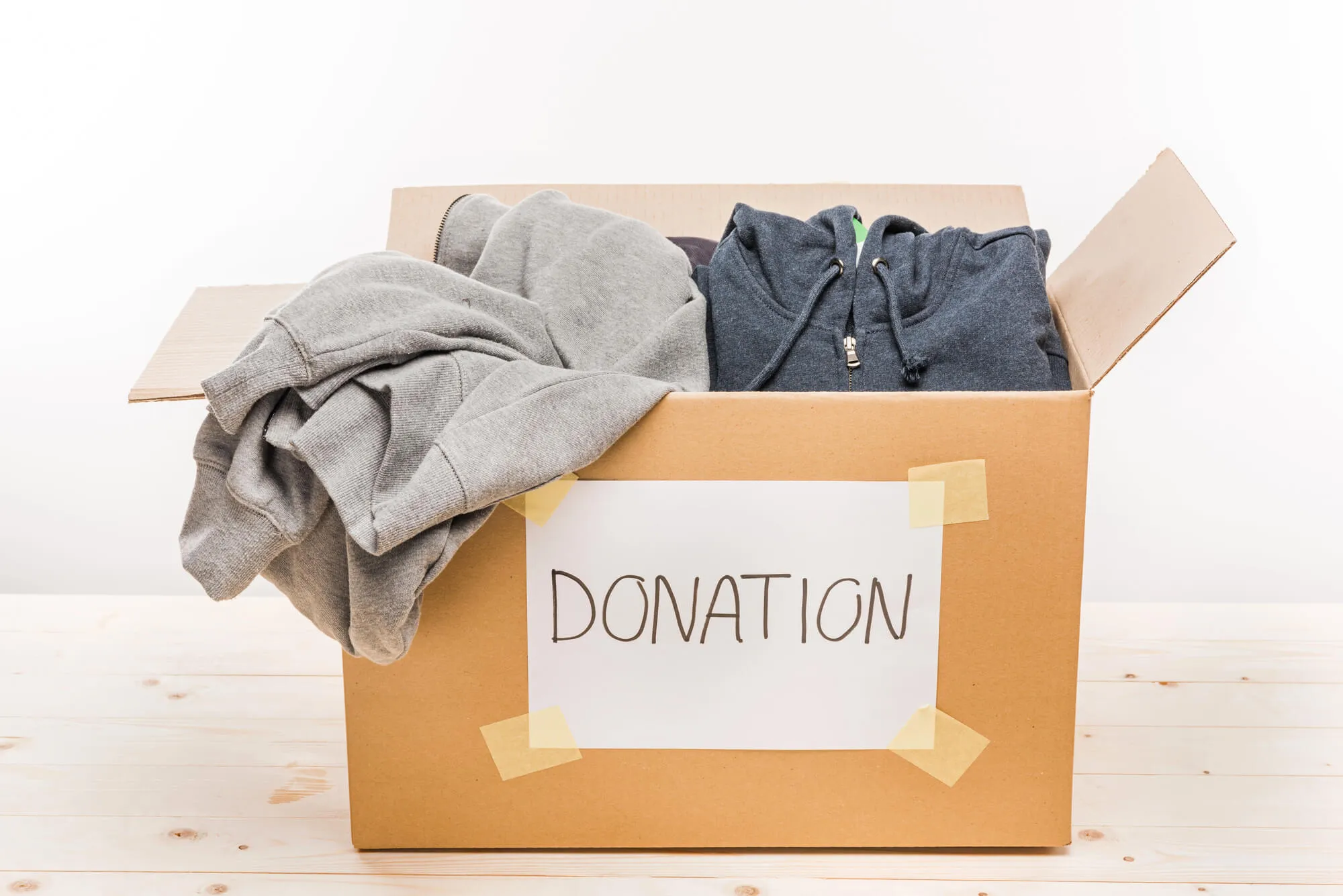
If an item is clean and wearable, donating it is almost always the right call. Your old work blazer might be exactly what someone wears to an interview next week. The sneakers your kids outgrew could save another family a week’s worth of grocery money. Donated clothes don’t vanish into a void. They land somewhere useful, with somebody who needs them.
Here’s where to donate clothes near you:
- Goodwill. Accepts most clothing in good condition, operates thousands of drop-off locations nationwide, and provides itemized tax receipts.
- Salvation Army. Runs one of the largest pickup-and-drop-off networks in the country. Donation sales fund rehabilitation programs.
- Habitat for Humanity ReStore. Takes clothing at select locations alongside furniture and housewares, with proceeds going toward building homes.
- Dress for Success. Specifically accepts professional women’s attire for job-seekers re-entering the workforce.
- Soles4Souls. A footwear-focused nonprofit that redistributes gently used shoes to people in need worldwide.
- Local shelters, churches, and women’s centers. Often need donations the most, and they sit closest to the families who need them.
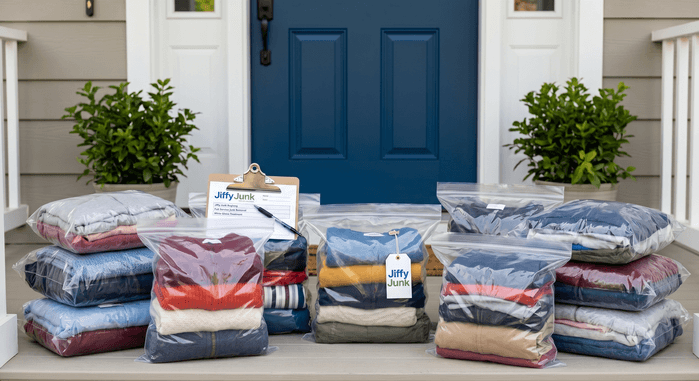
One tip from experience: wash everything before you donate, and bag similar items together. Tops with tops, shoes with shoes. Charities process hundreds of bags a day, and clean, sorted donations move through the system faster.
Recycle What You Can’t Donate
Here’s what most people miss about damaged clothes: they shouldn’t go straight to the curb. Ripped jeans, stained t-shirts, single socks, holey sweaters. Almost all of it is recyclable as long as it’s clean and dry. Textile recyclers turn worn-out clothing into insulation, industrial wiping cloths, carpet padding, and even new fabric.
Your options for how to recycle old clothing:
- Retailer take-back programs. H&M, Madewell, Levi’s, Nike, The North Face, and Patagonia all accept used clothing regardless of brand, and most offer store credit in return.
- Municipal textile bins. A growing number of cities run curbside or drop-off textile recycling. Check your local waste management site for what’s available.
- Council for Textile Recycling partner locations. The Wear. Donate. Recycle. locator points you to nearby textile recyclers in your area.
- Community swap events and clothing drives. These keep items in circulation and skip the landfill entirely.
One exception: clothing contaminated with mold, pests, or bodily fluids shouldn’t go to recycling. Those are the rare cases where disposal is the right call.
The Fastest Way: Use A Clothing Donation Pickup Service
If you’re clearing out a whole wardrobe, or helping with a move, a downsize, or an estate cleanout, driving carloads of clothing around town isn’t the best use of a Saturday. A clothing donation pickup service handles the sorting, the hauling, and the delivery to local charities. All you do is point to the pile.
That’s exactly what Jiffy Junk’s donation pickup service was built for. Our licensed, insured teams arrive in a scheduled window, load everything with the White Glove Treatment, and deliver your items to reputable community organizations. You get an itemized receipt for your taxes, and we recycle anything that can’t be donated. The goal is always to keep it out of the landfill.
Ready to book a clothes donation pickup near you? Jiffy Junk’s clothing donation pickup service is available nationwide, with transparent pricing, no hidden fees, and a booking process that takes about 60 seconds.
Here’s how it actually goes:
- Book online or call us. You get a free upfront quote in minutes, with no surprises later.
- We arrived on schedule. Our uniformed, fully insured team shows up in your booked time window, ready to load.
- We haul, donate, and recycle. You get a clutter-free space, an itemized donation receipt, and the peace of mind of knowing where your items ended up.
“We’ve run cleanouts in homes from Long Island to Los Angeles for more than a decade, and the same pattern shows up every time. A successful closet purge isn’t about willpower. It comes down to whether the donations ever actually leave the house. The people who finish the job are the ones who bag the clothes, schedule a pickup the same day, and never handle those items a second time.”
– From The Jiffy Junk Team
Essential Resources On How To Get Rid Of Old Clothes
We’ve pulled together the most useful places to turn to next, whether you’re looking for tax guidance, a drop-off locator, or a specific charity that lines up with your values. Every resource below comes from a trusted .gov or .org source.
1. Understand The Real Scale Of U.S. Textile Waste
The Environmental Protection Agency publishes the country’s most authoritative data on how much clothing and textiles Americans throw out, and how little of it gets recycled. Start here to see why your donation matters.
Source: EPA Textiles: Material-Specific Data
2. Claim Your Clothing Donation On Your Taxes
The IRS publishes clear rules on what you can deduct, how to value used clothing, and what paperwork you need for donations over $500. If you’re itemizing on Schedule A, read this first.
Source: IRS Publication 526 on Charitable Contributions
3. Find A Goodwill Donation Center Near You
Goodwill accepts most clothing in good condition, provides itemized tax receipts, and funds job training programs in your community. Their locator finds the closest drop-off in seconds.
Source: Goodwill donation center locator
4. Donate To A Habitat For Humanity ReStore
Habitat ReStores accept clothing, furniture, and household goods at select locations nationwide, with every dollar raised going toward building affordable homes.
Source: Habitat for Humanity ReStore donation program
5. Schedule A Salvation Army Donation Pickup
The Salvation Army runs one of the largest donation pickup networks in the U.S., with proceeds funding adult rehabilitation and community programs. Enter your ZIP code to schedule.
Source: Salvation Army donation pickup scheduler
6. Give Gently Used Shoes A Second Life
Soles4Souls collects and redistributes footwear to people in need worldwide, while keeping shoes out of landfills. A good option if you’ve got a pile of old sneakers or boots.
Source: Soles4Souls shoe donation program
7. Donate Professional Attire To Job-Seekers
Dress for Success accepts professional women’s clothing and outfits for job-seekers re-entering the workforce with interview-ready attire and career support.
Source: Dress for Success clothing donation program
Supporting Statistics
The case for donating and recycling old clothes isn’t abstract. Hard numbers back it up. Here’s what the research shows, alongside what we’ve seen first-hand across thousands of residential cleanouts.
1. U.S. Textile Waste Has Grown More Than 50% In Two Decades
A 2024 federal report found that textile waste in America surged by more than 50 percent between 2000 and 2018, fueled largely by fast fashion. In our crews’ experience, this shows up as closets packed with items that have been worn only a handful of times.
Source: U.S. GAO Textile Waste Report (GAO-25-107165)
2. 95% Of Used Clothing Is Recyclable, Even Torn Or Stained
According to the Council for Textile Recycling, 95 percent of all clothing and textiles can be recycled, including items that are stained, ripped, or worn out. Most people don’t know that, which is why so much still ends up in the landfill.
Source: Council for Textile Recycling
3. Textile Recyclers Keep Billions Of Pounds Out Of Landfills Annually
SMART Association members divert roughly 1 billion pounds of textile waste from U.S. landfills every year — about 25% of America’s post-consumer textile recycling. Members sort donations into reusable apparel, wiping cloths, and reprocessed fiber. That’s the infrastructure your donation plugs into.
Source:SMART — Giving Thanks to Our Members
Final Thoughts & Opinion
We’ve hauled away everything from a single couch to an entire estate over the last decade, so here’s our honest opinion. Most people already know their options for getting rid of old clothes. Starting is the hard part. Plenty of guides exist, including our own broader take on how to get rid of clutter. Plenty of charities will take the donation. Plenty of recyclers will handle the worn-out pieces. What’s usually missing is momentum.
Here’s what we recommend, based on what actually works in real homes:
- Don’t “someday” your way through a closet. Same-day action beats perfect planning every time.
- Sort donation-worthy from recycle-only before you pack anything. It takes 10 minutes on your end and saves charities hours.
- Treat recycling as a real option, not a lesser one. A worn-out t-shirt becoming home insulation is a genuine win.
- If the volume is more than you can carry in one trip, call for pickup. The time you save is worth more than the cost of the service.
Reclaiming the space is only half of it. The real payoff is walking into your closet, seeing what you own, grabbing what you actually need, and starting your morning without friction. Everything in this guide is in service of that. And once you have the breathing room back, these closet organization ideas help keep it that way.
Frequently Asked Questions
Q: What is the best way to get rid of old clothes?
A: The right approach depends on the condition. Donate anything clean and wearable to charities like Goodwill or the Salvation Army. Recycle stained or damaged pieces through retailer take-back programs or municipal textile bins. For full wardrobes or large loads, book a donation pickup service. It’s the fastest way to clear everything at once.
Q: Where can I donate clothes near me?
A: Most U.S. cities have Goodwill, Salvation Army, and Habitat for Humanity ReStore locations within a few miles. Local homeless shelters, women’s centers, and churches also accept clothing and often need it most. Many of these charities offer free pickup for large donations.
Q: How do I recycle old clothing that’s too worn to donate?
A: Clothing too damaged to donate can still be recycled. H&M, Madewell, Levi’s, and Nike run brand-agnostic take-back programs. Many cities offer textile recycling bins, and the Council for Textile Recycling locator helps you find nearby drop-offs. As long as items are clean and dry, even torn or stained pieces are recyclable.
Q: Does Jiffy Junk offer clothes donation pickup near me?
A: Yes. Jiffy Junk provides donation pickup nationwide, including clothing, furniture, and household items. Our licensed team sorts your donations, delivers them to reputable local charities, and provides an itemized tax-deductible receipt. Book online in about 60 seconds or call 844-JIFFY-JUNK for a free upfront quote.
Q: Is donating clothes tax-deductible?
A: Yes, if you donate to a qualified 501(c)(3) and itemize deductions on IRS Schedule A. You’ll need a written receipt from the organization, and donations totaling more than $500 require IRS Form 8283. Value your items at fair market value, not original retail price. Consult a tax professional for your specific situation.
Q: How should I sort clothes before donating?
A: Separate into four piles: donate (clean, wearable), sell (high-value or designer), recycle (worn or damaged), and toss (only if contaminated). Wash your donations first, and bag similar items together. Tops with tops, shoes with shoes. It speeds up charity processing and gets clothes to the next person faster.
Q: Can I get rid of an entire wardrobe at once?
A: Absolutely. Full wardrobe cleanouts are one of our most common jobs. Our team handles volume loads from closets, estate cleanouts, and downsizing projects. That includes clothing, shoes, accessories, and storage furniture. One call clears everything, and we sort, donate, and recycle on your behalf.
Q: What clothes should never be donated?
A: Don’t donate items contaminated with mold, bodily fluids, bed bugs, pests, or chemicals. Heavily damaged pieces should be recycled rather than donated, since charities end up paying disposal fees on items they can’t use. Underwear and used socks are generally not accepted, though some shelters accept new, unopened packages.
Ready To Get Rid Of Your Old Clothes The Easy Way?
Skip the car trips, the sorting, and the “I’ll get to it next weekend.” Book a Jiffy Junk donation pickup today, and let our White Glove team handle everything, because we’re not happy until you’re happy.