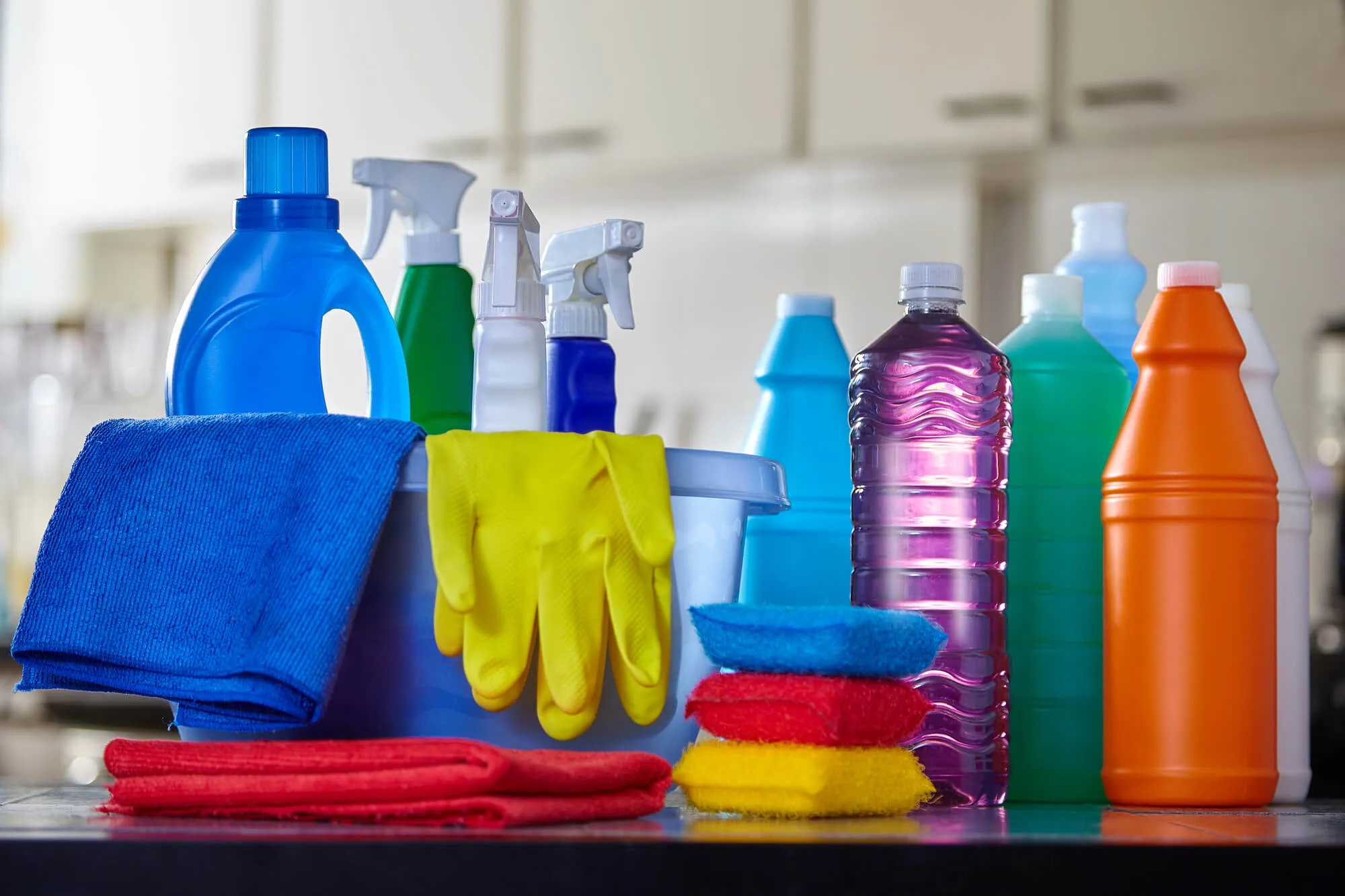
How to Safely Dispose of Household Chemicals and Hazardous Waste: Where to Drop Off or Get Rid of Old Cleaning Products and Toxic Materials Near Me
Our crews see the same cabinet on almost every cleanout: the one above the washing machine, or the corner of the garage that hasn’t been opened since the homeowner moved in a decade ago. Inside are household chemicals the owner stopped using years back and never figured out how to get rid of. Our trucks can’t haul any of that material. Federal rules prohibit licensed junk-removal companies from transporting hazardous waste, and those items belong at a household hazardous waste (HHW) facility instead. Jiffy Junk handles everything else in the cleanout with our White Glove Treatment.
Disposal itself isn’t complicated once you know the rules. Get it wrong, though, and you can contaminate drinking water, injure sanitation workers, start a fire in a garbage truck, or trigger municipal fines. We’ve been running residential cleanouts from Long Island to nationwide for more than a decade, and the guidance below is the same process our field crews and most county hazmat officials follow.
TL;DR Quick Answers
How To Dispose Of Household Chemicals
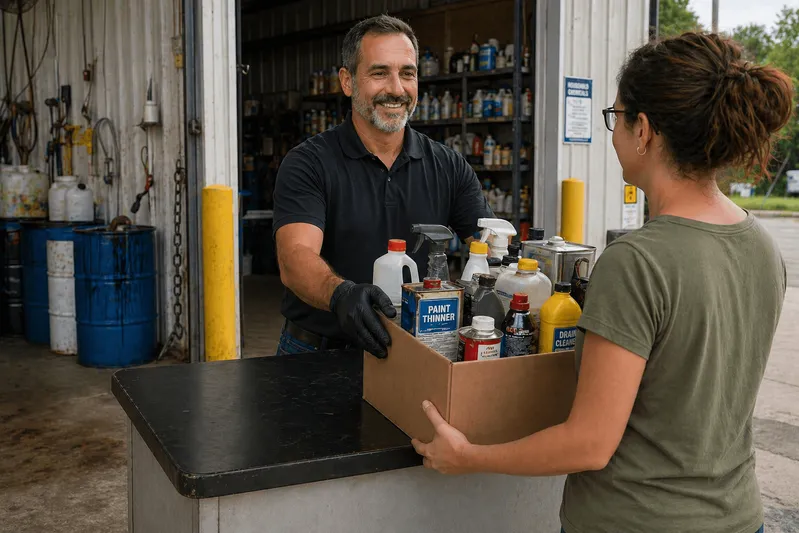
Keep household chemicals out of regular trash, drains, and storm sewers. Store each product in its original labeled container, never mix two products, and bring them to your local household hazardous waste (HHW) facility or a scheduled community collection event. The EPA’s Earth911 locator and your county solid-waste agency will point you to the closest drop-off. Retailer take-back programs also accept a lot of this material for free: auto-parts stores handle motor oil, Home Depot and Lowe’s take fluorescent bulbs and rechargeable batteries, PaintCare partners collect leftover paint. For furniture, appliances, debris, and general clutter in your cleanout, Jiffy Junk handles the haul while you route the hazardous items to the HHW facility.
Top 5 Takeaways
- Keep chemicals out of regular waste streams. HHW in landfills leaches into groundwater, reacts dangerously with other materials in garbage trucks, and puts sanitation workers at risk.
- Original containers, original labels, always. Never decant products into water or food containers, and never mix two products in the same container.
- Start with Earth911 and your county website. Those two resources locate 99% of drop-off facilities and collection events nationwide.
- Retailers accept a lot of this material for free. Auto-parts stores take motor oil and lead-acid batteries. Big-box retailers handle fluorescent bulbs and lithium batteries. PaintCare partners collect leftover paint.
- Full-service junk removal covers everything else. Licensed haulers can’t legally transport HHW under federal rules, but Jiffy Junk clears the furniture, appliances, and general clutter around it with our White Glove Treatment.
Table of Contents
- How to Safely Dispose of Household Chemicals and Hazardous Waste: Where to Drop Off or Get Rid of Old Cleaning Products and Toxic Materials Near Me
- TL;DR Quick Answers
- Top 5 Takeaways
- What Counts As A Household Chemical Or Hazardous Material
- How To Dispose Of Household Chemicals Safely: A Step-By-Step Approach
- Where To Drop Off Old Cleaning Products And Toxic Materials Near You
- When To Call Jiffy Junk For The Rest Of The Cleanout
- Expert Insight: Essential Resources On How To Dispose Of Household Chemicals
- Supporting Statistics
- Final Thoughts and Opinion
- Frequently Asked Questions
- Q: Can I put household chemicals in my regular trash?
- Q: What household items are considered hazardous waste?
- Q: How do I find a household hazardous waste drop-off near me?
- Q: Can I pour old cleaning products down the drain?
- Q: How do I get rid of old bleach?
- Q: How do I dispose of pool chemicals safely?
- Q: Does Jiffy Junk pick up household chemicals and hazardous waste?
- Q: Is it illegal to throw chemicals in the regular trash?
- Q: How should I store chemicals while I wait for a drop-off date?
- Ready To Clear The Rest Of The Clutter?
What Counts As A Household Chemical Or Hazardous Material
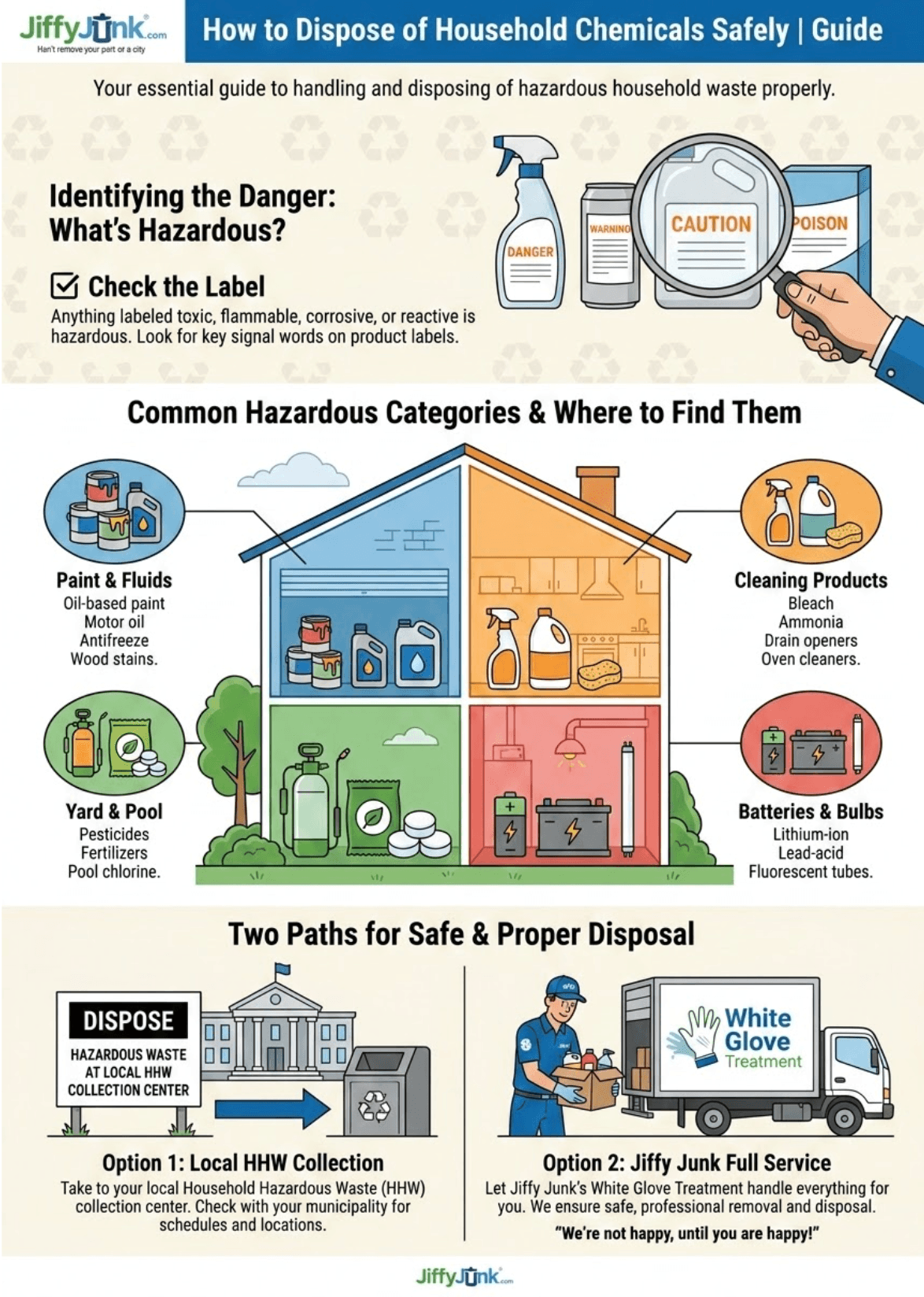
The term household chemicals covers more ground than most homeowners expect. Anything labeled toxic, flammable, corrosive, or reactive counts as household hazardous waste the moment you stop needing it. When you see DANGER, WARNING, CAUTION, or POISON on a label, treat the product as HHW.
Our cleanouts turn up the same categories over and over:
- Cleaning products: bleach, ammonia, drain openers, oven cleaner, toilet bowl cleaner, solvent-based polishes
- Paint and finishes: oil-based paint, stains, thinners, strippers, turpentine
- Automotive fluids: motor oil, antifreeze, gasoline, brake fluid, transmission fluid
- Yard and pool chemicals: pesticides, herbicides, pool chlorine, muriatic acid, fertilizer
- Batteries and bulbs: lithium-ion, button cell, lead-acid, fluorescent tubes, CFLs, mercury thermometers
- Pressurized containers: aerosols, propane tanks, fire extinguishers
If the label is missing or unreadable, treat the product as hazardous until you can confirm otherwise. That’s the default our field crews follow on every job.
How To Dispose Of Household Chemicals Safely: A Step-By-Step Approach
These six steps reflect what our crews actually do on cleanouts where HHW is present. County hazmat officials recommend the same process.
Step 1: Identify What You Have
Pull everything out and read the labels carefully, noting the signal words on each product. Photograph the containers for your records. If a container is bulging, leaking, or corroded, leave it alone and call your local hazmat line or your fire department’s non-emergency number.
Step 2: Keep Products In Their Original Containers
Never pour a chemical into a water bottle, food container, or unlabeled jar. If part of a label has worn off, tape a fresh label over it with the contents and hazard type written clearly. Drop-off facility staff rely on that information to route your chemicals correctly.
Step 3: Never Mix Products, Not Even During Disposal
Mixing products causes the worst incidents our crews see on cleanout days. A handful of classic pairings to keep separate:
- Bleach and ammonia, which produce chloramine gas
- Bleach and rubbing alcohol, which produce chloroform and other toxic compounds
- Two different drain cleaners, which can boil over or react violently
- Pool chlorine with any oxidizer or organic material, which creates a fire risk
Step 4: Contain Any Leaks
For a leaking container, place the original bottle inside a larger sealed plastic bucket or a doubled garbage bag, then cushion it with an absorbent lmaterial ike cat litter or sand. Close the outer container, label it, and transport it upright. If the leak is serious or the substance is unknown, call a professional.
Step 5: Transport Safely
Drive directly to the HHW facility. Keep containers upright, separate liquids from powders and aerosols, crack a window for ventilation, and never put chemicals in the passenger compartment with kids or pets.
Step 6: Handle The Empty Containers
Most dry, empty aerosol cans and cleaning bottles can go in the regular trash. You can triple-rinse and recycle many plastic jugs if the label permits. When in doubt, check with your curbside recycling program before tossing anything.
Where To Drop Off Old Cleaning Products And Toxic Materials Near You
Finding a safe disposal location near you usually takes five minutes once you know where to look. Start with the national locators, then fall back to retailer take-back programs.
Your County Or Municipal HHW Facility
Most U.S. counties operate either a year-round HHW facility or scheduled collection events a few times per year, often around Earth Day, spring, and fall. Search your county name plus “household hazardous waste collection” to find hours, accepted items, and any residency requirements.
Earth911 And The EPA Locator
Earth911’s recycling locator and the EPA’s HHW page both let you type in your ZIP code and find the closest drop-off. Together, they cover nearly every HHW location in the country.
At-Home Collection Programs
Some cities contract with services that pick up HHW directly from your home by appointment. Waste Management’s At Your Door Special Collection is the most common national option. Your city sanitation department may also offer a local equivalent.
Retailer Take-Back (Usually Free)
- Auto-parts stores (AutoZone, O’Reilly, Advance): used motor oil, antifreeze, lead-acid car batteries
- Home Depot and Lowe’s: fluorescent bulbs, CFLs, rechargeable batteries, and some cordless tool batteries
- Best Buy: lithium-ion and button cell batteries, small electronics
- PaintCare partners (in 12 states and DC): leftover latex and oil-based paint, stains, and varnishes. For the step-by-step at home, see our guide on how to dispose of old latex and oil paint safely.
- Pharmacies: expired or unwanted medications through authorized take-back kiosks and the DEA’s National Prescription Drug Take Back Day.
When To Call Jiffy Junk For The Rest Of The Cleanout
Federal and state regulations prohibit every licensed junk-removal company (ours included) from transporting hazardous waste. That’s a safety rule, and we follow it strictly. The hazardous items go to an HHW facility. Period.
Our crews handle everything else. When you’re clearing a garage, basement, attic, estate, or foreclosure property, the hazardous chemicals are usually a small fraction of what needs to go. Old furniture, appliances, exercise equipment, yard waste, debris, general clutter: our full-service junk removal services cover the rest with our signature White Glove Treatment. Our licensed, insured crew hauls the non-hazardous items while you route the chemicals to the county drop-off.
We also donate and recycle as much as possible from every job, matching the same environmental thinking behind safe chemical disposal. Pricing is upfront, and our crews clean up after themselves before they leave. We’re not happy until you are happy.
If the cleanout started with a garage full of decades of stuff (as ours often do), our step-by-step garage decluttering guide walks through the sort-and-zone system our crews use on every job.
“On almost every estate or garage cleanout we run, we find chemicals the homeowner forgot they even owned: 20-year-old paint thinner, a corroded can of pool shock, a cracked jug of antifreeze. The single biggest mistake we see is mixing products during cleanup. The second is throwing them in a contractor bag and assuming the trash truck will take them. Neither ends well. Route the chemicals to your county HHW facility first, and let us handle the rest of the haul.”
– From The Jiffy Junk Team
Expert Insight: Essential Resources On How To Dispose Of Household Chemicals
When you’re ready to take the next step, these seven resources will get you from “I have a cabinet full of questions” to “it’s gone, safely.” Our crews reference these same sources in the field.
1. The Federal Playbook On Household Hazardous Waste
The U.S. Environmental Protection Agency maintains the authoritative overview of what HHW is, why it matters, and how the federal framework treats residential chemical waste. Start here for definitions and the foundational rules.
Source: U.S. EPA Household Hazardous Waste Guide
2. Product Safety Data Before You Dispose
The U.S. Consumer Product Safety Commission publishes hazard alerts, recall notices, and safety guidance for thousands of household products. Check here if you’re unsure whether a specific product is still safe to handle.
Source: CPSC Poison Prevention Safety Center
3. 24/7 Help If Someone Is Exposed
America’s Poison Centers runs the nationwide Poison Help line (1-800-222-1222) and provides free, expert guidance any time a chemical exposure happens at home. Keep this number on your fridge.
Source: America’s Poison Centers Poison Help
4. Free Paint Drop-Off In 12 States And DC
PaintCare operates a nonprofit take-back network for leftover architectural paint, stain, and varnish in participating states. Enter your ZIP code to find the nearest drop-off. Most locations sit at local paint and hardware stores.
Source: PaintCare Nationwide Paint Drop-Off Network
5. The Battery Recycling Network
Call2Recycle is North America’s largest consumer battery stewardship program, with drop-off locations at more than 16,000 retailers. Essential for lithium-ion and rechargeable batteries that should never go in the trash.
Source: Call2Recycle Battery Drop-Off Locator
6. Disposal Guidance From The Cleaning-Product Industry Itself
The American Cleaning Institute publishes plain-English disposal advice directly from cleaning-product manufacturers. Particularly useful for questions like “Can I pour this down the drain?” for common cleaners.
Source: American Cleaning Institute Product Disposal Guide
7. Safer Alternatives For Next Time
The Natural Resources Defense Council publishes practical guides to nontoxic household cleaners and lower-hazard alternatives. If you’d rather not accumulate another decade of chemicals, this is where to start.
Source: NRDC Guide to Nontoxic Spring Cleaning
Supporting Statistics
The numbers behind safe HHW disposal explain why our crews take it as seriously as we do. Three figures we reference most often:
1. Poison Center Calls About Cleaners Jumped 20% In A Single Quarter
CDC’s Morbidity and Mortality Weekly Report tracked 45,550 poison center exposure calls involving cleaners and disinfectants in a single three-month window of 2020 — a 20.4% rise in cleaner exposures and 16.4% rise in disinfectant exposures over the same quarter the year before. Cleaners drove the larger share, with 28,158 individual exposures in three months. Every unattended bottle under a sink is part of that number.
Source: CDC MMWR Report on Cleaning and Disinfectant Chemical Exposures
2. 100,000+ Tons Of HHW Get Trashed In One State Alone
The New York State Department of Environmental Conservation reports that New Yorkers throw more than 100,000 tons of household hazardous waste into their trash cans every year. Those chemicals end up in landfills, incinerators, or are dumped on soil and storm drains. Multiply by the population nationwide, and you see the real scale of improper disposal.
Source: New York State Department of Environmental Conservation HHW Management Guide
3. Hazardous Household Products Are The Leading Cause Of Child Poisonings
The Iowa Department of Natural Resources reports that hazardous household products are the leading cause of poisonings in children. Their developing systems process toxins less effectively than adults do. Safe storage and safe disposal sit on the same side of the child-safety equation.
Source: Iowa Department of Natural Resources Household Hazardous Materials
Final Thoughts and Opinion
After clearing thousands of homes, our honest take is this. The chemical-disposal step in a cleanout is almost always easier than people expect. It’s also almost always the one people skip.
Laziness gets the blame, but the real reason is uncertainty. People don’t know if the local trash service will take it, whether pouring bleach down the drain is fine, or where the nearest facility is. So the products sit in the garage for another five years until the next cleanout.
Three short rules cut through the uncertainty:
- If the label carries DANGER, WARNING, CAUTION, or POISON, assume it’s HHW and route it accordingly.
- If you’re not sure, call your county solid-waste department before you act. They answer this question all day.
- Chemicals go to the HHW facility. The old couch, the broken appliance, the boxes that have lived in the basement since 2009? That’s our job.
That division of labor is the fastest, safest way to actually finish a cleanout. It’s also the one we see working every day in the field.
Frequently Asked Questions
Q: Can I put household chemicals in my regular trash?
A: No. Household chemicals in landfills leach into groundwater, can react with other materials in the garbage truck, and put sanitation workers at risk. A few fully empty, dried-out containers are usually fine. Liquids and active products are not.
Q: What household items are considered hazardous waste?
A: Any product labeled toxic, flammable, corrosive, or reactive. In practice, that means bleach, drain and oven cleaners, paint and solvents, motor oil and antifreeze, pesticides and pool chemicals, aerosols, propane tanks, batteries, fluorescent bulbs, and anything carrying a DANGER, WARNING, CAUTION, or POISON label.
Q: How do I find a household hazardous waste drop-off near me?
A: Start with Earth911’s ZIP-code locator or the EPA’s HHW page. If neither shows a nearby facility, search your county name plus “household hazardous waste collection.” Most counties run either a year-round site or scheduled events.
Q: Can I pour old cleaning products down the drain?
A: Most water-soluble cleaners (dish soap, laundry detergent, all-purpose spray) are designed to go down the drain during normal use. Solvent-based polishes, drain openers, and oven cleaners should not. When in doubt, store the product for HHW drop-off.
Q: How do I get rid of old bleach?
A: Use it up on laundry or for diluted sanitizing tasks if possible. Otherwise, dilute heavily with cold water and flush slowly down a drain with running water. Never mix bleach with ammonia, rubbing alcohol, or any other cleaner. Recycle the empty, rinsed bottle.
Q: How do I dispose of pool chemicals safely?
A: Pool chlorine and pool shock are powerful oxidizers and a real fire risk if mixed with organics. Keep them in the original container, never combine them with anything else, and bring them to your HHW facility. Tell the staff exactly what’s inside.
Q: Does Jiffy Junk pick up household chemicals and hazardous waste?
A: No licensed junk-removal company can, by federal and state rule. Route the hazardous items to your county HHW facility. Jiffy Junk handles everything else in the cleanout (furniture, appliances, electronics, debris, general clutter) with our White Glove Treatment.
Q: Is it illegal to throw chemicals in the regular trash?
A: It depends on your state and county. California regulates home-generated HHW strictly. Most other states don’t impose household-level fines but do prohibit commercial dumping. Regardless of legality, improper disposal is unsafe, and many municipalities fine repeat offenders.
Q: How should I store chemicals while I wait for a drop-off date?
A: Keep products in their original labeled containers, upright, in a cool, dry place away from children, pets, and heat sources. Don’t stack heavy items on top. A locked garage cabinet is ideal. Transport them directly to the facility on drop-off day.
Ready To Clear The Rest Of The Clutter?
Route your household chemicals to your local HHW facility, then let Jiffy Junk’s White Glove Treatment handle the furniture, appliances, debris, and everything else. New to junk removal? Our junk removal preparation checklist covers what to expect on the day so your appointment goes smoothly. Book your free estimate today and reclaim your space in a jiffy.