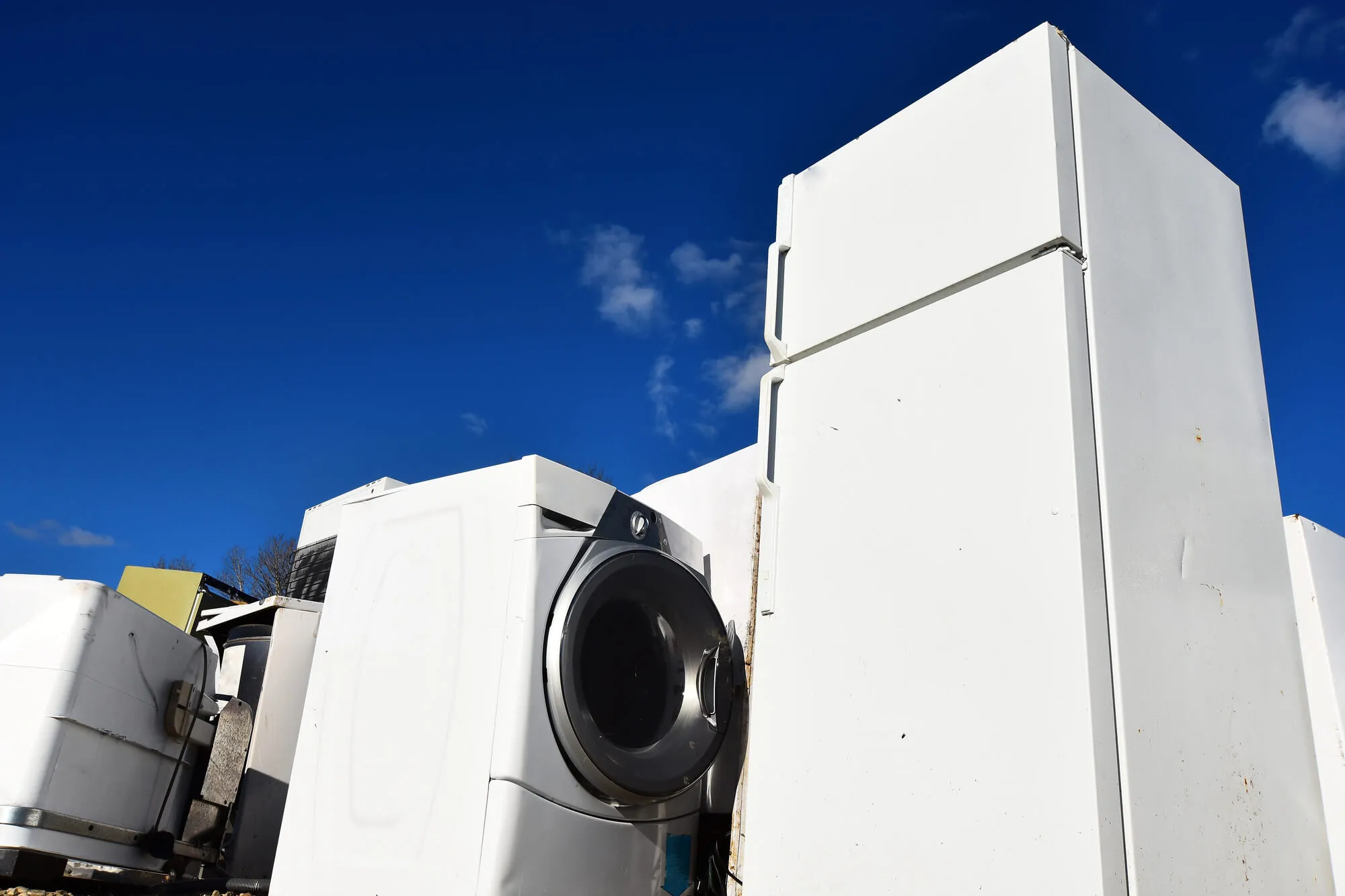
How Much Does Appliance Removal Cost? Average Prices for Refrigerator, Washer, Dryer, and Large Appliance Haul Away and Disposal So You Can Budget With Confidence
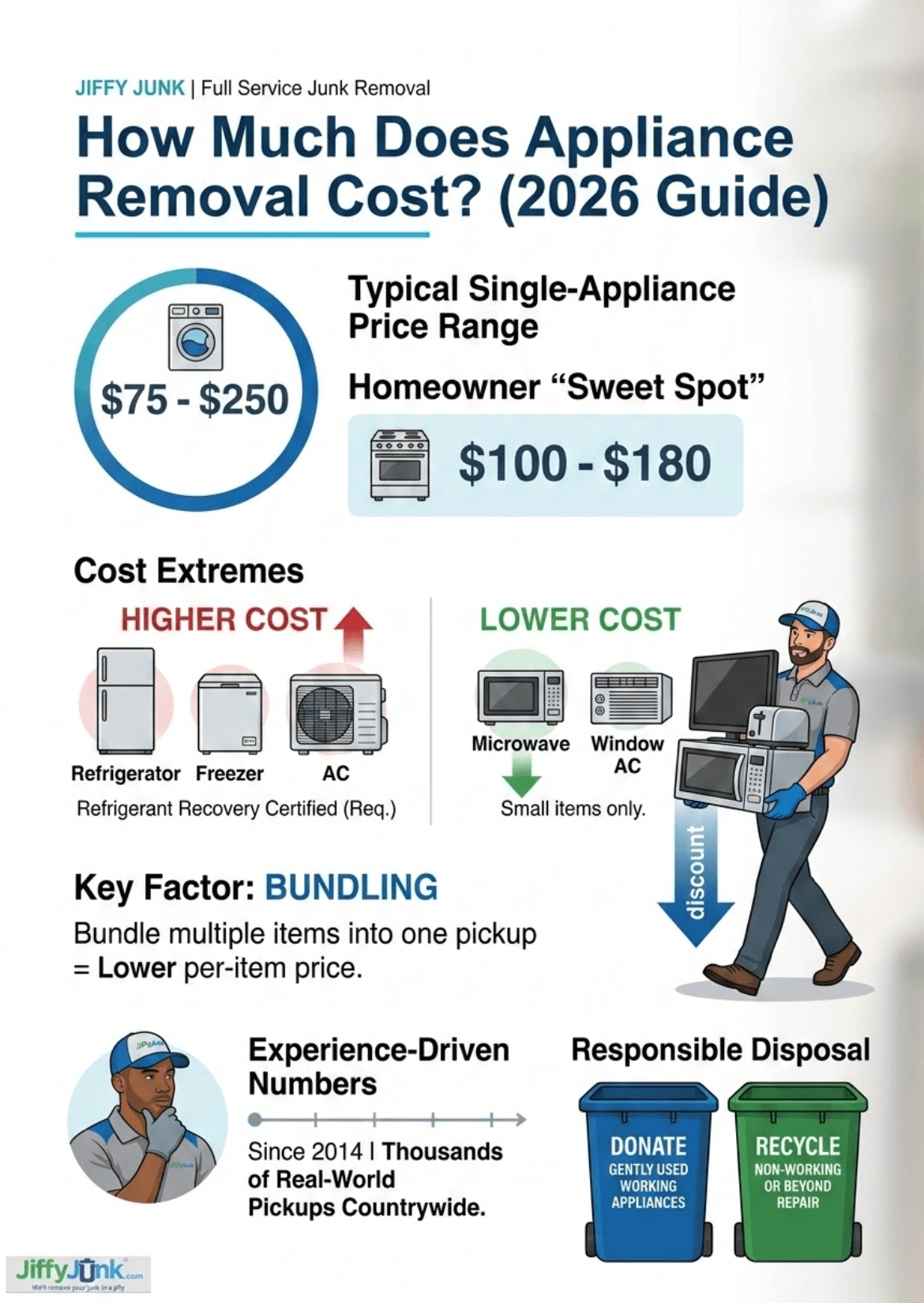
The honest number first: most people pay between $75 and $250 to have one appliance hauled away in 2026, and most homeowners land in the $100 to $180 range. Refrigerators and freezers sit at the top of that range because the EPA requires certified refrigerant recovery before any unit can be taken apart, and that handling costs real money. Microwaves and small window ACs sit at the bottom.
We’ve been doing this since 2014. The ranges on this page come from inside the truck: tens of thousands of appliance pickups across the country, not a calculator’s guess.
Keep reading for the full cost breakdown by appliance, the factors that move the quote up or down, and the ways you can actually lower the final price without skipping the parts that matter.
TL;DR Quick Answers
Appliance Removal Cost
Most single-appliance removals run $75 to $250 in 2026. Most homeowners pay $100 to $180. Refrigerators, freezers, and window ACs run toward the top because federal law requires certified refrigerant recovery before disposal. Small items like microwaves come in the lowest. Bundling two or more appliances into the same appointment almost always lowers the per-item price. For a deeper breakdown of how each option compares, see our full guide to appliance removal and haul-away options.
Top 5 Takeaways
Five things to carry with you:
- One appliance usually runs $75 to $250. Most jobs pay around $100 to $180.
- Refrigerators, freezers, and window ACs run higher because federal law requires certified refrigerant handling before disposal.
- Access changes the quote more than the appliance itself. A basement carry or an upstairs laundry room adds real labor.
- Bundling items brings the per-item cost down meaningfully. Industry data suggests savings in the 30–40% range on bundled jobs, pending team confirmation of a citable source.
- A firm, all-inclusive quote saves you more than a low headline price with fuel fees, weight surcharges, and disposal add-ons tacked on at the end.
Table of Contents
- How Much Does Appliance Removal Cost? Average Prices for Refrigerator, Washer, Dryer, and Large Appliance Haul Away and Disposal So You Can Budget With Confidence
- TL;DR Quick Answers
- Top 5 Takeaways
- What Appliance Removal Actually Costs In 2026
- What Makes Some Appliances Cost More Than Others
- How To Lower Your Appliance Removal Cost Without Cutting Corners
- Essential Resources On Appliance Removal Cost
- 1. EPA Section 608 — Federal Rules On Appliance Disposal
- 2. ENERGY STAR Flip Your Fridge Calculator — See What An Old Fridge Actually Costs You
- 3. IRS Energy Efficient Home Improvement Credit — Tax Savings On Qualifying Upgrades
- 4. Department Of Energy — Buying And Maintaining Refrigerators And Freezers
- 5. Habitat For Humanity ReStore — Donate Working Appliances For A Tax Deduction
- 6. Goodwill Industries — Donate Working Small Appliances For A Tax Deduction
- 7. Consumer Product Safety Commission — Appliance Recalls To Check Before You Haul It Out
- Supporting Statistics
- Final Thoughts & Opinion
- Frequently Asked Questions
- Q: How much does appliance removal cost on average?
- Q: How much does it cost to haul away an old refrigerator?
- Q: How much does washer and dryer removal cost for a pair?
- Q: Will Home Depot or Lowe’s haul away my old appliance for free?
- Q: Do I need to disconnect the appliance before you arrive?
- Q: Why do refrigerators and freezers cost more to remove than other appliances?
- Q: Can I put an old appliance on the curb for pickup?
- Q: Is appliance removal cheaper if I bundle multiple items into one pickup?
- Q: Does Jiffy Junk recycle old appliances?
- Ready To Get The Old Appliance Out Today? Let’s Make It Easy
What Appliance Removal Actually Costs In 2026
Pricing changes with region, access, and the appliance itself. The ranges below reflect what most homeowners are paying nationwide right now, informed by our pickup data since 2014 and cross-referenced with 2026 ranges published by Angi, Homewyse, and Dropcurb.
- Refrigerator: $100 to $250. Most first-floor pickups land near $150. Basement carries older units with heavier insulation, trending toward $250.
- Chest or upright freezer: $100 to $230. Same refrigerant rules as fridges.
- Washing machine: $90 to $180. Heavier than most people expect, and laundry closets are rarely friendly to a quick carry.
- Dryer: $80 to $160. Gas dryers need a safe disconnect, which adds a few minutes to the job.
- Washer and dryer pair: $145 to $300. Stacked units in upstairs laundry rooms trend toward the top.
- Stove, oven, or range: $90 to $180. Built-in wall ovens cost more because of the partial cabinet work.
- Dishwasher: $80 to $160. The pickup itself is quick, while the uninstall is usually the bigger job.
- Microwave: $50 to $140. Countertop models are easy to grab, while over-the-range units need a two-person lift.
- Window or portable AC: $50 to $120. Refrigerant handling applies here, too.
- Water heater: $100 to $200. Fully drained and disconnected before pickup.
Something we see on almost every job: the appliance that costs the most is rarely the largest one. A mini-fridge stuck on a third-floor walk-up routinely costs more to remove than a full-size refrigerator parked in an open garage. Access wins that contest more often than size does.
What Makes Some Appliances Cost More Than Others
Most cost guides stop at “prices vary.” Not useful when you’re trying to budget. The pricing model itself matters too — most professional junk removal companies price by volume rather than by the hour, which protects you from surprise fees when a job runs long. Here’s what actually moves the number on an appliance pickup:
- Weight and bulk. A refrigerator can weigh 250 to 350 pounds. Washers are dense. Older freezers are unexpectedly bulky. More weight means more labor and more truck space.
- Refrigerant recovery (EPA-regulated). Federal law requires certified recovery of refrigerants inside fridges, freezers, window ACs, and dehumidifiers before the unit can be dismantled or landfilled. That specialized handling gets priced into the job.
- Access. Basements, tight stairwells, and upstairs laundry rooms push labor up. One flight of stairs can add $25 to $75 on its own.
- Disconnection. Water, gas, and hardwired electrical take time. Some jobs need a licensed plumber or electrician for safe shutoff, and we’ll tell you upfront when that’s the case.
- Disposal path. Where the appliance goes matters. Donation, recycling, and scrap all carry different built-in costs. If you’ve ever wondered what officially qualifies as a home appliance versus a built-in fixture, the line is clearer than you’d think, and it affects how the item is categorized for disposal.
- Local labor rates. Dense metros like Miami, NYC, Los Angeles, Boston, and San Francisco run higher than smaller markets. That’s true for every trade, not just ours.
- Number of items. One appliance is usually the most expensive on a per-item basis. Two, three, or four in the same pickup lowers that number fast.
How To Lower Your Appliance Removal Cost Without Cutting Corners
A friendlier price doesn’t have to mean a worse experience. A few simple moves can meaningfully shrink the quote:
- Bundle items into one appointment. If the fridge is going, look around at what else is ready to leave. Old patio chairs, a dead microwave, a mattress in the garage: add them to the same pickup and the per-item cost drops.
- Disconnect safely before the crew arrives. Unplug fridges 6 to 8 hours ahead and leave the doors open to air out. Shut the water off on dishwashers. If gas is involved, leave that to a licensed pro.
- Move the unit to the garage if you can. Easier access means faster labor, which means a friendlier quote. If the appliance still works and you’d like it to find a new home, we’ll route it to a local donation center on our way out.
- Check for utility rebates. Many electric utilities pay $25 to $75 for old, working refrigerators and freezers through ENERGY STAR recycling programs.
- Ask about the Energy Efficient Home Improvement Credit. If your appliance removal ties into a qualifying energy upgrade, you may be eligible for a federal tax credit of up to $3,200.
When access is simple and your timing is flexible, the moves above can shave a meaningful amount off the quote.(Our internal estimate is $30–$100; the team should confirm a citable range before publication.) When access is hard, or timing is tight, booking a full-service professional appliance pick-up service is usually the faster, cleaner path. Our crews handle the disconnect, the heavy lifting, the haul-away, and the eco-friendly disposal in a jiffy, in one stop.
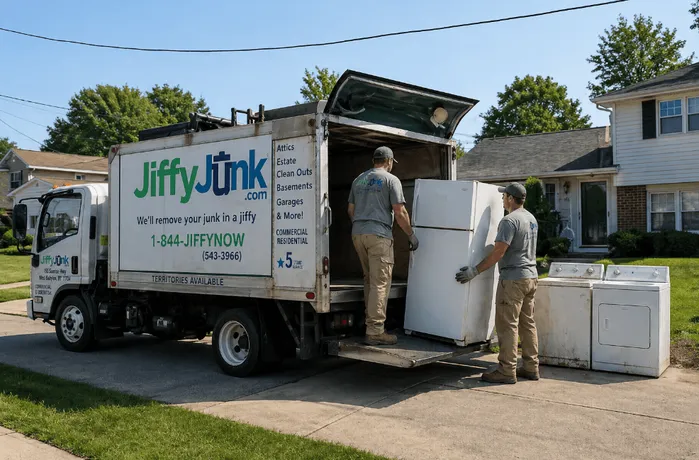
That’s the White Glove Treatment: licensed, insured, on time, in uniform, and every space left broom-clean when we leave. The quote we give you is the price you pay, with no fuel fees, weight surcharges, or disposal add-ons showing up at the end.
“After twelve years and tens of thousands of appliance pickups across the country, here’s what our crews and our pricing data agree on: the months people lose living around an old appliance end up costing them far more than any removal fee ever would.”
— Jiffy Junk Operations Team
Essential Resources On Appliance Removal Cost
If you’re weighing options, these are the seven sources our team points customers to most often. Every link goes to a federal agency or an established nonprofit. All of them are free to read with no account required.
1. EPA Section 608 — Federal Rules On Appliance Disposal
The clearest explanation of why fridges, freezers, and ACs can’t simply be set out at the curb. Federal law requires certified refrigerant recovery before any unit is dismantled or landfilled.
Source: EPA Appliance Disposal
2. ENERGY STAR Flip Your Fridge Calculator — See What An Old Fridge Actually Costs You
Punch in your fridge’s age and size to see exactly what it’s adding to your electric bill every year. The calculator alone often pays for the pickup.
Source: ENERGY STAR Flip Your Fridge
3. IRS Energy Efficient Home Improvement Credit — Tax Savings On Qualifying Upgrades
If your removal is tied to a qualifying heat pump, water heater, or HVAC upgrade, homeowners can claim up to $3,200 in federal tax credits for improvements completed through Dec. 31, 2025.
Source: IRS Energy Credit
4. Department Of Energy — Buying And Maintaining Refrigerators And Freezers
Plain-English guidance on what to look for in a new unit and how to responsibly retire the old one. A smart read before you buy the replacement.
Source: DOE Energy Saver
5. Habitat For Humanity ReStore — Donate Working Appliances For A Tax Deduction
If your appliance still runs, ReStore locations across the country accept working donations and resell them to fund local home builds. A meaningful way to reduce your net disposal cost.
Source: Habitat ReStore
6. Goodwill Industries — Donate Working Small Appliances For A Tax Deduction
Working small appliances like microwaves, toasters, and countertop units are accepted at most Goodwill donation centers nationwide, and your donation may qualify for a charitable tax deduction. A strong complement to ReStore when the item is under about $50 of fair market value.
Source: Goodwill Donation Guide
7. Consumer Product Safety Commission — Appliance Recalls To Check Before You Haul It Out
If your appliance is under recall, you may be entitled to a free replacement, refund, or pickup. Worth a two-minute search before you schedule any haul-away.
Source: CPSC Recalls
Supporting Statistics
Three data points that frame why appliance removal pricing looks the way it does in 2026. Each number comes from a federal agency or an established nonprofit. We left industry marketing numbers out on purpose.
Roughly Three In Ten U.S. Households Run A Second Refrigerator
The Residential Energy Consumption Survey has long reported that close to three in ten U.S. homes keep a second refrigerator plugged in, and most of those secondary units are older, less efficient garage or basement models. From our own pickups, that “just in case” fridge is the single most common appliance our customers finally remove.
Source: U.S. Energy Information Administration
U.S. Iron And Steel Scrap Consumption Reached 63 Million Metric Tons In 2024
Large appliances are a real part of the U.S. scrap metal stream. The U.S. Geological Survey reports U.S. apparent consumption of iron and steel scrap at about 63 million metric tons in 2024, with appliances named as one of the primary consumer end uses. That’s the story behind eco-friendly disposal when it’s done right.
Source: U.S. Geological Survey Mineral Commodity Summaries 2025
Old Refrigerators Can Use About 35% More Energy Than ENERGY STAR Models
An old refrigerator uses about 35% more electricity on average than a newer ENERGY STAR–labeled model, per Natural Resources Defense Council reporting on appliance efficiency, a figure consistent with U.S. Department of Energy guidance. For a typical household, that’s the difference between roughly $95 a year and under $35 a year to run the unit. After a decade of fridge pickups, we can confirm: the longer you wait to remove an old secondary fridge, the more it quietly costs you.
Source: NRDC — Energy Efficiency: The Clean Facts
Final Thoughts & Opinion
After more than a decade of hauling appliances out of every kind of property in America, here’s the honest take from our side of the truck.
Price matters, but it’s rarely what should decide the job.
- A $79 curbside quote with a fuel fee, a weight fee, and a disposal surcharge tacked on at the end can easily land above a $149 all-inclusive pickup.
- A free municipal pickup with a three-week wait usually costs you more in spoiled freezer space, stubbed toes, and mental friction than you’d save.
- Companies that quote the lowest upfront number are often the same ones that charge for surprises once the crew is on site. We’ve written more on why “free” junk removal is rarely free if you want the full picture.
Our opinion, informed by tens of thousands of appliance removals since 2014: the best price is the one you get upfront, in writing, with every cost included. That’s why we quote all-in, and it’s why the White Glove Treatment covers the parts other services cut, from protecting your floors on the way out to confirming recycling or donation when it matters to you and leaving the space broom-clean.
Waiting is what actually costs you. The appliance itself is just a reminder. Get a firm quote, pick a time, and get on with your week.
Frequently Asked Questions
Q: How much does appliance removal cost on average?
A: Most single-appliance pickups cost $75 to $250 in 2026, with the national average landing around $100 to $180. Refrigerators and freezers run higher because of EPA refrigerant handling, and microwaves or small ACs come in lower. Bundling multiple appliances into one pickup lowers the per-item cost.
Q: How much does it cost to haul away an old refrigerator?
A: Expect $100 to $250 for a standard fridge pickup, with most homeowners paying around $150. Basement carries, older units with heavier insulation, and refrigerant recovery push the number toward the high end. If your electric utility runs an appliance recycling program, you may even receive a small rebate on top.
Q: How much does washer and dryer removal cost for a pair?
A: A standard washer-dryer pair typically runs $145 to $300, with most jobs landing near $200. Stacked units, second-floor laundry rooms, and gas dryer disconnections trend toward the higher end. A pair already disconnected and waiting in the garage lands at the low end.
Q: Will Home Depot or Lowe’s haul away my old appliance for free?
A: Usually not. Both retailers offer haul-away for $30 to $50, and only when you’re buying a replacement with delivery. If you’re not purchasing a new one or you need the old unit gone today, a professional removal service is typically faster and more flexible.
Q: Do I need to disconnect the appliance before you arrive?
A: No. Our crews handle disconnection on most standard jobs. If gas is involved or the unit is hardwired, we’ll tell you upfront when a licensed plumber or electrician is required for a safe shutoff. Unplugging fridges 6 to 8 hours before pickup is appreciated but not required.
Q: Why do refrigerators and freezers cost more to remove than other appliances?
A: Federal law requires certified recovery of refrigerants before any fridge, freezer, window AC, or dehumidifier can be dismantled or landfilled. That specialized handling, plus the weight and bulk of the units, is why refrigerated appliances sit at the top of most pricing tables.
Q: Can I put an old appliance on the curb for pickup?
A: It depends on your municipality, and it’s usually more restricted than people assume. Many cities won’t collect anything with refrigerant, and nearly all have size, weight, or scheduling limits. Curbside also leaves the unit exposed to weather and passersby until the pickup window actually arrives.
Q: Is appliance removal cheaper if I bundle multiple items into one pickup?
A: Yes, almost always. Adding a second or third appliance to the same appointment spreads the fixed costs across more items, which drops the per-item cost meaningfully. Many customers see a meaningful per-item reduction when bundling: pending team confirmation of the specific percentage range.
Q: Does Jiffy Junk recycle old appliances?
A: Yes. Donation and recycling come first in our disposal process, and the landfill is always the last resort. We partner with local recyclers and donation centers nationwide, and we follow all federal, state, and local rules on refrigerant recovery and hazardous materials.
Ready To Get The Old Appliance Out Today? Let’s Make It Easy
Book your free appliance removal quote online in under 60 seconds at jiffyjunk.com/booking, or call 844-JIFFY-JUNK (844-543-3966) and we’ll lock in a time that works for you. You get one crew, an all-inclusive price, and the Jiffy Junk promise: we’re not happy until you are happy.