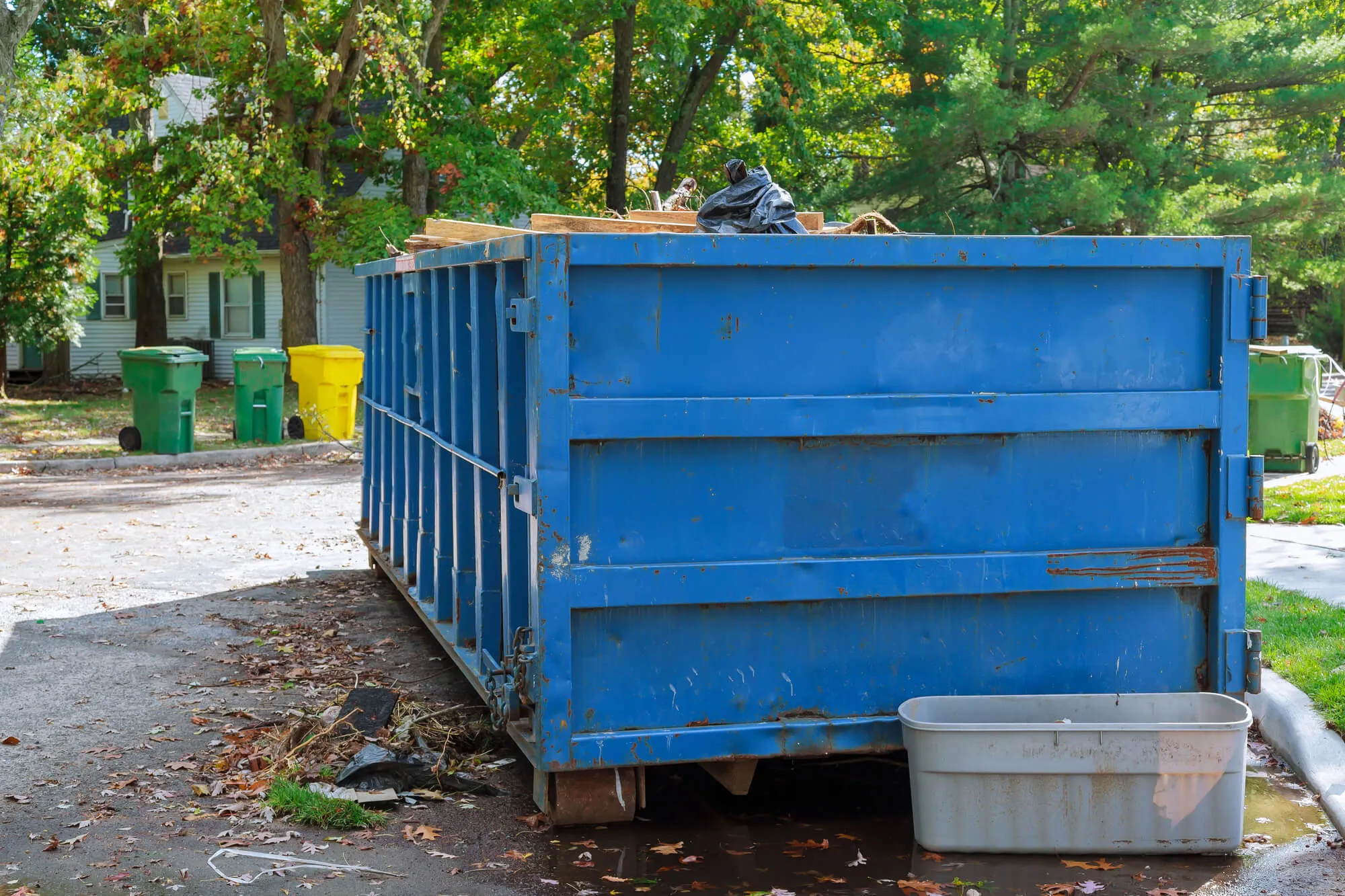
How Big Is a 25 Cubic Yard Dumpster? Understanding Size, Dimensions, Capacity, and Rental Cost So You Know Exactly What You’re Getting Before You Book
A full kitchen-and-bath remodel rarely fits cleanly into a 20-yard dumpster, and it rarely fills a 30. That middle zone is where the 25-yard container earns its spot. Our Jiffy Junk teams have loaded thousands of these since 2014, and we’ll walk you through exact dimensions, real weight limits, honest rental cost, and whether this size is the right fit for your project.
Here’s what most national haulers won’t tell you: they skip the 25-yard entirely. It’s a niche size, and if it’s not in their standard inventory, they default you up to a 30. You pay for capacity you never use. This guide fixes that with straight answers and upfront pricing, no surprises at pickup.
TL;DR Quick Answers
25-yard dumpster
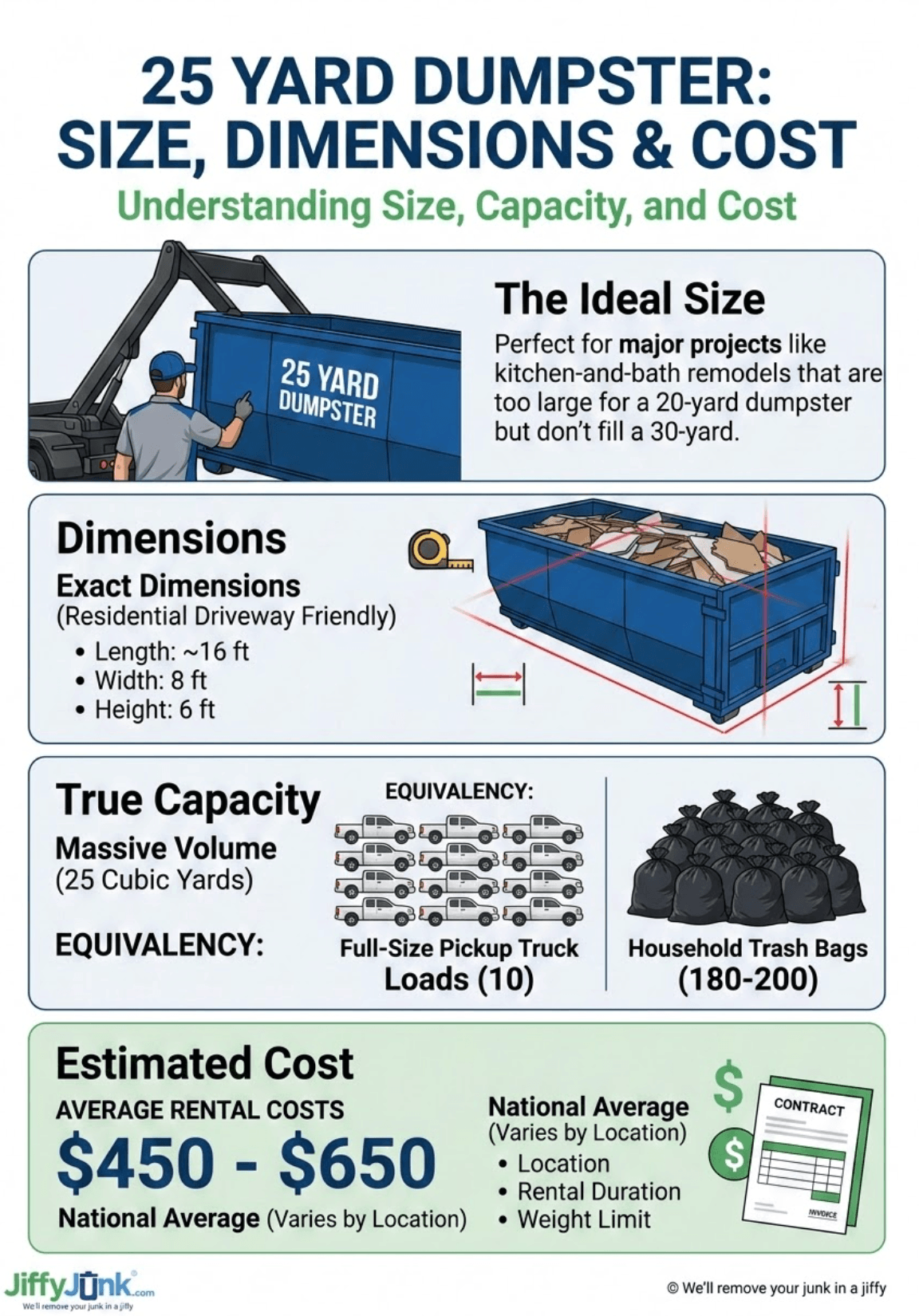
A 25-yard dumpster is a mid-to-large roll-off container holding 25 cubic yards of debris. That works out to roughly 9 or 10 pickup truck loads, or 180 to 200 standard 13-gallon bags. A typical unit measures about 16 feet long, 8 feet wide, and 6 feet tall, with 2 to 6 tons of weight included. National rental costs run $380 to $720 for a standard 7- to 10-day period, depending on your ZIP code, materials, and local landfill fees. It fits full home renovations, large estate cleanouts, mid-size commercial fit-outs, and smaller-home roofing jobs — anywhere a 20 feels tight but a 30 is more than you need.
Top Takeaways
- Dimensions. About 16 feet long, 8 feet wide, and 6 feet tall. Fits most standard driveways with clearance to spare.
- Capacity. Holds 9 to 10 pickup truck loads of debris, or roughly 180 to 200 standard 13-gallon bags.
- Weight limit. Usually, 2 to 6 tons are included. Dense materials like concrete and roofing shingles hit the tonnage cap before the container looks full.
- Cost. National range runs $380 to $720 for a 7- to 10-day rental. Final price depends on ZIP code, material type, and weight.
- Best fit. Full home renovations, estate cleanouts, office fit-outs, and smaller-home roofing jobs. The sweet spot between a 20 and a 30 yarder.
Table of Contents
- How Big Is a 25 Cubic Yard Dumpster? Understanding Size, Dimensions, Capacity, and Rental Cost So You Know Exactly What You’re Getting Before You Book
- TL;DR Quick Answers
- Top Takeaways
- What Is a 25 Cubic Yard Dumpster?
- Dimensions, Footprint, and Placement
- Capacity and Weight Limits
- 25 Yard Dumpster Rental Cost
- Best Uses for a 25 Yard Dumpster
- When to Size Down (or Up)
- Essential Resources on “25 Yard Dumpster”
- 1. Understand Safe Waste Handling on Your Job Site
- 2. Donate Reusable Furniture and Building Materials First
- 3. Find a Local Construction & Demolition Recycler
- 4. Earn LEED Waste Diversion Credits on Green Builds
- 5. Get Solid Waste Management Best Practices
- 6. Plan Your Renovation Scope with Confidence
- 7. Protect Yourself When Hiring and Paying a Contractor
- Supporting Statistics
- Final Thoughts & Our Opinion
- Frequently Asked Questions
- Q: How big is a 25-yard dumpster?
- Q: How much does a 25-yard dumpster rental cost?
- Q: How many pickup truck loads fit in a 25-yard dumpster?
- Q: What’s the weight limit on a 25-yard dumpster?
- Q: Is a 25-yard dumpster bigger than a 20-yard dumpster?
- Q: Will a 25-yard dumpster fit in my driveway?
- Q: Do I need a permit for a 25-yard dumpster?
- Q: What materials can go in a 25-yard dumpster?
- Q: How long is a standard 25-yard dumpster rental period?
- Q: Does Jiffy Junk deliver 25-yard dumpsters nationwide?
- Ready to Reclaim Your Space with a 25 Yard Dumpster?
What Is a 25 Cubic Yard Dumpster?
A 25-yard dumpster is a mid-to-large roll-off container dropped off at your residence or job site, loaded at your pace, then hauled away by a specialized truck. “Cubic yards” measure volume: one cubic yard equals the space inside a three-foot cube. Twenty-five of those stacked together give you a serious amount of working room.
The size question gets interesting once you map it against the full lineup. A 20-yard handles most residential cleanouts. A 30-yard dumpster handles most construction and demolition debris. Plenty of mid-to-large projects land in between: full home renovations, mid-size office fit-outs, and large estate cleanouts. That’s exactly where the 25 sits. When a hauler actually stocks one, it’s usually because their customers asked for it enough times to justify the space.
Dimensions, Footprint, and Placement
Standard 25-yard dumpsters run about 16 feet long, 8 feet wide, and 6 feet tall. Dimensions vary slightly by region and equipment. Some providers stock a shorter version, around 14 feet long and 6.5 feet tall, for tighter driveways. After thousands of deliveries, our crews share these placement rules:
- Clear a flat area at least 25 feet long and 10 feet wide for the container.
- Allow roughly 60 feet of truck maneuvering clearance for the delivery vehicle.
- Watch for overhead clearance. Tree limbs and power lines cause most of our delivery reschedules.
- Check local permit rules if the container will extend into the street. Private-property placement usually skips the permit. Public right-of-way usually does not.
- Protect your driveway surface with plywood if you want to avoid marks from the roll-off rails.
Capacity and Weight Limits
Volume and weight are two separate limits. A 25-yard dumpster gives you 25 cubic yards of space and usually 2 to 6 tons of included weight, depending on the provider and local market. Our crews see the same pattern week after week:
- Materials that fill the space first. Furniture, mattresses, appliances, drywall scraps, cabinetry, light wood, carpet, yard waste, and bagged household debris.
- Materials that hit the weight cap first. Concrete, brick, roofing shingles, soil, ceramic tile, dense masonry.
For dense debris like roofing or concrete, a smaller container with a dedicated heavy-material rate usually costs less than hauling a half-full 25 over its weight limit. One more thing to plan around: paint, pesticides, oil, and similar household hazardous products should never go in a roll-off. Bring those to a local collection event instead. Ask about tonnage before booking, and we’ll steer you to the right size.
25 Yard Dumpster Rental Cost
Nationally, a 25-yard rental runs $380 to $720 for a standard 7- to 10-day period. The spread is wide because local pricing depends on:
- Your ZIP code and the local landfill tipping fee.
- Rental duration, with extensions typically running $10 to $15 per additional day.
- Material type and projected weight.
- Whether a street placement permit is required.
- Distance from the disposal or transfer facility.
We lock in delivery, pickup, disposal fees, and your weight allowance at booking. The number you see on the quote is the number you pay at pickup. That’s the White Glove Treatment difference.
Best Uses for a 25 Yard Dumpster
Based on the jobs our teams run every day, the 25-yarder works best for these projects:
- Full home renovations. Kitchen and bath combined, or whole-floor remodels with mixed debris.
- Large estate cleanouts. Multi-room contents plus light demolition in a single haul. See our estate cleanout cost guide for pricing expectations.
- Mid-size commercial fit-outs. Partition walls, ceiling tile, old office furniture, carpet.
- Smaller home roofing jobs. Watch tonnage closely. Shingles max out weight fast.
- Large landscaping or brush clearing. Tree limbs, sod, shrubs, and mulch pack in efficiently.
- Apartment turnover cleanouts. Furniture, mattresses, appliances, and bagged contents from multiple units.
When to Size Down (or Up)
Not every project calls for a 25. To see how your scope maps against every size in the lineup, browse our dumpster sizes chart. Our teams share the same rule of thumb with every customer:
- Single-room cleanout or small bathroom remodel. Size down to 10 or 15 yards.
- Full-floor basement or attic cleanout. A 20-yard one usually handles it.
- Mid-to-large renovation, estate cleanout, or office fit-out. The 25 hits the sweet spot.
- Whole-house renovation, large roof tear-off, or major demolition. Move up to 30 or 40 yards.
An empty dumpster costs the same to haul as a full one. A second container doubles your expense. When you’re between two sizes, sizing up almost always saves money.
“After delivering thousands of roll-off containers, we’ve learned the 25-yarder is the size customers request on their second project. First-timers default to a 20 or 30. The customers who’ve already done one renovation know exactly when 25 is the right call, and they stop overpaying for unused space.”
— Jiffy Junk Operations Team
Essential Resources on “25 Yard Dumpster”
The best project decisions rest on trusted, independent sources. Here are seven resources our teams recommend to customers planning a 25-yard rental.
1. Understand Safe Waste Handling on Your Job Site
OSHA’s construction waste regulations cover safe loading, container placement, and debris handling. Required reading if you’re supervising workers or a weekend crew.
Source: OSHA 1926.252 — Disposal of Waste Materials
2. Donate Reusable Furniture and Building Materials First
Habitat for Humanity ReStores accept usable furniture, appliances, and surplus building materials, often with free pickup. Every item donated is one you don’t pay to haul.
Source: Habitat for Humanity ReStore
3. Find a Local Construction & Demolition Recycler
The CDRA is the only national trade association dedicated to C&D recycling. Their member directory helps you find certified local recyclers that take concrete, wood, shingles, drywall, and metals.
Source: Construction & Demolition Recycling Association
4. Earn LEED Waste Diversion Credits on Green Builds
If your project is chasing LEED certification, USGBC’s Construction and Demolition Waste Management guidance lays out diversion goals, the five-material-stream requirement, and the documentation your hauler needs to provide for commingled loads to count toward your credit.
Source:U.S. Green Building Council — Construction & Demolition Waste Management Planning Guide
5. Get Solid Waste Management Best Practices
SWANA publishes industry standards, technical resources, and training that cover every stage of waste handling, from collection through final disposal.
Source: Solid Waste Association of North America
6. Plan Your Renovation Scope with Confidence
The National Association of Home Builders offers consumer remodeling guides and contractor-vetting checklists — useful upstream of any debris conversation, since the cleaner your project scope, the easier it is to estimate the cleanout you’ll need on the back end.
Source: National Association of Home Builders — Consumer Resources
7. Protect Yourself When Hiring and Paying a Contractor
The Consumer Financial Protection Bureau has plain-language resources on contractor agreements, home-improvement financing, and avoiding scams. Worth reading before you sign any renovation contract.
Source: Consumer Financial Protection Bureau
Supporting Statistics
The numbers below come from independent U.S. government sources. After a decade of hauling, they match what our crews see on the ground: mid-to-large renovations are happening at record volume, debris streams are massive, and the industry cleaning up is enormous.
1. U.S. Homeowners Spent $827 Billion on Home Improvement in Two Years
The latest American Housing Survey reports that American homeowners spent approximately $827 billion on home improvement projects in the two-year period ending in 2023, an increase of more than $200 billion over the prior period. Total project volume rose 4%. The trend is exactly what drives 25-yard demand: mid-to-large renovations at record volume.
Source: U.S. Census Bureau — American Housing Survey
2. 600 Million Tons of Construction & Demolition Debris Generated Annually in the U.S.
American job sites produce about 600 million tons of construction and demolition debris a year, according to EPA data from 2018, more than double the amount of municipal solid waste. Demolition alone accounts for over 90% of total C&D debris. Every 25-yard container we deliver is part of managing that flow responsibly.
Source: U.S. Environmental Protection Agency — Sustainable Management of C&D Materials
3. 1.6 Million Construction Laborers Powered the U.S. Job-Site Workforce in 2024
The U.S. Bureau of Labor Statistics reports 1.6 million construction laborer and helper jobs in 2024, the crews most often responsible for loading roll-off dumpsters. BLS projects 7% employment growth in the category through 2034, with about 149,400 job openings a year. The scale matches the real-world volume of debris that containers like the 25-yarder exist to handle.
Source: U.S. Bureau of Labor Statistics — Construction Laborers and Helpers
Final Thoughts & Our Opinion
Here’s the thing: most size charts won’t tell you that the 25-yard dumpster exists because the standard lineup has a gap. A 20 handles most residential cleanouts. A 30 handles most construction debris. Plenty of mid-to-large projects land in between.
From our side of the truck, we watch this play out every week. A customer books a 20 for a kitchen-plus-bath combo, fills it by day three, and we’re back for a second haul. Another customer books a 30 for the same project, pays for the bigger container, and waves us off with 10 cubic yards of empty space still in the bin. Both scenarios cost more than they had to.
Our unfiltered opinion, after thousands of deliveries:
- The 25 is underused, not unnecessary. National haulers skip it because it doesn’t fit their standard inventory. Customers want it. The inventory decision just hasn’t caught up.
- Weight is where most renters get surprised. Ask about tonnage before you book. A half-full bin of concrete can cost more than an overflowing bin of furniture.
- Donate before you dump. Habitat ReStores and similar charities will take usable furniture, appliances, and building materials, often with free pickup. Every item donated is one you don’t pay to haul.
- When in doubt, size up. The modest price jump between a 20 and a 25 almost always beats the cost of a second container.
The right dumpster size comes down to matching the container to what you’re actually hauling out. Guessing cubic yards is the slow way. Our teams are happy to think it through with you before you book.
Frequently Asked Questions
Q: How big is a 25-yard dumpster?
A: A 25-yard dumpster typically measures about 16 feet long, 8 feet wide, and 6 feet tall, and holds 25 cubic yards of debris. That’s roughly 9 to 10 pickup truck loads, or 180 to 200 standard 13-gallon bags. Exact dimensions vary by region and equipment. Some providers carry a shorter 14-foot version for tight driveways.
Q: How much does a 25-yard dumpster rental cost?
A: National pricing runs $380 to $720 for a standard 7- to 10-day period. Your final price depends on ZIP code, material type, weight allowance, and local landfill fees. Jiffy Junk’s quote covers delivery, pickup, disposal, and your weight allowance upfront. You pay the number on the quote, no surprise fees at pickup.
Q: How many pickup truck loads fit in a 25-yard dumpster?
A: Roughly 9 to 10 full-size pickup truck loads of debris. Loose, bulky items like furniture fill the space faster. Dense materials pack tighter. Our teams typically tell customers to estimate on the higher end. Overflow fees cost more than sizing up a bit at booking.
Q: What’s the weight limit on a 25-yard dumpster?
A: Most 25-yard rentals include a weight allowance of 2 to 6 tons, or 4,000 to 12,000 pounds, depending on the provider and local market. You’ll pay per additional ton over the limit. Ask your rental company for the included tonnage before booking, so nothing changes at pickup.
Q: Is a 25-yard dumpster bigger than a 20-yard dumpster?
A: Yes. A 25 holds 5 additional cubic yards of debris, or about 1 to 2 extra pickup truck loads, compared to a 20. The physical footprint is usually only slightly larger, which makes the 25 a practical step-up when you’re between sizes and want to avoid a second haul.
Q: Will a 25-yard dumpster fit in my driveway?
A: Most standard residential driveways fit a 25-yard dumpster. Confirm at least 25 feet of clear length, 10 feet of width, and roughly 60 feet of truck maneuvering space. Check overhead clearance for tree limbs and power lines, the two most common reasons our drivers have to reschedule a delivery.
Q: Do I need a permit for a 25-yard dumpster?
A: Private-property placement usually skips the permit. Street or public right-of-way placement usually needs one. Requirements vary by city and HOA, so confirm with your local municipality before delivery. Jiffy Junk can help you think through permit questions during the booking call.
Q: What materials can go in a 25-yard dumpster?
A: Most mixed residential and light commercial debris works: furniture, mattresses, appliances (surcharges may apply), drywall, cabinetry, carpet, yard waste, wood, and bagged household debris. Prohibited items typically include household hazardous waste, paint, asbestos, propane tanks, tires, and electronics. Always confirm specifics with your provider.
Q: How long is a standard 25-yard dumpster rental period?
A: Standard periods run 7 to 10 days. Extensions are usually available for a per-day fee, typically $10 to $15. Most residential cleanouts finish inside the standard window. Larger renovation projects sometimes need extra time as work moves through phases.
Q: Does Jiffy Junk deliver 25-yard dumpsters nationwide?
A: Jiffy Junk serves customers across the country with licensed, insured teams. Specific size availability varies by market. Call 844-543-3966 or book online at jiffyjunk.com/booking to confirm 25-yard availability in your ZIP code and get an instant, all-inclusive quote.
Ready to Reclaim Your Space with a 25 Yard Dumpster?
Get your transparent, all-inclusive quote in under 60 seconds, because we’re not happy until you are happy. Call 844-543-3966 or book online at jiffyjunk.com/booking, and our team will help you confirm the right size for your project.