How to Dispose of Paint Safely: A Complete Guide to Latex, Oil-Based, and Spray Paint Disposal, Drying, Donation, and Hazardous-Waste Drop-Off
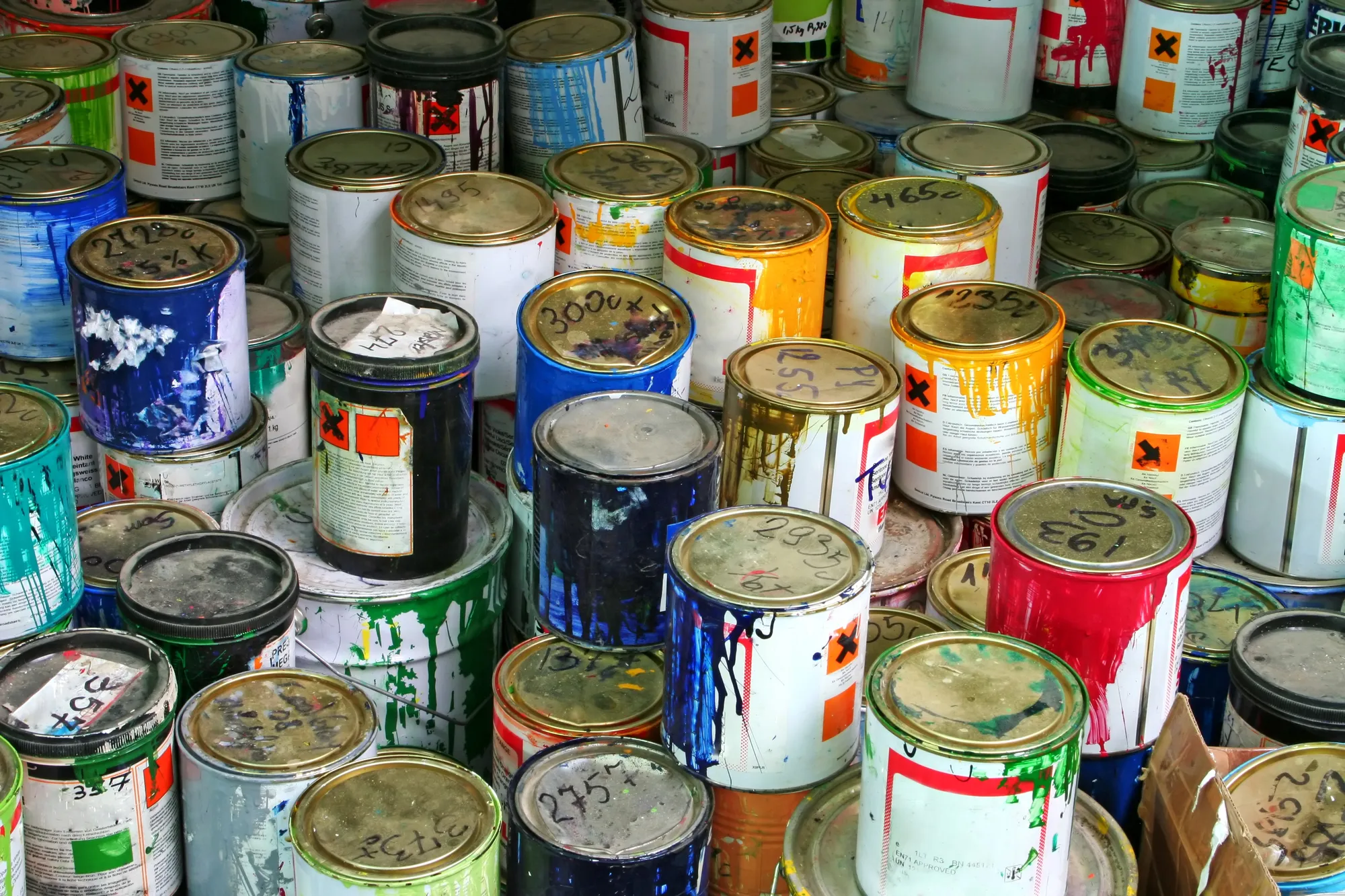
On a typical foreclosure cleanout, our crew finds anywhere from 20 to 60 paint cans tucked into basement shelves or garage corners. Most have sat untouched for years. Some are still legal to throw away. Many are not. That mix is exactly why we wrote this guide.
Jiffy Junk has been hauling paint out of garages, estates, and renovation sites since 2014. We’re licensed, insured, and trained on the federal and state rules that apply to every paint type a household might have on a shelf. This guide is built on what we see on real cleanouts, paired with current EPA and PaintCare guidance.
Whether you’ve got one leftover quart from a bedroom touch-up or a basement full of cans you inherited, the steps below will get you through it. Legally, safely, and with the White Glove Treatment we bring to every job.
TL;DR Quick Answers
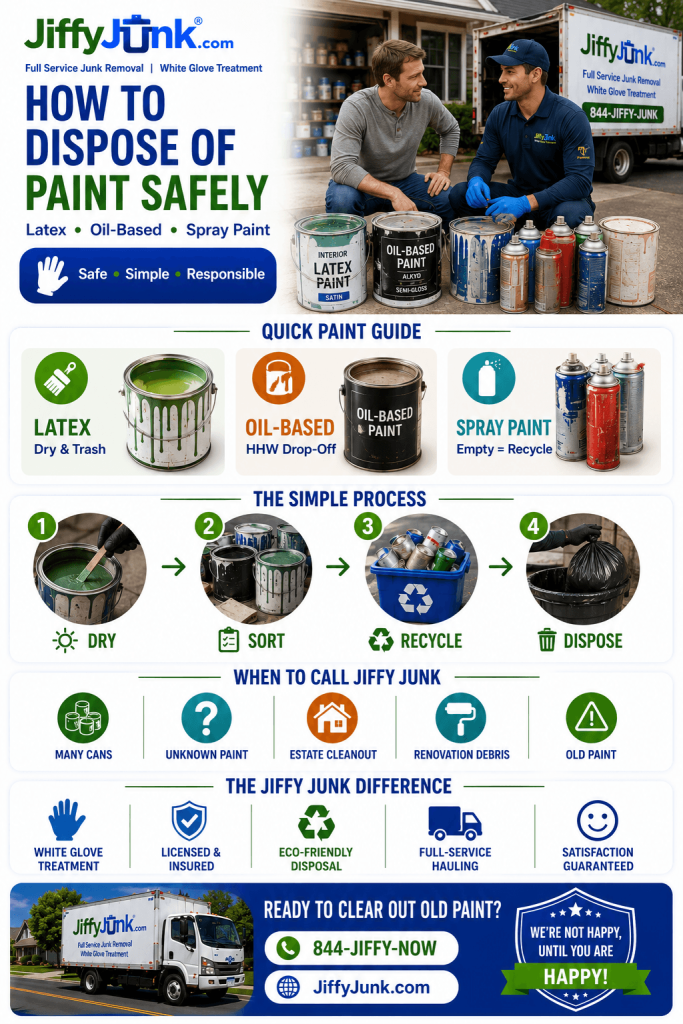
How To Dispose Of Paint
The short answer: it depends on the type. Dry out water-based latex paint and put the solid material in your regular household waste. Take liquid oil-based paint, varnish, stain, and spray paint to a PaintCare drop-off site or your local household hazardous waste (HHW) facility. Never pour any paint down a drain, onto soil, or into a storm drain. Federal and state rules ban every type of paint from those routes.
Method at a glance:
- Latex / water-based: dry it out with kitty litter, paint hardener, or air drying, then put the solid in your regular waste collection.
- Oil-based / alkyd: hazardous waste. Drop off at a PaintCare site or HHW facility in the original labeled container.
- Spray paint/aerosols: Use the can until empty and recycle the metal, or take partial cans to HHW. Never puncture or burn.
- Usable paint: donate to Habitat for Humanity ReStore, community theaters, or schools.
- Large quantities: call Jiffy Junk for a free virtual estimate. We sort, route, and haul the whole lot.
Top 5 Takeaways
- Latex isn’t hazardous, but liquid latex still needs to dry out before it joins your regular household waste. Most state and municipal rules require a solid before pickup.
- Oil-based paint is federally regulated hazardous waste. It’s classified as ignitable. No DIY drying method makes it landfill-legal.
- PaintCare drop-offs are free and operate in 13 jurisdictions. California, Colorado, Connecticut, Illinois, Maine, Maryland, Minnesota, New York, Oregon, Rhode Island, Vermont, Washington, and the District of Columbia.
- Spray cans are pressurized, hazardous waste. Empty cans are recycled with metal. Partial cans go to HHW. Puncturing or burning them is the single most common avoidable garage-cleanout incident we see.
- Big or messy paint loads belong with professionals. Estate cleanouts, renovation debris, and unlabeled containers carry transport-regulation risk most homeowners don’t realize they’re taking on.
Table of Contents
- How to Dispose of Paint Safely: A Complete Guide to Latex, Oil-Based, and Spray Paint Disposal, Drying, Donation, and Hazardous-Waste Drop-Off
- TL;DR Quick Answers
- Top 5 Takeaways
- How To Dispose Of Latex Paint (The Easy One)
- How To Dispose Of Oil-Based Paint And Hazardous Coatings
- Spray Paint, Solvents, And When To Call The Pros
- Other Solvents That Often Hide In The Same Closet
- When DIY Stops Making Sense
- Essential Resources On How To Dispose Of Paint
- 1. Get The Latest Update On The Newest State Paint-Recycling Program
- 2. Recognize The Hazards Of Solvent-Based Paints Before You Open A Can
- 3. Look Up The Toxicology Of Specific Paint Chemicals
- 4. See How A State Paint-Stewardship Program Reports Its Results
- 5. Donate Usable Paint Through The Nation’s Largest Home-Goods Charity
- 6. Find Your State’s Household Hazardous Waste Collection Rules
- 7. Read The Paint Industry’s Own Sustainability Messaging
- Supporting Statistics On Paint Disposal
- Final Thoughts & Opinion
- Frequently Asked Questions
- Q: Can I Throw Paint In The Regular Trash?
- Q: How Do I Dry Up Paint For Disposal?
- Q: What Is Paint Hardener And Where Do I Buy It?
- Q: Where Can I Dispose Of Paint Cans Near Me?
- Q: Is Spray Paint Hazardous Waste?
- Q: Can I Donate Old Paint Instead Of Throwing It Away?
- Q: What About Completely Empty Paint Cans?
- Q: Does Jiffy Junk Haul Away Leftover Paint?
- Ready To Clear Out The Paint?
How To Dispose Of Latex Paint (The Easy One)
Latex paint, also called water-based or acrylic paint, is the friendliest of the bunch. It’s not federally regulated as hazardous waste, which means once it’s dry and solid, most municipalities accept it with regular household waste. The catch: it has to be fully dry. Liquid latex paint is banned from landfills in most states because it sloshes in collection trucks, contaminates other recyclable loads, and clogs sorting equipment.
Three reliable ways to dry up paint for disposal:
Method 1 — Mix In Kitty Litter
- Pour the leftover paint into a lined cardboard box or the original can.
- Add clay-based, non-clumping kitty litter at roughly a one-to-one ratio with the paint.
- Stir until the mixture thickens to a peanut-butter consistency.
- Leave it uncovered in a ventilated area, out of reach of kids and pets, until fully solid.
- Put the solid block and can in your regular household waste with the lid off so haulers can see it’s dry.
Method 2 — Paint Hardener
Paint hardener is a powdered absorbent, typically sodium polyacrylate, that thickens liquid latex into a solid block. You’ll find it at most hardware stores and home improvement centers for a few dollars per packet. One packet handles up to about three-quarters of a gallon. It works faster than kitty litter and is the better choice when you have multiple cans to clear out at once. Stir it in, wait roughly 15 to 30 minutes, and you’re done.
Method 3 — Air Dry Small Amounts
If you have only an inch or two of paint at the bottom of a can, pull the lid off and set it in a well-ventilated spot away from kids, pets, and direct sun. Depending on humidity, it’ll be solid in anywhere from a day to a week.
On dried paint disposal and can recycling: once the paint inside is fully solid, the empty metal can is recyclable in most curbside metal programs. Leave the lid off when you set it out. Some programs prefer a thin dried film inside. Others want it completely scraped. A quick call to your local recycler settles it.
How To Dispose Of Oil-Based Paint And Hazardous Coatings
Oil-based paint is a different animal. Because it contains volatile organic compounds (VOCs) like mineral spirits and naphtha, the EPA classifies it as ignitable hazardous waste. It can catch fire below 140°F. The same rules apply to most stains, varnishes, shellacs, and paint thinners. DIY drying methods don’t work on these. They have to be routed to a facility built to handle them.
You have three legitimate paths for oil-based paint disposal:
- PaintCare drop-off (if you’re participating). Free, year-round, and they accept any brand. Bring the paint in its original five-gallon-or-smaller container with the label intact.
- Household hazardous waste (HHW) collection. Every county runs HHW events. Most happen quarterly. Some counties operate permanent drop-off facilities every week. They accept oil-based paint plus other home solvents and chemicals.
- Professional removal. For more than a few containers, unlabeled cans, or anything mixed in with renovation debris, a licensed hauler handles the sorting and transport.
The federal framework for all of this lives on the EPA’s household hazardous waste page, which spells out which products qualify, why they need special handling, and the general rules every state builds on top of. It’s worth a five-minute read before any garage cleanout where you suspect oil-based anything is sitting on a shelf.
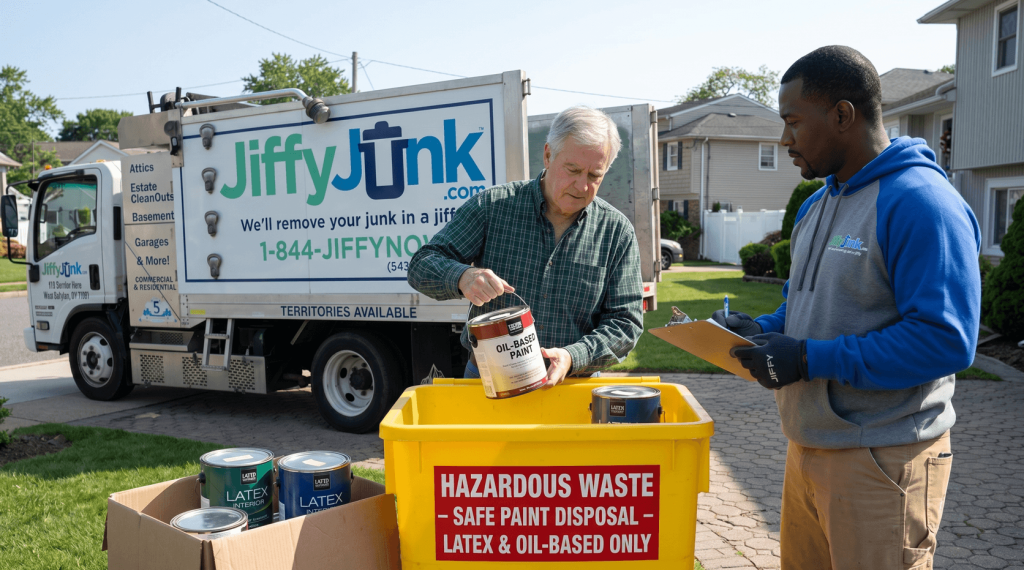
What we see on cleanouts: the most common wet paint disposal mistake is mixing oil-based with latex in the same can to “consolidate.” Skip that step. The resulting blend is harder to dispose of than either type alone. Most facilities will charge extra to accept it, and some will reject it outright. Keep the two categories separated.
Transport tips that make the drop-off go smoothly:
- Keep the original manufacturer’s label on every container. Unlabeled cans get rejected at most sites.
- Drive paint upright in a milk crate, cardboard box, or plastic bin to catch any drips.
- Stay under a few gallons of hazardous material per trip. Many states cap household quantities, so check your local rule before moving larger volumes.
Spray Paint, Solvents, And When To Call The Pros
Spray paint disposal is its own category. Aerosol cans are pressurized, which means heat or impact can rupture them. That’s why “never puncture, crush, or incinerate” is the rule everywhere. The EPA classifies hazardous-waste aerosols as universal waste, and most states follow that lead.
Here’s how to handle spray paint at home:
- Use it up. Spray the remaining contents onto cardboard or scrap material outdoors. Keep going until the propellant is gone and nothing sprays.
- Recycle the empty can. Most curbside metal programs accept fully empty aerosol cans with the nozzle still attached. Confirm with your local recycler.
- Take partial cans to HHW. Any cans that still spray go to your local hazardous waste facility. That includes full cans, half-full cans, and cans with just a little charge left. None of them belongs in your regular waste collection.
Other Solvents That Often Hide In The Same Closet
Paint thinners, lacquer thinners, mineral spirits, brush cleaners, and nail polish remover all follow the same hazardous-waste rules as oil-based paint. If you’re already running a paint-related cleanup, sweep these in too. We cover the two most common offenders in our companion guides on how to safely dispose of acetone at home and how to dispose of bleach the right way. Most of what applies to those two applies to every other home solvent on that shelf.
When DIY Stops Making Sense
There’s a clear line where leftover paint disposal moves out of the DIY zone:
- Ten or more cans, especially of mixed types.
- Unlabeled containers where the paint type isn’t obvious.
- Old paint. Anything from before the 1980s could contain lead.
- Renovation debris where paint is mixed in with drywall, brushes, drop cloths, and other materials.
- Estate, foreclosure, or hoarding cleanouts where decades of paint have accumulated.
From experience: our crews have cleared properties with 60+ paint cans dating back to the 1980s, sometimes mixed in with old gasoline, garden chemicals, and unidentified solvents. Sorting that safely takes training. Transporting it across state lines without the right paperwork can mean fines. That’s the work we do every day. Our crews are licensed, insured, and trained to route every material to a permitted facility. You point to what needs to go, and we handle the logistics. If you’re sizing up a cleanout that includes paint plus everything else, our bulk junk removal guide walks through how the whole process works from booking through final disposal.
“After a decade of clearing out garages, estates, and rental properties, here’s the pattern we see: the single can of paint someone wants to dispose of is rarely the real concern. The shelf of forgotten cans behind it is where the actual compliance work lives, and that’s where most homeowners get caught off guard.”
— The Jiffy Junk Removal Team
Essential Resources On How To Dispose Of Paint
These seven sources cover the full disposal journey. They walk through finding a free drop-off site, understanding the federal rules, and donating usable paint. Each one is a primary source we point our own customers to.
1. Get The Latest Update On The Newest State Paint-Recycling Program
PaintCare’s official article on the Maryland program launch explains exactly how a state’s paint-recycling program works in practice: eligible products, drop-off site network size, large-volume pickup rules, and the fee model. It’s the clearest single explainer of the PaintCare framework being rolled out nationally.
Source: PaintCare — Maryland Statewide Paint Recycling Program
2. Recognize The Hazards Of Solvent-Based Paints Before You Open A Can
OSHA’s solvent hazard recognition page lists the specific health risks of the chemicals you’ll find in oil-based paints, lacquers, and varnishes. The list covers nervous-system effects, skin reactions, and respiratory hazards. Worth reviewing before you spend an afternoon stirring kitty litter into open cans in your garage.
Source: OSHA — Solvent Hazard Recognition
3. Look Up The Toxicology Of Specific Paint Chemicals
The CDC’s ATSDR Toxicological Profiles index is the federal go-to reference for understanding the chemicals in paint, including toluene, xylene, methylene chloride, and dozens more. Each profile covers exposure routes, health effects, and safe-handling guidance, all written for non-specialists.
Source: ATSDR — Toxicological Profiles
4. See How A State Paint-Stewardship Program Reports Its Results
CalRecycle’s Paint Stewardship Program Annual Reports page publishes year-over-year data on how California processes its leftover paint: collection volumes, percentage recycled back into new paint, and where oil-based products go. Every PaintCare state publishes a similar report, so this works as a useful template for understanding any program.
Source: CalRecycle — Paint Stewardship Program Annual Reports
5. Donate Usable Paint Through The Nation’s Largest Home-Goods Charity
Habitat for Humanity’s official donate-goods page walks through what ReStore locations accept, how pickup works, and how donations fund affordable housing builds. Paint policies vary by ReStore, so check with your nearest store before driving over. Unopened or nearly-full cans of usable paint are commonly accepted.
Source: Habitat for Humanity — Donate Goods To ReStore
6. Find Your State’s Household Hazardous Waste Collection Rules
New York’s DEC household hazardous waste page is one of the clearest state-level resources in the country. It includes interactive maps, permitted facility lists, collection event schedules, and safer-alternative product guidance. Most other state environmental agencies publish similar pages. Start with your state’s site and use this one as the template.
Source: NYS DEC — Household Hazardous Waste
7. Read The Paint Industry’s Own Sustainability Messaging
The American Coatings Association is the industry trade group behind PaintCare. Their newsroom publishes plain-English explainers on leftover paint, low-VOC products, and how the stewardship model works from the manufacturer side. Helpful context for understanding why the rules exist and where they’re headed.
Source: American Coatings Association — Industry News And Media
Supporting Statistics On Paint Disposal
Three numbers that put paint disposal in perspective. They also match what we see on actual cleanouts every week.
1. More Than 1.5 Million Tons Of Hazardous Waste Recycled Each Year
The EPA reports that over 1.5 million tons of hazardous waste are recycled annually in the United States. That figure includes solvents, oil-based paints, and the kind of leftover coatings we routinely haul out of garages. The takeaway: proper disposal isn’t destruction. Most of what reaches a licensed facility gets recovered and put back into use, which is exactly why dropping off oil-based paint matters.
- Diversion happens. The system works when people use it.
- Latex paint, when collected through PaintCare, is most often remixed into recycled-content paint.
- Oil-based paint is typically used as supplemental fuel in cement kilns rather than being filled.
Source: EPA — Hazardous Waste Recycling
2. Asthmatic Children Are 10x More Likely To Have An Attack After Home Paint Exposure.
A National Institutes of Health-hosted study of children at University of Miami pediatric clinics found that asthmatic children exposed to home paint VOCs were roughly ten times more likely to experience an asthma attack than unexposed asthmatic children, after adjusting for other risk factors. VOCs persist indoors for weeks after painting. That’s also why we recommend drying out leftover paint outdoors, never in a basement or utility closet.
- Pediatric asthma affects roughly 6.2 million U.S. children.
- Ventilation during cleanup matters as much as ventilation during application.
- Low-VOC and zero-VOC paints reduce ongoing indoor exposure between projects.
Source: NIH/NLM — Pediatric Asthma Attack And Home Paint Exposure
3. About 10% Of Every Gallon Of Paint Sold Becomes Leftover
A 2025 Massachusetts paint stewardship background document, based on EPA estimates, calculates that roughly 10% of all architectural paint sold in the U.S. ends up unused. National paint sales hit approximately 868 million gallons in 2021, which works out to nearly 87 million gallons of leftover paint sitting in American homes every year. That helps explain why we keep finding 60-can paint shelves in garages on cleanouts. The numbers are routine, not the exception.
- Buying smaller quantities is the cheapest disposal strategy there is.
- Most leftover paint is still usable for at least two to three years if sealed and stored away from heat.
- Donation diverts a meaningful share of that 87 million gallons before it ever needs disposal.
Source: Mass.gov — Paint EPR Background Document
Final Thoughts & Opinion
What looks complicated about paint disposal is mostly just a lack of clear instructions.
The customers we meet on cleanouts have usually been told two contradictory things at once: “just dry it out” and “that’s hazardous waste.” Nobody ever explains which type follows which rule. So most people default to one of the wrong answers. Liquid paint in the curbside bin. Rinse brushes down the kitchen sink. Oil-based paint was poured into the backyard “because it’ll dry.”
Here’s what a decade of cleanouts has taught us:
- Small amounts add up. One can pour it down a drain, but it doesn’t break a system. A whole neighborhood doing it for thirty years does. Groundwater contamination from improper disposal is one of the most-cited categories on EPA Superfund sites, and most of it traces back to small individual decisions.
- Free options exist almost everywhere. If you live in a PaintCare state, year-round drop-off is built into the price you already paid for the paint. If you live in a non-PaintCare state, your county runs HHW events. Awareness is the real barrier, not cost.
- Old habits don’t survive modern rules. “My dad always poured it in the yard,” used to be common practice. Today, it’s a citable violation in most states, with environmental cleanup costs that dwarf what disposal would have cost.
- Professional help earns its place on big projects. The difference shows up as a clean transaction instead of weeks of paperwork and permitting calls. For estate cleanouts, hoarding cleanouts, and any property with decades of accumulated coatings, a licensed hauler is the standard move.
Our take: Treat paint the same way you treat the bigger items in a cleanout. Figure out what category each can fall into. Sort by type. Route each category to the right place. The work isn’t hard, but it does have to be done deliberately. That’s what the White Glove Treatment means on our side, and it’s the same standard we’d recommend to anyone tackling a paint cleanup on their own.
Frequently Asked Questions
Q: Can I Throw Paint In The Regular Trash?
A: Latex paint, once it’s fully dry and solid, yes. That’s accepted in most municipalities. Liquid latex, no. Oil-based paint and spray paint, never. Liquid paint of any type is banned from curbside collection in most states because it leaks, contaminates other loads, and clogs sorting equipment.
Q: How Do I Dry Up Paint For Disposal?
A: Three options work. Mix the paint with non-clumping clay kitty litter at about a one-to-one ratio, then let it solidify outdoors. Stir in commercial paint hardener for faster results, usually 15 to 30 minutes. Or remove the lid and air-dry small amounts in a well-ventilated area. Once the paint is fully solid, the can and contents go in your regular household waste.
Q: What Is Paint Hardener And Where Do I Buy It?
A: Paint hardener is a powdered absorbent, typically sodium polyacrylate, that thickens liquid latex into a solid block. You’ll find it at most hardware stores and home improvement centers for a few dollars per packet. One packet handles up to about three-quarters of a gallon. It works faster and cleaner than kitty litter when you have multiple cans to clear.
Q: Where Can I Dispose Of Paint Cans Near Me?
A: Three places to check, in order:
- PaintCare drop-off sites if you live in California, Colorado, Connecticut, Illinois, Maine, Maryland, Minnesota, New York, Oregon, Rhode Island, Vermont, Washington, or the District of Columbia.
- Your county’s household hazardous waste (HHW) facility or scheduled collection event.
- Curbside metal recycling for empty cans with the lid off and contents fully dry.
Q: Is Spray Paint Hazardous Waste?
A: Yes, federally and in most states. Aerosols are classified as universal waste, a streamlined category of hazardous waste. Empty cans are recycled with regular metal. Partial cans go to HHW. Never puncture, crush, or incinerate a spray paint can. The pressurized propellant can rupture and ignite.
Q: Can I Donate Old Paint Instead Of Throwing It Away?
A: Often, yes. Habitat for Humanity ReStores are the most reliable national channel for donations. They take unopened or nearly full cans of usable paint. Community theaters, schools, scout troops, and local mural projects often accept donated paint, too. Call ahead to confirm. As a rule of thumb, latex paint stays donation-quality for about two years. Oil-based stays good for about three, if sealed tight and stored away from heat.
Q: What About Completely Empty Paint Cans?
A: Empty metal paint cans are usually recycled in curbside metal programs. Leave the lid off so haulers can confirm the can is dry. A thin film of dried paint inside is fine in most programs. Liquid residue is what gets cans rejected. Plastic five-gallon buckets may also be recycled in some HDPE programs, so check with your local recycler.
Q: Does Jiffy Junk Haul Away Leftover Paint?
A: We do, with a few rules to keep everything compliant. Our crews can haul fully dried latex paint as part of a regular cleanout. For liquid oil-based paint, spray cans, or unidentified containers, we route the materials to permitted hazardous waste facilities so everything reaches the right destination. The cleanest answer for most customers: take a quick video on our free virtual estimate, and we’ll tell you exactly what we can take and what needs a separate drop-off before a truck gets dispatched.
Ready To Clear Out The Paint?
If you’d rather skip the kitty litter and the drop-off trips, our licensed and insured crews can handle the whole paint cleanout. We sort, haul, and route every container to the right facility, under the same White Glove Treatment we bring to every job. Once you’ve booked, our pre-appointment prep guide walks through exactly what to set aside before our truck arrives. Book a free virtual estimate at jiffyjunk.com/booking or call 844-JIFFY-NOW (844-543-3966). We’re not happy until you are happy, and your space will be clutter-free in a jiffy.