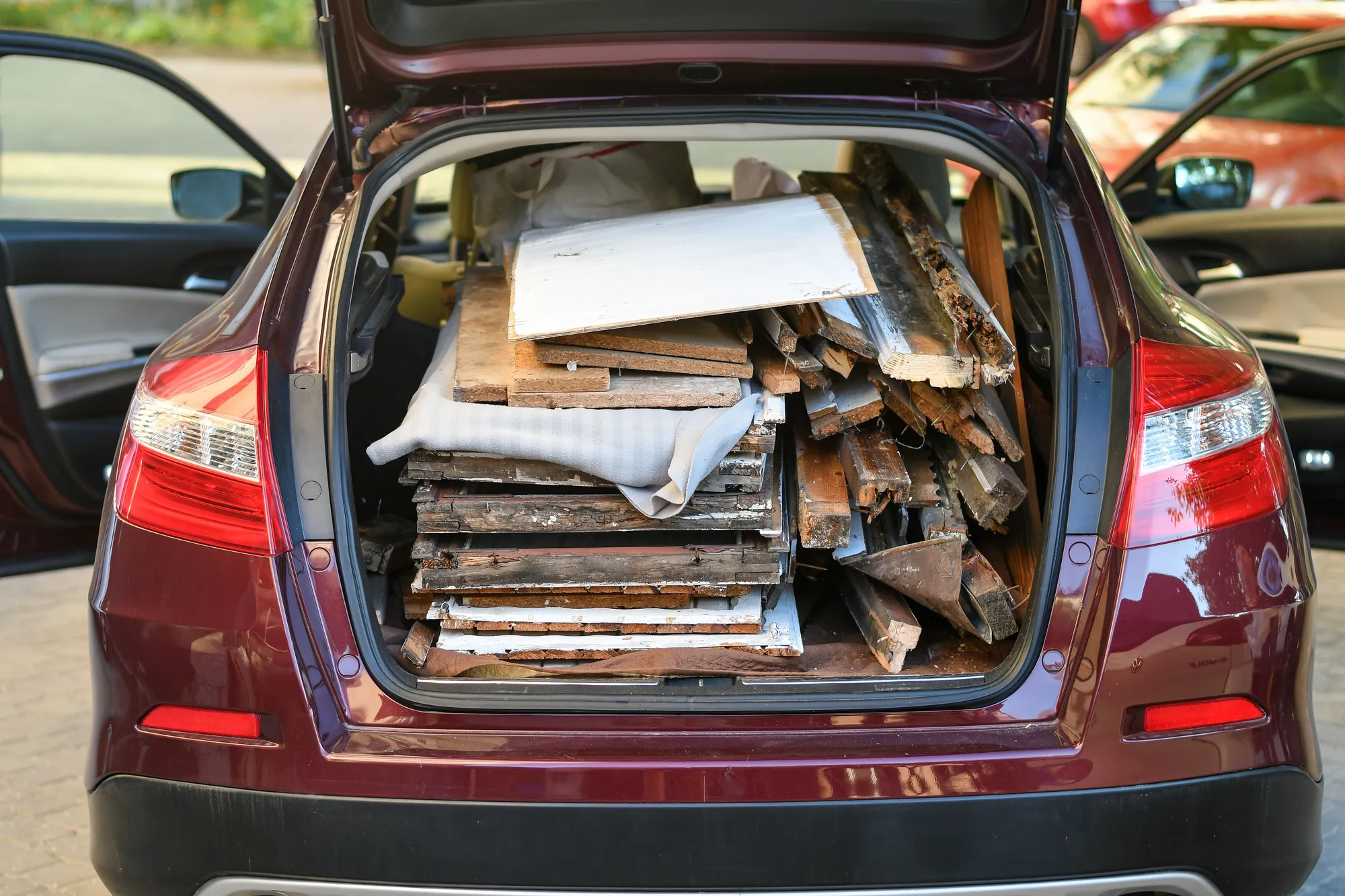
Is Junk Removal Worth It? When to Hire Pros vs. DIY, the Real Cost of Doing It Yourself, and the Hidden Value of Full-Service Hauling
DIY junk removal rarely saves you money. By the time you add a truck rental, the gas, the dump fees, and the Saturday afternoon you’ll lose, hiring a pro is usually the cheaper call. We’ve watched this pattern play out with homeowners across the country since 2014, and the math holds up almost every time.
Below, we walk through what hiring a junk removal company really costs, what DIY really costs, and the hidden value most homeowners overlook until the truck is loaded. We’ll also cover when DIY actually makes sense, because sometimes it does.
TL;DR Quick Answers
Is Junk Removal Worth It?
Yes, for almost any cleanout bigger than one light item. Once you total up the truck rental, the fuel, the dump fees, and the hours of lifting, hiring a pro usually costs less than handling it yourself. You also skip the sore back, the lost Saturday, and the chance that something perfectly donate-able ends up at the landfill.
- Hire a pro for: bulky items, multiple pieces, anything heavy, stairs, estate cleanouts, or anything time-sensitive.
- Consider DIY only for: one small light item, with your own truck, and a transfer station 10 minutes away.
- True cost of DIY: usually $80 to $220 once you count truck, fuel, dump fees, and your own labor.
- True cost of full-service: usually $99 to $600 flat, with the whole job included.
- The tiebreaker most people miss: donation and recycling. A pro sorts before disposing. DIY almost always heads straight to the landfill.
Top 5 Takeaways
Here’s what to remember if you’re weighing the call between DIY and full-service:
- The DIY price tag is misleading. Truck rental sounds like a bargain until the per-mile fees, fuel, dump charges, and the value of your Saturday land on the receipt. The “free” cleanout rarely is.
- One flat-rate price covers the whole job. Labor, lifting, truck, fuel, disposal, and recycling are all included in our quote. The number on the estimate is the number you pay.
- Lifting injuries are the part nobody budgets for. Sprains, strains, and back injuries from manual lifting top the workplace-injury data every year, and the same physics applies in your living room.
- Eco-friendly disposal is where the real value hides. A full-service team sorts every load for donation and recycling. DIY drop-offs at the transfer station rarely get sorted at all.
- The right answer depends on your job. One light item with your own truck and a transfer station nearby? DIY makes sense. For heavier items, full rooms, or anything you’d rather not lift, a pro earns the quote.
Table of Contents
- Is Junk Removal Worth It? When to Hire Pros vs. DIY, the Real Cost of Doing It Yourself, and the Hidden Value of Full-Service Hauling
- TL;DR Quick Answers
- Top 5 Takeaways
- The Real Cost Of Doing It Yourself
- What You Actually Get With Full-Service Junk Removal
- DIY Vs. Hiring Pros: A Side-By-Side Comparison
- The Hidden Value: Eco-Friendly Disposal And Peace Of Mind
- When DIY Actually Makes Sense
- Essential Resources On “Is Junk Removal Worth It?”
- 1. See What The EPA Says About Furniture And Appliance Waste
- 2. Learn Safe Lifting Limits Before You Move Anything Heavy
- 3. Schedule A Free Furniture Donation Pickup Through Habitat For Humanity
- 4. Check Goodwill’s Donation Guidelines Before Booking Any Hauler
- 5. Find An ENERGY STAR Recycling Program For Your Old Fridge Or Freezer
- 6. Tackle Hard-To-Recycle Items With Keep America Beautiful’s Guide
- 7. Understand How The Waste Industry Actually Works
- Supporting Statistics
- Final Thoughts And Opinion
- Frequently Asked Questions
- Q: Is Junk Removal Worth It For A Single Piece Of Furniture?
- Q: Should I Do My Own Junk Removal Or Hire A Company?
- Q: Why Hire A Junk Removal Company Instead Of Renting A Dumpster?
- Q: How Much Does Professional Junk Removal Cost?
- Q: Is Full-Service Junk Removal Worth The Extra Money?
- Q: What Items Won’t A Junk Removal Company Take?
- Q: How Fast Can Jiffy Junk Pick Up My Items?
- Q: Does Junk Removal Really Recycle And Donate, Or Does It All Go To The Landfill?
- Ready To Stop Wondering And Start Reclaiming Your Space?
The Real Cost Of Doing It Yourself
DIY sounds simple on paper: rent a truck, load it up, drive to the dump. The honest answer comes out at the kitchen table once the receipts add up.
Here’s the math we run when customers ask whether DIY would have saved them money:
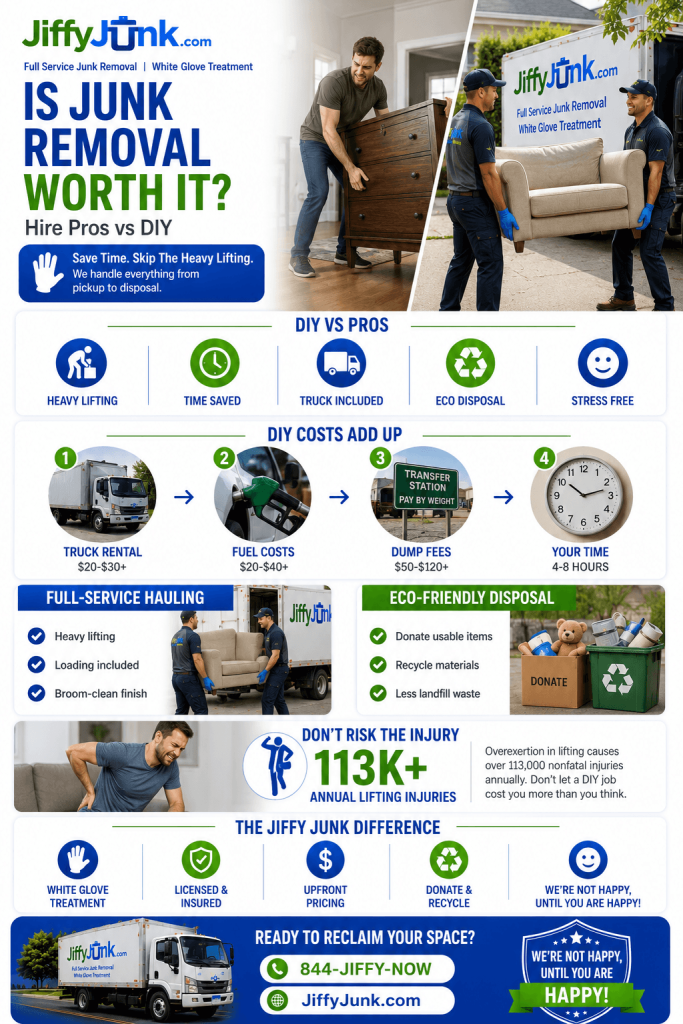
- Truck rental: a typical box truck or pickup rents for $20 to $30 base, plus $0.79 to $1.29 per mile. A simple cleanout with one dump run can easily hit 30 to 60 miles.
- Fuel: Rental trucks aren’t fuel-efficient. Plan on $20 to $40 in gas for the round trip and the dump run.
- Transfer-station fees: most facilities charge by the pound or the load. A single mattress can run $30 to $60. A pickup-bed full of mixed items usually lands between $50 and $120.
- Time: a single-room cleanout takes 4 to 8 hours, start to finish. That’s an entire Saturday.
- Hidden extras: a dolly rental, work gloves, ratchet straps, and a possible chiropractor visit after wrestling that armoire down the stairs.
Add it all up, and a DIY job most people peg at “$50, tops” usually lands closer to $150 to $220, before you count your own hours. Run that math before you book the rental.
For a deeper look at the line items, our breakdown of how junk removal pricing actually works walks through volume-based vs. hourly pricing, regional cost differences, and the hidden fees that catch first-time customers off guard.
What You Actually Get With Full-Service Junk Removal
A Jiffy Junk quote covers the full job, not just the truck. Here’s everything baked into one flat-rate price:
- Two-person crew, fully licensed and insured.
- All lifting, loading, hauling, and disposal. You don’t touch a single item.
- Truck, fuel, and transfer-station fees are built into the flat-rate price.
- Sorting for donation and recycling before anything heads to a landfill.
- Broom-clean cleanup after the truck pulls away. That’s our White Glove Treatment.
- Same-day and next-day scheduling in most service areas.
- An upfront quote that doesn’t move. The number we give you is the number you pay.
Want to see the full menu of what a Jiffy Junk crew can clear out for you? Here’s our complete list of full-service junk removal services, covering single-item pickups through whole-home estate cleanouts.
DIY Vs. Hiring Pros: A Side-By-Side Comparison
Both options work. They just work for very different jobs. Here’s how they actually compare once you factor in what the truck-rental sticker price hides:
- Total out-of-pocket cost. DIY usually costs around $80 to $220 for a small load. Full-service junk removal runs $99 to $600 flat for the same job, depending on volume.
- Time you invest. DIY eats 4 to 8 hours of your day. Full-service is roughly 30 minutes on-site, and you do none of it.
- Physical effort. DIY is high-effort and high-risk. Full-service is zero lifting on your part.
- Eco-friendly disposal. DIY usually defaults to the landfill. A full-service crew routes usable items to donation partners and recyclables to scrap and e-waste facilities first.
- Scheduling. DIY is weekend-only for most people. Full-service is same-day and next-day, seven days a week in most areas.
The Hidden Value: Eco-Friendly Disposal And Peace Of Mind
Where your items end up is the part most homeowners overlook until the truck has already pulled away. It’s also the biggest reason to hire full-service if you care about keeping usable belongings out of the landfill.
When you DIY, almost everything ends up at the landfill. A perfectly good couch, a working microwave, and a dresser that just needs a coat of paint. All of it gets weighed in and buried.
Our crews sort every load before any of it heads to disposal. Usable furniture gets routed to donation partners. Metals go to scrap. Electronics go to certified e-waste recyclers. Only what truly can’t be reused reaches the landfill. That approach matches what most waste management best practices recommend: keep usable belongings in circulation longer, and pull recyclable material out of the waste stream before it’s lost.
The peace-of-mind side matters too. Licensed and insured crews, broom-clean cleanup, transparent pricing, and the simple fact that your back doesn’t take the hit. For most homeowners, those things end up mattering more than the dollar amount on the invoice.
When DIY Actually Makes Sense
We’ll be straight with you. Junk removal isn’t the right call for every job. Here’s when DIY is genuinely the smarter move:
- You already own a pickup truck or SUV with fold-down seats.
- You’re moving one or two light items, like a single chair, a bagged-up closet purge, or broken-down boxes.
- Your local transfer station is under 15 minutes away.
- You’re healthy, you have the time, and nothing in the load is awkward, fragile, or above ground floor.
- There are no stairs, narrow doorways, or items heavier than you’d comfortably carry on a hike.
If you check every box, DIY can absolutely be the smarter call. For appliances, mattresses, multi-room cleanouts, or anything heavy you’d rather not lift, a full-service hauler is the move.
If you do decide to handle it yourself, our team has put together 11 insider junk removal tips that will save you a few trips and a sore back along the way.
“What we hear most often when we’re loading a truck: ‘I should have just called you first.’ Customers compare our flat rate to the truck-rental price, then forget to count the dump fees, the gas, the second trip back for what didn’t fit, and the four hours of their day they’ll never get back.”
— The Jiffy Junk Operations Team
Essential Resources On “Is Junk Removal Worth It?”
If you’re still weighing the decision, these are the seven most valuable resources to look at next. We’ve worked alongside several of these organizations on cleanouts over the years. They cover everything from donation pickup to safe-lifting guidance to appliance recycling, which are the pieces of the puzzle most “junk removal” articles skip.
1. See What The EPA Says About Furniture And Appliance Waste
The Environmental Protection Agency tracks how much furniture, appliances, and other durable goods Americans send to landfills every year, along with the recycling rates for each category. It’s the best place to start if you want to understand why eco-friendly disposal matters before booking any hauler.
Source: U.S. Environmental Protection Agency – Durable Goods Data
2. Learn Safe Lifting Limits Before You Move Anything Heavy
The CDC’s National Institute for Occupational Safety and Health publishes the Revised NIOSH Lifting Equation, a science-backed tool for figuring out how much weight you can safely lift in a given posture. If you’re thinking about hauling a couch or fridge yourself, read this first.
Source: CDC NIOSH – Revised Lifting Equation
3. Schedule A Free Furniture Donation Pickup Through Habitat For Humanity
Most Habitat ReStores offer free pickup of gently used furniture, appliances, and building materials. It’s a great way to keep usable belongings out of the landfill and support affordable housing in your community at the same time.
Source: Habitat for Humanity – Furniture Donation Pickup
4. Check Goodwill’s Donation Guidelines Before Booking Any Hauler
Goodwill accepts clothing, household items, electronics, and furniture in good condition, and your donation funds local job training programs. Reviewing their guidelines before a cleanout helps you separate donate-worthy items from what actually needs hauling.
Source: Goodwill – Donate Clothes, Household Goods & Electronics
5. Find An ENERGY STAR Recycling Program For Your Old Fridge Or Freezer
ENERGY STAR’s Responsible Appliance Disposal program helps you find retailers and utilities that properly recycle refrigerators, freezers, and air conditioners, capturing harmful refrigerants instead of letting them leak into the atmosphere.
Source: ENERGY STAR – Fridge & Freezer Recycling Programs
6. Tackle Hard-To-Recycle Items With Keep America Beautiful’s Guide
Keep America Beautiful has spent more than 70 years educating Americans on responsible recycling. Their guide to hard-to-recycle items walks you through how to handle batteries, paint, mattresses, and other belongings most haulers won’t take.
Source: Keep America Beautiful – How to Recycle Tricky Items
7. Understand How The Waste Industry Actually Works
The Solid Waste Association of North America publishes industry resources on recycling, hauling, and waste-management best practices. Worth a read if you want to understand what really happens after the truck pulls away.
Source: SWANA – Top 10 in the Bin Recycling Guide
Supporting Statistics
If you’re still on the fence, here are three numbers that have shaped how our team thinks about every cleanout we run. They all come from independent U.S. government and federal-agency sources. No Jiffy Junk math involved.
1. Overexertion in lifting and lowering caused 113,260 nonfatal workplace injuries in a single year. Musculoskeletal disorders, the category that covers sprains, strains, and back injuries, accounted for 31% of all serious workplace injuries that year. DIY furniture lifting puts you at risk for the same category of injury.
Source: U.S. Bureau of Labor Statistics – Nonfatal Occupational Injuries
2. The U.S. Occupational Safety and Health Administration reports that lifting loads heavier than about 50 pounds significantly raises the risk of back, wrist, elbow, and spinal injuries. Most dressers, mattresses, and full-size couches clear that 50-pound mark with room to spare.
Source: OSHA – Heavy Lifting & Materials Handling
3. The American Society of Civil Engineers reports that Americans generated 292 million tons of municipal solid waste in a single year, which works out to about 4.9 pounds per person every day. Much of that volume is furniture, appliances, electronics, and other bulky household items. Those are the exact categories a full-service hauler can route to donation and recycling before anything reaches the landfill.
Source: American Society of Civil Engineers – 2025 Report Card on Solid Waste Infrastructure
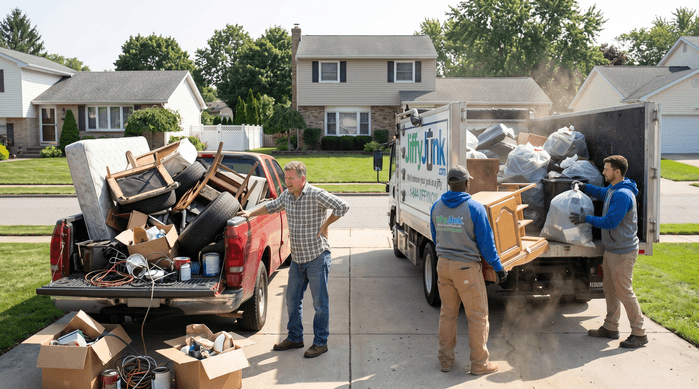
Final Thoughts And Opinion
Here’s the honest summary after thousands of jobs.
Junk removal earns its price for almost everyone. The exception is genuinely small jobs: one light item, your own truck, a transfer station around the corner. We’ll tell customers to handle that themselves. It’s not worth a phone call.
For everything else, the value isn’t really about convenience. It’s four things stacked together:
- Flat-rate honesty. The number we quote covers the whole job, including the dump fees most DIY runs forget to count.
- A real eco outcome. Loads get sorted before disposal: usable furniture to donation partners, metal to scrap, electronics to certified e-waste, and only what truly can’t be diverted ends up at the landfill.
- You get your Saturday back. Most jobs take us about 30 minutes on-site, and you don’t lift a thing.
- Your back stays in one piece. The chiropractor bill nobody budgets for is the hidden cost of DIY that homeowners never see coming.
Our opinion: people don’t hire junk removal because they can’t lift things. They hire it because they value their weekend, their spine, and knowing the couch isn’t going straight to a landfill. That’s the real product. It’s why we built our White Glove Treatment around it.
Frequently Asked Questions
Q: Is Junk Removal Worth It For A Single Piece Of Furniture?
A: Usually, yes. Once you factor in the truck rental, gas, and transfer-station fee for that single item, the DIY route often costs as much as a flat-rate pickup. Most haulers have a minimum-load charge, so the gap is smaller than people expect. Customers who DIY one couch almost always call us for the next one.
Q: Should I Do My Own Junk Removal Or Hire A Company?
A: Do it yourself if you have a truck, a single light item, a nearby transfer station, and a free afternoon. Hire a pro for bulky items, anything on stairs, multi-item loads, estate cleanouts, or jobs where you’d rather not lift. The honest test: if you’re hesitating, the convenience is probably worth the price.
Q: Why Hire A Junk Removal Company Instead Of Renting A Dumpster?
A: Dumpsters work for multi-day renovations where debris piles up gradually. Junk removal works for one-and-done cleanouts where you want a crew to handle the lifting. Two quick differences. A dumpster sits in your driveway for days, and you load it yourself. Full-service junk removal is in and out in about 30 minutes, and you don’t lift a thing. For a deeper look, see our full dumpster rental vs. junk removal comparison for region-by-region pricing.
Q: How Much Does Professional Junk Removal Cost?
A: Most residential jobs run between $99 and $600. The exact number depends on how much volume your items take up in the truck. Jiffy Junk’s Free One-Click Virtual Estimate gives you an exact price in about 60 seconds, without scheduling a site visit.
Q: Is Full-Service Junk Removal Worth The Extra Money?
A: For most homeowners, yes. The “extra money” turns out to be smaller than it looks once you add in DIY truck rentals, fuel, and dump fees. You’re also paying for sorting, donation, recycling, broom-clean cleanup, and the assurance that you won’t throw out your back. Those things don’t show up on a price comparison, but they’re where the real value lives.
Q: What Items Won’t A Junk Removal Company Take?
A: The usual exclusions are hazardous materials, including paint, gasoline, motor oil, propane tanks, pesticides, certain chemicals, and tires. Most haulers take everything else: appliances, mattresses, electronics, construction debris, and yard waste. Not sure about an item? Send us a photo, and we’ll tell you right away whether it fits.
Q: How Fast Can Jiffy Junk Pick Up My Items?
A: Same-day and next-day pickup is available across most of our service areas. You book online or by phone, we confirm a 2 to 4-hour arrival window, and we’re typically on-site for about 30 minutes. Most customers tell us the whole process is faster than getting a delivery from a furniture store.
Q: Does Junk Removal Really Recycle And Donate, Or Does It All Go To The Landfill?
A: It depends on the hauler, which is why this question matters. At Jiffy Junk, our crews sort every load before disposal. Furniture in usable shape goes to donation partners, metals to scrap recyclers, and electronics to certified e-waste facilities. We’ve also supported the planting of over 15,000 trees through New York Climate Week, because the environmental side of this work matters to us beyond the truck itself.
Ready To Stop Wondering And Start Reclaiming Your Space?
Skip the truck rental and the lost Saturday. Get a Free One-Click Virtual Estimate in 60 seconds and see exactly what your cleanout costs upfront. We’re not happy until you are happy!