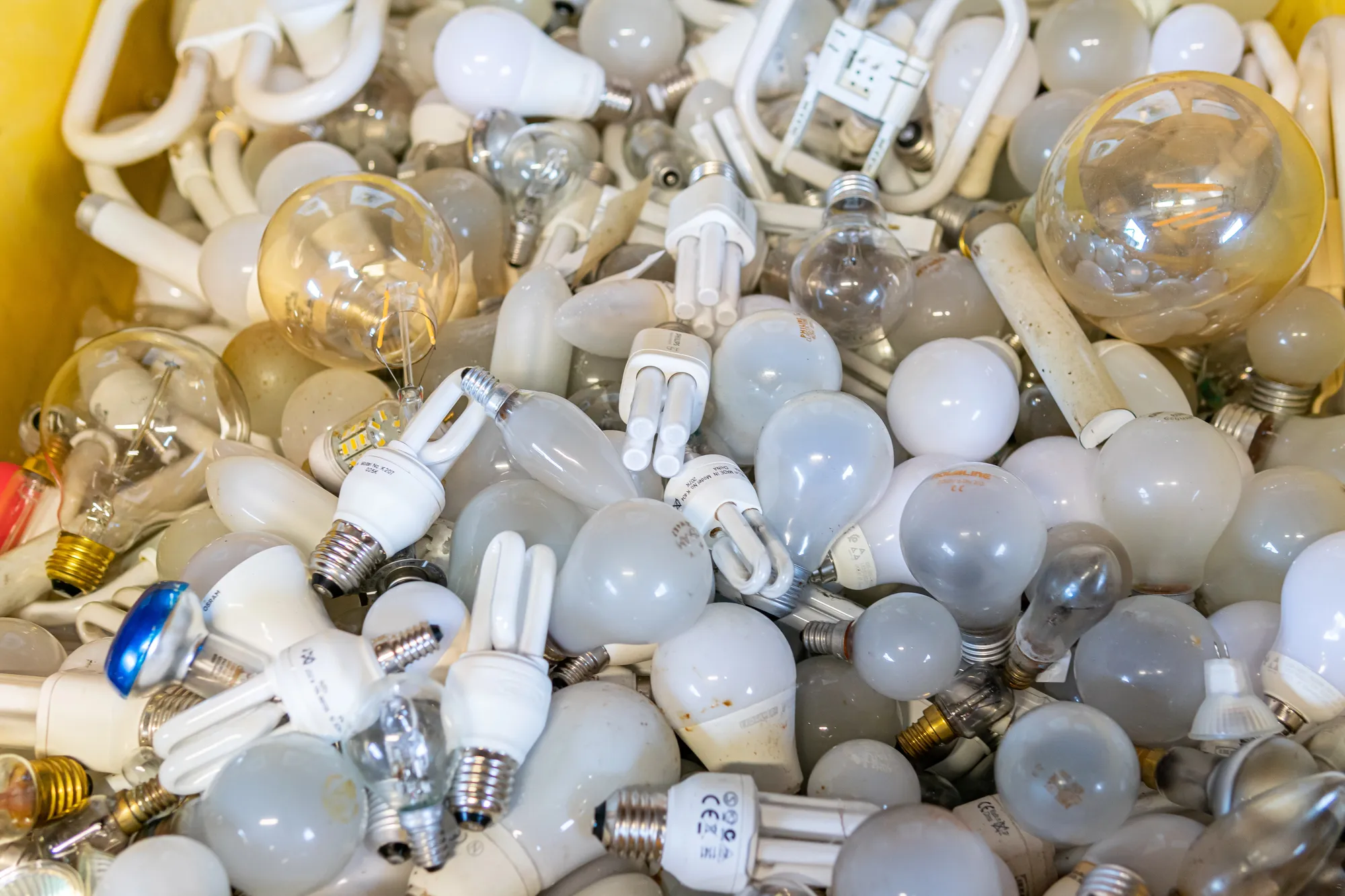
How to Dispose of Fluorescent Light Bulbs and CFLs: Safe Recycling, Mercury Handling, and Where to Take Tubes and Compact Fluorescents
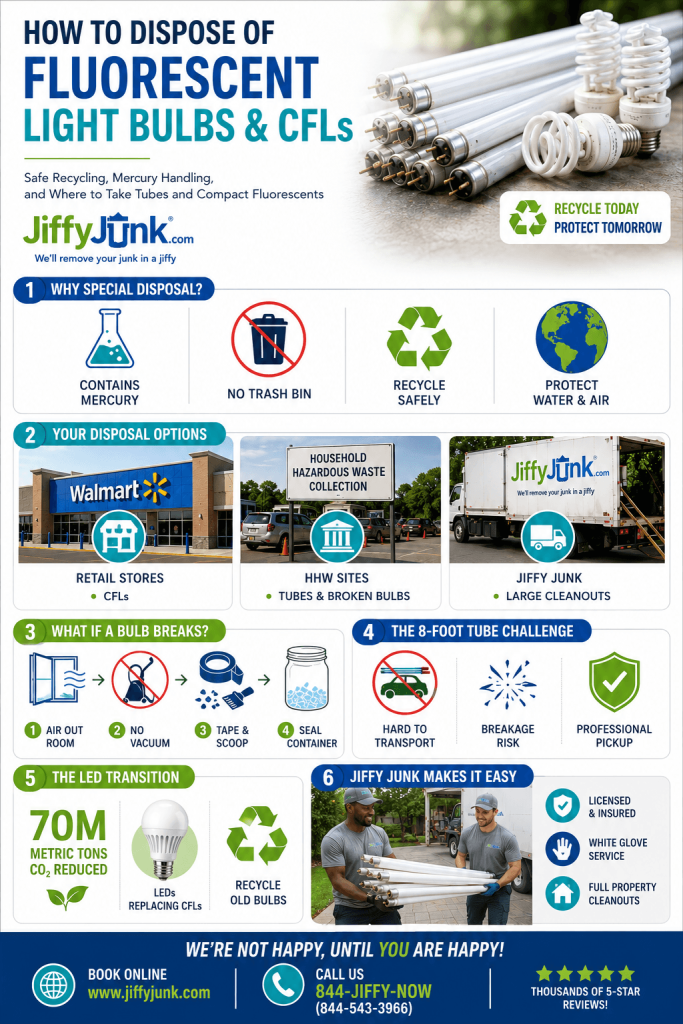
Every fluorescent bulb in your house contains mercury. The EPA puts the CFL average at about 4 milligrams per bulb, which is small but still enough to keep that bulb out of your curbside collection. Fluorescent disposal needs its own playbook.
Whether you’re holding a single spent spiral or staring at a stack of 8-foot tubes in the basement, this guide walks you through where each one should go. Jiffy Junk has been handling the bigger jobs since 2014, and our White Glove Treatment means you point while our licensed crews do the lifting.
TL;DR Quick Answers
How To Dispose Of Fluorescent Bulbs
Fluorescent bulbs and CFLs need to go to a recycler because of the mercury inside the glass. Here’s the short version, sized to how many bulbs you have.
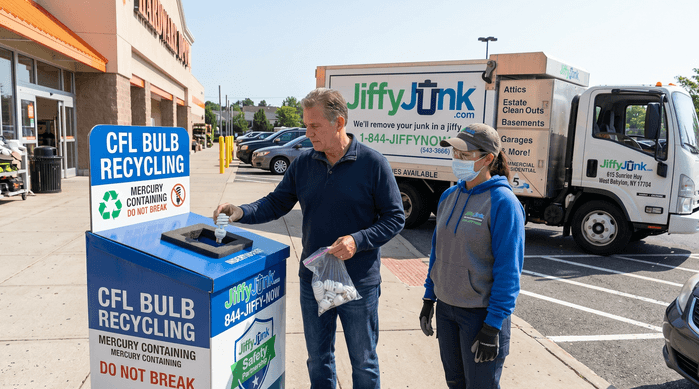
- A few CFLs at home: drop them at a participating Home Depot, Lowe’s, Batteries Plus, or IKEA. Programs vary, so call your local store first.
- Long tubes, broken bulbs, or larger volumes: head to your county Household Hazardous Waste (HHW) facility. They accept 4-foot tubes, 8-foot tubes, and broken bulbs in sealed containers.
- Storage in the meantime: stand bulbs upright in their original boxes or wrap each one in paper. Unprotected bulbs break, and a broken bulb becomes a bigger project.
- Renovation, garage relamp, or estate cleanout: that’s our wheelhouse. We pick up bulbs alongside appliances, electronics, and anything else you want gone in one appointment.
- The curbside recycling bin is the wrong destination. Recycling trucks crush their loads, and a crushed fluorescent bulb sends mercury straight into the air.
Top 5 Takeaways
1. Mercury Makes Them Different. Every CFL holds about 4 milligrams of mercury, sealed inside the glass. That’s the only reason fluorescent bulbs need their own disposal path.
2. The Right Option Depends On How Many Bulbs You Have. A few CFLs go to a big-box retailer for free. A boxful of tubes belongs at HHW. A whole basement, garage, or office lamp is where a licensed pickup pays for itself.
3. Broken Bulbs Are Not An Emergency. Air the room out, skip the vacuum, scoop with stiff paper, finish with sticky tape, and seal everything in a glass jar.
4. Eight-Foot Tubes Are The Awkward Ones. Most retailer drop-offs won’t take them. HHW will, and so will our crews, which saves you a sedan-and-tape-measure adventure.
5. Jiffy Junk Takes The Heavy Lifting. Our licensed and insured crews run same-day or next-day in many service areas, and the bulbs come along with whatever else you want gone.
Table of Contents
- How to Dispose of Fluorescent Light Bulbs and CFLs: Safe Recycling, Mercury Handling, and Where to Take Tubes and Compact Fluorescents
- TL;DR Quick Answers
- Top 5 Takeaways
- Why Fluorescent Bulbs And CFLs Need Special Disposal
- What To Do If A Fluorescent Bulb Breaks
- Where To Recycle Fluorescent Bulbs And CFLs
- Essential Resources On How To Dispose Of Fluorescent Bulbs
- 1. Find A Bulb Recycler Near You With NEMA’s National Locator
- 2. Understand Your State’s Universal Waste Rules (Pennsylvania Example)
- 3. Know The Strictest State Standard For Comparison (California DTSC)
- 4. Get The Federal Health Profile On Mercury Exposure
- 5. Read The Peer-Reviewed Mercury Science (NIH Bookshelf)
- 6. See Why Energy Savings Make CFLs A Net Win Despite Mercury
- 7. Walk Through A State Consumer-Friendly Recycling Guide
- Supporting Statistics On Fluorescent Bulb Disposal
- Final Thoughts And Opinion
- Frequently Asked Questions
- Q: Can I Throw Fluorescent Bulbs Away With Regular Household Waste?
- Q: How Do I Dispose Of 4-Foot Or 8-Foot Fluorescent Tubes?
- Q: Can I Just Take A Few CFLs To Home Depot Or Lowe’s?
- Q: What Should I Do If A CFL Breaks In My Home?
- Q: Can Jiffy Junk Pick Up Just A Couple Of Bulbs?
- Q: Do LED Bulbs Need The Same Kind Of Disposal?
- Q: What About The Ballast Inside My Old Fluorescent Fixture?
- Q: Are There Free Options For Recycling Fluorescent Bulbs?
- Q: Does Jiffy Junk Service My Area?
- Skip The Sorting And Let Jiffy Junk Take It All In One Trip
Why Fluorescent Bulbs And CFLs Need Special Disposal
Fluorescent bulbs make light by passing electricity through a small pocket of mercury vapor. Only a few milligrams of mercury sit inside each bulb. If that bulb breaks in a dumpster or a landfill, the mercury can escape into the air, leach into soil, and run off into water. Recycling captures it before any of that starts.
A few things worth knowing:
- All fluorescent lamps qualify. Spiral CFLs, T8 and T12 tubes, U-bend tubes in drop ceilings, and high-intensity discharge (HID) lamps like metal halide and high-pressure sodium all share the same disposal rules.
- State rules vary. California, Maine, Massachusetts, Minnesota, Vermont, and Washington ban residential disposal of fluorescent bulbs in regular household waste. Federal Universal Waste rules cover most businesses nationwide.
- Even where it’s technically legal at home, the EPA still recommends recycling over the landfill every time.
Handling this correctly is easier than the chemistry suggests. You just need a plan that matches your bulb count.
Mercury shows up in plenty of other household items, too. For the broader picture on what’s inside old electronics, CRT televisions, and appliances, our recycling electronics e-waste lowdown covers the hazards and how the recycling process actually works.
What To Do If A Fluorescent Bulb Breaks
A broken CFL is a small situation that responds to a clear sequence of steps. After more than a decade of cleanout work where bulbs occasionally get nicked along the way, here’s exactly what our crews do:
- Send everyone, including pets, out of the room and open a window for 5 to 10 minutes.
- Shut off central heating or air conditioning so vapor can’t drift through your ductwork.
- Skip the vacuum. Vacuuming can blow fine mercury particles back into the air.
- Scoop the larger glass and powder with stiff cardboard or paper, then collect tiny fragments with sticky tape.
- Seal everything (glass, tape, paper, used paper towels) inside a glass jar with a metal lid, or in two-layered zip bags.
- Label the container and take it to a hazardous waste facility, or set it aside for a licensed pickup.
For the full federal safety walkthrough, see the EPA’s cleaning broken CFL guidance. The page covers what to do during the first several hours afterward, with extra steps for carpeted rooms.
Where To Recycle Fluorescent Bulbs And CFLs
Once your bulbs are packed and labeled, four good options open up. The one to use depends on how many bulbs you have and how big they are.
1. Big-Box Retailers
Many Home Depot, Lowe’s, IKEA, and Batteries Plus locations accept residential-quantity CFLs and shorter tubes at no charge. Most stores have two practical limits: 8-foot tubes are usually a no, and commercial volumes are rarely accepted. A quick phone call to your local store before you drive over saves a trip.
2. Household Hazardous Waste (HHW) Facilities
County and municipal HHW programs are typically free for residents and accept almost every mercury-containing bulb, including 8-foot tubes and broken bulbs in sealed containers. Hours tend to be limited (often Saturday mornings only), so check the schedule before you load the car.
3. Mail-Back Recycling Kits
For offices and small businesses, prepaid mail-back kits work well. You fill the box at your own pace, seal it when full, and ship it back to a certified recycler. The cost per bulb depends on the kit size you buy.
4. Pickup Service From Jiffy Junk
When you’re clearing a basement, garage, attic, office, or estate, a pickup becomes the easiest path. Our licensed and insured crews haul your fluorescent bulbs along with old TVs, computers, appliances, and anything else you want gone, all in one appointment. See our electronics and lamp recycling pickup service for the full list of what we take, and our electronics disposal guide if you’re sorting through a stack of old gadgets at the same time. You skip the truck rental, the Saturday morning HHW line, and the careful drive across town with glass in the back seat.
“After more than a decade of pulling fluorescent bulbs out of basements, garages, and commercial buildings across the country, I can tell you that the biggest mistake homeowners make happens long before disposal day. It happens when bulbs sit loose in a box for years and break in storage, which turns a five-minute drop-off into a real cleanup. Pack them upright in their original packaging or in wrapped newspaper, and get them to a certified recycler while they’re still in one piece.”
— The Jiffy Junk Operations Team
Essential Resources On How To Dispose Of Fluorescent Bulbs
Once you’ve got the basics, these seven authoritative resources will help you finalize a plan that fits your state, your bulb count, and your timeline. Each link goes to the actual article — bookmark the ones that match your situation.
1. Find A Bulb Recycler Near You With NEMA’s National Locator
LampRecycle.org, run by the National Electrical Manufacturers Association, is the national hub for fluorescent lamp recycling information. The About page lays out how the resource works and points you toward the ZIP-code locator for drop-off and mail-back options near you.
Source: About LampRecycle.org
2. Understand Your State’s Universal Waste Rules (Pennsylvania Example)
Pennsylvania’s Department of Environmental Protection breaks down the Universal Waste Rule for fluorescent lamps in plain language. The page is useful even if you live elsewhere, since most state programs follow the same federal framework.
Source: PA DEP Fluorescent Lamp Recycling Page
3. Know The Strictest State Standard For Comparison (California DTSC)
California’s Department of Toxic Substances Control bans fluorescent bulbs from residential disposal and spells out the universal-waste rules businesses must follow. It’s a useful benchmark for the strictest end of the state regulatory range.
Source: California DTSC Fluorescent Tubes Fact Sheet
4. Get The Federal Health Profile On Mercury Exposure
The Agency for Toxic Substances and Disease Registry (ATSDR) publishes a plain-language ToxFAQs sheet on metallic mercury. It covers exposure routes and health effects, with practical guidance if you think you’ve been exposed.
Source: ATSDR ToxFAQs for Metallic Mercury (PDF)
5. Read The Peer-Reviewed Mercury Science (NIH Bookshelf)
Readers who want the deeper science behind mercury regulation can read the full ATSDR Toxicological Profile for Mercury, hosted on NIH’s National Center for Biotechnology Information. It covers health effects, exposure pathways, and regulatory guidelines chapter by chapter.
Source: NIH Toxicological Profile for Mercury
6. See Why Energy Savings Make CFLs A Net Win Despite Mercury
ENERGY STAR’s mercury fact sheet, produced jointly by EPA and the Department of Energy, frames the full trade-off. Because CFLs draw far less power than incandescent bulbs, they actually reduce total mercury in the environment by lowering coal-plant emissions, provided you recycle them at the end of their life.
Source: ENERGY STAR Mercury and CFL Fact Sheet (PDF)
7. Walk Through A State Consumer-Friendly Recycling Guide
The Texas Commission on Environmental Quality’s consumer outreach site, Take Care of Texas, offers one of the clearest plain-English walkthroughs of fluorescent recycling. It covers retailer acceptance, broken bulb cleanup, and local drop-off options in a single page.
Source: Take Care of Texas — How to Recycle Lights and Bulbs
Supporting Statistics On Fluorescent Bulb Disposal
The numbers below come from federal agencies our crews rely on every day. They’re worth knowing the next time someone asks why bulb recycling matters.
1. CFLs contain about 4 milligrams of mercury on average.
For context, older glass thermometers contained roughly 500 milligrams, which equals the mercury inside more than 100 CFLs. The amount in any single bulb is small, but it adds up quickly across millions of homes.
Source: EPA — What Are the Connections Between Mercury and CFLs?
2. New federal lightbulb efficiency standards will cut 70 million metric tons of CO2 over 30 years.
The Department of Energy projects that the 2024 standards, which effectively phase out CFLs in favor of more efficient LEDs starting in 2028, will save Americans more than $27 billion in utility bills and prevent emissions equal to nine million homes’ annual output. Our crews increasingly clear out CFL stockpiles during LED upgrades for exactly this reason.
Source: U.S. Department of Energy — DOE Finalizes Efficiency Standards for Lightbulbs
3. Coal-fired power plants are the largest source of mercury emissions to the atmosphere in the U.S.
According to the U.S. Geological Survey, atmospheric deposition from coal plants is the dominant route by which mercury enters lakes, rivers, and the fish that live in them. Every kilowatt-hour saved by recycling and switching to efficient bulbs has a downstream environmental payoff.
Source: USGS — Mercury Contamination of Aquatic Environments
Final Thoughts And Opinion
Fluorescent bulb disposal sounds intimidating until you’ve done it a couple of times. The rules feel technical, and the chemistry sounds scary, but most people really just want to know what to do with the box of old tubes in the garage. After more than a decade of doing this work in homes and businesses across the country, here’s our honest take.
- Most homeowners overthink the cleanup. A broken CFL is genuinely fine to handle yourself, as long as you stay calm, air the room out, and keep the vacuum in the closet.
- Most homeowners underthink the storage. A loose stack of T8 tubes propped against a wall is one slipped boot away from a real cleanup. Pack them upright in their original sleeves the day you replace them, not the day before you finally take them in.
- The highest hidden cost is time, not money. Customers tell us the same story almost every week: loading a sedan with 8-foot tubes, finding the HHW Saturday hours, missing the slot, then rescheduling. Sometimes the right move is to pay for a single pickup and have the whole basement handled at once.
- LEDs change the math, not the rules. As more households switch over to LEDs, the question we hear has shifted. People aren’t asking whether to keep using their CFLs. They’re asking what to do with the box of old ones they’re replacing, and the answer is the same as it’s always been. Recycle them.
Our White Glove Treatment exists for exactly this kind of job. Clearing your garage shouldn’t require a hazardous-waste credential. That part is our job, and we’re not happy until you are happy.
For readers who want to see where the items we pick up actually end up, our blog post on what happens to junk after removal walks through the recycling, donation, and disposal paths in detail.
Frequently Asked Questions
Q: Can I Throw Fluorescent Bulbs Away With Regular Household Waste?
A: It depends on your state. California, Maine, Massachusetts, Minnesota, Vermont, and Washington (among others) ban residential disposal of fluorescent bulbs in household waste. Federal Universal Waste rules cover most businesses nationwide. Even where the law allows it at home, the EPA recommends recycling over landfilling every time.
Q: How Do I Dispose Of 4-Foot Or 8-Foot Fluorescent Tubes?
A: Take linear tubes to a county Household Hazardous Waste facility, or schedule a licensed pickup. Most retailer drop-offs cap out at 4-foot tubes, and 8-foot tubes are particularly hard to transport without breakage. Our crews have taken thousands of them from customers’ hands over the years.
Q: Can I Just Take A Few CFLs To Home Depot Or Lowe’s?
A: Often yes, and for free. Programs vary by store, though, so call your local one first to confirm they accept the bulbs you’re bringing. From our experience, urban stores participate more consistently than rural locations.
Q: What Should I Do If A CFL Breaks In My Home?
A: Send people and pets out first, then air the room for 5 to 10 minutes and shut off the central HVAC. Skip the vacuum. Scoop the larger glass and powder with stiff paper, lift the fine fragments with sticky tape, and seal everything in a glass jar or doubled zip bag. Take the container to a hazardous waste drop-off when you can.
Q: Can Jiffy Junk Pick Up Just A Couple Of Bulbs?
A: Most of our customers add bulbs to a larger appointment, like electronics recycling, an appliance pickup, a basement cleanout, or an office relamp. The bulbs ride along at no extra trip on your end. Call 844-543-3966 for a quick, upfront quote based on the full list of what you want gone.
Q: Do LED Bulbs Need The Same Kind Of Disposal?
A: No. LEDs don’t contain mercury and can usually go with your regular household waste, though recycling is still the better option because they contain valuable metals and electronics. Fluorescent bulbs and CFLs are the ones that need hazardous-friendly handling.
Q: What About The Ballast Inside My Old Fluorescent Fixture?
A: Magnetic ballasts manufactured before 1979 may contain PCBs, a federally regulated toxic compound. If you suspect a pre-1979 ballast (often found in older basements, schools, and commercial buildings, which we clear), keep it out of your regular waste stream. Treat it as hazardous waste, or have a licensed crew handle it. Newer electronic ballasts are PCB-free but still belong in e-waste recycling.
Q: Are There Free Options For Recycling Fluorescent Bulbs?
A: Yes. Big-box retailer drop-offs are usually free for residential quantities, and county HHW events are typically free for residents who live in the county. The ZIP-code search tool on LampRecycle.org will surface options near you.
Q: Does Jiffy Junk Service My Area?
A: Jiffy Junk has served communities nationwide since 2014. Enter your ZIP code on JiffyJunk.com or call 844-543-3966 to confirm same-day or next-day availability where you live.
Skip The Sorting And Let Jiffy Junk Take It All In One Trip
Book a pickup today and have that stack of old fluorescent tubes and stockpiled CFLs off your property by tomorrow morning. Visit jiffyjunk.com/booking or call 844-543-3966 for an upfront quote, because we’re not happy until you are happy.