You already know the fence needs to come down. The question is who’s going to deal with it. At Jiffy Junk, we’ve been hauling away exactly these kinds of fences since 2014 — rotting wood, rusted chain link, concrete-anchored posts that haven’t budged in two decades. And the one thing we’ve learned is that the job is almost always bigger than it looks from the back porch.
Our licensed, insured crews handle the whole job in one visit: tear-down, post extraction, full haul away, and cleanup. We work nationwide. And we keep one straightforward promise — we’re not happy until you are.
What follows covers what fence removal actually costs, broken down by material type, what the full-service process looks like from booking to cleanup, and why the post removal step is the one most homeowners underestimate. Read it in five minutes. Book your appointment in sixty seconds.
TL;DR Quick Answers
Fence Removal Service
A professional fence removal service tears down and hauls away your old fence completely — panels, posts, and concrete footings — in a single visit. Pricing runs $3 to $10 per linear foot depending on material type and how the posts are anchored. Wood and picket fences cost the least to remove; chain link, vinyl, and metal cost more because of weight and post complexity. A licensed, insured company like Jiffy Junk handles everything from demolition through eco-friendly disposal. You point to the fence. We take care of the rest.
Top 5 Takeaways
- Most fence removal jobs cost $3-$10 per linear foot. Budget $400-$1,500 for a standard 100-foot residential fence. Posts set in concrete, heavy materials like wrought iron or vinyl, and tough site access all push costs higher.
- Professional removal is faster and safer than DIY — especially once concrete footings are involved. Without the right tools, you’re looking at a sore back and a lost weekend. A trained crew handles the same job in a few hours.
- Full-service means the posts come out, too. Always confirm before you book. At Jiffy Junk, post and footing removal is part of every job. There are no add-ons after we start.
- Metal fencing doesn’t have to end up in a landfill. Chain link and wrought iron are recyclable materials. We actively divert metal fence materials from landfills wherever we can.
- Get your price in writing before the crew starts. Your quote should be your invoice number — nothing added after. At Jiffy Junk, the price you approve on-site is the price you pay. Full stop.
Table of contents
- TL;DR Quick Answers
- Top 5 Takeaways
- What Is Fence Removal — And Why Does It Matter?
- How Much Does Fence Removal Cost? Breaking Down The Numbers
- What To Expect From A Professional Fence Removal Service
- Going Beyond The Fence: Full Outdoor Property Cleanup
- 7 Essential Resources For Anyone Researching Fence Removal Service
- 1. How The EPA Recommends Handling Demolition Debris
- 2. What OSHA Requires Of Demolition Crews
- 3. How To Spot A Contractor Worth Hiring
- 4. Contractor And Code Standards From InterNACHI
- 5. What American Homeowners Actually Spend On Property Improvements
- 6. Lead Paint Risks In Older Exterior Structures
- 7. What Happens To Your Fence Materials After Removal
- 3 Statistics That Explain Why Professional Fence Removal Matters
- Our Take: Why Professional Fence Removal Is Almost Always The Right Call
- Frequently Asked Questions
- Q: How much does fence removal cost near me?
- Q: Do you remove fence posts and concrete footings?
- Q: How long does fence removal take?
- Q: Do I need a permit to remove my fence?
- Q: Can you remove just a section of my fence?
- Q: What happens to my old fence materials after you haul them away?
- Q: Is Jiffy Junk licensed and insured?
- Q: What if my fence might have lead-based paint?
- Q: How do I book a fence removal with Jiffy Junk?
- Done Looking At That Old Fence? Let Jiffy Junk Tear It Down And Haul It Away Today.
What Is Fence Removal — And Why Does It Matter?
A fence is a tool. When it works, you don’t think about it. When it fails — when it leans after a storm, splinters under your hand, or lets the dog through a gap — it becomes the thing you notice every single day. Fences have existed in practically every form imaginable across thousands of years of human history. The sheer variety of materials and installation methods is exactly why removal requires trained hands and the right equipment, not just muscle and a free Saturday.
When a fence reaches the end of its useful life, full removal and disposal is almost always the right call. Here’s why:
- Safety. A leaning or unstable fence is a puncture and fall hazard — especially for children and pets. The longer it stands, the worse it gets.
- Curb appeal. A failing fence is one of the first things buyers and neighbors notice. It drags down everything around it.
- Property prep. Clearing an old fence opens the door to landscaping, new fencing, deck work, or a cleaner outdoor space.
- Code compliance. In some municipalities, a deteriorated fence triggers a violation. Better to remove it on your timeline than someone else’s.
The right removal company handles every part of the job: panel demolition, post and footing extraction, debris management, and full haul away. That’s exactly what Jiffy Junk delivers — start to finish, one visit, zero leftovers.
How Much Does Fence Removal Cost? Breaking Down The Numbers
Fence removal cost is the first question most homeowners search for before picking up the phone. Here’s what current 2026 pricing looks like for professional fence removal and disposal:
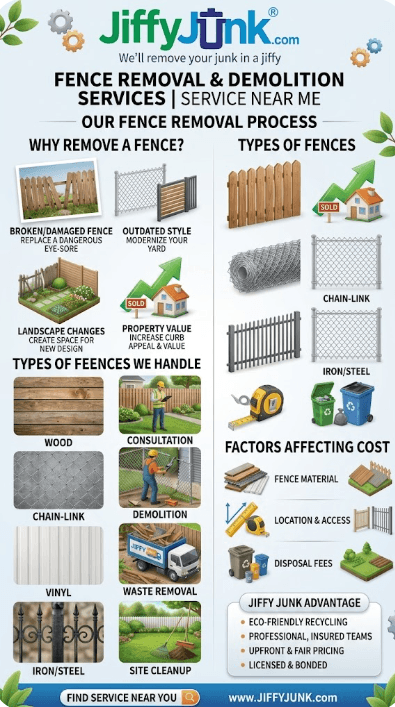
- Wood fence removal: $3-$10 per linear foot. Standard wood privacy fences are typically the most straightforward to remove. The condition of the wood matters — rotted material breaks apart during removal and slows the crew down.
- Chain link fence removal: $4-$9 per linear foot. More precision is required than with wood. Metal ties, post anchors, and concrete footings all add labor time. Metal materials can often be recycled.
- Vinyl fence removal: $5-$12 per linear foot. Vinyl panels are heavy and bulky. Disposal fees make up a bigger share of the total here than with wood.
- Picket fence removal: $3-$7 per linear foot. Generally, the most affordable removal because of lighter construction and shallower posts.
- Wrought iron and metal fence removal: $5-$15 per linear foot. Heavy materials, ornate designs, and deep-set concrete footings make this the most labor-intensive category.
- Concrete or brick fence removal: $14-$20 per linear foot. Demolition equipment is required. Our crews show up prepared for it.
For a standard 100-foot fence, the total typically runs between $400 and $1,500. Larger fences, concrete post removal, limited site access, or specialty disposal needs push costs higher. Your Jiffy Junk quote is fixed before any work begins — the price you approve is the price you pay.
The factors that move the number the most:
- Total linear footage drives both labor and disposal costs — longer fences simply take longer.
- Post depth and concrete anchoring can significantly increase removal time on any material type.
- Fence condition determines how quickly the crew can work, especially with rotted wood or rusted metal.
- Site access — tight yards, steep grades, or blocked pathways all affect labor time.
- Regional labor rates vary. Jiffy Junk prices are competitive in every market we serve.
What To Expect From A Professional Fence Removal Service
First time hiring a fence removal company? Here’s exactly how the Jiffy Junk process runs — and what separates a full-service experience from a pick-up-and-leave job:
- Book your appointment. Schedule online at jiffyjunk.com/booking or call 844-JIFFY-JUNK. Same-day and next-day options are available in most markets. The whole booking takes about 60 seconds.
- Our crew arrives on time. We give you a real arrival window, and we show up inside it. Your schedule matters.
- You get your final price before we touch anything. Our team walks the fence, checks the footings, confirms the full scope — then gives you a firm number on the spot. You approve it before a single panel comes down.
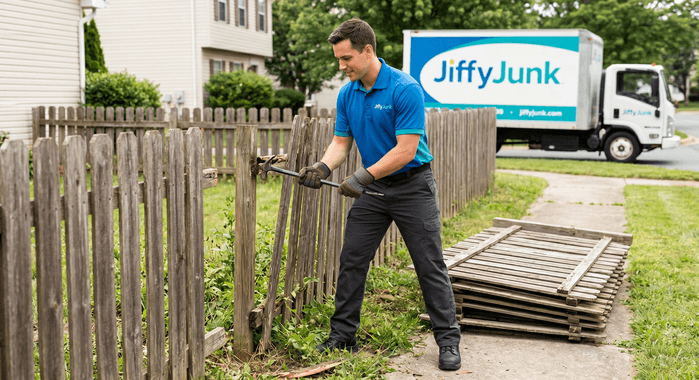
- We tear it all down. Every panel comes off, every post comes out, and concrete footings get broken out where needed. Nothing gets left half-done.
- We haul everything away. All of it goes on our truck. Metal goes to recycling wherever possible; wood goes through licensed disposal facilities.
- We clean up. We leave the ground clear and the yard clean. No debris left behind, no post holes to fill on your own time.
The job ends when the property is clean, and we’ve checked in with you to make sure you’re happy. That’s the White Glove Treatment — and it’s what we show up to deliver on every single job.
Going Beyond The Fence: Full Outdoor Property Cleanup
Fence removal is often one piece of a larger outdoor project. Whether you’re clearing space before a landscaping overhaul, getting a property ready to sell, or working through years of deferred maintenance, Jiffy Junk handles whatever the yard needs.
If an old deck is part of the cleanup too, we handle both in the same visit or back-to-back on a tight schedule. Our deck removal and demolition service works the same way: dismantle the structure, pull up footings, haul everything away, and leave the area ready for what comes next. No structure is too far gone for our crews to take on.
Other outdoor services we offer alongside fence removal:
- Yard waste removal
- Shed demolition and removal
- Storm damage debris removal
- Scrap metal pickup and recycling
One crew. One call. One clean property. That’s how we work.
“In our experience removing thousands of fences across the country, the single biggest mistake homeowners make is underestimating what’s underground. Concrete footings can double the labor time on a chain link or wood fence job — and that’s exactly why we walk every post before we quote, not after.”
-The Jiffy Junk Team
7 Essential Resources For Anyone Researching Fence Removal Service
Before you hire a crew, set a budget, or decide whether to tackle this yourself, read these. All seven come from government or nonprofit sources. No sales pages, no filler.
1. How The EPA Recommends Handling Demolition Debris
Old fences generate real construction and demolition debris — wood, metal, and concrete. The EPA’s official guide covers how these materials can be recycled, reused, or diverted from landfills. It’s the definitive resource for understanding how a responsible removal company should handle what comes off your property.
Source: EPA — Sustainable Management of Construction and Demolition Materials
2. What OSHA Requires Of Demolition Crews
Fence demolition involves real physical hazards — heavy materials, sharp edges, concrete, and buried utilities. OSHA’s demolition safety overview covers the planning requirements, safety standards, and protective equipment that licensed professional crews must follow. Worth knowing before you hire.
Source: OSHA — Demolition Safety Overview
3. How To Spot A Contractor Worth Hiring
The National Association of Home Builders lays out exactly what to check before you sign anything: licenses to verify, red flags to walk away from, and what your contract must spell out. Read this before you hire anyone to work on your property.
Source: NAHB — Don’t Get Scammed: Find a Qualified Contractor
4. Contractor And Code Standards From InterNACHI
InterNACHI is one of the most trusted contractor and inspection credentialing organizations in North America. Their contractor hub spells out what professional crews should meet in terms of property code compliance, insurance coverage, and best practices for exterior structural removal.
Source: InterNACHI — Contractor Resources
5. What American Homeowners Actually Spend On Property Improvements
The U.S. Census Bureau tracks national home improvement spending, including outdoor structures. This resource gives you real context for benchmarking your fence removal project against broader market activity and median project costs — useful when you’re budgeting.
Source: U.S. Census Bureau — 2023 Home Improvements Data
6. Lead Paint Risks In Older Exterior Structures
Fences on properties built before 1978 may carry lead-based paint. Disturbing painted surfaces during demolition can create hazardous dust. HUD’s guidance tells homeowners what they need to know before removing or demolishing any painted exterior structure — and why a trained, certified removal professional matters here.
Source: HUD — About Lead-Based Paint
7. What Happens To Your Fence Materials After Removal
Metal, wood, and concrete from an old fence don’t have to go straight to a landfill. The EPA’s demolition recycling resource explains which materials can be diverted through reuse, donation, or recycling — and how responsible removal companies should handle disposal from the start.
Source: EPA — Reuse and Recycling Opportunities During Demolition
3 Statistics That Explain Why Professional Fence Removal Matters
Numbers talk. The three below come from verified government sources and speak directly to the safety, environmental, and real-cost case for hiring a professional fence removal service.
Stat 1: Construction Work Injures At Nearly Twice The Rate Of The Average Job
The U.S. Bureau of Labor Statistics found that construction laborers experienced a nonfatal injury rate of 213.9 cases per 10,000 full-time workers in 2020, and 62.2 percent of those workers are regularly exposed to heights. Fence removal carries the same physical demands: heavy materials, sharp edges, unstable structures, and posts that require real leverage to extract. Hiring a trained, insured crew removes that risk from your property entirely.
Source: BLS — Workplace Injuries and Job Requirements for Construction Laborers
Stat 2: The U.S. Generates More C&D Debris Than All Municipal Solid Waste Combined
In 2018, the EPA estimated that the United States generated 600 million tons of construction and demolition debris — more than twice the amount of all municipal solid waste generated that same year. Wood, steel, and concrete (the core materials of most residential fences) are all part of that stream. When a removal company recycles and diverts instead of landfilling, it makes a measurable difference. Jiffy Junk actively recycles metal fence materials and uses licensed disposal facilities for wood.
Source: EPA — Construction and Demolition Debris: Material-Specific Data
Stat 3: Construction Workers Suffered 1,032 Fatalities In 2024 — Falls Were The Leading Cause
According to the BLS 2024 National Census of Fatal Occupational Injuries, construction and extraction workers experienced 1,032 fatalities that year. Falls, slips, and trips accounted for 370 of those deaths. Fence demolition — which involves working around unstable structures, heavy posts, and concrete — sits squarely in that risk category. A fully insured professional crew absorbs that risk. A homeowner going DIY on a concrete-anchored fence does not.
Source: BLS — National Census of Fatal Occupational Injuries, 2024
Our Take: Why Professional Fence Removal Is Almost Always The Right Call
We see this regularly. The fence removal jobs that turn into real headaches are almost always the ones someone tried to handle themselves first.
A rotted wood fence looks manageable until you’re three posts deep and your puller is locked in hardened concrete. A chain link fence seems simple until you find posts running two feet down with solid footings anchored decades ago. Then come the surprises no one mentions in weekend tutorials: exterior paint that predates 1978 and may contain lead, posts sitting directly above buried utility lines, fence sections that share a property line with a neighbor who has opinions about the timeline.
Our honest take, based on what we see:
- Short fences — under 30 linear feet, shallow posts, no concrete — are manageable as a DIY project if you have the tools and a clear Saturday. Below that threshold, the time and effort equation can work in your favor.
- Anything longer, anything with concrete footings, anything made of heavy material, or anything on a real timeline — hire it out. The cost of renting the right equipment and paying disposal fees yourself frequently equals or exceeds what a professional crew charges to just do it.
- Always confirm the job includes posts and footings before you book anyone. A crew that hauls panels and leaves posts behind creates a future project and extra cost. Get that scope confirmed in writing.
- Price transparency isn’t optional. The fence removal market has no shortage of companies that quote low and add fees once the job’s started. Any company worth hiring fixes the price before the crew starts work — full stop.
Your weekend is worth more than the savings from a job that goes sideways. Jiffy Junk exists to take exactly this kind of project completely off your plate — permanently and professionally.
Frequently Asked Questions
Q: How much does fence removal cost near me?
A: Most homeowners pay $3 to $10 per linear foot for professional fence removal. A standard residential fence runs $400 to $1,500, depending on material, footage, and how the posts are anchored.
What moves that number most:
- Fence material and condition — rotted wood and heavy metal take longer to handle
- Whether posts are set in concrete — this is the single biggest variable in labor time
- Total linear footage — longer jobs cost more in both labor and disposal
- Regional labor rates — Jiffy Junk prices competitively in every market we serve
Your Jiffy Junk quote is fixed before we start. The number you approve is the number on your invoice.
Q: Do you remove fence posts and concrete footings?
A: Yes — always. Post and footing removal is part of every job we do. We don’t haul panels and leave posts standing. Our crew brings the right tools to extract posts regardless of how deep they’re set or how much concrete is involved. That’s already factored into your upfront quote.
Q: How long does fence removal take?
A: Most residential fence removals wrap up in two to four hours. Larger fences or heavy concrete footings may take longer. We come prepared for the full scope of the job and work efficiently — no second trips for forgotten equipment, no half-done cleanup.
Q: Do I need a permit to remove my fence?
A: In most cases, no. Fence removal permits are uncommon for residential properties. Replacement or new installation is a different story — that almost always needs a permit. A quick call to your local building department or HOA covers it. Jiffy Junk handles the teardown and haul away. Permits, when they’re required, are on the homeowner.
Q: Can you remove just a section of my fence?
A: Yes. We handle partial teardowns, gate replacements, and section-only jobs all the time. Describe what needs to go when you book, and we’ll quote exactly that scope — nothing more.
Q: What happens to my old fence materials after you haul them away?
A: We dispose responsibly. Here’s how it breaks down by material:
- Metal fencing (chain link, wrought iron, aluminum) — recycled wherever possible
- Wood fencing — disposed of through licensed waste management facilities; rotted or painted wood typically can’t be recycled or donated
- Vinyl fencing — disposed of through licensed facilities
- Reusable materials in good condition — donated to organizations like Habitat for Humanity ReStores when feasible
We take the environmental side of this seriously. Your old fence gets handled the right way — not just the fast way.
Q: Is Jiffy Junk licensed and insured?
A: Yes, fully. Every Jiffy Junk crew is licensed and insured nationwide. We carry full liability coverage on every job, which protects your property from the moment we arrive to the moment we leave. We’ll provide proof of insurance any time you ask for it.
Q: What if my fence might have lead-based paint?
A: If your fence was painted before 1978, lead-based paint is a real possibility. According to HUD, roughly 24 million older homes still have significant lead paint hazards — and exterior structures on those properties often do too. Disturbing painted surfaces during demolition can release hazardous dust. Let our team know when you book. Our crews follow safe handling practices, and for significant suspected lead exposure, EPA-certified abatement professionals may need to be involved before full demolition begins. We’ll guide you on the next steps.
Q: How do I book a fence removal with Jiffy Junk?
A: Two options, both fast:
- Online: jiffyjunk.com/booking — takes about 60 seconds
- Phone: 844-JIFFY-JUNK (844-543-3966) — talk to a real person
We confirm your appointment right away and send a reminder the day before. Same-day and next-day appointments are available in most markets.
Done Looking At That Old Fence? Let Jiffy Junk Tear It Down And Haul It Away Today.
Book your free fence removal quote and get your property back — posts, footings, debris, and all. Our licensed, insured crews handle the whole job in one visit, with an upfront price you approve before we touch anything. We’re not happy until you are.
Visit jiffyjunk.com/booking or call 844-JIFFY-JUNK. Sixty seconds to schedule.