How to Dispose of Old Tires: Where to Take Used Tires, Tire Shop Take-Back Programs, and Recycling Options Beyond the Curb
Most homeowners try the curb first. It rarely works.
Whole tires are banned from landfills in nearly every U.S. state. The law requires your hauler to leave them at the curb, and your county can fine you for trying. After more than a decade of hauling tires off properties across the country, we’ll show you the simpler path. Pick one of the five legal options below, and act on it.
TL;DR Quick Answers
How Do I Dispose Of Tires?
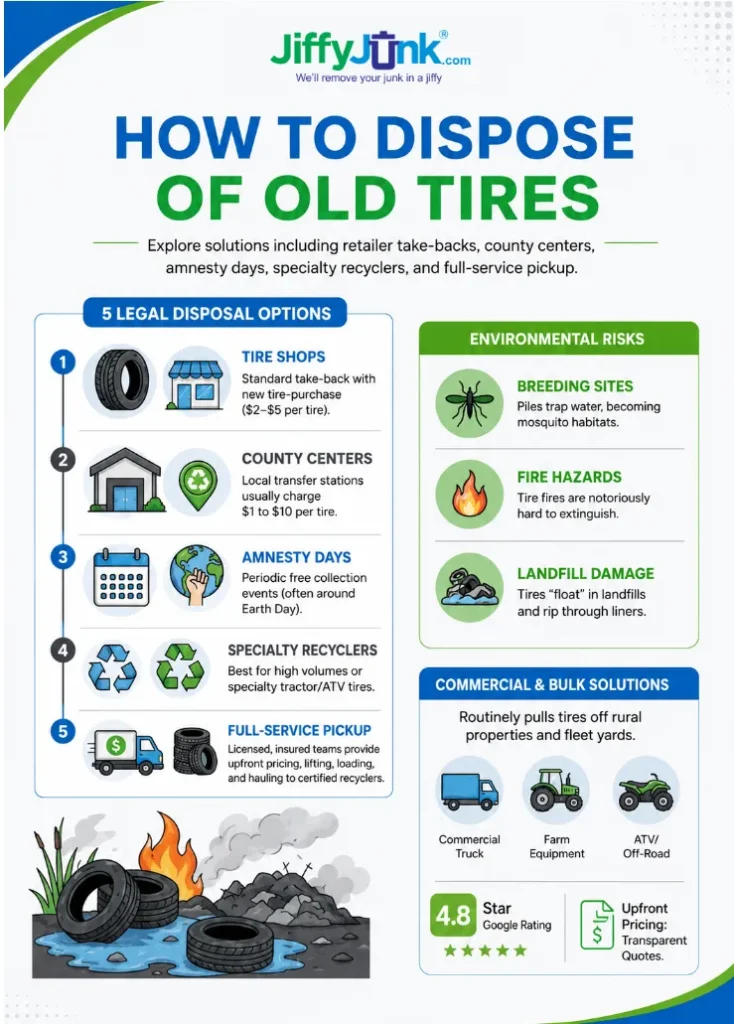
You have five legal options. The right one depends on quantity and convenience.
- Bring them to the tire shop to install your new tires (typically $2 to $5 per tire).
- Drop them at a county recycling center or transfer station ($1 to $10 per tire).
- Take large quantities to a dedicated tire recycler (volume pricing).
- Wait for a county tire amnesty event (often free, with annual limits).
- Book a full-service pickup with Jiffy Junk. We handle any quantity and any tire type, and you skip the lifting.
Curbside disposal, on-property burial, and tire burning are all illegal in most U.S. states. The fines add up fast.
Top 5 Takeaways
- Whole tires are banned from landfills in nearly every U.S. state. The curb is not an option.
- Tire shops will accept your old tires for $2 to $5 each, but only when you’re buying new ones from them.
- County recycling centers and annual amnesty events handle small quantities for $1 to $10 per tire, or free.
- Specialty tires like ATV, truck, farm, and off-road usually need a dedicated recycler or a full-service hauler.
- Jiffy Junk picks up any quantity of any tire type with our White Glove Treatment. You stay hands-off.
Table of Contents
- How to Dispose of Old Tires: Where to Take Used Tires, Tire Shop Take-Back Programs, and Recycling Options Beyond the Curb
- TL;DR Quick Answers
- Top 5 Takeaways
- Why Old Tires Need A Different Disposal Path
- Where To Take Used Tires: 5 Options That Work
- What Actually Happens To A Recycled Tire
- How Much Does Tire Disposal Cost?
- Specialty Tires: Truck, ATV, Farm, And Off-Road
- Jiffy Junk Tire Pickup: White Glove Removal In A Jiffy
- Essential Resources On How To Dispose Of Tires
- 1. The Federal Rulebook Behind Every State Tire Law
- 2. The Country’s Most Detailed State Tire Tracking System
- 3. New York’s Mandatory Tire Take-Back Law Explained
- 4. A Plain-English Breakdown Of Why Landfills Reject Tires
- 5. How Recycled Tires Become Playground Surfaces And Roads
- 6. The State Program That Tracks Every Tire From Pickup To Processing
- 7. The Industry View From The People Who Make The Tires
- Supporting Statistics
- Final Thoughts And Opinion
- Frequently Asked Questions
- Q: Can I Put Old Tires In My Regular Trash?
- Q: How Much Does It Cost To Dispose Of One Tire?
- Q: Do Walmart, Discount Tire, Or Firestone Take Old Tires?
- Q: Where Can I Find Free Tire Disposal Near Me?
- Q: What Do I Do With Truck, ATV, Or Farm Tires?
- Q: Is It Illegal To Burn Old Tires?
- Q: What Actually Happens To A Tire After I Drop It Off?
- Q: Can Jiffy Junk Pick Up Old Tires?
- Ready To Get Those Tires Out Of Your Way? Book Jiffy Junk.
Why Old Tires Need A Different Disposal Path
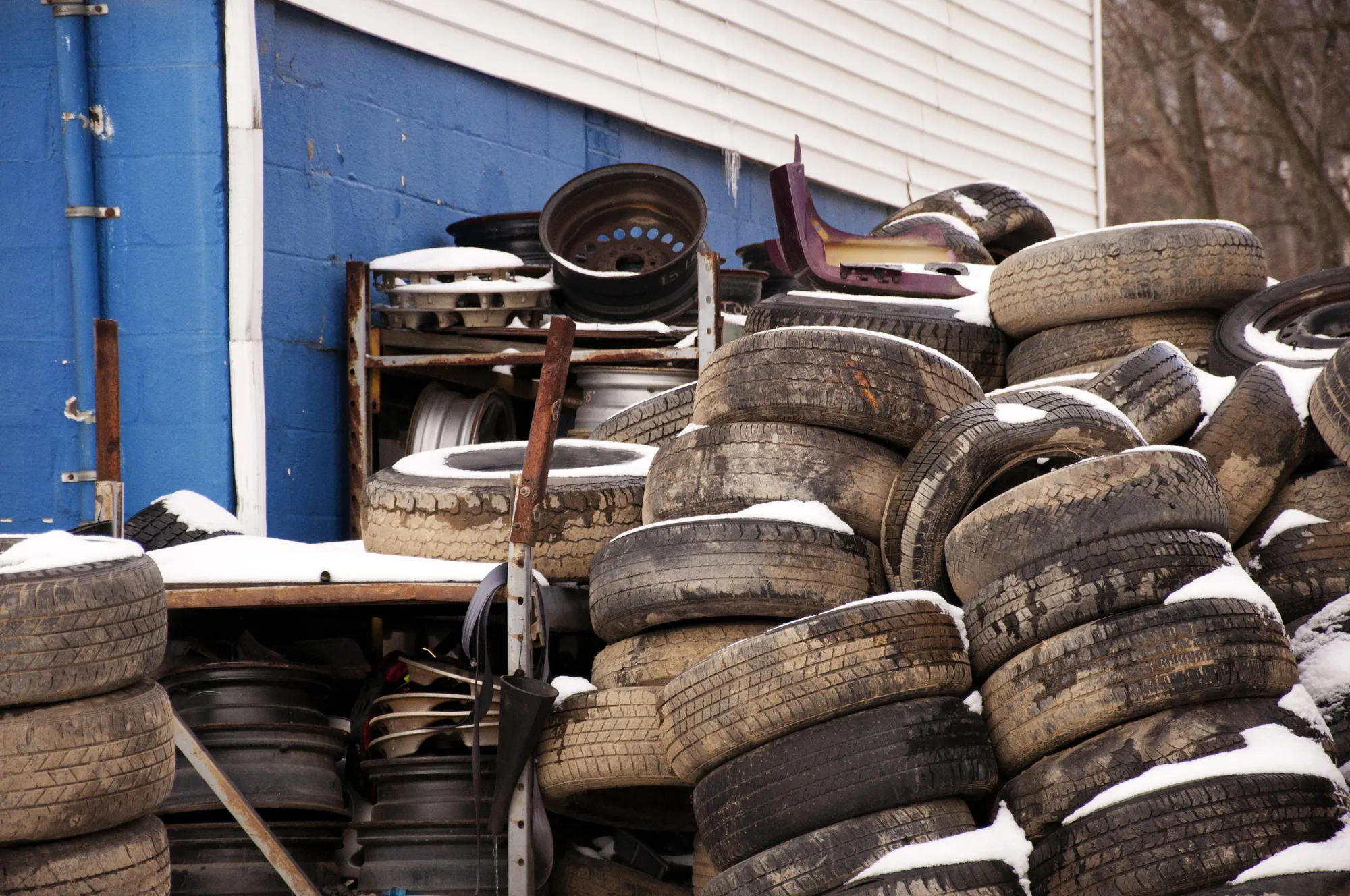
Tires behave differently from regular household items. They trap air and gas. Once buried, they float up to the surface of a landfill and rip through liners along the way.
A stacked pile becomes a mosquito breeding site and a fire hazard. Both are notoriously hard to deal with once they start.
That’s why nearly every U.S. state has banned whole tires from landfill disposal. Some states allow shredded tires. Most ban them in any form. Illegal dumping penalties vary by state, with fines commonly running from $500 to $25,000, and that’s before the court adds cleanup costs.
If your local hauler refuses your tires at the curb, this is the reason. They’re following federal and state law.
Where To Take Used Tires: 5 Options That Work
The full menu, ordered from most to least DIY effort. Pick the one that fits.
1. Tire Retailer Take-Back Programs
Most big-name retailers, including Walmart Auto Care, Discount Tire, Firestone, Pep Boys, Big O, and Costco, will dispose of your old tires when you buy new ones. The going rate is $2 to $5 per tire. A few states (Indiana is one) legally require new-tire sellers to accept old tires from customers on a one-for-one basis.
The catch: most retailers will only accept tires bundled with a new-tire purchase. Drop-offs without a purchase rarely work. Call ahead before you load up the truck.
2. County Recycling Centers And Transfer Stations
Your county solid waste district almost certainly accepts tires for a small fee, usually $1 to $10 each. Some sites limit you to 4 or 8 tires per visit. Hours, pricing, and limits vary by location, so check online or call before you go.
3. Dedicated Tire Recyclers
If you have more than ten tires, a dedicated recycler is usually the best move. They shred tires into crumb rubber and tire-derived aggregate, which become playground surfaces, athletic tracks, rubberized asphalt, and drainage media. Pricing is often by weight rather than per tire.
4. County Tire Amnesty Events
Many counties run one or two free tire collection days each year, often around Earth Day or community cleanup weekends. Per-household limits usually apply (4 to 10 tires is common). Call your county recycling office or search your state environmental agency’s website for the schedule.
Looking for other no-cost disposal channels in your area? Our guide to free junk removal options near you covers donation pickups, municipal bulk days, and the conditions each one comes with.
5. Full-Service Pickup With Jiffy Junk
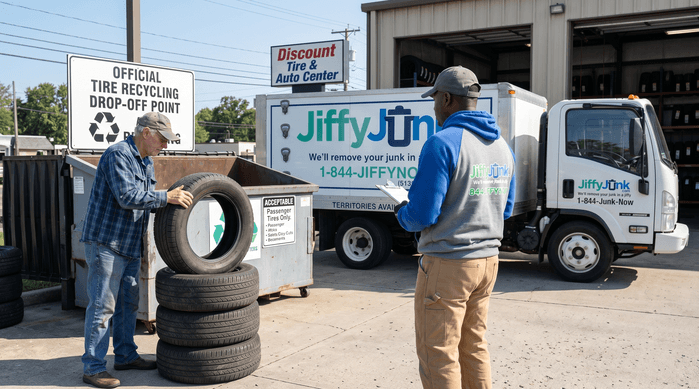
This is what we do. Our licensed, insured teams come to you, load every tire themselves, and route them to certified recycling partners. You skip the driving and the lifting. Point us to the pile, and we handle the rest. That’s the White Glove Treatment.
What Actually Happens To A Recycled Tire
A scrap tire has a second life that almost everyone underestimates.
Recyclers shred most tires into crumb rubber, which goes into playground surfaces, athletic tracks, rubber mats, and rubberized asphalt for road paving. Larger shreds become tire-derived aggregate, used as lightweight fill for civil engineering projects and drainage media for septic and stormwater systems. Cement kilns and paper mills burn a sizable share as tire-derived fuel, replacing coal in the process.
For the technical breakdown, the global tire recycling industry has built a full circular economy around end-of-life tires, spanning construction, manufacturing, energy, and consumer products. Send your old tires to a recycler, and they stay in that loop.
How Much Does Tire Disposal Cost?
Cost varies more than people expect. Two factors drive most of the difference: your state’s mandatory tire fee and your local shop’s disposal markup.
Here’s what to expect at each price point:
- State tire fee: usually $0.25 to $5 per tire, paid when you buy a new one. New York charges $2.50, Florida charges $1, Indiana charges $0.25, and Iowa charges nothing.
- Shop disposal fee: typically $2 to $5 per tire when a retailer removes old tires during installation.
- County drop-off: $1 to $10 per tire, depending on county and tire size.
- Specialty tires (truck, ATV, off-road): generally priced by weight, often higher than passenger tires.
- Jiffy Junk pickup: volume-based, quoted upfront, with all lifting, loading, and eco-friendly disposal included.
We work on transparent pricing. The quote we give you is the price you pay. No surprise fees, no “we found more stuff” upcharges at the curb.
Want the full picture beyond tires? Our local junk removal pricing guide breaks down what to expect on every job type, from a single pickup to a full-truck haul.
Specialty Tires: Truck, ATV, Farm, And Off-Road
Tractor tires test the limits of every retailer take-back program. Most retailers cap at passenger and light truck sizes. Once you cross into commercial truck, ATV, farm, or oversized off-road tires, options narrow quickly.
Your best bets are dedicated tire recyclers that price by weight (call ahead) or a full-service hauler with the right truck and equipment. Our crews routinely pull farm tires off rural properties, commercial truck tires from fleet yards, and ATV tires out of suburban garages. If it has rubber and a sidewall, we can take it.
Jiffy Junk Tire Pickup: White Glove Removal In A Jiffy
Here’s how a tire pickup with us actually works. You tell us how many tires you have and roughly where they are: driveway, garage, backyard, barn, or fleet yard. We give you an upfront quote and a scheduled window. Our licensed, insured team shows up, loads every tire, sweeps the spot, and routes everything to certified recycling partners. You stay hands-off.
Tire pickup is part of our broader debris removal services. The same crew that handles your old tires can also haul off construction debris, scrap metal rims, busted wheels, and anything else taking up space. One booking covers it.
First time scheduling a pickup with us? Take a look at our guide on how to prepare for your junk removal appointment before the truck arrives. A few minutes of prep make the whole job go faster.
We’ve earned a 4.8-star Google rating, a spot on the 2024 Inc. 5000 list of fastest-growing U.S. companies, and a place in the Forbes Business Council. The credential we care about most is the one we earn one job at a time: we’re not happy until you are happy.
“In over a decade of hauling tires, the most common mistake we see is homeowners assuming the curb is fair game. It rarely is, and the fines for illegal dumping cost far more than a pickup. The smartest move is to know your options before you load anything into a vehicle.”
— Jiffy Junk Operations Team
Essential Resources On How To Dispose Of Tires
These are the seven sources we trust when a customer asks about a state rule or a specific program. Each one answers a different piece of the puzzle, and all are official government or industry-association pages.
1. The Federal Rulebook Behind Every State Tire Law
The U.S. Environmental Protection Agency oversees the federal framework for scrap tire management and is currently proposing new rules to help clean up roughly 48 million abandoned tires scattered across the country. Read this for the federal context.
Source: EPA News Release On The Proposal To Clean Up Abandoned Tires
2. The Country’s Most Detailed State Tire Tracking System
California’s CalRecycle Waste Tire Manifest System is the most rigorous state-level tire program in the U.S. and a model for how scrap tires get tracked from generation through final disposal. The page is useful for anyone in California, and a strong reference for what a mature state tire program looks like.
Source: CalRecycle Waste And Used Tire Manifest Program
3. New York’s Mandatory Tire Take-Back Law Explained
The New York State Department of Environmental Conservation requires tire service centers to accept old tires from customers and collect a $2.50 recycling fee on new tires. If you’re in NY, the page outlines what your tire shop is legally required to do.
Source: NYSDEC Waste Tires Program Page
4. A Plain-English Breakdown Of Why Landfills Reject Tires
Iowa’s Department of Natural Resources lays out the disposal rules, storage limits, and environmental reasons behind the tire landfill ban in plain English. One of the easier state-agency pages to read on this topic.
Source: Iowa DNR Tire Disposal And Recycling Guide
5. How Recycled Tires Become Playground Surfaces And Roads
Indiana’s Department of Environmental Management has a strong quick-read on the second life of recycled tires: crumb rubber, rubberized asphalt, retread programs, and amnesty days. Read it to understand what actually happens after a recycler takes your tires.
Source: Recycle Indiana Waste Tire Recycling And Proper Disposal
6. The State Program That Tracks Every Tire From Pickup To Processing
Oregon’s Department of Environmental Quality requires permits for anyone storing more than 100 waste tires, and licenses every tire hauler in the state. The page is a strong reference for how tire transport regulation actually works.
Source: Oregon DEQ Waste Tire Management Program
7. The Industry View From The People Who Make The Tires
The U.S. Tire Manufacturers Association tracks national tire recycling rates and is the leading source for end-of-life tire market data. The page breaks down where recycled tires actually go and which end-uses dominate.
Source: USTMA Tire Recycling Markets Overview
Supporting Statistics
The numbers tell the story at scale. Three figures we keep coming back to:
1. Wisconsin Cleaned Up 16 Million Waste Tires In The 1990s
Between 1990 and 1997, Wisconsin’s DNR cleaned up 12 million tires from 162 sites, and private parties cleared another 4 million from 408 sites. Most got processed into fuel for energy generation. The Wisconsin story sits inside a much larger national pattern. State programs across the country have spent decades pulling scrap tires out of dumps and into recycling streams.
Source: Wisconsin DNR Waste Tires Program
2. Michigan Cleaned Up Over 507,000 Tires In 2023 Alone
Michigan alone cleaned up over 507,000 passenger tires in 2023, the equivalent of more than 126,000 vehicles’ worth of rubber pulled out of dumps and into recycling streams. The state generates over 10 million scrap tires a year, which the program routes into mulch, tire-derived fuel, road pavement, drainage media, and new tire and plastics manufacturing.
Source: Michigan EGLE Report On Cleaning Up Scrap Tires
3. Tennessee Has Diverted 9.5 Million Tires Since 2015
Tennessee’s Tire Environmental Act Program has diverted approximately 9.5 million tires from landfills since 2015, totaling nearly 107,000 tons. Those tires are now in rubberized asphalt, tire-derived aggregate, tire-derived fuel, and porous flexible pavement. Each one earned a second life instead of taking up landfill space.
Source: TDEC Tire Environmental Act Program
Final Thoughts And Opinion
Old tires are one of the most quietly difficult disposal items in American households. They’re not toxic enough to need hazmat gear, but they’re banned from landfill disposal, awkward to transport, and rejected by most retailers without a new-tire purchase. That gap is where most homeowners get stuck.
Here’s our honest take after more than a decade of doing this work:
- If you have 1 to 4 tires and you’re already buying new ones, let the tire shop handle it. That’s the easiest path.
- If you have 5 to 10 tires sitting in the garage from past swaps, your county drop-off is almost always the right call.
- If you have a barn full, a fleet yard, oversized tires, or you’d rather skip the lifting, call us. That’s the scenario we built our service for.
The best decision is the one you make before loading anything into a vehicle. Know your option, confirm the fee, and call ahead. Either you make one trip, or we make zero on your behalf. Either way, you end up with a clean garage and a clear conscience.
We’re not happy until you are happy. We use that line as the standard for every job we book.
Frequently Asked Questions
Q: Can I Put Old Tires In My Regular Trash?
A: No. Most U.S. states ban whole tires from landfills, which makes curbside disposal illegal. Penalties for illegal dumping vary by state and commonly run from $500 to $25,000. Use a tire shop, county drop-off, recycler, amnesty event, or a full-service hauler. Those are your five legal paths.
Q: How Much Does It Cost To Dispose Of One Tire?
A: Plan on $2 to $5 per tire at most retailers, and $1 to $10 at county drop-offs. Some counties offer free amnesty days a few times a year. Specialty tires (truck, ATV, farm) are usually priced by weight and cost more. Full-service pickup is quoted by volume and includes all the lifting.
Q: Do Walmart, Discount Tire, Or Firestone Take Old Tires?
A: Yes, but with conditions. All three accept old tires when you’re buying new ones, typically for $2 to $5 per tire. None reliably accepts drop-offs without a new tire purchase. Some Discount Tire locations will waive the fee if you keep your old tires, so always ask at the counter.
Q: Where Can I Find Free Tire Disposal Near Me?
A: Free options exist, but they’re limited. Check your county recycling office for annual tire amnesty events. These often happen around Earth Day or community cleanup weekends. Per-household limits usually apply (4 to 10 tires). Earth911 at 1-800-CLEANUP can also point you to the nearest free or low-cost option in your area.
Q: What Do I Do With Truck, ATV, Or Farm Tires?
A: Specialty tires are tough because most retailers turn them away. Your best options are a dedicated tire recycler that prices by weight (call ahead) or a full-service hauler with the right equipment. We’ve pulled tractor tires, commercial truck tires, and ATV tires out of properties across the country. Call us if retailers refuse to take yours.
Q: Is It Illegal To Burn Old Tires?
A: Yes, in every state we operate in. Open burning of tires releases toxic chemicals, including carcinogens, heavy metals, and oily residue that contaminates soil and water. Tire fires are extremely hard to extinguish. Burning tires is one of the surest ways to draw a hefty fine and possible criminal charges. Skip it entirely.
Q: What Actually Happens To A Tire After I Drop It Off?
A: Recyclers shred most tires into crumb rubber, which goes into playground surfaces, athletic tracks, rubberized asphalt, and drainage media. Some tires get processed into tire-derived fuel for cement kilns. A small share, usually commercial truck tires, gets retreaded and put back on the road. Almost nothing about a properly recycled tire goes to waste.
Q: Can Jiffy Junk Pick Up Old Tires?
A: Yes. Tire pickup is part of our full-service junk and debris removal. We handle any quantity of any tire type, including passenger, truck, ATV, farm, and commercial. Our licensed and insured team loads everything, sweeps the spot, and routes the tires to certified recycling partners. Booking takes about 60 seconds online or one phone call.
Ready To Get Those Tires Out Of Your Way? Book Jiffy Junk.
Skip the trips and the lifting, and let our White Glove Treatment take it from here, with any quantity and any tire type handled through eco-friendly disposal. Call 844-543-3966 or book online in 60 seconds, and we’ll have your space clutter-free in a jiffy.