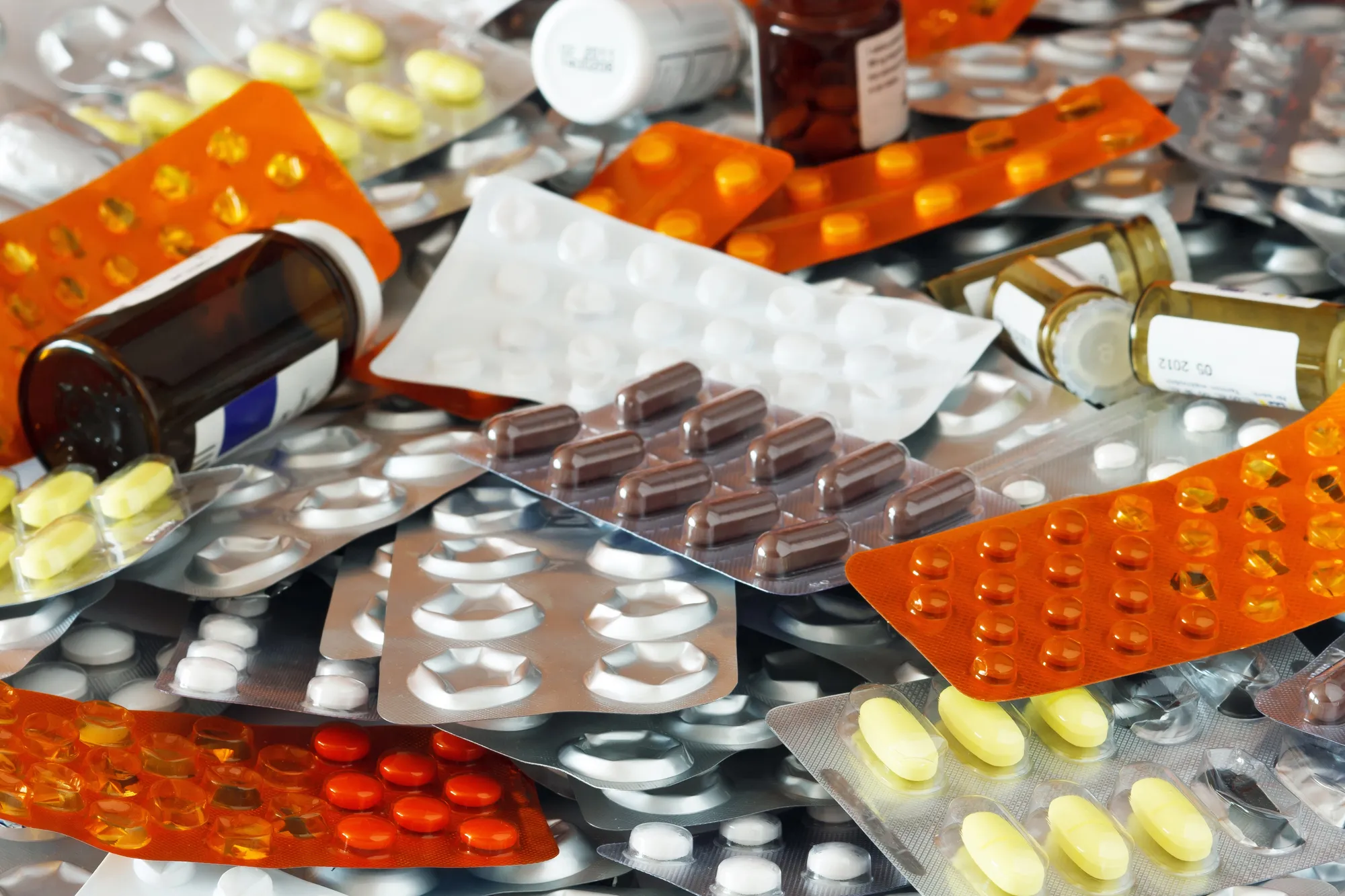
How To Dispose Of Expired And Unused Medications Safely: Drug Take-Back Locations, At-Home Disposal Methods, And Why You Should Never Flush Them
The medicine cabinet is the one part of every cleanout our crews aren’t legally allowed to touch. Federal rules block licensed junk-removal companies from hauling medications, which means somebody in your family ends up holding a paper bag of old prescriptions while we move the rest of the house. This guide is for that person.
Since 2014, Jiffy Junk has cleared homes from Long Island to the West Coast, and our teams have walked through thousands of medicine cabinets along the way. We’ve watched families flush opioids because no one told them better. We’ve seen pill bottles tossed in with the regular waste, name labels still attached. One cabinet hadn’t been opened in fifteen years. The advice below is what we wish every customer knew before our truck pulled into their driveway: where to drop medications for free, how to handle them at home when a drop-off isn’t an option, and the short list of pills the FDA actually does want you to flush. That last list is shorter than you’d think.
TL;DR Quick Answers
How To Dispose Of Medications
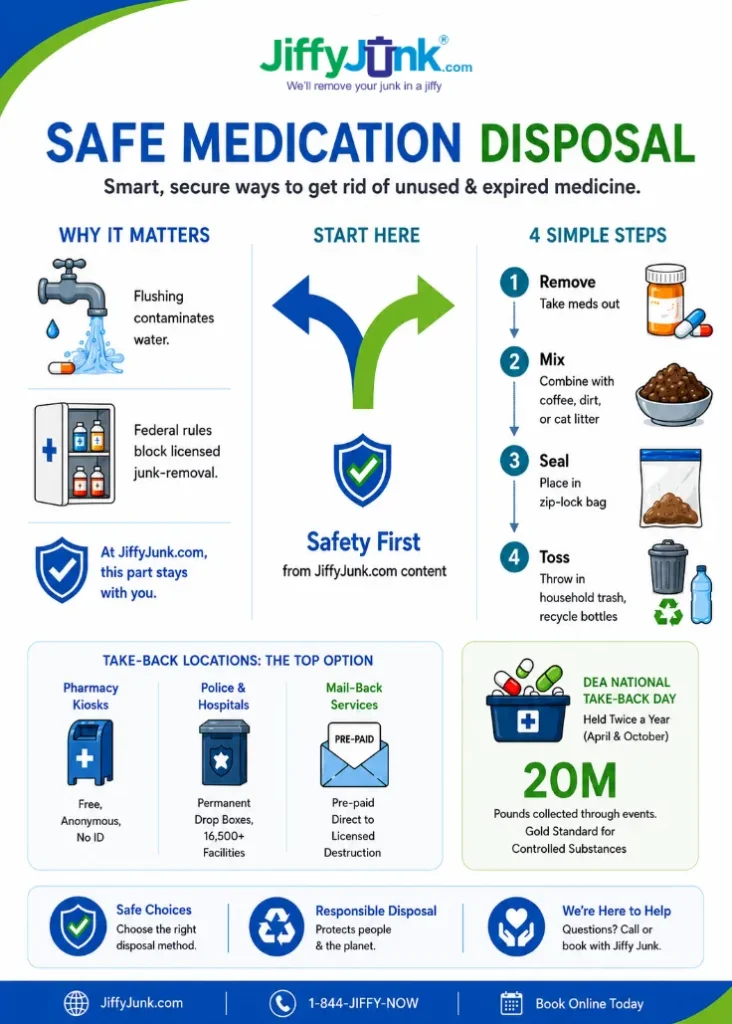
The safest way to dispose of medications is to drop them at a drug take-back location. That means a pharmacy disposal kiosk at Walgreens or CVS, a permanent drop box at a police station or hospital, or a DEA National Prescription Drug Take Back Day event held twice a year. The service is free and anonymous, and it accepts most prescription and over-the-counter drugs. If no take-back is available near you, mix the medications with cat litter or used coffee grounds, seal them in a plastic bag, and place that in your household waste. Do not flush medications unless they appear on the FDA Flush List, a short roster of high-risk drugs (mostly opioids and fentanyl patches) where the risk of accidental ingestion outweighs the environmental cost.
Top 5 Takeaways
- Drug take-back locations are the gold standard. They’re free, anonymous, and available at thousands of pharmacies, police stations, and hospitals across the country.
- DEA Take Back Day happens twice a year, once in April and once in October. The October 2025 event alone collected 571,054 pounds of medication across thousands of locations.
- Don’t flush most medications. Flushing contaminates surface water and drinking water supplies, and the FDA Flush List spells out the small set of exceptions.
- At-home waste disposal works when a take-back kiosk is out of reach. Mix pills (do not crush them) with cat litter or coffee grounds, seal the bag, scratch out your name on the label, and toss it.
- Junk-removal companies, including Jiffy Junk, cannot legally transport medications. That part of any cleanout stays with you, but the rest of the house is on us.
Drug Take-Back Locations Are Your Best Option
If you only do one thing from this article, do this: take everything to a drug take-back location. Federal regulators, environmental agencies, and our own field crews all agree on it. A take-back kiosk is the safest, most secure, and most environmentally responsible way to clear out expired or unused medications. You don’t have to peel labels, mix anything, or crush pills first. You just drop the bottles in.
Pharmacy Disposal Kiosks (Year-Round)
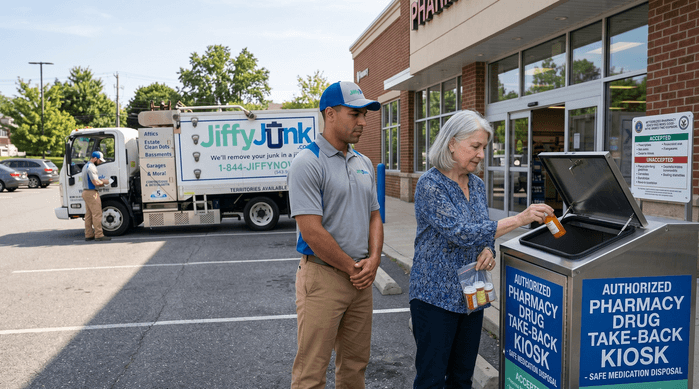
Walgreens, Duane Reade, and many CVS Pharmacy locations have safe medication disposal kiosks that sit near the pharmacy counter and look like oversized mailboxes. You drop your bottles, blister packs, or patches in, and a licensed disposal partner takes it from there. The service is free, available during regular pharmacy hours, and requires no ID. Walgreens has installed more than 1,000 of these kiosks across the country, and CVS operates Drug Take Back Units in hundreds more. Find your nearest one through each chain’s store locator.
Pharmacies that don’t have a kiosk usually offer the next best thing: free pre-paid mail-back envelopes. Ask at the counter, drop your medications inside, and put the sealed envelope in any USPS mailbox. The envelope ships to a destruction facility. We’ve recommended this option to a lot of rural customers who didn’t have a nearby kiosk.
DEA National Prescription Drug Take Back Day
Twice a year, on a Saturday in April and another in October, the U.S. Drug Enforcement Administration runs the National Prescription Drug Take Back Day. From 10 a.m. to 2 p.m. local time, more than 4,000 collection sites open their doors. The list includes police stations, pharmacies, hospitals, and fire departments. It’s free, completely anonymous, and one of the few times most law enforcement agencies will collect controlled substances directly from the public. Pet medications and vaping devices without their lithium batteries are accepted at most sites, too.
Police Station And Hospital Drop Boxes
More than 16,500 pharmacies, hospitals, and businesses across the country host permanent drug-disposal drop boxes that operate year-round. Many local police departments host them, too. These are the places we point estate clients to first when there are controlled substances in the cabinet. Bring the bottles upright, in a small bag, and drop them in. There’s no paperwork, and no one asks for your name.
How To Dispose Of Medications At Home (When Take-Back Isn’t Practical)
Sometimes a take-back location is too far, or you’ve found a single bottle of expired ibuprofen and don’t want to make a trip. That’s fine. The U.S. Food and Drug Administration has a clear, four-step process for safely throwing medications away at home, and it works for almost every common over-the-counter and prescription drug.
The Four-Step At-Home Disposal Method
- Take the medication out of its original container. Don’t crush the pills.
- Mix it with something unappealing. Used coffee grounds, dirt, and cat litter all work. The point is to make the mixture unrecognizable and unattractive to children, pets, or anyone going through the household waste.
- Seal the mixture inside a plastic bag, an empty can, or another container that won’t leak.
- Throw the sealed container in your household waste. Scratch out or peel off your name and any personal information on the empty prescription bottle, then recycle or dispose of the bottle separately.
If your medication came with specific disposal instructions in the patient information leaflet, follow those first. Some drugs, especially patches and inhalers, have unusual handling requirements.
Drug Deactivation Pouches Make It Even Easier
Brands like DisposeRx and Deterra sell small pouches containing an activated-carbon powder that turns medications into a non-recoverable, biodegradable gel. You drop the pills in, add warm water, shake, and throw the sealed pouch in the waste. A lot of pharmacies, including Walgreens, hand them out free to patients filling certain prescriptions. They’re particularly useful when you have controlled substances and no nearby take-back location.
Why Flushing Almost Always Causes Harm
We’ve watched customers reach for the toilet as a default. It’s understandable. Flushing feels final. But standard wastewater treatment plants are not built to remove pharmaceutical compounds. Drug residues pass through, enter rivers and lakes, and eventually show up in surface water and drinking water supplies. Septic systems are worse because flushed medications leach into the groundwater directly.
There is one short, specific exception. The FDA keeps a Flush List of medications (mostly opioids, fentanyl patches, and a small number of other high-risk drugs) where one accidental dose can kill a child or pet. For those drugs, when a take-back location isn’t immediately available, the agency considers the risk of misuse or accidental ingestion to outweigh the environmental cost of flushing. For the current list and the official guidance, see the FDA’s resource on where and how to dispose of unused medicines. If your medication isn’t on that list, don’t flush it.
Cleaning Out A Loved One’s Medicine Cabinet
This is the situation we see most. A parent has passed away, or a relative has moved into long-term care, and someone has been handed responsibility for the house. The medicine cabinet is rarely the first concern, but it’s often the most sensitive. Decades of prescriptions sit in a row, sometimes including narcotic pain medications from a final illness. We treat that moment with the care it deserves, and we’d ask you to do the same. (When the move involves cleaning out an elderly parent’s house, the medicine cabinet usually comes up before the furniture does.)
Inventory Before You Dispose
Walk through the cabinet, the nightstand, the kitchen drawer where a pill organizer hides, and any bag or suitcase. Document what’s there if you’re an executor. Some states require it. Watch for opioids and other controlled substances, and remove those from the home as soon as practical. The cleanout process brings unfamiliar people through, and prescription drugs are among the most commonly stolen items during estate transitions. (When a cabinet reflects years of accumulated belongings, our hoarding cleanup guide walks through how we approach the bigger picture with the family.)
Take-Back First, Always
For the family medicine cabinet, drive everything to a pharmacy kiosk or police drop box. It is the simplest, most respectful end for medications that helped someone you cared about. If no kiosk is available, use the four-step at-home method or a deactivation pouch. Don’t flush opioids unless they’re on the FDA Flush List.
What Jiffy Junk Can and Cannot Handle
Here’s the part most customers don’t expect us to say out loud. Federal regulations prohibit licensed junk-removal companies, including Jiffy Junk, from transporting medications and controlled substances. That part of the cleanout stays with you. The same rule applies to other hazardous household items. Solvents, certain cleaners, and chemicals like acetone all need specialized handling. For one common example, see our guide on how to safely dispose of acetone. Everything else, from the furniture in the dining room to the freezer in the garage to the decades of paperwork in the attic, is on us. We handle it with our White Glove Treatment so you can focus on what matters.
Special Cases We See On Cleanouts
- Liquid medications: Most take-back kiosks accept liquids when they’re sealed in their original containers. For at-home disposal, mix the liquid with cat litter, seal it, and toss.
- Inhalers and aerosols: Not always accepted at kiosks because they’re pressurized. Many municipal household hazardous waste facilities take them. Call first.
- Fentanyl patches: Each used patch still contains enough drug to kill a child or pet. The FDA Flush List specifically authorizes flushing for these. Fold the patch sticky side to sticky side before disposal.
- Needles, syringes, and sharps: Never go in a drug take-back box. Use an FDA-cleared sharps container, or ask your pharmacy about a community collection program.
“In more than ten years of estate cleanouts, the single most common mistake we see isn’t dumping pills in the regular waste. It’s families flushing controlled substances because they’re scared somebody might take them. The right answer was always five miles down the road at a pharmacy kiosk, and nobody told them. That’s the gap this guide is meant to close.”
— Jiffy Junk Operations Team
Essential Resources On How To Dispose Of Medications
We’ve narrowed the universe of medication-disposal guidance down to the seven sources our team trusts and points customers toward most often. Every link below leads to a specific government or nonprofit article, not a marketing page. Together, they cover the federal disposal rules, environmental science, the day-to-day take-back logistics, and the safety guidance every household needs.
1. The FDA’s Drug Disposal Questions And Answers
The FDA’s Drug Disposal Q&A is the federal government’s most thorough plain-language resource on this topic and the one our team references first. It walks through every disposal option (take-back, mail-back, the FDA Flush List, the four-step at-home waste method) and answers the specific edge cases families ask us about most: hospice settings, controlled substances, donating unused medications, sharps and inhalers, and what to do when no take-back location is available.
Source: FDA: Drug Disposal Questions And Answers.
2. The DEA’s National Prescription Drug Take Back Day Hub
Bookmark this page in April and October every year. The DEA publishes its biannual take-back event dates and a ZIP-code-based locator for the thousands of participating sites. It’s the easiest, free, anonymous disposal option in the country.
Source: DEA: National Prescription Drug Take Back Day.
3. The EPA’s Plain-English Guide To How Drugs Enter The Environment
The Environmental Protection Agency explains exactly why flushing matters for water quality. The article walks through what happens at wastewater treatment plants, how drug residues reach surface water and septic systems, and which limited exceptions the FDA recognizes. Required reading if you’ve ever wondered what actually happens after you flush.
Source: EPA: How Pharmaceuticals Enter The Environment.
4. The CDC’s Tips For Safe Storage And Disposal Of Prescription Medicine
The Centers for Disease Control and Prevention frames disposal as the back end of a safer-storage practice. The page is short, scannable, and especially useful when children, teens, or guests have access to your home.
Source: CDC: Your Prescription Medicine, Tips For Safe Storage And Disposal.
5. The HHS Hub For Safe Drug Disposal Options
The U.S. Department of Health and Human Services pulls together the DEA locator, FDA disposal rules, and storage tips on a single landing page. A solid starting point if you want to compare options side-by-side.
Source: HHS: How To Safely Dispose Of Drugs.
6. NIH MedlinePlus Patient Instructions For Getting Rid Of Unused Medicines
Written for patients and caregivers, the National Institutes of Health’s MedlinePlus article explains when a medication becomes unsafe to keep and how to dispose of it without harming children, pets, or the water supply.
Source: MedlinePlus: How And When To Get Rid Of Unused Medicines.
7. Safe Kids Worldwide On Medication Safety In The Home
Medications are the leading cause of child poisoning in the United States, and Safe Kids Worldwide publishes the most practical home-safety guidance we’ve found on storing and disposing of them responsibly. If you have grandchildren in the house even occasionally, this is required reading.
Source: Safe Kids Worldwide: Medication Safety.
Supporting Statistics
A few numbers explain why this topic matters more than most people realize, and why our crews bring it up on almost every cleanout we run.
1. More Than 20 Million Pounds Of Medications Collected Through DEA Take Back Day Since 2010
Since the program launched in the fall of 2010, the DEA has collected more than 20,391,815 pounds of prescription drugs from medicine cabinets across the country. The October 2025 event alone brought in 571,054 pounds. We’ve helped clear cabinets that hadn’t been opened in fifteen years. Multiply that by every house in the country, and the 20-million-pound figure actually starts to feel low.
Source: Get Smart About Drugs: 2026 National Take Back Day.
2. Roughly 7.6 Million Americans Misused Prescription Opioids In 2024
Most prescription drugs that are misused come from family or friends, often straight from a home medicine cabinet that nobody got around to cleaning out. Disposing of unused medications promptly is one of the simplest prevention steps a household can take. It’s why our crews bring it up on every estate cleanout.
Source: SAMHSA: 2024 National Survey On Drug Use And Health.
3. Nearly 80,000 Americans Died From Opioid-Involved Overdoses In 2023
Illicit fentanyl drives most of those deaths. But prescription opioids still played a role in thousands of fatal overdoses, and they remain a meaningful share of accidental child poisonings. Keeping unused opioids in a cabinet is a risk, not a safety net.
Source: NIDA: Drug Overdose Death Rates.
Final Thoughts And Opinion
Medication disposal is one of those tasks that feels harder than it is. The instructions sound complicated, the warnings sound dire, and somewhere along the way, most people just leave the bottles where they are and hope for the best. That instinct is what fills the cabinets we open on every cleanout.
Here’s the honest opinion from a company that has run thousands of these jobs:
- Take-back is so much easier than the alternatives that it’s almost unfair to debate. A five-minute drive to a pharmacy kiosk replaces every other method in this article.
- The at-home waste method exists for a reason and works fine, but it’s the backup, not the default.
- The flushing instinct is wrong nine times out of ten. Trust the FDA Flush List, not your gut.
- The most overlooked moment is the estate cleanout. If you’re staring at a parent’s medicine cabinet right now, your first job isn’t sorting boxes in the basement. It’s driving those pills to a kiosk before anyone else walks through that house.
We say it on every job. We’re not happy until you are happy. That goes for the medicine cabinet, too, even if it’s the one part of the cleanout we can’t legally do for you.
Frequently Asked Questions
Q: Can I Throw Old Pills Out With The Household Waste?
A: Yes, for most medications, as long as you prepare them first. Take them out of the bottle, mix with cat litter or used coffee grounds, seal the mixture in a plastic bag, and put the bag in your household waste. Scratch out your name on the empty bottle before recycling. A take-back location is still the safer option when one is available.
Q: Where Is The Closest Medication Drop-Off Location Near Me?
A: A few quick ways to find one. Use the DEA’s year-round disposal locator at DEATakeBack.com or the Diversion Control locator on dea.gov. Check the store locator at walgreens.com or cvs.com and filter for medication-disposal kiosks. Or call your local police department’s non-emergency line. Most departments host a permanent drop box.
Q: Does Walgreens Take Back Old Medications?
A: Yes. Walgreens has installed more than 1,000 safe medication disposal kiosks in its stores across the country, available during regular pharmacy hours. Locations without a kiosk usually provide free pre-paid mail-back envelopes. Just ask at the pharmacy counter. Most over-the-counter and prescription medications are accepted, including many controlled substances.
Q: Does CVS Dispose Of Medications?
A: A lot of CVS Pharmacy locations operate Drug Take Back Units in the pharmacy waiting area. Use the store locator on cvs.com to find a participating store. Aerosols and inhalers aren’t always accepted at CVS kiosks, so call ahead if those are part of your disposal load.
Q: When Is The Next DEA National Prescription Drug Take Back Day?
A: The DEA holds Take Back Day events twice a year, once in April and once in October. The events typically run on a Saturday from 10 a.m. to 2 p.m. local time. Visit dea.gov/takebackday for the current schedule and the locator for participating sites in your area.
Q: Can I Flush Old Prescription Pills Down The Toilet?
A: Only when the medication appears on the FDA Flush List. That list is short and focused on high-risk drugs, mostly opioids and fentanyl patches, where the risk of accidental ingestion outweighs the environmental cost. For every other medication, flushing pollutes the water supply and is the wrong call.
Q: How Do I Dispose Of Fentanyl Patches Safely?
A: Fentanyl patches are on the FDA Flush List for a reason. Even a used patch retains enough drug to kill a child or pet. If you can’t get to a take-back location quickly, fold the patch sticky-side to sticky-side and flush it. Take-back is still preferred when it’s available.
Q: How Long Are Medications Good For After The Expiration Date?
A: Expiration dates are the manufacturer’s guarantee of full potency, not a hard cliff for safety. Some medications retain effectiveness for years past their expiration date. Others, particularly liquids, antibiotics, and anything stored in heat or humidity, degrade faster. Don’t take expired medications without checking with your pharmacist, and don’t keep them indefinitely either. Dispose of anything you’re no longer using.
Q: Can Jiffy Junk Pick Up Medications During A Cleanout?
A: No, and neither can any other licensed junk-removal company. Federal regulations prohibit hauling medications and controlled substances. Those items stay with you, and we’ll point you to the right take-back location. Everything else in the cleanout, from furniture to appliances to clutter and debris, we handle with our White Glove Treatment.
Ready To Clear Out The Rest? Let’s Talk.
Once the medicine cabinet is sorted, the rest of the cleanout doesn’t have to be your problem. Book your Jiffy Junk Full Service Junk Removal pickup in 60 seconds and let our crews handle the furniture, the clutter, and the heavy lifting. If you’re trying to budget for the project first, see our breakdown of how much an estate cleanout typically costs. Transparent pricing, fully licensed and insured teams, and the promise we put on every job: we’re not happy until you are happy.