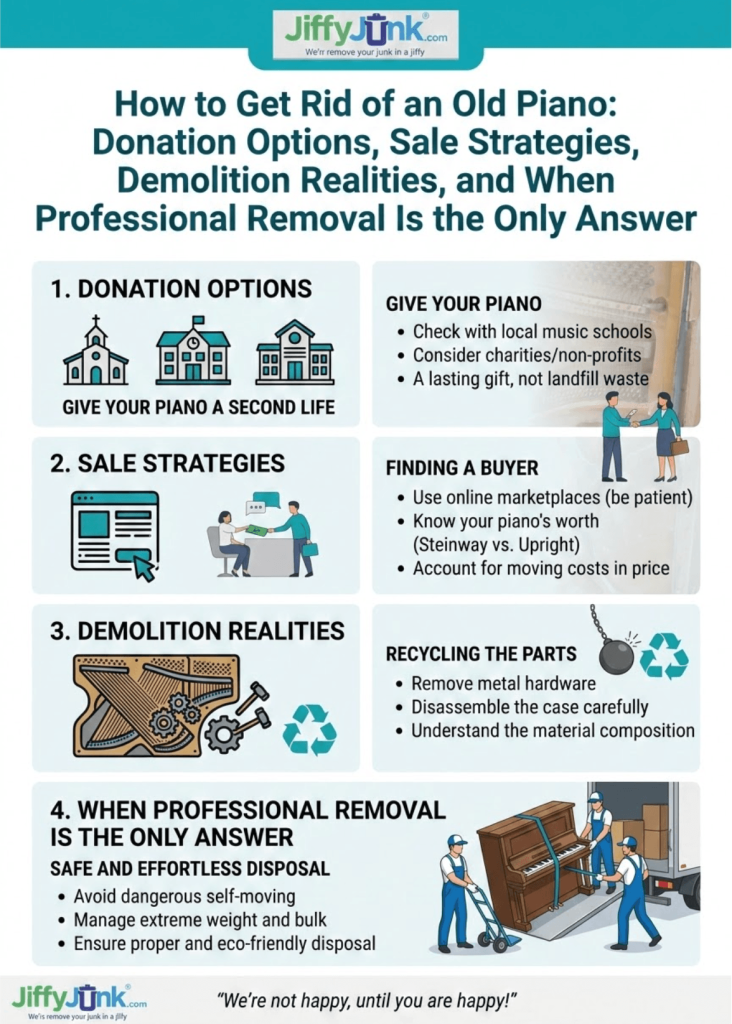
How to Get Rid of an Old Piano: Donation Options, Sale Strategies, Demolition Realities, and When Professional Removal Is the Only Answer
Your old piano isn’t going to sell on Craigslist. The local school doesn’t want it either. We’ve been hauling pianos out of basements, second-floor walk-ups, and estate cleanouts for the better part of a decade, and the homeowner’s reaction is almost always the same: they had no idea this would be so hard.
You have four real options: donate the piano to a charity that will actually accept it, sell it for what little it’s worth, take it apart yourself, or hire a professional to handle the whole thing. Most people end up at option four. Here’s why.
TL;DR Quick Answers
How Do I Get Rid Of A Piano?
You have four real options. Donating to a school or nonprofit is the hardest path actually to finish. Selling on Facebook Marketplace or to a piano dealer rarely nets much money. Taking the piano apart yourself is dangerous, and it almost always costs more than people expect. Hiring a professional junk removal service costs $150 to $500+ and takes 60 to 90 minutes to complete the job. For most homeowners, especially anyone with an upstairs piano or a grand, professional removal is the practical answer.
Top 5 Takeaways
- Most charities decline used pianos. Donation works best for tuned instruments under 30 years old, from recognized brands, in playable condition.
- Used pianos typically sell for $0 to $500, even when the seller lists them higher. Plan for 4 to 12 weeks on market.
- DIY demolition isn’t free. Tools, dumpster rental, and time add up fast. The cast-iron harp inside also holds enough string tension to seriously injure someone.
- Professional removal averages $150 to $500+ and takes one crew about an hour, with floor protection, donation attempts, and recycling built in.
- Whatever path you choose, your piano never has to be called junk. It’s an instrument with a story, and it deserves a thoughtful exit.
Table of Contents
- How to Get Rid of an Old Piano: Donation Options, Sale Strategies, Demolition Realities, and When Professional Removal Is the Only Answer
- TL;DR Quick Answers
- Top 5 Takeaways
- Why Pianos Are Uniquely Hard To Get Rid Of
- Why Most Charities Politely Decline Your Piano Donation
- Selling Your Piano For What It’s Really Worth
- Why DIY Piano Demolition Almost Always Backfires
- When Professional Removal Is The Only Practical Answer
- Essential Resources On How To Get Rid Of A Piano
- 1. Submit A Piano Donation Through A Twin Cities Nonprofit
- 2. Donate To A Public-Art Piano Project
- 3. Check Whether Your Local ReStore Accepts Your Other Household Items
- 4. Explore Regional Music-Education Donation Options
- 5. Schedule A Specialized Piano Pickup Through A Regional Charity
- 6. Document Your Piano Donation For Tax Purposes
- 7. Find A Donation Drop-Off Location For Other Household Items
- Supporting Statistics
- Final Thoughts & Opinion
- Frequently Asked Questions
- Q: Will Any Charity Take A Free Piano?
- Q: How Much Does It Cost To Dispose Of A Piano?
- Q: Can I Just Put My Old Piano At The Curb?
- Q: Are Pianos Recyclable?
- Q: Is It Dangerous To Take Apart A Piano Myself?
- Q: How Long Does Professional Piano Removal Take?
- Q: Will Jiffy Junk Remove My Baby Grand Or Concert Grand Piano?
- Q: What If My Piano Is On The Second Floor?
- Ready To Reclaim Your Space?
Why Pianos Are Uniquely Hard To Get Rid Of
A piano isn’t furniture in the usual sense. It’s a precision instrument built around a cast-iron plate, hundreds of taut steel strings, a wooden frame, and a complex mechanical action. If you want the technical breakdown, the Wikipedia entry on the piano covers the construction in detail. What matters here is the weight. An upright runs 300 to 500 pounds. A baby grand often hits 650, and a full concert grand can push 1,200. All of that sits in one stubborn package that won’t flatten, fold, or move with a single set of hands.
Municipal trash pickup doesn’t accept pianos. Most landfills refuse a whole instrument, too. Donating, selling, and recycling all hit the same bottleneck: who’s going to move the thing, and how much will that cost?
Why Most Charities Politely Decline Your Piano Donation
Donating sounds like the obvious first step. In practice, it’s the hardest path actually to finish.
Most schools, churches, and community organizations already have all the pianos they need. The ones that could use another usually lack the budget for tuning, the storage space, or the funds to pay movers. Habitat for Humanity ReStores, Goodwill, and Salvation Army drop-offs typically decline pianos altogether. The handful of programs that do accept piano donations have specific criteria.
Realistic donation paths:
- Piano-specific nonprofits like Keys 4/4 Kids or the Beethoven Foundation accept playable, tunable instruments from recognized brands.
- Sing for Hope installs donated pianos as public-art pieces and then rehomes them in schools, hospitals, and community centers.
- Local music schools or houses of worship may take a well-maintained piano, especially if you cover the moving cost.
- Online giveaways (Facebook Marketplace, Freecycle, Nextdoor) sometimes find a taker. Plan on two to eight weeks of inquiries and several no-shows.
What disqualifies a piano from donation? A cracked soundboard. An instrument that can’t hold a tune. Anything over 50 years old without restoration. Player-piano mechanisms. Any piano located above a ground floor without elevator access. And in almost every case, you pay for the move, not the charity.
If you do find a charity willing to take your piano, get a written donation receipt. Pianos appraised at more than $500 require IRS Form 8283.
Selling Your Piano For What It’s Really Worth
Most used pianos sell for $0 to $500, even when the seller lists them higher. Real resale value lives in a narrow band of brands (Steinway, Yamaha, Kawai, Mason & Hamlin, Bösendorfer), pianos under 30 years old, and instruments with a documented tuning history.
Where to list your piano:
- Facebook Marketplace and Craigslist for quick local sales.
- Reverb and PianoMart for buyers searching nationally.
- Local piano dealers for trade-in or consignment, especially if you’re upgrading to a newer instrument.
Two notes from experience. First, look at sold listings, not asking listings. The two numbers are rarely the same. Second, subtract $400 to $800 from whatever you ask, because the buyer rarely pays for the move. If your piano predates 1920 and still has an intact case and harp, get a professional appraisal before you list. Some antique instruments hold real value for restorers, but only a specialist can tell you which ones.
If eight weeks of listings produce nothing, the last two options are now in play.
Why DIY Piano Demolition Almost Always Backfires
The appeal is real. People imagine free disposal, useful firewood, and a satisfying weekend project. The reality looks different.
Disassembling a piano means safely releasing roughly 18 to 20 tons of combined string tension across the cast-iron harp. Get that wrong and metal pieces move at high speed. Then you have to cut through hardwood, pry loose a 300- to 500-pound cast iron harp, and figure out where each component goes. No single bin accepts a whole disassembled piano.
Hidden costs people forget to budget for:
- Reciprocating saw, sledgehammer, safety equipment: $150 to $300 if you don’t already own them.
- 10-yard dumpster rental for the debris: $300 to $500.
- 8 to 15 hours of physical labor across one or two weekends.
- Risk of back injury, a dropped harp on a foot, and damaged hardwood or tile floors.
For grand and baby grand pianos, we never recommend DIY disassembly. The lid weight, the orientation of the harp, and the structural geometry all make a grand, materially more dangerous instrument than an upright.
The math nearly always favors calling someone. Roughly $300 to $800 in DIY costs plus 10 or more hours of labor plus injury risk, versus $150 to $500 for a professional crew to finish the job in about an hour. For a deeper look at what drives the final number on professional jobs, see our complete breakdown of professional piano removal pricing.
When Professional Removal Is The Only Practical Answer
For most homeowners, this is where the decision actually lands. In these situations, professional removal moves from preferable to necessary.
You almost certainly need a pro if any of these apply:
- The piano is on the second floor, in the basement, or down a narrow hallway.
- It’s a grand, baby grand, or concert grand.
- The piano is broken, water-damaged, or simply no longer plays.
- The doorway, corner, or stair access is tight.
- You’re managing an estate cleanout, a real-estate closing, or an eviction cleanup on a deadline.
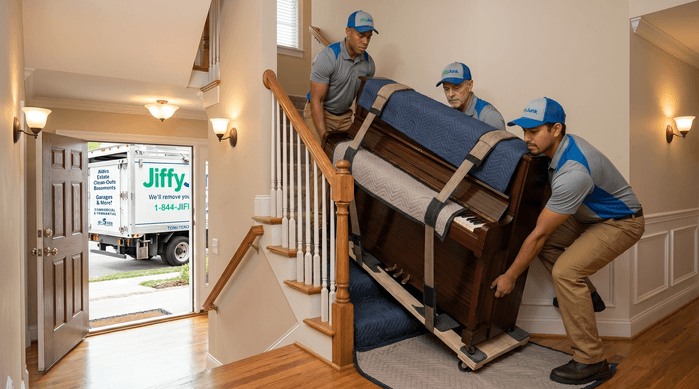
A professional service like Jiffy Junk’s piano removal team sends a licensed and insured two- to four-person crew. We bring piano-specific equipment: four-wheel piano dollies, piano boards, stair climbers, and heavy-duty straps. We protect floors and walls throughout the entire route. We try donation first, recycling second, and disposal only as a last resort. The White Glove Treatment finishes the job. We sweep your space thoroughly before we drive away.
Cost runs $150 to $500+, depending on piano type, location in the home, stairs, and access. We provide every quote upfront and in writing before any work begins. No hidden fees.
“After more than a decade of piano jobs across the country, the pattern is the same. By the time someone calls us, they’ve usually tried two or three options that didn’t pan out. The piano has become the last obstacle between them and a clear room. Our job is to get it out cleanly and respectfully. That’s what the White Glove Treatment was built for.”
— Jiffy Junk Specialty Removal Team
Essential Resources On How To Get Rid Of A Piano
If your piano still plays well, a donation is worth the time. Here are seven verified resources for the paths most homeowners pursue. They cover everything from finding a nonprofit that will actually accept your instrument to documenting the donation for taxes.
1. Submit A Piano Donation Through A Twin Cities Nonprofit
Keys 4/4 Kids is a Minnesota nonprofit that accepts piano donations within 100 miles of the Minneapolis/St. Paul metro area, refurbishes the instruments, and places them with students and music programs in need. If a donated piano can’t be placed, the team breaks it down and recycles the parts.
Source: Keys 4/4 Kids Donate a Piano page
2. Donate To A Public-Art Piano Project
Sing for Hope installs artist-painted pianos in parks and public spaces each summer. After the public run, the organization donates each piano to a school, hospital, or community center across New York City and beyond.
Source: Sing for Hope Piano Donation program
3. Check Whether Your Local ReStore Accepts Your Other Household Items
Most Habitat for Humanity ReStores decline pianos. They’re still a useful drop-off for other furniture or appliances you’re clearing out at the same time. Their official donation guide lists exactly what each location accepts.
Source: Habitat for Humanity ReStore donation guide
4. Explore Regional Music-Education Donation Options
Music Institute Chicago accepts piano donations through its in-kind gift program and publishes a step-by-step acceptance process. It’s a useful template for the kind of regional music-education nonprofits worth calling in your own city.
Source: Music Institute Chicago Piano Donations and In-Kind Gifts
5. Schedule A Specialized Piano Pickup Through A Regional Charity
American Samaritan offers piano-specific donation pickups across Colorado and accepts shipped donations from other states. The organization pairs professional movers with a piano placement program, which makes it a good model to look for in your own region.
Source: American Samaritan Piano Pick-Up & Delivery page
6. Document Your Piano Donation For Tax Purposes
IRS Publication 526 walks through how to claim a deduction for noncash charitable contributions, including the appraisal rules and Form 8283 requirements that apply to pianos valued over $500.
Source: IRS Publication 526, Charitable Contributions
7. Find A Donation Drop-Off Location For Other Household Items
The Salvation Army operates more than 2,500 drop-off locations across the U.S. Most decline pianos, but they’re a useful destination for the rest of the household items you may be sorting through during a cleanout.
Source: Salvation Army Donation Drop-Off Finder
Supporting Statistics
Here are the numbers behind why piano disposal is so much harder and so much riskier than most people expect.
1. Manual Lifting Is The Leading Source Of Workplace Back Injuries
OSHA’s heavy-lifting guidance reports that more than 36% of injuries involving missed workdays come from shoulder and back injuries, with overexertion as the biggest factor. OSHA specifically warns that loads heavier than 50 pounds raise injury risk significantly. A piano weighs 6 to 24 times that limit.
Source: OSHA Heavy Lifting eTool
2. Most Household Furniture Ends Up In Landfills, Not Recycled
The EPA reports that 12.1 million tons of furniture and furnishings entered the U.S. municipal solid waste stream in 2018. Almost all of it went to landfill rather than recycling or reuse.
Source: EPA Durable Goods: Product-Specific Data
3. Furniture Tip-Overs Send Thousands Of Americans To The ER Every Year
The CPSC’s most recent tip-over report (2020–2022 data) estimates that 17,800 Americans visit an emergency department each year for tip-over injuries. The number is a real reminder of how dangerous large, heavy household items can be when they’re moved without the right equipment.
Source: CPSC Furniture and TV Tip-Over news release
Final Thoughts & Opinion
After more than a decade of piano jobs across the country, here’s what we’ve learned. The people who call us are almost always relieved, not regretful. They’ve already exhausted donation listings, dealer calls, and well-meaning friends with trucks. By the time the piano is loaded and the room is swept, the conversation has shifted from junk removal to something simpler. People want their living room back.
A meaningful share of these jobs comes bundled with a larger project. If you’re tackling a piano as part of a wider move-out, our whole-house estate cleanout cost guide breaks down what a broader project looks like in time and dollars.
Our honest opinion:
- If your piano still plays beautifully and you have time, try donating. Schools and music nonprofits really do change lives with these instruments.
- If you aren’t sure of the condition or brand, an hour with a local piano technician is worth more than weeks of guesswork.
- If you’re already three weeks into Marketplace listings with nothing to show, stop. The piano isn’t going to sell on its own, and the room isn’t going to clear itself.
- Skip DIY dismantling. Of all the removal projects we see go wrong, pianos rank near the top.
What matters is choosing the right path for your situation, not which company you call. Sometimes that means professional removal. Sometimes a great donation does the trick. Either way, the instrument deserves a thoughtful exit, and you deserve your living room back.
Frequently Asked Questions
Q: Will Any Charity Take A Free Piano?
A: A handful of nonprofits will. Most will not. Piano-specific groups like Keys 4/4 Kids or Sing for Hope accept donations when the instrument is playable, in tune, and from a recognized brand. General charities like Goodwill, Habitat for Humanity, and the Salvation Army usually decline pianos altogether.
Q: How Much Does It Cost To Dispose Of A Piano?
A: Professional piano removal runs $150 to $500+ in most U.S. markets. Price depends on piano type, location in the home, stairs, and access. Uprights on the ground floor land at the lower end. Grand pianos and upper-floor jobs land at the higher end.
Q: Can I Just Put My Old Piano At The Curb?
A: No. Municipal trash pickup excludes pianos in most cities, and most landfills refuse whole instruments. Leaving one at the curb usually earns a citation, not a pickup.
Q: Are Pianos Recyclable?
A: Yes, in parts. A recycler can scrap the cast-iron harp for metal, save the wood frame for reuse, and salvage some of the hardware. Disassembly is the hard part, and it’s a job for trained professionals. Eco-friendly removal companies like Jiffy Junk separate and recycle components whenever possible.
Q: Is It Dangerous To Take Apart A Piano Myself?
A: Yes. A piano’s cast-iron harp holds an estimated 18 to 20 tons of combined string tension. Releasing that tension incorrectly can send metal pieces flying. The harp itself weighs 300 to 500 pounds. We never recommend DIY disassembly for any piano, and especially not for grand or baby grand instruments.
Q: How Long Does Professional Piano Removal Take?
A: Most upright removals take 60 to 90 minutes from arrival to clean-up. Grand pianos and upper-floor removals can take two to three hours.
Q: Will Jiffy Junk Remove My Baby Grand Or Concert Grand Piano?
A: Yes. Our specialty crews handle uprights, consoles, baby grands, full grands, and concert grands. We bring piano-specific equipment for every job and provide an upfront quote before we start.
Q: What If My Piano Is On The Second Floor?
A: We handle upper-floor pianos every week. Our crews use stair climbers, four-wheel piano dollies, and floor and wall protection throughout the route. Upper-floor removals factor into the quote, so you’ll know the price before we lift a thing.
Ready To Reclaim Your Space?
Stop wrestling with an instrument you no longer use. Jiffy Junk’s licensed and insured specialty crews handle every type of piano, from spinet to concert grand, with the White Glove Treatment that leaves your space swept and ready. For a wider view of local junk removal pricing in your area before you book, our regional breakdown covers what to expect. To schedule your piano job, call 844-JIFFY-NOW (844-543-3966) or get your free, upfront quote at jiffyjunk.com/booking. We’re not happy until you are happy!