Where to Donate Furniture: Free Pickup Charities, Local Thrift Stores, and What Conditions They Will and Will Not Accept
The Salvation Army stopped picking up furniture in many ZIP codes back in 2020, and most donors find out the hard way. The truck doesn’t show up. Or it comes, takes one look at the couch, and drives off.
Our crew has been coordinating donation pickups across the country since 2014. We hand-sort every load. What qualifies goes to charity partners like Habitat ReStore and local furniture banks. The rest goes to certified recyclers. Landfill is the last stop, not the first.
This page is the field guide we wish more donors had: which national charities still pick up for free, what each one will and won’t take, and what to do when a piece doesn’t make the cut.
TL;DR Quick Answers
Where Can I Donate Furniture?
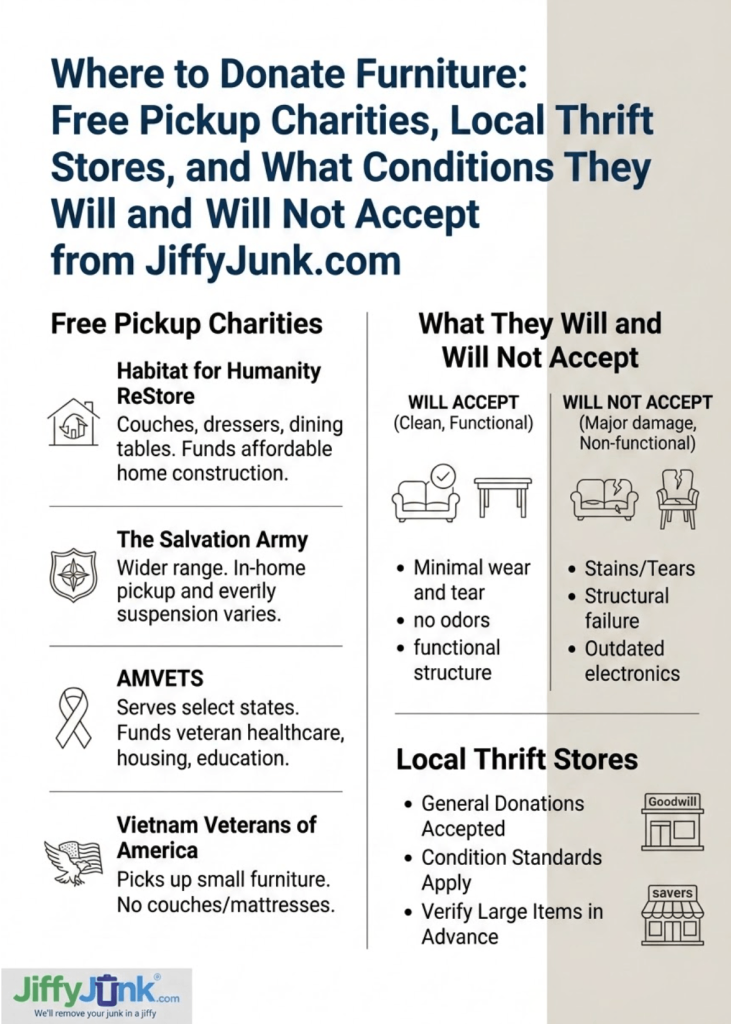
For free pickup, the best four options are Habitat for Humanity ReStore, the Salvation Army, AMVETS, and Vietnam Veterans of America. Habitat ReStore tends to be the most reliable for couches, dressers, and dining tables, since most locations still pick up large items at no charge. The Salvation Army accepts a wider range but has suspended pickup in many ZIP codes since 2020. Always check satruck.org with your ZIP first. AMVETS only operates in Maryland, Virginia, D.C., Delaware, Texas, and Oklahoma. VVA picks up small furniture nationwide, but won’t take a couch or mattress in any condition. Local furniture banks and independent thrift stores fill in the gaps. In every case, items must be clean and structurally sound. No rips, stains, pet damage, or odors. If donation isn’t a fit for your piece, our complete guide to getting rid of old furniture walks through all five disposal options.
Top 5 Takeaways
- Four national charities cover most of the country. Habitat ReStore, the Salvation Army, AMVETS, and Vietnam Veterans of America each pick up furniture for free. Coverage, accepted items, and wait times vary by ZIP, so it pays to check before scheduling.
- Condition decides everything. Charities accept only what they can sell or hand directly to a family. Rips, stains, pet damage, missing parts, or odors mean an automatic refusal. If you wouldn’t pass it to a relative, a charity won’t take it either.
- Mattresses get refused more than anything else. Most national charities won’t touch them for hygiene reasons. A small number of local furniture banks accept and sanitize them. For everything else, mattress recycling recovers most of the materials through specialty processors.
- You can deduct the value on your taxes. Donations to qualified 501(c)(3) nonprofits qualify for fair-market-value deductions. Get a written receipt at pickup. Snap photos of every piece. Keep both for your records.
- Plan for the no. Roughly a third of items offered to charities get turned away due to wear and damage. A full-service crew can sort what works, donate what qualifies, recycle what doesn’t, and keep the landfill out of the equation.
Table of Contents
- Where to Donate Furniture: Free Pickup Charities, Local Thrift Stores, and What Conditions They Will and Will Not Accept
- TL;DR Quick Answers
- Top 5 Takeaways
- Free Furniture Donation Pickup: The Major National Charities
- What Charities Will And Will Not Accept
- What To Do When Your Furniture Doesn’t Qualify For Donation
- Essential Resources On “Where Can I Donate Furniture”
- 1. Goodwill’s Official Page On What To Donate And Whether They Pick Up Furniture
- 2. The Salvation Army’s Free Pickup Scheduling And Accepted Items Page
- 3. IRS Rules On Claiming A Tax Deduction For Donated Furniture
- 4. Why Furniture Donation Matters: EPA Data On Durable Goods
- 5. Vietnam Veterans Of America’s Accepted Donations Checklist
- 6. AMVETS’ Donor FAQ: Service Areas, Accepted Items, And Tax Receipts
- 7. Find A Local Furniture Bank That Delivers Directly To Families In Need
- Supporting Statistics
- Final Thoughts & Opinion
- Frequently Asked Questions
- Q: Who Picks Up Furniture Donations For Free Near Me?
- Q: Will Goodwill Pick Up Furniture From My House?
- Q: Where Can I Donate A Couch Near Me?
- Q: Where Can I Donate A Dresser?
- Q: Can I Donate A Mattress?
- Q: Where Can I Donate A Dining Table?
- Q: How Long Does A Free Furniture Donation Pickup Take To Schedule?
- Q: Can I Get A Tax Deduction For Donating Furniture?
- Q: What If My Furniture Is Too Damaged To Donate?
- Q: Is It Better To Donate Or Sell My Old Furniture?
- Ready To Clear The Space? We’ll Handle The Rest
Free Furniture Donation Pickup: The Major National Charities
Four nonprofit networks handle most of the country’s free furniture pickup. Each runs its program a little differently. Knowing the rules ahead of time saves days of phone calls and the curb-side disappointment of a pickup that falls through.
Habitat for Humanity ReStore. We start most donor recommendations here. The Habitat for Humanity ReStore network runs independently operated home improvement stores and donation centers across the country. They accept couches, dressers, dining tables, appliances, and surplus building materials. Most locations offer free pickup of large items, and the sale proceeds fund affordable home construction right in your community.
The Salvation Army. The most recognizable name in donation pickup also comes with the biggest caveat. In-home pickups have been suspended in many ZIP codes since 2020. Anyone scheduling needs to verify availability at satruck.org first, because the wait for a confirmed pickup can still run a few weeks during busy seasons.
AMVETS. American Veterans (AMVETS) picks up clothing, household goods, and small furniture in six service areas: Maryland, Virginia, Washington D.C., Delaware, Texas, and Oklahoma. They turn down large appliances, stained mattresses, and anything hazardous. Donations fund veteran healthcare, housing, and education.
Vietnam Veterans of America. VVA runs one of the most widely available pickup services in the country through its pickup service partners. They take clothing, shoes, small household items, and small furniture like chairs, end tables, and dressers. They won’t pick up couches, sofas, mattresses, box springs, large appliances, or TVs of any size.
What Charities Will And Will Not Accept
Every charity in the country runs some version of the same test. Would this item sell as-is in a thrift store, or would it serve a family without making them feel like a charity case? If yes, donate. If not, find another path. We send every piece through the same filter on every job.
Furniture in donation-ready condition typically meets these standards:
- Clean upholstery free of stains, tears, and odors
- Wood pieces with intact joinery, all hardware, and working drawers
- Appliances less than 5 to 10 years old, in working condition, with power cords
- No pet hair, pet damage, or signs of bed bugs
- All parts and pieces present (chairs to a table set, drawer pulls, shelf pegs)
Items that nearly every charity refuses include:
- Couches and sofas with rips, sagging cushions, or pet damage
- Mattresses (one of the most commonly refused items nationwide)
- Particle-board furniture that has water damage or is falling apart
- Gas appliances and built-in appliances (ovens, stoves, dishwashers)
- Large console televisions or TVs older than five years
- Anything from a home with a known bed bug or pest problem
The most useful thing we can tell you is also the cheapest. Send the charity a clear photo before scheduling. Most organizations come back within a day with a yes or no. That one email saves the rest of the weekend.
What To Do When Your Furniture Doesn’t Qualify For Donation
Roughly a third of items donors hope to give away never make it past a charity’s condition check. A cushion that almost cleaned up but didn’t. A basement chair with a faint odor that won’t air out. Pieces like these still have value, but it’s recycling value rather than resale value.
When a charity won’t take your furniture, you have three real options:
- List it free on Facebook Marketplace, Craigslist, or Freecycle and hope someone takes it within a few days.
- Schedule a city bulk pickup, which is free or low-cost in many municipalities but can take weeks and typically ends up in a landfill. Our guide on whether to leave furniture on the curb covers when curbside works and when it backfires.
- Hire a full-service junk removal team that sorts, donates what qualifies, recycles what can be recycled, and only treats landfill as a last resort.
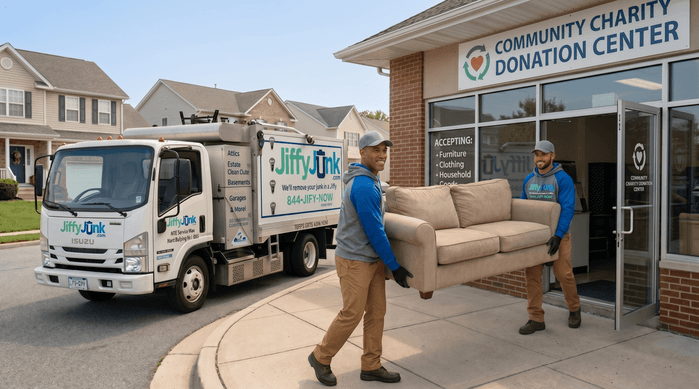
We built our furniture donation pickup service around this exact gap. Our crew arrives licensed, insured, and with established relationships with local charity partners. We assess every piece at the curb. Donation-quality items go to nonprofits like Habitat ReStore and the Salvation Army. We route metals, wood, and textiles to certified recyclers. Whatever the donor can’t move, we move. We sweep the space before we leave. That’s what customers mean when they talk about the Jiffy Junk White Glove Treatment. For a behind-the-scenes look at the sorting and recovery process, our breakdown of what happens to your items after pickup walks through every step.
“After thousands of donation pickups since 2014, the most common mistake we see is donors loading a truck before confirming the charity will accept the item. Ninety seconds and one photo email can save the whole weekend.”
— Jiffy Junk Operations Team
Essential Resources On “Where Can I Donate Furniture”
These are the seven sources our team turns to first when answering donor questions. Every link points to a working .org or .gov article. We confirmed each one this week.
1. Goodwill’s Official Page On What To Donate And Whether They Pick Up Furniture
Goodwill’s national donate-goods page explains what their stores accept and notes that policies vary by region. Most local Goodwill organizations make house calls for furniture and other large items, though pickup availability differs from market to market. Use the locator tool first to find the nearest store and confirm what they’ll take.
Source: Goodwill — Donate Goods
2. The Salvation Army’s Free Pickup Scheduling And Accepted Items Page
Enter your ZIP on the Salvation Army’s scheduling page to confirm whether free pickup is available where you live. The same page flags which locations have suspended in-home pickups and lists everything they’ll accept.
Source: Salvation Army Donation Pickup Scheduling
3. IRS Rules On Claiming A Tax Deduction For Donated Furniture
Publication 526 is the IRS document that lays out charitable contribution deductions. It explains who qualifies, how to value non-cash donations, and when you need to file Form 8283 for furniture donations over $500.
Source: IRS Publication 526 — Charitable Contributions
4. Why Furniture Donation Matters: EPA Data On Durable Goods
The EPA’s durable goods report tracks how much furniture ends up in American landfills each year and how much gets recycled. The numbers explain why donating gently used pieces actually matters.
Source: EPA Durable Goods Product-Specific Data
5. Vietnam Veterans Of America’s Accepted Donations Checklist
The VVA Pickup Service page lists exactly what their drivers will and won’t take, broken out by state. Worth a quick read before scheduling, since they don’t pick up couches, mattresses, or large appliances.
Source: Vietnam Veterans of America Accepted Items
6. AMVETS’ Donor FAQ: Service Areas, Accepted Items, And Tax Receipts
AMVETS Pickup’s FAQ covers what they accept, which states they serve, how to schedule, and how the tax-deductible receipts work. If you’re in Maryland, Virginia, D.C., Delaware, Texas, or Oklahoma, read it first.
Source: AMVETS Pickup Frequently Asked Questions
7. Find A Local Furniture Bank That Delivers Directly To Families In Need
Furniture banks work differently from thrift stores. They hand donated furniture directly to families coming out of homelessness, domestic violence shelters, or deep poverty. The directory finds the closest one to your ZIP.
Source: Furniture Banks Network Directory
Supporting Statistics
Three numbers shape how our team approaches every donation pickup. They’re also the reason we sort for donation before we sort for recycling, and we keep the landfill out of the conversation whenever we can.
1. Homelessness Hit Historic Highs In 2024, And Furniture Banks Help Families Recover
- Roughly 771,480 people experienced homelessness in the United States on a single night in January 2024.
- That’s an 18% jump from 2023 and the highest count since national reporting began in 2007.
- Families with children saw a 39% rise in just one year, the steepest jump of any group.
From our crews’ experience, a single donated dresser or dining table can be the first piece of stable furniture a family receives after a shelter stay. That’s why we route every qualifying piece to a local nonprofit before considering any other path.
Source: HUD 2024 Annual Homeless Assessment Report To Congress (PDF)
2. Children Experiencing Homelessness Rose 33% In A Single Year
- In 2024, 148,238 people under 18 were counted as experiencing homelessness on a single night.
- The number of children without housing rose 33% from 2023 to 2024, the highest annual increase across any age group.
- Of all new shelter beds added that year, 78% were earmarked for families with children.
That population benefits the most from furniture banks and ReStores. A clean dresser, a sturdy dining table, or a working couch can turn an empty shelter unit into a place that feels like home.
Source: National Alliance to End Homelessness — State Of Homelessness 2025
3. Furniture-Funded Rehab Programs Served More Than 151,000 People In 2024
- In 2024, the Salvation Army served more than 151,000 people through its Adult Rehabilitation Centers.
- Those centers run almost entirely on the resale of donated furniture, clothing, and household goods.
- Participants get a 180-day residential program with counseling, work therapy, and life-skills development at little or no cost.
Every donated couch, dresser, and dining table you contribute funds to real recovery work in your community. What looks like decluttering on your end becomes the funding source for one of the country’s largest free rehabilitation networks.
Source: The Salvation Army USA — Adult Rehabilitation Centers Impact Story
Final Thoughts & Opinion
Furniture donation works, but it only works when you start with realistic expectations.
After more than a decade of clearing furniture from homes and businesses across the country, our team has settled on a few principles that guide every donation handoff.
- Start with photos, not phone calls. One emailed photo to a local Habitat ReStore or furniture bank saves the most common donation mistake. Loading a piece, hauling it across town, and getting refused at the curb is a Saturday nobody wants.
- Habitat ReStore is the most reliable starting point for large furniture. They accept the widest range of items, offer pickup at most locations, and route proceeds straight to home construction in your neighborhood.
- Don’t feel guilty when items don’t qualify. Some furniture has lived its useful life. The responsible move is recycling what can be recovered, donating what still works, and keeping the landfill as the last option.
- Schedule earlier than you think you need to. Most free pickups run one to three weeks out, longer during spring cleaning and post-holiday months. If you’re working on a move or closing date, build that lead time in.
Donating is the best outcome when a piece still has life in it. When it doesn’t, full-service removal with donation-first and recycling-second sorting gets you nearly all the way there. Either way, your furniture doesn’t have to default to a landfill.
Frequently Asked Questions
Q: Who Picks Up Furniture Donations For Free Near Me?
A: Habitat for Humanity ReStore, the Salvation Army, AMVETS in select states, and Vietnam Veterans of America all offer free furniture pickup. Coverage varies by ZIP. For couches, dressers, and dining tables, Habitat ReStore is usually the most reliable. Local furniture banks are also worth checking through the Furniture Banks Network directory.
Q: Will Goodwill Pick Up Furniture From My House?
A: Most Goodwill locations don’t offer free in-home furniture pickup. Stores operate independently, so policies vary by region. Some locations partner with the paid service ReSupply, which runs about $130 per item. Call your local store before loading anything up.
Q: Where Can I Donate A Couch Near Me?
A: Habitat for Humanity ReStore and the Salvation Army are the two best options for couches in good condition. Both want clean upholstery, intact cushions, and no signs of pets or odors. Send a photo first to confirm, then schedule pickup through their websites.
Q: Where Can I Donate A Dresser?
A: Dressers are one of the most-wanted donations, because families resettling rarely have storage. Habitat ReStore, local furniture banks, and the Salvation Army all accept them. All drawer slides, pulls, and hardware need to be present and working.
Q: Can I Donate A Mattress?
A: Almost no major charity accepts mattresses. The exceptions are a handful of local furniture banks that sanitize and rehome them. Houston Furniture Bank is one of the largest. For mattresses that can’t be donated, specialty recyclers recover most of the materials through dedicated mattress-recycling programs.
Q: Where Can I Donate A Dining Table?
A: Dining tables are strong donation candidates. Habitat ReStore and furniture banks accept them readily, as long as the surface is intact and the legs are stable. Donate the chairs and any leaves as a complete set whenever possible.
Q: How Long Does A Free Furniture Donation Pickup Take To Schedule?
A: Most free charity pickups schedule one to three weeks out. During spring cleaning and post-holiday January, waits can stretch to a month or more. Same-week pickup typically requires a paid service like Jiffy Junk or ReSupply.
Q: Can I Get A Tax Deduction For Donating Furniture?
A: Yes. Donations to qualified 501(c)(3) nonprofits are deductible at fair market value. Get a written receipt at pickup, keep photos of every piece, and consult IRS Publication 526 for the current rules. Donations over $500 require Form 8283. This is general information, not tax advice. Talk to a CPA for your specific situation.
Q: What If My Furniture Is Too Damaged To Donate?
A: A full-service junk removal team sorts every load by hand. Donation-quality items go to charity partners. Metals, wood, and textiles head to recyclers. Landfill is the last resort, not the default. That’s how Jiffy Junk operates on every job.
Q: Is It Better To Donate Or Sell My Old Furniture?
A: Donating is faster and easier for average used pieces. Selling makes sense only for valuable antiques or high-end items that justify the time investment in listing, negotiating, and coordinating with buyers. For everything in between, donation pickup is almost always the better call.
Ready To Clear The Space? We’ll Handle The Rest
Whether your furniture is donation-ready or past its best days, our crew will sort, donate, recycle, and clean up in a single visit. That’s the White Glove Treatment Jiffy Junk has delivered since 2014. Book your free quote today and reclaim your space the easy way.
Call 844-543-3966 or visit jiffyjunk.com/booking to schedule your pickup.