How Much Does It Cost To Dispose Of A Refrigerator? Pickup Fees, Freon Surcharges, Free Programs, And What You Will Actually Pay
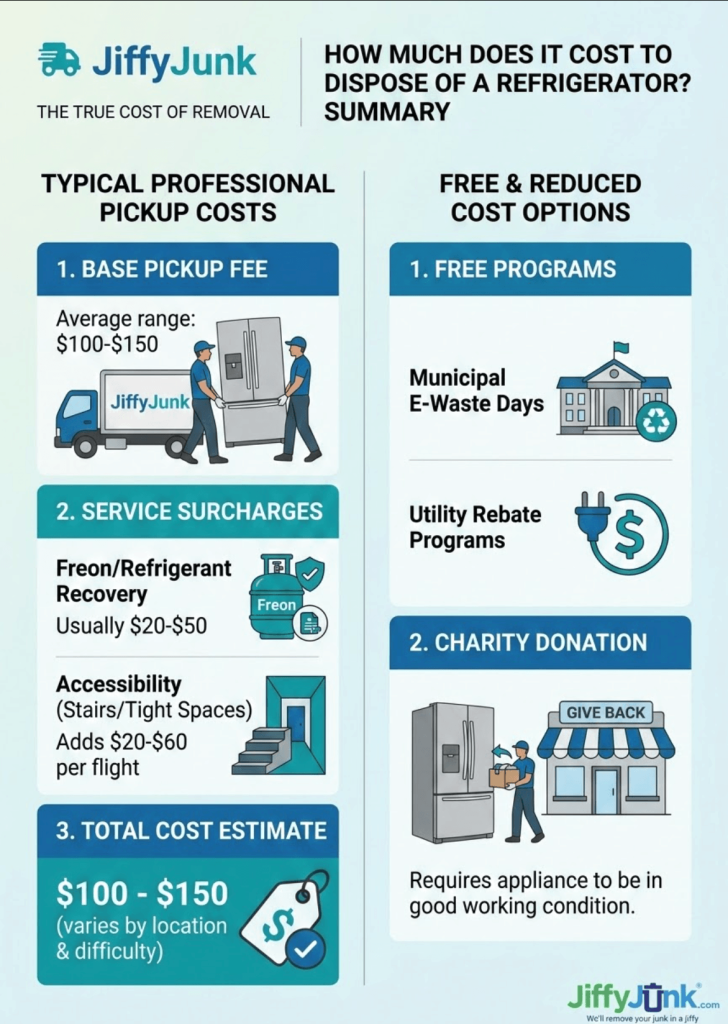
$100 to $150. That’s what most homeowners pay to get an old refrigerator out of the house in 2026. Three things swing the number in either direction: where you live, how hard the unit is to reach, and whether refrigerant recovery is part of the quote.
Our crews have been pulling fridges out of homes since 2014. We’ll show you which options charge nothing, which utility programs will turn you down, and why every legitimate quote includes $20 to $50 for federal refrigerant compliance.
TL;DR Quick Answers
How Much Does It Cost To Dispose Of A Refrigerator?
Most full-service refrigerator pickups cost $75 to $250 in 2026. The national average sits around $100 to $150. Three factors set your final number:
- Where you live: urban rates run 20 to 40 percent above rural rates
- How hard the unit is to reach: stairs and basement pickups add $20 to $60 per flight
- Whether refrigerant recovery is part of the quote: most legitimate crews build in $20 to $50
Free pickup exists through utility recycling programs, but only for working units in specific size ranges. With Jiffy Junk, the quote we give you is the quote you pay. Refrigerant recovery, transport, and recycling are included.
Top 5 Takeaways
- Most homeowners pay $75 to $250 for full-service refrigerator disposal in 2026. The national average sits around $100 to $150.
- Federal law (EPA Section 608 of the Clean Air Act) requires a certified technician to recover the refrigerant. That’s where the $20 to $50 freon surcharge comes from on most quotes.
- Utility recycling programs pick up working refrigerators for free, and many pay rebates of $25 to $100. The catch: most exclude broken units and units outside the 10-to-28 cubic-foot range.
- Retailer haul-away from Home Depot, Lowe’s, and Best Buy typically runs $25 to $50 when you’re buying a new fridge with delivery.
- Jiffy Junk’s upfront quote is the quote you pay. No surprise add-ons. No fees at the curb. White Glove Treatment leaves your kitchen broom-clean.
Table of Contents
- How Much Does It Cost To Dispose Of A Refrigerator? Pickup Fees, Freon Surcharges, Free Programs, And What You Will Actually Pay
- TL;DR Quick Answers
- Top 5 Takeaways
- What You’ll Pay To Dispose Of A Refrigerator
- Free And Low-Cost Pickup Options Worth Knowing About
- Why Freon Quietly Drives The Price (And What That Costs)
- Essential Resources On How Much It Costs To Dispose Of A Refrigerator
- 1. Find A Free Refrigerator Recycling Program Near You
- 2. Understand The Federal Rules Behind Refrigerator Disposal
- 3. Calculate The Energy You Will Save By Retiring An Old Fridge
- 4. Keep Children Safe Before, During, And After Disposal
- 5. Donate A Working Fridge And Receive A Tax Receipt
- 6. Learn How New Standards Cut Fridge Energy Use Dramatically
- 7. See Why Appliance Efficiency Has Improved So Dramatically Over Time
- Supporting Statistics
- Final Thoughts And Opinion
- Frequently Asked Questions
- Q: How Much Does It Cost To Dispose Of A Refrigerator In 2026?
- Q: Is There A Separate Freon Disposal Fee?
- Q: Can I Get Free Refrigerator Pickup?
- Q: How Much Do Home Depot And Lowe’s Charge To Haul Away An Old Fridge?
- Q: What Is The Scrap Value Of An Old Refrigerator?
- Q: Do I Need To Prep The Fridge Before Pickup?
- Q: How Fast Can Jiffy Junk Pick Up My Refrigerator?
- Q: Where Does My Old Refrigerator Actually End Up?
- Q: Why Does The Price Vary So Much From One Quote To The Next?
- Ready To Reclaim Your Kitchen Space?
What You’ll Pay To Dispose Of A Refrigerator
Every modern refrigerator is a sealed system. Federally regulated refrigerant gases sit alongside motor oils, foam insulation, and roughly 120 pounds of recyclable steel. No disposal method is truly free by default. Someone has to handle the unit, transport it safely, and run it through certified recycling. Those costs sit somewhere.
Six options, ranked from cheapest to priciest:
- Utility recycling program: Free, plus a $25-to-$100 rebate (working units only)
- Municipal bulk pickup: Free to $50. Wait times can stretch 2 to 9 weeks, and many cities exclude refrigerators
- Scrap metal pickup: Free, occasionally pays you $15 to $35 for the metal (best for non-working units)
- Self-haul to a recycling center: $10 to $80 in tipping fees. You also do all the lifting
- Retailer haul-away with new purchase: $25 to $50, only available when delivered with a new unit
- Full-service junk removal: $75 to $250. Indoor pickup, broken units accepted, no eligibility hoops
What moves the number on your invoice? Regional labor rates, accessibility (stairs and basement pickups add $20 to $60 per flight), and combined-load discounts when you bundle the fridge with other items.
For a fuller breakdown of pickup logistics and what each option involves on the ground, see our full guide to fridge pickup, removal, and disposal.
Free And Low-Cost Pickup Options Worth Knowing About
“Free refrigerator pickup” is one of the most-searched phrases in junk removal. It’s also one of the most misunderstood. Free options exist. Everyone comes with eligibility rules worth knowing before you assume you qualify.
Utility Company Recycling Programs
Many electric utilities offer free pickup and a rebate for recycling a working second refrigerator. Programs we see customers use most often include PSE&G in New Jersey, FirstEnergy and Potomac Edison (rebates up to $100), National Grid in Massachusetts, Minnesota Power, UGI Electric, and Riverside Public Utilities in California. Eligibility runs consistently across most programs: the unit must be working, between 10 and 28 cubic feet, at your primary residence, and you must be a customer of the participating utility.
Retailer Take-Back Programs
Home Depot, Lowe’s, and Best Buy will haul away your old fridge for $25 to $50 when delivering a new one. Some Pro memberships waive the fee. Seasonal promotions occasionally make it free.
Scrap Metal Pickup
Local scrap collectors often haul away non-working refrigerators at no charge for the metal value. Some will pay you a small amount on top. A solid option for a dead unit sitting in a garage or driveway.
Municipal Bulk Pickup
Highly variable by city. New York City offers free curbside collection, but only for refrigerators manufactured before 2012. Many cities don’t accept refrigerators at all because of refrigerant requirements. Call 311 or check your local sanitation department before scheduling.
Worth knowing before you book any “free” service: we wrote a full piece on why free junk removal is never truly free. The short version is that recyclable metal value, eligibility rules, and quiet add-on fees usually carry the cost the customer doesn’t see.
Why Freon Quietly Drives The Price (And What That Costs)
If you’ve seen a $20 to $50 “freon disposal fee” on a quote and wondered what you’re paying for, the short answer is federal law.
EPA Section 608 of the Clean Air Act requires a certified technician to recover the refrigerant before anyone dismantles or recycles the appliance. That includes refrigerators, freezers, window air conditioners, and dehumidifiers. The reason matters. Refrigerants are potent greenhouse gases, and older units may contain refrigerants that damage the ozone layer.
Reputable full-service crews build refrigerant recovery into the upfront quote. You won’t see it as a surprise line item at the curb. With Jiffy Junk, our certified recycling partners handle the recovery, and we fold the cost into the price we quote. Older units (pre-1995) may contain mercury switches and PCB-laden capacitors, which need specialty handling. We cover that in the same flat quote.
Federal rules set the floor, but state rules can change what’s available where you live. See how to dispose of a refrigerator in your state for a breakdown of curbside eligibility, utility rebate programs, and refrigerant restrictions by region.
When It Makes Sense To Call A Full-Service Crew
Free options work well when they fit. Four situations call for paid full-service removal instead:
- Your fridge isn’t working. Most utility programs will turn you down.
- Your unit is upstairs, downstairs, or wedged into a tight kitchen. Curbside-only services aren’t built for indoor pickup.
- You need it gone today or tomorrow. Municipal pickup can stretch into weeks of waiting.
- You’d rather not touch it. Same-day, no-lifting, broom-clean removal is what we do best.
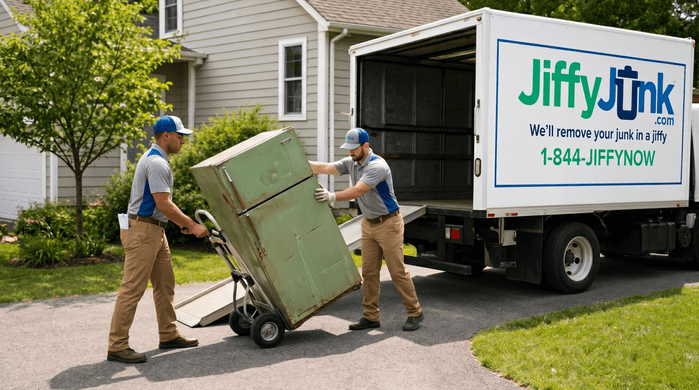
This is the situation our refrigerator removal service was built for. Our team arrives in your scheduled window, disconnects the unit, removes the doors if needed, and hauls the fridge out from wherever it sits. Basements, third-floor walkups, tight galley kitchens. We’ve worked them all. Choose the White Glove Treatment add-on, and we’ll leave the space broom-clean. The unit goes to certified recycling partners, refrigerant included. You lift nothing.
With over 1,000 five-star reviews and a decade of nationwide service, we’ve built our reputation on one promise: we’re not happy until you are happy.
“In our experience pulling thousands of fridges out of homes since 2014, the price you pay almost always comes down to three things: where you live, how hard the unit is to reach, and whether refrigerant recovery is part of the quote. The biggest surprise for most homeowners? Free utility programs almost always exclude broken units, and a broken unit is usually why they’re calling us in the first place.”
— Jiffy Junk Operations Team
Essential Resources On How Much It Costs To Dispose Of A Refrigerator
Seven resources worth bookmarking before you hire anyone. Every one is a free .gov or .org article. No marketing fluff, just the data you need to compare your options.
1. Find A Free Refrigerator Recycling Program Near You
Enter your ZIP code on ENERGY STAR’s nationwide locator to find utility programs that pick up and recycle working refrigerators for free, often with a cash rebate.
Source: ENERGY STAR — Find A Fridge Or Freezer Recycling Program
2. Understand The Federal Rules Behind Refrigerator Disposal
The U.S. Environmental Protection Agency explains why refrigerators don’t belong in regular household waste, what certified recyclers do under Section 608 of the Clean Air Act, and how the Responsible Appliance Disposal (RAD) program protects the environment.
Source: U.S. EPA — Appliance Disposal Under Section 608
3. Calculate The Energy You Will Save By Retiring An Old Fridge
The U.S. Department of Energy breaks down operating costs and savings, including why running that second garage fridge often costs more than disposing of it. Their guidance also covers proper recycling at ethe nd of life.
Source: U.S. Department Of Energy — Purchasing And Maintaining Refrigerators And Freezers
4. Keep Children Safe Before, During, And After Disposal
The U.S. Consumer Product Safety Commission outlines life-saving steps for any old refrigerator. Door removal isn’t optional, and many local jurisdictions require it by law.
Source: U.S. CPSC — Refrigerator Entrapment Safety Guide For Children
5. Donate A Working Fridge And Receive A Tax Receipt
Habitat for Humanity ReStore accepts working refrigerators in many regions and offers free pickup in most markets. Donations qualify for a tax deduction, and proceeds fund affordable housing in your community.
Source: Habitat For Humanity — Donate Goods To ReStore
6. Learn How New Standards Cut Fridge Energy Use Dramatically
The Natural Resources Defense Council details the federal efficiency standards that make even mid-range new fridges more affordable to run than a 15-year-old unit, saving an estimated $1.8 billion per year for U.S. consumers.
Source: NRDC — DOE Freezes Energy Waste With New Refrigerator Standards
7. See Why Appliance Efficiency Has Improved So Dramatically Over Time
The American Council for an Energy-Efficient Economy charts four decades of efficiency gains across major appliances, showing a 65 percent drop in refrigerator energy use since standards began. Keeping an old fridge is rarely the most affordable choice, and this piece walks you through why.
Source: ACEEE — The Amazing Drop In Home Appliance Energy Use
Supporting Statistics
Three data points behind how we price, schedule, and prioritize refrigerator removal. Each comes from a government or research source, not industry marketing material.
1. Nearly Every U.S. Home Has A Fridge, And A Third Have Two
Ninety-nine percent of U.S. homes have a refrigerator, and 34 percent have two or more. The primary fridge costs an average of $87 per year to operate, while a second fridge, typically older and less efficient, adds another $66 in annual electricity costs. In our experience, that second unit is the single most common reason customers call us.
Source: U.S. Energy Information Administration — Electricity Use In Homes
2. Most Fridges In Service Are Older, Less-Efficient Models
Only 35 percent of U.S. housing units contain ENERGY STAR-rated refrigerators. That makes them the most common ENERGY STAR appliance in American homes. It also confirms most fridges in service are older, less-efficient models due for replacement. We see this pattern every day on pickup routes.
Source: U.S. Census Bureau — American Housing Survey 2011 Findings
3. New Standards Cut Fridge Energy Use By Roughly 25 Percent
New U.S. Department of Energy efficiency standards for refrigerators and freezers cut energy use by approximately 25 percent for the majority of new models, saving consumers an estimated $36 billion cumulatively over 30 years and avoiding 344 million metric tons of carbon dioxide emissions. Recycling the old one is half of that benefit.
Source: Appliance Standards Awareness Project — New Refrigerator Standards: The Coolest Yet
Final Thoughts And Opinion
Refrigerator disposal isn’t one flat price. It depends on how the unit gets out of your kitchen, how the refrigerant gets handled, and where the steel and parts end up.
Here is our honest take after a decade of doing this work nationwide:
- The most affordable option isn’t always the best one. Utility programs and curbside pickups work well for units in good condition. A broken fridge in a basement rarely qualifies.
- Free is rarely truly free. Long wait times, eligibility restrictions, and DIY transport all carry hidden costs in time and energy.
- Customers tell us that what they appreciate most isn’t the lowest number on the quote. It’s knowing the price in advance, watching the unit leave their kitchen without lifting a finger, and trusting that the refrigerant gets recovered properly.
A few quick rules of thumb we share with every customer:
- If your fridge works and falls between 10 and 28 cubic feet, call your electric utility first. Free is free.
- If you’re buying a replacement, ask about haul-away during the delivery scheduling call.
- If your unit is broken, hard to reach, or you’re in a hurry, full-service removal is almost always worth the price.
- If the fridge still works well, consider donation. Habitat for Humanity ReStore picks up in many regions, and you’ll get a tax receipt.
That’s the White Glove Treatment promise: respect your time, respect your home, and tell you the truth about what a job costs.
Frequently Asked Questions
Q: How Much Does It Cost To Dispose Of A Refrigerator In 2026?
A: $75 to $250 is the typical range for full-service pickup. The national average lands around $100 to $150. Free options exist through utility programs for working units that meet eligibility rules. The exact price depends on your location, accessibility, and whether the quote includes refrigerant recovery.
Q: Is There A Separate Freon Disposal Fee?
A: Most full-service crews build refrigerant recovery into the upfront quote, usually $20 to $50 of the total. With Jiffy Junk, you won’t see a separate freon line item. We include it in the price we quote, and our certified recycling partners handle the recovery under EPA Section 608 of the Clean Air Act.
Q: Can I Get Free Refrigerator Pickup?
A: Yes, in three situations:
- Your electric utility’s recycling program (working units that meet size and eligibility rules)
- Some municipal bulk-pickup programs vary widely by city.
- Scrap metal collectors for non-working units (some will pay you for the metal)
Q: How Much Do Home Depot And Lowe’s Charge To Haul Away An Old Fridge?
A: Usually $25 to $50, available when you’re buying a new fridge with delivery. Some retailers waive the fee for Pro members or during seasonal promotions. The catch: the haul-away has to happen on the same day as the new delivery, and the swap must go smoothly.
Q: What Is The Scrap Value Of An Old Refrigerator?
A: Roughly $15 to $35 at 2026 metal prices. Many scrap collectors will pick up for free of charge in exchange for keeping the metal. The catch is that federal law doesn’t require scrap collectors to recover refrigerant the way it requires certified recyclers.
Q: Do I Need To Prep The Fridge Before Pickup?
A: A short list:
- Empty the unit and dispose of perishables.
- Unplug it 6 to 8 hours before pickup so it can defrost.
- Leave the door open to prevent odor and child entrapment risk.
- Clear a path to your exit door.
Our crews handle door removal, refrigerant recovery, and any remaining prep onsite.
Q: How Fast Can Jiffy Junk Pick Up My Refrigerator?
A: Same-day in many markets, next business day in most. You can book online in 60 seconds at jiffyjunk.com or call 844-543-3966 to speak with our team. We’ll confirm your time window on the spot.
Q: Where Does My Old Refrigerator Actually End Up?
A: Working units that another family could use go to our donation partners. For everything else, certified technicians recover the refrigerant, recycling partners process the steel and other metals, and only non-recoverable material heads to a landfill (typically less than 25 percent of the unit’s weight).
Q: Why Does The Price Vary So Much From One Quote To The Next?
A: A few honest factors shape the spread: regional labor rates, accessibility, and whether the company is fully licensed and insured (and handling refrigerant correctly). The lowest quote isn’t always the most transparent one. Ask what the quote covers before you book.
Ready To Reclaim Your Kitchen Space?
Book your refrigerator pickup online in 60 seconds, or call 844-543-3966 for a free upfront quote. We’ll handle the lifting, the recycling, and the federal paperwork. You get your kitchen back.