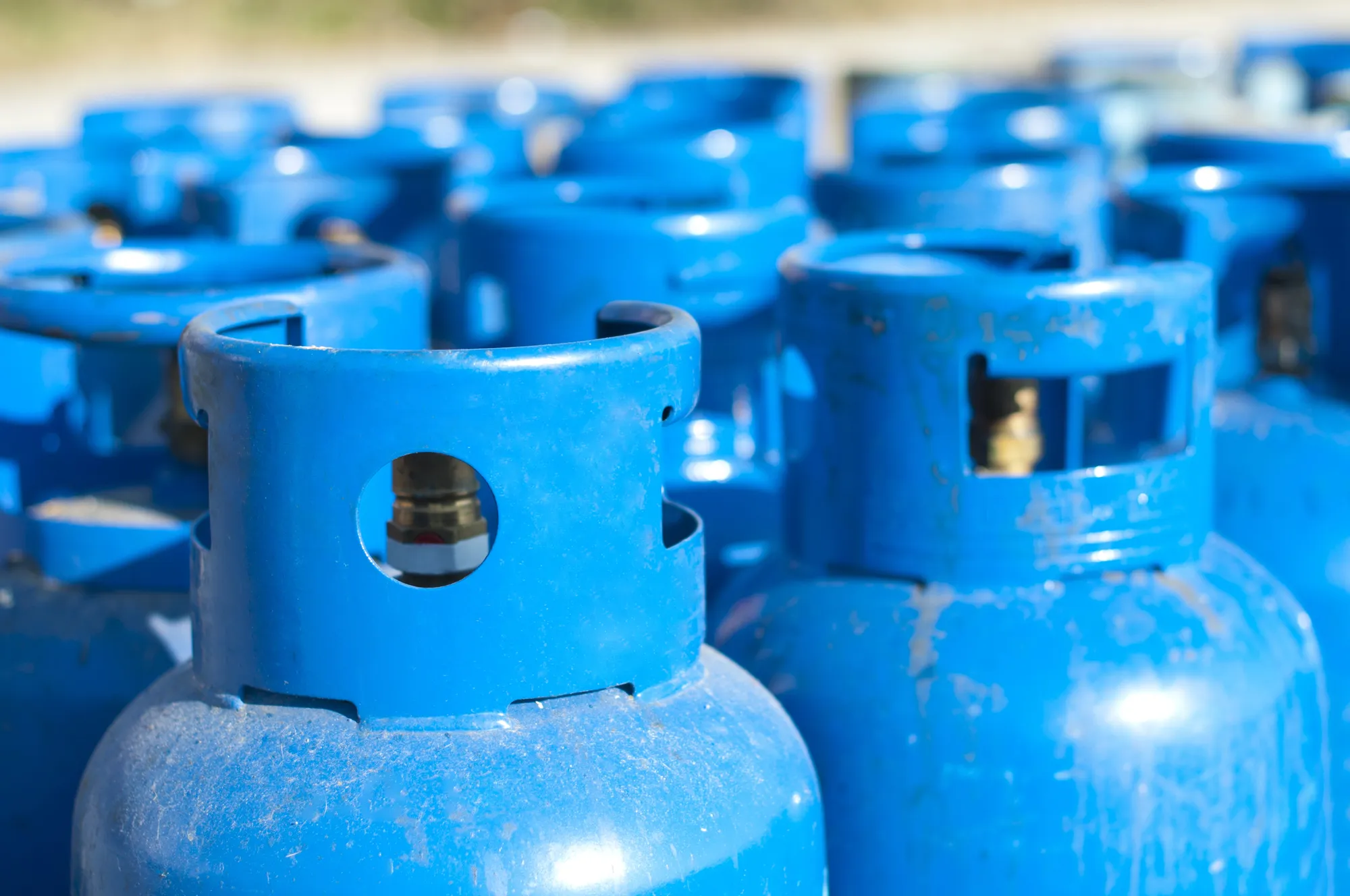
How to Dispose of a Propane Tank Safely: Where to Take Empty and Full Tanks, Exchange Programs, and What Junk Removal Companies Will and Will Not Take
Don’t put a propane tank in your curbside cart, even one you think is empty. The compaction inside a collection truck can rupture the cylinder and ignite the residual gas inside, which is why every state classifies propane as household hazardous waste. It’s also why most junk removal crews, ours included, can’t load a pressurized tank onto a standard cleanout route.
That gap surprises a lot of our customers. We’ve been clearing garages, sheds, and full estate properties since 2014, and the old 20-pound BBQ tank is the item we have to redirect most often. Customers point to it, expecting we’ll grab it on the way out. We can’t. But we can tell you exactly where it goes, how much it’ll cost (usually nothing), and how to handle the rest of the cleanout while we’re there.
This guide covers your working options: exchange programs, your county household hazardous waste facility, licensed propane dealers, and scrap recycling. You’ll also see what to do with expired, rusty, and damaged tanks, plus the four main tank sizes you might be staring at right now. By the end, you’ll know what we can take, what we can’t, and how to finish the job with the White Glove Treatment.
TL;DR Quick Answers
How to Dispose of a Propane Tank
Never place a propane tank in your curbside cart, recycling bin, or bulk pickup. Residual gas inside the cylinder can rupture under compaction. Here are the safe routes, ranked by how convenient they tend to be:
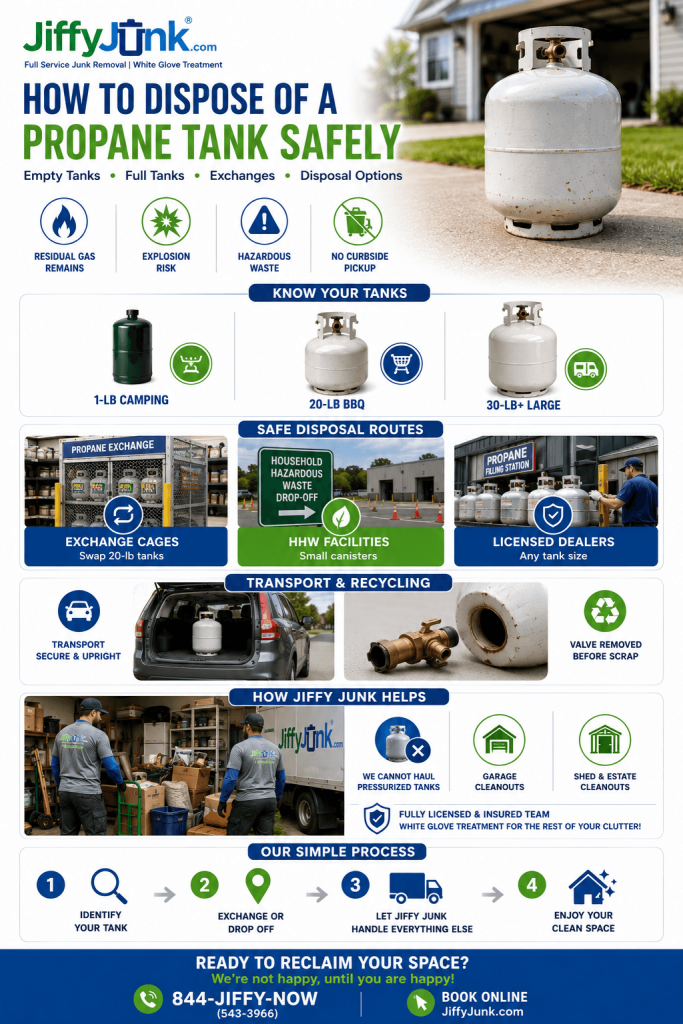
- Exchange it. Drop your 20-pound BBQ tank at a Blue Rhino or AmeriGas cage. You’ll find them at Walmart, Home Depot, Lowe’s, Ace Hardware, and most gas stations. They take expired, rusty, and damaged tanks. You don’t have to buy a refill to drop one off.
- Drop it off. Take any tank size to your county Household Hazardous Waste (HHW) facility. Drop-off is free for residents in most counties.
- Return it to a dealer. A licensed propane dealer will refill, recertify, or recycle the cylinder. Most accept it at no charge.
- Scrap the steel. Once a propane professional purges the tank and removes the valve, a metal recycler will take the empty shell.
- For 1-pound camping cylinders, exchange cages will not accept them. Your county HHW facility is the right call.
Top 5 Takeaways
What matters most, in five lines:
- Curbside is off-limits for propane tanks. The pressure inside the cylinder doesn’t go away when the fuel does.
- Blue Rhino and AmeriGas exchange cages are your easiest stop for a 20-pound BBQ tank. They accept expired and damaged ones, and you don’t always have to buy a full one to drop off the old one.
- Small 1-pound camping cylinders need a Household Hazardous Waste facility. Exchange cages will not take them. Most HHW sites will, for free.
- Tanks are certified for twelve years from the date stamped on the collar. A licensed dealer can recertify yours for another five years at $20 to $60.
- We can’t haul pressurized tanks on a Jiffy Junk route. We can clear out the rest of the garage, shed, or estate in the same visit.
Table of Contents
- How to Dispose of a Propane Tank Safely: Where to Take Empty and Full Tanks, Exchange Programs, and What Junk Removal Companies Will and Will Not Take
- TL;DR Quick Answers
- Top 5 Takeaways
- Why You Can’t Place a Propane Tank in Your Regular Waste Bin
- Know Your Tank: The Four Main Propane Tank Sizes
- Where to Take Your Propane Tank for Safe Disposal
- What Jiffy Junk Will and Won’t Take
- Essential Resources for Propane Tank Disposal
- 1. Find a Free Drop-Off Location Through the EPA
- 2. Check Workplace Exposure Standards from OSHA
- 3. Understand Federal Transport Rules from PHMSA
- 4. Reference the National Safety Code from NFPA
- 5. Know the Health Risks Before You Handle a Tank
- 6. Learn How Propane Fits the Broader Energy Picture
- 7. Locate Industry-Vetted Dealers Through the NPGA
- Supporting Statistics on Propane Use and Disposal
- Final Thought and Opinion
- Frequently Asked Questions
- Q: Can You Put a Propane Tank in Your Regular Curbside Bin or Recycling Cart?
- Q: Will Blue Rhino or AmeriGas Take an Expired or Rusty Propane Tank?
- Q: How Do I Get Rid of a Small 1-Pound Camping Cylinder?
- Q: Where Can I Drop Off a Propane Tank for Free Near Me?
- Q: Does Jiffy Junk Pick Up Propane Tanks?
- Q: How Long Is a Propane Tank Good for Before It Expires?
- Q: Can I Recycle a Propane Tank as Scrap Metal?
- Q: What Should I Do with a Leaking Propane Tank?
- Q: How Do I Transport a Propane Tank Safely in My Car?
- Ready to Clear Out the Rest of the Garage?
Why You Can’t Place a Propane Tank in Your Regular Waste Bin
A propane cylinder is a pressurized steel vessel holding a liquefied petroleum gas. You can read the full chemistry on Wikipedia’s propane page. The pressurization is what changes the disposal conversation.
A tank that’s been sitting in a shed for ten years still holds residual liquid propane and vapor inside the cylinder. The valve assembly is fragile. The pressure relief device is calibrated for storage temperatures, not for the inside of a compactor truck on a 95-degree afternoon. Propane tanks injure sanitation workers across the country every year, and most municipalities classify the cylinders as household hazardous waste. Curbside disposal can also result in a fine in your name.
A couple of things worth knowing before you load anything into your car:
- Empty doesn’t mean empty. Tanks always retain residual vapor and a small amount of liquid propane.
- Compaction is the danger. The pressure inside a collection truck or a baler can exceed the cylinder’s rated relief point.
- State environmental agencies and the EPA legally classify propane tanks as household hazardous waste.
Propane sits in the same disposal category as paint cans, pesticides, old batteries, and pool chemicals. If you’re sorting through more than one item from that cabinet, our guide on how to dispose of household chemicals covers the drop-off logic for the rest of the shelf.
Know Your Tank: The Four Main Propane Tank Sizes
Tank size determines disposal route, so figure out what you have first. Four categories cover most of what we see on the truck.
1-Pound Camping Cylinders (Small Green Canisters)
These are power camp stoves, lanterns, and portable heaters. Most are single-use and don’t refill safely. Exchange cages will not accept them. Your county Household Hazardous Waste facility will. If you camp often, a refillable 1-pound cylinder from Flame King or Little Kamper pays for itself in three or four trips.
20-Pound BBQ Grill Tanks
This is the standard backyard grill tank. Refillable, exchangeable, and the simplest to handle. Look for the manufacturer’s date stamped on the collar. Twelve years from that date, the tank either gets recertified by a licensed dealer or retired from service.
30-Pound to 40-Pound RV and Forklift Tanks
You’ll see these on travel trailers, ice resurfacers, and warehouse forklifts. Exchange cages will not accept these sizes. A licensed propane dealer will refill, recertify, or take them off your hands.
100-Pound and Larger Residential Tanks
Whole-house heating tanks usually belong to your propane supplier, not to you. Call your provider before you do anything with one. They’ll arrange purging, decommissioning, and pickup. Don’t try to move a 100-pound or larger tank yourself.
Where to Take Your Propane Tank for Safe Disposal
You have four working options. Pick the one closest to where you already drive.
Propane Exchange Cages
Blue Rhino and AmeriGas run exchange cages at thousands of retailers: Walmart, Home Depot, Lowe’s, Ace Hardware, Tractor Supply, Kroger, 7-Eleven, and most independent gas stations. Drop your old 20-pound tank in the cage and pick up a full one. Expect to pay $19 to $28 in 2026, with regional variation. Both programs accept expired, rusty, and damaged tanks, which is a real advantage if your tank looks rough.
Household Hazardous Waste (HHW) Facilities
Most U.S. counties run permanent HHW facilities or quarterly collection events. These take every tank size, including the small 1-pound cylinders that exchange cages refuse. Drop-off is usually free for residents. Call ahead to confirm size limits, especially for tanks 40 pounds and up.
Licensed Propane Dealers
Local propane dealers refill, recertify, and recycle tanks. Most accept any size at no charge because the steel cylinder carries scrap value. Some will credit a small amount toward your next refill.
Scrap Metal Recyclers
A scrap yard will take your tank only after a licensed propane technician has purged the cylinder and removed the valve. Don’t show up with a sealed tank. Most yards will turn you away on the spot.
A Note on Transport
Whichever option you choose, transport the tank upright and secured. A milk crate or cargo netting works well. Crack a window, and skip the climate control. Never leave a tank in a hot, closed trunk. Drive directly to the disposal site with no errands in between.
What Jiffy Junk Will and Won’t Take
Straight answers about propane and our crews.
What we generally cannot remove:
- Full or partially full propane tanks of any size.
- Leaking tanks. If you smell gas, do not transport. Call your fire department’s non-emergency line for guidance.
- Tanks with damaged valves or compromised pressure relief devices.
- 100-pound and larger residential tanks are still connected to a home system.
What we sometimes can remove, case by case:
- Fully purged tanks with the valve removed by a licensed propane technician, treated as scrap metal. Call ahead so we can confirm.
- Everything around the tank: the rusted grill, the broken patio set, the boxes from the last move, the full estate.
Propane sits in the same disposal category as several other household chemicals we have to redirect to a specialized facility. If you’re working through a workshop or a long-stored garage, our guide on how to dispose of acetone covers the parallel rules for nail polish remover, paint thinner, and similar solvents. Worth bookmarking before a big cleanout.
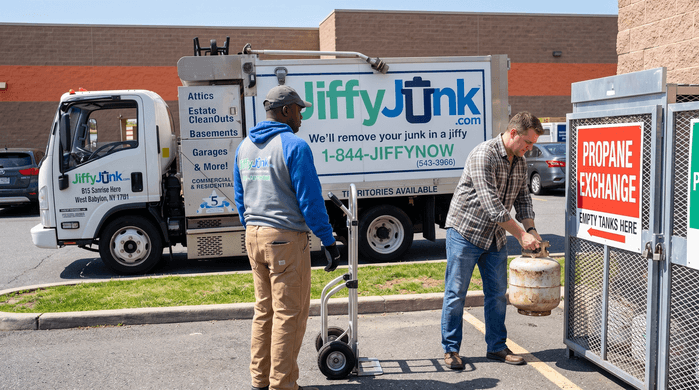
The workflow we recommend most often goes like this: swap your 20-pound tank at a Blue Rhino or AmeriGas cage on your way home from work, then book a Jiffy Junk pickup for everything else. You handle the five-minute detour. We handle the heavy lifting. That’s the White Glove Treatment in practice.
“After more than a decade of cleanouts, we’ve come to expect at least one forgotten propane tank in every other garage we walk into. The fix is almost always a five-minute stop at an exchange cage or a hazardous waste site. We just have to be the ones who tell people that, because the local junk hauler usually can’t.”— The Jiffy Junk Removal Team.
Essential Resources for Propane Tank Disposal
Seven authoritative sources we hand to customers when they want to confirm what they’re hearing from us.
1. Find a Free Drop-Off Location Through the EPA
The U.S. Environmental Protection Agency runs the official starting point for finding safe disposal channels by county. Use it to confirm what your area accepts and when the next collection event is scheduled.
Source: EPA Household Hazardous Waste Guide
2. Check Workplace Exposure Standards from OSHA
OSHA’s chemical database entry for propane lists permissible exposure limits, vapor density, flammability data, and the chemical’s synonyms. Worth the read if you’ve stored tanks in a closed garage or basement and want to confirm safe handling at home.
Source: OSHA Occupational Chemical Database: Propane
3. Understand Federal Transport Rules from PHMSA
The Pipeline and Hazardous Materials Safety Administration sets the federal rules for moving and requalifying propane cylinders. This interpretation letter spells out exactly when personal-use exemptions apply and when commercial rules take over.
Source: PHMSA Interpretation: Propane Cylinder Requalification
4. Reference the National Safety Code from NFPA
The National Fire Protection Association’s NFPA 58 standard governs the safe storage, handling, and disposal of liquefied petroleum gas. It’s the same code propane professionals work from on installations and decommissioning.
Source: NFPA 58 Liquefied Petroleum Gas Code Development
5. Know the Health Risks Before You Handle a Tank
The CDC’s NIOSH Pocket Guide entry for propane gives you the quick safety profile: inhalation effects, flammability range, frostbite risks, and recommended personal protective equipment. Print it out before any large cleanout.
Source: NIOSH Pocket Guide to Chemical Hazards: Propane
6. Learn How Propane Fits the Broader Energy Picture
The U.S. Department of Energy’s Alternative Fuels Data Center explains how propane is produced, distributed, and used across residential and industrial sectors. Useful background for understanding why the disposal infrastructure looks the way it does.
Source: Alternative Fuels Data Center: Propane Basics
7. Locate Industry-Vetted Dealers Through the NPGA
The National Propane Gas Association represents thousands of licensed dealers, marketers, and equipment professionals. Their codes and standards page helps you find vetted providers for recertification, decommissioning, and large-tank handling.
Source: NPGA Codes and Standards Overview
Supporting Statistics on Propane Use and Disposal
Three figures that put the disposal challenge in context.
1. Propane Heats Millions of U.S. Homes, Which Means Millions of Tanks in Circulation
According to the U.S. Energy Information Administration’s 2020 Residential Energy Consumption Survey, about 11 million U.S. households use propane as a major fuel, and roughly 42 million households use propane for outdoor grilling. Those numbers add up to a lot of cylinders that eventually need a disposal plan.
Source: EIA Uses of Hydrocarbon Gas Liquids: Propane in Depth
2. Residential Building Fires Remain a Serious U.S. Hazard
The U.S. Fire Administration reports that from 2014 to 2023, residential building fires decreased 6%, deaths from those fires rose 5%, and injuries decreased 8%. Improperly stored fuel cylinders contribute to that risk profile.
Source: USFA Residential Fire Estimate Summaries
3. Around 40 Million Single-Use 1-Pound Cylinders Are Sold Each Year in the U.S.
County-level data from San Mateo County Health’s ReFuel Your Fun Program reports that around 40 million single-use 1-pound propane cylinders are sold in the United States each year. A significant share ends up in landfills, recycling streams, or campsite waste, where they pose explosion risks for sanitation crews.
Source: San Mateo County Health ReFuel Your Fun Program
Final Thought and Opinion
Our Take After a Decade of Hauling
Propane disposal doesn’t have to be confusing. Most homeowners overcomplicate it because nobody explains the routes clearly. After thousands of garage, shed, and estate cleanouts since 2014, here’s what we’d want every customer to know:
- The risk most people underestimate is the assumption that an empty tank is safe to set at the curb. We’ve seen the aftermath: corroded plumbing fittings, melted vinyl from leaking valves, and the occasional close call with a collection truck.
- The fix is genuinely easier than expected. Exchange cages, HHW facilities, and licensed propane dealers handle almost every situation, and most of the options are free.
- We’d rather tell a customer up front that we can’t haul a full propane tank than show up, walk away, and leave you with a half-finished job. That’s why this guide exists.
If the tank is part of a larger project, our step-by-step garage decluttering guide walks through the sort-and-zone system our crews use on every job.
The Bottom Line
If you remember three things, you’ll be ahead of most homeowners we meet:
- Never use your curbside cart. Ever.
- Match the tank to the right disposal route. 20-pound tanks go to exchange cages, 1-pound cylinders to HHW, and larger tanks to a licensed dealer.
- Call us for the rest. We can’t haul the cylinder, but we’ll handle everything around it. And we’re not happy until you are.
Frequently Asked Questions
Q: Can You Put a Propane Tank in Your Regular Curbside Bin or Recycling Cart?
A: No, never. Even a tank that feels empty contains residual liquid propane and pressurized vapor. The compaction inside a collection truck or a recycling baler can rupture the tank and ignite the gas. Most municipalities classify propane tanks as household hazardous waste, and curbside disposal can lead to fines for the homeowner.
Q: Will Blue Rhino or AmeriGas Take an Expired or Rusty Propane Tank?
A: Yes. Both programs accept expired, rusty, and damaged 20-pound tanks. You don’t have to buy a full replacement. Most cages will accept a tank for disposal if you ask the store associate. Blue Rhino and AmeriGas handle the inspection, recertification, or scrapping on their end.
Q: How Do I Get Rid of a Small 1-Pound Camping Cylinder?
A: Take it to your local Household Hazardous Waste facility. Exchange cages will not accept 1-pound canisters because they’re not part of the refillable cylinder program. Most HHW sites accept them free of charge for residents. If you camp often, consider switching to a refillable 1-pound cylinder. It eliminates the disposal question.
Q: Where Can I Drop Off a Propane Tank for Free Near Me?
A: Your three free options are your county Household Hazardous Waste facility, a licensed local propane dealer, and a municipal collection event (usually quarterly). Use a search tool like Earth911 to confirm the closest site and current hours. Many propane dealers accept old tanks at no charge because the steel itself has recycling value.
Q: Does Jiffy Junk Pick Up Propane Tanks?
A: Generally, no. Pressurized tanks fall outside what our standard cleanout teams are licensed and insured to transport. Fully purged tanks with the valve removed by a licensed propane technician may be removed as scrap metal on a case-by-case basis. Call us first. We can absolutely clear out everything around the tank: the old grill, the rusted lawn equipment, the garage clutter, and the full estate. If you’re prepping for a relocation, our junk removal when moving guide covers which items need separate handling before moving day, propane tanks included.
Q: How Long Is a Propane Tank Good for Before It Expires?
A: Twelve years from the manufacture date stamped on the collar. After that, a licensed propane dealer can recertify the tank for another five years at $20 to $60, or accept it for disposal. Exchange cages bypass this entirely because the exchanged tank is inspected and recertified before it goes back into circulation.
Q: Can I Recycle a Propane Tank as Scrap Metal?
A: Only after a licensed propane professional has fully purged the tank and removed the valve. The empty steel cylinder is then recyclable. Don’t try to puncture, cut, or vent a tank yourself. A small spark in the presence of residual vapor can be catastrophic. Most scrap yards will refuse a sealed tank on sight.
Q: What Should I Do with a Leaking Propane Tank?
A: Move it outdoors immediately, away from any ignition source. Keep it away from pilot lights, electrical equipment, and cigarettes. Don’t transport a leaking tank in your vehicle. Call your fire department’s non-emergency line for guidance, or contact a local propane dealer. Many offer emergency pickup for leaking cylinders. Ventilate the area where the tank was stored.
Q: How Do I Transport a Propane Tank Safely in My Car?
A: Keep it upright, valve closed, and secured so it can’t roll or shift. A milk crate, cargo netting, or a passenger-side floor space all work. Crack a window. Never lay the tank on its side. Drive directly to the disposal site with no other errands. Federal rules generally limit non-commercial transport to four 20-pound tanks at a time.
Ready to Clear Out the Rest of the Garage?
We can’t haul your pressurized propane tank, but we can give the rest of your garage, shed, or estate the full White Glove Treatment in a single visit. Get a free quote at jiffyjunk.com/booking or call 844-JIFFY-NOW (844-543-3966) today. We won’t be happy until you are.