How To Dispose Of Used Motor Oil And Oil Filters Safely: Where To Recycle, What Auto Stores Accept, And Why You Should Never Pour It Down The Drain
Pouring used motor oil down a drain is illegal in most U.S. states and is the single most common disposal mistake our crews see on cleanouts. On a Long Island garage we cleared last year, two shelves were lined with quart bottles of leftover oil going back to the previous homeowner. He had lived in the house for thirty years and never knew where to take any of it. Free disposal had been sitting three miles up the road the entire time.
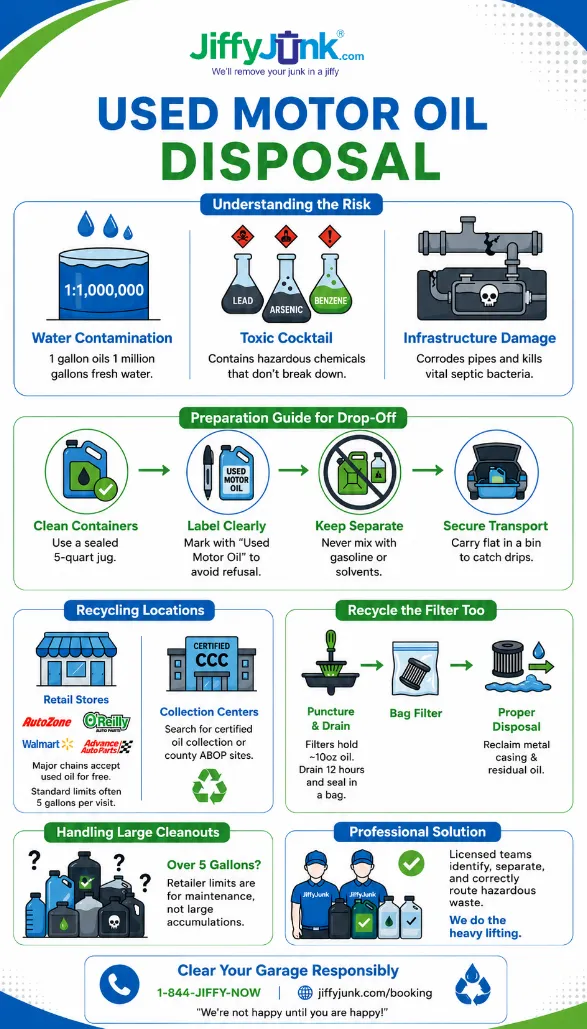
Used motor oil counts as hazardous material under federal law, and one gallon of it can foul a million gallons of fresh water. The wrong disposal path shows up in groundwater, septic systems, and EPA enforcement files. The right path is much shorter. AutoZone, O’Reilly Auto Parts, Walmart Auto Care, and certified collection centers in most U.S. counties take used oil and filters for free.
TL;DR Quick Answers
How To Dispose Of Motor Oil
Never pour used motor oil down a drain, on soil, or in your household waste. Federal law classifies it as hazardous material. The drained oil corrodes pipes, kills septic bacteria, and seeps into groundwater that supplies entire neighborhoods.
Safe disposal options:
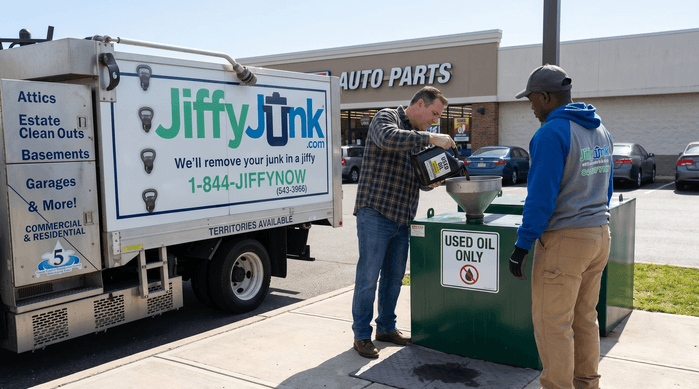
- Drop off at an auto parts store. AutoZone, O’Reilly, Walmart Auto Care, and Advance Auto Parts take used motor oil at no cost, usually up to 5 gallons per visit.
- Use a certified collection center. Most U.S. states publish a free directory of public drop-off sites that accept both oil and filters.
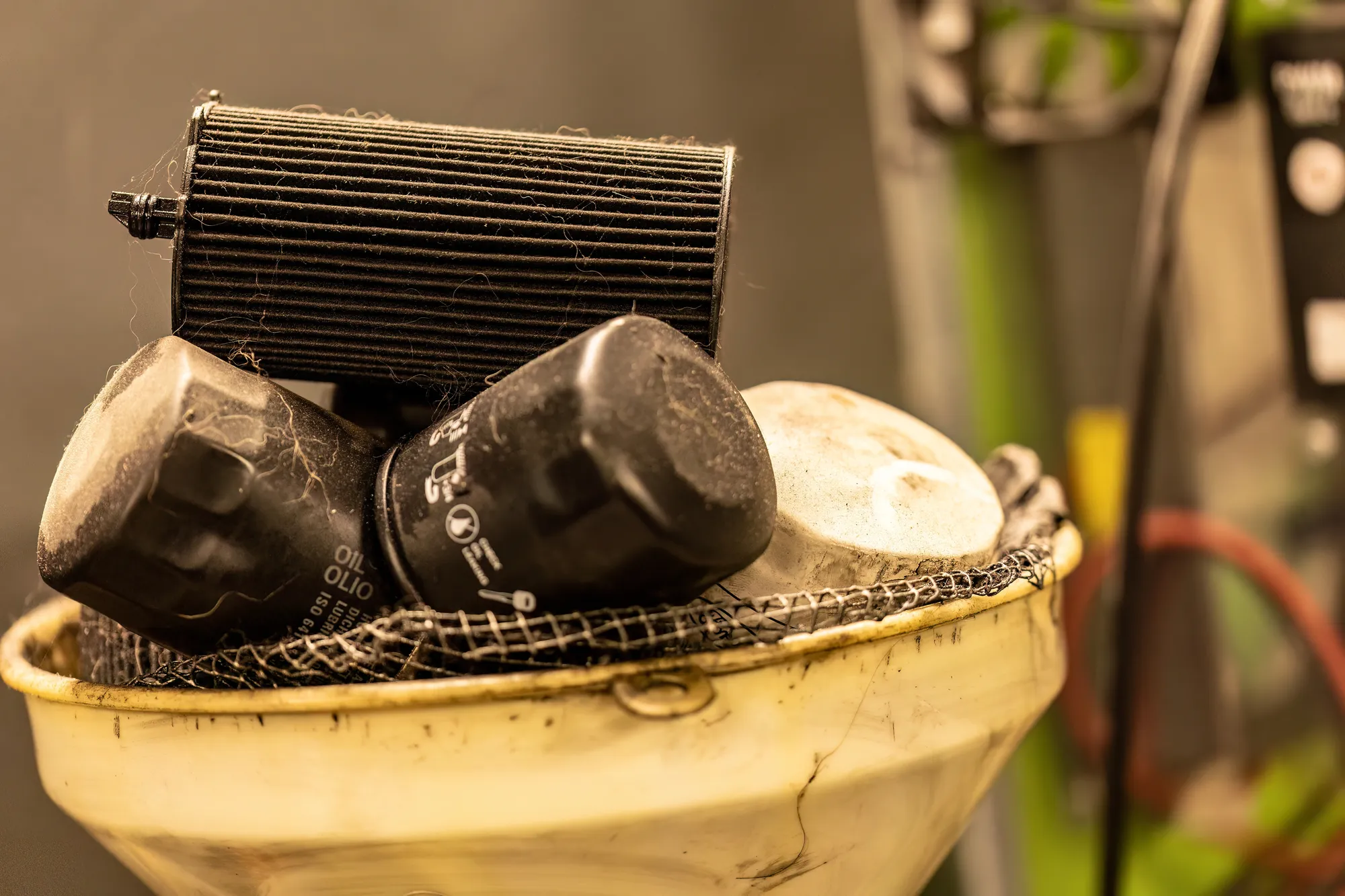
- Recycle the filter too. Drain it for 12 hours over your drip pan, then drop it off wherever you drop off the oil.
- Volumes past 5 gallons need a pickup. Retailer drop-off limits are not built for full garage cleanouts; they are handled one bottle at a time.
Top 5 Takeaways
- Used motor oil belongs at a certified drop-off, not in any drain or your household waste. One gallon can foul a million gallons of fresh water.
- Free drop-offs are usually within a few miles of home. Most AutoZone, O’Reilly, and Walmart Auto Care locations take used oil and filters at no cost.
- A used filter still holds about 10 ounces of oil even after a quick drain. Puncture it, invert it over your drain pan for 12 hours, then drop it off with your oil.
- Never mix fluids in one container. Antifreeze, gasoline, or solvents in your oil container will get the whole drop-off refused at the counter.
- Volumes past 5 gallons need a licensed pickup. When a cleanout uncovers decades of stored fluids, a professional crew handles transport and disposal without leaving the paperwork on your desk.
Table of Contents
- How To Dispose Of Used Motor Oil And Oil Filters Safely: Where To Recycle, What Auto Stores Accept, And Why You Should Never Pour It Down The Drain
- TL;DR Quick Answers
- Top 5 Takeaways
- Why Used Motor Oil Is Classified As Hazardous Material
- How To Prepare Used Motor Oil And Filters For Drop-Off
- Where To Take Used Motor Oil And Filters For Free Recycling
- What To Do With Larger Quantities From Garage Cleanouts And Estate Projects
- Essential Resources On “How To Dispose Of Motor Oil”
- 1. The Nationwide Drop-Off Locator That Pulls From Every Source
- 2. The Largest Network Of Free Drop-Off Centers In The Country
- 3. A State-By-State Look At What Counts As A Public Collection Site
- 4. The Law That Forces Retailers To Take Your Used Oil For Free
- 5. A Statewide Map Of Public Used Oil Collection Centers
- 6. A County-Level Guide To Local Auto Parts And Hazardous Waste Drop-Offs
- 7. A Major City’s List Of Free Drop-Off Sites In One Place
- Supporting Statistics On Used Motor Oil Disposal
- Final Thoughts And Opinion
- Frequently Asked Questions
- Q: Can I Pour Used Motor Oil Down The Drain, On The Ground, Or In My Household Waste?
- Q: Where Is The Closest Place To Drop Off Used Motor Oil For Free?
- Q: How Do I Recycle A Used Oil Filter?
- Q: What Should I Do If I Have More Than 5 Gallons Of Used Motor Oil?
- Q: Is Used Motor Oil Considered Hazardous Waste?
- Q: Can I Take Used Motor Oil To Multiple AutoZone Or O’Reilly Locations In One Day?
- Ready To Clear Out Your Garage The Right Way?
Why Used Motor Oil Is Classified As Hazardous Material
Engine use changes motor oil at the molecular level. As oil cycles through pistons and bearings, it picks up lead, arsenic, benzene, and other heavy metals that do not break down naturally in soil or water. That makes its end-of-life path narrower than people assume. Pour it down a drain and it can corrode PVC, kill the bacteria a septic tank needs to function, and seep into groundwater serving entire neighborhoods.
According to the U.S. EPA, used motor oil is among the largest sources of oil pollution in U.S. lakes, streams, and rivers . The federal rules covering generators, collection centers, and recyclers live in the EPA’s used oil management standards, the regulation every state agency builds its program on.
Motor oil mixed with antifreeze, gasoline, or household solvents reclassifies as full hazardous waste and routes through a Household Hazardous Waste facility instead. That is the same channel that handles paint thinner, bleach, pesticides, and the other materials we cover in our guide to disposing of household chemicals and hazardous waste.
Our crews see the consequences of bad disposal on almost every cleanout. We have found quart bottles tucked in corners going back to the Reagan era, and we have stood in basements where renovation crews uncovered pipes crumbling at the joint after thirty years of oil and degreaser going down the kitchen sink. None of those outcomes was necessary. Free disposal sat a few miles away the entire time.
How To Prepare Used Motor Oil And Filters For Drop-Off
Most retailers and certified collection centers will take your oil and filters in under five minutes if you bring them in correctly. The prep below covers what facilities want to see and what tends to get turned away at the counter.
- Use a clean, sealed container. A 5-quart oil jug from your last purchase works well. Avoid reusing a bottle that held antifreeze, brake fluid, gasoline, or bleach. Contaminated oil gets rejected on the spot.
- Label the container clearly. Mark it “USED MOTOR OIL” in permanent marker, large enough to read from a few feet away. Unlabeled containers tend to get refused by busy counter staff.
- Keep different fluids separate. Transmission fluid, gear oil, brake fluid, and antifreeze each go in their own labeled jug. A mixed jug becomes hazardous waste and is routed through a different facility entirely.
- Drain the oil filter for at least 12 hours. Puncture the dome end with a clean screwdriver and invert the filter over your drain pan. Gravity pulls out most of the residual oil overnight.
- Bag the drained filter. Drop it into a sealable plastic bag so any remaining oil stays inside on the way to the recycler.
- Transport everything flat in your trunk. A sturdy bin or cardboard box catches the inevitable drip. A leaking jug rolling around the back seat is the start of a long upholstery bill.
Where To Take Used Motor Oil And Filters For Free Recycling
The fastest free drop-off is almost always an auto parts store. Most major chains take used oil at the counter, ask a couple of questions about contamination, and pour it into a recovery tank in the back. A few details by retailer:
- AutoZone takes used motor oil, transmission fluid, gear oil, and oil filters. Five gallons per visit is the standard limit. No charge.
- O’Reilly Auto Parts takes a wider range of fluids, including motor oil, transmission fluid, power steering fluid, gear oil, hydraulic fluid, and used filters. Same 5-gallon limit, no charge.
- Walmart Auto Care Center takes motor oil and filters at locations with a service center. Phone ahead to confirm yours has one.
- Advance Auto Parts takes motor oil, oil filters, and old car batteries.
- Pep Boys, NAPA, and Jiffy Lube participation varies by store. Call before driving.
If a retailer is not convenient, search for a Certified Used Oil Collection Center (CCC), a Household Hazardous Waste (HHW) facility, or an ABOP site in your county. ABOP stands for Antifreeze, Batteries, Oil, and Paint. Some California cities also offer curbside oil pickup on regular collection days, though bagging and labeling rules apply and vary by program.
One rule every facility agrees on: containers left outside a closed location count as illegal dumping in most states. Fines can run into the thousands.
What To Do With Larger Quantities From Garage Cleanouts And Estate Projects
The 5-gallon drop-off limit covers a single oil change. It does not cover a 30-year garage clearout, an inherited workshop full of unknown fluids, or a property where the previous owner left half-empty containers stacked behind the lawnmower.
Those scenes look different from a typical drop-off. Unlabeled bottles end up sharing shelf space with mixed fluids and the occasional jug of acetone or paint thinner. Some of those materials are hazardous on their own, which we walk through in our acetone disposal guide. Once you move more than household quantities, federal transport rules apply, labeling requirements change, and a single mix-up can route the whole load to a more expensive disposal stream.
That is the situation a full-service garage cleanout actually solves. Our licensed, insured teams walk the space, identify what is there, separate fluids that cannot share a container, and route each material to the facility licensed to take it. Federal regulations do not allow licensed junk-removal crews to haul liquid hazardous materials in our trucks, so the oil itself goes to a certified collection center while our team handles the rest of the garage. Our guide to what junk removal companies can and cannot take walks through the full list of items that need a separate channel. You point. We carry, transport, and document.
It is the White Glove Treatment our customers expect from Jiffy Junk: clutter cleared, fluids handled correctly, and no EPA paperwork on your kitchen counter.
“Most homeowners we meet on a cleanout can name a half-dozen places to buy oil. Almost none of them can name the closest place to drop the old oil off, even though it is usually an AutoZone they drive past twice a week.”
— Jiffy Junk Removal Team
Essential Resources On “How To Dispose Of Motor Oil”
Seven sources worth bookmarking. The first answers federal questions. The next six help you find a free drop-off in your county or state.
1. The Nationwide Drop-Off Locator That Pulls From Every Source
Earth911’s recycling locator is the single most-cited drop-off finder for used motor oil in the country. Type a zip code and “motor oil,” and the tool returns every retailer, certified collection center, and HHW facility within range, with hours, accepted materials, and call-ahead notes for each site. The EPA, CalRecycle, and most state agencies link out to this same tool rather than maintain duplicate locators of their own.
Source: Earth911’s Motor Oil Recycling Search Tool
2. The Largest Network Of Free Drop-Off Centers In The Country
California’s CalRecycle program lists over 3,000 certified used oil collection centers, and residents receive a small per-gallon recycling incentive on drop-off. The locator searches by zip code.
Source: CalRecycle’s Certified Used Oil Collection Centers Locator
3. A State-By-State Look At What Counts As A Public Collection Site
Indiana’s environmental management agency lists exactly which retailers and county programs accept used oil and filters. The format works as a model for finding similar pages in other states.
Source: Indiana IDEM’s Motor Oil And Oil Filters Recycling Guide
4. The Law That Forces Retailers To Take Your Used Oil For Free
New York State law requires every service shop that sells 500 or more gallons of new oil per year to accept up to 5 gallons of used oil per person, per day, at no charge.
Source: New York DEC’s Used Oil Page
5. A Statewide Map Of Public Used Oil Collection Centers
Florida’s Department of Environmental Protection publishes a searchable directory of free Public Used Oil Collection Centers by county or zip code, plus a guide for spill response.
Source: Florida DEP’s Used Oil Recycling Program
6. A County-Level Guide To Local Auto Parts And Hazardous Waste Drop-Offs
Kane County, Illinois, publishes a practical list of every retailer, repair shop, and HHW facility that accepts used oil in the region. The same format exists at most county solid waste departments.
Source: Kane County, Illinois’s Motor Oil Recycling Page
7. A Major City’s List Of Free Drop-Off Sites In One Place
San Francisco’s environment department publishes a searchable list of more than 20 free used motor oil collection sites organized by neighborhood, with separate waterfront sites for boaters.
Source: SF Environment’s Used Motor Oil Disposal Sites
Supporting Statistics On Used Motor Oil Disposal
Three numbers from federal and state agencies that match what our crews see on cleanouts every week.
1. 1.37 Billion Gallons Of Used Lubricating Oil Were Available For Collection In A Single Year
Americans use roughly 2.47 billion gallons of lubricating oil each year. The U.S. Department of Energy estimated that more than 1.37 billion gallons were available for collection and reuse in 2018. The collection network is in place at every scale, from federal recyclers down to the AutoZone counter. Most of the leakage happens in the home garage.
Source: U.S. Department Of Energy’s Used Lubricating Oil Management Report
2. One Gallon Of Used Motor Oil Can Contaminate One Million Gallons Of Fresh Water
State environmental agencies repeat this figure because the math turns abstract pollution into something a homeowner can picture. One quart of bottle going down a storm drain can ruin a year of drinking water for 50 people. That is enough scale to make “just a little” a real concern.
Source: Mississippi DEQ’s Used Motor Oil Recycling FAQ
3. Illegal Dumping Of Used Oil Carries Fines Up To $10,000 And Up To Six Months In Jail
California’s penal and health and safety codes set these maximums. County-level enforcement has stepped up year over year. Every state has similar penalties on the books, though the dollar amounts vary. We have worked on properties where the previous owner left this kind of liability behind for an executor to deal with.
Source: Los Angeles County CleanLA’s Used Motor Oil Recycling FAQ
Final Thoughts And Opinion
Used motor oil recycling is one of the cleanest infrastructure stories in U.S. environmental policy. Almost every American lives within a short drive of a free drop-off site, the EPA framework has been stable since 1992, and major retailers have built used-oil acceptance into their service offer for decades. The reason an estimated 200+ million gallons still hit soil, drains, and household waste each year is not capacity. It is a stubborn awareness gap, and our crews see it firsthand on most cleanouts.
A few patterns we have watched play out across more than a decade of work:
- Most homeowners learn the hard way. A pipe corrodes during a renovation, or a well test fails after the buyer’s inspection, and the disposal lesson lands long after the consequence.
- “Just a little” is the real story. A quart down the storm drain feels harmless in isolation. Multiply that quart across every garage in every zip code, every weekend, for thirty years, and the math at the top of this article starts to make sense.
- The real value of a professional cleanout is judgment, not muscle. Crews earn their keep when the situation grows past a 5-gallon limit, when fluids are mixed, or when an executor has to clear a property fast.
Every DIY oil change should end with two stops in the same parking lot. New oil on the way in, used oil and filter on the way out. The recycling network is already there. Drop yours off.
Frequently Asked Questions
Q: Can I Pour Used Motor Oil Down The Drain, On The Ground, Or In My Household Waste?
A: No. Used motor oil counts as hazardous material under federal law and in every U.S. state’s statutes. Pouring it down a sink, storm drain, or onto soil is illegal in most jurisdictions and can carry fines that run into the thousands. The drained oil also damages pipes, kills the bacteria a septic tank needs to function, and contaminates groundwater for decades after the spill.
Q: Where Is The Closest Place To Drop Off Used Motor Oil For Free?
A: Most AutoZone, O’Reilly Auto Parts, Walmart Auto Care, and Advance Auto Parts locations accept used motor oil at no cost, typically up to 5 gallons per visit. Your county may also operate a Certified Collection Center, an ABOP site, or a Household Hazardous Waste facility. Search your zip code in your state’s used oil program directory before you drive.
Q: How Do I Recycle A Used Oil Filter?
A: Drain the filter for at least 12 hours by puncturing the dome end with a screwdriver and inverting it over your drain pan. Place the drained filter in a sealed plastic bag and drop it off at the same retailer or collection center that takes your used oil. The steel casing gets recycled, and any residual oil stays in the regulated stream.
Q: What Should I Do If I Have More Than 5 Gallons Of Used Motor Oil?
A: Most drop-off locations cap acceptance at 5 gallons per person per day. Larger amounts are common after a garage cleanout, an inherited workshop, or a property handover. In those cases, a licensed pickup is more practical. Crews handle transport, paperwork, and disposal under state and EPA rules, so the receipts and chain-of-custody land on us, not on you.
Q: Is Used Motor Oil Considered Hazardous Waste?
A: The answer depends on what is in the container. EPA regulates used motor oil under 40 CFR Part 279 as “used oil,” a federal category with its own management rules. Properly recycled used oil is not classified as hazardous waste. Used oil that has been mixed with solvents, gasoline, antifreeze, or other chemicals becomes hazardous waste and is routed through a Household Hazardous Waste facility instead.
Q: Can I Take Used Motor Oil To Multiple AutoZone Or O’Reilly Locations In One Day?
A: Most chains apply the 5-gallon limit per person per day across all locations, not per store. For larger volumes, a certified collection center, an HHW facility, or a professional pickup is the practical and legal path. Splitting loads across multiple stores can also violate state transport rules for hazardous materials.
Ready To Clear Out Your Garage The Right Way?
Skip the multiple trips and the 5-gallon limits. Jiffy Junk’s licensed teams handle used motor oil, filters, and the rest of your garage clutter in a single visit. For full property cleanouts, inherited workshops, or any project that goes well past a single garage, our bulk junk removal guide covers exactly what to expect on the day. Get a free quote at jiffyjunk.com/booking or call 844-JIFFY-JUNK (844-543-3966), because we’re not happy until you are happy!