How to Dispose of an Old TV: Free TV Recycling Drop-Off, Manufacturer Take-Back Programs, and When to Call a Junk Removal Service
Twenty-five states make it illegal to set a television out with regular household pickup. Goodwill turns down most broken sets. Best Buy passes on CRTs. That’s why so many old TVs end up parked in the basement for months. Nobody knows where they’re supposed to go.
You have five legal ways to get rid of an old TV. Most of them cost you nothing. The right one for your TV depends on two things: whether it still works and whether you can move it. Jiffy Junk has been hauling away televisions across the country since 2014, so we know which programs accept what and which ones turn you away at the door.
TL;DR Quick Answers
How To Dispose Of An Old TV
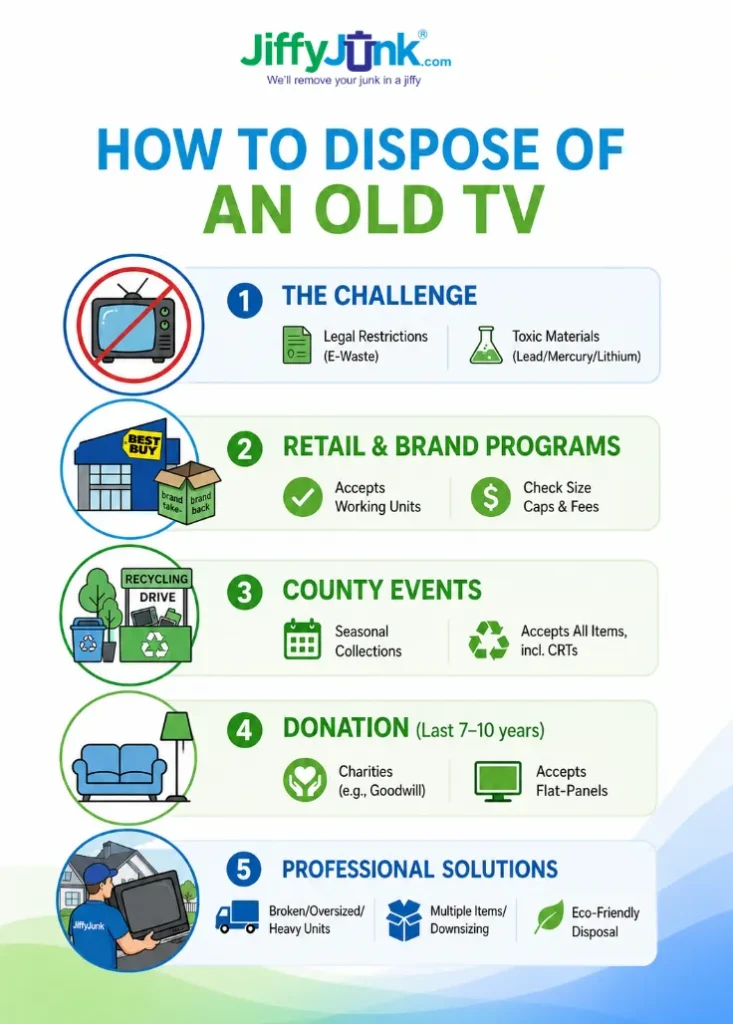
Most U.S. states prohibit televisions in regular household pickup. TVs hold lead, mercury, and other regulated materials, so they need their own disposal stream. Pick one of these five legal options:
- Drop it off free at a participating Best Buy store. Working flat-panels under their size cap qualify, and some states add a small fee.
- Use the manufacturer’s take-back program. Samsung, LG, Sony, Vizio, and TCL all run free recycling nationwide.
- Bring it to a county e-waste collection event. Most counties host two to four free events per year.
- Donate working units to Goodwill, a school, or a local charity. Call first, because CRTs rarely qualify.
- Schedule a professional pickup when the TV is broken, oversized, or you’d rather skip the lifting.
In our crews’ experience, the right answer comes down to two questions. Does it still work? Can you physically move it? Answer those, and your path is clear.
Top 5 Takeaways
- Most States Ban TVs From Curbside Pickup. Twenty-five U.S. states plus D.C. have e-waste laws that block televisions from landfills and regular pickup.
- Free Options Are More Common Than People Think. Best Buy, manufacturer programs, and county collection events accept most working TVs at no cost.
- CRT TVs Are The Hardest Case. Tube TVs from the 1990s and earlier hold four to eight pounds of leaded glass, which keeps most free programs from accepting them.
- Wipe Your Data Before The TV Leaves The House. Smart TVs store streaming credentials and Wi-Fi info. Sign out of every app and run a factory reset first.
- Professional Pickup Pays Off In Five Specific Situations. Broken units, oversized projection TVs, multiple TVs at once, no transportation, or a larger cleanout already in motion.
Table of Contents
- How to Dispose of an Old TV: Free TV Recycling Drop-Off, Manufacturer Take-Back Programs, and When to Call a Junk Removal Service
- TL;DR Quick Answers
- Top 5 Takeaways
- Why Disposing Of An Old TV Takes Special Steps
- Your Free And Low-Cost TV Disposal Options
- When A Junk Removal Service Makes The Most Sense
- Essential Resources On How To Dispose Of An Old TV
- 1. The Federal Hub For Electronics Donation And Recycling
- 2. Find A Certified TV Recycler In California
- 3. Why Old TVs Produce X-Rays And What That Means For Disposal
- 4. The Free Recycling Rules For New York Residents
- 5. A Plain-English Fact Sheet On Cathode Ray Tube Hazards
- 6. A State-By-State Map Of E-Waste Recycling Laws
- 7. The Industry-Run Directory Of State Programs
- Supporting Statistics On TV And Electronic Waste
- Final Thoughts And Opinion
- Frequently Asked Questions
- Q: Can I Throw An Old TV In The Dumpster Or With My Regular Household Pickup?
- Q: Where Can I Take An Old TV Near Me?
- Q: Does Best Buy Still Take Old TVs?
- Q: Will Goodwill Take My Old TV?
- Q: How Do I Dispose Of A Broken Flat-Screen TV?
- Q: What Is The Safest Way To Dispose Of A CRT Or Tube TV?
- Q: Do I Need To Wipe Data From A Smart TV Before Disposing Of It?
- Q: How Much Does It Cost To Have An Old TV Picked Up?
- Ready To Get That Old TV Out Of Your Home?
Why Disposing Of An Old TV Takes Special Steps
Federal and state laws classify televisions as electronic waste. The category covers products that hold hazardous materials, and the government regulates them separately from regular household pickup. Older tube televisions (CRTs) hold four to eight pounds of leaded glass per unit. Flat-panel sets use mercury vapor lamps and lithium components. Drop those materials in a landfill, and they leach into soil and groundwater.
Twenty-five U.S. states plus the District of Columbia now block televisions from regular household pickup and curbside recycling. Penalties run from warnings to fines in the hundreds and thousands of dollars, depending on local rules. Even in states without a formal ban, most haulers leave the TV behind. A cracked screen at the curb turns into a hazardous mess fast.
The fix is simple: route the TV to a program built to handle it. Every option below is legal, eco-friendly, and used by millions of households every year. If you’ve got other electronics on the way out too, our broader electronics disposal guide covers the full menu of devices and the rules behind each one.
Your Free And Low-Cost TV Disposal Options
Most homeowners have at least three free paths available. Start at the top of this list and work down. The first option that fits your TV is usually the right one.
Best Buy And Other Retailers’ Take-Back
Best Buy operates the largest retail electronics recycling program in the country. Most stores accept working flat-panel TVs up to a set screen size, with a small fee in some states. CRTs and projection TVs usually fall outside the program. Check Best Buy’s recycling page before you load up, since policies vary by state and store. Staples and Office Depot accept many other electronics, but televisions usually aren’t part of their programs either.
Manufacturer TV Take-Back Programs
If you know your TV’s brand, the manufacturer probably runs a free recycling program. Samsung, LG, Sony, Vizio, TCL, and Panasonic (through MRM Recycling) all offer take-back nationwide. Some use mail-back. Most point you to a partner drop-off site. Eligibility and drop-off availability change by state, so check the manufacturer’s recycling page first.
County And Municipal E-Waste Collection Events
Nearly every U.S. county hosts two to four free e-waste collection events per year, typically through the public works or sanitation department. Search your county name plus “e-waste collection event” to find upcoming dates. These events accept almost everything, including the CRTs that retailers turn away.
Donation — Only If It Still Works
Goodwill, Salvation Army, and most local thrift stores accept working flat-panel TVs from roughly the last seven to ten years. They almost always turn away broken sets and CRTs. Call your local store before you load the truck. Schools, community centers, and churches are also worth a quick phone call. A working TV can earn a second life in a classroom or break room. If you’re weighing the donation route against straight recycling, our take on whether you should donate or recycle an old TV set walks through both paths in more depth.
When A Junk Removal Service Makes The Most Sense
Free options handle most TVs. Five situations make a paid pickup the better math:
- Broken or cracked TVs that retailers and thrift stores refuse.
- Oversized CRT, rear-projection, or console units that weigh 100 to 300 pounds.
- Multiple TVs at once from a downsized, estate cleanout, or office refresh.
- No vehicle or no help to safely transport the TV to a drop-off site.
- A larger cleanout is already in motion, where the TV is one of many items going at the same time.
Projection TVs sit in a special category of their own. If that’s what you’re working with, our projection TV disposal walkthrough covers the specific challenges those units bring and the most practical way to handle them.
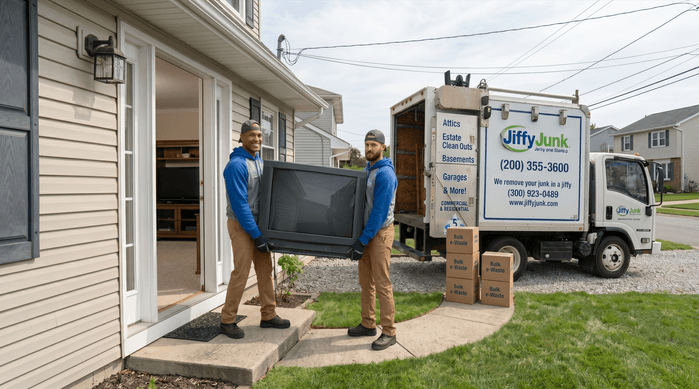
When those describe your situation, our professional TV removal service handles every step: in-home pickup, eco-friendly disposal, and donation of working units when possible. Pricing varies by TV type and location, and most single-TV pickups land between $75 and $150. You book online, our team arrives in a branded truck, and we haul the TV away the same day.
“In over a decade of TV removals nationwide, we see homeowners get one thing wrong more than any other: they assume Best Buy will take their old CRT for free. Best Buy rarely does. The honest answer for most CRTs is a county hazardous-waste day or a professional pickup, full stop.”
— The Jiffy Junk Operations Team
Essential Resources On How To Dispose Of An Old TV
The seven resources below are the ones we’d hand to a friend asking this exact question. Each is an authoritative government or nonprofit source, and together they cover federal law down to your local drop-off.
1. The Federal Hub For Electronics Donation And Recycling
Start here. The Environmental Protection Agency’s electronics page covers federal rules, how to prep your devices, and where to find certified recyclers.
Source: EPA Electronics Donation And Recycling Guide
2. Find A Certified TV Recycler In California
California’s CalRecycle directory is the gold standard for state-level locators. If you live in California or want to see what a well-funded e-waste program looks like, the searchable map points you to nearby state-certified collection sites.
Source: CalRecycle E-Waste Recycling Center Locator
3. Why Old TVs Produce X-Rays And What That Means For Disposal
The FDA’s television radiation page explains how CRT and older TVs can emit low-level X-rays during operation. That’s useful background for why regulators treat those units more strictly than flat panels.
Source: FDA Guidance On Television Radiation Safety
4. The Free Recycling Rules For New York Residents
New York’s Department of Environmental Conservation lays out the state’s free, manufacturer-funded recycling system. It’s a useful read for anyone in the Northeast, and a model many other states follow.
Source: New York DEC Consumer E-Waste Recycling Guide
5. A Plain-English Fact Sheet On Cathode Ray Tube Hazards
Vermont’s Department of Environmental Conservation publishes a concise CRT fact sheet that explains why tube TVs and old computer monitors need special handling. Quick read. Useful before you try to move one.
Source: Vermont DEC Used Television And Computer Monitor Fact Sheet
6. A State-By-State Map Of E-Waste Recycling Laws
The National Conference of State Legislatures tracks every state e-waste law in one place. It’s the fastest way to learn whether your state requires recycling, runs a free program, or bans televisions from the landfill.
Source: NCSL Electronic Waste Recycling Legislation Tracker
7. The Industry-Run Directory Of State Programs
The National Center for Electronics Recycling keeps an interactive directory of all state electronics-recycling laws, with summaries and links to local programs. A practical complement to the NCSL page when you want operational details.
Source: NCER State Electronics Recycling Laws Directory
Supporting Statistics On TV And Electronic Waste
The numbers below explain why TV disposal matters and why so few households get it right. We’ve watched these trends play out on our trucks for over a decade, and every figure here matches what our crews see on the ground.
1. America Produces 6.9 Million Tons Of E-Waste Every Year
The United States generates roughly 6.9 million tons of electronic waste annually, making it the second-largest e-waste producer in the world behind only China. Televisions are among the heaviest single contributors per household, which is why even one TV done wrong adds up across millions of homes.
Source: U.S. PIRG: What Is E-Waste?
2. A Single CRT TV Holds Up To Eight Pounds Of Lead
One cathode ray tube television or computer monitor can hold four to eight pounds of lead, embedded in the funnel glass to shield viewers from X-rays. That lead makes CRTs the most hazardous TV type to throw out wrong. It also makes them the heaviest to lift, which is why most retailers turn them away.
Source: Basel Action Network Electronics Stewardship Page
3. Electronics Are A Major Lead Source In U.S. Landfills
EPA-sponsored research found that discarded electronics, including televisions, consistently leach lead at concentrations above the federal threshold for hazardous waste. Those findings drive every state-level CRT disposal regulation now on the books.
Source: NIH PMC: Hazardous Waste, Electronics, And Landfills
Final Thoughts And Opinion
After hauling away tens of thousands of televisions, here’s our honest read.
Most homeowners default to one of two extremes. They either drag the TV to the curb and hope for the best, which is illegal in roughly half the country, or they assume the only option is a paid service. Both miss the mark. The middle path is the right one, and almost nobody talks about it.
Our take, drawn directly from years of customer calls:
- If your TV is a working flat-panel under 50 inches, Best Buy or the manufacturer’s program almost always handles it for free.
- If it’s a CRT, tube, or projection TV, skip the retail run. Those stores turn you away. Go straight to a county e-waste event or call a pickup service.
- If you have a stack of TVs, no truck, or a back that already complains about your couch, the math on a professional pickup is better than people expect once you add up time, gas, and the very real risk of dropping a 150-pound CRT on a hardwood floor.
The single best piece of advice we can offer: spend five minutes identifying your TV type and confirming your state’s rules before you do anything else. Those five minutes will save you an afternoon, a fine, or both.
Frequently Asked Questions
Q: Can I Throw An Old TV In The Dumpster Or With My Regular Household Pickup?
A: In most states, no. Twenty-five states and D.C. have explicit e-waste disposal bans, and even in states without a ban, most haulers leave the TV behind. Choose a retail drop-off, a manufacturer program, a county collection event, or a pickup service instead.
Q: Where Can I Take An Old TV Near Me?
A: Search your county or city name plus “e-waste collection event” for free local options, or check Best Buy and your TV manufacturer’s recycling page. For a same-day haul-away anywhere in the United States, Jiffy Junk can pick it up directly from your home.
Q: Does Best Buy Still Take Old TVs?
A: Most Best Buy stores accept working flat-panel TVs up to a set size limit, with small fees in some states. CRTs, plasmas, and projection TVs usually fall outside the program. Confirm policy on Best Buy’s recycling page before you drive over, since rules change periodically.
Q: Will Goodwill Take My Old TV?
A: Goodwill accepts working flat-panel TVs at many locations, typically from the last seven to ten years. They almost always turn away broken units, CRTs, and projection TVs. Call your local store before bringing it in, since acceptance varies.
Q: How Do I Dispose Of A Broken Flat-Screen TV?
A: Retailers and thrift stores turn away broken units. You have two practical options: a certified e-waste recycler (look for R2 or e-Stewards certification) or a professional pickup service. In our experience, broken flat-panels are the most common reason homeowners call us. They’re awkward, dangerous when cracked, and other outlets rarely accept them.
Q: What Is The Safest Way To Dispose Of A CRT Or Tube TV?
A: A municipal hazardous-waste collection event or a professional pickup. CRTs hold four to eight pounds of leaded glass, and most states regulate them as hazardous waste. Never leave one at the curb, in a dumpster, or in the woods. Fines for illegal CRT dumping run into the hundreds and thousands of dollars.
Q: Do I Need To Wipe Data From A Smart TV Before Disposing Of It?
A: Yes. Smart TVs store Wi-Fi credentials, streaming-account logins, and sometimes voice-assistant history. Sign out of every streaming app, then run a factory reset from the Settings menu before the TV leaves your home. It takes five minutes and protects your accounts.
Q: How Much Does It Cost To Have An Old TV Picked Up?
A: Most single-TV pickups run between $75 and $150, depending on TV type, size, and location. CRTs and projection TVs sit at the higher end because of weight and recycling fees. The exact number comes from a free online quote, since every TV, location, and access situation is different.
Ready To Get That Old TV Out Of Your Home?
Whether you’ve got a single broken flat-screen or a basement full of tube TVs, the Jiffy Junk team handles every step with our signature White Glove Treatment. You skip the lifting and the driving, and we leave your home clean. Book a free quote in under sixty seconds, and remember: we’re not happy until you are happy!